Dean Weingarten has a good find at Ammoland.
Judge Eduardo Ramos, the U.S. District Judge for the Southern District of New York, has issued an Opinion & Order that a ban on stun guns is constitutional. A New York State law prohibits the private possession of stun guns and tasers; a New York City law prohibits the possession and selling of stun guns. Judge Ramos has ruled these laws do not infringe on rights protected by the Second Amendment of the United States Constitution.
Let's briefly [read more]
From Tom Ricks’ blog concerning one Marine NCO’s view of patrolling:
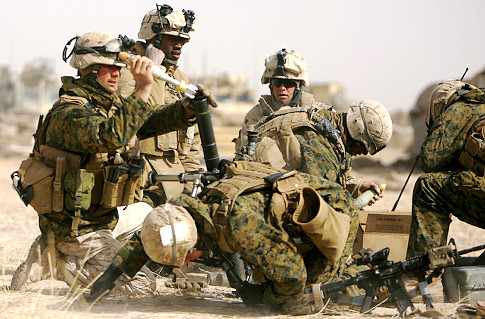
We have to get back our patrolling capabilities. Ninety percent of everything we do is patrolling but we aren’t good at it. The Iraq experience has done some good things for our Corps but it has diminished our patrolling capabilities. Our NCOs’ experience in Iraq has fostered a sure knowledge that the double column is the preferred formation and moving along roads is acceptable, which are exactly the wrong things to do. Right now we operate at an acceptable level but with some focused training we can limit our casualties, while killing more of the enemy. Everyone can spout 5-3-5 rules but few know what it is and even fewer practice it.
A) Each patrol needs a viable mission that accomplishes a needed task. Going here because we went over there yesterday is beyond stupid and you are failing as a leader with that reasoning.
B) Go through the orders process in its entirety when able. At a minimum do route planning and brief an order covering Situation (past 24 or 48 hours and other patrols) Mission (what, where and purpose), Execution (intent, where you expect to make contact or find IEDs and actions when that happens, IA drills for contact, IED strike, Medevac, and cover formation types – where you will satellite/guardian angel, wedge echelon etc).
C) Do a confirmation brief with the platoon commander.
D) Conduct Initial and Final Inspections.
E) Use an Initial Rally Point inside the wire to conduct your final inspection, do last minute rehearsals or rehearsal of concept drills, final com checks, get in your initial combat formation and be counted out of the wire by the APL – use your APL, most of the Marines now days don’t even know what that is.
F) Point men need to be trained along with flanks. Use a dual point system – one guy looking close for IED threat and one far scanning tree lines. Walk at a pace that facilitates your mission, not which gets you back to the patrol base quicker.
G) Take security halts and observe your surroundings frequently. Have one of your patrol elements set up in observation covertly while the other element moves into the village. Watch the actions the locals do. Want atmospherics, see if there are runners or people move towards the patrol to greet them. If something happens, this observation team is already set as a base of fire.
H) Investigate what is happening. Marines often see locals doing routine tasks, like pumping water or kids playing, when if they investigated vice just continuing to patrol on by, they would see the hole perfectly shaped for an IED amongst the playing children dug by the guy with a pick axe being shielded by the pretty kids playing in the road. The Taliban are masters at using the obvious to deploy IEDs right under your nose.
I) Use deception. Send out two patrols at a time in different directions, and then have one circle back. All too often we rotate patrols in and out. The Taliban quickly figure out that if the patrol just went west, he has complete freedom of movement to the East.
J) Use Satellites, traveling and bounding over watch and a variety of formations to match the threat.
K) Do not set patterns.
L) Stay the fuck off of roads and trails. I believe that every casualty our battalion has taken from IEDs, with the exception of two incidents, has been on a road or trail and it has been at times when the Marines were not required to be on the road or trail as part of a sweep/clearance mission.
M) Use rally points.
N) Use the appropriate formation to be in the most advantageous position to immediately gain the initiative and kill the enemy. We are very lacking in this area and a lot of our squad leaders just don’t get it. Use TDGs and a variety of training scenarios to get them up to speed and understand a variety of terrain and tactical based scenarios.
O) Crossing Linear Danger areas is a lost art, especially when a patrol will walk three hundred meters along a canal to find a foot bridge to cross it – terrible at setting patterns, just walk through the water but set up near and far side security first and use a variety of techniques so you don’t set patterns.
I’ll leave it to the reader to finish the diatribe at Tom’s blog. Every boot learns from the experienced Marines before him, and so on the process goes. Many of the Marines with Iraq experience have since left the Corps, and thus many Marines deploying to Afghanistan have no combat experience. But neither did the Marines who deployed to the Anbar Province the first time.
Patrolling in Anbar took on the characteristics that it needed in order to succeed. Patrolling in the Helmand Province will do likewise, retaining some characteristics that have been learned from Iraq and jettisoning others, while modifying the skill set to adapt to the environs.
Satellite patrolling has been around for a while and will continue as a useful tactic. This NCO doesn’t need to tell Marines what a satellite patrol is – they already know, and they know how to do it. But if standard two by two cover formation along roads isn’t appropriate for Helmand because of IEDs and canals are safer and more productive, the Marines will pick it up and adapt quickly.
This NCO is exaggerating about the Marines’ need to learn patrolling. Not everyone who screams that we don’t know how to do counterinsurgency has the most objective view of things or deserves to have his views cast as representing the entire service. Something that should be taught to young Marines by his superiors isn’t necessarily the same thing as tactical incompetence on the part of the entire force.
… let’s assume for the purposes of argument that Pakistan does not drop its resistance to tackling Afghan militants in its border regions. (Pakistan argues it cannot tackle everyone at once and has its hands full fighting the Pakistani Taliban; its critics say it is hedging its bets ahead of any eventual U.S. withdrawal, when it might want to use groups like the Haqqani network and the Afghan Taliban to counter Indian influence in Afghanistan.)
At that point, a major U.S. military success in Afghanistan could be the only way to break the stalemate. An in that light, Yon’s focus on the Arghandab River Valley becomes essential reading.
We’ll return to Myra’s point momentarily. Michael performs far-reaching analysis, from use of the Russian experience in Afghanistan (The Bear Went Over the Mountain) to the revised tactical directive issued by General McChrystal (ROE). Michael doesn’t weigh in himself on the ROE. He does honestly point out that the ROE will cause additional casualties. Petraeus also confesses that Afghanistan will get bloodier than it is now. It will so for more reasons than simply adding more troops (or better said, it could be less bloody than it is going to be).
The question is not whether there is ROE. Michael points out that the Russian ROE turned the population completely against them because they essentially had no ROE. We do, we did, and we will in the future. The question is more nuanced than that. I am aware from a number of sources the nature of combat and other operations in Fallujah in 2007 (and at other points in the campaign for Anbar), and the ROE were more robust than currently in place in Afghanistan; or in other words, McChrystal’s tactical directive is more restrictive than the ROE in effect while the Anbar Province was being won by the U.S. Marine Corps. In order to believe that the revised tactical directive is beneficial to the campaign one must believe that the ensuing casualties for which it is at least a contributing cause will be less in the long run than if a more robust ROE were in place with its accompanying increased force protection. We’ll see. Troop morale and public opinion mean everything to the campaign.
Michael continues by pointing out that the border between Pakistan and Afghanistan is fictitious. Taliban cross with impunity through this imaginary border, and the coming battle will be for Afghanistan’s South.
In Helmand, the fight is serious, and friendly troops are spread far too thinly. Some experts believe that focusing on Helmand before securing Kandahar was a strategic error. Most districts in Kandahar are said to be under Taliban control or heavy influence. Some areas of the south are under complete, uncontested Taliban control …
The Taliban want Kandahar and are in a good position to get it. The year 2010 likely will mark a true Battle for Kandahar, though it probably will not be punctuated by the sort of pitched battles we saw in places like Mosul and Baghdad. This remains unknown.
Armies from at least three countries have ventured into the Arghandab River Valley: British, followed by Soviets, and more recently Canadians; all were unsuccessful.
Michael compares and contrasts the Russian campaign with the coming U.S. and ISAF operations, and then rehearses a bit of recent history for us.
The enemy is not defeated, but our people were now operating among them. U.S. casualties continued during the next three months but there are indications that the enemy is today in disarray. The enemy became afraid to sleep indoors where they might be killed by an airstrike—or by U.S. soldiers, who have a tendency to burst in during periods of maximum REM sleep. The Taliban were terrorized and began sleeping in the orchards at night, rigging homes with explosives, which they arm at night. (I’ve heard similar reports from Pakistan. Pakistanis have said that drone strikes are demoralizing and terrorizing the Taliban, and though drone strikes are controversial, some Pakistanis want to see the strikes increased.)
And so we have a dilemma even in Michael’s account. These episodes of bursting in by U.S. Soldiers came to an end with McChrystal’s tactical directive, and the drone strikes into Pakistan which have so disheartened the Taliban don’t have an analogy with the ROE in use by Soldiers and Marines in Helmand and elsewhere in Afghanistan.
But Michael points out that fresh troops are indeed on the way, and that’s good. More force projection is needed. But I have titled this the battle for Kandahar and Helmand because the fight cannot be disentangled from Helmand any more than it can be from Pakistan. Population centric COIN doctrine has driven us to Kandahar, but leaving Helmand alone is not an acceptable solution given that the Taliban train there, raise their support there, and take refuge in its scattered towns.
The Marines left the operations in Now Zad improperly resourced and thus the Taliban fighters garrisoned there escaped. Marja is next, and the Marines’ claim is that “We won’t leave anywhere else uncovered. We won’t go anywhere we can’t clear, we won’t clear anywhere we can’t stay and we won’t stay anywhere we can’t build.” Helmand and Kandahar may be seen as coupled, with operations in one place affecting operations in the other.
True enough, Pakistani Army operations on the imaginary side of the border mean something. Back to Ms. MacDonald’s point, I have previously said that:
The conversation on Pakistan versus Afghanistan presupposes that the Durand Line means anything, and that the Taliban and al Qaeda respect an imaginary boundary cut through the middle of the Hindu Kush. It doesn’t and they don’t. If our engagement of Pakistan is to mean anything, we must understand that they are taking their cue from us, and that our campaign is pressing the radicals from the Afghanistan side while their campaign is pressing them from the Pakistani side.
Advocating disengagement from Afghanistan is tantamount to suggesting that one front against the enemy would be better than two, and that one nation involved in the struggle would be better than two (assuming that Pakistan would keep up the fight in our total absence, an assumption for which I see no basis). It’s tantamount to suggesting that it’s better to give the Taliban and al Qaeda safe haven in Afghanistan as Pakistan presses them from their side, or that it’s better to give them safe haven in Pakistan while we press them from our side. Both suggestions are preposterous.
That there is an indigenous insurgency (the so-called ten dollar Taliban) that bootstraps to the real religiously motivated fighters is irrelevant. We had to fight our way through this group in Iraq too, and it is the nature of these insurgencies. Complaining about it is acceptable – but using it as an excuse to abandon the campaign is not. That every contact isn’t with Arabic or Chechen or Uzbek jihadists is irrelevant. That doesn’t mean that Afghanistan is not a central front in the transnational insurgency called Islamic Jihad. The Taliban are important inasmuch as they gave and would continue to give safe haven to globalists.
For this reason the campaign in Afghanistan must be successful. Pakistan will take their cue from us and follow our lead.
Richard North at Defence of the Realm engages in a little gloating (and frustration as well).
Referring to the daily stream of truck convoys that bring supplies into the landlocked nation, Hilary Clinton said to the Senate Armed Services Committee:
“You know, when we are so dependent upon long supply lines – as we are in Afghanistan, where everything has to be imported — it’s much more difficult than it was in Iraq, where we had Kuwait as a staging ground.
You offload a ship in Karachi. And by the time whatever it is – you know, muffins for our soldiers’ breakfast or anti-IED equipment – gets to where we’re headed, it goes through a lot of hands. And one of the major sources of funding for the Taliban is the protection money. That has nothing to do with President Karzai.”
As we pointed out – it is all done under a doctrine of “plausible deniability”. We do not pay the Taliban – oh no! But we build their payments into the contractors’ fees, which they then pass on, to ensure safe passage.
And well deserved gloating it is. I will engage in a little myself. And … much frustration. One year and eight months ago I described the Taliban and al Qaeda strategy of interdiction of supply routes from the Pakistan port city of Karachi to the Khyber pass (and through the Torkham Crossing) or Chaman towards Kandahar (a smaller percentage of our supplies goes through Chaman than Khyber). In fact, my Logistics category is well populated with studies of supply problems – larger scale through Pakistan, and smaller scale logistics to remote combat outposts in which the helicopter is king because we don’t own the roads and can’t ensure security. It costs $400 to get a single gallon of gasoline to the Helmand Province.
Approximately one year ago I recommended an alternative logistics route, and nine months ago I concluded that it was time to engage the Caucasus in order to make this happen. The proposed route: through the Caucasus region, specifically, from the Mediterranean Sea through the Bosporus Strait in Turkey, and from there into the Black Sea. From the Black Sea the supplies would go through Georgia to neighboring Azerbaijan. From here the supplies would transit across the Caspian Sea to Turkmenistan, and from there South to Afghanistan.
Difficult? Certainly. Riddled with political problems and in need of security? Sure. But better than what we have with Pakistan if we had worked to make it happen. Instead, we courted the Russians for a route through their territory, and thus far to no one’s surprise there has been precious little in the way of real cooperation or significant amounts of supplies going through Russia.
As if this issue has not been developing and growing for the last several years, senior Pentagon officials now face a dilemma. Deploy additional troops, but supply those troops with currently unknown logistical routes.
The White House has settled on sending additional troops to Afghanistan, and now the Pentagon must grapple with another thorny problem: how to support them once they get there.
For Ashton Carter, the top Pentagon official in charge of weapons purchases, that has meant focusing on the concrete — literally. Basic materials for building bases are in short supply or nonexistent in Afghanistan, so U.S. officials must search for staples like concrete next door in Pakistan.
Another priority: Getting thousands of blast-resistant trucks from Oshkosh Corp.’s factory in Oshkosh, Wis., to U.S. forces in the Afghan hinterlands.
“At this phase, Afghanistan is a logistics war as much as any other kind of war,” said Mr. Carter, whose formal title is under secretary of defense for acquisition, technology and logistics, in a recent interview.
Unlike Iraq, Afghanistan has no modern infrastructure. Critical supplies such as fuel must be imported. The country is landlocked and has just three major overland routes. Enormous distances separate bases and outposts. High mountains and valleys, as well as extreme weather, make air travel difficult.
Defense Secretary Robert Gates has pushed the Pentagon to stay on a wartime footing rather than focus on preparing for future conflicts. Top officials have shifted their priorities.
“Everything is…more expensive, but that’s not really as much the issue as whether you can get it done at all,” Mr. Carter said.
Mr. Carter’s predecessor had a full plate dealing with defense-industry programs such as the $300 billion Joint Strike Fighter and the sprawling $200 billion Army modernization effort known as Future Combat Systems. Mr. Carter, by contrast, is entrenched in the minutiae of Iraq and Afghanistan, as well as big weapons programs.
The author of the article, Mr. August Cole, makes excuses for the current administration in the last three paragraphs. Busy, they are. Finally focused on the details unlike their predecessors in the Bush administration who were focused on defense industry programs. Except that this is a false narrative. Obama’s defense team has been in place long enough to decipher the problems. If a Milblog can pick up on the problems and alternatives, so can the DoD.
The Bush team failed in terms of setting up conditions for logistical success in Afghanistan. But this doesn’t obviate or justify the current failure to plan for supplies. The Bush team never planned for more troops in Afghanistan. The Obama team did, and is just now stumbling over the most important element of any campaign – logistics.
Is it too late to engage the Caucasus? Is it too late for the Obama team to start thinking ahead or at least reading the Milblogs?
FOB HASSANABAD, Afghanistan — The young Marines at this outpost could be on a camping trip to Hell.
The living conditions in Helmand Province, one of the worst regions for trouble in Afghanistan, are such that most of friends and family in the United States wouldn’t consider putting up with them for one day, much less the months these men will be assigned here.
It’s not even officially winter, yet temperatures routinely fall below freezing at night, and there’s no heat in the tents. At night when standing guard in one of the security towers, the Marines put on layer after layer of clothes, including thermal suits. It does little to ward off the chill of the desert air.
There is no hot water. The only running water in the camp comes from a 3 inch diameter hose that jets out cold water in fire hydrant fashion. Clothes are washed in buckets, when time permits and the weather cooperates, then strung between tents and dried in the sun.
There are “sun” bags that can warm water to a tolerable temperature but they’re used outside in a small wooden enclosure where the wind wreaks havoc on the bathing experience. Some of the men go for a couple of weeks without a real bath, using cloth sanitary wipes. Many just use the cold water from the hose and get clean as fast as possible without succumbing to uncontrollable shivering.
Meals come in a box. After a few days they all taste the same: Chicken with salsa, meat loaf, pork loin patty, cheese tortellini. The men gruble, as military nmen have for centuries.
Toilet facilities are wooden stalls with canvas doors and plastic commode seats where WAG (Waste Allocation and Gell) bags are used.
Mice are everywhere, pouring in from the surrounding cornfields. The men have adopted several kittens, even outfitting them with flea collars. The arrangement benefits t the cats and the Marines; the cats crave the attention and they have a healthy appetite for the mice.
But the Marines of Golf Company don’t mind the austere conditions. Most shrug their shoulders and say they don’t like spending much time in the base camp anyway, they’d rather be out on patrol chasing the bad guys.
There’s no shortage of bad guys in Helmand, scene of some of the most intense fighting in Afghanistan. It boasts the highest casualty rate in the country.
But the Marines say they don’t mind. After all they are Marines.
The base’s main road, a tree-lined thoroughfare called “Disney drive,” is so congested at times it looks like a downtown street at rush hour. Kicking up dust on that road are Humvees, mine-resistant vehicles, SUVs, buses, trucks and sedans.
A pedestrian path running alongside that road is as busy as a shopping street on a Saturday afternoon, with hundreds of soldiers, Marines, airmen, navy officers and civilian contractors almost rubbing shoulders. Similarly, the lines are long at the overcrowded food halls, the American fast food outlets, cafes, PX stores and ATM machines.
Signs on bathroom walls warn of a water shortage.
“If you think you are maybe wasting water, YOU PROBABLY ARE,” warns one sign.
Clients must wait, sometimes for up to an hour, for a haircut. For the luxury of a back massage, an appointment is recommended.
The ratio of support to infantry is far too high, the efficiency of logistics too low, and the expense of supplies out of control. Until this institutional and bureaucratic bloat is lanced, any campaign will cost more than it should not only in terms of dollars, but in that most important metric: human lives. The DoD needs real force transformation, not shuffling the deck chairs.
Regular readers already know my history regarding special forces (and read here also special operations forces). While on the one hand advocating specialized billets for certain forces that would be too expensive to establish across the board, I have also strongly advocated against the reliance on SOF as direct action troops while relegating GPF (general purpose forces) to counterinsurgency efforts and policing the population.
SOF troops come in the middle of the night and kill high value targets (always members of some one’s family), disappear into the night, and leave the GPF to explain the next day why it all occurred. It’s horrible for the campaign, bad for morale within the GPF, bad for maintenance of capabilities within the GPF, and bad for the overall qualifications of SOF and SF.
Furthermore, it misses the point of why SF were created. Finally, it allows the degradation of the qualifications and capabilities of GPF by rule, regulation and law. To rehearse yet another sore spot, I have strongly opposed women in combat billets, and yet with the division of SOF to perform DA missions and GPF to perform COIN, it makes it easier to justify women in these billets, especially if they operate out of huge bases rather than from combat outposts. The Army in the Korengal Valley has proven that GPF can do what is needed in terms of DA missions and other combat. The Marines in the Helmand Province have also shown why only males are allowed in combat billets (with combat loads of 120+ pounds).
The Small Wars Journal has an interesting commentary on whether SOCOM has outlived its usefulness. You can read the entire commentary at the SWJ, but a few comments are lifted out and given below.
… many outside the military establishment are enamored with the myth and romanticism of Special Operations. There are so many “groupies” among staffers and in academia that it is hard to see Special Operations for what it really is and what it has become. And within the military, Special Operations has been “hijacked” by a group of hyper-conventional Ranger types and other supporting elements that Special Operations and most important, its heart and soul – Special Forces – has lost its way …
USSOCOM has allowed itself to become dominated by the hyper-conventional side of SOF with domination by the so-called direct action forces to the detriment of Special Forces, Civil Affairs, and Psychological Operations. The cultures of these two types of forces hinder effective cooperation and coordination. There is probably more disdain between the direct and indirect forces of SOF than there is between SOF and conventional forces.
The entire paper is worth the study time. A comment made by MAJ Mike Dhunjishah is also telling:
As a former 7th SFG officer who has been away from group for several years, I find it interesting to talk to my contemporaries who, upon returning to group, find that SF has indeed “lost its way.” I’m not sure who is to blame, but it seems as if Army SF is focused on DA at the expense of UW. After 9/11, Army SF filled a void that General Purpose Forces (GPF) could not regarding DA missions. However, now, 8 years later, the GPF have developed the capability to do all but the most complicated DA missions. Therefore, it is time for SF to do what SF was created to do; conduct missions that the GPF cannot. We need to refocus on the hard stuff, read UW, before we lose our institutional knowledge. Great article on some of the hard questions Army SF and the Special Operations community in general needs to address.
Finally, as one pictorial depiction of just what is being said, see this photo taken from Foreign Policy.
I’ll let you read Foreign Policy’s take on why this bearded SOF is not good for the campaign. But take note of what has happened. This special operator no longer looks anything like any of the Afghanis, even if he is SF and not SOF. If he is SOF performing direction action operations along with other SOF operators, then with the backwards ball cap, sleeveless shirt and lack of a uniform, he simply looks like an undisciplined thug. Nothing more. He doesn’t need to look like he does. He has no compelling reason to appear thuggish and silly.
Again to the position that I have pressed: just like Force Recon Marines, attach all SOF to infantry (and Force Recon has no business with SOCOM, as they are simply another Marine billet attached to infantry). If an infantry unit needs a specialized billet, then train to that billet. Rely on GPF to perform most if not all DA missions, and this reliance will shape the force. It’s time to end the absurdity that has become SOCOM. If you want the romantic notion of direct action SOF operators who perform missions like those that can be found in Call of Duty: Modern Warfare 2 (air support from the AC-130), then train a few operators to do this. It’s still better to make this capability more widely distributed rather than less, and to attach these troopers to infantry.
The Taliban commander was back in the village. Our base roared to life as we prepared to capture him. Two Chinook helicopters spun their blades in anticipation in the dark. Fifty Afghan commandos brooded outside, pacing in the gravel. I was nearby, yelling into a phone: “Who else do we need approvals from? Another colonel? Why?”
A villager had come in that afternoon to tell us that a Taliban commander known for his deployment of suicide bombers was threatening the elders. The villager had come to my unit, a detachment of the United States Army stationed in eastern Afghanistan, for help.
Mindful of orders to protect the civilian population, we developed a plan with the Afghan commandos to arrest the Taliban commander that evening before he moved back into Pakistan. While the troops prepared, I spent hours on the phone trying to convince the 11 separate Afghan, American and international forces authorities who needed to sign off to agree on a plan.
Some couldn’t be found. Some liked the idea, others suggested revisions. The plan evolved. Hours passed. The cellphone in the corner rang. “Where are you?” the villager asked urgently. The Taliban commander was drinking tea, he said.
At 5 a.m. the Afghan commandos gave up on us and went home. The helicopters powered down. The sun rose. I was still on the phone trying to arrange approvals. Intelligence arrived indicating that the Taliban commander had moved on. The villagers were incredulous.
This incident is typical of what I saw during my six-month tour in Afghanistan this year. We were paralyzed by red tape, beaten by our own team. Our answer to Afghans seeking help was: “I can’t come today or tomorrow, but maybe next week. I have several bosses that I need to ask for permission.”
In my experience, decisions move through the process of risk mitigation like molasses. When the Taliban arrive in a village, I discovered, it takes 96 hours for an Army commander to obtain necessary approvals to act.
Analysis & Commentary
We dealt with this same thing in Seeking Riskless War based on an experience by Vampire 06 blogging at Afghanistan Shrugged. Illumination rounds were needed in order to conduct kinetic operations against insurgents, with the request to deliver those rounds denied by Battalion command 100 miles away because the eight pound canister might land on a domicile.
This same mentality is evident in McChrystal’s tactical directive that essentially promulgates new rules of engagement under a single signature. The rules as they stood were restrictive enough, and if McChrystal had wanted to calibrate his reports a closed door meeting would have been the best option. Instead, publishing the new rules has opened up new space for the insurgents according to the Pentagon.
Four Marines were killed in the Kunar Province while under fire, when after twice requesting artillery and air support, they were twice denied by command who was located remotely. The problem goes not to the issue of whether there should be rules or whether overuse of kinetics might lead to rejection of U.S. forces by the population. The problem goes to whether tactical directives should be issued from remote locations to Lance Corporals in the field under fire, thus undermining the decision-making of those sustaining the real risk.
Norville de Atkine in Why Arabs Lose Wars has a remarkable analysis of the role of NCOs and first line command on troops and troop performance (also available here).
The social and professional gap between officers and enlisted men is present in all armies, but in the United States and other Western forces, the non-commissioned officer (NCO) corps bridges it. Indeed, a professional NCO corps has been critical for the American military to work at its best; as the primary trainers in a professional army, NCOs are critical to training programs and to the enlisted men’s sense of unit esprit. Most of the Arab world either has no NCO corps or it is non-functional, severely handicapping the military’s effectiveness. With some exceptions, NCOs are considered in the same low category as enlisted men and so do not serve as a bridge between enlisted men and officers. Officers instruct but the wide social gap between enlisted man and officer tends to make the learning process perfunctory, formalized, and ineffective. The show-and-tell aspects of training are frequently missing because officers refuse to get their hands dirty and prefer to ignore the more practical aspects of their subject matter, believing this below their social station. A dramatic example of this occurred during the Gulf War when a severe windstorm blew down the tents of Iraqi officer prisoners of war. For three days they stayed in the wind and rain rather than be observed by enlisted prisoners in a nearby camp working with their hands.
A strong NCO corps was and is something that the Iraqi Security Forces haven’t been able to implement despite the best efforts of U.S. trainers. But the trend in U.S. warfare is going in the wrong direction. While officers might like to claim that they have the utmost respect for and confidence in their Gunnys, First Sergeants, Sergeant Majors, and in the Army, Command Sergeant Majors, the practice of micromanaging conflicts shows this claim is to some extent wishful thinking.
The U.S. officer corps has unwittingly bought into the Western business and industrial model of high level managers micromanaging their employees, metrics, and even day to day actions. Officers have become more managers than military leaders, and paradoxically this has driven the U.S. military away from the Western strength of the NCO corps and towards a more Middle Eastern model.
I have recommended chasing the Taliban into their lairs by a combination of tactics, including distributed operations (Force Recon, Scout Snipers, small unit operation, and high confidence in their decision-making). Based on the micromanagement of the campaign by high level officers, this is a forlorn hope and wasted counsel. We continue to seek riskless war.
From Stars and Stripes, we are headed back to the Waigal Valley, Nuristan and Kunar Provinces.
The 2nd Battalion, 503rd Infantry Regiment is heading back to the same region where it took part in the Army’s deadliest battle in Afghanistan.
While the rest of the 173rd Airborne Brigade Combat Team is heading to Logar and Wardak provinces for its upcoming deployment, the 2-503rd will be assigned to the 4th Brigade Combat Team, 4th Infantry Division, said Maj. Thomas Gilleran, 173rd public affairs officer.
The 4th Brigade Combat Team is serving in Kunar province, the same region where the 2-503rd served in 2007-2008.
During its 14-month tour, “The Rock,” as the unit is known, engaged in hundreds of contacts with enemy forces, including the battle of Wanat, in which hundreds of insurgents attacked a small, remote Army outpost. In the hours-long battle, nine 2-503rd soldiers were killed and more than two dozen were wounded.
The region is still volatile.
Since the beginning of October, 12 soldiers assigned to the 4th Brigade Combat Team have died, including eight who were killed Oct. 3 in Kamdesh district in an attack similar to the one at Wanat.
Kamdesh is in Nuristan province and northeast of Wanat. Kamdesh is one of a collection of isolated valleys near northeastern Afghanistan’s border with Pakistan where U.S. troops have faced fierce resistance in recent years. Military and outside analysts have described the insurgency in northeast Afghanistan as a hybrid of local, tribally based fighters loosely allied with the Taliban and other insurgent networks. The military initially ascribed the Kamdesh attack to tribal militias but later blamed the Taliban.
Battalion leaders confirmed the 2-503rd’s upcoming assignment.
The Captain’s Journal will follow this deployment. Let’s hope that we have learned the many lessons of Wanat and Kamdesh – controlling the high ground, sufficient logistics, properly resourced and manned deployments, adequate force projection, taking the initiative concerning the population instead of waiting for their approval, adequate force protection, and so on. This is a chance to prove that we have.
Hundreds of U.S. Marines and Afghan soldiers descended on a nearly empty city in southern Afghanistan on Friday to cut off supply routes for Taliban fighters who have taken refuge in the area.
The troops want to starve out the insurgents holed up around Now Zad, which was once a vibrant city of 30,000 but now is a virtual ghost town because years of fighting.
The assault in Helmand province, named Cobra’s Anger, may prove to be a warmup for a larger, more complex and more dangerous assault on Marja, a town to which many Taliban fighters and narcotics middlemen fled after Marines descended on nearby villages this summer.
In Now Zad, Marines had to contend with roadside bombs that Taliban militants buried in anticipation of the Americans’ arrival. Even more such bombs are expected to await troops in Marja.
“Marja is that last major sanctuary in Helmand province, the last place where the enemy has freedom of movement,” said Brig. Gen. Larry Nicholson, commander of the 2nd Marine Expeditionary Brigade. “We’re going to take that away from him.”
Nicholson compared the prospective battle in Marja to the fight in late 2004 to clear barricaded insurgents from the Iraqi city of Fallouja.
But Marja is split up by irrigation canals that will make moving troops and vehicles difficult. A vigorous house-to-house assault by Marines on a town also would raise the specter of civilian casualties, an issue that has strained relations between Western forces and the government of Afghan President Hamid Karzai.
Still, Nicholson said, the only issue is when Marja will be emptied of insurgents. No timetable has been announced.
In Now Zad, Marines of the 3rd Battalion, 4th Regiment, based in Twentynine Palms, and the 3rd Reconnaissance Battalion, based in Okinawa, Japan, met only light opposition, which may not be the case in Marja.
No Marine casualties were reported in the first stage of the Now Zad assault. Some of the troops descended on key supply routes via the Marines’ tilt-rotor Osprey aircraft.
Commentary & Analysis
In order to place this operation in context, note that I have been covering Now Zad for one year and two months, ever since our friend Major Cliff Gilmore, USMC, sent his first update (published only at TCJ). I have also been demanding more Marines for Now Zad for about that long.
Eight months ago I asked very directly: Now Zad is currently abandoned. Perhaps someone in the chain of command could drop by and explain the strategic and/or tactical significance of patrolling and holding an abandoned town. Do we intend to secure it, rebuild it, and repopulate it with the original citizens?
Within two weeks I got my answer via DVIDS: ” … the Marines had proactively conducted combat operations in Now Zad’s District center daily in order to shape the battlefield by moving insurgents into disposable positions.” But is this really what was happening?
When the Marines figured out that the civilian population had been evicted and that Now Zad was inhabited only by insurgents, they all but apologized that there was no Afghan National Police there to train, and no population to protect. They were left with the only thing they could do, attempt to battle the insurgents.
The Marines were undermanned, and thus they and the Taliban fought each other to a stalemate. Now Zad was so dangerous that the unit deployed there was the “only Marine unit in Afghanistan that brings along two trauma doctors, as well as two armored vehicles used as ambulances and supplies of fresh blood.” Many of the Marines found themselves living in hobbit holes at night in order to stay alive.
U.S. forces had the perfect opportunity in Now Zad, i.e., to battle an insurgency which had taken to using Now Zad as an R&R area after having evicted the population. In other words, we could battle the insurgency without having to worry about harming noncombatants. But rather than sending more Marines to Now Zad, we left units like 2/7 Golf Company there to fight the Taliban to a draw, because there was no “population to protect.”
This is population-centric counterinsurgency run amuck. Jules Crittenden has a good synopsis of reactions across the web, including from J.D. Johannes who doubts the value in this operation because anvil and hammer operations rarely succeed in counterinsurgency. He recommends census taking and other related actions. True enough, gated communities, databases and census taking has worked at other times (although combined with heavy kinetics).
But his objection still misses the point about Now Zad. We have become strategically so blinded by the doctrines of population-centric counterinsurgency that we couldn’t decide to send troops to defeat a non-trivial number of enemy fighters because there was no population to protect. Instead, we allowed them to escape to Marja where it will likely be more difficult and perhaps even among the population where the rules of engagement will prevent kinetics if it is possible that noncombatants might be in the vicinity.
Our doctrines have made it more dangerous for the population and left an enemy behind that will kill and maim more Marines, and while the U.S. Marine Corps has had visions of Expeditionary Units dancing in its head, Corporal Matthew Lembke lost his legs, and then his life.
Now Zad, having taken the lives and legs of so many Marines, is a missed opportunity. Perhaps its lessons will be learned for the next operations, including in Marja. Now Zad will be re-populated, and enough forces will have to be garrisoned there to prevent the return of the Taliban. But the Taliban have slipped the noose, and they will live to kill another day. Little has been gained in spite of the bravery of the Marines who have battled the insurgents there over the past year, and that’s sad.
TCJ was linked at Hannity, and it seems like every time a rules of engagement article is linked, some wise guy drops by and says something like “but this isn’t war, it is a counterinsurgency and in COIN we must prevent killing innocents and thus win the hearts and minds.”
Well now. I just hadn’t figured it like that. I hereby rescind everything I have ever written about ROE. On second thought, nevermind. Maybe we should consider this for a second. No one wants to see noncombatants die, and everyone wants the cooperation of the locals. It’s more complicated than that, leading such experienced hands as Ken White of the Small Wars Council to respond, upon hearing of McChrystal’s tactical directive, that “Aside from the impacts on own forces, the net result is most likely to be more, not fewer, civilian casualties …”
Even Pentagon officials have admitted that the new ROE has opened up space for the insurgents. The problem is never the intent – it is the unintended consequences of our actions. I would conclude by reminding us of the robust ROE in place in the Anbar Province, and … ahem … that the Marines’ campaign in Anbar was successful.
Next, The Captain’s Journal appreciates the link by Andrew McCarthy at NRO in Alinsky Does Afghanistan. And Jules Crittenden has a remarkable find from a military historian named Richard F. Miller. A short clip of his analysis:
The most important convention these sorts of speeches is first, simplicity of message (e.g., attack, retreat, hold) and next, consistency of message. The latter is key — time and attention spans are short. When a civilian commander, versus a NCO, gives such a speech, multiple audiences have to be accounted for — friends, allies, enemies, fence sitters, etc. This actually puts nuance at a severe discount — clarity is key. Battle speeches are not diplomacy. The same message must be received by all constituencies.
Given the foregoing, but not addressing the policy merits, Obama’s speech was a failure. It transgressed both simplicity and consistency with its call for a July 2011 terminus (since walked backwards and forwards by a variety of administration shills).
The speech was too long, and its length was spent badly. Where he might have outlined some basic tactics (a key according to SLA Marshall) he was silent about details — the numbers matter less than what one does with the troops. (Here both Bush and Petraeus excelled in defining broadly where and how new force would be applied.) Consistency also fell short because he reproached his predecessor, an gratuitous distraction from his message.
Consistency was also violated by the other boundaries that Obama set. For example, in emphasizing, unnecessarily, in my view, that America’s war-making capacity was subject to economic limitations, should the Taliban to assume that American can be compelled to withdraw by, Heaven forbid, dynamiting the New York Stock Exchange? In general, a battle speech, or call to action is not the place to recite one’s limitations. One can imagine FDR calling for “the inevitable triumph” but “subject to the success of next war bond drive.”
Moreover, civilian commanders-in-chief have a special responsibility in their battle speeches from which their military counterparts are exempt — rallying the civilian population. Here, Obama failed miserably, save for the only segment of the civil population that seemed to matter to him — the Democrats’ left wing.
But didn’t Obama’s new Middle East outreach — stamped with Bush culpability, recognition of Islam’s brilliance, monotonous promises of friendship, and emphasis on Obama’s unique name, heritage, and patrimony — at least bring political dividends?
Hardly. Iran has announced an expansion, not the cessation, of its nuclear-enrichment program. We have achieved the paradoxical result of having polarized our democratic ally Israel without winning over the autocratic Palestinians. The Sunni Arab world assumes that a Shiite Persia will go nuclear, and in response the Arabs will probably seek their own deterrent. Obama’s cozying up to Syria has achieved nothing other than bolstering Damascus’s confidence about re-entering Lebanon and copycatting the Iranian model of nuclear acquisition.
In general, the Arab world is suspicious of those who trash their own. Its leaders interpret Obama’s apologies for his own country as being as much a character defect as proof of any new accommodation. And while Obama repents for America’s misdemeanors, most leaders in the Middle East have no intention of apologizing for their countries’ felonies.
When President Obama spoke to troops at Alaska’s Elmendorf Air Force Base last month, the unit there parked a shiny new F-22 fighter plane in the hangar. But according to multiple sources, White House aides demanded the plane be changed to an older F-15 fighter because they didn’t want Obama speaking in front of the F-22, a controversial program he fought hard to end.
“White House aides actually made them remove the F-22-said they would not allow POTUS to be pictured with the F-22 in any way, shape, or form,” one source close to the unit relayed.
It’s difficult to imagine a more un-serious, trivial, childish man for President of the U.S., surrounded by people who could be any more un-serious, trivial and childish than they are.
Last, try to take in Hannity tonight on TV, as our friend Michael Ledeen is on. I just haven’t yet been able to find a point of disagreement with Michael. If I could I would parade it around for Michael and you to see.
In Why we must chase the Taliban and Refusing the Chase we covered how the ROE was preventing U.S. troops from engaging the insurgency when it was possible that noncombatants could be involved, and that this tactical approach had caused the need to chase the insurgents when they took cover in civilian areas and then later escaped. We must chase the Taliban and kill every last one of them, we are told by some Afghanis.
But we don’t have the troops, helicopters or logistics to continue the chase into the valleys, mountains and fields of Afghanistan. From Lt. Col. Scott Cunningham, commander of the 1st Squadron, 221st Cavalry, of the Nevada National Guard, we have another indication of insurgent tactics that brings up the issue of chasing the enemy.
The enemy in Afghanistan is elusive. They will rarely attack unless they have absolute superiority. Because of that, we usually maneuver with enough soldiers and firepower to defeat any potential threat we may encounter. Getting cut off by a superior force is a recipe for disaster. A TIC, or “Troops in Contact” is unlikely in any given patrol, but essentially inevitable over the course of an entire deployment. It can be either an IED, long-distance harassing fire or a close-up ambush. Depending on the enemy tactic, the maneuver unit will immediately attempt to pin the enemy down, and then use artillery, helicopters, or aircraft weapons on him, or flank them with maneuver forces.
The enemy has the tendency to attack from long range and then run away, often into villages, where our rules of engagement prevent us from effectively engaging him, or into the mountains where the weight of our gear prevents rapid pursuit.
One more important account comes to us from a Marine who was embedded with the Afghan National Army in the Kunar Province.
Upon getting into the village, we did the usual – looked around at the terrain and figured out how we were going to set up security with our sparse forces (2 Marines and perhaps a dozen ANA), before looking around for the village elder to talk to. We eventually got ourselves set up and found an elder, who invited me, my terp, and the ANA leader inside “The White House” for tea, nuts, and candies. No matter how poor, down and out an Afghan is, they’ll always have some small provisions for guests. It was a pretty gloomy, rainy day and the old fella seemed kind of down, though it’s never easy to really read people when you can’t understand a word they are saying. Eventually, his nephews, young men in their 20’s, came out and proceeded to show us pictures of their father, who apparently had been the head man in the village, but had been killed by the insurgents just a few months before. At that point, the older gentlemen teared up and had to leave the room. The story was that the Taliban killed him because he had been a powerful figure in the local area, and wasn’t showing enough support to them. It’s those moments where you really realize how alone those people are. They may have had each other, living in a huge house built of stones fitted together like a jigsaw puzzle, but once we left the area that day they were really on their own. Our base may have been less than a mile away, but we didn’t really know what went on in that village at night. “Protecting the people” in Afghanistan is a tough thing to do.
Especially in a land where the people will not combat the insurgents themselves, it becomes necessary to take additional measures to target the insurgents. In this case it might come down to distributed operations. Additional troops will be needed, and Scout Sniper, Force Recon and DMs (Designated Marksman) will be used extensively along with the rest of infantry. But we must lie in wait, perform reconnaissance, find them before they find us (or the people), chase them into the valleys and hills, and be prepared to work in smaller units where force protection may not be the most important of the doctrines.
Of course, the embedded Marine in Kunar hasn’t the resources necessary to do these things. At least in part, that’s the point. The new population-centric counterinsurgency strategy will heavily target the population centers such as Kandahar. But I fear that we don’t even have enough troops to secure Kandahar. Population centric counterinsurgency is a romantic idea, but in lieu of unflagging support from the American people, perfect logistics, never-ending good will among the U.S. military and no problem with repeated deployments for a campaign that seems to never end, another strategy must be employed.
We must consider more robust ROE and chasing the enemy into his domain. I fear that absent such a radical shift in strategy we will lose. We simply don’t have the resources necessary to perform the magic outlined in FM 3-24. This is what Lt. Col. Allen West is saying, I think.