John Lovell On Gear Load-Out
BY Herschel Smith 6 years, 6 months ago
 8 years, 11 months ago
President Obama’s administration on Wednesday claimed dominion over all of America’s streams, creeks, rills, ditches, brooks, rivulets, burns, tributaries, criks, wetlands — perhaps even puddles — in a sweeping move to assert unilateral federal authority.
The Environmental Protection Agency, along with the Army Corps of Engineers, says it has the authority to control all waterways within the United States — and will exercise that authority.
Do you recall how the terrorists think of water?
According to an article posted by Chatham House, a London-based independent policy institute, water infrastructure has been targeted by both sides in the conflict, leading to crippling disruptions in water supply over the last several months in cities such as Aleppo, Homs and Hama. The disabling of water treatment plants has led to a reported increase in waterborne diseases such as typhoid.
According to Chatham House researcher and fellow Nouar Shamout, the war has only worsened an already complicated and precarious water situation. ISIS, the Islamist rebel group that has seized control of many parts of Syria and northern Iraq, controls key parts of the water infrastructure in the regionally crucial Euphrates River system, including Al-Raqqa dam, which supplies one-fifth of Syria’s electricity and controls irrigation flows downstream.
The federal government is filled with terrorists who rival ISIS in their nefariousness and who are unrivaled in their power and influence. They’re just more subtle about it. What’s that I’ve heard about “enemies foreign and domestic?”
9 years, 5 months ago
NYT:
DNEPROPETROVSK, Ukraine — In a cramped kitchen that smelled strongly of cabbage and beets, a small army of women labored into the night, preparing what would become dried borscht to supply Ukrainian soldiers in the field.
One Ziploc bag of the borscht, which looks something like wood chips, can feed 10 men and is distributed as a type of Ukrainian meal ready to eat. Each bag comes with a handwritten note saying, “Bon appétit, made with love.”
“Who in the Ministry of Defense is going to make borscht?” Tatyana V. Sirko, an obstetrician volunteering on a recent evening, said. “I want to help somehow. I want to help our guys. They aren’t having an easy time.”
In late summer, with rebel fighters on the run from a concerted government drive, Russian troops and military equipment poured over the border and launched a devastating counterattack, stopping the Ukrainians in their tracks.
A shaky truce declared in early September has averted all-out war. But as NATO documents the arrival in recent weeks of another incursion of Russian armored columns, artillery units and elite troops, the country is bracing for a new assault.
While the Ukrainian government maintains that it is prepared for any sort of attack, the preparations are veiled in secrecy that many fear is a cover for weakness. Most of the open fortification for the troops is coming now from volunteers, who offer not just moral and physical support but at least a glimmer of hope that the Ukrainian forces can hold their own against what appears to be a vastly superior force.
Powering the Ukrainian war effort, teams of volunteers, most of them women, work around the clock at a logistics center to send an array of products — bottles of homemade pickles, sets of handmade underwear and commercially available military equipment, like night vision scopes for rifles.
In one room, a man stacked hand-sewn ballistic vests, peculiarities of the war in Ukraine, a nation with a rich tradition of handicrafts but a woefully underfunded military. Others at the site sort sleeping bags, miniature wood stoves and wool socks.
[ … ]
Volunteers are also fighting — 15,000 to 20,000 irregular combatants in about 30 volunteer battalions active in the east.
“Without us, the situation would be far more grievous,” Vitaly G. Feshenko, a former furniture salesman and deputy commander of the Dnipro-1 volunteer battalion, said in an interview. “We are lawyers, businessmen and housewives,” he said. Serving in one of his units, for example, is a former cellphone store accountant who fights under the nom de guerre “The Accountant” and is rumored to be widely feared along the front.
Read the rest at The New York Times. This is an outstanding article on the logistics of fighting a war. Without socks, clothing, ammunition, medical supplies, R&R for the troops, deployment rotations, food, sleeping bags, functional vehicles, guns and their accoutrements (scopes, magazines, cleaning supplies, etc.), potable water and everything else an army needs to function, all the physical and tactical training in the world doesn’t matter.
9 years, 8 months ago
In a war, anything can be a weapon. In a particularly ruthless war, such as the conflict that has been raging in Syria for more than three years, those weapons are often turned against civilians, making any semblance of normal life impossible. Such is the case, experts say, with the way the nation’s water supply is being manipulated to inflict suffering on the population.
According to an article posted by Chatham House, a London-based independent policy institute, water infrastructure has been targeted by both sides in the conflict, leading to crippling disruptions in water supply over the last several months in cities such as Aleppo, Homs and Hama. The disabling of water treatment plants has led to a reported increase in waterborne diseases such as typhoid.
According to Chatham House researcher and fellow Nouar Shamout, the war has only worsened an already complicated and precarious water situation. ISIS, the Islamist rebel group that has seized control of many parts of Syria and northern Iraq, controls key parts of the water infrastructure in the regionally crucial Euphrates River system, including Al-Raqqa dam, which supplies one-fifth of Syria’s electricity and controls irrigation flows downstream.
Shamout writes:
The Euphrates River, which provides 65 per cent of the country’s water needs, is also experiencing a dangerous decrease in its flow rates. This is likely to be due to a combination of factors: decades of poor water management, current neglect of water infrastructure on the Euphrates, and the absence of any coordination between Syria and upstream Turkey regarding the river flow. As a result, in late May, the river dried up downstream of Al-Raqqa city, depriving many downstream towns of water. The water level of Al-Assad Lake — Syria’s largest reservoir, which provides irrigation for some 500 square miles of agricultural land and all of Aleppo’s drinking water — has dropped by six meters since ISIS took control in January. If the lake loses one more meter the water system will stop working. This will leave more than four million inhabitants without access to safe water. This could result in a humanitarian catastrophe that would overwhelm agencies on the ground.
The article devolves at that point, with analysis by Peter Gleick about how water is one of the causes of the current conflict. In fact, the conflict is caused by militant Islam and criminal warlords (and Islam, given its history and inherent problems and self contradiction, welcomes criminal warlords).
But up until that point the article is worth heeding in its warnings. For those of us who believe that the current system and infrastructure cannot and will not continue due to the ideological and moral rot at its core, there are a number of object lessons.
First of all, without logistics – and this includes ordnance, food, ammunition, water, clothing, hygiene products – an army cannot even survive, much less be effective and succeed. But this goes for men and their families too.
Consider the recent example of Toledo, Ohio:
Water in Toledo, Ohio, and surrounding areas remained officially undrinkable Sunday evening, more than 24 hours after a do-not-drink order went into place for 500,000 people.
Water at a Toledo treatment plant tested positive for a toxin on Saturday, leading the governor to declare a state of emergency in three counties, state officials told the Los Angeles Times.
[ … ]
Ohio Gov. John Kasich declared a state of emergency for residents of Lucas, Wood and Fulton counties early Saturday after two water samples from a Toledo treatment plant tested positive for microcystin, a toxin possibly caused by an algae bloom in Lake Erie.
[ … ]
Earlier Saturday, state officials warned residents in Toledo and surrounding areas not to drink, or even boil, the water tainted with microcystin, which can cause nausea and impair liver function.
This incident presumably has natural causes, and yet it has literally shut down Toledo’s water supply. Consider the damage that could be done with intentional and malicious actions by, say, terrorists bent on inflicting death and destruction.
The same could be said of terrorist actions against the nation’s electrical grid, as we’ve discussed before here, here and here. Without electricity, the nation’s financial system and manufacturing infrastructure comes to a halt. But the issue of water and other essential logistics is even more pernicious in that the lack of it means certain death, and very quickly.
In addition to death without it, it means certain violence and pandemonium among those who are deprived of it. Those who are left without the requirements for life will lose patience quickly with efforts to find them, and thievery and killing ensues.
If the lack of water and other requirements for life is pernicious because of the very nature of basic necessities, what man can do with that need is even more pernicious because nature isn’t evil. Man is.
Suppose that the state decides to approach the basic necessities of life as a means to ensure their own survival and power? You and your clan are then at the mercy of the authorities unless you have the means to provide those necessities yourself without state support (and it goes without saying, without state interference).
The Islamists have already learned to do that, and in fact used the electrical grid, drainage systems, sewage systems, and water supply as weapons of war during Operation Iraqi Freedom. The Syrian authorities and ISIS are not the first to do this. The Roman Empire long before had learned to use water as a means of control over the population.
… powerful individuals followed legislation on rural water use with considerable interest. Water was always central for crops and animals, and the access to and right to use rivers, torrents, lakes, ponds,springs and wells was of paramount importance. Thus there should always have been much attention paid to legislation dealing with irrigation and rural water rights and servitudes.
Again, one could substitute electricity, food and other necessities here, but the best example is the most extreme. Don’t believe for a second that the modern counterinsurgency theorists haven’t thought of basic needs as keys to populations, e.g., see Kilcullen’s own prose on this subject.
This era’s unprecedented urbanization is concentrated in the least developed areas of Asia, Latin America and Africa. The data shows that coastal cities are about to be swamped by a human tide that will force them to absorb—in less than 40 years—almost the entire increase in population absorbed by the whole planet, in all of recorded human history up to 1960. And virtually all this urbanization will happen in the world’s least developed areas, by definition the poorest equipped to handle it—a recipe for conflict, crises in health, education and governance, and food, energy and water scarcity.
Rapid urbanization creates economic, social and governance challenges while simultaneously straining city infrastructure, making the most vulnerable cities less able to meet these challenges. The implications for future conflict are profound, with more people fighting over scarcer resources in crowded, under-serviced and under-governed urban areas.
There is no specific recipe for success against terrorists, whether foreign or your own government, except to know and read the signs of the times, think about your options, and be prepared.
UPDATE #1: What It’s Like To Die Of Thirst
As this barbarism continues, I asked Jeffrey Berns, president-elect of the National Kidney Foundation and a nephrologist at the University of Pennsylvania, what these children may be going through.
“Thirst, as you probably know, is one of the most potent drives for behavior we have. It may be the most potent we have, more than even hunger,” he said.
“People are going to be miserable.”
The body is about 60 percent water, and under normal conditions, he said, an average person will lose about a quart of water each day by sweating and breathing and another one to three quarts by urinating, he said. In the heat and under more difficult physical conditions, that amount increases, he said.
If it’s not replaced over time and dehydration becomes severe, cells throughout the body will begin to shrink as water moves out of them and into the blood stream, part of the body’s efforts to keep the organs perfused in fluid.
“All the cells will shrink,” Berns said, “but the ones that count are the brain cells. They don’t operate normally when they’re’ shrinking.” Changes in mental status will follow, including confusion and ultimately coma, he said. As the brain becomes smaller, it takes up less room in the skull and blood vessels connecting it to the inside of the cranium can pull away and rupture.
This man, who died of dehydration, during a wilderness survival exercise, suffered delirium and hallucinations before he succumbed, according to an Associated Press investigation.
Victims’ kidneys may shut down first, Berns said, as they continue to lack access to both water and salt. The kidneys cleanse the blood of waste products which, under normal conditions, are excreted in urine. Without water, blood volume will decline and all the organs will start to fail, he said. Kidney failure will soon lead to disastrous consequences and ultimately death as blood volume continues to fall and waste products that should be eliminated from the body remain.
Also see WRSA.
11 years, 9 months ago
From Military.com:
The Taliban said they detonated a bomb on a fuel tanker Wednesday and then opened fire on other NATO supply trucks in a morning attack that destroyed 22 vehicles loaded with fuel and other goods for U.S.-led coalition forces in Afghanistan.
In western Afghanistan, a NATO helicopter crashed, injuring two troops serving with the U.S.-led military coalition, NATO said. The helicopter went down early Wednesday at an undisclosed location in the relatively peaceful west. No other information has been released about the crash, which is under investigation.
The Taliban said they attacked NATO supply trucks parked overnight in Samangan province in the north.
“We put explosives on a fuel tanker. When it exploded, we fired on the trucks,” Taliban spokesman Zabiullah Mujahid told The Associated Press in a telephone call.
Sidiq Azizi, a spokesman for the province, said many tankers and semi-trailers caught fire after the bomb went off around 2 a.m.
By midday, heavy black smoke still poured from the Rabatak area of the province where the truckers had stopped to rest. Firefighters were spraying water on the burning vehicles.
[ … ]
The tankers in the convoy were transporting fuel south toward the Afghan capital, Kabul, from neighboring Uzbekistan to the north.
Earlier this week, three NATO supply trucks were destroyed by militants in Sayd Abad district of Wardak province in eastern Afghanistan.
This is a troubling development, specifically because of the fact that this supply line isn’t the Khyber Pass or Chaman. Logistical lines should have changed long ago, specifically to focus on the Northern route (one reason that the current Northern route is so expensive is that, foolishly, we don’t use Turkmenistan) and a different Southern route (i.e., from India through Pakistani controlled Kashmir and then to Kabul, with troop protection through Kashmir).
But as we stand down in Afghanistan that wouldn’t matter. Logistical lines within Afghanistan itself will become even more problematic, to the point that the only viable means left will be air logistics to Kabul and Kandahar air field.
Sad. This is what half-ass commitment to the campaign looks like. You can thank your current administration for that.
11 years, 11 months ago
The Obama Administration and its Statist Media enablers have been bravely trying their best to disguise the unfolding calamity that is Afghanistan today.
A few weeks back we had the Administration crowing about a “strategic agreement” that had been signed by the U.S. and Afghan governments, even though that agreement did not provide any specifics about the type or level of commitment Afghanistan would receive from the U.S. It was simply an empty agreement to someday come to a specific agreement. Maybe.
This article in The New York Times dealing with logistical issue and a related article dealing with the withdrawal of combat forces, however, show that the mask is slipping.
CHICAGO — President Obama was struggling to balance the United States’ relationship with two crucial but difficult allies on Sunday, after a deal to reopen supply lines through Pakistan to Afghanistan fell apart just as Mr. Obama began talks on ending the NATO alliance’s combat role in the Afghan war.
***
American officials said the main sticking point was the amount NATO would pay for each truck carrying supplies from Karachi, on Pakistan’s Arabian Sea coast, to the Afghan border. Before the closing, the payment per truck was about $250. Pakistan is now asking for “upward of $5,000” for each truck, another American official said.
Considering the huge proportion of supplies that had previously flowed through Pakistan to U.S. forces in Afghanistan, this is no small matter.
The fact that Pakistan is now demanding twenty times the previous amount for each truck is an obvious non-starter and shows just how hostile the Pakistanis are at this point.
In the NYT article by David Sanger, Obama is playing a political game with the lives of U.S. forces:
By early 2011, Mr. Obama had seen enough. He told his staff to arrange a speedy, orderly exit from Afghanistan. This time there would be no announced national security meetings, no debates with the generals. Even Defense Secretary Robert M. Gates and Secretary of State Hillary Rodham Clinton were left out until the final six weeks.
The key decisions had essentially been made already when Gen. David H. Petraeus, in his last months as commander in Afghanistan, arrived in Washington with a set of options for the president that called for a slow withdrawal of surge troops. He wanted to keep as many troops as possible in Afghanistan through the next fighting season, with a steep drop to follow. Mr. Obama concluded that the Pentagon had not internalized that the goal was not to defeat the Taliban. He said he “believed that we had a more limited set of objectives that could be accomplished by bringing the military out at a faster clip,” an aide reported.
After a short internal debate, Mr. Gates and Mrs. Clinton came up with a different option: end the surge by September 2012 — after the summer fighting season, but before the election. Mr. Obama concurred. But he was placing an enormous bet: his goals now focus largely on finishing off Al Qaeda and keeping Pakistan’s nuclear weapons from going astray. Left unclear is how America will respond if a Taliban resurgence takes over wide swathes of the country America invaded in 2001 and plans to largely depart 13 years later.
None of this is a surprise to TCJ readers. There has never been a doubt that Obama was essentially going through the motions in Afghanistan. Nonetheless, it is surprising to see the Statist flagship paper stating it so plainly.
12 years, 4 months ago
From The Times of India:
The US is now less dependent on Pakistan for supply of cargo for its troops fighting al-Qaida and Taliban militants in Afghanistan, a Congressional report said today, amid a standoff between Washington and Islamabad over supplies through the country.
The Senate committee report said that only 29% of the total Afghan cargo supply now goes through Pakistan; which about an year ago was nearly 50%.
Islamabad has closed the crucial Nato supply route from Pakistan after the November 26th airstrikes that killed 24 of its soldiers.
“An estimated 40% of all cargo transits the NDN (Northern Distribution Network), 31% is shipped by air, and the remaining 29% goes through Pakistan. An estimated 70% of cargo transiting the NDN enters Afghanistan via Uzbekistan’s Hairaton Gate,” the Senate Foreign Relations Committee said.
Since 2009, the US has steadily increased traffic on the Northern Distribution Network (NDN), a major logistical accomplishment.
According to US Transportation Command, close to 75 per cent of ground sustainment cargo is now shipped via the NDN, it said.
As a result of increasing dependence on NDN for supply of logistics and cargo to its troops in Afghanistan, Senator John Kerry, chairman of the Senate Foreign Relations Committee emphasized that there was a need to build relationship with the Central Asia countries.
“Central Asia matters. Its countries are critical to the outcome in Afghanistan and play a vital role in regional stability. As we reassure our partners that our relationships and engagement in Afghanistan will continue after the military transition in 2014, we should underscore that we have long-term strategic interests in the broader region,” Kerry said.
And of course, you heard about the need for this transition here before you heard about it anywhere else. But there is a catch. Kerry is right – Central Asia matters, but our lines of logistics now rely exclusively on routes through Central Asia and Russia (whereas I had recommended a logistics line from the Mediterranean Sea through the Bosporus Strait in Turkey, and from there into the Black Sea. From the Black Sea the supplies would go through Georgia to neighboring Azerbaijan. From here the supplies would transit across the Caspian Sea to Turkmenistan, and from there South to Afghanistan). The added benefit of such a logistics line would be increased spending, influence and authority in the region, a region heavy in oil and natural gas.
The Caucasus region matters too. From The Jamestown Foundation:
The “disbalance of interests” (see EDM, December 15), favoring Russia over the United States in the South Caucasus, used to be offset by superior US resources, attractiveness and credibility. But that offset has diminished as US policy turned toward de-prioritizing this region (compared with the earlier level of Washington’s engagement). Lacking a strategy for the South Caucasus, the US has taken a back seat to Russia at least since 2008 in the negotiations on the Armenia-Azerbaijan conflict.
Washington had reduced its profile and role on this issue (and on South Caucasus regional security writ large) already during the second term of the Bush administration. It folded the Karabakh conflict portfolio into other portfolios within the State Department; it handled this issue through medium-level diplomats versus Russia’s top leaders; and it separated this issue from US regional strategy, which was itself fading out. Under the Obama administration, the policy drift grew more pronounced, with domestic politics distorting US diplomacy on the Armenia-Azerbaijan conflict.
Takeaway point: “Lacking a Strategy.” Read the whole report. What other administration could pull off such a feat? We have transitioned our logistics lines to the North (as I recommended almost three years ago), all the while alienating the Caucasus region in favor of Russian routes. Meanwhile, while every other nation is preparing to cut and run from Afghanistan, including the U.K., Georgia is literally doubling down on its troop levels in Afghanistan.
What a strange world in which we live. Georgia is begging to be our ally, assisting us in Afghanistan at their own peril, and we have the chance to increase U.S. authority and presence in the Caucasus, and choose instead to empower Russia. Again, what other administration could pull off something like this?
12 years, 5 months ago
Our dependence on the lines of logistics through Chaman and the Khyber Pass, as well as Pakistan’s duplicity towards the U.S., are well-worn issues with regular readers. The Northern logistics routes are in increased and expanding usage due to the troubles in Pakistan.
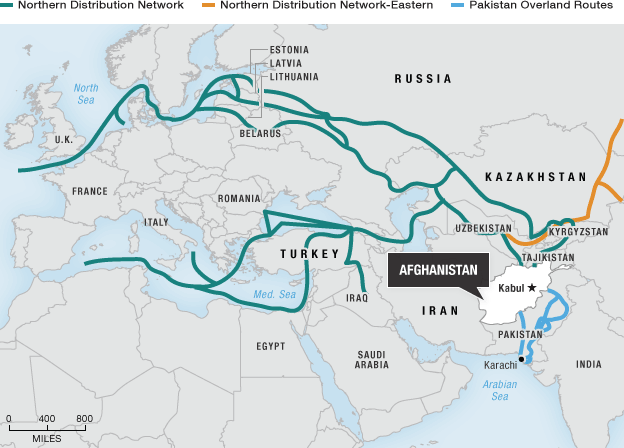
Image courtesy of EagleSpeak. The magnitude of the challenge is well described for us by Vice Adm. Mark Harnitchek, deputy commander of the U.S. military’s Transportation Command.
“This is the logistics challenge of our generation” … “The challenge of my father’s generation was escorting convoys across the north Atlantic when we didn’t know how to do that very well. Convoys in 1943 would lose 16 of their 32 ships. The Army had their challenge supplying Patton in his race across France, keeping him resupplied. Supporting operations in Afghanistan is our generational challenge.”
For the first seven years of the war in Afghanistan, almost all supplies and equipment were shipped by sea to the Pakistani port of Karachi. From there, they were trucked overland to Afghanistan, through parts of Pakistan effectively controlled by the Taliban.
In 2008, according to Harnitchek, the U.S. military lost as much as 15 percent of its supplies in those areas due to ambushes and theft. Establishing another supply route became a top priority.
Near the beginning of 2009 I explained the necessity for the Northern logistics route, and described it in detail. The routes shown above come close, but still rely on Russia and fail to engage Turkmenistan. I recommended that we develop a route “through the Caucasus region, specifically, from the Mediterranean Sea through the Bosporus Strait in Turkey, and from there into the Black Sea. From the Black Sea the supplies would go through Georgia to neighboring Azerbaijan. From here the supplies would transit across the Caspian Sea to Turkmenistan, and from there South to Afghanistan.”
I explained the urgency of the situation, and also described in subsequent posts on logistics how reliance on lines of logistics through Russia could affect the outcome of New START as well as endanger Georgia and cause another Russian incursion into the Caucasus (Ossetia and beyond). Yet we are still lethargic concerning full development of the Northern logistics routes.
The urgency is still present, and we continue to see further examples of Pakistani duplicity.
As targeted killings have risen sharply across Afghanistan, American and Afghan officials believe that many are the work of counterintelligence units of the Haqqani militant network and Al Qaeda, charged with killing suspected informants and terrorizing the populace on both sides of the Afghanistan-Pakistan border.
Military intelligence officials say that the units essentially act as death squads and that one of them, a large group known as the Khurasan that operates primarily in Pakistan’s tribal areas, has been responsible for at least 250 assassinations and public executions.
The Haqqani network is, of course, coddled and enabled by the Pakistani ISI. For some inexplicable reason the otherwise clear thinking Bing West comments concerning this report that:
The administration has to adopt a tough, transactional negotiating posture with Pakistan.
What is this song of enchantment that Pakistan continues to sing to its disappointed suitors? Is it nuclear weapons? There is the need for robust Pentagon war gaming concerning the securing of Pakistan’s nuclear weapons, as I have described. Is it the belief that more negotiations will convince Pakistan not to support the Afghan Taliban? Is it the belief that Pakistan isn’t really controlled by Islamic fundamentalism, or that the Army isn’t preoccupied with fabricated and delusional notions of danger from India?
Whatever it is, we are years behind schedule in divorcing ourselves from Pakistan, whether concerning logistics or reliance on their internal security over their nuclear arsenal. The Obama administration is “scrambling to repair” relations with Pakistan, as I would have expected. But leaving the juvenile and moving to the adult, when even most knowledgeable analysts are suggesting that we need to take a tough negotiating stance and repair relations with Pakistan, we have a problem.
These relations with Pakistan never really existed. Pakistan’s ultimate aim has never changed, even though the campaign has evolved. Pakistan wants its high-powered insurgents (e.g., the Haqqani network) in order to effect change in Afghanistan (on its whim) and convince India that it is a force to be reckoned with, Kashmir or elsewhere. Pakistan isn’t an ally of the U.S., and never was. It’s time to stop pretending that they are. It is always difficult to face the truth, but time is short and the situation is dire.
All monies should cease, lines of logistics should shift completely to the North, and in the future if Pakistan wants to engage the U.S. as an ally, it must start over and prove itself. We must always negotiate from a position of strength, as we learned from Sun Tzu.
12 years, 10 months ago
Here is yet another example of the now infamous double-game being played by Pakistan, our so-called ally in the war against Islamic fundamentalism:
Twice in the last few weeks, US intelligence officials have provided the Pakistanis with the coordinates of bomb factories in the rugged tribal region of Waziristan, on the Afghan border — only to see the info leak to the enemy, who evacuated the sites before the Pakistani military arrived.
***
Incoming Defense Secretary Leon Panetta arrived in Pakistan Friday to discuss “rebuilding” the Pakistan-US relationship, and reportedly confronted his hosts with the evidence that they’d tipped off the Taliban about the bomb sites.
This is just getting tiresome beyond words.
Is it even worth keeping score any longer? Why does the U.S. continue to allow the Pakistanis to get away with this kind of thing?
There is only one reason I can find: we just can’t face the consequences of putting the screws to Pakistan.
The Obama Administration is afraid that even a hint or threat of even reduced aid will push the Pakistanis over the edge and into the arms of the Islamofascists. Which is to say that Pakistan would openly embrace the terrorists rather than just discreetly.
As the Captain pointed out years ago, if the U.S. had any strategic sense, it would have developed alternative logistical routes to Afghanistan that did not depend upon Pakistan. As it is, we are precariously reliant upon the Pakistanis keeping the land route open for the bulk of supplies coming into Afghanistan.
Other than having to find a new route to keep the campaign supplied, the other consequence of denying aid to Pakistan would be the loss of what little presence Pakistan still allows to CIA operatives who help to track down and target terrorists inside Pakistan. Is this limited capability so vitally important that we are willing to fund a government that actively works against us as much as it does with us? Given the increasing restrictions placed on operations within Pakistan, it is doubtful that the gains at this point are worth the losses. Would a drone strike from a CIA base in Pakistan really have much of an effect on the Afghan Campaign? If the death of Bin Laden made no impact, what would?
Then there is the benefit of clarity. Having Pakistan as a declared enemy in the Afghan Campaign would certainly not be welcome, but at least the U.S. could take actions in the porous border areas that it cannot with an “ally” that acts like an enemy. Clarity can be a wonderful thing. Ambiguity in this regard has left us in strategic knots, knowing where the Taliban are getting re-supplied and trained but unable to effectively do anything about it.
Finally, the U.S. may have far more to gain by cutting Pakistan loose and allying closely with India. As it is, the U.S. must temper its cooperation and policies with India due to Pakistani sensitivities. If Pakistan is determined to act like a rogue state, then the U.S. is far better off developing closer ties to India, not only in regard to Afghanistan (where India could become a major player and partner) but also as a strategic counterweight to China and Russia.
It is high time for Pakistan to decide whether it belongs to civilization or to the barbarians. By the same token, it is high time that the U.S. faced up to the hard truth: Pakistan, for whatever reason, is not willing to remove the terror bases from their territory and must be treated accordingly.
12 years, 10 months ago
From Reuters:
Stocking warehouses in most police forces is low-rank, unglamorous work. In Afghanistan, where literacy and education are at a premium, Lieutenant Colonel Christopher Hurley is pushing to make it a well-paid and prestigious job.
The U.S. and its allies are rushing to ready the Afghan army and police to take over control of security from July, but they are discovering they have a job far more complex than just providing guns and training about how to use them.
Years of funding shortages, civil war, corruption and weak leadership have eaten away at the backbone of logistics, medical and training systems that support front-line troops.
So U.S. Air Force officer Hurley is just one of hundreds of foreign soldiers who have found themselves in Afghanistan fighting a war with training manuals, Excel spreadsheets and theories about supply lines.
Hurley runs training and management at the Afghan police force’s largest regional logistics hub, where just six Afghan officers coordinate supplies for 20,000 police in the south.
“One of the greatest challenges we face is the lack of literate, capable Afghan logisticians,” Hurley told Reuters in a gleaming warehouse stacked with everything from waterproof coats to pistols kept in a padlocked wire cage.
At present the pay and rank of the jobs are low. In a country where two-thirds of the population is illiterate, that makes it virtually impossible to attract police with the management and record-keeping skills needed, or give them a salary that ensures they resist temptations toward corruption.
“Logistics isn’t terribly glamorous, but what they control are the resources and the weapons so there is incredible pressure on them and a huge revenue stream,” Hurley said, adding that it is also a dangerous career choice.
“If they are doing things honorably they are at huge risk from the Taliban,” he said, gesturing to the stacks of guns.
Read the whole article. I’ll predict that no amount of laptops, EXCEL spreadsheets, training or oversight will develop a logistics force or the capability to transport goods and services from place to place in Afghanistan. But what’s more important, nothing we can do will rid the force of its systemic corruption. As I recently observed, “in the end, evil is a moral problem, not an epistemological one, and you cannot educate or rehabilitate evil out of mankind.”
Corruption is neither a financial nor a pedagogical problem. No literacy program will modify behavior. Endemic corruption is an Afghani problem, and they Afghans will have to solve it, or they will fail at everything they do. In this case the failure would be in logistics. I have observed before that no army can long survive without logistics. Logistics rules.





