
It’s Time to Engage the Caucasus
BY Herschel Smith 17 years, 5 months ago
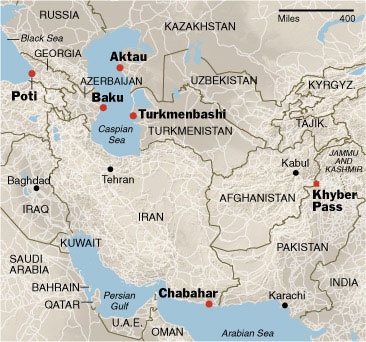
We have closely followed the implementation of the Taliban strategy (pointed out here at The Captain’s Journal one year ago and one half year before it began in earnest) to shut down lines of logistics via the Khyber region and through the Torkham Crossing. The closing of the Manas Air Base in Kyrgyzstan has occurred due to entirely different reasons than enemy strategy. Or has it? Russia is asserting itself in what it considers to be its near abroad, and has essentially bribed the officials in Kyrgyzstan to close down the Manas Air Base. This makes the U.S. utterly dependent on logistical lines that run through Russia to Central Asia. Of course, this places the U.S. in a precarious position regarding membership of Georgia and Ukraine in NATO, as well as missile programs in Poland and elsewhere. If the U.S. is dependent on Russia for logistics, then it is much more likely that Russia will be able to assert itself in the region with U.S. weakness because of dependence on Russian cooperation for logistics.
For this reason The Captain’s Journal had recommended approximately two months ago that the U.S. work harder on a potential logistical lines through the Caucasus region, specifically, from the Mediterranean Sea through the Bosporus Strait in Turkey, and from there into the Black Sea. From the Black Sea the supplies would go through Georgia to neighboring Azerbaijan. From here the supplies would transit across the Caspian Sea to Turkmenistan, and from there South to Afghanistan.
If this line of supply came to pass, then this leaves the issue of refueling for air supply and transit through the region unaddressed, since this was the primary mission of the Manas Air Base. Stephen Blank, professor at the US Army War College, has written that of the potential replacements for Manas, none appear to be viable. But unaddressed in Blank’s commentary is the potential to base air support in either Azerbaijan or Turkmenistan.
Returning to lines of logistical supply, as we recently reported, there are ongoing talks concerning the Caucasus region regarding the very routes we have discussed. Furthermore, trial runs of supplies are ongoing to test these routes.
… the Air Force is working on contingency plans to move the tanker fleet to bases in the Persian Gulf if it loses basing rights to Manas.
The Azeri capital, Baku, is emerging as a leading candidate to substitute for Manas, should the Kyrgyz government refuse to reconsider its withdrawal of the basing rights.
American and Azeri officials said that the focus of the discussions on Monday and Tuesday was a surface route that would move supplies from the Georgian port of Poti on the Black Sea and overland to Baku, where they would cross the Caspian Sea to Aktau, Kazakhstan, and then overland across Uzbekistan into Afghanistan.
A second potential route would land cargo at the Caspian seaport of Turkmenbashi, in Turkmenistan, for transit into Afghanistan. Talks on supply routes have also been held with officials in Tajikistan, another neighbor to the north of Afghanistan.
One American official said the first “trial run” of cargo containers on the new route was conducted within the last two weeks, with shipments of lumber sent from Turkey to Georgia to Azerbaijan, and then onward toward Afghanistan.
So this report notes not one, but two potential lines of logistical supply over land, as well as the potential replacement of the Manas Air Base with Baku, Azerbaijan. At this point it might be that the Russians backpedal on disallowing Manas to continue to function (thus the recent equivocation in the news), since U.S. involvement in the Caucasus (i.e., their near abroad) is the last thing they want.
But this logistical transit route is viable. First to Azerbaijan.
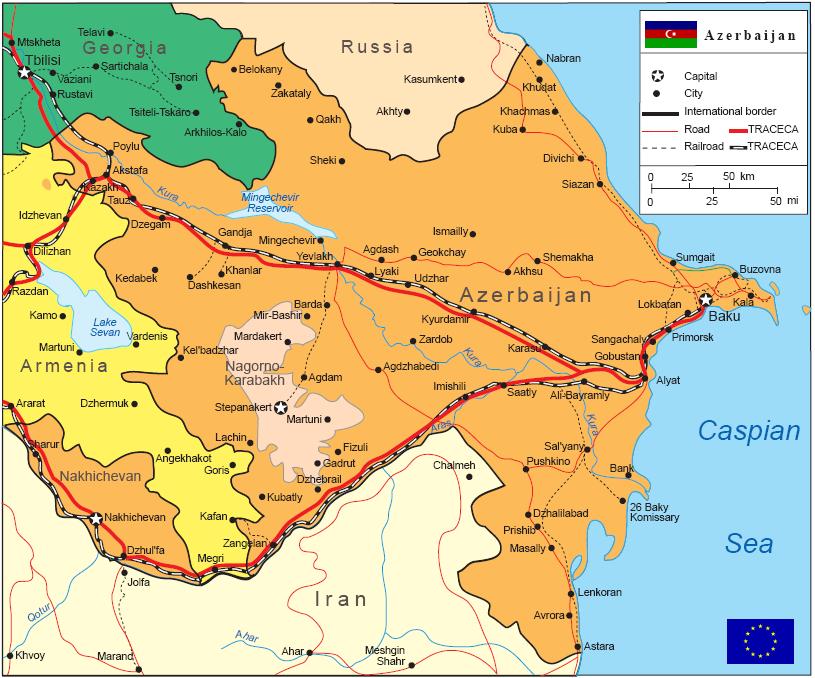
Azerbaijan is more developed than Turkmenistan, and is obviously the center of gravity of both of the potential logistical lines discussed above. Baku would be almost ideal for an air base to support refueling operations for U.S. aircraft supporting Operation Enduring Freedom. Turkmenistan is far less developed, and the only viable route for supplies would go through Ashgabat from the port city of Turkmenbashi, and then South to Kandahar or East to Kabul.
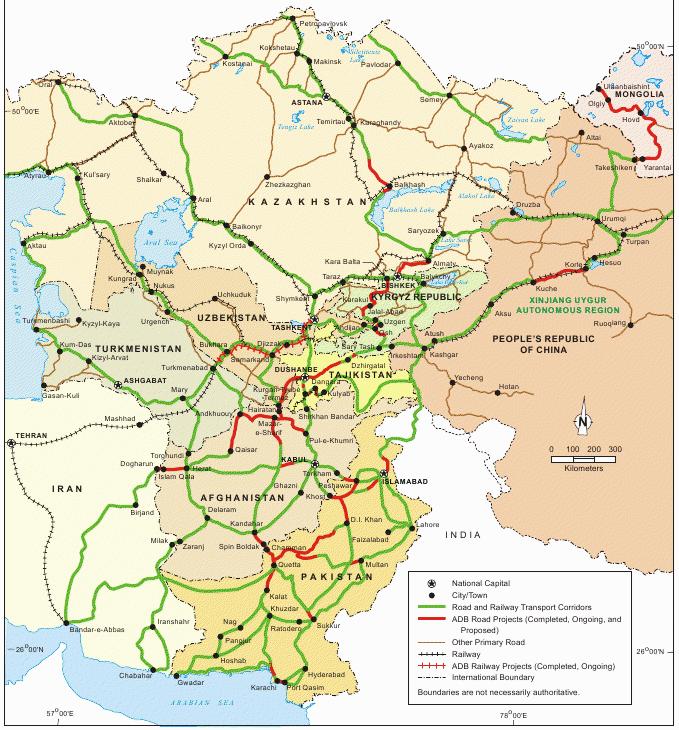
Much ink has been spent spilled over the human rights record of Turkmenistan and Uzbekistan, and both are undoubtedly repressive regimes, although there is evidence that Turkmenistan is slowly and gradually changing for the better. There is also significant corruption in Turkmenistan. But there is also indication that Turkmenistan is opening up to economic cooperation. They have expressed an interest in becoming an associative partner in the ECO (Economic Cooperation Organization), and have recently opened their air space to NATO supply flights to Afghanistan.
The U.S. has a history of moral preening when it comes to working with unsavory dictators and political regimes, but this preening must be put aside in favor of functionality and logistics. Georgia, Azerbaijan and Turkmenistan have all expressed an interest in working with the U.S. to enable lines of logistical supply to Afghanistan. This plan is, after all, what provided more than 40% of the supplies to Russian troops during their campaign.
Moreover, a stronger presence in the Caucasus region is in the interests of the U.S. in both the near and long term. Stronger ties will serve to ensure continued supplies to U.S. troops in Afghanistan, cement critical relations in this region and Central Asia, and provide a counterbalance to Russia’s increasing hegemony in their near abroad. It is the right time and circumstances to engage the Caucasus.
Postscript: The Captain’s Journal thanks Mr. Bob King, Instructor, U.S. Army Command and General Staff College, Department of Joint, Interagency and Multinational Operations, Leavenworth, for the encouragement to write this article.






On March 20, 2009 at 11:46 pm, rrk3 said:
In researching Chechnya the Caucsus also have some issues as this will put us running our logistics through a potential shatter zone in that area. While I think will be more reliable than anything through Pakistan it is still an area for concern.
I read an interesting article concerning firearms ownership in Pakistan. The applications for private citizens to own firearms is sky rocketing. In the non-tribal areas citizens can only own firearms through a application process. I am in the process of reviewing and updating some data I did on the FATA last year and I do not think I can show any improvement in that area. I do not think the Pakistan is going to make it another five years before the Taliban control it as well. Then they will have their bomb. Of all the areas where radical Islam is on the rise Somalia, Yemen the FATA and Pakistand still scare me the most
I realize I went a little off topic but I have not posted recently and had to get this out there.
RRK
On March 21, 2009 at 5:43 pm, subbob said:
Herschel – Appreciate the nod in your postscript.
You present a thoughtful and well-referenced article examining an alternative option for logistics supply to Afghanistan. In reading it, three items came to mind for further analysis: the tension between Russia & Georgia, the ongoing Nagorno-Karabakh “frozen conflict” and the availability of adequate shipping transportation within the Caspian Sea.
Russia & Georgia Tensions
In last year’s invasion of Georgia, Russian forces drove far enough south that they could have interdicted the lines of communication proposed in your article. Would they have done so with American presence there? That is debatable, but it definitely sets up the potential for increased tension, if not conflict, between our two countries.
Georgia desires NATO membership and, not surprisingly, Russia strongly opposes such a move. Within the last week a bi-partisan recommended President Barack Obama should stop encouraging Georgia and Ukraine’s bids to join NATO.
REF: http://www.google.com/hostednews/afp/article/ALeqM5j1LUY_ELU2rd9N9CTqa8y-NCniBw
Nagorno-Karabakh (NK) “Frozen Conflict”
Looking at the map (as linked in your post above), the main LOC through Azerbaijan passes within 25-30 km of the disputed NK region. With that situation remaining unsettled, there could be a significant potential for third-party organizations to oppose and interfere with U.S. logistical operations in region. Armenia, and the ethnic Armenians occupying the NK region, may likely see this as reinforcing Azerbaijan influence in the area.
REF: http://en.wikipedia.org/wiki/Nagorno-Karabakh
Adequate Shipping within the Caspian Sea
The Caspian Sea is landlocked, so the availability of shipping to transport our supplies is limited to that which is already there, or that could be built in the future. The viability of using the Caspian for our needs would require further analysis of available shipping and port infrastructure at each end.
Not surprisingly, Russia maintains the largest military naval presence on the Caspian Sea. As you point out above regarding their “near abroad”, they would not be keen on increased U.S. presence in this region.
REF: http://en.wikipedia.org/wiki/Caspian_Sea
On March 21, 2009 at 6:00 pm, subbob said:
Readers interested in this area should also take a look at the Central Asia-Caucasus Institute at the Johns Hopkins School of Advanced International Studies. Their events are free and open to the public and a great opportunity to learn more about this region. Many of the events are recorded and made available on their site.
They also publish the Central Asia-Caucasus Analyst, the biweekly journal of the Central Asia-Caucasus Institute & Silk Road Studies Program Joint Center.
Johns Hopkins SAIS Central Asia-Caucasus Institute
http://www.sais-jhu.edu/centers/caci/index.htm
Central Asia-Caucasus Institute & Silk Road Studies Program
http://www.silkroadstudies.org/new/
CACI Analyst
http://www.cacianalyst.org/