I linked and commented on Ralph Peters’ commentary Pick Your Tribes in Winning in Afghanistan, and since then so did the Small Wars Journal blog. Indeed, there has been quite a discussion of late on the issue of tribal engagement as a solution to the insurgency in Afghanistan. One commenter asks whether I support Peters’ rejection of the necessity to implement Western style government in Afghanistan.
I do not support the necessity of building Western style democracies in Afghanistan or anywhere else, but weighing in as an expert in the human and cultural terrain in Afghanistan would make a liar out of me. The reader should consult the many writings of my friend Joshua Foust (his most recent discussion of the engagement of the tribes can be found here). Christian Bleuer is also a wonderful resource. I think it’s remarkably silly for folks to weigh in on human, cultural and anthropological terrain unless they are studied in that field. I am not, and they are. So don’t consult me on that issue.
My fundamental point was that understanding the exigencies of the human terrain is not a prerequisite for killing insurgents, and the initial stages of the campaign can be accomplished – in fact, must be accomplished – without reference to the human terrain. Let me explain further.
I have weighed in before concerning The Anbar Narrative, in which I challenge (and reject out of hand) the populist myth that has been built up around the tribes in Anbar (while also acknowledging that the tribes were important in Ramadi). Concerning Fallujah 2007, a part of the campaign with which I am familiar, I have written (among other things):
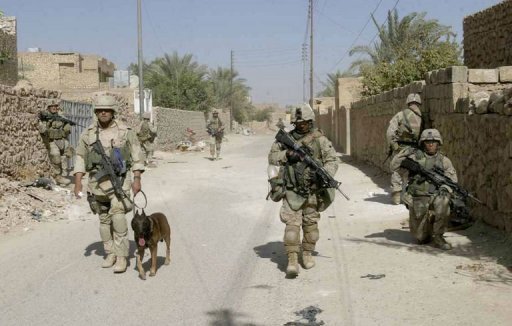
By early 2007 both foreign fighters and indigenous insurgents had been driven from Al Qaim, Ramadi and Haditha, and they had landed squarely in Fallujah. When the 2/6 Marines arrived in Fallujah in April of 2007, they had to construct some of Forward Operating Base Reaper while laying on their backs and passing sand bags over their bodies (to eventually be used for walls) because of the constant fire coming their way. The previous unit had begin patrolling only at night because of snipers, and because they didn’t own the daytime, IEDs controlled their night time patrols, thus relegating them to sitting in their FOBs for the last three weeks of their deployment awaiting relief. The population was so allied with AQI that their children were sent out with black balloons to demarcate patrol locations so that insurgent mortars could target the U.S. Marines (even at grave risk to the children).
Operation Alljah was started, and the Marines went in hard (I am not linking the Wikipedia link on Operation Alljah because of know with certainty that much of the data is simply erroneous or mistaken and incomplete. The link is essentially worthless). HMMWVs with loud speakers were deployed to every Mosque in the city bellowing U.S. positions and propaganda. Heavy and aggressive patrols were conducted, and heavy fires were employed any time any insurgent used weapons against the Marines, including everything from fire team and squad level weapons to combined arms.
Policing of the population was aggressive, ubiquitous and around the clock. In order to address the vehicle-borne IED problem, the use of automobiles was prohibited within Fallujah proper until such time as security was established. Concrete barricades were set up throughout the city, and census data was taken on the entire population, much of it at night so that the population was awakened to Marine presence in their homes.
Many local insurgents were killed, and also even more foreign fighters. Insurgents from Chechnya, men with skin “as black as night,” and even “men with slanted eyes” were killed in Fallujah in the summer of 2007. The city was locked down and the atmosphere made very uncomfortable for the population – until, that is, they began cooperating with the U.S. Marines Corps. I know many more things that I simply cannot share concerning this operation, but things that I have communicated to Colonel Gian Gentile …
I am not at liberty to discuss the balance of the TTPs employed by the Marines in Fallujah 2007. But if you think that I am over-reaching, consider Schmedlap’s comments (while not specific to Anbar, still representative of the reality versus the myth that has developed around the campaign in Iraq).
One thing that I think many people forget about Iraq (or maybe it wasn’t reported?) is that in 2007 and 2008 we were killing and capturing lots of people on a nightly basis. Protecting the populace was A priority. When speaking to the folks back home, in order to sell the war, perhaps we said that it was the priority. But on the ground, I do not recall a single Commander’s Update Brief spending any time at all discussing what we had done to protect anyone. We were focused on punching al-Qaeda in the nuts at every opportunity and dismantling their networks. The reconcilables got the message loud and clear that they could take money and jobs in return for cooperation, or they would die a swift death when we came knocking down their doors in the middle of the night. The rest of the populace made it clear to them that they should take the offer. The only protection that the population got from us was good fire discipline so that we did not kill non-combatants. We made it clear that the government intended to win this thing and we did not send that message by delivering governance or digging wells. We shot motherf******s in the face. Pop-COIN blasphemers, your scripture is false teaching. Here is some truth:
To every thing there is a season, and a time to every purpose under the heaven: A time to be born, and a time to die; a time to plant, and a time to pluck up that which is planted; A time to kill, and a time to heal; a time to break down, and a time to build up; – Ecclesiastes 3:1-3 (KJV)
It’s time to kill.
Who wins in the long run is something the Afghans themselves will have to work out. We shouldn’t be siding with anyone right now. All politics is local, and in Fallujah 2007, the ISF was told to go home. They weren’ wanted, weren’t needed, and weren’t welcome. The Marines didn’t trust them, and only slept around them with a Marine awake and standing duty, along with concertina wire between Marines and ISF. On the other hand, the Marines worked seamlessly with the IPs.
I have exchanged e-mail with Tom Ricks, one of the priests of COIN, who also sees every event in Iraq as proof that AQ is coming back and Iraq is falling apart, explaining that Fallujah will never again accept AQ in their city. Maybe the Diyala Province, maybe Mosul, but not Fallujah. The IPs won’t allow it to happen. It’s a local thing, and you would just have to know what the 2/6 Marines set into motion in order to understand why AQ can never go back there. Ever.
Speaking of local, Tim Lynch explains for us in simple yet elegant terms what’s so problematic with this policy of engagement.
This “inspired” idea of using locals to provide security will fail because nobody responsible for it will get off the FOB to provide daily detailed supervision. I can’t stress enough the importance of daily, full time, supervision. The Skipper’s EOD program works because he provides daily, detailed supervision, while EOD programs elsewhere in the country languish. CPT America is re-building the entire Provincial irrigation system because he provides daily, detailed supervision, while the same projects elsewhere in the country barely break ground. If we can’t get the various government agencies to operate off of the FOB then there is only one viable option. Armed, outside the wire, experienced, contractors.
I just don’t know how else to say it. There are some in Afghanistan who are doing COIN. The boys in the Korengal Valley did (they are gone now, unfortunately). The Marines in Helmand are. But confinement to FOBs is death to the campaign. And that means the “special” SOF boys who ride helicopters to direct action kinetics for the night, and then back to the FOB for a warm meal and a bed for the night. They aren’t contributing to the campaign. They are a drain and drag on the national treasury. Period. The Marines in Fallujah in 2007 spent weeks at a time in distributed operations, in units as small as a fire team, embedded with IPs at local Police Precincts, killing insurgents, taking note of the human terrain, and ensuring that their AO was locked down. The SOF needs to figure out a way to contribute like this.
Tim is also in the news in The Star for recommending just such a program. Go read it. Now, as for a good example of COIN, The New York Times had just such a gem.
American troops in Afghanistan’s Paktika Province called in a helicopter strike against Taliban fighters who ambushed them here Tuesday night, killing several. The missile strike narrowly avoided doing serious damage to a mosque where some of the fighters were hiding, underlining both the risks and the potential benefits of using air power to support ground troops.
Under rules of engagement strictly enforced by Gen. Stanley A. McChrystal that have provoked resentment among troops, American forces are required to exercise extreme caution when calling in airstrikes, and generally avoid mosques entirely. But in this case, American commanders defended the action, saying that they believed no civilians had been killed and that there was no way of knowing the building was a mosque.
If Afghanistan is getting a reputation as a war in which the “soft” side of counterinsurgency is driving out the use of force — and that is certainly the perception among some soldiers in the south — this is an instance of the “hard” side being brought to bear in the way familiar to any officer who fought in Iraq during the surge.
The American patrol set out from a base in Yahya Khel district center at 6 p.m. Tuesday, planning to provoke a fight with a team of Taliban sharpshooters suspected to be operating around the village of Palau. The troops, from Angel Company, 3rd Battalion, 187th Infantry Regiment, dropped off a team at a small Afghan army outpost and then moved by foot toward the village.
Just before dusk, the patrol was ambushed, not by the expected long-range marksmen, but by a team of gunmen who attacked with rifles and grenades from as close as 50 feet away. Two American soldiers were wounded. Half an hour later, at the outpost, Angel Company’s commander, Capt. Joshua Powers, received permission over the radio from Col. David Fivecoat, the battalion commander, to call in fire from attack helicopters. The pilots had watched a group of fighters move from the area of the gun battle to a courtyard in a small village north of Palau. They told Captain Powers that they could make out a machine gun and several rifles. At 8:38 p.m., one of the helicopters fired a Hellfire missile into the cluster, then shot another man who was on the roof of the building abutting the courtyard. Over the next half hour the helicopters attacked two more groups of suspected fighters in the area with cannon fire.
In the dark, Angel Company walked north from the outpost to assess the damage. In the courtyard, the corpses of two men were illuminated by burning weapons and motorcycles. While his medic tended to a third man, severely wounded and clad in camouflage, Captain Powers radioed his battalion with bad news: The building by the courtyard was a mosque. The pilots had not known, since no loudspeakers were visible and identifying writing was visible only from the ground. There was shrapnel damage to the walls, and the roof had a hole in it from cannon rounds.
The patrol, along with a group of Afghan soldiers and their commander, Lt. Col. Mir Wais, stayed the night outside the mosque. The Taliban would undoubtedly claim that civilians had been killed, Captain Powers explained, and he wanted to be there when the villagers woke up to show them the weapons and combat gear. “If we hold this ground, we can show them the evidence right away,” he said. “The first story is usually the one that sticks.”
The pilots thought they had killed half a dozen fighters at a second site the helicopters had attacked, but the bodies were already gone when the patrol arrived. Captain Powers acknowledged that this meant there was no way to know for sure whether civilians had been killed, but thought it unlikely: the site was secluded, and among charred motorcycles there were rocket-propelled grenades and camouflage vests with rifle magazines. At the first site, all four bodies — the two in the courtyard, the one on the roof, and the wounded man, who later died — wore camouflage fatigues and similar vests, containing grenades, ammunition, makeshift handcuffs and a manual on making homemade explosives.
Around 5 a.m., the men of the village started to congregate by the mosque. Captain Powers and Colonel Mir Wais addressed them, telling their story of what had happened. The men complained that the strike had frightened their wives and children and damaged the mosque, and that they were trapped between the pressures of the Americans and the Taliban. But they did not suggest that any residents of the village had been wounded or killed, and did not claim the bodies. Later in the morning, the district subgovernor, Ali Muhammad, described the night’s events to citizens gathered in the Yahya Khel bazaar. He also signed, along with Captain Powers, a letter about the attack that would be distributed in the area after dark: a counterpoint to the Taliban’s infamous “night letters.”
The same people who ordered the strike were there to explain it in the morning, just as I suggested should happen. The same people who fight by night are there for the locals to look at in the morning. And look into their eyes. If they see cut and run, they will side with the insurgents, or someone else, whomever that may be. If they see victory and determination, they will side with the stronger horse. We need to be the stronger horse. Understanding the tribes, people, human terrain and other complicated aspects of the culture can come next. In a tip of the hat to a withdrawal deadline, we are trying to get the cart before the horse.
Force projection … force projection … force projection. It comes first.
Update:
I appreciate the attention given to this article at the U.S. Army’s site Stand-To. A screen shot (with MWSnap) is shown below.



 16 years, 1 month ago