New York Sun on Nuclear Iran
Nuclear yield within six to twelve months.
McNeill ties length to Pakistan tribal region, likely to be protracted anyway.
Multinational force press release on Sadr City operations and seizure of weapons and munitions.
"We will fight them to the end."
War on terror not popular with Pakistani population.
U.S. presence expanding Southward in Iraq.
Its full steam ahead for Iran.
And SECDEF Gates continues to press this issue.
Pajamas Media exclusive: how your tax dollars fund terror.
Southwestern Baptist Theological Seminary Graduate executed in Afghanistan.
Nearly 1000 dead from harshest Afghan winter in 30 years.
Attacks in Baghdad down 80% according to Iraqi Army.
Lack of appropriate defense spending a grave situation.
Olmert claims Iran still on target to construct nuclear weapon.
Promoted to Army Vice Chief of Staff. Well deserved.
Must read on Israeli Army shame and lawyer happiness with war against Hezbollah.
Libyans joining jihad in increasing numbers.
How relevant will Maliki be to Iraq's future?
Maj. Gen. Gaskin: "The positive trends are permanent."
Abizaid questions whether Maliki can bring unity to Iraq.
From the Multinational Force, more on Operation Lion Pounce.
An important ally in Iraq has been assassinated.
Israel to show Chairman of Joint Chiefs of Staff nuclear intelligence on Iran.
Cabinet approves proposed agreement with U.S.
Prof. Kingsley Browne on his new book.
Major General Robert Scales: "Outcome is irreversible"
Mullen says military needs larger slice of GNP to modernize.
For siding with the U.S. against al Qaeda.
Terrorist poses as bride. Ugh!
Legislation in trouble.
Al Qaeda documents discovered near Syrian border.
Shameful people jeer disabled veterans in swimming pool.
Saudi jihadist in Iraq tells his personal story.
Concerning Iranian meddling and Quds.
Michael Yon breaks bread with General Petraeus.
Ralph Peters on the advancements in Iraq.
War between al Qaeda and Hezbollah.
Traumatic brain injury not recognized.
Ballistic Sensor Fused Munition.
High intensity electronic warfare.
Iranian weapons are a sign of continued Iranian meddling in Iraq.
U.S. forces in Iraq are using a high-resolution, thermal/infrared sensor system.
Washington Post profiles AQI (al Qaeda in Iraq, or al Qaeda in Mesopotamia).
Taiwan may not be as secure as we would like to think.
Be thankful your daughter isn't be raised in Basra.
Pastor discusses rules of engagement and sacrificial U.S. deaths.
In counterinsurgency (COIN), patience is a virtue. But violence has decreased so fast in
Foxnews is carrying an article on a dust-up over body armor within the Corps.
The Pentagon and Marine Corps authorized the purchase of 84,000 bulletproof vests in 2006 that not only are too heavy but are so impractical that some U.S. Marines are asking for their old vests back so they can remain agile enough to fight.
Marine Commandant Gen. James Conway wants to know who authorized the costly purchase of the nearly 30-pound flak jackets and has ordered the Marine procurement officers at the Quantico base in Virginia to halt the rest of an unfilled order, FOX News has learned.
“I’m not quite sure how we got to where we are, but what I do know is it is not a winner,” Conway told FOX News at the end of his recent trip to Iraq.
“I think it is foolish to buy more.”
Twenty-four thousand more vests were scheduled to be shipped to Iraq in the coming months, but Conway halted that order during his trip.
“I’ve asked them to tell me — to walk me through — the whole process … how it evolved,” Conway said.
“It goes back a couple of years. I think the vest has its advantages. It fits pretty well on the waist. The weight is distributed more evenly on the hips than shoulders, but Marines don’t like it. I didn’t like it when I put it on.”
The protective jackets, manufactured by Protective Products International in Sunrise, Fla., are known as Modular Tactical Vests, or MTVs. With heavy plates, known as sappis, on their sides, they provide more coverage than the older vests. That makes them much safer but also much heavier. The MTVs have more protection than the older “Interceptor,” made by Point Blank, and they distribute weight more evenly.
The new vests, weighing in at about 30 pounds each, are three lbs. more than previous regulation body armor. Marines, who are already carrying up to 95 lbs. depending on the mission, say they feel the difference.
It is frankly difficult to imagine that this issue could have become so confused to so many people. Hopefully this article will be enlightening for the careful reader. To begin with, it is necessary to show a picture of a Marine in Fallujah during Operation Alljah, wearing the IBA (Interceptor). This picture comes to you courtesy of Bill Ardolino who embedded with the 2/6 Marines in 2007.

Take particular note of the thing hanging on the side of this Marine’s IBA (Interceptor Body Armor) vest. It is called a side SAPI plate (small arms protective insert, or the enhanced version is ESAPI). The side SAPIs are not used when Marines train stateside. They are issued upon entry to the theater. They are issued to the Marine whether he has the IBA or MTV (Modular Tactical Vest). The 2/6 Marines were told that they would be issued the MTV prior to deployment, but delays made that impossible. To compensate, many of the Marines went to TAG (Tactical Applications Group) in Jacksonville, N.C., right at Camp Lejeune, and purchased their own tactical vest, the Spartan 2, which is the commercially available version of the MTV. This Marine didn’t get his before TAG ran out of the vests, so he took his IBA vest. When 2/6 deployed to Iraq, they deployed with the vest, the front and rear SAPI plates, and the soft ballistic panels. Some Marines from 2/6 deployed with their IBA, and had to have TAG send their back-ordered Spartan 2 to their home, and have their families send it to Iraq, since equipment vendors are not allowed to send packages directly to the theater. But the Marines of 2/6, who regularly spent most of the day in their armor during training, wanted the Spartan 2 (MTV) so badly that some of them had their families send them to Iraq.
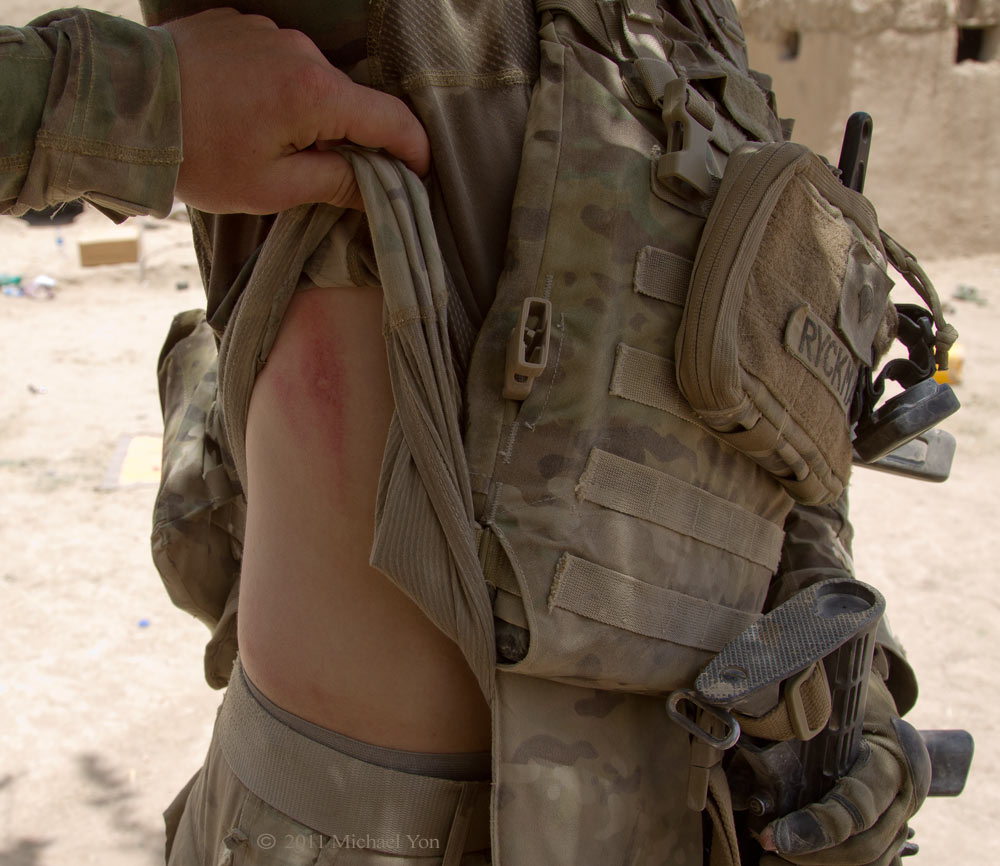
Take note also that the IBA doesn’t have the side SAPI integrated into the vest, so it hangs onto the IBA with Molle straps. In fact, this particular Marine has his side SAPI hanging a full five or six inches below the rest of his vest (in the early days of the Anbar campaign, this gap under his arms was a favorite target for snipers, whereas the MTV solves this problem). When this Marine was at Camp Lejeune, he didn’t have the side SAPIs hung onto the vest with Molle straps. In fact, he didn’t have them at all. Again, these SAPIs are issued upon entry to Iraq, and those side SAPI plates add quite a few pounds to the system. Notice also that the rear SAPI is hiked up a bit in the back well above the lower part of his spine. This is the way the IBA holds the SAPI plates. Down in the front, high in the back, and side SAPIs hanging on by Molle, sagging down and exposing their ribs and lungs.
The IBA and the MTV are merely tactical outer vests to hold the soft panels (to protect against very small arms fire or shrapnel) and SAPI plates (to protect against up to a 7.62 mm round). The body armor itself - front SAPI, rear SAPI, soft panels and side SAPIs - are exactly the same between the two body armor systems. This point is critical to understanding the current dust-up. Again, the weight between the two is the same. The MTV does not weigh more than the IBA. The MTV and IBA are vests, not armor.
There are a few changes made to the MTV that make it different than the IBA. First, the front SAPI is raised a little and the rear SAPI is lowered a little to provide protection to the spine. Second, a neck guard is provided for shrapnel, and third, a soft panel groin protector is provided. The neck and groin protectors add little to the weight of the vest - no more than a pound or so. Fourth, the MTV fully integrates the side SAPIs into the vest rather than hanging them onto the vest. Finally, the MTV hugs the torso and places the weight on the hips, much like an internal frame backpack, as opposed to the IBA which places all of the weight on the shoulders.
Because of all of this, I commented on a post at the Small Wars Journal the following:
I have completely, absolutely, positively no idea whatsoever what this article is talking about. It makes absolutely no sense at all to me. The MTV is a carrier, not a new set of body armor. All of the weighty elements from the IBA – the front ESAPI plate, the rear ESAPI plate, and the side SAPIs, along with the soft panels placed inside the carrier – are still there with the MTV.
More precisely, the soft panels are taken out of the IBA along with the SAPI plates and placed in the new carrier. The soft panels had been inefficiently deployed in the shoulder area in the IBA, and now are fully utilized. One big difference in the MTV and the IBA is the fact that the IBA hung completely on the shoulders, and allowed no load bearing whatsoever on other parts of the body. The MTV hugs the torso, especially at the hips, and places the weight on the hips somewhat like an internal frame backpack.
This feature was so popular among the grunts with my son’s unit before they deployed to Iraq in 2007 (which happened to be prior to the point that the MTV had been issued) that most of the men went to TAGs (Tactical Applications Group) just outside Camp Lejeune and purchased the commercial version of the MTV, or the Spartan 2.
I have heard multiple Marines myself praise the MTV for its ability to take the load off of the shoulders and place it on the hips – and thus PREVENT BACK PROBLEMS, and have never once heard even the slightest complaint. I have also worn the IBA and Spartan 2, and know the difference first hand. I simply cannot account for the report in this article. The only possible explanation I have for it is that the complaints may not be coming from grunts who have to go on 20 mile “humps” with their armor on (along with ammunition, Camelback, carabineer to hold weapon, etc.). The MTV (or Spartan 2) was so popular among Marines at Camp Lejeune that, again, personal funds were spent purchasing it.
Compare this to the IBA which places the load on the shoulders, and again, I simply do not understand this article. Also, the IBA hangs the side SAPIs by Molle loops, so usually they sag (making good sniper targets under the arms of the wearer because of this sagging). The only real weight difference with the Spartan 2 / MTV and the IBA that I have seen is the existence of the front groin soft panel guard. This adds what – several ounces of weight?
Again, confused, and suspect there is more to this story than meets the eye.
As it turns out after reading the discussion thread on this post, I was right, and the Marines are complaining about the weight of the armor and not the design of the vest. In other words, this is what is happening. Marines who are not infantry have trained with their vests on less frequently and not as long in duration as Marines who are infantry, and when they do have them on, they only have the front and rear SAPI plates inserted. The Marines of 2/6 trained with only their front and rear SAPI plates as well, but knew that they would receive side SAPIs upon deployment to Iraq because many of them were “salty” Marines; they had done this before, some more than once. Marines who are complaining of heavier weight haven’t been properly briefed or trained to expect heavier loads due to the side SAPIs whether they wear the IBA or MTV.
So the complaints flow concerning weight, as if the weight is all about the MTV versus the IBA rather than the four SAPI plates themselves. Just to make sure about this, I recently conversed with a senior Marine in whom I place the greatest confidence. Here is what he told me.
“Sir, you need to understand that there is a difference between a garrison Marine and a grunt, and between a veteran and a combat veteran. The IBA is good for nothing but back problems, and the people complaining about the MTV are Marines who don’t have to wear their armor 16 hours a day. The Marines have done a fine job of saving our backs with the MTV. We like ours and wouldn’t give them up. Basically, sir, this isn’t about the difference in weights because they are the same. This is about weight - period. Sir, this all comes down to a fight between grunts and pogues. The grunts do what they have to do, and the pogues complain. Simple as that.”
Yes, the battle space weight is significant, with the armor, the hydration system, ammunition, firearm, radios and other equipment. The debate is about the use of side SAPI plates, not the MTV or the IBA. It had been previously considered to jettison the requirement to wear side SAPIs based on conditions in theater, but this is a situation-specific decision. Weight must be reduced in order to save the health of our warriors, and this should be a goal of future warrior systems. The MTV is a vest, not armor, and thus has nothing whatsoever to do with the debate about weight. The MTV was an outstanding success, my Marine contact tells me. The USMC should be proud of the equipment they have designed for armor. It is the best available anywhere.
Prior:
IEDs have received their due attention, but with the exception of web sites like this one, sniper attacks have been somewhat overlooked in the press in terms of troop risk and force protection. The Department of Defense knows about the risk, and has requested supplemental funding to decrease the risk for fiscal year 2008.
The dangers from enemy sniper attacks have increased steadily during the past year, with the number of attacks quadrupling. These attacks have not only caused numerous casualties, but have had an adverse psychological effect on both Coalition forces and the Iraqi civilian populace. Victims in sniper incidents have a fatality rate of over 70 percent. A shift in enemy tactics that increases the number of sniper attacks could potentially inflict even more casualties than IEDs. To guard against such a shift, the Amendment includes $1.4 billion for a full suite of counter-sniper capabilities designed to prevent, survive, and react to sniper attacks. This includes enhanced optics, soldier protection, active sniper defeat systems, sensors, concealment, and development of new tactics.
Tens of millions of people were walking to work a few days after this was released and glanced over at the newspaper stands seeing USA Today charge the Pentagon with falsification of data regarding the sniper threat in Iraq.
The Pentagon has asked Congress for $1.4 billion in emergency spending to combat a growing threat of sniper attacks in Iraq based on an overstated assessment of the extent of the attacks, its records show.
In last week’s spending request, the Pentagon said sniper attacks have quadrupled in the past year and, if unchecked, the attacks could eclipse roadside bombs as the top killer of U.S. troops. However, the rate of sniper attacks has dropped slightly in 2007 and fallen dramatically in the past four months, according to military records given to USA TODAY.
Pentagon officials acknowledged the mistake Monday after questions about the data were raised by USA TODAY.
“The term quadrupled will be removed from the justification because it is simply incorrect,” said Dave Patterson, deputy undersecretary of Defense.
In 2006, there were 386 sniper attacks on coalition forces, according to data from the Multi-National Force-Iraq headquarters in Iraq. Through Oct. 26 of this year, there were 269 sniper attacks, the figures show.
Noah Shachtman at Danger Room responded to his initial discussion of this with nevermind, and various left leaning blogs jumped on the opportunity to charge the Pentagon with dishonesty. But should Noah have stuck to his guns, and do the left leaning blogs have something to crow about? The answer is certainly not nevermind.
Spook at In From the Cold has an interesting analysis of the data given to USA Today.
First, let’s examine the so-called “rate of attacks” cited by the paper. In 2007, the military reported 386 sniper attacks against coalition forces in Iraq, an average of just over one per day. Through 26 October of this year, there have been 269 sniper attacks, an average of less than one a day. But the paper also acknowledges that there has been a dramatic drop over the last four months–without acknowledging the apparent reason for the decrease, i.e., the troop surge (emphasis mine). Mistake #1.
USA Today’s second error is failing to compute the surge’s impact on the decrease in sniper attacks. Without the drop that occurred between July and October, what would the numbers look like? While it’s highly unlikely that the difference would equal a four-fold increase, it is reasonable to assume that without the surge (and the recent drop in violence), the number of sniper attacks would be on pace with last year’s total–or perhaps slightly higher. That would provide additional justification for sniper mitigation programs.
This is true, and while it calls into question the USA Today model for understanding the data, and while it is tempting to go down this analysis rabbit trail, it neglects the fundamental flaws in the article. Consider the number again: 269 sniper attacks. So precisely what constitutes a sniper attack, according to the Multinational Force data? Deaths of U.S. servicemen is routinely reported as something like “Multinational Force West forces attacked,” for example. If attacks means deaths or casualties, then the data necessitates consideration of a host of things other than sniper risk, such as the success of the surge, overall success of Operation Iraqi Freedom, combat operations, both planned and intelligence-driven, etc. Any Soldier or Marine in a hot spot in Iraq knows that the value of 269 doesn’t come close to representing the number of shots taken by an individual Platoon or Company during deployment, much less the entirety of the U.S. forces in Iraq. This number is so low that even the USA Today reporter should have questioned the use of it to prove anything, much less the extent of the sniper threat in Iraq.
Moreover, while it is easy to define an IED, we may ask the question “how do we define a sniper attack?” Would the definition of “fire received from a position of concealment with U.S. forces lacking positive identification (PID) of the enemy” suffice? If so, then the vast majority of small arms fire in Iraq is sniper fire, at least initially, given the military operations on urban terrain (MOUT).
Semantics cloud the issue and precise definitions elude us. It is simple enough to parse U.S. risk into two cause categories: IEDs and small arms fire (whether they immediately redound to casualties or not). The Department of Defense, although lethargic to respond, now has a robust program of MRAPs and other equipment to address the IED problem. While there are various gadgets that the DoD is investigating, the solution to the sniper problem seems to have three avenues of approach: time, distance and shielding. Distance is a difficult tactic to leverage to our advantage, since urban terrain presents the closest combat operations anywhere on earth. The two remaining avenues are time and shielding.
Time may be dealt with at the tactical level by maneuvers such as satellite patrols, modifications and variations on satellite patrols, rapid movement, concealment, etc. But regardless of how small a Soldier or Marine makes himself, small arms fire is a difficult problem, and as we have covered here, shooters have learned to aim for areas not covered by ceramic ballistic plates (head, neck, and armpits just above the side ESAPI plate, especially if it is sagging because of being hung with Molle straps). Terry Nickelson, previously embedded with Golf Company, 2nd Battalion, 6th Marine Regiment, reported recently from Fallujah.
Movement – and staying behind cover — is the best defense against snipers. They dash across intersections and run across fields and vacant lots filled with rubble all the while zigging and zagging, bobbing and weaving, and turning and pivoting to make themselves as difficult targets as possible. With all the extra movement – and weight – crossing a 100 meter vacant lot can become a 200 meter broken field lung-burster …
It was during a similar patrol a week or so earlier that a Marine from Golf Company was on the roof of a similar house and — with a sudden, small spark as a bullet flew through the back of his kevlar helmet – was killed. According to his friends, he was what he wanted to be – a Marine …
One insurgent sniper has a signature shot: the bullet piercing both the neck and the mouth of his targets. He is credited with several kills. Intelligence officers believe that a rogue American has trained him and other insurgents.
Body armor is heavy, and an Australian soldier was recently killed in Afghanistan because the mission stipulated quick maneuverability. Shielding requires that the warrior wear the armor, and it requires maneuverability, something suffering under the weight of 32 pounds of armor with the current system. Moreover, ballistic plate coverage needs to be larger, but this requires investment and research in order to keep the weight down so that the warrior can physically move in the battlespace.
And thus we are back to where we started. In order to formulate an article on funding for countersniper measures, USA Today likely threatened to complete the paperwork for a freedom of information act request. They summed a few numbers supplied by Multinational Force command, and proceeded to craft a hit piece to put in front of millions of people. Yet the definitions are imprecise, the data close to meaningless, and the article is without research. The author of the article has likely never worn body armor, or taken fire from a concealed location, or stepped into a street filled with fire to run for the next domicile, or stood on the roof of a house firing a squad automatic weapon to provide suppressing fire for his fire team or squad to escape danger.
The article’s author - Tom Vanden Brook - knows nothing of being in the line of fire. It would be appropriate for him to grab a camera, put on some body armor, and report from the field before he implies that U.S. warriors are not suffering from a “sniper” problem or that funds are not needed. Even if the Pentagon goofed on the data (which we have stated to be irrelevant to the case in point), fire from concealment will be a problem into the future not only in Iraq, but in the forgotten war, Afghanistan. In the mean time, the USA Today article is worthless until Tom goes into the field to get his facts straight.
Prior:
TCJ, Snipers.
TCJ, Body Armor.
The AP recently published an article on the subject of the cost of equipping U.S. soldiers and Marines (picked up later by Australia’s Herald Sun which printed a redacted version of the article).
As official Washington argues over the spiraling price of the war in Iraq, consider this: Outfitting a soldier for battle costs a hundred times more now than it did in World War II. It was $170 then, is about $17,500 now and could be an estimated $28,000 to $60,000 by the middle of the next decade.
“The ground soldier was perceived to be a relatively inexpensive instrument of war” in the past, said Brig. Gen. Mark Brown, head of the Army agency for developing and fielding soldier equipment.
Now, the Pentagon spends tens of billions of dollars annually to protect troops and make them more lethal on the battlefield.
In the 1940s, a GI went to war with little more than a uniform, weapon, helmet, bedroll and canteen. He carried some 35 pounds of gear that cost $170 in 2006 inflation-adjusted dollars, according to Army figures.
That rose to about $1,100 by the 1970s as the military added a flak vest, new weapons and other equipment during the Vietnam War.
Today, troops in Iraq and Afghanistan are outfitted with advanced armor and other protection, including high-tech vests, anti-ballistic eyewear, earplugs and fire-retardant gloves. Night-vision eyewear, thermal weapons sights and other gear makes them more deadly to the adversary.
In all, soldiers today are packing more than 80 items — weighing about 75 pounds — from socks to disposable handcuffs to a strap cutter for slashing open a seatbelt if they have to flee a burning vehicle.
Several items were added since 2002, when troops in Afghanistan complained that their equipment was outdated and not best suited to the new campaign.
I have not been able to recover the actual cost of an M1-Gerand which was predominantly in use in World War 2, but its predecessor Springfield had a cost of $42.50 in 1932. Conservatively assuming no change in cost for the Gerand, this means that for approximately $130 the U.S. Army outfitted its troops with a backpack, helmet, shovel, ammunition belt, canteen, boots, socks, fatigues, cold weather gear, rain gear, overcoat, bayonet, etc. (the list above is gratuitously shortened).
This is a mistake, or at least, grossly exaggerated. We prefer simply incorrect for whatever reason. However, let’s stipulate the premise, i.e., that the costs associated with modern warfare have increased dramatically. The corollary to this is that the lethality of modern warfare has increased nearly in proportion to its costs, as has the human costs of conducting that warfare decreased. Equipment innovations (e.g., ceramic SAPI plates) and medical advances (among other things) have decreased both the battlefield dead and the ratio of dead to wounded. As for battlefield weight, I have written extensively about the difficulty in movement added by 32 lbs of body armor (Body Armor Wars: The Way Forward), and also recommended that further technological advancements reduce that battlefield weight for the warrior (Body Armor Goes Political). Ironically, the solution to heavy battlefield weight is the very thing that the author of the article seems to be arguing against - more spending and technological developments.
No Marine or Soldier wants to deploy to the theater with inferior body armor, as evidenced by Marines being adopted by veteran’s organizations to procure Spartan 2 body armor when it became apparent that the Modular Tacitical Vest would not become available in time for recent deployments. Also, given the success of IEDs as a tactic of the enemy in Iraq, no Marine or Soldier wants to deploy in HMWVVs, even uparmored HMWVVs, in lieu of the MRAP, mine resistant ambush protected V-shape hull transport vehicle.
The Pentagon has argued for more funds to be transferred to the MRAP program (partly at the insistence of Secretary of Defense Gates), but even as this occurs, some Pentagon leadership wonders if the future of new weapons system is not being sold for better protection now. It is also this thinking that caused the delay in the deployment of the program when it was learned that IEDs were so effective against U.S. forces. More money spent now, so the thinking went, means less for the future. Thus did Pentagon thinkers play the devil’s game, with the lives of American warriors hanging in the balance with roadside bombs and IEDs.
Rather than wonder about the morality of future weapons systems and the alleged high costs of outfitting Marines and Soldiers with body armor, ballistic goggles, night vision and tie wraps for detaining individuals, the author - as well as thinkers at the Pentagon - ought better to wonder about the morality of decision-making that sacrifices warrior’s lives for money that is easily raised and spent by the Department of Defense. Where Congress is culpable, they ought to have the same watershed moral revelation. When considering money for lives, the decision is simple, assuming that the decision-maker has a moral constitution to begin with.
As for the Marines who are soon to deploy? The North County Times gives us their current perspective on equipment and preparedness.
When an estimated 11,000 Camp Pendleton troops head to Iraq soon, they’ll be taking a host of new equipment with them such as lighter helmets, better flak jackets and more heavily armored vehicles.
They’ll also be taking a wealth of experience from lessons learned during the March 2003 U.S.-led invasion and the multiple deployments in the nearly five years since.
That’s been evident at Camp Pendleton in recent weeks, where troops from private to major attend classes and train in the field as they prepare to replace the North Carolina-based II Marine Expeditionary Force in the Anbar province west of Baghdad.
The Pentagon announced in late July that three major Camp Pendleton units would be deployed beginning late this year and continuing into early 2008.
Class themes for the troops heading to the Middle East run the gamut, from how to spot roadside bombs to how to grasp parts of Iraqi culture and language.
In Counterinsurgency: Know Thine Enemy, I argued for just such language and culture training. Continuing with the North County Times article:
The Camp Pendleton troops will be riding in some new hardware in Iraq, including the Osprey, which takes off and lands like a helicopter, but it flies faster and like an airplane, using tilt-rotor propellers.
The first group of Ospreys, which can ferry troops to hot spots much faster than helicopters, reached Iraq last week. With a history of deadly crashes that has marred its development, the Osprey’s performance will be closely watched with keen attention paid to maintenance issues and how the lightly armed aircraft is able to respond to any ground attacks.
More important for the “ground pounders” is the latest generation of heavily armored vehicles, including the new “Mine Resistant Ambush Protected” or MRAP. The Pentagon is rushing as many of the V-shaped hulled vehicles as it can into Iraq in an attempt to reduce deaths and injuries from roadside bombs to older generation Humvees.
New flak jackets, with more protective gear around the head, neck and back, have also been issued, and the helmets are much lighter than the Marines wore in their first deployments (Editorial note: the flak that he refers to is the Modular Tactical Vest versus the Interceptor Body Armor).
“There’s no question the gear we’re going with is better,” Hughes said.
So agreed Cpl. Samuel Lott, a motor pool specialist heading to Iraq for the second time. He led an overview of the vehicles that will carry Marines around Iraq, pointing out that most have much better protection against small-arms and rocket fire as well as roadside bombs.
“I’m anxious to go back,” Lott said. “Very few of the Marines in my shop have combat experience, so I’m glad I’m going to be with them.”
Thankfully, those who would play “the devil’s game” have not successfully thwarted the expenditure of monies to outfit the Pendleton Marines soon to deploy.
There is no moral dilemma. Here at The Captain’s Journal, we are in favor of spending now and spending later to equip the American warriors. Those who are not are playing the devil’s game.
The AP recently published an article on the subject of the cost of equipping U.S. soldiers and Marines (picked up later by Australia’s Herald Sun which printed a redacted version of the article).
As official Washington argues over the spiraling price of the war in Iraq, consider this: Outfitting a soldier for battle costs a hundred times more now than it did in World War II. It was $170 then, is about $17,500 now and could be an estimated $28,000 to $60,000 by the middle of the next decade.
“The ground soldier was perceived to be a relatively inexpensive instrument of war” in the past, said Brig. Gen. Mark Brown, head of the Army agency for developing and fielding soldier equipment.
Now, the Pentagon spends tens of billions of dollars annually to protect troops and make them more lethal on the battlefield.
In the 1940s, a GI went to war with little more than a uniform, weapon, helmet, bedroll and canteen. He carried some 35 pounds of gear that cost $170 in 2006 inflation-adjusted dollars, according to Army figures.
That rose to about $1,100 by the 1970s as the military added a flak vest, new weapons and other equipment during the Vietnam War.
Today, troops in Iraq and Afghanistan are outfitted with advanced armor and other protection, including high-tech vests, anti-ballistic eyewear, earplugs and fire-retardant gloves. Night-vision eyewear, thermal weapons sights and other gear makes them more deadly to the adversary.
In all, soldiers today are packing more than 80 items — weighing about 75 pounds — from socks to disposable handcuffs to a strap cutter for slashing open a seatbelt if they have to flee a burning vehicle.
Several items were added since 2002, when troops in Afghanistan complained that their equipment was outdated and not best suited to the new campaign.
I have not been able to recover the actual cost of an M1-Gerand which was predominantly in use in World War 2, but its predecessor Springfield had a cost of $42.50 in 1932. Conservatively assuming no change in cost for the Gerand, this means that for approximately $130 the U.S. Army outfitted its troops with a backpack, helmet, shovel, ammunition belt, canteen, boots, socks, fatigues, cold weather gear, rain gear, overcoat, bayonet, etc. (the list above is gratuitously shortened).
This is a mistake, or at least, grossly exaggerated. We prefer simply incorrect for whatever reason. However, let’s stipulate the premise, i.e., that the costs associated with modern warfare have increased dramatically. The corollary to this is that the lethality of modern warfare has increased nearly in proportion to its costs, as has the human costs of conducting that warfare decreased. Equipment innovations (e.g., ceramic SAPI plates) and medical advances (among other things) have decreased both the battlefield dead and the ratio of dead to wounded. As for battlefield weight, I have written extensively about the difficulty in movement added by 32 lbs of body armor (Body Armor Wars: The Way Forward), and also recommended that further technological advancements reduce that battlefield weight for the warrior (Body Armor Goes Political). Ironically, the solution to heavy battlefield weight is the very thing that the author of the article seems to be arguing against - more spending and technological developments.
No Marine or Soldier wants to deploy to the theater with inferior body armor, as evidenced by Marines being adopted by veteran’s organizations to procure Spartan 2 body armor when it became apparent that the Modular Tacitical Vest would not become available in time for recent deployments. Also, given the success of IEDs as a tactic of the enemy in Iraq, no Marine or Soldier wants to deploy in HMWVVs, even uparmored HMWVVs, in lieu of the MRAP, mine resistant ambush protected V-shape hull transport vehicle.
The Pentagon has argued for more funds to be transferred to the MRAP program (partly at the insistence of Secretary of Defense Gates), but even as this occurs, some Pentagon leadership wonders if the future of new weapons system is not being sold for better protection now. It is also this thinking that caused the delay in the deployment of the program when it was learned that IEDs were so effective against U.S. forces. More money spent now, so the thinking went, means less for the future. Thus did Pentagon thinkers play the devil’s game, with the lives of American warriors hanging in the balance with roadside bombs and IEDs.
Rather than wonder about the morality of future weapons systems and the alleged high costs of outfitting Marines and Soldiers with body armor, ballistic goggles, night vision and tie wraps for detaining individuals, the author - as well as thinkers at the Pentagon - ought better to wonder about the morality of decision-making that sacrifices warrior’s lives for money that is easily raised and spent by the Department of Defense. Where Congress is culpable, they ought to have the same watershed moral revelation. When considering money for lives, the decision is simple, assuming that the decision-maker has a moral constitution to begin with.
As for the Marines who are soon to deploy? The North County Times gives us their current perspective on equipment and preparedness.
When an estimated 11,000 Camp Pendleton troops head to Iraq soon, they’ll be taking a host of new equipment with them such as lighter helmets, better flak jackets and more heavily armored vehicles.
They’ll also be taking a wealth of experience from lessons learned during the March 2003 U.S.-led invasion and the multiple deployments in the nearly five years since.
That’s been evident at Camp Pendleton in recent weeks, where troops from private to major attend classes and train in the field as they prepare to replace the North Carolina-based II Marine Expeditionary Force in the Anbar province west of Baghdad.
The Pentagon announced in late July that three major Camp Pendleton units would be deployed beginning late this year and continuing into early 2008.
Class themes for the troops heading to the Middle East run the gamut, from how to spot roadside bombs to how to grasp parts of Iraqi culture and language.
In Counterinsurgency: Know Thine Enemy, I argued for just such language and culture training. Continuing with the North County Times article:
The Camp Pendleton troops will be riding in some new hardware in Iraq, including the Osprey, which takes off and lands like a helicopter, but it flies faster and like an airplane, using tilt-rotor propellers.
The first group of Ospreys, which can ferry troops to hot spots much faster than helicopters, reached Iraq last week. With a history of deadly crashes that has marred its development, the Osprey’s performance will be closely watched with keen attention paid to maintenance issues and how the lightly armed aircraft is able to respond to any ground attacks.
More important for the “ground pounders” is the latest generation of heavily armored vehicles, including the new “Mine Resistant Ambush Protected” or MRAP. The Pentagon is rushing as many of the V-shaped hulled vehicles as it can into Iraq in an attempt to reduce deaths and injuries from roadside bombs to older generation Humvees.
New flak jackets, with more protective gear around the head, neck and back, have also been issued, and the helmets are much lighter than the Marines wore in their first deployments (Editorial note: the flak that he refers to is the Modular Tactical Vest versus the Interceptor Body Armor).
“There’s no question the gear we’re going with is better,” Hughes said.
So agreed Cpl. Samuel Lott, a motor pool specialist heading to Iraq for the second time. He led an overview of the vehicles that will carry Marines around Iraq, pointing out that most have much better protection against small-arms and rocket fire as well as roadside bombs.
“I’m anxious to go back,” Lott said. “Very few of the Marines in my shop have combat experience, so I’m glad I’m going to be with them.”
Thankfully, those who would play “the devil’s game” have not successfully thwarted the expenditure of monies to outfit the Pendleton Marines soon to deploy.
There is no moral dilemma. Here at The Captain’s Journal, we are in favor of spending now and spending later to equip the American warriors. Those who are not are playing the devil’s game.
Courtesy of Forward Deployed, we learn that some of the Marines in Anbar might be shedding body armor soon.
COMBAT OUTPOST RAWAH, Iraq — The commander of a U.S. Marine Corps unit in Iraq wants to have his Marines begin patrolling without helmets and with less body armor.But the Marines would have the gear at their local patrol bases and could resume wearing it whenever needed, said Lt. Col. Kelly Alexander, commanding officer of Task Force Highlander, part of Regimental Combat Team-2, which operates in western Anbar province.The proposed changes apply to what is called PPE, or personal protective equipment.Alexander said a change to a “soft posture? can now be considered because the security situation has improved significantly in recent months. That is especially so in local cities where the Marines work closely with an ever-growing Iraqi police force and where residents have shown a newfound willingness to tip the police to insurgent activity.
“In my opinion … things are good enough now that we can begin to institute a reduction in the PPE? in the task force’s area of operation, Alexander said in an interview this week.
The task force, whose elements include the 1st Light Armored Reconnaissance Battalion, is headquartered at Combat Outpost Rawah, near the Euphrates River.
Alexander said he’s proposed to RCT-2 that the changes be made and that the regiment Tuesday night told him it would seek the OK from higher headquarters.
Were the proposal to get the go-ahead, Marines patrolling the cities would first shed extra plates on their body armor.
“So that’ll save us about 10 pounds,? he said.
It would appear that what Lt. Col. Alexander is discussing is jettisoning the side ESAPI plates (enhanced side arms protective insert, that we have covered in Body Armor Wars: The Way Forward). This might be a good move in terms of weight that the Marine must carry, and eventually they might shed all of the body armor except for the soft panels and outer tactical vest).
But the situation in Eastern Anbar around Fallujah isn’t quite as far along as in the West, and the Second Battalion, 6th Marine Regiment, RCT-6, is still establishing new police precincts in what was the last stronghold of the insurgency and where kinetic operations have recently occurred.
Marines with 2nd Battalion, 6th Marine Regiment, Regimental Combat Team 6, worked alongside Iraqi soldiers and police in the Fallujah district of Andaloos to establish the newest precinct during Operation Alljah July 28.
“Operation Alljah is a shaping operation,? 1st Lt. Brian P. Mahon, executive officer of Company E, explained. “We’re sectioning off the city into more manageable communities for Iraqi security forces.?
For this step of the multiple-phase Operation Alljah, a police precinct was established as a joint service station for Iraqi soldiers, police, Marines and local community leaders in the historical Andaloos district, which remains a dangerous area of the city. The district is known to have the most mosques and schools within the city, and is considered a very strategically-important piece of the overall operation.
“It’s a very bold plan,? said Mahon. “It’s labor-intensive. It definitely wouldn’t be something everyone would volunteer for, but we understand that this plan has a great chance to succeed because we’ve already seen it work with other areas. It’s the most effective thing I’ve seen or heard of in Iraq since we’ve been here.?
These precincts create a secure outpost in their respective districts. They also provide a center of gravity for Iraqi Security Forces to maintain a constant presence as well as helping them build relationships with the people living within the district.
“We’re working a tri-partnership with (the Iraqi police) and (Iraqi army) to push all of the insurgency out and make a safe gated community so the Iraqi people can live in peace,? said Staff Sgt. Donnie F. Bridges, a platoon commander with Company E, 2nd Battalion, 6th Marine Regiment.
It is best not to shed body armor components when they are potentially still needed. But if it is judged that they they are no longer needed, shedding the side ESAPI plates will be good for the morale of the Marines because of weight reduction, and this is the best reason of all to make the call.
Prev | List | Random | Next · Join Powered by RingSurf! |