Abu Ahmed and the Fight for Anbar

BY Herschel Smith
1 year, 7 months ago

There are many (sometimes competing) versions of the campaign for Anbar, which is why The Captain’s Journal has a category for The Anbar Narrative.  We hope to bring some clarity to this part of Operation Iraqi Freedom.  While we have covered many nuances of the campaign in Western Iraq, one theme is irrefutable, consistent and prominent. It is that security trumps everything else in counterinsurgency. An important account from the very Western reaches of Anbar was recently published by AFP entitled Abu Ahmed, a ’sheriff’ in Iraq’s far west.

AL-QAIM, Iraq (AFP) — The midday sun turns the dusty streets of the Iraqi frontier town of Al-Qaim into a furnace. It’s a heat that keeps many people inside, but it fails to deter the man known as “the sheriff” on whom a fragile peace seems to depend.

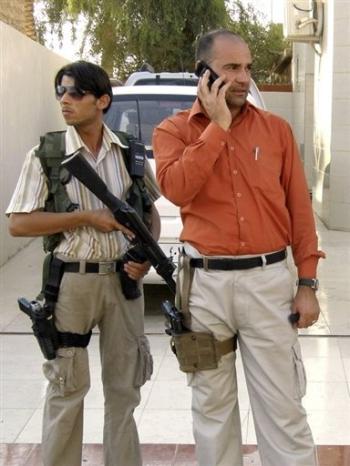
Wearing a saffron-coloured shirt, a 16-shot Beretta strapped to his hip and a shaved head, Abu Ahmed patrols Al-Qaim in a new Japanese all-terrain vehicle, surrounded by bodyguards toting assault rifles.

“The law here is the law of the tribes,” he said. “The rule of the tribes is stronger than that of Baghdad.”

Abu Ahmed belongs to the Bou Mahal, the most powerful clan in this isolated region of Iraq, some 400 kilometres (250 miles) northwest of the capital. Exclusively Sunni, the tribe controls the nearby porous frontier with Syria — a kingdom for those who smuggle cigarettes, fuel and weapons.

“We are ready to respect the law of Baghdad, but the government has to represent the people,” he said in a scarcely veiled criticism of the central power, dominated by Shiites.

This reticence to acknowledge the state as the legitimate centre of authority and power illustrates the fragility of a nation in which people prefer to put their trust in the hands of men like Abu Ahmed.

The 40-year-old is a hero to the 50,000 residents of Al-Qaim for having chased Al-Qaeda from the agricultural centre where houses line the green and blue waters of the Euphrates.

In the main street, with its fruit and vegetable stalls, its workshops and restaurants, men with pistols in their belts approach Abu Ahmed to kiss his cheek and right shoulder in a mark of respect.

It was not always this way.

He tells how one evening in May 2005 he decided that the disciples of Osama bin Laden went too far — they killed his cousin Jamaa Mahal.

“I started shooting in the air and throughout the town bursts of gunfire echoed across the sky. My family understood that the time had come. And we started the war against Al-Qaeda.”

It took three battles in the streets of Al-Qaim — in June, in July and then in November 2005 — to finish off the extremists who had come from Arab countries to fight the Americans.

Abu Ahmed, initially defeated by better equipped forces, had to flee to the desert region of Akashat, around 100 kilometres (60 miles) southwest of Al-Qaim. There he sought help from the US Marines.

“With their help we were able to liberate Al-Qaim,” he said, sitting in his house with its maroon tiled facade.

This alliance between a Sunni tribe and American troops was to be the first, and it give birth to a strategy of other US-paid Sunni fighters ready to mobilise against Al-Qaeda.

It resulted in the Sunni province of Al-Anbar being pacified in two years.

The US military, which since it led the Spring 2003 invasion of Iraq had sought to control the frontier with Syria, found in the men of Abu Ahmed an auxiliary force completely au fait with all the routes used by the smugglers.

And while Abu Ahmed has been able to receive the homage and rewards which are seen as his right as a warlord, he is very aware that the current calm is a fragile one.

“I’ve drawn up my will several times,” he said. “I expect to die.”

Notice that the Marines needed Abu Ahmed, and Ahmed needed the Marines. Without involvement with the population, resilience and persistence of the Marines in kinetic operations, and coupling with the leaders to ensure security, Anbar wouldn’t have been won. Ahmed was initially defeated, a similar story to the one delivered by Colonel Sean MacFarland concerning Ramadi.

Not coincidentally, this message is also the same one delivered by the people of Afghanistan. “We don’t want food, we don’t want schools, we want security!” said one woman council member.” The force projection necessary to bring security will be necessary in Afghanistan just as it was in Anbar. It’s a proven recipe, and there are no replacements or substitutes.


No comments yet.

RSS feed for comments on this post. TrackBack URL

Leave a comment

You must be logged in to post a comment.


You are currently reading "Abu Ahmed and the Fight for Anbar", entry #1223 on The Captain's Journal.

This article is filed under the category(s) The Anbar Narrative and was published August 3rd, 2008 by Herschel Smith.

If you're interested in what else the The Captain's Journal has to say, you might try thumbing through the archives and visiting the main index, or; perhaps you would like to learn more about TCJ.

26th MEU (10)
Abu Muqawama (12)
ACOG (1)
Afghan National Army (22)
Afghan National Police (9)
Afghanistan (463)
Afghanistan SOFA (3)
Agriculture in COIN (3)
Air Force (27)
Air Power (7)
al Qaeda (73)
America (1)
Animals in War (3)
Ansar al Sunna (15)
Anthropology (3)
Arlington Cemetery (2)
Army (25)
Australian Army (3)
Azerbaijan (2)
Backpacking (1)
Badr Organization (8)
Baitullah Mehsud (21)
Basra (17)
Battle of Bari Alai (1)
Battle of Wanat (10)
Battle Space Weight (2)
Blogroll (2)
Blogs (1)
Body Armor (14)
Books (1)
Britain (18)
British Army (29)
Caucasus (2)
CENTCOM (5)
Center For a New American Security (4)
Charity (3)
China (6)
Christmas (1)
CIA (6)
Civilian National Security Force (3)
Col. Gian Gentile (6)
Combat Outposts (3)
Combat Video (1)
Concerned Citizens (6)
Constabulary Actions (3)
COP Keating (4)
Corruption in COIN (1)
Council on Foreign Relations (1)
Counterinsurgency (164)
DADT (2)
Defense Contractors (1)
Department of Defense (92)
Distributed Operations (3)
Dogs (2)
EFV (1)
Egypt (1)
Expeditionary Warfare (4)
F-22 (2)
F-35 (1)
Fallujah (16)
Far East (3)
Fathers and Sons (1)
Favorite (1)
Fazlullah (3)
Featured (112)
Financing the Taliban (2)
Force Projection (27)
Force Protection (2)
Force Transformation (1)
general (14)
General McChrystal (22)
General McKiernan (5)
General Suleimani (3)
Georgia (16)
GITMO (2)
Google (1)
Gulbuddin Hekmatyar (1)
Haditha Roundup (10)
Haiti (1)
HAMAS (5)
Hate Mail (7)
Hekmatyar (1)
Heroism (2)
Hezbollah (6)
Homecoming (1)
Humor (6)
ICOS (1)
IEDs (4)
Immigration (17)
India (7)
Infantry (3)
Information Warfare (2)
Infrastructure (2)
Intelligence (15)
Intelligence Bulletin (6)
Iran (131)
Iraq (344)
Iraq SOFA (18)
Islamic Facism (24)
Islamists (14)
Israel (10)
Jaish al Mahdi (21)
Japan (1)
Jihadists (63)
John Nagl (4)
Joint Intelligence Centers (1)
Kabul (1)
Kajaki Dam (1)
Kamdesh (6)
Kandahar (4)
Karachi (7)
Kashmir (2)
Khyber (11)
Knife Blogging (1)
Korea (3)
Korengal Valley (1)
Kunar Province (6)
Language in COIN (3)
Language in Statecraft (1)
Language Interpreters (2)
Lawfare (6)
Leadership (3)
Lebanon (5)
Let Them Fight (2)
Lines of Effort (1)
Littoral Combat (7)
Logistics (34)
Lt. Col. Allen West (1)
Marine Corps (177)
Marines in Bakwa (1)
Marines in Helmand (48)
Marjah (4)
Media (10)
Memorial Day (2)
Micromanaging the Military (4)
Military Blogging (20)
Military Equipment (22)
Mosul (4)
Mountains (4)
MRAPs (1)
Mullah Baradar (1)
Mullah Fazlullah (1)
Mullah Omar (2)
Musa Qala (3)
Music (13)
NATO (14)
Navy (14)
Navy Corpsman (1)
NCOs (2)
NGOs (1)
Nicholas Schmidle (2)
Now Zad (18)
NSA James L. Jones (5)
Nuclear (29)
Nuristan (4)
Obama Administration (36)
Offshore Balancing (1)
Operation Alljah (7)
Operation Khanjar (14)
Ossetia (7)
Pakistan (140)
Palestine (3)
Patriotism (3)
Patrolling (1)
Personal (7)
Petraeus (6)
Philip Smucker (2)
Pictures (1)
Piracy (11)
Police in COIN (2)
Policy (6)
Politics (65)
Poppy (2)
Prisons in Counterinsurgency (1)
Qatar (1)
Quadrennial Defense Review (1)
Quds Force (12)
Quetta Shura (1)
RAND (2)
Recommended Reading (5)
Refueling Tanker (1)
Religion (36)
Religion and Insurgency (14)
Reuters (1)
Roads (4)
Rules of Engagement (49)
Rumsfeld (1)
Russia (21)
Sabbatical (1)
Saqlawiyah (1)
Satellite Patrols (2)
Saudi Arabia (2)
Scenes from Iraq (1)
Secretary Gates (6)
Shura Ittehad-ul-Mujahiden (1)
SIIC (2)
Small Wars (72)
Snipers (9)
Sniveling Lackeys (1)
Soft Power (4)
Somalia (7)
Sons of Afghanistan (1)
Sons of Iraq (2)
Special Forces (12)
Squad Rushes (1)
State Department (8)
Statistics (1)
Sunni Insurgency (10)
Syria (25)
Taliban (138)
Tarmiyah (1)
TBI (1)
Technology (16)
Tehrik-i-Taliban (74)
Terrain in Combat (1)
Terrorism (76)
Thanksgiving (2)
The Anbar Narrative (22)
The Art of War (5)
The Fallen (1)
The Long War (16)
The Surge (2)
The Wounded (10)
Thomas Barnett (1)
Transnational Insurgencies (5)
Tribes (4)
TSA Ineptitude (1)
U.S. Sovereignty (4)
UAVs (1)
UBL (1)
Ukraine (2)
Uncategorized (14)
Unrestricted Warfare (4)
USS Iwo Jima (2)
USS San Antonio (1)
Uzbekistan (1)
V-22 Osprey (4)
Veterans (2)
War & Warfare (199)
War & Warfare (37)
War Movies (1)
War Reporting (14)
Wardak Province (1)
Warriors (4)
Waziristan (1)
Weapons and Tactics (46)
West Point (1)
Winter Operations (1)
Women in Combat (8)
WTF? (1)
Yemen (1)


Prev | List | Random | Next · Join Powered by RingSurf!

Featured in Alltop

about · archives · contact · register

Copyright © 2006-2010 Captain's Journal. All rights reserved.