New York Court Holds Stun Gun Ban is Not Unconstitutional, in Contravention of Caetano

Herschel Smith · 30 Mar 2025 · 2 Comments

Dean Weingarten has a good find at Ammoland. Judge Eduardo Ramos, the U.S. District Judge for the Southern District of New York,  has issued an Opinion & Order that a ban on stun guns is constitutional. A New York State law prohibits the private possession of stun guns and tasers; a New York City law prohibits the possession and selling of stun guns. Judge Ramos has ruled these laws do not infringe on rights protected by the Second Amendment of the United States Constitution. Let's briefly…… [read more]

The Violence Belongs to Iraq Now

BY Herschel Smith
16 years, 11 months ago

There are seasons in any campaign, in any counterinsurgency effort.  The Army Chief of Staff may have claimed that U.S. forces could be in Iraq for ten more years, but they will mainly serve to ensure that Iraq is a protectorate of the U.S.  American troops will not be performing classical constabulary operations.

In a sign of the nature of the current phase of the campaign, the last Marine artillery is headed home.

CAMP AL TAQADDUM, Iraq – As the security situation in the Al Anbar province continues to improve, the final Marine Corps artillery unit to operate its cannons in Iraq, Battery G, 2nd Battalion, 10th Marines, Regimental Combat Team 6, is preparing to go home, signifying a significant change in the nature of the conflict in Anbar.

Three Marine artillerymen currently deployed with RCT-6 were present during the initial push into Iraq in 2003, and these same men returned with a new mission – to see the conclusion of artillery’s chronicle in Anbar province.

On Monday, May 25, a roadside bomb blast killed three people in demonstration of the fact that Iraq has failed at the present to adequately address the issue of the Sons of Iraq.

A roadside bomb killed three Americans traveling in Falluja on Monday, including a State Department official working at the United States Embassy in Baghdad, American officials said Tuesday.

The State Department official, Terrence Barnich, was deputy director of the Iraq Transition Assistance Office in Baghdad. A resident of Chicago, he was hired for the job in January 2007, according to State Department officials.

The attack also killed an American soldier and a civilian working for the Defense Department. Their names were being withheld pending notification of relatives. Two civilians working for the Defense Department were wounded, the officials said.

The attack took place within a few miles of the bridge where four American contractors were killed in March 2004, their bodies burned and mutilated, and dragged through the streets. The jarring images of that attack were a major factor in the American military’s decision to begin its first major offensive in Falluja, a center of the Sunni insurgency, months later.

The insurgency is fundamentally defeated, but not completely absent.  But the Status of Forces Agreement (SOFA) has ensured that the U.S. forces don’t have the freedom, latitude or authority that was once theirs.  Each security incident brings with it the threat that Iraq will demand that U.S. Soldiers be tried in Iraqi courts for crimes against Iraqi citizens.

U.S. Soldiers and Marines will soon be out of cities altogether under the SOFA.  There are troubling signs, including the fact that there appears to be a stark failure to honor agreements made to the Sons of Iraq.  In the South, the Basra police are simply dreadful.

In March 2008, about the same time the 793rd arrived in Baghdad, the Iraqi army swept through Basra and cleaned out the Shiite-backed militias who waged much of the violence in the area.

During the campaign, some Basra police either joined the militias or abandoned their posts, according to Marine 1st Lt. Mike Masters, the intelligence officer for an Iraqi army training unit inside Basra.

They are attempting to live down this reputation.  Nonetheless, violence against the Basra police is as prevalent as ever, and “earlier this month, the top police chief in Basra survived an assassination attempt outside his home. A police lieutenant colonel was not as lucky and died last weekend in an attack.”

But there are also encouraging signs.  The newly elected Speaker of Parliament is shaping that institution into one that might be able to hold the Maliki administration accountable for its ineptitude.  There will be both encouraging and discouraging reports coming from Iraq for a long time to come.  But given the basic framework for U.S. involvement and the phase of the campaign, the Iraqis have an opportunity at a functional society.  Any future violence is in their hands and on their collective conscience.  It belongs to them now.

Philip Smucker on the Shorthanded U.S. Strategy in Afghanistan

BY Herschel Smith
16 years, 11 months ago

The incomparable Philip Smucker has given us a very stark look at the latest counterinsurgency struggle at a far flung outpost in Afghanistan.

The Taliban took shelter in the U.S.-built school they blew up last year before they began the 400-foot climb, rockets in hand, to the American bastion on the hill.

Wrapped in space blankets – thin foil sheets familiar to campers – to avoid detection by the thermal imaging cameras in the U.S. outpost, they zigzagged up the escarpment. Troops at the base said insurgents had come right up on the helicopter landing zone, fired their rockets, then disappeared “like ninjas into the night.”

Fortress Margha, with its grenade launchers and mortars sticking out from behind sandbags and bulletproof windows on three watchtowers, is a safe redoubt for the American troops stationed there. Within its walls, soldiers play ice hockey and video games that imitate guerrilla warfare.

For the Afghans who live in a medieval world of mud homes with interlocking walls in the valley below, however, reality is a reign of terror.

Taliban fighters rule the day and the night in the Bermel district, using threats and atrocities to control the civilian population, Afghans in the valley told a visiting reporter in interviews over two weeks. Accompanied by Arab and Chechen advisers, they behead civilians or sever their hands to force their cooperation. One of the latest Taliban edicts is a ban on cutting trees, so that insurgents can hide and lay ambushes for foreign troops.

From a distance, the U.S. base in Margha, occupied by a platoon from the 3rd Battalion, 509th Infantry Regiment of the 4th Brigade of the 25th Infantry Division out of Fort Richardson, Alaska, is a monument to a risk-averse, shorthanded American strategy in Afghanistan …

The small U.S. base can be defended against as many as a thousand insurgents at once, confident American soldiers said. That sums up their dilemma, however: The fortress protects American troops, but it does little to help win a guerrilla war that’s now in its eighth year and about to enter another violent summer.

The faltering U.S. and NATO efforts in eastern Afghanistan have in effect surrendered the countryside – village after village – to insurgent bands, many of them criminal gangs but some of them with weaponry and the backing of al-Qaida.

The American troops descend from their bastion only on occasion, and there’s no one to protect Afghan civilians from Taliban fighters, who collect a “zakat,” or religious tax, from many residents in Bermel …

An older man, leaning against a mud wall, sighed … “People want protection, but they have none,” he said.

“The enemy attacks are sophisticated and well-coordinated,” he said. “They fight you longer and harder than the insurgents in Iraq. At the same time, when you pursue, they just disappear and blend back into the population.”

Jones said that in a half-dozen attacks on his “route clearance” convoy – manned mostly by National Guardsmen from Virginia and California – insurgents had destroyed several hundred thousand dollars’ worth of U.S. equipment. He added that his platoon hadn’t been able to confirm that it had killed a single Taliban fighter.

Read the entire article.  There are a number of nuggets of gold in this one.  First of all, it’s time that this unit get out of Fortress Margha and go on patrol.  It’s being done in the Korangal valley, and it can be done in Bermel.  Second, take note again at Philip’s salient observation: the campaign is “shorthanded.”  It has always been, and as long as there is reluctance in the Obama administration to send more than 68,000 troops, it will always be shorthanded.

It’s worse than whack-a-mole” counterinsurgency in Iraq.  We have ceded control of the rural terrain to the insurgents, and melting back into the population is why day and night time patrols must be conducted and the population engaged.

There are many more observations we may draw from this report, but take note of the recent Taliban tactic of using space blankets to avoid thermal imaging technology.  This is a learning and adaptive insurgency, and the employing of technology as a replacement for boots on the ground simply won’t do.

Language in Statecraft

BY Herschel Smith
16 years, 11 months ago

Companion Category: Language in Counterinsurgency

From USA Today concerning language and the State Department:

Complicating the Obama administration’s plan to ramp up civilian aid to Pakistan and Afghanistan, the State Department employs just 18 foreign service officers who can speak the language of the region where the Taliban insurgency rages, according to records and interviews.

Two of them work in Afghanistan, both in the capital, Kabul, according to the State Department’s Bureau of Human Resources. Five are in Peshawar, Pakistan.

“It’s a grim illustration of two problems,” said Ronald Neumann, a veteran diplomat who was U.S. ambassador to Afghanistan from 2005 to 2007. “First, there is no money, and second, there are no people.”

The Pashto language is the main tongue of the mountainous Pashtun region that straddles the border between Pakistan and Afghanistan, where the Taliban and al-Qaeda recruit and operate. Afghan President Hamid Karzai is among the estimated 35 million Pashtuns in both countries.

The State Department has long failed to meet its language needs. In 2006, the Government Accountability Office found that nearly 30% of State Department employees based overseas in “language-designated positions” could not speak and write the local language well enough to meet basic requirements.

The language deficit is one reason the United States has turned to contractors to deliver foreign aid, a practice that Secretary of State Hillary Rodham Clinton says she wants to curb. Clinton is asking for billions in the coming budget to hire 1,226 additional diplomats, but it will take time to train them.

After the 9/11 terrorist attacks, the U.S. military and the State Department boosted their training in Afghan languages, but the military commands vastly more resources. Seven years into the Afghanistan war, the Defense Department says it has trained 200 people in Pashto and 300 in Dari, the primary language of the non-Pashtun areas of Afghanistan.

The California-based Defense Language Institute has given 10,000 people some basic exposure to Pashto through mobile training units, spokesman Brian Lamar said. The Defense Department gave a half-million-dollar grant to Indiana University to train ROTC candidates in Pashto.

The State Department’s efforts have been more modest. In addition to the 18 foreign service officers who are proficient in Pashto, 82 speak Dari, State’s Bureau of Human Resources said in an e-mail. It said 20 Dari speakers are in Afghanistan.

Those figures will improve, said Ruth Whiteside, who directs State’s Foreign Service Institute, which is training 13 diplomats in Pashto and 37 in Dari. A larger 2010 budget will expand those numbers, she said.

Rather than reflexively blame the situation on the lack of money, let’s frame the problem somewhat differently.  The Department of Defense knew that the exposure to and need for knowledge in the indigenous languages would be significant in counterinsurgency, so directed the funds and energy towards that end.  The State Department is filled with “lifers,” many of them, who want to conduct international relations while sitting in Washington.

North Korea has not been prevented from achieving nuclear status by State Department labors, and neither has Iran been persuaded to relinquish its pursuit of its own nuclear weapon.  Syria was never forced to stop assisting the influx of foreign fighters into Iraq, and Hamas still controls Gaza.

There should be mandatory language training at least one day per week at State (whether by tape or trainer).  After all.  What else do they have to do?  Then after the languages are mastered, there ought to be mandatory field rotations for all State employees (that is, deployments).  After all, what else do they have to do?

Kill the Enemy

BY Herschel Smith
16 years, 11 months ago

Ralph Peters:

We made one great mistake regarding Guantanamo: No terrorist should have made it that far. All but a handful of those grotesquely romanticized prisoners should have been killed on the battlefield.

The few kept alive for their intelligence value should have been interrogated secretly, then executed.

Terrorists don’t have legal rights or human rights. By committing or abetting acts of terror against the innocent, they place themselves outside of humanity’s borders. They must be hunted as man-killing animals.

And, as a side benefit, dead terrorists don’t pose legal quandaries.

Captured terrorists, on the other hand, are always a liability. Last week, President Obama revealed his utter failure to comprehend these butchers when he characterized Guantanamo as a terrorist recruiting tool.

Gitmo wasn’t any such thing. Not the real Gitmo. The Guantanamo Obama believes in is a fiction of the global media. With rare, brief exceptions, Gitmo inmates have been treated far better than US citizens in our federal prisons.

But the reality of Gitmo was irrelevant — the left needed us to be evil, to “reveal” ourselves as the moral equivalent of the terrorists. So they made up their Gitmo myths.

Really, Ralph.  Can’t you just give me a little while to craft my own views without having you surreptitiously undercut me by publishing my prose first?  Honestly, I was very nearly about to craft such a commentary, but framed about prisons in counterinsurgency and criminal prosecutions of pirates.

Ralph launches his diatribe from the framework of Gitmo, and while I concur exactly with his views, I also advocate such an approach to reducing the number of prisons necessary in counterinsurgency operations.  Certainly, there are local “accidental guerrillas” (as they are called by Kilcullen) who we need to identify and attempt to sway, rehabilitate or otherwise turn to our advantage.

But as for the hard core, ideologically motivated fighters, rather than overcrowd the local prisons with bad actors who will only be released into the population to continue their activities, it is better that they be killed on the field of battle.  In many ways, their surrender is the worst of all options.  Their surrender means countless lawyer-hours, evidence-gathering, constabulary work, judicial work, prison construction, attempted rehabilitation, and ultimately release to conduct the same activities again.

The same goes for pirates, who even throughout history have been able to escape justice by claiming forced conscription.  Finally, we have better things to do with our money and lawyers’ time than to chase the legalities of piracy in order to stamp out the practice.  Better to kill the pirates on the high seas.  When it reaches the point that we are capturing the pirates rather than killing them, or sending SEALs to save hostages, it has gone too far.  The focus of the fight is misplaced.

Taliban Cleared in North West Frontier Province – Or Not

BY Herschel Smith
16 years, 11 months ago

There have been recent reports of fierce clashes between Pakistan Army and Taliban fighters There are even glowing reports that much of the North West Frontier Province has been cleared of Taliban.

Eighty percent areas of Bajaur, Lower Dir and Buner have been cleared of the Taliban and displaced population has started returning to their native areas, Benazir Income Support Programme Chairwoman Farzana Raja said on Wednesday. Those who were returning to their homes were being facilitated and the situation would improve in the days to come, Farzana told a private television channel. She said accommodating 2.5 million internally displaced persons (IDPs) was a difficult task but efforts were underway to provide all basic necessities to the IDPs living in the relief camps. Farzana said rehabilitation would be the next phase and the government would undertake it in a befittingly manner. She said international assistance had also started to pour in and hoped the matter would be dealt with effectively.

But is this report accurate?  Other sources say not.

Mehmood had to climb to a hilltop to get a signal for his cell phone. He sounded angry at both the Taliban and the army, but was especially critical of the security forces.
Thousands of people are still trapped here due to the fighting between the Taliban and the army.

They are in a state of virtual confinement due to the curfew.

The government spokesmen, sitting in Islamabad or Peshawar, are making false claims about the situation in Swat, saying they have taken control of the situation, or captured that place, or killed so many Taliban.

I swear upon God that it’s nothing like that.

Except for some parts of the GT (Grand Trunk) road, some mountain tops and the circuit house in Mingora, all of Swat is under the control of the Taliban.

If the government really has cleared and taken control of the region, it should bring in the media and let the whole world see it for themselves.

I keep moving around, and in several places I have seen army checkpoints with a Taliban checkpoint nearby.

However, neither side engages the other, and even helicopters and jets are not called in to attack the Taliban positions.

A few days ago I tried to speak to a masked Taliban militant in Pashto, and then in Urdu, and he could not understand me.

Then another militant told me that his comrade was an Arab and did not speak Pashto or Urdu.

I then asked him ‘how are you’ in Arabic, and they all laughed.

This raises doubts over the government’s claims that they have blocked all routes into the valley.

How could he get in, when all roads are blocked?

I also don’t understand who the operation is aimed against.

A majority of the people who have been killed here are civilians.

This is not an operation, it is a drama. Swat’s people cannot be made fools of.”

In order to understand this, we must remember that the Pakistan Army is not skilled in counterinsurgency strategy or tactics.  But as we discussed eight months ago, and as reported by Dexter Filkins, there is something deeper.

“Pakistan is dependent on the American money that these games with the Taliban generate,” the official told me. “The Pakistani economy would collapse without it. This is how the game works.”

As an example, he cited the Pakistan Army’s first invasion of the tribal areas — of South Waziristan in 2004. Called Operation Shakai, the offensive was ostensibly aimed at ridding the area of Taliban militants. From an American perspective, the operation was a total failure. The army invaded, fought and then made a deal with one of the militant commanders, Nek Mohammed. The agreement was capped by a dramatic meeting between Mohammed and Safdar Hussein, one of the most senior officers in the Pakistan Army.

“The corps commander was flown in on a helicopter,” the former official said. “They had this big ceremony, and they embraced. They called each other mujahids. ”

“Mujahid” is the Arabic word for “holy warrior.” The ceremony, in fact, was captured on videotape, and the tape has been widely distributed.

“The army agreed to compensate the locals for collateral damage,” the official said. “Where do you think that money went? It went to the Taliban. Who do you think paid the bill? The Americans. This is the way the game works. The Taliban is attacked, but it is never destroyed.

“It’s a game,” the official said, wrapping up our conversation. “The U.S. is being taken for a ride.”

Have the rules of the game changed enough for the Pakistan Army to clear the North West Frontier Province of Taliban for good, and stay and perform peace-keeping and stability operations?  Time will tell, but we’ve heard this song before.  If history is any indication, at some point the Pakistan Army will retreat and call it victory, while the Taliban who have slipped away into the hills return to enforce Sharia law and collect “taxes” to fund their military campaign.

Outsourcing Defense

BY Herschel Smith
16 years, 11 months ago

The Future Combat System Vehicle is soon to bite the dust.

The $87 billion Manned Ground Vehicle Program will probably be killed this week, Army Chief of Staff Gen. George Casey told the Senate Appropriations defense subcommittee Tuesday morning.

Army Secretary Pete Geren also clarified one point that is sure to raise the hackles of Sen. James Inhofe — the Non Line of Sight Cannon was killed as well. Inhofe had the NLOC made a separate program in large part to protect it from any cuts made to FCS. But Defense Secretary Robert Gates made the decision that killing MGV also meant killing the NLOS-C, Geren said today.

An Acquisition Decision Memorandum should be out this week, splitting the Manned ground Vehicle from the rest of the FCS program and killing MGV, Casey told the subcommittee.  He said they have already instructed Training and Doctrine Command to being drawing up new requirements.  A new program outline for a new ground vehicle should be ready “after Labor Day,” Casey said.  The military will consider foreign vehicles, though Casey seemed reluctant to commit to the idea of buying one should it look tempting. (While the Army has bought excellent equipment from overseas in the past, it has been badly burned before over buying from foreign suppliers — remember those black berets made in China…. ) The first vehicles should roll out of the plant within five to seven years.

Sec. Gates and his budget experts have made very clear they expect MRAP will be a major part of the new approach to FCS. Casey and Geren were very cautious in responding to reporters questions about this after the hearing.  “We are working to incorporate the MRAP” into whatever approach the Army comes up with, Geren said. And Casey said the Army is already putting networked MRAPs — with other FCS spinouts — into testing at Fort Bliss.

And is being replaced with something that the Pentagon believes to be more conducive to fighting insurgencies and other asymmetric conflicts.  Concerning the first article on the FCS Vehicle, commenter

As was the case with the Chinese made black berets…the emerging issue is our declining defense manufacturing capacity. At the outset of the current “over-seas contingent operation” (we used to call them wars) we did not even have the capability to manufacture enough 5.56 ball ammo! Most units crossed the l/d without the basic load!  This is not so much a ‘buy America” issue as one of being self sustaining.

Except that the problem actually runs deeper than that.  First as the commenter mentions, there is the need to be self sufficient.  The Captain’s Journal has mentioned the problems in the past with the loss of shipbuilding engineering experience, and it is no surprise that the USS San Antonio had so many problems straight out of port (see also here).

But remember that defense dollars also means development of both infrastructure and technology.  When money goes to contractors other than American, U.S. dollars are helping both to transfer U.S. technology overseas, and also to develop new technology in countries other than America.

Finally, it gets even worse when those assisted with U.S. defense dollars are criminals like Vladimir Putin, who now owns a signficant portion of EADS and who stands to profit from the Airbus refueling tanker if the contract is awarded to EADS.  This is the worst of all possible worlds.  In this case, the U.S. would lose the capability to manufacture this aircraft, technology would be transferred overseas, and communist criminals would become wealthy off of U.S. defense dollars.

But we just don’t want to learn our lessons.  Sarbanes-Oxley is bad law, contractors know how to game the system, and the low bid almost always means getting the worst equipment.

How did that Sunshine Diplomacy thing work out?

BY Herschel Smith
16 years, 11 months ago

Well, by now it’s old news that the first botched attempt at a North Korean nuclear weapon has retreated in our consciousness in the face of a new threat.  They have succeeded in developing a real weapon.  There has already been and will continue to be worldwide denunciations, but in the end, nothing will be done about it, at least, nothing that has any affect on the North Korean regime.

Now consider the Iranian regime and its recent claims in light of this example.

Iran’s President Mahmoud Ahmadinejad on Monday rejected a Western proposal for it to “freeze” its nuclear work in return for no new sanctions and ruled out any talks with major powers on the issue.

The comments by the conservative president, who is seeking a second term in a June 12 election, are likely to further disappoint the U.S. administration of President Barack Obama, which is seeking to engage Iran diplomatically.

The United States, Russia, China, France, Germany and Britain said in April they would invite Iran to a meeting to try and find a diplomatic solution to the nuclear row …

“Our talks (with major powers) will only be in the framework of cooperation for managing global issues and nothing else. We have clearly announced this,” Ahmadinejad said.

The nuclear issue is a finished issue for us,” he told a news conference.

One is tempted to ask South Korea how that sunshine diplomacy thing has worked out, but sniping and sarcasm aside, the example is valuable.  From the perspective of Benjamin Netanyahu, after having watched negotiations fail in bringing North Korea to its ideological knees for so long, and after having watch a botched attempt become the forerunner of a successful nuclear test, what option does Israel have except to prepare to defend itself with the governments of the world continuing to advocate the same approach that failed in the Far East?  Nothing will be done to turn Iran away from its pursuit of nuclear weapons, and so the clock is ticking for Israel.  We’ve heard this song before.

Memorial Day 2009: Remember the Families

BY Herschel Smith
16 years, 11 months ago

Our friend Mike at Cop the Truth is the most faithful follower of losses of airborne troopers of any person on the Internet.  The Captain’s Journal has tried to be the same for Marines.  Not openly, mind you, but silently and discretely.  Beginning in 2005 and going through the present, whenever a Marine was killed in the Anbar Province in Iraq (and now beginning in Afghanistan), I have tried to make it a point to read the account, his family’s reaction, and the official press release – and then pray for his family.

The years in Anbar were very hard, and with fully one quarter of the more than 4000 deaths coming from Marine fatalities in the Anbar Province alone (for losses of more than 1000 Marines due to combat action), the last several years have been hard.  The year 2006 and the followup year of 2007 (when my son was deployed) were especially dark.

One commendable thing about posting to blogs and opinion sites is that while I attempt to keep the writing tilted towards good analysis and commentary (even if containing advocacy), occasionally I give myself the freedom to engage in dissemination of deeply personal views.  And it’s okay to do that.

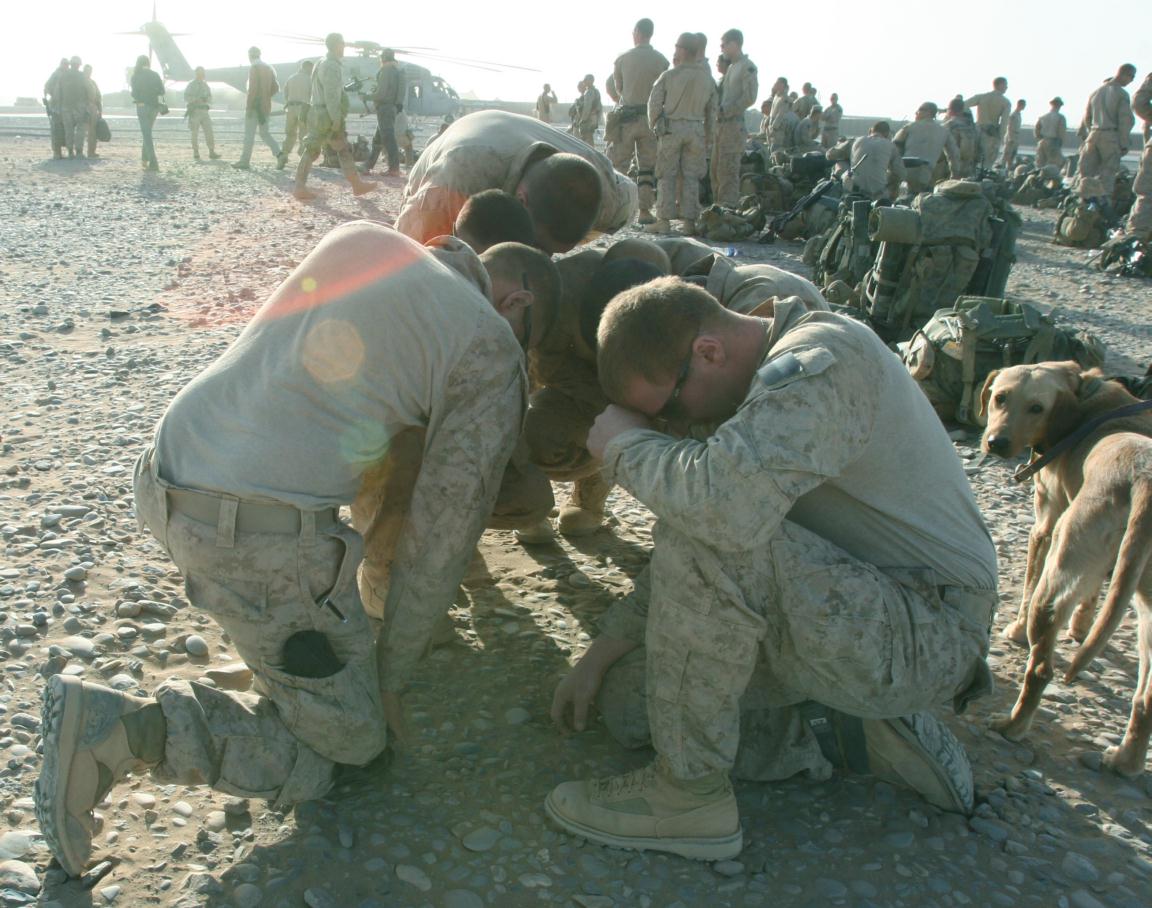
If you are one of those sad souls who believes that when a person dies his body cools to ambient temperature and then that’s the end, then I don’t have much for you.  You may take Memorial Day and ponder the sacrifice of those who died too young for this great nation of ours.  This all seems rather empty to me.  But if you are like me, a believer in orthodox Christianity, I encourage you to say a prayer of thanks to God for our Soldiers, Sailors, Airmen and Marines who keep us safe, past, present and future.  Another way of saying it is that while those warriors have bravely died on the field of battle, they aren’t now dead.

Those who have gone before us are in God’s hands.  While certainly unorthodox, I recommend that the focus of your prayers and giving this Memorial Day be the families of American warriors who have given their all, along with those warriors who have disabilities from their combat.  Pray that the Lord would assuage the pain of their losses, whether limbs lost, brain function lost, or sons or daughters lost on the field of battle.  I am not suggesting that you convert this Memorial Day into Veteran’s Day.  I am suggesting that you remember those who still suffer on behalf of our deceased warriors.  Our deceased warriors no longer suffer.

This Memorial Day, do more than ponder silently, which is therapeutic for no one except you.  Intercede on behalf of grieving families for God to bless them today and throughout the year.  Have a great Memorial Day 2009.

Army Delays in Body Armor Testing

BY Herschel Smith
16 years, 11 months ago

From Stars and Stripes:

The Army’s policy of testing body armor at its own laboratory instead of private facilities is causing delays in approval and is raising costs for manufacturers, The New York Times reported.

Army officials told the paper on Tuesday the decision to test armor at Aberdeen Proving Ground in Maryland was made as part of an effort to upgrade safety standards. However, they said they might still hand some of the work back to private labs if delays became common.

According to the Times, manufacturers said the cost of the tests has in some cases tripled, and results that might be returned within 24 hours from a private lab are taking as long as a week to be returned from the Army lab.

Asia Fernandez, who owns Armacel Armor in Camarillo, Calif., told the Times that the Army charged more than $50,000 to perform safety tests on a new product. Testing at a private lab, she said, would have cost less than $15,000.

“It’s a little rocky right now,” said David P. Reed, the president for North American operations at Ceradyne, the Army’s largest body-armor contractor. The Army lab, at the Aberdeen Proving Ground in Maryland, “is not really as responsive as we’d like to see,” he told the paper. Reed added that so far the delays have not hurt troops because the Army had been stockpiling armor.

However, congressional aides told the paper they were looking into the accusations to ensure that there are no delays in getting critical gear to servicemembers in the field.

It is, after all, the Army.  To expect that the Army would keep people in their employ who were technical experts in all areas of application is unreasonable.  Also, this report doesn’t say that the Army did not perform adequate testing.  But the efficiency with which it is done calls into question the propriety of having this function done in-house.  The Captain’s Journal has addressed this before.

Given the lack of confidence inspired by the federal government, independent consultative support is necessary to restore the public confidence in the system.  Support, that is, who doesn’t stand gain from whatever conclusions that are reached.  This is necessary for not only proof of principle for future body armor designs, but for currently deployed armor we well.

While not exactly addressing the same issue, we have recommended independent consultative support for body armor technology.  This wouldn’t preclude corporate-based testing by the manufacturer, but it would necessitate an independent assessment and some kind of oversight; not oversight that the Army could deliver alone, but as assisted by engineers and technical experts.

In further news, proposed legislation may force the issue.

Representative Niki Tsongas has introduced legislation that would require the Pentagon to develop lighter body armor for soldiers in an effort to reduce the thousands of orthopedic injuries reported each year as a result of lugging heavy gear.

The Lowell Democrat, a member of the Armed Services Committee, introduced the bill Tuesday and has enlisted the support of other key lawmakers, including Representative Neil Abercrombie, the Hawaii Democrat who chairs the panel’s Air and Land Forces Subcommittee, her office said today.

The legislation would set up a special task force to evaluate various personal protection technologies that could provide the same level of defense as current body armor, but with reduced weight, according to the bill.

Tsongas told the Globe that in the course of her investigation of the issue, including in committee hearings and discussions with an Army captain who serves on her staff, she found that the amount of gear that troops must carry is sometimes too much to bear.

“There is a tendency to take it off,” she said in a brief phone interview.

And many soldiers exhibit lasting health effects from wearing their personal gear for long periods of time.

In 2007, the Army reported 257,000 injuries attributed to the stress of bearing heavy loads during repeated deployments. The service’s vice chief of staff, Gen. Peter Chiarelli, estimates that such injuries are currently sidelining 20,000 soldiers.

“With the increased emphasis on Afghanistan in the coming years the load that soldiers must carry will no doubt become more of an issue,” said John Noble, a spokesman for the two-term congresswoman.

Tsongas’ bill would also establish a separate program in each branch of the military dedicated to the research and procurement of body armor. Such efforts are now included in multi-billion dollar research accounts that cover all types of military equipment.

By establishing a stand-alone funding stream Tsongas believes Congress will be able to monitor how much money is being spent on body armor and better identify shortcomings.

“This is so we know exactly what is there and that it is being spent appropriately,” she said.

This also follows closely with our previous recommendations to lighten the load that Soldiers and Marines carry.  Our first target has been the weight of the SAPI plates (Side Arms Protective Inserts), the heavy ceramic plates help by the carrier in the front, back and sides.  The soft ballistic panels carried throughout the carrier is not a significant actor in the overall system weight.

The Army also happens to be testing lighter armor at the present.

FORT BELVOIR, Va. — The Army will test lighter body armor next week with plans to field up to 100,000 sets beginning in August, said Lt. Col. Robert W. Myles Jr. of Program Executive Office Soldier.

The tests will take place May 11-22 in Yuma, Ariz., and will involve 10 Soldiers from the 173rd Airborne Brigade Combat Team and 25 Soldiers with the 82nd Airborne Division, Myles said Wednesday.

Soldiers can carry a load of about 100 pounds of gear, body armor and ammunition. The Improved Outer Tactical Vests that Soldiers currently wear weighs about 31 pounds with all four ballistic plates, Myles said.

The Army will evaluate four new types of body armor, each weighing about 24 pounds, as well as body armor already worn by Soldiers, Marines and Special Operations Forces, he said.

The body armor will be evaluated based on ballistic tests, form, wear and comfort, and cost, Myles said.

As a stop-gap measure, the Army will soon issue a battalion of Soldiers with the 4th Infantry Division the lightweight body armor that Special Operations Forces wear, he said.

“We want to lighten the load as quick as possible; that’s our No. 1 goal,” Myles said.

In January, Gen. Peter Chiarelli, Army vice chief of staff, told reporters that an increasing number of Soldiers were becoming nondeployable in part due to musculoskeletal injuries from the heavy loads they carry.

“You can’t hump a rucksack at 8,000-11,000 feet for 15 months, even at a young age, and not have that have an impact on your body,” Chiarelli said during a roundtable with reporters.

Exactly right.  And lighter armor should have been issued much earlier, including the same type worn by SOF if that is lighter than the IBA and MTV (the IBA with panels and SAPIs is about 31 pounds, the MTV with panels and SAPIs is about 32 pounds with groin and neck protectors).

The article doesn’t make clear what the weight modifications involve, and the recommendations we have made include the same level of ballistic protection with less weight.  It’s all a matter of funding and research.  The health and maneuverability of our warriors is of paramount importance to any campaign, even more so than non-infantry related gear and equipment.  The functionality of infantry gear and equipment may redound not only to the success of the campaign and deployability of the troops, but to their very lives.  This makes it worth the investment, whatever that cost is.

Prior:

More on Battle Space Weight

University of Virginia Student Designs New Body Armor

DoD Testing Requirements for Body Armor and Army Recall

Changes in Body Armor for Marines

Body Armor Wars in the Marine Corps

Body Armor Goes Political

Body Armor Wars: The Way Forward

Strategic Desisions Concerning Marines and Expeditionary Warfare

BY Herschel Smith
16 years, 11 months ago

From Government Executive:

The Marine Corps is pursuing a number of initiatives to give its units more fire support and more mobility to meet operational demands, with one near-term project being a less-sophisticated version of the Air Force’s powerful AC-130 gunship, Gen. James Conway said on Friday.

The Marine Corps commandant said the service is working on a longer-term proposal to use the Navy’s Littoral Combat Ships to provide high-volume fire support for Marine forces ashore. In addition, Marines are looking to modify their Mine-Resistant, Ambush-Protected vehicles to enable them to operate in Afghanistan’s rugged terrain, Conway told a Center for Strategic and International Studies forum.

Conway said the Marines “have lusted for years” over the AC-130’s capability but could not afford the sophisticated Air Force gunships. Instead, they are taking advantage of their KC-130J transport-tankers in a program called “Harvest Hawk,” he said. It consists of a “roll-on, roll-off package” that can be installed in hours and gives the KC-130s the ability to fire a 30mm rapid-fire gun and Hellfire missiles in support of ground forces, Conway said. “I think you’re going to see one in [Afghanistan] before the end of the calendar year.”

A Marine spokesman said later that “this is not intended to be a gunship” but a response to an urgent need of Marines in Afghanistan who want persistent intelligence, surveillance and reconnaissance capabilities. “The ISR is the priority, but we also want the capability to use some weapons against targets we can see,” the spokesman said.

The commandant said he has an agreement with Adm. Gary Roughead, the chief of naval operations, to examine use of a “box of rockets” that could be installed on an LCS to provide fire support for Marines ashore. It could replace the capabilities the Marines expected from the Advanced Gun System developed for the DDG-1000 destroyer, whose production is being stopped at three ships.

LCS is designed to accept a variety of “mission packages,” which include weapons, sensors, controls and operators that enable a ship to perform a variety of combat assignments. A Marine fire-support package was not one of the three original missions developed for LCS but has been discussed recently.

One proposal has been to use the non-line-of-sight launch system being developed as part of the Army’s Future Combat Systems. But that system does not have the range the Marines would need, Conway said. Systems that would have the range could not provide the volume of fire needed, he added. He did not provide any indication of when a satisfactory system could be available.

Commentary & Analysis

The Commandant has been in a fight with the Navy for a while now over the issue of its refusal to go closer to shore than 25 miles – the horizon – and thus his call for support of the Expeditionary Fighting Vehicle.  In order to do forcible entry, Marines need to project firepower on shore, and this vehicle must be able to function on both the land and sea.

But The Captain’s Journal has opposed the EFV for reasons going beyond its design and maintenance problems and cost overruns.  Basically, this vehicle will never be used as a staple of land operations.  Its primary use will be from sea to shore and then slightly beyond.

The Littoral Combat Ship is anything but a combat ship.  It has a small crew and essentially no forward force projection capability.  It is a horrible platform for support of the Marines or a Marine Expeditionary Unit, and backfitting it with a “box of rockets” will likely prove to be problematic and not what the Marines were after.

Let’s assume that as a policy position we need forcible entry from the sea.  Delivery of Marines without heavy firepower is probably not a good idea, and we have recommended a delay in the retirement of the CH-46 (from which Marines can fastrope) and investment in a new generation of Marine attack helicopters.  The Navy must be pressed to be more involved in the delivery of heavy equipment (such as MRAPs, tanks, armored personnel carriers, etc.) after the Marines have accomplished forcible entry and if the strategy involves a protracted engagement.

We have also recommended a new generation of Marine vehicles similar to the Army Stryker.  Heavy investment in a generation of vehicles, fighting or otherwise, that has as its sole use operation in littoral waters is probably not a wise investment of limited resources.  No one intends for protracted land use of the EFV, and that itself is a telling observation.  It is basically a useless platform without the necessity for forcible entry or the threat of it.

As for the air transport turned gunship, the Marine spokesman’s words are confusing and probably unnecessary.  A gunship is exactly what is desired and needed.  This kind of adaptive innovation is to be commended, and the Marines in Afghanistan will benefit from this improvisation.

Concluding, TCJ doubts that the LCS can successfully deliver high volume fire in support of Marines on shore, doubts the necessity for a fighting vehicle that has as its sole use operation in littoral waters, and has recommended other means of forward force projection (such as use of the F-35 off the deck of the Amphibious Assault Docks, additional Navy involvement to land heavier vehicles, and a new generation of Marine attack helicopters).  All of the above would seem to be a better use of limited monies that either the EFV or the modified LCS.

As for the necessity for forcible entry from the sea, it was Colin Powell who observed that:

Lying offshore, ready to act, the presence of ships and Marines sometimes means much more than just having air power or ship’s fire, when it comes to deterring a crisis. And the ships and Marines may not have to do anything but lie offshore. It is hard to lie offshore with a C-141 or C-130 full of airborne troops.

Nice words, but a very expensive way to level threats at other nations.  A Battalion of Marine infantry sitting on board an Amphibious Assault Dock for seven to nine months doing nothing is an awful waste of resources (and also a sitting duck for land-based surface to surface missiles).  The expeditionary concept should be applied sparingly and with frugality.  The capabilities of the Marines are needed across the globe in real time active and ongoing operations, not “could be,” “would be,” “maybe” and “we want it not to be” operations.

Prior:

Arguments Over the EFV and V-22

Navy and Marines to Part Ways Over Expeditionary Strike Groups?

Kill the Expeditionary Fighting Vehicle


26th MEU (10)
Abu Muqawama (12)
ACOG (2)
ACOGs (1)
Afghan National Army (36)
Afghan National Police (17)
Afghanistan (704)
Afghanistan SOFA (4)
Agriculture in COIN (3)
AGW (1)
Air Force (42)
Air Power (10)
al Qaeda (83)
Ali al-Sistani (1)
America (23)
Ammunition (305)
Animals (327)
Ansar al Sunna (15)
Anthropology (3)
Antonin Scalia (1)
AR-15s (394)
Arghandab River Valley (1)
Arlington Cemetery (2)
Army (91)
Assassinations (2)
Assault Weapon Ban (29)
Australian Army (7)
Azerbaijan (4)
Backpacking (4)
Badr Organization (8)
Baitullah Mehsud (21)
Basra (17)
BATFE (247)
Battle of Bari Alai (2)
Battle of Wanat (18)
Battle Space Weight (3)
Bin Laden (7)
Blogroll (3)
Blogs (24)
Body Armor (23)
Books (3)
Border War (18)
Brady Campaign (1)
Britain (39)
British Army (36)
Camping (5)
Canada (20)
Castle Doctrine (1)
Caucasus (6)
CENTCOM (7)
Center For a New American Security (8)
Charity (3)
China (19)
Christmas (18)
CIA (30)
Civilian National Security Force (3)
Col. Gian Gentile (9)
Combat Outposts (3)
Combat Video (2)
Concerned Citizens (6)
Constabulary Actions (3)
Coolness Factor (3)
COP Keating (4)
Corruption in COIN (4)
Council on Foreign Relations (1)
Counterinsurgency (218)
DADT (2)
David Rohde (1)
Defense Contractors (2)
Department of Defense (220)
Department of Homeland Security (26)
Disaster Preparedness (5)
Distributed Operations (5)
Dogs (15)
Donald Trump (27)
Drone Campaign (4)
EFV (3)
Egypt (12)
El Salvador (1)
Embassy Security (1)
Enemy Spotters (1)
Expeditionary Warfare (18)
F-22 (2)
F-35 (1)
Fallujah (17)
Far East (3)
Fathers and Sons (2)
Favorite (1)
Fazlullah (3)
FBI (39)
Featured (192)
Federal Firearms Laws (18)
Financing the Taliban (2)
Firearms (1,873)
Football (1)
Force Projection (35)
Force Protection (4)
Force Transformation (1)
Foreign Policy (27)
Fukushima Reactor Accident (6)
Ganjgal (1)
Garmsir (1)
general (15)
General Amos (1)
General James Mattis (1)
General McChrystal (44)
General McKiernan (6)
General Rodriguez (3)
General Suleimani (9)
Georgia (19)
GITMO (2)
Google (1)
Gulbuddin Hekmatyar (1)
Gun Control (1,722)
Guns (2,412)
Guns In National Parks (3)
Haditha Roundup (10)
Haiti (2)
HAMAS (7)
Haqqani Network (9)
Hate Mail (8)
Hekmatyar (1)
Heroism (5)
Hezbollah (12)
High Capacity Magazines (16)
High Value Targets (9)
Homecoming (1)
Homeland Security (3)
Horses (2)
Humor (72)
Hunting (62)
ICOS (1)
IEDs (7)
Immigration (123)
India (10)
Infantry (4)
Information Warfare (4)
Infrastructure (4)
Intelligence (23)
Intelligence Bulletin (6)
Iran (171)
Iraq (379)
Iraq SOFA (23)
Islamic Facism (64)
Islamists (98)
Israel (19)
Jaish al Mahdi (21)
Jalalabad (1)
Japan (3)
Jihadists (82)
John Nagl (5)
Joint Intelligence Centers (1)
JRTN (1)
Kabul (1)
Kajaki Dam (1)
Kamdesh (9)
Kandahar (12)
Karachi (7)
Kashmir (2)
Khost Province (1)
Khyber (11)
Knife Blogging (7)
Korea (4)
Korengal Valley (3)
Kunar Province (20)
Kurdistan (3)
Language in COIN (5)
Language in Statecraft (1)
Language Interpreters (2)
Lashkar-e-Taiba (2)
Law Enforcement (6)
Lawfare (14)
Leadership (6)
Lebanon (6)
Leon Panetta (2)
Let Them Fight (2)
Libya (14)
Lines of Effort (3)
Littoral Combat (8)
Logistics (50)
Long Guns (1)
Lt. Col. Allen West (2)
Marine Corps (281)
Marines in Bakwa (1)
Marines in Helmand (67)
Marjah (4)
MEDEVAC (2)
Media (68)
Medical (146)
Memorial Day (6)
Mexican Cartels (47)
Mexico (71)
Michael Yon (6)
Micromanaging the Military (7)
Middle East (1)
Military Blogging (26)
Military Contractors (5)
Military Equipment (25)
Militia (9)
Mitt Romney (3)
Monetary Policy (1)
Moqtada al Sadr (2)
Mosul (4)
Mountains (25)
MRAPs (1)
Mullah Baradar (1)
Mullah Fazlullah (1)
Mullah Omar (3)
Musa Qala (4)
Music (25)
Muslim Brotherhood (6)
Nation Building (2)
National Internet IDs (1)
National Rifle Association (97)
NATO (15)
Navy (31)
Navy Corpsman (1)
NCOs (3)
News (1)
NGOs (3)
Nicholas Schmidle (2)
Now Zad (19)
NSA (3)
NSA James L. Jones (6)
Nuclear (63)
Nuristan (8)
Obama Administration (222)
Offshore Balancing (1)
Operation Alljah (7)
Operation Khanjar (14)
Ossetia (7)
Pakistan (165)
Paktya Province (1)
Palestine (5)
Patriotism (7)
Patrolling (1)
Pech River Valley (11)
Personal (77)
Petraeus (14)
Pictures (1)
Piracy (13)
Pistol (4)
Pizzagate (21)
Police (672)
Police in COIN (3)
Policy (15)
Politics (999)
Poppy (2)
PPEs (1)
Prisons in Counterinsurgency (12)
Project Gunrunner (20)
PRTs (1)
Qatar (1)
Quadrennial Defense Review (2)
Quds Force (13)
Quetta Shura (1)
RAND (3)
Recommended Reading (14)
Refueling Tanker (1)
Religion (501)
Religion and Insurgency (19)
Reuters (1)
Rick Perry (4)
Rifles (1)
Roads (4)
Rolling Stone (1)
Ron Paul (1)
ROTC (1)
Rules of Engagement (76)
Rumsfeld (1)
Russia (37)
Sabbatical (1)
Sangin (1)
Saqlawiyah (1)
Satellite Patrols (2)
Saudi Arabia (4)
Scenes from Iraq (1)
Second Amendment (713)
Second Amendment Quick Hits (2)
Secretary Gates (9)
Sharia Law (3)
Shura Ittehad-ul-Mujahiden (1)
SIIC (2)
Sirajuddin Haqqani (1)
Small Wars (72)
Snipers (9)
Sniveling Lackeys (2)
Soft Power (4)
Somalia (8)
Sons of Afghanistan (1)
Sons of Iraq (2)
Special Forces (28)
Squad Rushes (1)
State Department (23)
Statistics (1)
Sunni Insurgency (10)
Support to Infantry Ratio (1)
Supreme Court (81)
Survival (216)
SWAT Raids (58)
Syria (38)
Tactical Drills (38)
Tactical Gear (17)
Taliban (168)
Taliban Massing of Forces (4)
Tarmiyah (1)
TBI (1)
Technology (21)
Tehrik-i-Taliban (78)
Terrain in Combat (1)
Terrorism (96)
Thanksgiving (13)
The Anbar Narrative (23)
The Art of War (5)
The Fallen (1)
The Long War (20)
The Surge (3)
The Wounded (13)
Thomas Barnett (1)
Transnational Insurgencies (5)
Tribes (5)
TSA (25)
TSA Ineptitude (14)
TTPs (4)
U.S. Border Patrol (8)
U.S. Border Security (22)
U.S. Sovereignty (29)
UAVs (2)
UBL (4)
Ukraine (10)
Uncategorized (105)
Universal Background Check (3)
Unrestricted Warfare (4)
USS Iwo Jima (2)
USS San Antonio (1)
Uzbekistan (1)
V-22 Osprey (4)
Veterans (3)
Vietnam (1)
War & Warfare (435)
War & Warfare (41)
War Movies (4)
War Reporting (21)
Wardak Province (1)
Warriors (6)
Waziristan (1)
Weapons and Tactics (80)
West Point (1)
Winter Operations (1)
Women in Combat (21)
WTF? (1)
Yemen (1)

April 2026
March 2026
February 2026
January 2026
December 2025
November 2025
October 2025
September 2025
August 2025
July 2025
June 2025
May 2025
April 2025
March 2025
February 2025
January 2025
December 2024
November 2024
October 2024
September 2024
August 2024
July 2024
June 2024
May 2024
April 2024
March 2024
February 2024
January 2024
December 2023
November 2023
October 2023
September 2023
August 2023
July 2023
June 2023
May 2023
April 2023
March 2023
February 2023
January 2023
December 2022
November 2022
October 2022
September 2022
August 2022
July 2022
June 2022
May 2022
April 2022
March 2022
February 2022
January 2022
December 2021
November 2021
October 2021
September 2021
August 2021
July 2021
June 2021
May 2021
April 2021
March 2021
February 2021
January 2021
December 2020
November 2020
October 2020
September 2020
August 2020
July 2020
June 2020
May 2020
April 2020
March 2020
February 2020
January 2020
December 2019
November 2019
October 2019
September 2019
August 2019
July 2019
June 2019
May 2019
April 2019
March 2019
February 2019
January 2019
December 2018
November 2018
October 2018
September 2018
August 2018
July 2018
June 2018
May 2018
April 2018
March 2018
February 2018
January 2018
December 2017
November 2017
October 2017
September 2017
August 2017
July 2017
June 2017
May 2017
April 2017
March 2017
February 2017
January 2017
December 2016
November 2016
October 2016
September 2016
August 2016
July 2016
June 2016
May 2016
April 2016
March 2016
February 2016
January 2016
December 2015
November 2015
October 2015
September 2015
August 2015
July 2015
June 2015
May 2015
April 2015
March 2015
February 2015
January 2015
December 2014
November 2014
October 2014
September 2014
August 2014
July 2014
June 2014
May 2014
April 2014
March 2014
February 2014
January 2014
December 2013
November 2013
October 2013
September 2013
August 2013
July 2013
June 2013
May 2013
April 2013
March 2013
February 2013
January 2013
December 2012
November 2012
October 2012
September 2012
August 2012
July 2012
June 2012
May 2012
April 2012
March 2012
February 2012
January 2012
December 2011
November 2011
October 2011
September 2011
August 2011
July 2011
June 2011
May 2011
April 2011
March 2011
February 2011
January 2011
December 2010
November 2010
October 2010
September 2010
August 2010
July 2010
June 2010
May 2010
April 2010
March 2010
February 2010
January 2010
December 2009
November 2009
October 2009
September 2009
August 2009
July 2009
June 2009
May 2009
April 2009
March 2009
February 2009
January 2009
December 2008
November 2008
October 2008
September 2008
August 2008
July 2008
June 2008
May 2008
April 2008
March 2008
February 2008
January 2008
December 2007
November 2007
October 2007
September 2007
August 2007
July 2007
June 2007
May 2007
April 2007
March 2007
February 2007
January 2007
December 2006
November 2006
October 2006
September 2006
August 2006
July 2006
June 2006
May 2006

about · archives · contact · register

Copyright © 2006-2026 Captain's Journal. All rights reserved.