
Arguments Over the EFV and V-22
BY Herschel Smith 17 years, 4 months ago
In Gates Reshapes DoD Budget Plans we observed that the Expeditionary Fighting Vehicle (EFV) had gotten off unscathed. It’s budget dollars remained intact, or so it seemed. It’s a little more murky now with Marine Corps Commandant Conway publicly arguing for the EFV.
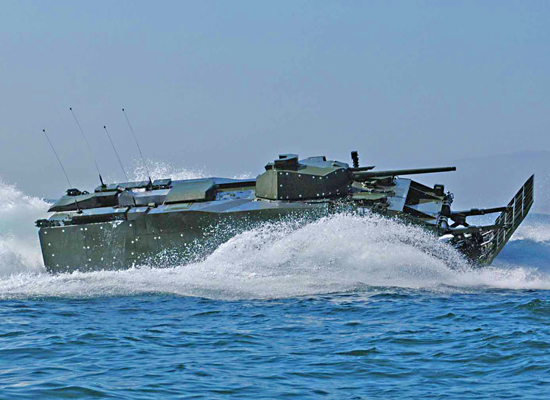
U.S. Marines must be able to storm enemy shores in amphibious vehicles such as those being built by General Dynamics Corp, the top Marine said, defending a $13.2 billion program called into question by Defense Secretary Robert Gates.
General Dynamics’ Expeditionary Fighting Vehicle, or EFV, “is inextricably linked to that capability and an absolutely critical requirement for us,” General James Conway, the Marine Corps commandant, told reporters at a Pentagon briefing on Wednesday.
“And, by the way, China has already fielded a similar vehicle and is building more,” he said.
As conceived by the Marine Corps, the EFV is to be able to transport up to 18 combat-ready Marines at high speeds on both land and sea. It would have advanced communications capabilities, provide increased armored protection against rocket-propelled grenades and improvised explosive devices, and deliver lethal firepower up to 2,000 meters (2,200 yards).
Part of the argument is based on the intent of the Navy and its reluctance to engage and support near the coastline.
Conway said he believes strongly the military needs the forcible entry capability provided by the EFV, particularly as the Navy plans to operate at least 25 miles from the shoreline.
“That’s a 25-mile bridge that has to be managed somehow and you’re not going to do it with our current set of vehicles,” the four-star general said. “We think the best way to do that is with a vehicle that can do it in a couple of hours, not in a day. And that’s what it would virtually take with our existing fleet” of amphibious assault vehicles.
But Secretary Gates apparently is still considering what to do with the program.
Defense Secretary Robert Gates, who has announced major changes to many of the military’s largest development and procurement projects, has put off making a decision on the EFV, a program with a troubled history, until the completion of the Quadrennial Defense Review next year. Costs on the General Dynamics program have soared 43 percent to an estimated $13 billion while the Marine Corps has been trying over the last two years to correct reliability problems.
“We have to take a hard look at where it would be necessary or sensible to launch another major amphibious action again,” Gates said during an April 17 visit to the Naval War College in Newport, R.I. “In the 21st century, how much amphibious capability do we need?” But Conway said he believes the EFV is essential not just for a major amphibious assault, which the Marine Corps has not done since 1950, but also for humanitarian assistance and evacuation operations. “It really runs the whole gamut from peacetime sort of engagement all the way up to forcible entry,” he said. “And we think that that’s what the nation really needs.”
We also get some news on the V-22 Osprey.
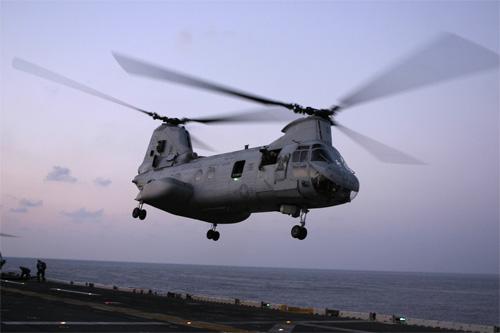
Conway said he expects the Marine Corps to deploy a squadron of MV-22 Osprey helicopters to Afghanistan before the end of the year. The next deployment for the Osprey, which was first used operationally in Iraq in 2007, will be aboard a ship to test the aircraft’s “seaworthiness,” Conway said.
But then a squadron will head to Afghanistan. “We have had issues with our current medium-lift capability” in Afghanistan, Conway said. “The old CH-46 has run up against age and altitude and environment and is not doing the job that we need for our medium lift squadrons to do.”
The CH-46 will be in service for a long time to come, and is currently the only platform from which Marines can fastrope. As Colonel Desens put it, “I think the last 46 pilot may have been born, but not yet commissioned.” On the whole the Osprey has performed well in Iraq, but it will be the true test of its worthiness to test it both at sea in a maritime environment and in the high plains, deserts and mountains of Afghanistan.
Analysis & Commentary
Humanitarian assistance is an absolutely horrible misuse of U.S. Marines. It’s like driving a corvette on a speedway to deliver pizza. The Marine expeditionary concept is a good one, with all needed billets and specializations embedded with and assigned to the force. The expeditionary, quick strike, rapid deployment concept is a good use of the Corps, as long as this use doesn’t detract from the essential deployments in support of the long war, and in the current case, Operation Enduring Freedom.
We have been moderately to strongly supportive of the Osprey V-22 program, but dismissing the helicopter fleet too soon is a monumental error. In fact, the question necessarily arises “do we need two means of forcible entry – air and sea?” If we continue support of the V-22 program as well as maintain the existing fleet of helicopters, along with commissioning a new fleet soon, is this a better expenditure of money than the EFV would be? Note that we aren’t questioning the expeditionary concept or the need for forcible entry. The question is by what means.
Finally, the Navy must be pressed to strategically engage in 21st century warfare. The horizon – 25 miles – is a pointless distance given the increasingly available missile technology. The Navy must find a way to counter this threat and shoulder some of the burden.
In summary, we recommend continued viability of the Amphibious Assault Docks, maintaining the existing helicopter fleet, commissioning a new helicopter fleet, continuation of testing of the Osprey V-22, and high intensity warfare and quick strike use of the Corps (as opposed to humanitarian assistance). We remain skeptical of the EFV.






On May 1, 2009 at 10:20 pm, Warbucks said:
There is also the Micky-Finn warfare. Rather than take the beach head, you send in unmanned drones that disburse immobilizing penetrators by the 100’s of thousands or millions. See concept:
http://peaceandconflictresolution.googlepages.com/micky-finns
10% find targets, but that’s good enough.