
DoD Testing Requirements for Body Armor and Army Recall
BY Herschel Smith 17 years, 7 months ago
On January 29 we learned that the Army was issuing a recall of more than 16,000 sets of ESAPI (or enhanced side arms protective inserts) that had been issued to its soldiers. By way of description, the SAPIs are ceramic plates that are designed for stopping 7.62 mm rounds, while the soft panel armor (with more coverage, but less weight) is designed for protection against 9 mm rounds and shrapnel. The plates and soft panels are fundamentally the same for both Army and Marine body armor, but the carrier vests are slightly different.
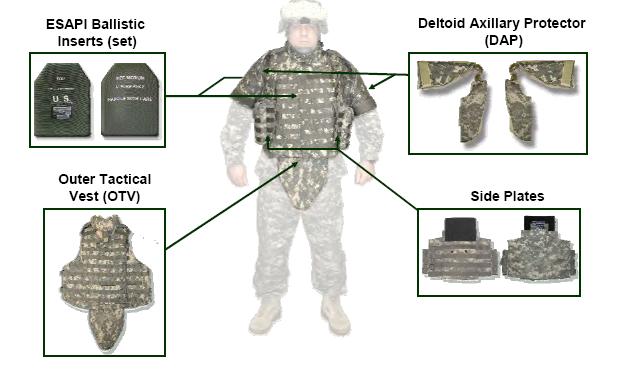
The Department of Defense Inspector General’s Office released the report over which so much speculation occurred. Report No. D-2009-047, DoD Testing Requirements for Body Armor, was written at the behest of certain members of Congress. The report is the third in a series of reports on DoD body armor and armored vehicles issued in response to requests from Representative Louise M. Slaughter, 28th District, New York, and Senator James H. Webb, Virginia. Since the Inspector General’s investigation was prompted by speculation of problems and since the SAPI plates of such importance to the success of the overall system, we analyzed the findings of the report with eager anticipation. This anticipation was heightened by the introductory paragraphs of the report. They found that:
… testing facility officials did not consistently follow the test plan or COPD requirements for the fair shot determination, measurement of BFD, or plate size, and that the PEO Soldier scoring official could not provide adequate documentation that explained why certain plates were selected for scoring and others were disregarded during the scoring process.
We were also concerned that the contracting officer technical representative (COTR) made an unauthorized change to Contract 0040 by instructing the testing facility officials to deviate from the COPD and use an offset correction technique (a mathematical formula used to adjust the BFD). The PEO Soldier COTR communicated this change by e-mail to the testing facility without approval from the contracting officer.
COPD is “Contract Purchase Description,” PEO is “Program Executive Officer,” and BFD means “Back Face Deformation.” This last concept becomes important in the overall picture. Turning to the specifics of the report, several key findings are outlined below for the purpose of providing examples of the investigation.
The inconsistencies that we identified concerned the treatment of over velocity shots. During first article testing conducted on February 20 and November 7, 2007, shots on six of the plates were over the required velocity. Because none of the shots resulted in a complete penetration, the shots should have been considered fair, and the test should have proceeded, according to the COPD. During the November 7, 2007, test, the testing facility official complied with the COPD and correctly proceeded with testing. However, even though the scenario was exactly the same for the February 20, 2007, test, the testing facility official conducted retests on additional plates. The testing facility official documented all of the shots, including the retests, and provided the test results to PEO Soldier for scoring. When scoring the test results for the February 20, 2007, first article test (design M3D2S2), the PEO Soldier scoring official chose to use the test results for the retested plates when he computed the test score. Use of the retested plates resulted in a score of 5.5 points, and the contractor passed the first article test. Had the scoring official followed the fair shot acceptance criteria as stated in the COPD and used the initial plates that withstood the over velocity shot, the contractor would have accumulated an additional 1.5 points (complete penetration on the second shot) and would have failed the first article test with 7 points.
Translation: When an over-velocity shot is taken on a plate, the testing may proceed if the plate is not penetrated under the assumption that a lower velocity shot would not have penetrated either. This is a reasonable assumption. However, if the plate is penetrated by the second shot it fails the testing, even if weakened by the initial shot. The PEO made the decision to exclude the plates that had sustained over-velocity shots on the initial testing and to perform retests, but not consistently (as later records show). A second example of the Inspector General’s findings pertains to measurements of BFD (back face deformation).
PEO Soldier instructed the testing facility to deviate from the COPD and use an offset correction technique (a mathematical formula used to adjust the BFD) when measuring the BFD. The testing facility official used this technique during 2 of the 21 first article tests conducted under Contract 0040. The COPD required that the testing facility officials measure the BFD at the deepest point in the clay depression after the bullet impacted the plate. However, PEO Soldier officials stated that contractors complained that the BFD measurement was not fair if the deepest point in the clay was not behind the point of impact. Therefore, a PEO Soldier official instructed the testing facility in an April 25, 2005, e-mail to use the offset correction technique if the deepest point in the clay depression was not behind the bullet’s point of impact.
Translation: The contractors complained when the measurement of deepest penetration was made at any point other than the point of bullet impact, which is the point of highest risk to the Soldier. Therefore, the PEO made a decision that a correction would be applied to account for this effect and bring consistency to the program.
The Captain’s Journal initially concurs with both of the program deviations discussed above, since it isn’t fair to penalize one plate as compared to another if an over-velocity shot happened to be taken against it, and also since the highest risk to the Soldier does happen to be the point of bullet impact.
And it is also fair to point out that these aren’t the only problems discussed in the report. But there are deeper problems that discussed even in the report. With respect to the over-velocity shots, our judgment is that not enough SAPI plates are being included in the test samples (i.e., the sample size is not large enough) and the boundary conditions (such as shot velocity) are not being well-managed. With respect to the deformation, the question naturally arises why the most severe deformation is occurring anywhere other than the point of bullet impact? What’s happening to the ESAPI plates that is causing deformation in other than impact locations?
These questions (and other such technical questions) are not posed or answered in the Inspector General’s report, since the investigation is done by a government office. The investigation focuses on programs, QA, adherence to procedures, consistency of application of rules and the like. True enough, there are problems with some of the above.
But Senators and Representatives who have infinite trust in the power of government to solve problems leave the technology to the experts when a government office is the the sole arbiter of the strength of any technical program – and technological expert doesn’t usually define government offices. In this particular case, as we have suggested before, there is no shame in assistance from industry experts.
Questions have been raised above which point to the need for completely independent consultative services focusing on QA, programmatic controls, statistical analysis of sample size, control over testing boundary conditions, and most especially the SAPI plates themselves and the underlying fracture mechanics of bullet impacts by finite element analysis.
The Army has understandably defended their program, and it should also be pointed out that contrary to published reports, the Inspector General’s office didn’t offer any conclusions about the safety of particular lots of SAPI plates currently in theater. But as long as government organizations are battling with each other over government requests to investigate each other, and as long as independent engineering consultative services are not procured, whatever solution that floats to the top will be less than satisfying, and probably less than ideal.
One final point is in order. This nugget of gold is contained in the report. “The Army purchased 51,334 sets of ESAPI for $57,107,890.00.” This is just over $1100 to outfit each Soldier with hard plate body armor. All testing and design is probabilistic, with sample size being limited for the so-called “zero percent chance of penetration” test and with other design criteria based on equal probability of penetration and non-penetration. It is the way of things. Performance is not digital; it isn’t as if safety can be guaranteed in any particular circumstance. Again, science and engineering is in many ways a probabilistic endeavor.
But this is a minimal cost to provide minimal protection for our warriors. If the truth is told, even in a time of budget difficulties, there is absolutely no reason that protection cannot be increased and weight decreased (we have observed before that the only way to significantly decrease the total weight of body armor is to decrease the ESAPI plate weight). It’s merely a matter of commitment.
Prior:
Changes in Body Armor for Marines
New Body Armor for the Marines
Body Armor Wars in the Marine Corps






Trackbacks & Pingbacks
Comments
RSS feed for comments on this post. TrackBack URL
Leave a comment