New York Court Holds Stun Gun Ban is Not Unconstitutional, in Contravention of Caetano

Herschel Smith · 30 Mar 2025 · 2 Comments

Dean Weingarten has a good find at Ammoland. Judge Eduardo Ramos, the U.S. District Judge for the Southern District of New York,  has issued an Opinion & Order that a ban on stun guns is constitutional. A New York State law prohibits the private possession of stun guns and tasers; a New York City law prohibits the possession and selling of stun guns. Judge Ramos has ruled these laws do not infringe on rights protected by the Second Amendment of the United States Constitution. Let's briefly…… [read more]

Alignment with Losers in Counterinsurgency

BY Herschel Smith
16 years, 4 months ago

I have long decried our irrational support of Nouri al-Maliki, who is a sectarian leading a sectarian party.  His sectarianism may be part of the reason that Allawi, a Sunni, is virtually tied in the vote count with him.  He allowed – and as Prime Minister, is accountable for – the dissociation of religious and political sects under the guise of the Iraq Justice and Accountability Commission.  In many ways, the path forward has been more difficult in Iraq because of our alignment with losers like Chalibi and Maliki.

We mustn’t make the same mistakes in Afghanistan, but it appears that we are careening headlong into the same failure there.

The Taliban, who imposed de facto rule in Marjah in 2008, appear to have scattered since the offensive, but their influence still looms. The leaders of the insurgency mostly fled, locals say, and their shadow government – complete with Islamic courts and a “police” force – has disbanded.

But the residue of nearly two years of Taliban rule remains. Most midlevel leaders and the rank and file have simply melted back into the population. “They still have spies and supporters everywhere. If they catch us talking to the troops they can behead us,” says Musa Aqa Jan, a laborer, echoing a widely shared view …

Many of those who have fled have returned, however, and say they are ready to brave the possibility of Taliban threats. But for them an even greater potential danger lurks: the new government slated to take the Taliban’s place.

The man tapped to be Marjah’s governor is Abdul Zahir, a Helmand native who has spent the past 15 years in Germany and is unknown to most of the local population. He only travels with heavy protection and has yet to visit most parts of Marjah. It may take months before his efforts can be appraised, Helmand authorities say.

In the meantime, he is helping assemble one of Marjah’s key governing institutions: the local shura, or council. This group will draw from local notables and will aid Mr. Zahir in running day-to-day affairs. The Afghan government will ultimately pick the body’s members, but with input from the local population and Western officials.

It’s the makeup of this council that stokes the most concern among locals. At the heart of the fears is whether it will include a notorious veteran mujahideen commander who has played a central role in Helmand’s politics for more than 20 years. Abdur Rahman Jan was the province’s police chief until 2006, and he heads a 34-man council of landlords, elders, and commanders that ruled Marjah until the 2008 Taliban takeover.

While in power the council became so infamous for abuse that some say it turned locals away from the government. “The main reason the Taliban grew in Marjah is because of these people,” says Qasim Noorzai, a government official in Helmand who works with tribal elders from the area. A number of other government officials, Marjah elders, and locals agree with this assessment.

Marjah elders who met President Hamid Karzai earlier in the month insisted that their backing of the new government depends on whether the old officials are excluded, authorities say. “But they [the old officials] have really good connections and backing in Kabul, so they are not out of the picture yet,” says Mr. Noorzai.

As Afghan officials work to develop a new council, the old council is angling for influence in the post-Taliban administration. “We want to convince the Afghan government and the Americans that only we can stabilize Marjah,” says Muhammad Salim, a council member, interviewed in Kabul. He and more than a dozen others have traveled to the capital several times in recent months to lobby lawmakers and associates of President Karzai

The Afghan National Police are still as problematic as ever, a continual theme at the The Captain’s Journal.

Mohammad Moqim watches in despair as his men struggle with their AK-47 automatic rifles, doing their best to hit man-size targets 50 meters away. A few of the police trainees lying prone in the mud are decent shots, but the rest shoot clumsily, and fumble as they try to reload their weapons. The Afghan National Police (ANP) captain sighs as he dismisses one group of trainees and orders 25 more to take their places on the firing line. “We are still at zero,” says Captain Moqim, 35, an eight-year veteran of the force. “They don’t listen, are undisciplined, and will never be real policemen.”

Poor marksmanship is the least of it. Worse, crooked Afghan cops supply much of the ammunition used by the Taliban, according to Saleh Mohammed, an insurgent commander in Helmand province. The bullets and rocket-propelled grenades sold by the cops are cheaper and of better quality than the ammo at local markets, he says. It’s easy for local cops to concoct credible excuses for using so much ammunition, especially because their supervisors try to avoid areas where the Taliban are active. Mohammed says local police sometimes even stage fake firefights so that if higher-ups question their outsize orders for ammo, villagers will say they’ve heard fighting.

With corrupt government and corrupt police, there is little left for the population to do other than turn to armed gangs for defense.  Enter the Taliban – again – after they have been dislodged by the blood, sweat and tears of U.S. warriors.

We are in such a hurry to develop a legitimate government and security apparatus that we are on the verge of developing an illegitimate one.  We (or rather, the British) made this mistake in Musa Qala as well.  If we are going to appoint rulers, the least we can do is appoint men who actually care about the people under their charge.

Contractors Tied to Effort to Track and Kill Militants

BY Herschel Smith
16 years, 4 months ago

I wanted to circle around and cover a report from The New York Times about a week ago.

Under the cover of a benign government information-gathering program, a Defense Department official set up a network of private contractors in Afghanistan and Pakistan to help track and kill suspected militants, according to military officials and businessmen in Afghanistan and the United States.

The official, Michael D. Furlong, hired contractors from private security companies that employed former C.I.A. and Special Forces operatives. The contractors, in turn, gathered intelligence on the whereabouts of suspected militants and the location of insurgent camps, and the information was then sent to military units and intelligence officials for possible lethal action in Afghanistan and Pakistan, the officials said.

While it has been widely reported that the C.I.A. and the military are attacking operatives of Al Qaeda and others through unmanned, remote-controlled drone strikes, some American officials say they became troubled that Mr. Furlong seemed to be running an off-the-books spy operation. The officials say they are not sure who condoned and supervised his work.

It is generally considered illegal for the military to hire contractors to act as covert spies. Officials said Mr. Furlong’s secret network might have been improperly financed by diverting money from a program designed to merely gather information about the region.

Moreover, in Pakistan, where Qaeda and Taliban leaders are believed to be hiding, the secret use of private contractors may be seen as an attempt to get around the Pakistani government’s prohibition of American military personnel’s operating in the country.

Officials say Mr. Furlong’s operation seems to have been shut down, and he is now is the subject of a criminal investigation by the Defense Department for a number of possible offenses, including contract fraud.

Even in a region of the world known for intrigue, Mr. Furlong’s story stands out. At times, his operation featured a mysterious American company run by retired Special Operations officers and an iconic C.I.A. figure who had a role in some of the agency’s most famous episodes, including the Iran-Contra affair.

The allegations that he ran this network come as the American intelligence community confronts other instances in which private contractors may have been improperly used on delicate and questionable operations, including secret raids in Iraq and an assassinations program that was halted before it got off the ground.

“While no legitimate intelligence operations got screwed up, it’s generally a bad idea to have freelancers running around a war zone pretending to be James Bond,” one American government official said. But it is still murky whether Mr. Furlong had approval from top commanders or whether he might have been running a rogue operation …

The contractor, Robert Young Pelton, an author who writes extensively about war zones, said that the government hired him to gather information about Afghanistan and that Mr. Furlong improperly used his work. “We were providing information so they could better understand the situation in Afghanistan, and it was being used to kill people,” Mr. Pelton said.

He said that he and Eason Jordan, a former television news executive, had been hired by the military to run a public Web site to help the government gain a better understanding of a region that bedeviled them. Recently, the top military intelligence official in Afghanistan publicly said that intelligence collection was skewed too heavily toward hunting terrorists, at the expense of gaining a deeper understanding of the country.

Instead, Mr. Pelton said, millions of dollars that were supposed to go to the Web site were redirected by Mr. Furlong toward intelligence gathering for the purpose of attacking militants.

Take a look at what Tim Lynch has to say about Eason and this whole bunch, and also don’t miss the scathing critique by Brad Thor.  Go and read the whole NYT article.  Especially take a look at the screen capture of the web site they built.  It has the look and feel of Iraq Slogger in which Eason Jordan was also involved.

So the story line is that Jordan and his cohorts were hired to build and maintain a web site similar to Iraq Slogger, except for Afghanistan.  I don’t believe that charging for content on Iraq Slogger worked out very well, and they apparently worked a deal with the DoD to fund this new web site with tax dollars.  Some of “their” money got diverted to use in actually developing real intelligence and killing the enemy, and they went to The New York Times, complaining and moaning about lost revenue.

Since I have gone on record demanding a covert campaign to foment an insurgency inside of Iran (as well as advocated targeted assassinations of certain figures such as Moqtada al Sadr and others), it should come as no surprise that I have no problem with dollars being spent wherever they are best utilized.  It’s amusing that a government official said “no legitimate intelligence operations got screwed up.”  No, to the contrary, these dollars redounded to success.  There is a lesson in this.

Aside from the issue of dollars being sent the direction of private security and intelligence contractors, there is the moralistic element to this account.  It’s an outrage: his information was “being used to kill people,” intoned the flabbergasted Pelton.  This is the same preening, holier than thou, sanctimonious crap that we heard from the anthropologists who weighed in against the use of human terrain teams – as if war isn’t a legitimate application for anthropology.  Every enlisted man and officer in war practices anthropology every day.

As I passed a car today I saw a bumper sticker that questioned “Who would Jesus bomb?”  The Apostle grants the power of the sword for the purpose of justice, and Professor Darrell Cole has done an excellent job of explaining the notion of good wars from the perspective of Calvin and Aquinas.  Certainly, not every aspect of every war America has ever fought falls under this rubric, but war can be righteous and justified, and denial of this truth can lead to ridiculous conclusions (and even more ridiculous bumper stickers).  In the end though, it’s more likely that Jordan and Pelton are offended over the money, and The New York Times allowed itself to get ensnared in a fight over income rather than ethics.

The Health Care Fiasco Will Affect the U.S. Military

BY Herschel Smith
16 years, 4 months ago

From Mark Steyn:

Well, it seems to be in the bag now. I try to be a sunny the-glass-is-one-sixteenth-full kinda guy, but it’s hard to overestimate the magnitude of what the Democrats have accomplished. Whatever is in the bill is an intermediate stage: As the graph posted earlier shows, the governmentalization of health care will accelerate, private insurers will no longer be free to be “insurers” in any meaningful sense of that term (ie, evaluators of risk), and once that’s clear we’ll be on the fast track to Obama’s desired destination of single payer as a fait accomplis.

If Barack Obama does nothing else in his term in office, this will make him one of the most consequential presidents in history. It’s a huge transformative event in Americans’ view of themselves and of the role of government. You can say, oh, well, the polls show most people opposed to it, but, if that mattered, the Dems wouldn’t be doing what they’re doing. Their bet is that it can’t be undone, and that over time, as I’ve been saying for years now, governmentalized health care not only changes the relationship of the citizen to the state but the very character of the people. As I wrote in NR recently, there’s plenty of evidence to support that from Britain, Canada, and elsewhere.

More prosaically, it’s also unaffordable. That’s why one of the first things that middle-rank powers abandon once they go down this road is a global military capability. If you take the view that the U.S. is an imperialist aggressor, congratulations: You can cease worrying. But, if you think that America has been the ultimate guarantor of the post-war global order, it’s less cheery. Five years from now, just as in Canada and Europe two generations ago, we’ll be getting used to announcements of defense cuts to prop up the unsustainable costs of big government at home. And, as the superpower retrenches, America’s enemies will be quick to scent opportunity.

Longer wait times, fewer doctors, more bureaucracy, massive IRS expansion, explosive debt, the end of the Pax Americana, and global Armageddon. Must try to look on the bright side . . .

I think that Mark is basically right.  You will see a gradual waning of the ability to project force abroad.  It will have at its root the health care fiasco we witnessed tonight – the socialization and nationalization of the greatest health care system on earth.  I may as well take my car in for minor maintenance, only to watch the mechanics beat up my engine bay with sledge hammers, hand the car keys back to me, and tell me that the problem is fixed.  Indeed, very consequential days we live in.

Battlespace Control and Special Operations Forces in Afghanistan

BY Herschel Smith
16 years, 4 months ago

In Reigning in SOF in Afghanistan I addressed the issue of General McChrystal having brought Special Operations Forces under his direct control in Afghanistan, or in other words, putting into place a structure that would ensure unity of command over all U.S. troops in Afghanistan.  The ostensible reason given for this was continuing noncombatant casualties and the need to reduce them by making SOF accountable to someone directly inside Afghanistan.

I demurred, rehearsing the idea once again that the attempt completely to end noncombatant casualties had contributed to the unnecessary deaths of U.S. servicemen.  Pristine, riskless war is a preening moralists dream and a warrior’s nightmare.  But I did support the idea of organizing all troops under a singular command structure.

I support the consolidation of forces because SOF shouldn’t be operating out of the chain of command.  If there is a direct action raid and a father or a son is killed in the middle of the night, the infantry (or those attached to the infantry, i.e., SOF) should have done it, under the direction of the immediate chain of command, and they should all be present the next morning to explain to the village why it happened.  If you don’t harbor insurgents, this won’t happen.  There is nothing like a little time with the villagers by those who did the killing … expending effort policing, teaching and admonishing.

But this isn’t the end of the story, and it appears that the reason given for the reorganization is mere cover.  First, consider what the always interesting and knowledgeable Tim Lynch tells us about Marine Corps operations in the Helmand Province regarding their use of Special Operations Forces.

While the Marines handled the close fight around Marjah they used the varsity Special Operations assets to go deep. Getting those organizations to work for you in a subordinate role is not just hard; it is one of the most impressive accomplishments of the Marine deployment to date. I’ve known General Nicholson and the senior members of his operations staff all my adult life and this last accomplishment impresses me more than anything else they have done since arriving in Afghanistan. That’s how hard it is to get the big boys to play nice.  One of the consistent complaints concerning the Joint Special Operations forces in Afghanistan is their penchant for running operations without informing or coordinating or even talking to the battle space commander responsible for the area they were working. Tim of Panjwai once got a call from the Canadian HQ in Kandahar back in the day when he was on active duty and in command of a company deployed deep inside the Panjwai district:

“Why are you currently fighting in the town of XXXX?” he was asked.

“Sir, I’m on my COP and were I not here and engaged in some sort of fight I assure you sir, that you would be the first to know.”

“Then who the hell is in XXXX wearing Canadian uniforms shooting the place up?”

It was the varsity SF guys running their own mission with their own assets for reasons known only to them.  Tim and his troops had to deal with the mess they created after they were long gone.  To this day they have no idea what went on or if the mission which cost them in lost credibility, lost cooperation, and the loss of hard earned good will was worth it.

The Marines made a deal last summer – which went something like this: “We want you guys operating in our AO and we will give you priority on our rotary wing, intelligence and fire support assets, but you have work with us integrating everything you do with our campaign plan.”  It was not an easy sell and at first there was reluctance from the varsity to cooperate.  But they gave it a shot, and they started chalking up success after success and nothing attracts more talent into the game like success.  While the Marine snipers and their recon brothers have been bleeding the Taliban around Marjah, the varsity has been going deep and going deep often.  All the big boys have joined the game now, the SAS, the SEAL’s, The Unit and other organizations who you have never heard of and never will hear about.   It is true that killing lots of fighters is not that relevant in the COIN battle.  Yet you still need to target and kill competent leaders along with any proficient logistic coordinators who pop up on the radar screen.  The varsity SOF guys have been doing that for months.

The Marines handled SOF differently than does Army, Navy or Air Force.  Unity of command is essential to the MEU (Marine Expeditionary Unit) and MAGTF (Marine Air-Ground Task Force) mission oriented approach.  Having SOF in their battle space without knowing, approving and integrating their efforts into a unity of approach isn’t the Marine way.  And given McChrystal’s appreciation for unity of command in Afghanistan, he surely approves.

Or does he?  First, there was this comment on the Small Wars Journal blog (regarding this Washington Post article about Army complaints concerning Marines’ autonomy in Helmand).

The rumor is that the Commandant, Gen Conway, spoke to Gen Petraeus and McChrystal and asked them, “What are you not getting that you want?” In other words, if you want some other result, tell the Marines what you want and they will change course. But let us handle it our way. The problem is that McChrystal does not respect, appreciate, or want the MAGTF. He wants to use the Marines in piecemeal fashion in suppport of Army forces.

I heard it second hand. Someone should ask this question of the Commandant.

I followed up reading this comment with a letter to General McChrystal’s Public Affairs Officer, asking the following question(s).

I would like to pose a question for General McChrystal.  If he would like to respond, I will post his response without any editorial comment, remarks or redaction.  Here is the question:

As you are no doubt aware, there is apparently a push to exert more control over the Marine Corps operations in the Helmand province.

Furthermore, there are indications – however reliable or not – that the MAGTF concept (philosophy and organization structure) is under-appreciated.

But mission-based, strict Marine Corps chain of command philosophy is the cornerstone of the MEU and MAGTF approach, and it has redounded to significant successes wherever it has been implemented, from the Anbar Province to Helmand (and many engagements prior to those).  Can you give us your perspective on the Marine Corps operations thus far in Helmand, and speak to the issues raised in the subject article?

Thank you.

This letter was written five days ago and to this date there has been no response (and the commitment to post the response in full with no redaction or editorializing still holds).  Still another source tells me that I have missed the real point behind the reorganization of SOF.  Briefly, there is a desire not to have second-guessing going on with CENTCOM when commanders in Afghanistan made a decision to use SOF for some particular purpose or mission.  The reorganization of SOF into the chain of command in Afghanistan moves them out of the chain of command at CENTCOM, and directly into the chain of command of Operation Enduring Freedom.

Furthermore, commanders in a particular battlespace do not have operational control over SOF or their missions.  They may not, in fact, have any knowledge of such actions until they are dealing with the consequences after the missions.  The degree of control and the unity of command that the Marines have exercised in Helmand is seen as a lesser version of the same problem as CENTCOM controlling SOF.

To be sure, there may be reasons that the chain of command in Afghanistan would want direct control over the SOF, given that they are the most timely and responsive units that any military in the world can deploy.  But just as surely, the Marine Corps doesn’t want control over SOF (excluding perhaps MARCENT), as much as it wants them matrixed to their chain of command during missions if and when they participate.

There are several very important issues with which we are faced.  First, while Tim Lynch may be lauding the Marine Corps philosophical approach to warfare – and while I may agree – there are some very powerful commanders who apparently do not have that same appreciation.  Second, there is apparently internecine warfare within the U.S. military, and just as apparently the Army doesn’t appreciate at all the degree of autonomy afforded the Marines in Helmand.  Third, the Marines have been highly successful in Helmand, just as in Anbar.  Success has nothing whatsoever to do with politics.

Fourth and finally, consider how badly the main stream media missed this.  Not a single MSM reporter performed further research into why this reorganization took place or what motivation brought it about.  This speaks poorly about our ability to trust their reports.  A corollary, of course, is that the Milblogs are providing increasingly salient and incisive analysis.

Prior:

Reigning in SOF in Afghanistan

Abolish SOCOM

The Cult of Special Forces

What I Saw Today on Capitol Hill

BY Herschel Smith
16 years, 4 months ago

From Keith Smith:

I am writing this message to you from the parking deck of a Metro station just outside Washington, DC.  I just witnessed one of the most incredible sights I have ever seen in my life.  By my estimate, there were more than 50,000 of average Americans like me gathered on the west side of the Capitol, yelling and screaming, because we feel that our elected representatives in that very building are ignoring us. The most popular sign that I saw today simply said, “Listen to Me!”  What were we yelling about?  A terrible piece of legislation, and a terrible idea known as ObamaCare.  50,000 people is not a bad turn-out, considering that the event was planned less than 48 hours in advance.  I found out about it late Thursday night.  And on Friday evening after work, I started driving, and kept driving.

Why did I do it, and was it worth it?  I did it because after having written my Senators and Congressman (multiple times), after having researched the policy issues and forwarded to many of you the results of my research, after having been to Tea Parties and Town Halls, after having contributed to organizations fighting this terrible legislation, well, after all of that, attending today’s protest was the only thing left for me to do.  Will our efforts today pay off, and will Congress do what we asked them to do, “Kill the Bill”?  I honestly don’t know.  Did my presence today make a difference?  I honestly believe it did.  At the very least, I have the satisfaction of knowing that I have now done everything that I can do to stop this.  Was it worth it?  Absolutely!!!

Many of you have talked to me, or emailed me, or even called me on the phone, to express your frustration and helplessness and to ask me what can be done to stop a tone-deft and tyrannical President and Congress.  I have several ideas, and I promise a long answer in the future.  But for now, the short answer is that we all need to be more INFORMED, ENGAGED, VOCAL and ACTIVE than we have ever been before.  It’s up to us to make a difference.  I saw today, first hand, what a difference ordinary citizens can make.  There’s nothing like seeing a line of Congressman exiting a House office building with voters on both sides cheering their demands.  Go America!  Go democracy!

Other interesting things I saw today:  I saw Congresswoman Michelle Bachman literally sprint up the Capitol steps . . . in high heels!  I thanked John Voigt for coming.  Congressman Tom Price thank ME for coming and wished me a safe drive back home to Georgia.

TCJ Editorial Comment: Thanks to Keith for being there when I couldn’t.  En loco protestari, or something like that?

Wanat Officers Issued Career-Ending Reprimands

BY Herschel Smith
16 years, 4 months ago

Regarding the Battle of Wanat that has received so much attention here at TCJ, it appears as if the field grade officers involved in the planning and decision-making for the outpost have been issued career-ending reprimands.

Myer, along with two of his superior officers who were not at the battle, have received career-ending letters of reprimand for failing to prepare adequate defenses in the days leading up to the attack.

Forty-nine Americans and 24 Afghan soldiers had been ordered to set up the outpost deep in enemy territory.

It was July of 2008, and according to Sgt. David Dzwick, they were short of not just troops, but basic necessities.

“The second day we were extremely low on water,” Dzwick said. “When you start running out of water it’s very hard to continue working through the heat of the day.

Despite warnings from villagers that an attack was imminent, an unmanned surveillance drone which had been watching over the troops was diverted to a higher priority mission.

“Not having surveillance was the concern for me,” Dzwick said. “Part of the planning is that we would have some.”

The first Apache helicopters got there an hour and five minutes after the Taliban opened fire. By then, Captain Myer was the only officer still alive.

Myer can still appeal but right now he has been both decorated and reprimanded for the same battle.

I am no fan of witch hunts, and in general I think such things are destructive of any organization which implements such tactics.   Furthermore, we must allow our military to be a learning institution, and if errors cannot be silently addressed, then intransigence will win the day.

Yet … the failures at Wanat are severe.  We have discussed them in detail: failure to believe local intelligence, lack of timeliness in setting up the Vehicle Patrol Base (almost one year of negotiating with the local elders to obtain their approval) allowing Taliban to plan, deploy and mass forces, lack of force protection, lack of logistics, awful terrain problems with the VPB and especially Observation Post Top Side, lack of adequate forces, and so on the list goes.

But why stop at Colonel?  The same kinds of expectations are still customary in other parts of Afghanistan.

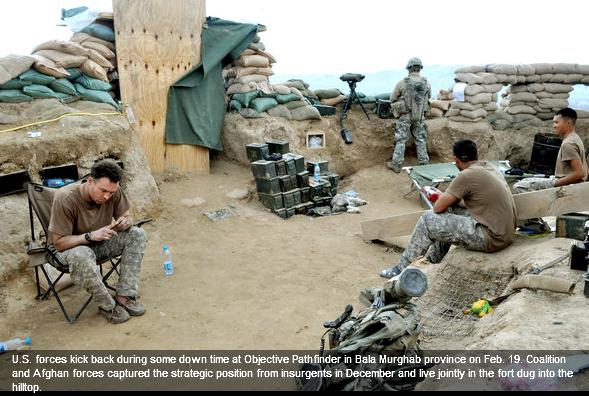
BALA MURGHAB, Afghanistan — The gunfire came as no surprise, several short volleys smacking the dirt as soldiers bounded across an open field.

The U.S., Italian and Afghan soldiers were keenly aware that by venturing just a few miles south of their base, they’d crossed into enemy territory. Taking fire was almost a given.

“They always shoot at me,” Staff Sgt. Jason Holland said in mock bemusement afterward. “I like this country, but they always shoot at me.”

Since November, the men of the 82nd Airborne’s 1st Battalion, 508th Parachute Infantry Regiment have fought pitched battles in Bala Murghab to take a small bubble of key terrain in this Taliban-controlled valley in Afghanistan’s remote west.

But the mission here is hamstrung by a shortage of forces. And except for these show-of-presence patrols, that security bubble is as far as they can go until Afghan reinforcements arrive.

Insurgents sit to their north and to their south, ready at the trigger.

For the men of Company B’s second platoon, it feels like being on the front lines of the wrong war.

“We are not doing anything right now,” said Sgt. Alfred Seddon, 24, from St. Petersburg, Fla. “All we hear is we want to push south but we don’t have enough people. So why not just stay where we are and accomplish something?”

“I was excited when I heard we were doing a COIN (counterinsurgency) mission,” he added. “I thought, ‘Yeah, great, we are gonna achieve something.’ But now it feels like a facade.”

Bala Murghab is not a priority under Gen. Stanley McChrystal’s strategy of focusing on main population centers to combat the insurgency. So unlike in the south, where a new surge of U.S. forces is pouring in, the 82nd Airborne soldiers here are stretched thin, manning this valley that they like to describe as a Taliban vacation spot with a small contingent of forces and just barely enough supplies …

“This is just no man’s land crawling with Taliban, and one small platoon sitting right in the middle of it,” said Hand.

“There’s a definite line,” said Holland. “The minute you cross it, they open fire.”

BALA_MURGHAB

While it appears that they have dealt with the terrain issues, they are ready-fodder for a massed assault.  So where does the accountability end up the chain of command, and how does this get balanced with the need to be a learning institution?  Expectations clearly continue to point in the direction of insufficient troops to meet the demands being placed on them.

Prior on the Battle of Wanat and Kamdesh:

Second Guessing the Battles of Wanat and Kamdesh

Taliban Tactics: Massing of Troops

Kamdesh: The Importance of Terrain

Attack at Kamdesh, Nuristan

Wanat Video 2

The Battle of Wanat, Massing of Troops and Attacks in Nuristan

The Contribution of the Afghan National Army in the Battle of Wanat

Investigating the Battle of Wanat

Analysis of the Battle of Wanat

Reigning in SOF in Afghanistan

BY Herschel Smith
16 years, 4 months ago

From The New York Times:

Gen. Stanley A. McChrystal, the top American commander in Afghanistan, has brought most American Special Operations forces under his direct control for the first time, out of concern over continued civilian casualties and disorganization among units in the field.

“What happens is, sometimes at cross-purposes, you got one hand doing one thing and one hand doing the other, both trying to do the right thing but working without a good outcome,” General McChrystal said in an interview.

Critics, including Afghan officials, human rights workers and some field commanders of conventional American forces, say that Special Operations forces have been responsible for a large number of the civilian casualties in Afghanistan and operate by their own rules.

Maj. Gen. Zahir Azimi, the chief spokesman for the Afghan Ministry of Defense, said that General McChrystal had told Afghan officials he was taking the action because of concern that some American units were not following his orders to make limiting civilian casualties a paramount objective.

“These special forces were not accountable to anyone in the country, but General McChrystal and we carried the burden of the guilt for the mistakes they committed,” he said. “Whenever there was some problem with the special forces we didn’t know who to go to, it was muddled and unclear who was in charge.”

Spencer Ackerman seems to support McChrystal’s consolidation of forces into one chain of command because of the need to protect the population as the center of gravity of the campaign.  I do not.  To be clear, I do not support the consolidation of forces into one chain of command for the reason that the population is the center of gravity (see Center of Gravity Versus Lines of Effort in COIN).  I do indeed support the consolidation of forces.

Ending the silly high value target campaign (capturing mid-level Taliban commanders, only to release them 96 hours later) won’t end unintended noncombatant casualties.  The attempt to completely end noncombatant casualties has already contributed to unnecessary deaths of U.S. troops.  I support the consolidation of forces because SOF shouldn’t be operating out of the chain of command.  If there is a direct action raid and a father or a son is killed in the middle of the night, the infantry (or those attached to the infantry, i.e., SOF) should have done it, under the direction of the immediate chain of command, and they should all be present the next morning to explain to the village why it happened.  If you don’t harbor insurgents, this won’t happen.  There is nothing like a little time with the villagers by those who did the killing … expending effort policing, teaching and admonishing.

Prior:

Abolish SOCOM

The Cult of Special Forces

Hugs, Kisses and Colonels

BY Herschel Smith
16 years, 4 months ago

Michael Yon told us about the refusal of the Spanish to work well together with U.S. forces.  Bratty kids, they are.  A snippet of a letter from a Lt. Colonel in the 82nd Airborne Division follows (full disclosure, my father served in the 82nd Airborne, and this Lt. Col. sounds to me like he is in the line of distinguished, hard core infantry and airborne warriors who have graced this division).

Qal E Naw: The Spanish are not interested in helping in anyway, and are trying to make us decide to leave based on their unacceptable treatment of Americans. Our refuelers [soldiers who refuel helicopters] that are living there have to run out, unroll the hoses, pull security, and roll everything back up. They have asked for gravel along the FLS as it is currently calf deep mud, but the Spanish refuse to make any improvements. They asked for a T barrier (just one) to put at a 45 degree angle outside the fence where the FARP [Forward Arming and Refueling Point; where helicopters land for ammo and gas] has to be set up so they can run for cover in case there is small arms fire, the Spanish say no and refuse to make any improvements. They asked for a small gate where their billets are located so they can access the FARP directly rather than going a half mile loop to get out the gate, but the Spanish said no and refuse to make any improvements. They [sic] guys are living hard (we understand that) but have to do laundry by hand as all of their stuff is stolen if they turn it into the laundry, they discussed this with the Spanish, but they refuse to many any improvements …

BmG: Who ever briefed that they have gravel there has never been there. We arrived during a TIC [fighting] and a MEDEVAC mission. The aircraft have to land/park in a field that has no gravel and then they sink into the ground. They have to be moved everyday to pull them back out of the mud. If we can’t get gravel, how about putting some AM2 matting, stakes and a couple of Red Horse guys on a CH-47 and fly them in to build a couple of pads just big enough to park an individual UH-60 on? We’ve been pushing the gravel issues since last fall and are no closer to a solution. Those guys are living in fighting positions. When it begins to warm up in the next month, that field will be untenable without gravel or AM2 matting. We don’t want to lose MEDEVAC capability there because we couldn’t put in two pads. We did a MEDEVAC [troop(s) wounded] and Hero [troop(s) killed] mission while I was there and the next day as well, let’s not forget that they are on the tip of the spear, we owe them more.

Michael follows up with a letter from Colonel Robert J. Ulses (U.S.) to Colonel Jesus De Miguel Sabastian (Spain).  He says in this letter that he is assured that the Spanish leadership has been very responsive to all requests for support.  Indeed.  The letter closes with this – I kid you not, go look at the letter at Michael’s site – hand written note.

“Thanks for the support!! Look forward to meeting you.

Now they’ve done it.  I feel all warm and gooey inside.  On the other hand, not really.  Having a father who was in the 82nd Airborne Division, a son who has spent four years in the Marines as an infantry grunt and who earned the CAR in Fallujah, a daughter who is in the process of joining the Navy as an officer, and having spent 28 years in corporate America and industry, I have never, ever, seen anything like this before.

The only thing that remains is for Colonel Ulses to put hugs and kisses on the letter.  Something like this:

XOXOXOXOXO !!!!!

Which, as best as I can tell, is big, excited hugs and kisses since it is followed by the exclamation marks.  Oh … oh … I feel that I’m going to be sick to my stomach.  So would there have been a more appropriate way to end this sniveling letter?  Has anyone even seen anything like this?  My God.  Give us men like Chesty Puller!!!!! (In a tip of the hat to the subject of this post, I thought it appropriate to end this sentence with some exclamation marks).  No hugs and kisses, just exclamation marks.

One Kilometer Outside Musa Qala

BY Herschel Smith
16 years, 4 months ago

British troops are poised to hand over control of Musa Qala to the U.S. Marines.

British troops are to hand over control of the largest town in north Helmand to US forces as part of a major “rebalancing” of UK forces in Helmand, the Defence Secretary said yesterday.

Speaking on a visit to Helmand, the Defence Secretary, Bob Ainsworth, said that Musa Qala would be handed over to US forces in the next month and that “further changes” are likely to ensure that British forces have the “greatest effect in countering the threat posed by the insurgency and protecting the civilian population.”

The decision to hand over Musa Qala to US forces had been one of a series of options under consideration by senior Nato commanders. In January The Times reported that British troops were likely to be pulled out of Musa Qala, Kajaki and possibly the iconic town of Sangin …

British troops originally moved into Musa Qala in June of 2006 to counter Taleban attacks that threatened to overwhelm weak local security forces in the town. In late 2006 British forces withdrew from Musa Qala under the terms of a controversial deal that saw local tribes promises to exclude the Taliban and govern the town.

However, Taliban fighters retook Musa Qala in February 2007 and held it till December when it was retaken in a major offensive by a mixed US and UK force. The retaking of the town was aided by the defection of a local Taleban commander, Mullah Abdul Salaam, who was subsequently installed as the local district governor.

Twenty-three British soldiers have died in and around the town. General Messenger said that British forces would leave behind a success story.

There is a problem within the Ministry of Defence (and the higher echelon of the chain of command) in Britain.  Musa Qala is not a success story.  The British warrior is a good as any on earth, but the officer corps has a troubling predilection to grant themselves special dispensation to turn their own failures into successes (it happened with the campaign in Basra).

Let’s take a quick detour through recent history.  The British were on the front end of the attempt to make deals with the Taliban, and even earlier, the local tribes.  A deal was indeed struck with the locals to turn away the Taliban.  The promise didn’t obtain, and the Taliban took control of Musa Qala.

In a tip of the hat to more deal-making, the British befriended one Mullah Abdul Salaam, a so-called “former mid-level Taliban commander” who promised to bring his fighters to bear upon the Taliban during the initial assault of U.S. and British troops to retake Musa Qala.  In fact, upon the initiation of the assault, Salaam “stayed in his compound in Shakahraz, ten miles east, with a small cortège of fighters, where he made increasingly desperate pleas for help.”  In other words, he screamed like a little girl.

This whole incident has been a stain on the British effort, and is not indicative of the high quality enlisted men in the British military.  The CTC Sentinel at West Point had some very direct words to the MoD regarding Musa Qala in July 2008.

Since the initial withdrawal from Musa Qala in 2006, the British image for military capability in general and counter-insurgency competence in particular has suffered a number of setbacks, by no means all in Afghanistan. The success of Iraqi forces in Basra in 2008 was widely seen as them doing a job that the British had left unfinished for political reasons. Britain’s relations with Kabul have suffered a number of setbacks, from the removal of diplomats following direct negotiations (bypassing Kabul) with the Taliban at Musa Qala in 2006 to Kabul’s rejection of Lord Paddy Ashdown to be the new UN envoy in Afghanistan … If the United Kingdom fails in Musa Qala, its relations with coalition partners and Afghans alike is likely to be harmed, and it may have a further impact on its international standing.

One and a half years ago the relations between Salaam and the British troops had soured.  The British had accused him of corruption and thuggery, while he had accused the British of undermining his “authority.”  Salaam was “feathering his own nest” while reconstruction is not forthcoming from the largesse poured into Musa Qala.  It would appear that relations have not gotten any better in the last year.  “At their latest meeting, Mullah Salaam is complaining that the Household Cavalry Regiment Battlegroup, which has been here for nearly six months, simply isn’t violent enough.”

This is from a man who couldn’t convince his own “fighters” to make good on their promises to take Musa Qala back from the Taliban.  Yet it also appears that Salaam hasn’t added one iota to the security around the area in the time that he has been “governor” of the area.  Government officials still can’t move more than one kilometer outside of Musa Qala because of security problems.

It’s time for some serious counterinsurgency in and around Musa Qala, and this means that Salaam must go, or be relegated to the sidelines as the irrelevant lackey that he is.  If the British didn’t have the resources to pacify the area, then the U.S. Marines might be able to squeeze the enemy out of hiding and kill them – and retake the roads in the area.  And so much for tribal engagement and deals with the Taliban as the answer to every problem in Afghanistan.

Prior:

The British and Musa Qala

The Example of Musa Qala

Musa Qala and the Argument for Force Projection

Our Deal with Mullah Abdul Salaam

Whence Goeth Iraq?

BY Herschel Smith
16 years, 4 months ago

Ralph Peters is sanguine concerning Iraq.  Daniel Pipes is much less so.  I tend towards bleak outlooks, but am waiting on either of the very good analysts at Iraq the Model to weigh in, or Nibras Kazimi at Talisman Gate (with whom I have had knock down, drag out fights).  Several things are clear at this point.  It is clear that there is a lot of confusion.  It is clear that Ahmad Chalabi is a sniveling lackey and treacherous scumbag who has empowered Iran and hurt Iraqi unity by causing the dissociation of its sects.  I have complained long and loudly concerning the Status of Forces Agreement and what it has done to U.S. power in the region.  We have spent too much blood and treasure to give up so much authority and allow the criminalization of so many Sunnis who participated in the sons of Iraq program to defeat al Qaeda.  ITM weighed in on the exclusion of so many Sunnis from elections and concluded that it has as its basis sectarianism.

Odierno_Raad_Ali

More troubling still, this sectarian violence is still going on.

Hunkered down in a community outside Baghdad, Raad Ali watched the national elections Sunday in anonymity. No one bothers him here. Strangers think he is just another displaced Iraqi from the capital.

The days are long, and he misses his wife and children.

He believes that the election results could mean either his return home or exile, far from his loved ones.

With his button-down shirts, slacks and habitual smile, Ali looks like an unassuming civil servant or eager salesman growing into a chubby middle age. The only sign of worry is his five o’clock shadow.

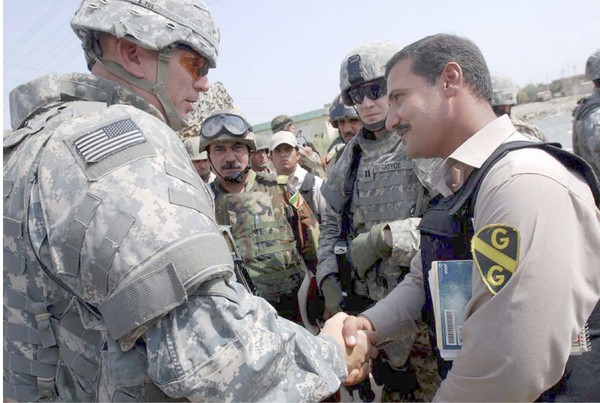
A little over two years ago, he was shaking U.S. Army Gen. Ray Odierno’s hand in his old neighborhood, Ghazaliya, where Ali commanded one of the first Baghdad branches of a Sunni paramilitary movement that helped restore calm to Baghdad. Now Iraqi security forces are hunting him, despite the fact that he took on the Mahdi Army and Al Qaeda in Iraq in his west Baghdad neighborhood.

Ali prays that the national elections will solve his problems. If Iyad Allawi wins, he thinks there would be a place for him in his country. If Nouri Maliki or another Shiite Islamist wins, he believes the harassment will never stop. It would only be a matter of time before he was jailed and separated from his family forever.

“If Allawi doesn’t win, the future is dark,” he said. “They will target everyone.”

Having allowed such a situation to obtain is not only bad for Iraq (and to say that Maliki is bad for Iraq is redundant).  It is also bad for U.S. power and force projection.  God help us if we ever have to go back to Iraq, or if the tribal leaders in Afghanistan see how we have deserted the Sunnis.  We have no staying power, no stomach for enforcing deals we have struck.  We are in such felt-need for legitimacy in our campaigns that we are willing to allow Iraq to stipulate the conditions of the SOFA when the U.N. approvals expire.  To have a picture of General Odierno shaking the hand Raad Ali in 2008 while he is being hunted now is more than embarrassing.  It’s belittling to the most powerful nation on earth – which is also still engaged in counterinsurgency campaigns across the globe.

I have the utmost respect for General Odierno and his son who lost his arm fighting in Iraq.  I have difficulty mustering such respect for the politicians who agreed to the Status of Forces Agreement or timeline for withdrawal, or who refused to take Iran on in the regional war that it declared against the U.S.  This picture is worth a thousand words, and it makes me sick.


26th MEU (10)
Abu Muqawama (12)
ACOG (2)
ACOGs (1)
Afghan National Army (36)
Afghan National Police (17)
Afghanistan (704)
Afghanistan SOFA (4)
Agriculture in COIN (3)
AGW (1)
Air Force (42)
Air Power (10)
al Qaeda (83)
Ali al-Sistani (1)
America (23)
Ammunition (305)
Animals (336)
Ansar al Sunna (15)
Anthropology (3)
Antonin Scalia (1)
AR-15s (397)
Arghandab River Valley (1)
Arlington Cemetery (2)
Army (91)
Assassinations (2)
Assault Weapon Ban (29)
Australian Army (7)
Azerbaijan (4)
Backpacking (4)
Badr Organization (8)
Baitullah Mehsud (21)
Basra (17)
BATFE (247)
Battle of Bari Alai (2)
Battle of Wanat (18)
Battle Space Weight (3)
Bin Laden (7)
Blogroll (3)
Blogs (24)
Body Armor (23)
Books (3)
Border War (18)
Brady Campaign (1)
Britain (39)
British Army (36)
Camping (5)
Canada (20)
Castle Doctrine (1)
Caucasus (6)
CENTCOM (7)
Center For a New American Security (8)
Charity (3)
China (19)
Christmas (18)
CIA (30)
Civilian National Security Force (3)
Col. Gian Gentile (9)
Combat Outposts (3)
Combat Video (2)
Concerned Citizens (6)
Constabulary Actions (3)
Coolness Factor (3)
COP Keating (4)
Corruption in COIN (4)
Council on Foreign Relations (1)
Counterinsurgency (218)
DADT (2)
David Rohde (1)
Defense Contractors (2)
Department of Defense (220)
Department of Homeland Security (26)
Disaster Preparedness (5)
Distributed Operations (5)
Dogs (15)
Donald Trump (27)
Drone Campaign (4)
EFV (3)
Egypt (12)
El Salvador (1)
Embassy Security (1)
Enemy Spotters (1)
Expeditionary Warfare (18)
F-22 (2)
F-35 (1)
Fallujah (17)
Far East (3)
Fathers and Sons (2)
Favorite (1)
Fazlullah (3)
FBI (39)
Featured (192)
Federal Firearms Laws (18)
Financing the Taliban (2)
Firearms (1,876)
Football (1)
Force Projection (35)
Force Protection (4)
Force Transformation (1)
Foreign Policy (27)
Fukushima Reactor Accident (6)
Ganjgal (1)
Garmsir (1)
general (15)
General Amos (1)
General James Mattis (1)
General McChrystal (44)
General McKiernan (6)
General Rodriguez (3)
General Suleimani (9)
Georgia (19)
GITMO (2)
Google (1)
Gulbuddin Hekmatyar (1)
Gun Control (1,730)
Guns (2,416)
Guns In National Parks (3)
Haditha Roundup (10)
Haiti (2)
HAMAS (7)
Haqqani Network (9)
Hate Mail (8)
Hekmatyar (1)
Heroism (5)
Hezbollah (12)
High Capacity Magazines (16)
High Value Targets (9)
Homecoming (1)
Homeland Security (3)
Horses (2)
Humor (72)
Hunting (65)
ICOS (1)
IEDs (7)
Immigration (123)
India (10)
Infantry (4)
Information Warfare (4)
Infrastructure (4)
Intelligence (23)
Intelligence Bulletin (6)
Iran (171)
Iraq (379)
Iraq SOFA (23)
Islamic Facism (64)
Islamists (98)
Israel (19)
Jaish al Mahdi (21)
Jalalabad (1)
Japan (3)
Jihadists (82)
John Nagl (5)
Joint Intelligence Centers (1)
JRTN (1)
Kabul (1)
Kajaki Dam (1)
Kamdesh (9)
Kandahar (12)
Karachi (7)
Kashmir (2)
Khost Province (1)
Khyber (11)
Knife Blogging (7)
Korea (4)
Korengal Valley (3)
Kunar Province (20)
Kurdistan (3)
Language in COIN (5)
Language in Statecraft (1)
Language Interpreters (2)
Lashkar-e-Taiba (2)
Law Enforcement (6)
Lawfare (14)
Leadership (6)
Lebanon (6)
Leon Panetta (2)
Let Them Fight (2)
Libya (14)
Lines of Effort (3)
Littoral Combat (8)
Logistics (50)
Long Guns (1)
Lt. Col. Allen West (2)
Marine Corps (281)
Marines in Bakwa (1)
Marines in Helmand (67)
Marjah (4)
MEDEVAC (2)
Media (68)
Medical (146)
Memorial Day (6)
Mexican Cartels (48)
Mexico (72)
Michael Yon (6)
Micromanaging the Military (7)
Middle East (1)
Military Blogging (26)
Military Contractors (5)
Military Equipment (25)
Militia (9)
Mitt Romney (3)
Monetary Policy (1)
Moqtada al Sadr (2)
Mosul (4)
Mountains (25)
MRAPs (1)
Mullah Baradar (1)
Mullah Fazlullah (1)
Mullah Omar (3)
Musa Qala (4)
Music (25)
Muslim Brotherhood (6)
Nation Building (2)
National Internet IDs (1)
National Rifle Association (97)
NATO (15)
Navy (31)
Navy Corpsman (1)
NCOs (3)
News (1)
NGOs (3)
Nicholas Schmidle (2)
Now Zad (19)
NSA (3)
NSA James L. Jones (6)
Nuclear (63)
Nuristan (8)
Obama Administration (222)
Offshore Balancing (1)
Operation Alljah (7)
Operation Khanjar (14)
Ossetia (7)
Pakistan (165)
Paktya Province (1)
Palestine (5)
Patriotism (7)
Patrolling (1)
Pech River Valley (11)
Personal (77)
Petraeus (14)
Pictures (1)
Piracy (13)
Pistol (4)
Pizzagate (21)
Police (673)
Police in COIN (3)
Policy (15)
Politics (999)
Poppy (2)
PPEs (1)
Prisons in Counterinsurgency (12)
Project Gunrunner (20)
PRTs (1)
Qatar (1)
Quadrennial Defense Review (2)
Quds Force (13)
Quetta Shura (1)
RAND (3)
Recommended Reading (14)
Refueling Tanker (1)
Religion (501)
Religion and Insurgency (19)
Reuters (1)
Rick Perry (4)
Rifles (1)
Roads (4)
Rolling Stone (1)
Ron Paul (1)
ROTC (1)
Rules of Engagement (76)
Rumsfeld (1)
Russia (37)
Sabbatical (1)
Sangin (1)
Saqlawiyah (1)
Satellite Patrols (2)
Saudi Arabia (4)
Scenes from Iraq (1)
Second Amendment (715)
Second Amendment Quick Hits (2)
Secretary Gates (9)
Sharia Law (3)
Shura Ittehad-ul-Mujahiden (1)
SIIC (2)
Sirajuddin Haqqani (1)
Small Wars (72)
Snipers (9)
Sniveling Lackeys (2)
Soft Power (4)
Somalia (8)
Sons of Afghanistan (1)
Sons of Iraq (2)
Special Forces (28)
Squad Rushes (1)
State Department (23)
Statistics (1)
Sunni Insurgency (10)
Support to Infantry Ratio (1)
Supreme Court (84)
Survival (216)
SWAT Raids (58)
Syria (38)
Tactical Drills (38)
Tactical Gear (17)
Taliban (168)
Taliban Massing of Forces (4)
Tarmiyah (1)
TBI (1)
Technology (21)
Tehrik-i-Taliban (78)
Terrain in Combat (1)
Terrorism (96)
Thanksgiving (13)
The Anbar Narrative (23)
The Art of War (5)
The Fallen (1)
The Long War (20)
The Surge (3)
The Wounded (13)
Thomas Barnett (1)
Transnational Insurgencies (5)
Tribes (5)
TSA (25)
TSA Ineptitude (14)
TTPs (4)
U.S. Border Patrol (8)
U.S. Border Security (22)
U.S. Sovereignty (29)
UAVs (2)
UBL (4)
Ukraine (10)
Uncategorized (107)
Universal Background Check (3)
Unrestricted Warfare (4)
USS Iwo Jima (2)
USS San Antonio (1)
Uzbekistan (1)
V-22 Osprey (4)
Veterans (3)
Vietnam (1)
War & Warfare (435)
War & Warfare (41)
War Movies (4)
War Reporting (21)
Wardak Province (1)
Warriors (6)
Waziristan (1)
Weapons and Tactics (80)
West Point (1)
Winter Operations (1)
Women in Combat (21)
WTF? (1)
Yemen (1)

August 2026
July 2026
June 2026
May 2026
April 2026
March 2026
February 2026
January 2026
December 2025
November 2025
October 2025
September 2025
August 2025
July 2025
June 2025
May 2025
April 2025
March 2025
February 2025
January 2025
December 2024
November 2024
October 2024
September 2024
August 2024
July 2024
June 2024
May 2024
April 2024
March 2024
February 2024
January 2024
December 2023
November 2023
October 2023
September 2023
August 2023
July 2023
June 2023
May 2023
April 2023
March 2023
February 2023
January 2023
December 2022
November 2022
October 2022
September 2022
August 2022
July 2022
June 2022
May 2022
April 2022
March 2022
February 2022
January 2022
December 2021
November 2021
October 2021
September 2021
August 2021
July 2021
June 2021
May 2021
April 2021
March 2021
February 2021
January 2021
December 2020
November 2020
October 2020
September 2020
August 2020
July 2020
June 2020
May 2020
April 2020
March 2020
February 2020
January 2020
December 2019
November 2019
October 2019
September 2019
August 2019
July 2019
June 2019
May 2019
April 2019
March 2019
February 2019
January 2019
December 2018
November 2018
October 2018
September 2018
August 2018
July 2018
June 2018
May 2018
April 2018
March 2018
February 2018
January 2018
December 2017
November 2017
October 2017
September 2017
August 2017
July 2017
June 2017
May 2017
April 2017
March 2017
February 2017
January 2017
December 2016
November 2016
October 2016
September 2016
August 2016
July 2016
June 2016
May 2016
April 2016
March 2016
February 2016
January 2016
December 2015
November 2015
October 2015
September 2015
August 2015
July 2015
June 2015
May 2015
April 2015
March 2015
February 2015
January 2015
December 2014
November 2014
October 2014
September 2014
August 2014
July 2014
June 2014
May 2014
April 2014
March 2014
February 2014
January 2014
December 2013
November 2013
October 2013
September 2013
August 2013
July 2013
June 2013
May 2013
April 2013
March 2013
February 2013
January 2013
December 2012
November 2012
October 2012
September 2012
August 2012
July 2012
June 2012
May 2012
April 2012
March 2012
February 2012
January 2012
December 2011
November 2011
October 2011
September 2011
August 2011
July 2011
June 2011
May 2011
April 2011
March 2011
February 2011
January 2011
December 2010
November 2010
October 2010
September 2010
August 2010
July 2010
June 2010
May 2010
April 2010
March 2010
February 2010
January 2010
December 2009
November 2009
October 2009
September 2009
August 2009
July 2009
June 2009
May 2009
April 2009
March 2009
February 2009
January 2009
December 2008
November 2008
October 2008
September 2008
August 2008
July 2008
June 2008
May 2008
April 2008
March 2008
February 2008
January 2008
December 2007
November 2007
October 2007
September 2007
August 2007
July 2007
June 2007
May 2007
April 2007
March 2007
February 2007
January 2007
December 2006
November 2006
October 2006
September 2006
August 2006
July 2006
June 2006
May 2006

about · archives · contact · register

Copyright © 2006-2026 Captain's Journal. All rights reserved.