Myths About Afghanistan
Victor Davis Hanson on whether Afghanistan is really the "graveyard of empires ..."
Ernie Pyle's timeless wartime columns ...
No July 4 hot dogs with the Iranian Mullahs ...
Mark Steyn, U.S. sclerotic and ineffectual, declining into societal dementia ...
Nicholas Schmidle asks some hard questions about Nawaz Sharif ...
The CIA's war against President Bush was motivated by ass covering, or by political
NSA Director Keith Alexander, a three-star general, is expected to earn a fourth star when he
Providing electronic devices for IEDs ...
Police watched from a distance and did not intervene ...
Been there, done that in the Middle East ...
Matt Sanchez - repealing DADT would be a disaster.
Too much U.S. largesse has created corruption in Afghan government.
Dan Riehl weighs in on language, thinking and security from terrorism ...
The U.S. is seeking to hire a merchant ship to deliver hundreds of tonnes of arms to Israel
Sharif brothers on Baitullah Mehsud's hit list.
No Georgian destruction of Tskhinvali, contrary to lying Russian claims.
Nuclear yield within six to twelve months.
McNeill ties length to Pakistan tribal region, likely to be protracted anyway.
Multinational force press release on Sadr City operations and seizure of weapons and munitions.
"We will fight them to the end."
War on terror not popular with Pakistani population.
U.S. presence expanding Southward in Iraq.
Its full steam ahead for Iran.
And SECDEF Gates continues to press this issue.
Pajamas Media exclusive: how your tax dollars fund terror.
Southwestern Baptist Theological Seminary Graduate executed in Afghanistan.
Nearly 1000 dead from harshest Afghan winter in 30 years.
Attacks in Baghdad down 80% according to Iraqi Army.
Lack of appropriate defense spending a grave situation.
Olmert claims Iran still on target to construct nuclear weapon.
Promoted to Army Vice Chief of Staff. Well deserved.
Must read on Israeli Army shame and lawyer happiness with war against Hezbollah.
Libyans joining jihad in increasing numbers.
How relevant will Maliki be to Iraq's future?
Maj. Gen. Gaskin: "The positive trends are permanent."
Abizaid questions whether Maliki can bring unity to Iraq.
From the Multinational Force, more on Operation Lion Pounce.
An important ally in Iraq has been assassinated.
Israel to show Chairman of Joint Chiefs of Staff nuclear intelligence on Iran.
Cabinet approves proposed agreement with U.S.
Prof. Kingsley Browne on his new book.
Major General Robert Scales: "Outcome is irreversible"
Mullen says military needs larger slice of GNP to modernize.
For siding with the U.S. against al Qaeda.
Terrorist poses as bride. Ugh!
Legislation in trouble.
Al Qaeda documents discovered near Syrian border.
Shameful people jeer disabled veterans in swimming pool.
Saudi jihadist in Iraq tells his personal story.
Concerning Iranian meddling and Quds.
Michael Yon breaks bread with General Petraeus.
Ralph Peters on the advancements in Iraq.
War between al Qaeda and Hezbollah.
Traumatic brain injury not recognized.
Ballistic Sensor Fused Munition.
High intensity electronic warfare.
Iranian weapons are a sign of continued Iranian meddling in Iraq.
U.S. forces in Iraq are using a high-resolution, thermal/infrared sensor system.
Washington Post profiles AQI (al Qaeda in Iraq, or al Qaeda in Mesopotamia).
Taiwan may not be as secure as we would like to think.
Be thankful your daughter isn't be raised in Basra.
Pastor discusses rules of engagement and sacrificial U.S. deaths.
In counterinsurgency (COIN), patience is a virtue. But violence has decreased so fast in
Ralph Peters is sanguine concerning Iraq. Daniel Pipes is much less so. I tend towards bleak outlooks, but am waiting on either of the very good analysts at Iraq the Model to weigh in, or Nibras Kazimi at Talisman Gate (with whom I have had knock down, drag out fights). Several things are clear at this point. It is clear that there is a lot of confusion. It is clear that Ahmad Chalabi is a sniveling lackey and treacherous scumbag who has empowered Iran and hurt Iraqi unity by causing the dissociation of its sects. I have complained long and loudly concerning the Status of Forces Agreement and what it has done to U.S. power in the region. We have spent too much blood and treasure to give up so much authority and allow the criminalization of so many Sunnis who participated in the sons of Iraq program to defeat al Qaeda. ITM weighed in on the exclusion of so many Sunnis from elections and concluded that it has as its basis sectarianism.
More troubling still, this sectarian violence is still going on.
Hunkered down in a community outside Baghdad, Raad Ali watched the national elections Sunday in anonymity. No one bothers him here. Strangers think he is just another displaced Iraqi from the capital.
The days are long, and he misses his wife and children.
He believes that the election results could mean either his return home or exile, far from his loved ones.
With his button-down shirts, slacks and habitual smile, Ali looks like an unassuming civil servant or eager salesman growing into a chubby middle age. The only sign of worry is his five o’clock shadow.
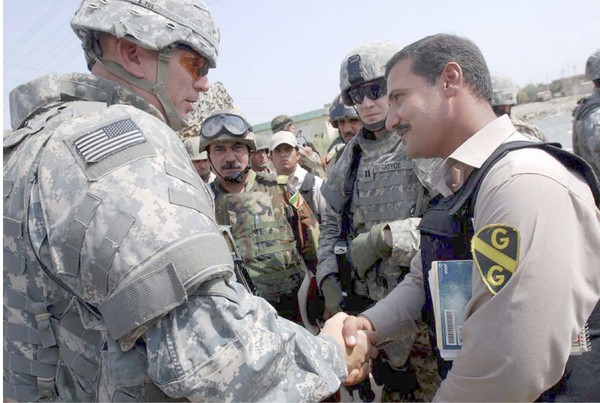
A little over two years ago, he was shaking U.S. Army Gen. Ray Odierno’s hand in his old neighborhood, Ghazaliya, where Ali commanded one of the first Baghdad branches of a Sunni paramilitary movement that helped restore calm to Baghdad. Now Iraqi security forces are hunting him, despite the fact that he took on the Mahdi Army and Al Qaeda in Iraq in his west Baghdad neighborhood.
Ali prays that the national elections will solve his problems. If Iyad Allawi wins, he thinks there would be a place for him in his country. If Nouri Maliki or another Shiite Islamist wins, he believes the harassment will never stop. It would only be a matter of time before he was jailed and separated from his family forever.
“If Allawi doesn’t win, the future is dark,” he said. “They will target everyone.”
Having allowed such a situation to obtain is not only bad for Iraq (and to say that Maliki is bad for Iraq is redundant). It is also bad for U.S. power and force projection. God help us if we ever have to go back to Iraq, or if the tribal leaders in Afghanistan see how we have deserted the Sunnis. We have no staying power, no stomach for enforcing deals we have struck. We are in such felt-need for legitimacy in our campaigns that we are willing to allow Iraq to stipulate the conditions of the SOFA when the U.N. approvals expire. To have a picture of General Odierno shaking the hand Raad Ali in 2008 while he is being hunted now is more than embarrassing. It’s belittling to the most powerful nation on earth – which is also still engaged in counterinsurgency campaigns across the globe.
I have the utmost respect for General Odierno and his son who lost his arm fighting in Iraq. I have difficulty mustering such respect for the politicians who agreed to the Status of Forces Agreement or timeline for withdrawal, or who refused to take Iran on in the regional war that it declared against the U.S. This picture is worth a thousand words, and it makes me sick.
The mood is tense in the Anbar Province, but more to the point, there is general intelligence ambiguity in Iraq.
U.S. commanders say they are unsure about who is responsible for the persistent violence in Iraq, underscoring the challenge they face trying to keep a lid on it amid parliamentary elections this weekend.
While security has improved significantly across Iraq in recent years, in the weeks leading up to the March 7 vote, U.S. commanders have reported an increase in low-level violence: kidnappings, assassinations, and mortar attacks against Baghdad’s heavily fortified Green Zone, the seat of government power.
And since August, a series of large-scale bombings aimed at government buildings have ripped through Baghdad, killing several hundred people and shaking confidence in Prime Minister Nouri al-Maliki’s security services, following the withdrawal of most U.S. combat forces from major Iraqi cities last summer.
Commanders worry the violence could spike further after the election if parties feel there was fraud or if negotiations to form a government after the vote break down.
U.S. and Iraqi successes cracking down on organized insurgent groups have caused the groups to splinter into an ill-defined web of smaller, often independent, groups with widely divergent motives, ranging from the ideological to the purely material, according to American military officials.
“There is definitely less clarity as to who the enemy is,” says a U.S. Special Forces officer in Baghdad. “The big-time players aren’t there anymore. The organized terrorists aren’t there anymore.”
Iraqi officials are blaming al Qaeda-linked terrorists and loyalists to Saddam Hussein’s Baath Party for the attacks. Iraq officials said Tuesday the number of Iraqis killed in February was twice as high as in January and 40% higher than a year earlier.
But U.S. military officers, working in Baghdad and Anbar provinces, say the real picture is less clear, making effective countermeasures more difficult.
“Whether or not the violence is extremist, political or tribal is not clear at this point,” says U.S. Army Brig. Gen. Kevin Mangum, the deputy commanding general of U.S. forces in Baghdad and Anbar. “We’re not being evasive; it’s just really hard to figure out.”
Of course the situation is hard to figure out. It’s no wonder that the U.S. Marines are now gone from the Anbar Province. The Status of Forces Agreement tied their hands to the point that they were required to give the Iraqis 72 hours notice prior to troop movements outside of their bases, and then only with Iraqi escort. According to one honest Iraqi Colonel, “They are now more passive than before,” he said of U.S. troops. “I also feel that the Americans soldiers are frustrated because they used to have many patrols, but now they cannot. Now, the American soldiers are in prison-like bases as if they are under house-arrest.”
When no patrols can be conducted and no force projected, the atmospherics of the population cannot be assessed. There is no way to perform counterinsurgency under these conditions, and the best hope is that a political solution can be worked out between sects and political parties. Based on what has been demonstrated to date, this may be a forlorn hope in the short term.
Amir Taheri recently had a commentary in the New York Post which shouldn’t be passed over.
The next general election is three months away, but Iraq is already in high gear for what promises to be a hard-fought campaign over the future of the newly liberated nation. The outcome could determine the course of politics in the Middle East and the future US role in that turbulent region.
Three camps are emerging.
The first is a bloc of 40 groups led by Prime Minister Nouri al-Maliki. Known as The State of the Law, the coalition promises a modern democracy transcending ethnic and sectarian divides.
Maliki quit his Islamist party, Dawa (The Call), precisely because of its Shiite sectarian nature. His new coalition includes both Arab Sunni and ethnic Kurdish groups. Yet he hopes to still attract many Shiites — who, after all, are the majority of the population.
The second camp is known as “the party of Iran.” Its hard core consists of the remnants of the Mahdi Army (Jaish Al-Mahdi) of the maverick mullah Muqtada Sadr and splinter groups from Dawa led by former Prime Minister Ibrahim al-Jaafari. A third Shiite group, the Supreme Islamic Assembly of Iraq — led by Ammar al-Hakim, a junior mullah — provides the remaining leg of the pro-Iranian triangle.
Jaafari is emerging as Iran’s candidate for prime minister — if his bloc, known as the Iraqi National Alliance, wins control of the National Assembly (parliament). Last week, Jaafari visited Iran to be feted by “Supreme Guide” Ali Khamenei and President Mahmoud Ahmadinejad.
“The American era is ending,” Iran’s official news agency quoted Jaafari as saying. “We must prepare for a new era in which Islamic forces set the agenda.”
The third camp is formed by secular Shiite groups, led by ex-Prime Minister Iyad Allawi, plus Arab Sunni parties led by Saleh Mutlak and the remnants of the Ba’ath party.
This camp enjoys support from such Arab states as Egypt, Jordan and Saudi Arabia. Its principal theme: With the US embarked on a strategic retreat under President Obama, Arab states must do all they can to prevent Iran from dominating Iraq and emerging as the regional “superpower.”
Iraq’s Kurdish community, some 20 percent of the population, is also split. Massoud Barzani’s Kurdish Democratic Party has indicated it might support Maliki’s bloc in a common bid to preserve Iraq’s independence from Iran and Arab states. The new Change (Goran) bloc, which made spectacular gains in the last Kurdish local elections, also opposes Iranian domination.
Yet the other longtime Kurdish party — the Patriotic Union of Kurdistan, led by President Jalal Talabani — argues that, with the US unwilling to provide leadership, Kurds must look to Iran as their protector against Arab nationalism. The Kurdish branch of the Hezbollah also supports the Iranian option.
Behind all this are Obama’s hints that he might speed up the withdrawal of US forces before 2011, short-circuiting the Status of Forces Agreement signed by the Bush administration. The American president’s obvious attitude has hurt Iraqi politicians who advocate strategic alliance with Washington.
“Obama is not interested in Iraq,” says analyst Ma’ad Fayyad. “This is because, if Iraq succeeds as the first Arab democracy, it might look as if Bush was right after all.”
Obama’s tepid, not to say hostile, attitude toward Iraq’s new democracy has some Iraqi politicians recasting themselves as anti-Americans …
“If Obama wants to run away, no Iraqi can afford to appear more pro-American than the US president,” says a political advisor to Maliki.
Meanwhile, Iran is throwing in everything to defeat Maliki and seize control of Iraq’s government …
Commentary & Analysis
Taheri’s analysis is cogent and well formulated until it goes off track into considerations of the Status of Forces Agreement. Confined to a training role, and with no patrols allowed, much less kinetic operations, and also having to inform the Iraqi Security Forces upon troop movement of any sort for any reason whatsoever, the SOFA has left the U.S. forces powerless and ineffectual in their role. There is no reason for them to be in Iraq. This is not Obama’s fault. The blame lies at the feet of both Bush and the Iraqis.
But if the SOFA is in Bush’s court, the lack of interest in Iraq lies with Obama, and the current regional empowering of Iran has continued from the Bush to the Obama administration. The Obama administration, however, took a giant leap into morally dubious (and also stupid) territory when they released Iranian Quds members expecting to get anything in return. They have also shamefully abandoned the MEK.
Given the situation as it exists, the war now is both covert and political. We are losing on the political front, but it doesn’t have to be this way. Omar at Iraq the Model has information about a significant escalation in the covert war.
Unknown gunmen assassinated 30 Mahdi Army commanders in the Syrian capital Damascus. The killings, made in the past few weeks, were all made “quietly, inside the victims apartments”, said an unnamed source in the Sadr movement. The source added that among those assassinated was Laith al-Ka’bi, who commanded the Mahdi Army in the Palestine Street neighborhood in eastern Baghdad. The report adds that large numbers of Mahdi Army operatives left to Iran out of fear the assassinations wave could expand to target them.
This is a positive move, but given one view of things (from one Army intelligence officer) in the war on the CIA conducted by the Obama administration, it’s doubtful that the CIA was involved.
I would never compare my few years as an Army Intelligence Special Agent to the careers of committed CIA operatives, but I harbor no doubt that if I were one of them, I would be looking for a way out. My immediate focus would be on protecting myself, my family and the identities of the foreign nationals with whom I worked. I would be operating as if secrets no longer exist. Risk taking would cease. My reports would be gleaned from newspaper articles.
Indeed. Much less would targeted killings be conducted by the CIA. As both an intelligence-gathering and covert warfare organization, the CIA is effectively finished until and unless a framework is put into place that protects their agents and until an administration which is intelligence-friendly is elected. Whomever is responsible for this (Mossad, Ba’athists in Syria?) did both America and Iraq a favor. Obama would do well to pay Iraq a visit and express the urgent need for Iraq to abandon hopes of ties with Iran. The war in Iraq has now taken a different turn, and we will adjust and adapt or lose to the Iranians.
Tom Ricks has a depressing and saddening post on the influence of Iran in Iraq relying on a first hand account by an Army officer.
Ghaz, as you may know, is mainly Shia in the northern half and Sunni in the southern half. We closed the last JSS in Ghaz on Sept. 7 (it had been allowed to stay open past the 30 June deadline) and the day after it was closed the Iraqi army battalion in south Ghaz raided the South Ghaz (Sunni) SOI headquarters, confiscating weapons and equipment a US unit had supplied them back in 2007-2008. The JSS, which straddled the Shia-Sunni fault line across the middle of Ghaz, was basically the buffer for the Sunni in the south. SOI and local council leaders were reported to have fled the neighborhood, citing Shia militia threats. Keep in mind, directly to Ghaz’s north is the Shia enclave of Shulla, a mini-Sadr City that is basically controlled by JAM remnant groups (and a heavily complicit Iraqi Army battalion). This Shia influence spills into north Ghaz and has been encroaching upon south Ghaz over the past several months.
For various reasons I am not concerned about Sunni-controlled areas like Anbar in Western Iraq (I am convinced that the Iraqi Police in Sunni-controlled areas have the upper hand). But I am very concerned about the degree to which Iran controls the politics inside of Iraq, and no President since Carter has seriously confronted the Iranian Mullahs. This was the great risk in Operation Iraqi Freedom, and we have not acted to in any way ameliorate that risk.
A good indication should be forthcoming as to where Iraq stands in its independence from Iran. The MEK (People’s Mujahedin of Iran) had previously been in some trouble with the advent of the Status of Forces Agreement (SOFA).
An Iraqi judge ruled that the 36 dissidents, who went on a hunger strike in captivity, should be released. But Iraqi Interior Ministry officials, using new tactics, have argued that the dissidents entered the country illegally and should be expelled — obviously to Iran. If this tactic is successful, it could be applied to the 3,400 or so PMOI members remaining in Camp AshrafThe National Council of Resistance of Iran bluntly warned of the then-imuienant problem.
With the signing of a Status of Forces Agreement and the beginning withdrawal this year of American forces to their bases, the United States ceded sovereignty over Camp Ashraf to the Iraqis. The United States sought, and received, promises from the Iraqi government that Camp Ashraf’s population would be protected after the handover.
But Iran has been pressuring sympathetic Iraqi politicians to close the camp and expel the PMOI members. On July 28, Iraqi forces, saying they were establishing a police presence in the camp, launched an attack, killing 11 dissidents, wounding 450 and taking 36 hostages. U.S. forces nearby remained aloof.
The National Council of Resistance of Iran bluntly warned of the then-imminent problem.
Mohaddessin told Aftenposten, “We warned the United States that if the responsibility to protect Camp Ashraf is transferred to Iraq a humanitarian catastrophe would occur because the Iraqi government does Iran’s bidding. The forces’ attack against the camp did not surprise us; What we didn’t expect was the degree of brutality.”
There may be a reprieve coming.
Wednesday, Iraq’s chief prosecutor, Ghadanfar Mahmoud, issued a blanket order for police to release 36 members of an Iranian opposition group who were detained during a raid on their camp in northern Iraq in July.
The People’s Mujahedeen of Iran has claimed Iraqi security forces have refused to free the men even though they have not been charged by judicial authorities.
The group operated for years in Iraq under Saddam Hussein, but nearly 3,500 members have been confined to a camp since the U.S.-led invasion in 2003. The U.S. military turned over responsibility for Camp Ashraf to the Iraqis on Jan. 1.
“(The detainees) should have been released by now … We have issued orders to all police stations to release them wherever they are,” said Mahmoud.
As they have had in so many instances before, the Iraqi government has yet another opportunity to demonstrate that they aren’t lap dogs for the Iranian Mullahs. If it weren’t so sad and so worn by now, the same thing could be said of the U.S. “negotiations” with Iran which have been going on for 30 years.
The Obama administration’s talks with Iran—set to take place tomorrow in Geneva—are accompanied by an almost universally accepted misconception: that previous American administrations refused to negotiate with Iranian leaders. The truth, as Secretary of Defense Robert Gates said last October at the National Defense University, is that “every administration since 1979 has reached out to the Iranians in one way or another and all have failed.”
After the fall of the shah in February 1979, the Carter administration attempted to establish good relations with the revolutionary regime. We offered aid, arms and understanding. The Iranians demanded that the United States honor all arms deals with the shah, remain silent about human-rights abuses carried out by the new regime, and hand over Iranian “criminals” who had taken refuge in America. The talks ended with the seizure of the American Embassy in November.
The Reagan administration—driven by a desire to gain the release of the American hostages—famously sought a modus vivendi with Iran in the midst of the Iran-Iraq War during the mid-1980s. To that end, the U.S. sold weapons to Iran and provided military intelligence about Iraqi forces. High-level American officials such as Robert McFarlane met secretly with Iranian government representatives to discuss the future of the relationship. This effort ended when the Iran-Contra scandal erupted in late 1986.
The Clinton administration lifted sanctions that had been imposed by Messrs. Carter and Reagan. During the 1990s, Iranians (including the national wrestling team) entered the U.S. for the first time since the ’70s. The U.S. also hosted Iranian cultural events and unfroze Iranian bank accounts. President Bill Clinton and Secretary of State Madeleine Albright publicly apologized to Iran for purported past sins, including the overthrow of Prime Minister Mohammed Mossadegh’s government by the CIA and British intelligence in August 1953. But it all came to nothing when Supreme Leader Ali Khamenei proclaimed that we were their enemies in March 1999.
Most recently, the administration of George W. Bush—invariably and falsely described as being totally unwilling to talk to the mullahs—negotiated extensively with Tehran. There were scores of publicly reported meetings, and at least one very secret series of negotiations. These negotiations have rarely been described in the American press, even though they are the subject of a BBC documentary titled “Iran and the West.”
At the urging of British Foreign Minister Jack Straw, the U.S. negotiated extensively with Ali Larijani, then-secretary of Iran’s National Security Council. By September 2006, an agreement had seemingly been reached. Secretary of State Condoleezza Rice and Nicholas Burns, her top Middle East aide, flew to New York to await the promised arrival of an Iranian delegation, for whom some 300 visas had been issued over the preceding weekend. Mr. Larijani was supposed to announce the suspension of Iranian nuclear enrichment. In exchange, we would lift sanctions. But Mr. Larijani and his delegation never arrived, as the BBC documentary reported.
My friend and fellow Marine father Michael Ledeen then goes on to describe the decades-long failure of sanctions against Iran. It is must reading – especially for the current administration. It remains to be seen whether Iraq fails as an independent state in light of the Iranian pressure from within and without. It also remains to be seen what role the U.S. will play in regional stability. Will we continue the same pattern of failed negotiations, or will we bring enough pressure to cause regime change – the only hope of avoiding war?
The New York Times has an informative analysis about the multiple personalities within Iraq concerning the continued presence of the U.S. military.
Iraqi military officials often refer to their American counterparts as “the friends,” a circumlocution full of Eastern subtlety that is often lost on the friends themselves. Add some more quotation marks, and it comes closer to the sense intended, “the ‘friends.’ ” Not sarcastic, exactly, but rather colored with mixed emotions, as in the sentence, “The ‘friends’ came by yesterday to complain again about payroll skimming.”
Americans find this hard to understand about the Iraq war, that their trillion-dollar enterprise in Iraq has made Iraqis and particularly the Iraqi military not only deeply dependent on America, but also deeply conflicted, even resentful about that dependency. After all, we saved them from defeat at the hands of a ruthless insurgency that a few years ago indeed could have destroyed them, and we spent 4,000 lives doing it, left probably 10 times that many young Americans crippled for life, and they’re not grateful?
That is not, at bottom, how the Iraqis see it. They are grateful, many of them, but gratitude is a drink with a bitter aftertaste. They also chafe at the thousands of daily humiliations they endure from a mostly well-meaning but often clueless American military. An Iraqi politician who wishes to remain nameless (“I have to deal with the friends,” he explains) tells of traveling with the Iraqi Army’s chief of staff, a general in uniform, epaulets bristling with eagles, stars and swords. They were at the Baghdad airport, about to get on one of the few Iraqi military planes, when an American sergeant stopped him and refused to allow him to board. Despite the general’s remonstrations of rank and privilege, the sergeant made sure the plane took off without him.
“Once I had a meeting with the division commander in charge of Baghdad,” the politician went on. “A private meeting. In walks an American colonel and sits there with a translator, taking notes on our conversation. He apologized and said ‘I’m sorry, I can’t do anything about this.’ ”
This indirectly explains a lot about the current state of affairs, post June 30. Iraqis have enthusiastically embraced their newfound military sovereignty, even when, as is often the case, they’re not really ready for it. They can field troops who can fight, but they can’t fix their Humvees. They can mount their own operations against insurgents, but are reluctant to do so without air cover — which so far only the Americans can provide. They can marshal large numbers of soldiers — their army now is more numerous than America’s in Iraq — but they depend on the Americans to handle most of their logistics, since their own are plagued by corruption and mismanagement.
Under the new Status of Forces Agreement between the countries, not only did American troops leave all population centers after June 30, but they’ve also agreed not to get involved, in or out of the cities, unless invited to do so by the Iraqis. And the Iraqi inclination has been not to invite them, partly out of pride, partly out of concern for the political blowback from their own public when they do ask for help.
This was brought into sharp relief by the two ministry truck bombings on Aug. 19, which succeeded because fortifications had been prematurely removed from in front of those ministries. “It was Iraqi aspirations exceeding their ability to secure their country on their own,” says John Nagl, a retired Army lieutenant colonel and an author of influential works on counterinsurgency. “The Iraqi government and the Iraqi security forces are improving steadily but they’re not yet able to handle these threats responsibly,” Mr. Nagl says.
He argues that the Iraqi and American militaries need to set up standing pre-arrangements by which the United States can intervene in an emergency on the ground; such arrangements are entirely possible under the terms of the forces agreement, even if they may cause political difficulties, especially in an election year.
I agree with Nagl concerning the current Iraqi inability to ensure its own security. I have argued that we should withdraw even logistical and air support in order to catalyze that understanding within the Iraqi military and administration. But unlike Nagl, I am not so sure that the existing SOFA supplies the necessary provisions for even force protection, much less kinetic engagements inside Iraqi cities.
I believe that modifications are necessary to both the formal SOFA and the manner in which it is being locally implemented by the ISF. I’m unimpressed by the complaint of “thousands of daily humiliations” on the part of the Iraqis. This sounds like exaggeration but it makes for good drama. Continuing with the article:
The tension between Iraq’s desire to embrace its sovereignty and its continuing military shortcomings is likely to last many years, Mr. Nagl says, because the United States has done little so far to give the Iraqi military the ability to defend its country against external threats once Americans leave by the end of 2011.
The most glaring shortcoming is the almost complete lack of an air force, aside from a few transport and reconnaissance aircraft; there is not a single jet. The first T-6 jet trainer, a propeller- driven aircraft that simulates a jet, is on order for next December. Training pilots will take many years more. In a modern world, Mr. Nagl says, “You can’t defend the sovereignty of your country if you can’t defend your air space.”
Lt. Gen. Frank Helmick, commander of the American military’s training command, says that was inevitable in the rush to build large army and police ground forces to counter the insurgency.
General Helmick says he is unconcerned about the lack of an international defensive capability. “What do they need to defend themselves against?”
Nothing, so long as American troops are there in such numbers, but once they’re gone, Iraq will remain surrounded by potential enemies. Turkey has been regularly bombing Iraqi territory in the north, in an effort to wipe out Kurdish guerrillas who use the area as a sanctuary for attacks in Turkey. Iran is a friend now, but in the 1980s it fought a decade-long war involving many divisions of tanks, airstrikes and even chemical warfare.
Here I break with Nagl. The U.S. has done much in terms of blood, sweat, tears and wealth to secure Iraq. The Iraqis must secure their future by weeding out crime, corruption and malfeasance. Their oil fields alone, if functioning properly and profits shared and wisely used, would have gone a long way towards rebuilding their infrastructure, including a military apparatus.
In any case, with respect to air support, Iraq may be a protectorate of the U.S. for a decade. Over the course of that decade unless the SOFA is modified to allow more latitude of operations – including robust force protection – the ground troops must come home and air power supplied from locations where force protection isn’t problematic.
Prior:
Should U.S. Troops Return to Iraqi Cities?
Iraq SOFA Category
Prev | List | Random | Next · Join Powered by RingSurf! |