
Kamdesh Troops Were Sitting Ducks: The Importance of Terrain
BY Herschel Smith 16 years, 9 months ago
From the AP.
Stationed at a remote, undermanned Army outpost in a dangerous patch of northeastern Afghanistan, Stephan Mace knew trouble was brewing. His father says U.S. military commanders should have known that the troops there “were sitting ducks.”
Larry Mace’s soldier son was buried Monday at Arlington National Cemetery with full military honors, one of eight U.S. troops killed earlier this month in Kamdesh when several hundred militant fighters armed with automatic rifles and rocket-propelled grenades stormed their base, known as Combat Outpost Keating.
The attack at Kamdesh, along with a similarly costly battle a year earlier in nearby Wanat, have emerged as powerful symbols of the challenges the Obama administration faces as the war in Afghanistan enters its ninth year.
Without more troops and firepower, the Taliban-led insurgency will grow stronger. But devoting more people and equipment risks an open-ended commitment to a war increasingly unpopular with the American public.
American commanders didn’t reinforce Keating or pull the troops that were there out in time, Larry Mace said.
Led by an Army band, Stephan Mace’s flag-draped casket was borne to the grave site on a horse-drawn caisson. Under blue skies with a cool wind blowing, he was remembered as an all-American boy from rural Virginia who answered his country’s call to duty. After three rifle volleys by a firing party, a bugler played Taps. A bagpiper followed with Amazing Grace.
More than a year before the firefight at Kamdesh, nine U.S. soldiers were killed and 27 more were wounded when their base at Wanat, a village about 30 miles from Kamdesh, was nearly overrun by insurgents.
“The only differences between the two (battles) are the dates and the names of the soldiers killed,” Larry Mace said. “They haven’t changed their game plan. They’re fighting a war with too few people.”
Following the Oct. 3 battle that killed Stephan Mace, U.S. forces left Keating and another outpost at Kamdesh. The withdrawal had been planned before the attack had occurred, according to the NATO-led coalition.
A spokesman said the shift was part of a new strategy outlined months ago by the top U.S. commander in Afghanistan, Gen. Stanley McChrystal, to shut down difficult-to-defend outposts and redirect forces toward larger population areas to protect more civilians.
Even as his son was being remembered as a hero, Larry Mace remains angered by the circumstances surrounding his son’s death. Stephan was home in August on two weeks leave. Sitting in the living room of their home in Winchester, Va., Mace said Stephan told him the Taliban were massing in Kamdesh.
Yet strict rules of engagement kept the soldiers from taking aggressive action to prevent an attack, Larry Mace said.
Mace recalled that Stephan gave his dog tags to his brother Brad before returning.
“I think he knew he wasn’t coming back,” Larry Mace said.
Born in Falls Church, Va., Stephan Mace was the second-eldest of four brothers. He joined the Army in January 2008. Mace was made a “19 Delta,” Army parlance for a cavalry scout, and assigned to the 4th Brigade Combat Team at Fort Carson, Colo. He was sent to Afghanistan in early 2009.
When he was home just a few weeks ago, Stephan anguished over returning to Keating, his father said. Dedicated to his unit, there was no doubt he would go back. But he was weighed down by worries the base was vulnerable to an onslaught he felt sure was coming, according to Larry Mace.
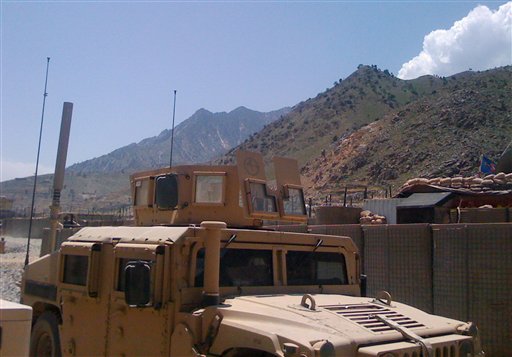
Photos that Stephan Mace took in May of Outpost Keating showed a base located on low ground, surrounded by craggy outcroppings that made ideal hiding spots for enemy fighters.
His father had also noticed a physical change in his son. He’d lost about 20 pounds from his 185-pound frame, a combination of the rigors of military life and the stress of being on the front lines.
Larry Mace had planned a fishing trip with Stephan, who alternated between the Mace home and staying with old high school friends while on leave. But on the day of the outing, Stephan didn’t show.
Larry Mace didn’t see his son before he left. In text messages they later exchanged, Stephan asked his father to forgive him.
“Of course I did,” Larry Mace said.
Is this a sickness within the American military?
Take a look once more at the Wanat video linked in a previous article. Now recall a comment left by Slab at Analysis of the Battle of Wanat.
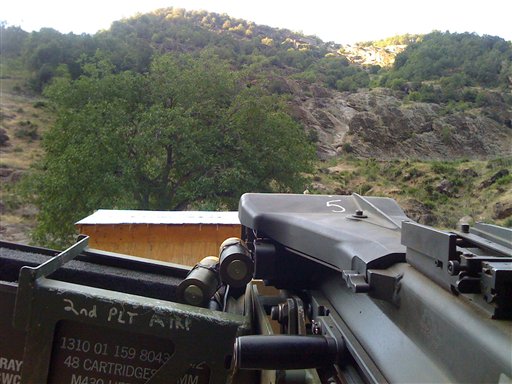
Where I think you hit the nail on the head is when you mention the terrain. The platoon in Wanat sacrificed control of the key terrain in the area in order to locate closer to the population. This was a significant risk, and I don’t see any indication that they attempted to sufficiently mitigate that risk. I can empathize a little bit – I was the first Marine on deck at Camp Blessing back when it was still Firebase Catamount, in late 2003. I took responsibility for the camp’s security from a platoon from the 10th Mountain Div, and established a perimeter defense around it. Looking back, I don’t think I adequately controlled the key terrain around the camp. The platoon that replaced me took some steps to correct that, and I think it played a significant role when they were attacked on March 22nd of 2004. COIN theorists love to say that the population is the key terrain, but I think Wanat shows that ignoring the existing natural terrain in favor of the population is a risky proposition, especially in Afghanistan.
We know that the Taliban are going to conduct mass assaults against our positions. We know that they want the advantage terrain offers them. Yet we continue to emplace Combat Outposts manned by platoon-size U.S. forces in the absolute worst locations imaginable from the perspective of terrain. The … worst … locations … imaginable.
Really. What gives? Is this a sickness within the American military? McChrystal’s position, i.e., deploying the troops in population centers, obviously neglects the countryside in a tip of the hat to the (utterly failed) Soviet model. But the answer to failed combat outposts in poor terrain is not to withdraw. It’s to position the outposts on favorable terrain for force protection and garrison them with the right number of troops.
What’s hard about this?
Prior:






On June 7, 2012 at 4:01 pm, Šťoural said:
Is this a sickness within the American military?
No,it is probably standard operating procedure.
http://www.reuters.com/article/2012/06/07/us-afghanistan-sniper-idUSBRE8560LT20120607
On June 7, 2012 at 4:51 pm, Herschel Smith said:
Yes, Šťoural, I saw this about two hours before you posted this comment. I couldn’t make up anything any worse than this. I’ll have a post on this tonight.