Articles by Herschel Smith


The “Captain” is Herschel Smith, who hails from Charlotte, NC. Smith offers news and commentary on warfare, policy and counterterrorism.


Upgraded A-10s Prove Worth in Iraq

18 years, 6 months ago

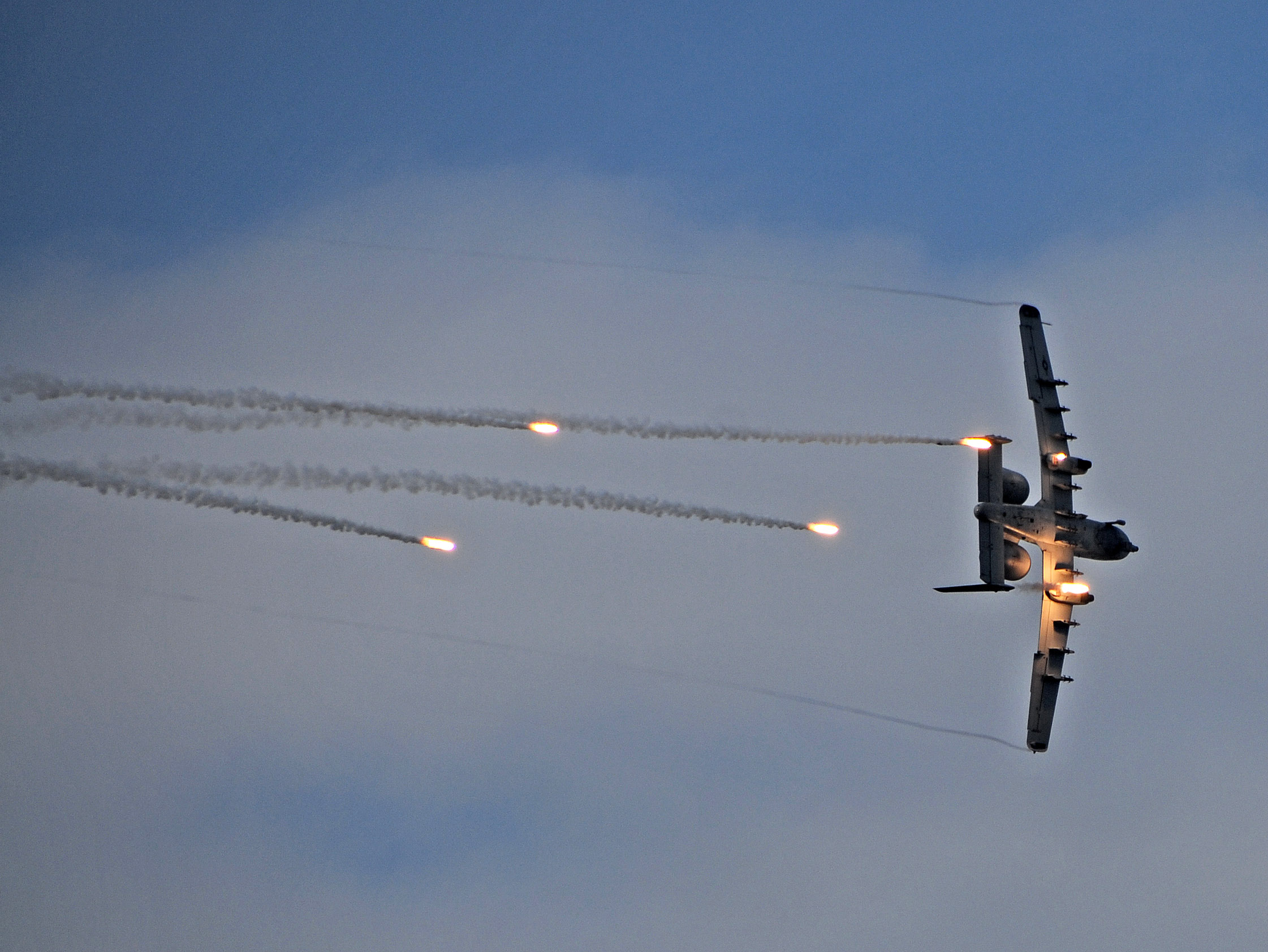
A-10 at Al Asad Air Base, Iraq

Senior Airman Daniel Young marshals in an A-10 Thunderbolt II for munitions disarming after an Oct. 28 mission at Al Asad Air Base, Iraq.

The only problem with the title for the Air Force article is that of assuming that the A-10 is in need of proof of its worth.  For those of use who know about the A-10, it has proven its worth since its creation and continues to do so.  From Al Asad Air Base, Iraq:

A new version of the A-10 Thunderbolt II has been flying over Iraq providing close-air support for the ground troops from Al Asad Air Base for nearly two months.

As part of the Precision Engagement Upgrade Program, the Maryland Air National Guard’s 175th Wing has been converting it’s A-10s from A to C models.

“We are the first A-10C model squadron to deploy to combat,” said Lt. Col. Timothy Smith, the 104th Expeditionary Fighter Squadron commander. “We just transitioned to the aircraft six months prior to coming here, and the C-model was officially declared combat ready just two weeks before we deployed. I am very proud of our unit. We’ve put in a monumental effort, as individuals and as a group to get to this point.”

The A-10C might look the same on the outside, but the recent upgrades have turned the aircraft, which was originally designed to battle Russian tanks during the Cold War, into an even more lethal and precise close-air-support weapons system.

A few of the key upgrades are a “first ever” for the aircraft, said Capt. Rich Hunt, a 104th EFS A-10C pilot. One of them is the situational awareness data link.

“Previously, for me to keep track of all the other airplanes that are around me or to help us perform the mission, I would literally have to write those down with a grease pencil inside my canopy or write them down on a white piece of paper on my knee board in order to keep track of all that,” Captain Hunt said.

“Now I have a color display that has all of the other airplanes that are up supporting the same mission across all of Iraq right now,” he said. And they are all digitally displayed through that data link on my map. So now, especially at night when awareness is a little bit lower, I can look at that beautiful map display and know exactly what other airplanes are around me.”

The new system also provides the pilot with other critical information, such as what the other airplanes might be targeting, what munitions they have on board and fuel levels.

“That awareness provides us with a ton of valuable information in a very user-friendly manner,” the captain said. “(It allows us) to do our mission with a lot clearer understanding of exactly what is going on around us in the battle space and what our wingmen may be targeting” …

Something else the new C-model provides to the pilots is the integration of advanced targeting pods, which have also been upgraded. The new pods include long-range TV and infrared cameras with zoom capabilities and a laser target designator.

“Primarily, we still use the pods for weapons strikes,” Captain Hunt said. “However, in Iraq we find ourselves supporting the troops on the ground by doing a lot of counter improvised explosive devices missions.”

The pods infrared capability can be used to detect buried IEDs by picking up on their heat signature.

The new targeting pods have also been outfitted with the ROVER downlink capability, allowing the aircraft to transmit the live video feed to a joint terminal attack controller on the ground. This allows for more precise strikes with less chance of a chance for collateral damage.

“In Iraq that is especially important because it’s a very difficult situation when we provide close-air support in such a densely urban environment,” the captain said. “By the controller being able to look through my targeting pod real time, we can compare exactly what we are looking at and make sure we have an absolutely 100 percent positive identification of the target.”

Another upgrade that increases the A-10’s precision is that it can now employ the Global Positioning System-guided joint direct attack munitions.

“Sometimes we find ourselves where we have to destroy a terrorist stronghold location. But in the house across the street are friendly Iraqi civilians,” Captain Hunt said. “We know we have to destroy the stronghold, but we don’t want to cause any collateral damage whatsoever. So the JDAM has been outstanding for us. We’ve had unbelievable success where we’ve been able to strike the stronghold without causing any damage to the houses around it.

“Between the situational awareness data link, the targeting pod with the ROVER down link to the controller on the ground and the JDAM, the A-10C on this deployment has been an amazing success for us,” the captain said.

The A-10 has been around the Air Force since the 1970s and with these new upgrades will remain well into the future.

“As technology moved further ahead, we stayed pretty far behind,” Colonel Smith said. “And now, all over sudden, we have leapfrogged all the way pretty much to the front edge of all the technology for everybody.”

But the colonel also said while they are the first unit to fly the C-model in combat, their main focus is not on the upgrades.

“In our minds we are just flying like we normally do,” Colonel Smith said. “We don’t see ourselves as the first A-10C model in combat, we see ourselves as A-10 pilots out helping the guy on the ground. I have great respect for the men and women on the ground. They are the ones who are really putting their lives on the line when they are out there. Our job is to ride shotgun for them — to sit there in position, and ready for them when they need us. And now we have more tools available to do it faster and more precisely.”

Prior at The Captain’s Journal:

Faster Kill Chain
A-10 Update and Pictures
A-10s Aid in Counterinsurgency
Air Power in Small Wars

Just for fun, A-10 Flyover.

Profiles in Courage

18 years, 6 months ago

While most of America is working on a computer, talking on a phone, watching television or at the mall, these brave warriors get up every morning and face something more difficult than most of us will ever know our whole lives.  You should take a minute today and visit the story below (ignoring the politics in it, as always) about badly burned or maimed veterans attempting to recover from their wounds and go on with their lives.  And then say a long prayer for them and their families, and thank God that He gave us men like them.

Profiles in Courage.

Shoes that Shine, the Commandant, and Birthday of the Marines

18 years, 6 months ago

Making it through boot camp at Parris Island creates a special warrior.  There is time later for training in speciality, weapons and tactics, but boot camp teaches a Marine how to be a Marine: how to honor fellow warriors, personal obligation, unit obligation, honor, code, history, and the consequences of personal or unit failure.  The pits, the sand fleas, the austere conditions – all go into making the Island what it is.  Sitting at attention on benches the week of lecture on targeting at the range drives home the necessity to qualify with the rifle at 500 yards, the longest distance of any branch in any armed forces in the world.

Many stories come from boot camp, and these are followed by stories of School of Infantry and the fleet, followed on by stories of Marines from horrible and epic battles in Fallujah and other places where they are deployed.  These stories can never be written down and fully captured, but just as surely must be told with timbre, inflection and context to be understood.  But these stories travel, and people remember.  They know all about the Marines and what it takes to be considered among the greatest warriors on earth.

I know a certain Marine who left his dress shoes with me to take to a repair shop several months ago, and upon picking them up, the owner said “these are nice shoes, where can I get a pair of these?”  I responded by saying that the shoes were purchased on Parris Island.  He and I stood without response for a while, and a man whom I didn’t know in line behind me ended the standoff by yelling to the owner “Sir, you don’t buy those shoes.  You have to earn them!”

And to all who have earned the right to carry the title United States Marine in life and after, happy birthday, 10 November 1775.

Other sources:

Happy Birthday, Marines!, Human Events (h/t Tom Smith at The Tank)

Marine Corps Birthday Message, USMC

232 Years and Counting, US Cavalry On Point

Marines at Landstuhl celebrate Corps’ birthday, Stars and Stripes

Hotel Tango (H/T) to our friend Smitten Eagle, here is the Commandant’s birthday message.  It is made even better by the fact that my favorite actor, Sam Elliot, helps to narrate it.

Western Anbar Versus the Shi’a South: Pictures of Contrast

18 years, 6 months ago

Much discussion has ensued on Eastern Anbar in and around Fallujah, but RCT-2 is seeing steady improvement in Western Anbar Province.

Marines have seen a 75 percent plunge in “enemy incidents

The Anbar Narrative and the Future of the Marines

18 years, 6 months ago

In Payment to Concerned Citizens: Strategy of Genius or Shame?, I discussed payments to neighborhood watch police and “concerned citizens” in Anbar and elsewhere to help achieve community security:

First, this approach is effective.  It was used in Fallujah (a variant of it), and use of this strategy has proven to reduce crime, violence, and increase local control over communities.  Its expansion into Baghdad and surrounding areas has reduced the available terrain in which the insurgency can operate.

Second, this approach is anthropologically sound.  A search of scholarly works pointing to the role of head of house as the income-earner and supporter of the family unit yields so many results that it is utterly impossible to digest it all …  Giveaway programs and inability among men to support their families is dishonorable.  More honorable, however, is the earning of income for services rendered.

Third and finally, it is the right thing to do.  Men and women both are searching for a way to support and provide for their families in the wake of collapse of their civilization.

Regarding the first two points, we see the results of the expansion of this program into areas other than Anbar first hand from an officer who was recently deployed Southwest of Baghdad.

Army 1st Lt. Michael Kelvington has seen things change dramatically for the better in the town where he has served in Iraq for more than a year.

The 2001 Springfield High School and 2005 West Point graduate, serves with Company A, 1st Battalion, 501st Airborne, 4th Brigade Combat Team, 25th Infantry Division, in Jurf as Sakhr, a town southwest of Baghdad.

Today, Kelvington, 25, who spoke via telephone from Iraq and expects to leave Iraq later this fall, talks about how the town’s people have come to the aid of the Americans and have told al-Qaida warriors to stay away.

Q: What was going on in the town before you got there?

A: To make a long story short, and to sum up the last 12 months of the deployment, we had small-arms fire, mortar attacks, IEDs in the roads. Something happened pretty much every day. Along with us and the Iraqi Army guys, the people in the town were getting tired of it.

We got a new sheik. And basically, he came to us with this idea of civilians from the area manning checkpoints and basically arming themselves against al-Qaida in our area.

One of the big problems in our area is unemployment. Al-Qaida would recruit these guys to do things like place bombs in the roads and try to attack our patrol base and shoot at our towers. A few times we’ve had hand grenades come over the wall where we operate. They would pay them to make those attacks.

Those people had no alternative. It’s a poor agrarian area. They have mouths to feed. A lot of times that is what they would do for money.

Now, with this new program, they are getting paid to protect their own areas and secure their neighborhoods, almost like an armed neighborhood watch program.

Q: Is what’s happening in your town happening elsewhere in Iraq?

A: The idea originally started in Anbar province

As I have stated before, the Anbar narrative is rich and involved counterinsurgency applied in one of the most difficult regions of the world, far more involved and complex than the story about a tribe or two “flipping” to support the U.S.  The Anbar province represents three years of investment by U.S. forces (primarily Marines, but certainly supplemented by Army and National Guard), and its model is proving successful in other parts of Iraq.  So what will happen to the Marines now that Anbar is relatively safe?  We have covered the Commandant’s plans to redeploy Marines to Afghanistan in The Future of the Marines and Marines Take, Army Holds?  The Commandant has taken some flak for his preliminary plans, but recently shot back a retort:

The proposal to remove Marines from Iraq and send them to Afghanistan is neither a power grab nor an attempt to get out of Iraq “while the getting is good,

A Call for Global Strategic Thinking

18 years, 6 months ago

Having been a strong proponent of the wise and strategic use of air power in small wars, The Captain’s Journal continues to advocate both retooling and rethinking not only the Air Force proper, but air assets in the Navy, Army and Marines.  The order of the day seems to be small wars and counterinsurgency, and any air support of the efforts in Iraq and Afghanistan are bound to be highly visible.  The Air Force knows this, and the Multinational Force cooperates with the need to publicize the many accomplishments of air power in Operation Iraqi Freedom.  MNF press releases routinely include air power summaries, whether involving precision-guided munitions, A-10 engagements, helicopter gunship engagements, or flyovers to cause a “show of force.”

This advocacy for involvement in small wars on our part can be misconstrued, however, to intend the diminution of the Air Force proper, and some analysts have gone on record advocating not just the diminishing of the Air Force, but the complete reorganization of this branch into the other branches of the U.S. Armed Forces, in a role subservient to the needs of the specific branch to which the assets have been assigned.  But are these calls for busting up the Air Force really strategic, and if so, how forward reaching is the underlying strategy?

In terms of global strategic thinking, Pentagon senior leadership has bigger problems than what to do with the Air Force.  In a stark admission of what repeated and protracted (15 month) deployments have done to the Army, Chairman of the Joint Chiefs of Staff Admiral Mike Mullen weighed in on his view of the current state of the ground forces: “Are the ground forces broken? Absolutely not,

Regional Flux and the Long War

18 years, 6 months ago

Former Commander of CENTCOM General John Philip Abizaid, born to a Christian Lebanese-American father and fluent in Arabic and knowledgeable in Middle Eastern culture, coined the phrase long war to describe the conflict with extremist Islamic groups such as al Qaeda.  This phrase was dropped by Admiral William J. Fallon, but the idea is the same and the conflict will not go away because the phrase isn’t used at CENTCOM any more.

Michael Yon has posted an interesting and well-supported article entitled Al Qaeda is Defeated.  He documents the perspective of a powerful South Baghdad tribe concerning al Qaeda violence in their city.

Sheik Omar, who has gained the respect of American combat leaders for his intelligence and organizational skills, said the tough line against al Qaeda is also enforced at the tribal level. According to Sheik Omar, the Jabouri tribe, too, is actively committed to destroying al Qaeda. So much so, that Jabouri tribal leaders have decided they would “kill their own sons

The Sniper Threat and USA Today Hit Piece

18 years, 6 months ago

IEDs have received their due attention, but with the exception of web sites like this one, sniper attacks have been somewhat overlooked in the press in terms of troop risk and force protection.  The Department of Defense knows about the risk, and has requested supplemental funding to decrease the risk for fiscal year 2008.

The dangers from enemy sniper attacks have increased steadily during the past year, with the number of attacks quadrupling. These attacks have not only caused numerous casualties, but have had an adverse psychological effect on both Coalition forces and the Iraqi civilian populace. Victims in sniper incidents have a fatality rate of over 70 percent. A shift in enemy tactics that increases the number of sniper attacks could potentially inflict even more casualties than IEDs. To guard against such a shift, the Amendment includes $1.4 billion for a full suite of counter-sniper capabilities designed to prevent, survive, and react to sniper attacks. This includes enhanced optics, soldier protection, active sniper defeat systems, sensors, concealment, and development of new tactics.

Tens of millions of people were walking to work a few days after this was released and glanced over at the newspaper stands seeing USA Today charge the Pentagon with falsification of data regarding the sniper threat in Iraq.

The Pentagon has asked Congress for $1.4 billion in emergency spending to combat a growing threat of sniper attacks in Iraq based on an overstated assessment of the extent of the attacks, its records show.

In last week’s spending request, the Pentagon said sniper attacks have quadrupled in the past year and, if unchecked, the attacks could eclipse roadside bombs as the top killer of U.S. troops. However, the rate of sniper attacks has dropped slightly in 2007 and fallen dramatically in the past four months, according to military records given to USA TODAY.

Pentagon officials acknowledged the mistake Monday after questions about the data were raised by USA TODAY.

“The term quadrupled will be removed from the justification because it is simply incorrect,” said Dave Patterson, deputy undersecretary of Defense.

In 2006, there were 386 sniper attacks on coalition forces, according to data from the Multi-National Force-Iraq headquarters in Iraq. Through Oct. 26 of this year, there were 269 sniper attacks, the figures show.

Noah Shachtman at Danger Room responded to his initial discussion of this with nevermind, and various left leaning blogs jumped on the opportunity to charge the Pentagon with dishonesty.  But should Noah have stuck to his guns, and do the left leaning blogs have something to crow about?  The answer is certainly not nevermind.

Spook at In From the Cold has an interesting analysis of the data given to USA Today.

First, let’s examine the so-called “rate of attacks” cited by the paper. In 2007, the military reported 386 sniper attacks against coalition forces in Iraq, an average of just over one per day. Through 26 October of this year, there have been 269 sniper attacks, an average of less than one a day. But the paper also acknowledges that there has been a dramatic drop over the last four months–without acknowledging the apparent reason for the decrease, i.e., the troop surge (emphasis mine). Mistake #1.

USA Today’s second error is failing to compute the surge’s impact on the decrease in sniper attacks. Without the drop that occurred between July and October, what would the numbers look like? While it’s highly unlikely that the difference would equal a four-fold increase, it is reasonable to assume that without the surge (and the recent drop in violence), the number of sniper attacks would be on pace with last year’s total–or perhaps slightly higher. That would provide additional justification for sniper mitigation programs.

This is true, and while it calls into question the USA Today model for understanding the data, and while it is tempting to go down this analysis rabbit trail, it neglects the fundamental flaws in the article.  Consider the number again: 269 sniper attacks.  So precisely what constitutes a sniper attack, according to the Multinational Force data?  Deaths of U.S. servicemen is routinely reported as something like “Multinational Force West forces attacked,” for example.  If attacks means deaths or casualties, then the data necessitates consideration of a host of things other than sniper risk, such as the success of the surge, overall success of Operation Iraqi Freedom, combat operations, both planned and intelligence-driven, etc.  Any Soldier or Marine in a hot spot in Iraq knows that the value of 269 doesn’t come close to representing the number of shots taken by an individual Platoon or Company during deployment, much less the entirety of the U.S. forces in Iraq.  This number is so low that even the USA Today reporter should have questioned the use of it to prove anything, much less the extent of the sniper threat in Iraq.

Moreover, while it is easy to define an IED, we may ask the question “how do we define a sniper attack?”  Would the definition of “fire received from a position of concealment with U.S. forces lacking positive identification (PID) of the enemy” suffice?  If so, then the vast majority of small arms fire in Iraq is sniper fire, at least initially, given the military operations on urban terrain (MOUT).

Semantics cloud the issue and precise definitions elude us.  It is simple enough to parse U.S. risk into two cause categories: IEDs and small arms fire (whether they immediately redound to casualties or not).  The Department of Defense, although lethargic to respond, now has a robust program of MRAPs and other equipment to address the IED problem.  While there are various gadgets that the DoD is investigating, the solution to the sniper problem seems to have three avenues of approach: time, distance and shielding.  Distance is a difficult tactic to leverage to our advantage, since urban terrain presents the closest combat operations anywhere on earth.  The two remaining avenues are time and shielding.

Time may be dealt with at the tactical level by maneuvers such as satellite patrols, modifications and variations on satellite patrols, rapid movement, concealment, etc.  But regardless of how small a Soldier or Marine makes himself, small arms fire is a difficult problem, and as we have covered here, shooters have learned to aim for areas not covered by ceramic ballistic plates (head, neck, and armpits just above the side ESAPI plate, especially if it is sagging because of being hung with Molle straps).  Terry Nickelson, previously embedded with Golf Company, 2nd Battalion, 6th Marine Regiment, reported recently from Fallujah.

Movement – and staying behind cover — is the best defense against snipers.  They dash across intersections and run across fields and vacant lots filled with rubble all the while zigging and zagging, bobbing and weaving, and turning and pivoting to make themselves as difficult targets as possible.  With all the extra movement – and weight – crossing a 100 meter vacant lot can become a 200 meter broken field lung-burster …

It was during a similar patrol a week or so earlier that a Marine from Golf Company was on the roof of a similar house and — with a sudden,  small spark as a bullet flew through the back of his kevlar helmet —  was killed.  According to his friends, he was what he wanted to be – a Marine …

One insurgent sniper has a signature shot: the bullet piercing both the neck and the mouth of his targets.  He is credited with several kills.  Intelligence officers believe that a rogue American has trained him and other insurgents.

Body armor is heavy, and an Australian soldier was recently killed in Afghanistan because the mission stipulated quick maneuverability.  Shielding requires that the warrior wear the armor, and it requires maneuverability, something suffering under the weight of 32 pounds of armor with the current system.  Moreover, ballistic plate coverage needs to be larger, but this requires investment and research in order to keep the weight down so that the warrior can physically move in the battlespace.

And thus we are back to where we started.  In order to formulate an article on funding for countersniper measures, USA Today likely threatened to complete the paperwork for a freedom of information act request.  They summed a few numbers supplied by Multinational Force command, and proceeded to craft a hit piece to put in front of millions of people.  Yet the definitions are imprecise, the data close to meaningless, and the article is without research.  The author of the article has likely never worn body armor, or taken fire from a concealed location, or stepped into a street filled with fire to run for the next domicile, or stood on the roof of a house firing a squad automatic weapon to provide suppressing fire for his fire team or squad to escape danger.

The article’s author – Tom Vanden Brook – knows nothing of being in the line of fire.  It would be appropriate for him to grab a camera, put on some body armor, and report from the field before he implies that U.S. warriors are not suffering from a “sniper” problem or that funds are not needed.  Even if the Pentagon goofed on the data (which we have stated to be irrelevant to the case in point), fire from concealment will be a problem into the future not only in Iraq, but in the forgotten war, Afghanistan.  In the mean time, the USA Today article is worthless until Tom goes into the field to get his facts straight.

Prior:

TCJ, Snipers.

TCJ, Body Armor.

Target: Jamal al-Badawi

18 years, 6 months ago

The mastermind behind the USS Cole bombing has either been released by authorities in Yemen, or is soon to be released.

The United States is dismayed over what officials said was Yemen’s failure to cooperate in the war against Al Qaida.

The Bush administration expressed disappointment with Yemen’s decision to release the man regarded as the mastermind of the Al Qaida attack on the USS Cole in Aden in 2000.

“The United States is dismayed and deeply disappointed in the government of Yemen’s decision not to imprison [Al] Badawi,” National Security Council spokesman Gordon Johndroe said. “This action is inconsistent with a deepening of our bilateral counterterrorism cooperation.”

Officials said Sanaa has largely failed to respond to a significant U.S. investment in Yemen’s military and security forces. They pointed to about $100 million in U.S. military and security assistance since 2004, which included the formation of Yemen’s coast guard.
“We have communicated our displeasure to Yemeni officials and will work with the Yemeni government to ensure Al Badawi is held accountable for his past terrorist actions,” Johndroe said on Oct. 26.

In 2004, Al Badawi was convicted of plotting and conducting the bombing of the USS Cole. A Yemeni court condemned Al Badawi to death, but the sentence was reduced to 15 years in prison.

Still, officials said, Yemen has failed to keep Al Badawi and other Al Qaida operatives behind bars. He escaped prison twice since 2004, allegedly with help of Yemeni jailers. The FBI has offered $5 million for information that would lead to his arrest.

Officials said the release of Jamal Al Badawi violated a pledge to capture and prosecute those behind the suicide attack in which 17 American sailors were killed. In mid-October, Al Badawi surrendered to Yemeni authorities in an arrangement that allowed him to return home to Aden. Al Badawi, officials said, pledged loyalty to the regime of Yemeni President Ali Abdullah Saleh.

On Sunday, Yemen asserted that Al Badawi was still in detention. But the Yemeni Interior Ministry would not elaborate.

It is a truism that the best developed plans will come to naught at times when the predicate for the plans is the honor of other men and nations.  The U.S. must negotiate and purchase and obtain agreement and all of the things that the State Department works at, but in the end, we must be prepared to be alone in the pursuit of our own national security interests.

But when other countries fail us, what is the recourse?  The Small Wars Journal Blog is currently hopping with interesting debate about the moral viability of torture – or lack thereof – and while this debate is salient for future detainees, we face a situation in which a major terrorist is about to be released into the global population with the knowledge and consent of the host country.

So will there be a well-aimed sniper round targeted at Badawi, or a neatly devised car bomb set to detonate at exactly the right time?  Will U.S. black operations be his undoing, or will he live to perpetrate yet another disaster on U.S. troops somewhere else in the world?  Mind you, this isn’t a low level actor; this is a major player in the world of jihadist terror.

The answer is a bit involved.  Even if Badawi was on the physical field of battle, there is question as to whether the rules of engagement allow the targeting of even a known enemy if said enemy is not currently brandishing a weapon and currently a threat to U.S. forces.  But this situation is even more murky and complex, and this complexity explains the consternation of U.S. diplomats at the release of Badawi.

Some background.  First in U.S. jurisprudence there is the constitution.  Its liberties and strictures guides the making of laws.  Second comes law, and of course this requires the approval of the Senate and House of Representatives, along with the approval of the President unless there is an override of a veto.  Next comes regulations.  This is where is becomes murky, because the executive branch takes the laws that have been passed by the Congress and interprets them and adds to the law in order to make something actually able to be enforced, i.e., regulations.  At this level, challenge can be brought in court, and negotiations pursued with the proper authorities regarding code compliance.

This process is ugly and tedious, much like making saugage.  It involves thousands of lawyers, federal register notices, comments, incorporation of comments, and ultimately the approval of yet more lawyers resulting in revisions to the federal code.  It probably gives far too much power to the executive branch of the government, but given the dysfunction of the legislative branch of the government, it is understandable.  When one branch abdicates its responsibilities, the others swarm into the gap.

Next comes an even murkier and lower level regulation, the so-called “executive order.”  Effective March 1, 1976, President Ford issued the following executive order: “No employee of the United States Government shall engage in, or conspire to engage in, political assassination.”  And there is the crux of the issue, and in large part the reason for the panic at the State Department.

No sitting President wants to be the one who reverses this order, and yet no sitting President wants to be responsible for allowing a high level terrorist back into the global population to cause further harm to U.S. forces and assets around the world.  But this executive order is in serious need of revisiting and revision, unless of course, the U.S. is just fine with releasing Jamal al-Badawi to perpetrate his wares.

Homecoming!

18 years, 6 months ago

A son comes home from war, a crucial campaign has been won in Fallujah, and the homecoming of 2nd Battalion, 6th Marine Regiment, Golf Company, a unit which has performed heroically in Iraq, is as remarkable for who didn’t show up as who did.

In answer to ten thousand prayers, our son, who has earned the Combat Action Ribbon, has come home safely from Fallujah. 2nd Battalion, 6th Marine Regiment, Golf Company, arrived home on Tuesday, October 16th, from Fallujah, Iraq. Families were ecstatic to see the busses finally arriving at Camp Lejeune from Cherry Point.

homecoming-034.jpg

The busses arrive at Camp Lejeune from Cherry Point, to waiting family, most of whom had been there for two or more hours.

I had what I believed to be a reliable offer to embed with the Marines and report from Fallujah, but this offer dried up, and I was left with the wonderful reporting by Jim Spiri and Bill Ardolino, along with some of my own research, all of which was better than any report from the main stream media.

It has been a hard ride for me as father of a warrior. Upon the inevitable reports of deaths of Marines in Anbar (without names being released as is the practice), I found myself unable to sleep many nights, and I spent some amount of time at the front door waiting on that visit from Marine officers that thankfully never came. I will find a way to embed with 2/6 the next time they deploy, God willing.

But it has been a productive seven months for the Marines in Fallujah. With the advances against the insurgency in Ramadi and other parts of Anbar, Fallujah (and the surrounding area) had become a safe haven for rogue elements and a veritable witch’s brew of foreign terrorists and indigenous insurgents who were using this area of operations as a launching point not only for attacks in Fallujah, but Baghdad and other areas. It was the last stronghold of the enemy in the Anbar Province, and without pacification of Fallujah, Anbar could have been turned against coalition forces and the tribal “awakening.”

Upon arrival at Forward Operating Base Reaper by 2/6, the security situation had badly degraded in Fallujah, but due in no small part to the bravery and hard work of the 2/6 Marines, it has been reported that last week there was not a single military casualty — Iraqi or U.S. — in Anbar.

The 2/6 Marines (and in particular, Golf Company, 3rd Platoon), engaged in more kinetic operations than reported in the main stream media or the Multinational Force, and 2/6 engaged in more reconstruction and rebuilding activity than reported. From intense fire fights and endless patrols, to gated communities and biometrics and sewage system reconstruction, Fallujah is a model for counterterrorism and counterinsurgency. It occurred at an accelerated pace, as if counterinsurgency on speed and steroids. It will be studied in war college classrooms for decades to come – or at least, it should be.

We stayed on Emerald Island, the Southernmost island of the Outer Banks, 20 miles from Camp Lejeune and an extremely well-kept secret and absolutely lovely and wonderful place. The next evening after receiving our son home, we fed him and six other Marines steak and all of the sides. They ate an enormous amount of beef that night, and we listened to stories until very late. It was a good time, and we knew that we were in the company of heros of Operation Iraqi Freedom, brothers to Marines who preceeded them in the great battles of the South Pacific – men, 21 and 22 years old, who had already played a pivotal role in something more important than most people will ever experience in an entire lifetime.

The day 2/6 Golf Company arrived home, only I (as a Milblogger) and Terry Nickelson were there to report on it (Terry embedded with 2/6, and is doing what he hopes to be a PBS special on Chaplains). For the next few days I monitored both the Jacksonville Daily News, and the Camp Lejeune news (The Globe), and there were no reports of 2/6 coming home.

Victor Davis Hanson observed approximately a year ago of the brave troops in battle in Iraq that “The safety of millions of brave Iraqi reformers, the prestige of the United States and its military, the policy of fostering democratic reform in the Middle East, the end to the nexus between failed autocracies and scapegoating the West through terrorists; success of the Bush Administration; the effectiveness of the Democratic opposition; the divide between Europe and America; the attitude toward the United States of the Middle East autocracies; the reputation of the Islamic terrorists — all that will be adjudicated by the verdict in Iraq. Rarely have so many ideologies, so much politics, so many reputations been predicated on just a few thousand American combat soldiers and their Iraq allies.”

Indeed. Those brave warriors recently returned to the States, and only their loved ones were there to greet them. I can recall not too long ago the press reports in the main stream media of returning warriors, their accomplishments, and their losses. It has all become so very passé, now, and few pay attention to the details. This attitude prevents us from feeling the grief that parents feel from the losses of Lance Corporal Dale G. Peterson, Lance Corporal Walter K. O’Haire, and Lance Corporal Jonathan E. Kirk; it prevents us from experiencing the joy that others feel upon the safe arrival of their sons or husbands; and it prevents us from being reminded of why we sent these men to war.


26th MEU (10)
Abu Muqawama (12)
ACOG (2)
ACOGs (1)
Afghan National Army (36)
Afghan National Police (17)
Afghanistan (704)
Afghanistan SOFA (4)
Agriculture in COIN (3)
AGW (1)
Air Force (42)
Air Power (10)
al Qaeda (83)
Ali al-Sistani (1)
America (23)
Ammunition (305)
Animals (328)
Ansar al Sunna (15)
Anthropology (3)
Antonin Scalia (1)
AR-15s (395)
Arghandab River Valley (1)
Arlington Cemetery (2)
Army (91)
Assassinations (2)
Assault Weapon Ban (29)
Australian Army (7)
Azerbaijan (4)
Backpacking (4)
Badr Organization (8)
Baitullah Mehsud (21)
Basra (17)
BATFE (247)
Battle of Bari Alai (2)
Battle of Wanat (18)
Battle Space Weight (3)
Bin Laden (7)
Blogroll (3)
Blogs (24)
Body Armor (23)
Books (3)
Border War (18)
Brady Campaign (1)
Britain (39)
British Army (36)
Camping (5)
Canada (20)
Castle Doctrine (1)
Caucasus (6)
CENTCOM (7)
Center For a New American Security (8)
Charity (3)
China (19)
Christmas (18)
CIA (30)
Civilian National Security Force (3)
Col. Gian Gentile (9)
Combat Outposts (3)
Combat Video (2)
Concerned Citizens (6)
Constabulary Actions (3)
Coolness Factor (3)
COP Keating (4)
Corruption in COIN (4)
Council on Foreign Relations (1)
Counterinsurgency (218)
DADT (2)
David Rohde (1)
Defense Contractors (2)
Department of Defense (220)
Department of Homeland Security (26)
Disaster Preparedness (5)
Distributed Operations (5)
Dogs (15)
Donald Trump (27)
Drone Campaign (4)
EFV (3)
Egypt (12)
El Salvador (1)
Embassy Security (1)
Enemy Spotters (1)
Expeditionary Warfare (18)
F-22 (2)
F-35 (1)
Fallujah (17)
Far East (3)
Fathers and Sons (2)
Favorite (1)
Fazlullah (3)
FBI (39)
Featured (192)
Federal Firearms Laws (18)
Financing the Taliban (2)
Firearms (1,873)
Football (1)
Force Projection (35)
Force Protection (4)
Force Transformation (1)
Foreign Policy (27)
Fukushima Reactor Accident (6)
Ganjgal (1)
Garmsir (1)
general (15)
General Amos (1)
General James Mattis (1)
General McChrystal (44)
General McKiernan (6)
General Rodriguez (3)
General Suleimani (9)
Georgia (19)
GITMO (2)
Google (1)
Gulbuddin Hekmatyar (1)
Gun Control (1,724)
Guns (2,412)
Guns In National Parks (3)
Haditha Roundup (10)
Haiti (2)
HAMAS (7)
Haqqani Network (9)
Hate Mail (8)
Hekmatyar (1)
Heroism (5)
Hezbollah (12)
High Capacity Magazines (16)
High Value Targets (9)
Homecoming (1)
Homeland Security (3)
Horses (2)
Humor (72)
Hunting (62)
ICOS (1)
IEDs (7)
Immigration (123)
India (10)
Infantry (4)
Information Warfare (4)
Infrastructure (4)
Intelligence (23)
Intelligence Bulletin (6)
Iran (171)
Iraq (379)
Iraq SOFA (23)
Islamic Facism (64)
Islamists (98)
Israel (19)
Jaish al Mahdi (21)
Jalalabad (1)
Japan (3)
Jihadists (82)
John Nagl (5)
Joint Intelligence Centers (1)
JRTN (1)
Kabul (1)
Kajaki Dam (1)
Kamdesh (9)
Kandahar (12)
Karachi (7)
Kashmir (2)
Khost Province (1)
Khyber (11)
Knife Blogging (7)
Korea (4)
Korengal Valley (3)
Kunar Province (20)
Kurdistan (3)
Language in COIN (5)
Language in Statecraft (1)
Language Interpreters (2)
Lashkar-e-Taiba (2)
Law Enforcement (6)
Lawfare (14)
Leadership (6)
Lebanon (6)
Leon Panetta (2)
Let Them Fight (2)
Libya (14)
Lines of Effort (3)
Littoral Combat (8)
Logistics (50)
Long Guns (1)
Lt. Col. Allen West (2)
Marine Corps (281)
Marines in Bakwa (1)
Marines in Helmand (67)
Marjah (4)
MEDEVAC (2)
Media (68)
Medical (146)
Memorial Day (6)
Mexican Cartels (47)
Mexico (71)
Michael Yon (6)
Micromanaging the Military (7)
Middle East (1)
Military Blogging (26)
Military Contractors (5)
Military Equipment (25)
Militia (9)
Mitt Romney (3)
Monetary Policy (1)
Moqtada al Sadr (2)
Mosul (4)
Mountains (25)
MRAPs (1)
Mullah Baradar (1)
Mullah Fazlullah (1)
Mullah Omar (3)
Musa Qala (4)
Music (25)
Muslim Brotherhood (6)
Nation Building (2)
National Internet IDs (1)
National Rifle Association (97)
NATO (15)
Navy (31)
Navy Corpsman (1)
NCOs (3)
News (1)
NGOs (3)
Nicholas Schmidle (2)
Now Zad (19)
NSA (3)
NSA James L. Jones (6)
Nuclear (63)
Nuristan (8)
Obama Administration (222)
Offshore Balancing (1)
Operation Alljah (7)
Operation Khanjar (14)
Ossetia (7)
Pakistan (165)
Paktya Province (1)
Palestine (5)
Patriotism (7)
Patrolling (1)
Pech River Valley (11)
Personal (77)
Petraeus (14)
Pictures (1)
Piracy (13)
Pistol (4)
Pizzagate (21)
Police (672)
Police in COIN (3)
Policy (15)
Politics (999)
Poppy (2)
PPEs (1)
Prisons in Counterinsurgency (12)
Project Gunrunner (20)
PRTs (1)
Qatar (1)
Quadrennial Defense Review (2)
Quds Force (13)
Quetta Shura (1)
RAND (3)
Recommended Reading (14)
Refueling Tanker (1)
Religion (501)
Religion and Insurgency (19)
Reuters (1)
Rick Perry (4)
Rifles (1)
Roads (4)
Rolling Stone (1)
Ron Paul (1)
ROTC (1)
Rules of Engagement (76)
Rumsfeld (1)
Russia (37)
Sabbatical (1)
Sangin (1)
Saqlawiyah (1)
Satellite Patrols (2)
Saudi Arabia (4)
Scenes from Iraq (1)
Second Amendment (713)
Second Amendment Quick Hits (2)
Secretary Gates (9)
Sharia Law (3)
Shura Ittehad-ul-Mujahiden (1)
SIIC (2)
Sirajuddin Haqqani (1)
Small Wars (72)
Snipers (9)
Sniveling Lackeys (2)
Soft Power (4)
Somalia (8)
Sons of Afghanistan (1)
Sons of Iraq (2)
Special Forces (28)
Squad Rushes (1)
State Department (23)
Statistics (1)
Sunni Insurgency (10)
Support to Infantry Ratio (1)
Supreme Court (82)
Survival (216)
SWAT Raids (58)
Syria (38)
Tactical Drills (38)
Tactical Gear (17)
Taliban (168)
Taliban Massing of Forces (4)
Tarmiyah (1)
TBI (1)
Technology (21)
Tehrik-i-Taliban (78)
Terrain in Combat (1)
Terrorism (96)
Thanksgiving (13)
The Anbar Narrative (23)
The Art of War (5)
The Fallen (1)
The Long War (20)
The Surge (3)
The Wounded (13)
Thomas Barnett (1)
Transnational Insurgencies (5)
Tribes (5)
TSA (25)
TSA Ineptitude (14)
TTPs (4)
U.S. Border Patrol (8)
U.S. Border Security (22)
U.S. Sovereignty (29)
UAVs (2)
UBL (4)
Ukraine (10)
Uncategorized (105)
Universal Background Check (3)
Unrestricted Warfare (4)
USS Iwo Jima (2)
USS San Antonio (1)
Uzbekistan (1)
V-22 Osprey (4)
Veterans (3)
Vietnam (1)
War & Warfare (435)
War & Warfare (41)
War Movies (4)
War Reporting (21)
Wardak Province (1)
Warriors (6)
Waziristan (1)
Weapons and Tactics (80)
West Point (1)
Winter Operations (1)
Women in Combat (21)
WTF? (1)
Yemen (1)

May 2026
April 2026
March 2026
February 2026
January 2026
December 2025
November 2025
October 2025
September 2025
August 2025
July 2025
June 2025
May 2025
April 2025
March 2025
February 2025
January 2025
December 2024
November 2024
October 2024
September 2024
August 2024
July 2024
June 2024
May 2024
April 2024
March 2024
February 2024
January 2024
December 2023
November 2023
October 2023
September 2023
August 2023
July 2023
June 2023
May 2023
April 2023
March 2023
February 2023
January 2023
December 2022
November 2022
October 2022
September 2022
August 2022
July 2022
June 2022
May 2022
April 2022
March 2022
February 2022
January 2022
December 2021
November 2021
October 2021
September 2021
August 2021
July 2021
June 2021
May 2021
April 2021
March 2021
February 2021
January 2021
December 2020
November 2020
October 2020
September 2020
August 2020
July 2020
June 2020
May 2020
April 2020
March 2020
February 2020
January 2020
December 2019
November 2019
October 2019
September 2019
August 2019
July 2019
June 2019
May 2019
April 2019
March 2019
February 2019
January 2019
December 2018
November 2018
October 2018
September 2018
August 2018
July 2018
June 2018
May 2018
April 2018
March 2018
February 2018
January 2018
December 2017
November 2017
October 2017
September 2017
August 2017
July 2017
June 2017
May 2017
April 2017
March 2017
February 2017
January 2017
December 2016
November 2016
October 2016
September 2016
August 2016
July 2016
June 2016
May 2016
April 2016
March 2016
February 2016
January 2016
December 2015
November 2015
October 2015
September 2015
August 2015
July 2015
June 2015
May 2015
April 2015
March 2015
February 2015
January 2015
December 2014
November 2014
October 2014
September 2014
August 2014
July 2014
June 2014
May 2014
April 2014
March 2014
February 2014
January 2014
December 2013
November 2013
October 2013
September 2013
August 2013
July 2013
June 2013
May 2013
April 2013
March 2013
February 2013
January 2013
December 2012
November 2012
October 2012
September 2012
August 2012
July 2012
June 2012
May 2012
April 2012
March 2012
February 2012
January 2012
December 2011
November 2011
October 2011
September 2011
August 2011
July 2011
June 2011
May 2011
April 2011
March 2011
February 2011
January 2011
December 2010
November 2010
October 2010
September 2010
August 2010
July 2010
June 2010
May 2010
April 2010
March 2010
February 2010
January 2010
December 2009
November 2009
October 2009
September 2009
August 2009
July 2009
June 2009
May 2009
April 2009
March 2009
February 2009
January 2009
December 2008
November 2008
October 2008
September 2008
August 2008
July 2008
June 2008
May 2008
April 2008
March 2008
February 2008
January 2008
December 2007
November 2007
October 2007
September 2007
August 2007
July 2007
June 2007
May 2007
April 2007
March 2007
February 2007
January 2007
December 2006
November 2006
October 2006
September 2006
August 2006
July 2006
June 2006
May 2006

about · archives · contact · register

Copyright © 2006-2026 Captain's Journal. All rights reserved.