Articles by Herschel Smith


The “Captain” is Herschel Smith, who hails from Charlotte, NC. Smith offers news and commentary on warfare, policy and counterterrorism.


Attacking the Enemy’s Strategy in Iraq

18 years, 4 months ago

“Thus, what is of supreme importance in war is to attack the enemy’s strategy.  Next best is to disrupt his alliances.  The next best is to attack his army.”  Sun Tzu, The Art of War, III.4 – III.6

The role of Syria – at least tacitly – in the suicide bombings in Iraq and other foreign terrorist activities is well known.  Yet only recently is the United States diplomatic corps said to have lost patience with Syria.  Despite reports to the contrary, Iran continues to fund, arm, train and supply terrorists in Iraq in an effort to destabilize the country.  The foreign origins of the violence in Iraq could have been (and could be) better addressed than it has been.  The EFP (explosively formed projectile) factories in Iran should have been enemy targets as much as insurgent domiciles, and the Syrian Imams who recruited and supplied suicide bombers into Iraq should have been considered enemy fighters as much as those holding a weapon in Fallujah or Baghdad.  While the U.S. has conducted robust kinetic operations against the foreign fighters in Iraq with huge success, the strategy could still have been completed with so-called black operations against rogue elements in Syria and more visible operations against EFP factories in Iran (or at least diplomatic pressure against Iran, something the State Department seems loath to do).

However, in the area of the indigenous insurgents, the U.S. strategy has been more lucid.  The goal in counterinsurgency is to disrupt the allegiance of the people to the insurgents and then to ameliorate the conditions that led to the insurgency.  Kinetic operations against foreign fighters were necessary because they fight mainly due to religious motivation.  However, for the indigenous fighters, for months we have advocated both settling with the erstwhile insurgents and payment to the concerned citizens as both effective and anthropologically sound.  It has become in vogue, especially among the political left, to level very specific criticisms at this approach.  Kevin Drum gives us the template for this strategy bashing.

I’ve mentioned a few times before that our “bottoms up” strategy of supporting Sunni tribes in the provinces surrounding Baghdad carries a number of risks. The biggest risk, I suppose, is that once the tribes finally feel safe from the threat of al-Qaeda in Iraq, they’ll relaunch their insurgency and start shooting at American soldiers again. The second biggest risk is that the Shiite central government understands perfectly well that “competing armed interest groups” in the provinces are — well, competing armed interest groups.

That phrase comes from Australian Lt. Col. David Kilcullen (here), and a week ago I linked to a quote from a U.S. Army officer who was fairly candid about the effect that arming the tribes is likely to have on the balance of power in Iraq. “The grass-roots level will force change at the top,” he suggested, “because if they do not act on it, they will get overrun.”

Quite so. And does the Maliki government understand this threat? Via Cernig, AP reporter Diaa Hadid makes it clear that they do indeed:

Iraq’s Shiite-led government declared Saturday that after restive areas are calmed it will disband Sunni groups battling Islamic extremists because it does not want them to become a separate military force.

….The statement from Defense Minister Abdul-Qadir al-Obaidi was the government’s most explicit declaration yet of its intent to eventually dismantle the groups backed and funded by the United States as a vital tool for reducing violence.

“We completely, absolutely reject the [Sunni] Awakening becoming a third military organization,” al-Obaidi said at a news conference.

He added that the groups would also not be allowed to have any infrastructure, such as a headquarters building, that would give them long-term legitimacy. “We absolutely reject that,” al-Obaidi said.

The Maliki government has made similar noises in the past, but this is by far the most unequivocal they’ve ever been about it. And needless to say, the Sunni leaders are having none of it. There’s exactly zero chance that they will ever voluntarily disband their “Concerned Local Citizens” groups.

Who knows? Maybe this is posturing more than anything else. Maybe Petraeus and Crocker can work some magic that will defuse all this. But a year from now, if the Iraqi civil war is raging once again, this is where it will have started.

UPDATE: In the New York Times, Alissa Rubin and Damien Cave have a long overview piece on the current status of the Awakening. Money quote: “The Americans are haunted by the possibility that Iraq could go the way of Afghanistan, where Americans initially bought the loyalty of tribal leaders only to have some of them gravitate back to the Taliban when the money stopped.” The whole thing is worth a read.

Surely, with the Sunni leaders warning against sidelining the auxiliary police and concerned citizens, the Maliki administration should listen carefully.  Furthermore, Major General Rick Lynch has been clear on U.S. expectations for the administration.

A top U.S. commander warned that Sunnis who fight al-Qaida in Iraq must be rewarded and recognized as legitimate members of Iraqi society – or else the hard-fought security gains of the past six months could be lost.

Lynch has credited these groups for much of the improvement in security in the region he commands, an area that stretches to the Iranian and Saudi Arabian borders …

The people say security is good now, but we need jobs. It’s all about jobs and we have to create them,» he told The Associated Press as he flew into patrol base Salie, just south of Baghdad – where U.S. troops fund about 150 members of the tribal groups.  We are in a tenuous situation. We need to give jobs to the citizens (groups) or they will go back to fighting.

Lynch, who leads the 3rd Infantry Division, said he had 26,000 members of the groups in the area he controls and that they have given U.S. and Iraqi forces a key advantage in seeking to clear extremist-held pockets. They number about 70,000 countrywide, and are expected to grow by another 45,000 in coming months …

The U.S. military now funds the groups, known as Awakening Councils, Concerned Citizens and other names. But these Sunni groups expect to be rewarded for their efforts with jobs, either in the Iraqi security forces or elsewhere.

Having been militarily defeated by U.S. forces, we consider it to be unlikely that the Sunnis would take up the fight once again with the U.S.  More likely, however, is an escalation in the low intensity civil war that was ongoing for much of the previous two years.  This all makes it critical that political progress take root in the wake of the military successes.  But Kevin Drum’s concluding comment is absurd: ” … a year from now, if the Iraqi civil war is raging once again, this is where it will have started.”

Rather than an observation of the necessity for political progress, this statement follows the template of criticism set out by the left, and it has been followed with religious fervor.  Note carefully what Drum charges.  Rather than the seeds of violence being one thousand years of religious bigotry between Shi’a and Sunni, or recent history under Saddam’s rule, or the temptations of oil revenue in a land that has not ever seen the largesse of its natural resources due to corruption, the cause is said to be the “concerned local citizens” groups, i.e., U.S. strategy.

This outlandish claim betrays the presuppositions behind it – specifically, that it would be somehow better to continue the fighting than to, as they charge, buy peace with money.  But for the hundreds of thousands of disaffected Sunni workers who have no means to support their families, this criticism is impotent and offers no alternative to working for the insurgency to feed their children.  It ignores basic daily needs, and thus is a barren and unworkable view when considering the human condition.

The strategy all along has been one of ground-up counterinsurgency.  The statements by military leadership in Iraq, far from hiding the fact that political progress must follow on the heels of military progress, show not only a knowledge of this fact, but demonstrate that it is this way by design.  The intent from the beginning has been one of providing the window of opportunity for political reconciliation, at least insofar as the provision of basic human needs is concerned.  In this way, command in Iraq has attacked the enemy’s strategy, and has done so with remarkable success.

To the chattering class, success of the preparatory stages (the counterinsurgency proper), doesn’t provide a reason to hail the successes of the campaign.  Rather, it provides a reason to level the a priori charge that we caused a civil war, if in fact one ensues.  To the more sensible thinker, it should remind us of the fact that we are not finished, and more work needs to be done to complete the campaign.

Christmas

18 years, 4 months ago

The Holidays are certainly a time to remember those who serve us, especially those in the way of harm.  It is quite appropriate for a Military blog to convey love, deep gratitude and sincere appreciation for the hard service of being in combat in Iraq and Afghanistan any time, but so much more during the holiday season.  This is an especially hard time for the troops who wish more than anything else to be with loved ones.

But the purest love is given to us by God in His son, Jesus Christ, the Word incarnate, and this is what we celebrate during the Christmas season.  When so many are confused about what true religion means, it should be remembered that the message is not that mankind needs the perfect example, although the life of Christ was perfect.  Rather, it is that mankind needs a savior, and this was the reason He came to earth.

” … and she will bear a Son, and you shall call His name Jesus, for it is He who will save His people from their sins … Behold, the virgin shall be with child, and shall bear a Son, and they shall call His name Immanuel, which translated means, ‘God with us’.”  Matthew 1:21-23.

I wish all of my readers a very merry Christmas this holiday season, and leave you with a video of beautiful music.  May you be joyful and with family.

Dogs to the Rescue

18 years, 4 months ago

The health affects of pet ownership have long been known, from reduced blood pressure to higher survival rate after serious illnesses.  Dogs have been used in wars before, but a new emphasis in the utilization of dogs by the Department of Defense has become apparent, and it’s about time.  Dogs will soon be providing therapy to soldiers in Iraq.

Sgts. First Class Budge and Boe are headed to Iraq.

Budge and Boe don’t have last names: They’re dogs. But the pups are now officially enlisted as the Army’s first therapy dogs for soldiers in combat.

The two black Labrador retrievers will be stationed with the Army’s combat stress units in Tikrit and Mosul. Their role? To help soldiers deal with the stress of fighting overseas.

On Sunday, two (human) sergeants from the 85th Medical Detachment flew to Long Island to meet the two dogs at the Guide Dog Foundation for the Blind in Smithtown, which trained Budge and Boe.

“Our hope is that it brings some normalcy to the soldiers,” said Sgt. Mike Calaway, an occupational therapist based in Tikrit, who will handle Boe. “The human-animal bond will help relax them.”

And the dogs won’t just be playmates for the troops, said Sgt. Jack Greene, another occupational therapist who will take Budge back with him to Mosul.

“The major thing is, they are going to help us knock down the stigma around mental health,” he said.

But before heading off to Iraq, the dogs needed to get used to sights and sounds similar to those they will encounter in Iraq.

This week, the soldiers, the dogs and foundation officials visited the shooting range at Brookhaven National Laboratory, where the dogs were exposed to the sounds of submachine guns and handguns.

The dogs went to Long Island MacArthur Airport, standing by as Suffolk County police hovered in a helicopter, the wind whipping at the dogs’ fur.

And the dogs braved perhaps one of the toughest tests of all: a jaunt through Smithhaven Mall during holiday season, designed to test their reaction to the chaos of crowds.

The dogs have been in training for months, and each has learned simple tricks as well as how to respond to voice commands such as sit, stay and play.

Now Budge and Boe must bond with Calaway and Greene, their handlers until the spring, when the men are scheduled to return from Iraq.

Then, Maj. Arthur Yeager, an occupational therapist based at Walter Reed Army Medical Center, takes over. Yeager, who is to deploy to Iraq next year, said therapy dogs are used at Walter Reed to help soldiers deal with treatment and recovery. He said he expects it to work on the battlefield as well.

“This is very touchy-feely, no doubt about it, but this works,” Yeager said. “I know it works. I’ve seen it work. These dogs are stress sponges.”

Soldiers in Iraq visit the combat stress unit when they become overwhelmed with the rigors of battle or by problems their families face at home.

But not every soldier welcomes the idea of going to the unit. Some have difficulty asking for help with stress, Yeager said. That’s where Budge and Boe come in.

“To have a dog come up and nudge your hand — I have yet to see even the hardest soldier refuse that,” Yeager said.

The sergeants and dogs plan to leave Long Island on Saturday for Fort Hood, Texas, where the 85th Medical Detachment is stationed. There, Budge and Boe will be examined by a veterinarian for medical issues before deploying to Iraq.

Boe and Budge also will be given the new rank of sergeant first class. No one has to salute them, though. The rank is set higher than that of their human handlers to prevent possible abuse of the dogs, because the Army looks severely at any service member who abuses a higher-up.

Mike Sergeant, chief training officer with the foundation and a Vietnam-era veteran, said the Army’s program is a good step toward meeting the mental health needs of its soldiers.

“Dogs are not going to be the sole answer, but they certainly will be an icebreaker,” he said.

There are other uses being made with dogs for U.S. warriors.  “Starting in February, Stevi, a 17-month-old golden Labrador retriever, will be by Bill Campbell’s side at all times as his specially trained assistant, protector and companion.  Campbell, 46, lives with traumatic brain injuries and post-traumatic stress disorder. He will be the first service member diagnosed with PTSD to receive a dog under a new program started by Puppies Behind Bars, a New York-based nonprofit that trains inmates to raise service dogs.”

There are still further uses for dogs, helping not warriors, but bringing closure to the families of fallen warriors.

Lex attended the funeral of his best friend in March, playing with the 20-year-old Marine’s younger brother away from the crowd. He was beside Cpl. Dustin Lee when Lee was killed in a mortar attack in Falluja.

Wounded himself, Lex didn’t want to leave Lee’s side after the attack — fellow Marines had to pull him away from the young man’s body so medics could do their work.

Although some shrapnel remains in his body, Lex recovered from his wounds and returned to duty at the Marines’ Logistics Base in Albany, Georgia, to await a new assignment.

On Friday, Lex gets that new assignment — retirement to Lee’s family home in Quitman, Mississippi, where the 8-year-old bomb-sniffing German Shepherd will live out the rest of his life.

Jerome Lee, the young Marine’s father, lobbied the Marines hard for months to adopt the dog. Marine officials initially told Lee that it would be no problem to get the dog. But persuading the service to give up Lex before the dog’s mandatory retirement at age 10 proved to be a challenge. Watch Dustin’s father describe how the family struggled to adopt their son’s dog »

“Since Dustin’s death we’ve been trying to get his dog, Lex, from the Marine Corps, and needless to say we’ve had some difficulty there,” said Lee, a Mississippi Highway Patrol officer. “This thing went from colonels to generals all the way up to the commandant of the Marine Corps, and it almost went to the secretary of defense.”

One of the issues was making sure the dog was not “overly aggressive.” His behavior with the Lee youngsters — Lex played tug-o-war with 13-year-old Camryn at Dustin’s funeral — seemed to assure that wouldn’t be a problem. Marine officials also said the request had to go through the Air Force, which is the approving authority for all military dogs.

Finally, on December 13, the Marines agreed to let Lex live with Lee’s family. It was the first time the Marines have released a dog before its retirement to a former handler’s family.

“Lex has had two tours in Iraq,” said Jerome Lee. “He’s been through a lot, and we just want to get Lex home to our family, and let him have a happy life.”

Well before joining the Marines, Dustin Lee was known by all for his devotion to his country. A member of Quitman High School’s cross-country track team, Lee and three teammates participated in the Americans United: Flag Across America Run after the September 11, 2001, terror attacks on New York and Washington.

So it was no surprise when the young man joined the Marines out of high school in 2004, nor was it a surprise when he went to Albany to train military police dogs, inspired by his mother’s work with the county’s search and rescue team dogs when he was a boy.

Dustin, an animal lover who also rode horses, played hide and seek with his mother’s canine companion as a child, Jerome Lee said.

“He would let the dog get a sniff of his clothing and then go hide to see if the dog could find him,” the elder Lee said.

At the logistics base in Albany, Lee said, Dustin “worked with all the dogs and became the kennel master.”

Dustin and Lex had been stationed in Falluja for nearly five months before the fatal attack. When the Marine’s body was returned to Quitman in late March, hundreds lined the streets waving American flags to say a tearful goodbye. And Lex was there.

In Albany on Thursday, current kennel master Mike Reynolds led Lex through his paces for the last time in his military career. Now it’s time for the old pro to learn some new civilian tricks. In a ceremony on Friday, Lex will join the family of his best friend.

Jerome Lee hopes his other two children will feel closer to their missing older brother.

“There’s always going to be that missing link with Dusty gone,” he said. “But part of Dusty is here with Lex.”Lex attended the funeral of his best friend in March, playing with the 20-year-old Marine’s younger brother away from the crowd. He was beside Cpl. Dustin Lee when Lee was killed in a mortar attack in Falluja.

See also Family Adopts Slain Son’s Military Dog, and U.S. Troops in Iraq to Get Some Doggie Love.  With no apologies to cat lovers, “man’s best friend” is proving itself once again as good for the soul.

First Video of V-22 Osprey in Operation in Anbar

18 years, 4 months ago

It’s brief, but the USMC has released the first video of the V-22 Osprey in operation in Anbar.

The context: The footage of the tiltrotors appeared briefly as part of a USMC news story focusing on preparations in Western Iraq for the Haj, an annual religious pilgrammage. The two MV-22s were filmed clearing a landing zone along the route.

Iraq and How it has Affected Military Tactics

18 years, 4 months ago

Colonel Daniel Roper from the Counterinsurgency Center at Fort Leavenworth was recently interviewed on the counterinsurgency campaign in Iraq and how tactics have evolved to address the insurgency.

Largely lost in the surge that sent more troops to Iraq this year and that lengthened the deployments already there was that the U.S. military began to change how it fights.

New doctrine drawn from mistakes made in this war and in battling previous insurgencies has called for less shooting, more talking, fewer bombs and more building (Editorial note: This description by the journalist is apt for the later stages of the campaign, but certainly not the first two and a half years of the Anbar campaign when Marines were involved in heavy combat, regardless of what the journalist or Colonel Roper might claim).

That has been widely credited for helping ease violence in Iraq this year and shaping new alliances made in Iraqi communities to root out al-Qaida and other terror operations.

Army Col. Daniel Roper is just back from three months in Iraq to take over as director of the Army/Marine Corps Counterinsurgency Center at Fort Leavenworth. Part of his job is to tweak the doctrine. Part is also to sell its principles to the military and to the American public.

The colonel spoke with The Kansas City Star. The interview has been edited and condensed for brevity and clarity.

Q: Has the relative success in Iraq, a less dangerous but still violent and volatile place, come from the new approach to counterinsurgency, or because of the surge?

A: It’s both. To do counterinsurgency successfully requires resources. It means having boots on the ground. But then when you’re there, you need to do things the right way. Make connections. Build relationships. Earn trust with the population.

Q: Do the vastly larger troop numbers in Iraq explain why the situation there has improved while security has deteriorated in Afghanistan?

A: It’s the same principles. In Afghanistan it’s a lot about building roads, because that’s what they need so badly there. But there’s no secret that we’re looking to get additional help from other countries there.

Editorial observation: It is not apparent whether Colonel Roper is saying that road construction can be a means to defeat the insurgency, but if so, I must disagree.  Roads were not in place prior to the time at which the Taliban forcibly took authority over the government, and while we should support the construction of roads and other building projects as a means to bring trade and commerce and thereby undercut one motivator for recruitment for the insurgency, this should be seen as a means of amelioration and prevention, and certainly not a replacement for military tactics.  Finally, the existence of roads doesn’t necessarily mean that they can be used for commerce.  In Musa Qala: The Argument for Force Projection, we discussed a main road, Afghanistan’s Highway 1, that is dangerous enough that it is a deterrent to commerce.

The ruined Afghan police truck smoldered on the highway in the village bazaar, flames rising from its cargo bed. The village was silent. Its residents had hidden themselves ahead of a U.S. patrol.

The remains of a second truck, a tanker, sat on its wheel rims 100 yards to the north. To the south, another patrol was removing two other freshly burned tankers from the highway, clearing the lanes so traffic might pass.

The Americans examined the police truck. Holes marked where bullets had passed through. The front passenger door was gone; a rocket-propelled grenade had struck and exploded there.

This vehicle graveyard on Highway 1, roughly 50 miles south of Kabul, the Afghan capital, symbolizes both the ambitions and frustrations in Afghanistan six years after the Taliban were chased from power.

Highway 1 is the country’s main road, the route between Kabul and Kandahar, the country’s second largest city. It lies atop an ancient trade route that, in theory, could connect Central Asia and Afghanistan with ports in Pakistan, restoring Afghanistan’s place as a transit hub for something besides heroin.

The highway, which has been rebuilt with $250 million from the United States and other nations, accommodates a daily flow of automobiles, buses and ornately decorated cargo carriers, which the soldiers call “jingle trucks.”

The Afghan and U.S. governments say the road’s restored condition is a tangible step toward a self-sufficient Afghanistan.

But Highway 1 remains bedeviled by danger, extortion and treachery. Police corruption and insurgent attacks sow fear and make traveling many sections of the road a lottery. The risks limit its contribution to the economy and underscore the government’s weakness beyond Kabul.

Roads help, but they cannot defeat an insurgency.  Continuing with the interview:

Q: Might that suggest that our troop shortage, and the move we’re seeing now to begin to roll back from the surge, could mean a loss of the gains that have been made?

A: It’s patience. And that’s very hard. Do we want to sign up for something that’s going to last 10 years? Do we have a choice?

There’s a risk that we lose some of our gains when brigades pull out. But in talking with commanders in Iraq no one suggested that they were unduly concerned that all would be lost.

Q: How does mounting resentment toward the U.S. occupation in Iraq — four and a half years now — make it more difficult to win over ordinary Iraqis?

A: In some cases it would be a problem.

But we’re getting out with the people and getting away from being an occupying force. Just the right presence with just the right tactics, that’s how you actually win this fight.

Unless you plan to colonize a place and stay forever, you cannot kill your way to success.

The key is to isolate the insurgents from the population — both physically and psychologically.

Q: Lt. Col. John Nagl, a key contributor to the new counterinsurgency doctrine, said recently that the military is not going far enough or fast enough to adapt to the threat of insurgencies. Does he have a point?

A: You can make that case. We would all like it to move faster. There is a challenge for the guys on the ground. They have to adapt. This is not about how many people you can kill. It’s about how many connections you can make.

The hardest part is organizational. There are limited resources in competition with the need to be able to fight a major conventional conflict.

Q: In fact, some people suggest we might need two armies — one ready to take on the Koreans or the Chinese if the need arises, and one equipped for nuanced counterinsurgency. Is that right?

We’ll pause here for another editorial comment.  The interviewer is referring to what Thomas PM Barnett terms as the leviathan versus sysadmin forces,  the former being the forces that wage war, the later being the forces that builds nations and provides constabulary operations.  I am not convinced that the divisions are as clean and succinct as Barnett makes them out to be, but I will not weigh in on this issue at the moment beyond making this observation.  Concluding the interview:

A: Again, it’s a question of resources. That’s a decision for the Pentagon and a decision for the American people. What do you want the military to do? If being involved internationally means that you’re going to be dealing with insurgencies, then you make those choices.

This answer by Colonel Roper seems to presume that if there is going to be an imperial function in U.S. armed forces, this function necessitates that there be a leviathan/sysadmin bifurcation.  Whatever else one might think about this division, it is unrelated to the need for imperial troops, if such a function is deemed to be needful (The Marines have functioned in part as imperial troops in the more than 300 engagements since their birth on 10 November 1775.  It should be pointed out that whatever one thinks of interventionism and nation building, there are unintended consequences to isolationism too, and these consequences are seldom thought about by isolationists.  The assumption is usually made that proactive interventionism has only negative consequences, an obviously and demonstrably false assumption).

Can the Anbar Strategy Work in Pakistan?

18 years, 4 months ago

At the Small Wars Journal Blog there is an article by the same subject title.  This article is by Clint Watts and is another excellent warning to the Pentagon thinkers and planners.  It is commended to the reader, and I supplied the following comment.

I have argued similarly in the post:

The Special Forces Plan for Pakistan: Mistaking the Anbar Narrative

It has become in vogue to characterize the Anbar narrative as the “awakening,” and nothing more than this, as if it was all about getting a tribe to “flip.” To be sure, we needed Captain Travis Patriquin’s observations sooner than we got them, and I have argued almost nonstop for greater language training before deployment and payment to so-called “concerned citizens” and other erstwhile insurgents. You can qualify expert on the rifle range, but if you can’t speak the language, you’re going in ‘blind’ (to play on words).

But just to make it clear, to see the Anbar narrative as all about tribes “flipping” is an impoverished view of the campaign. It’s a Johnny-come-lately view. Hard and costly kinetic operations laid the groundwork for the tribal realignments. Sheikh Sattar had to have his smuggling lines cut and dismembered by specially assigned units conducting kinetic operations in order to ‘see the light’ and align with U.S. forces. Then, a tank had to be parked outside his residence to provide protection against the insurgents in order to keep him alive and aligned with the U.S.

The pundits talk about the tribes, but the Marines talk about kinetic operations inside Ramadi to provide the window of opportunity for the tribes to realign their allegiance:

Marine Staff Sergeant Helps Awaken Anbar

To be sure, the tribal alliance is a large part of the Anbar victory, but force projection (not force protection) was the pretext for the Anbar awakening. We simply cannot do COIN on the cheap. I hope that no one exists who believes that we could have waltzed into Anbar three years ago, without the pretext of force projection, and sat down with the tribes and verbally persuaded them to join “the cause?” Perhaps we could have done it (won) sooner (perhaps two years), and perhaps we could have done it without quite the heavy losses (if we had been prepared for IEDs and snipers a little better), and perhaps it could have been more efficient had we understood the culture and language better. But make no mistake. The strong horse gets the bet. There is no value in weakness in this part of the world. And the Anbar campaign must not be seen as the consequent of any revised strategy or the surge. It did not result from any of this, but was ongoing for three years separate from what happened in the balance of Iraq.

Export the strategy? Of course, but an understanding of the strategy is necessary in order to export it. SF operators and talk didn’t win Anbar. Force projection won Anbar.

COIN in Pakistan begins in Afghanistan and along the Pakistan / Afghanistan border. Unless and until we devote the troops and effect the force projection to let the people in these AOs know that we are serious about the campaign, there will be no success. The troops needed to conduct COIN in this campaign are currently in Anbar, or at Camp’s LeJeune or Pendleton.

Conclusion: This is a good article, and serves as yet another warning to the Pentagon thinkers and planners that there are no strings to pull, no buttons to push, and no magic words to speak. ‘Abracadabra’ plus the right formula just doesn’t work, and leaves us where we were before. COIN requires boots on the ground. How many more warnings will have to be issued?

Force projection + COIN =  A winning strategy.

Update on W. Thomas Smith, Jr.

18 years, 4 months ago

This brief post is made just to update my readers on the latest news concerning the railroading of W. Thomas Smith, Jr., and futher responses to the allegations against his reporting from Lebanon.  We’ll be following Tom, and I feel that he will continue to be the prolific and interesting writer he has always been.

Facts: The Story Behind the Story – Part I, W. Thomas Smith, Jr.

Facts: The Story Behind the Story – Part II, W. Thomas Smith, Jr.

War of the Words, Kay B. Day

This last article contains a discussion on blogging and editorial guidelines and stipulations.  I will weigh in later on this subject.  Each of the articles above are well worth the time.

Man of the Year

18 years, 5 months ago

Time has named Vladimir Putin person of the year.  George W. Bush looked the man in the eye and found him to be “very straightforward and trustworthy.”  On the other hand, I look Putin in the eye and see Lucifer.  Obviously, since he is fond of assassinating people by administering lethal doses of Polonium-210, he is not the choice of The Captain’s Journal for man of the year (we have jettisoned the gender-neutral “person” of the year moniker as stupid).

There are powerful arguments for General David Petraeus for man of the year.  But even Petraeus doesn’t make it to the top of the list.  Who then do we advocate for man of the year?  He is Corporal Raymond D. Hennagir.

Corporal Hennagir is a brave warrior who lost both legs and four fingers to an IED, and his story is one of An Unforgettable Reunion.

CAMP LEJEUNE, N.C. – For 10 weeks, ever since Cpl. Raymond D. Hennagir was blown up, he had longed for this moment, this homecoming, when the rest of his platoon would return from Iraq.
He missed them, his brothers. Hennagir, a 21-year-old Marine from Deptford, N.J., felt he had let them down by stepping on an improvised explosive device (IED), blowing off both legs and four fingers on his left hand – now, he said, in his darkest Marine humor, just “a pink mist and a memory.”

Hennagir desperately wanted to mend enough so that the Marine Corps would let him travel to Camp Lejeune for this day, Aug 26.

That wish motivated him, maybe even kept him alive, through the summer’s 16 surgeries and three skin grafts. The pain was so intense that he was sure his screams were heard all through the National Naval Medical Center in Bethesda, Md.

“There were times when I wondered if the kid was ever going to get a break,” said his uncle Jim English, a 20-year Navy veteran, who would stare helplessly out the hospital window.

And now here Hennagir was. The late-August sun was blazing. He sat in his wheelchair, his baggy new jeans from American Eagle tucked up under his lost legs.

Read all of the story – it will make you weep for the brave men who have suffered TBI, lost limbs, and lost lives, and weep for their loved ones.  And it will make you proud of their bravery.

But Corporal Hennagir is also a surrogate, and our nominating him man of the year is a vote for all of the wounded and all those warriors who have given it all for the cause.  Men like Lance Corporal Dale G. Peterson, Lance Corporal Walter K. O’Haire, and Lance Corporal Jonathan E. Kirk of 2/6 who lost their lives in Fallujah during the summer of 2007 are also men of the year.  It is men like these for whom I am truly thankful.

Kurds Desire Long Term U.S. Presence

18 years, 5 months ago

In Standing up the Iraqi Army, we made the case that the state of the Iraqi army necessitated the long term presence of U.S. forces in order to protect Iraqi borders and ensure national sovereignty.  The U.N. recently extended the security agreement for U.S. forces in Iraq through the end of 2008.

The U.N. Security Council voted unanimously Tuesday to extend the U.S.-led multinational force in Iraq for one year, a move that Iraq’s prime minister said would be his nation’s “final request” for help.

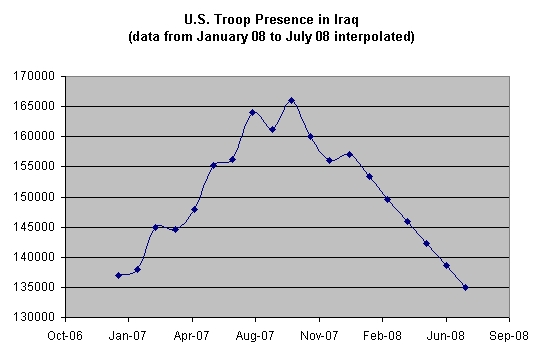
Authorization for the 160,000-strong multinational force was extended until the end of 2008 because “the threat in Iraq continues to constitute a threat to international peace and security,” according to the resolution.

Iraq’s U.N. Ambassador Hamid Al Bayati called it a historic day for the country because the council renewed the mandate “for the last time” after long and hard negotiation. He expressed hope that the council would deal with Iraq without any military authorizations after 2008.

“We realize that Iraq still needs more time and intensive efforts to enable our armed forces to take over the security responsibilities all over Iraq from the multinational forces,” he said, noting that Iraqi forces took responsibility for Basra two days ago and now control nine provinces.

U.S. Ambassador Zalmay Khalilzad formally introduced the resolution Tuesday afternoon and soon after the council met to approve it.

After the 15-0 vote, Khalilzad cited “positive developments in Iraq” including reduced violence. He welcomed the council’s support for the Iraqi government’s desire “to sustain this momentum” and keep the force in the country.

The resolution requires a review of the mandate at the request of the Iraqi government or by June 15, 2008. It reiterates a provision of past resolutions that the council “will terminate this mandate earlier” if Iraq requests that.

It also says the Security Council would have to consider Iraqi Prime Minister Nouri al-Maliki’s request, in a letter on Dec. 7 to the Security Council’s president, that “this is to be the final request … for the extension of the mandate” for the U.S.-led force.

Asked whether the United States wanted to keep the door open to maintaining its troops in Iraq longer, Khalilzad said the extension is at the request of the Iraqi government “representing the will of the Iraqi people.”

“We hope that … with progress in Iraqi security capabilities that Iraq’s goal of self-reliance can be achieved as soon as possible,” he said.

Permanent bases have seemingly been rejected by the Iraq national security advisor.  “We need the United States in our war against terrorism, we need them to guard our border sometimes, we need them for economic support and we need them for diplomatic and political support,” Mowaffaq al-Rubaie said.  “But I say one thing, permanent forces or bases in Iraq for any foreign forces is a red line that cannot be accepted by any nationalist Iraqi,” he told Dubai-based al Arabiya television.

Strong words, these are.  But the Kurds see things a little differently.

A top Iraqi Kurdish leader Tuesday said the Kurds want a deal with Washington that would protect their rights as well ensure long term American troops presence in the country.

On his arrival from a visit to Washington, Omar Fatah, deputy prime minister of Iraq’s northern Kurdish government, said they want a “strategic agreement with the Americans” similar to the one between Washington and Baghdad signed last month (editorial note: this refers to the Maliki agreement with and Iraqi cabinet approval of the petition before the U.N. referred to above).

That was for a long-term economic and political agreement that would also keep U.S. forces in Iraq beyond 2008.

“We expressed our pleasure about the agreement between Washington and Baghdad, ” said Fatah, adding Iraqi Kurds want a similar deal. “We want an agreement that would see that Kurds are not oppressed again,” he said, referring to atrocities committed by the former regime against them.

Fatah said during his visit he also told U.S. leaders the Kurds were in favor of a long-term U.S. presence in Iraq.

U.S. forces will be required long beyond 2008, and the Kurdish north is the likely beneficiary of the money and work that will flow as a result of this presence.  Another benefit of this arrangement is the role that U.S. forces will play in regional stabilization.

The Warrior’s Sabbatical

18 years, 5 months ago

Robert Burns reports on senior command changes occurring in Iraq.

The U.S. military in Iraq is undergoing its biggest changeover in senior commanders since Gen. David Petraeus launched a new counterinsurgency strategy nearly a year ago.

The high-level shifts come at a particularly delicate stage in the war as U.S. troop levels begin to decline, Iraqis are handed more security responsibility and Petraeus seeks to ensure that the gains achieved over the past several months continue.

The leadership changes are likely to be disruptive, at least for a brief period, as the new set of commanders — even those with Iraq experience — adjust to rapidly changing conditions.

Read the post at the Small Wars Journal Blog for a rundown of all of the changes coming to the U.S. command in Iraq.  Burns continues with a spot-on comment concerning Lt. Gen. Ray Odierno (actually, the comment comes from Frederick Kagan).

Topping the list of departures is Petraeus’ second-in-command, Army Lt. Gen. Ray Odierno, who is due to leave in February when the 3rd Corps finishes its command tour and returns to Fort Hood, Texas. He will be replaced by Lt. Gen. Lloyd J. Austin III, commander of 18th Airborne Corps, from Fort Bragg, N.C.

“He’s really done an amazing job with this counterinsurgency,” said Frederick Kagan, a military historian at the American Enterprise Institute, referring to Odierno. “He has it all at his fingertips, and there is no way that anyone could come in and immediately be functioning at that level.”

I have responded to the SWJ Blog with the following comment (for those readers who do not frequent both web sites).

This command change is is a major announcement. There was a recent discussion thread at the Small Wars Council concerning what exactly has changed in 2007 (Steve Metz and Col. Gian Gentile participated, among others). To quickly summarize my views, the answer may be that little changed. The surge was a continuation of the same things that we had been doing. Warfare has its ebb and flow, and society has a large inertia, as does momentum in warfare. The year 2007 might very well have reaped many benefits from doing the things that the Army and Marines do so well, although it may not have looked like it at the time. This isn’t to diminish the contributions of Petraeus or any other strategic modifications of adaptations, nor his powerful leadership, but merely to point out that the predecessors to the class of 2007 conducted intensive operations as well. I think that this is Col. Gentile’s point. Whatever the real reason(s) for the turnaround, this isn’t a debate I wish to have in the context of this comment. I want to focus on the commanders of the class of 2007.

If for no other reason than I have closely followed the class of 2007 commanders and know much about them, I feel that there is something special about this class. I will take two commanders as examples. Major General Walter Gaskin recently reported that attacks against Iraqi and U.S. troops in Anbar had decreased from 460 a week a year ago to 40 per week now.

Gains in Anbar Permanent

This is a decrease of an order of magnitude. A more astonishing turnaround I cannot imagine. One of Gaskin’s accomplishments, as best as I can determine, is to take very good people – e.g., Col. Simcock, Lt. Col. Bill Mullen in the East (now Col.), Lt. Col. Jason Bohm in the West, and others – and give them latitude, tools, and manpower. In short, he empowered them. But isn’t this what good leaders do?

Next I will turn to Lt. General Ray Odierno. Not only has he served with distinction, but he and I see eye to eye concerning the use of the concerned citizens program across Iraq. No, I am not naive concerning the fact that this provided a window of opportunity, and final political solutions must come from within Iraq itself. But this was the best solution given the circumstances. Further, he lead the effort with his troops while his son had lost an arm to the campaign in Iraq. Whatever else one might think of the campaign or its justification, Ray Odierno is a father with a son who lost a limb. No, I am not trying to stupidly stare or gape. Ray Odierno’s son is a still proud warrior. I bring this up to say that I hold Odierno (and of course his son) – literally – in heroic proportions. I continue to be in awe of him.

As for the class of 2007, I hope and pray that you enjoy your rest, however short it may be. It is a well-earned rest – a warrior’s sabbatical. Godspeed to your rest.

The Warrior’s sabbatical, indeed.


26th MEU (10)
Abu Muqawama (12)
ACOG (2)
ACOGs (1)
Afghan National Army (36)
Afghan National Police (17)
Afghanistan (704)
Afghanistan SOFA (4)
Agriculture in COIN (3)
AGW (1)
Air Force (42)
Air Power (10)
al Qaeda (83)
Ali al-Sistani (1)
America (23)
Ammunition (305)
Animals (328)
Ansar al Sunna (15)
Anthropology (3)
Antonin Scalia (1)
AR-15s (395)
Arghandab River Valley (1)
Arlington Cemetery (2)
Army (91)
Assassinations (2)
Assault Weapon Ban (29)
Australian Army (7)
Azerbaijan (4)
Backpacking (4)
Badr Organization (8)
Baitullah Mehsud (21)
Basra (17)
BATFE (247)
Battle of Bari Alai (2)
Battle of Wanat (18)
Battle Space Weight (3)
Bin Laden (7)
Blogroll (3)
Blogs (24)
Body Armor (23)
Books (3)
Border War (18)
Brady Campaign (1)
Britain (39)
British Army (36)
Camping (5)
Canada (20)
Castle Doctrine (1)
Caucasus (6)
CENTCOM (7)
Center For a New American Security (8)
Charity (3)
China (19)
Christmas (18)
CIA (30)
Civilian National Security Force (3)
Col. Gian Gentile (9)
Combat Outposts (3)
Combat Video (2)
Concerned Citizens (6)
Constabulary Actions (3)
Coolness Factor (3)
COP Keating (4)
Corruption in COIN (4)
Council on Foreign Relations (1)
Counterinsurgency (218)
DADT (2)
David Rohde (1)
Defense Contractors (2)
Department of Defense (220)
Department of Homeland Security (26)
Disaster Preparedness (5)
Distributed Operations (5)
Dogs (15)
Donald Trump (27)
Drone Campaign (4)
EFV (3)
Egypt (12)
El Salvador (1)
Embassy Security (1)
Enemy Spotters (1)
Expeditionary Warfare (18)
F-22 (2)
F-35 (1)
Fallujah (17)
Far East (3)
Fathers and Sons (2)
Favorite (1)
Fazlullah (3)
FBI (39)
Featured (192)
Federal Firearms Laws (18)
Financing the Taliban (2)
Firearms (1,873)
Football (1)
Force Projection (35)
Force Protection (4)
Force Transformation (1)
Foreign Policy (27)
Fukushima Reactor Accident (6)
Ganjgal (1)
Garmsir (1)
general (15)
General Amos (1)
General James Mattis (1)
General McChrystal (44)
General McKiernan (6)
General Rodriguez (3)
General Suleimani (9)
Georgia (19)
GITMO (2)
Google (1)
Gulbuddin Hekmatyar (1)
Gun Control (1,724)
Guns (2,412)
Guns In National Parks (3)
Haditha Roundup (10)
Haiti (2)
HAMAS (7)
Haqqani Network (9)
Hate Mail (8)
Hekmatyar (1)
Heroism (5)
Hezbollah (12)
High Capacity Magazines (16)
High Value Targets (9)
Homecoming (1)
Homeland Security (3)
Horses (2)
Humor (72)
Hunting (62)
ICOS (1)
IEDs (7)
Immigration (123)
India (10)
Infantry (4)
Information Warfare (4)
Infrastructure (4)
Intelligence (23)
Intelligence Bulletin (6)
Iran (171)
Iraq (379)
Iraq SOFA (23)
Islamic Facism (64)
Islamists (98)
Israel (19)
Jaish al Mahdi (21)
Jalalabad (1)
Japan (3)
Jihadists (82)
John Nagl (5)
Joint Intelligence Centers (1)
JRTN (1)
Kabul (1)
Kajaki Dam (1)
Kamdesh (9)
Kandahar (12)
Karachi (7)
Kashmir (2)
Khost Province (1)
Khyber (11)
Knife Blogging (7)
Korea (4)
Korengal Valley (3)
Kunar Province (20)
Kurdistan (3)
Language in COIN (5)
Language in Statecraft (1)
Language Interpreters (2)
Lashkar-e-Taiba (2)
Law Enforcement (6)
Lawfare (14)
Leadership (6)
Lebanon (6)
Leon Panetta (2)
Let Them Fight (2)
Libya (14)
Lines of Effort (3)
Littoral Combat (8)
Logistics (50)
Long Guns (1)
Lt. Col. Allen West (2)
Marine Corps (281)
Marines in Bakwa (1)
Marines in Helmand (67)
Marjah (4)
MEDEVAC (2)
Media (68)
Medical (146)
Memorial Day (6)
Mexican Cartels (47)
Mexico (71)
Michael Yon (6)
Micromanaging the Military (7)
Middle East (1)
Military Blogging (26)
Military Contractors (5)
Military Equipment (25)
Militia (9)
Mitt Romney (3)
Monetary Policy (1)
Moqtada al Sadr (2)
Mosul (4)
Mountains (25)
MRAPs (1)
Mullah Baradar (1)
Mullah Fazlullah (1)
Mullah Omar (3)
Musa Qala (4)
Music (25)
Muslim Brotherhood (6)
Nation Building (2)
National Internet IDs (1)
National Rifle Association (97)
NATO (15)
Navy (31)
Navy Corpsman (1)
NCOs (3)
News (1)
NGOs (3)
Nicholas Schmidle (2)
Now Zad (19)
NSA (3)
NSA James L. Jones (6)
Nuclear (63)
Nuristan (8)
Obama Administration (222)
Offshore Balancing (1)
Operation Alljah (7)
Operation Khanjar (14)
Ossetia (7)
Pakistan (165)
Paktya Province (1)
Palestine (5)
Patriotism (7)
Patrolling (1)
Pech River Valley (11)
Personal (77)
Petraeus (14)
Pictures (1)
Piracy (13)
Pistol (4)
Pizzagate (21)
Police (672)
Police in COIN (3)
Policy (15)
Politics (999)
Poppy (2)
PPEs (1)
Prisons in Counterinsurgency (12)
Project Gunrunner (20)
PRTs (1)
Qatar (1)
Quadrennial Defense Review (2)
Quds Force (13)
Quetta Shura (1)
RAND (3)
Recommended Reading (14)
Refueling Tanker (1)
Religion (501)
Religion and Insurgency (19)
Reuters (1)
Rick Perry (4)
Rifles (1)
Roads (4)
Rolling Stone (1)
Ron Paul (1)
ROTC (1)
Rules of Engagement (76)
Rumsfeld (1)
Russia (37)
Sabbatical (1)
Sangin (1)
Saqlawiyah (1)
Satellite Patrols (2)
Saudi Arabia (4)
Scenes from Iraq (1)
Second Amendment (713)
Second Amendment Quick Hits (2)
Secretary Gates (9)
Sharia Law (3)
Shura Ittehad-ul-Mujahiden (1)
SIIC (2)
Sirajuddin Haqqani (1)
Small Wars (72)
Snipers (9)
Sniveling Lackeys (2)
Soft Power (4)
Somalia (8)
Sons of Afghanistan (1)
Sons of Iraq (2)
Special Forces (28)
Squad Rushes (1)
State Department (23)
Statistics (1)
Sunni Insurgency (10)
Support to Infantry Ratio (1)
Supreme Court (82)
Survival (216)
SWAT Raids (58)
Syria (38)
Tactical Drills (38)
Tactical Gear (17)
Taliban (168)
Taliban Massing of Forces (4)
Tarmiyah (1)
TBI (1)
Technology (21)
Tehrik-i-Taliban (78)
Terrain in Combat (1)
Terrorism (96)
Thanksgiving (13)
The Anbar Narrative (23)
The Art of War (5)
The Fallen (1)
The Long War (20)
The Surge (3)
The Wounded (13)
Thomas Barnett (1)
Transnational Insurgencies (5)
Tribes (5)
TSA (25)
TSA Ineptitude (14)
TTPs (4)
U.S. Border Patrol (8)
U.S. Border Security (22)
U.S. Sovereignty (29)
UAVs (2)
UBL (4)
Ukraine (10)
Uncategorized (105)
Universal Background Check (3)
Unrestricted Warfare (4)
USS Iwo Jima (2)
USS San Antonio (1)
Uzbekistan (1)
V-22 Osprey (4)
Veterans (3)
Vietnam (1)
War & Warfare (435)
War & Warfare (41)
War Movies (4)
War Reporting (21)
Wardak Province (1)
Warriors (6)
Waziristan (1)
Weapons and Tactics (80)
West Point (1)
Winter Operations (1)
Women in Combat (21)
WTF? (1)
Yemen (1)

May 2026
April 2026
March 2026
February 2026
January 2026
December 2025
November 2025
October 2025
September 2025
August 2025
July 2025
June 2025
May 2025
April 2025
March 2025
February 2025
January 2025
December 2024
November 2024
October 2024
September 2024
August 2024
July 2024
June 2024
May 2024
April 2024
March 2024
February 2024
January 2024
December 2023
November 2023
October 2023
September 2023
August 2023
July 2023
June 2023
May 2023
April 2023
March 2023
February 2023
January 2023
December 2022
November 2022
October 2022
September 2022
August 2022
July 2022
June 2022
May 2022
April 2022
March 2022
February 2022
January 2022
December 2021
November 2021
October 2021
September 2021
August 2021
July 2021
June 2021
May 2021
April 2021
March 2021
February 2021
January 2021
December 2020
November 2020
October 2020
September 2020
August 2020
July 2020
June 2020
May 2020
April 2020
March 2020
February 2020
January 2020
December 2019
November 2019
October 2019
September 2019
August 2019
July 2019
June 2019
May 2019
April 2019
March 2019
February 2019
January 2019
December 2018
November 2018
October 2018
September 2018
August 2018
July 2018
June 2018
May 2018
April 2018
March 2018
February 2018
January 2018
December 2017
November 2017
October 2017
September 2017
August 2017
July 2017
June 2017
May 2017
April 2017
March 2017
February 2017
January 2017
December 2016
November 2016
October 2016
September 2016
August 2016
July 2016
June 2016
May 2016
April 2016
March 2016
February 2016
January 2016
December 2015
November 2015
October 2015
September 2015
August 2015
July 2015
June 2015
May 2015
April 2015
March 2015
February 2015
January 2015
December 2014
November 2014
October 2014
September 2014
August 2014
July 2014
June 2014
May 2014
April 2014
March 2014
February 2014
January 2014
December 2013
November 2013
October 2013
September 2013
August 2013
July 2013
June 2013
May 2013
April 2013
March 2013
February 2013
January 2013
December 2012
November 2012
October 2012
September 2012
August 2012
July 2012
June 2012
May 2012
April 2012
March 2012
February 2012
January 2012
December 2011
November 2011
October 2011
September 2011
August 2011
July 2011
June 2011
May 2011
April 2011
March 2011
February 2011
January 2011
December 2010
November 2010
October 2010
September 2010
August 2010
July 2010
June 2010
May 2010
April 2010
March 2010
February 2010
January 2010
December 2009
November 2009
October 2009
September 2009
August 2009
July 2009
June 2009
May 2009
April 2009
March 2009
February 2009
January 2009
December 2008
November 2008
October 2008
September 2008
August 2008
July 2008
June 2008
May 2008
April 2008
March 2008
February 2008
January 2008
December 2007
November 2007
October 2007
September 2007
August 2007
July 2007
June 2007
May 2007
April 2007
March 2007
February 2007
January 2007
December 2006
November 2006
October 2006
September 2006
August 2006
July 2006
June 2006
May 2006

about · archives · contact · register

Copyright © 2006-2026 Captain's Journal. All rights reserved.