John Rutherford of NBC News gives us an account from wounded in Afghanistan that is important in light of the NATO and U.S. claim among Army senior leadership that the campaign is advancing unabated in Afghanistan.
Two soldiers receiving Purple Hearts at Walter Reed Army Medical Center called Afghanistan a “forgotten war” being fought with not enough troops, supplies or support from the American people.
Army Spc. Jesse Murphree, 20, of Westminister, Colo., lost both legs to a roadside bomb on Dec. 27 in northeastern Afghanistan.
“Every day we were getting shot at,” he said in an interview after receiving his Purple Heart on Friday. “And you hear about other people in Iraq, they got shot at a couple of times. We’re like, we’ve been shot at every day.
“You start thinking you’re fighting a forgotten war, like no one’s paying attention. I went home on R&R before I got hurt and people were coming up to me, they’re like, at least you’re not in Iraq and stuff, and I was looking at them, and I was like, what? And they’d say, you don’t do, they called it battle, they’re like, you don’t do battle anymore? And I’m like, are you kidding me? Like, yeah, I do,” Spc. Murphree said.
“I know the area our unit’s at is definitely hot and definitely feels they’re forgotten about, like the people think that Afghanistan is really not a big deal or nothing’s really going on. We still got people that are dying, we still got people that are getting hurt.”
Army Pfc. Justin Kalenits, 24, of Geneva, Ohio, who was wounded in a Nov. 9 ambush in the Waygol Valley of Afghanistan, echoed Spc. Murphree’s sentiments.
“It’s a battle,” he said. “There’s not enough troops there. Need a lot of troops. Our unit’s stretched really, really thin. There’s not enough stuff. We’re doing a lot of fighting over there. We’re getting hurt. It’s not good. So, I’d like to see it end. Definitely.”
This call for an increase in force size coheres exactly with the thrust of The Captain’s Journal over the last several months. But there is also an indication that the Taliban have learned from their mistakes of the past. The large size kinetic engagements are apparently a thing of the past given the kill ratio (advantage U.S.). Instead, they are focusing on distributed operations. Haji Hashem, chairman of Zabul provincial council, describes their tactics:
Most of the fighters are foreign, Mr. Hashem explained. “They are Chechen, Arab, Punjab from Pakistan.”
Mr. Hashem said the Taliban insurgency operates in cells of 10 to 15 that stay in radio contact across the countryside.
The tactic of suicide bombing also fits neatly into this category. According to recent report, the Taliban are using suicide bombs as their equivalent of air power. As a standoff weapon (except for a single fighter), it is unmatched. Says one Taliban fighter, “It is good to be used against the non-Muslims, because they are not afraid of fighting for five days against us but they are afraid of one bomber.”
This tactic of forcing decision-making down within the organization, dispatching smaller, self-sufficient groups of fighters, and maintaining looser communication is perfectly adapted to the Afghanistan countryside, which is less about MOUT (military operations on urban terrain) than in Iraq. This guerrilla approach to warfare requires aggressive offensive operations to root them out in their hiding places. It also requires that U.S. forces participate in the chase. Fire and melt-away must become less attractive to the Taliban.
Five days ago when warning of the potential affects of lack of political will to see the battle for Basra through to the end, In The Battle in Basra, we said:
These elements will never renounce violence, but the danger is that they will call Maliki’s bluff and make a show of standing down, only to watch the Iraqi troops redeploy elsewhere and strike up the violence later when they don’t face such trouble. We have seen this scene play out for quite a while now, starting in 2004 with Sadr. If this happens, Maliki will look like an inept stooge.
The lack of political will seems to have caused just that, with Maliki calling for repeated extensions of the amnesty program for the Sadrists and lack of progress by the Iraqi Army.
Residents buried their dead after calm returned to the southern Iraqi city of Basra on Monday, but fighting broke out in Baghdad despite a truce called by Shi’ite cleric Moqtada al-Sadr to end a week of bloodshed.
Sadr called his Mehdi Army fighters off the streets on Sunday, nearly a week after Prime Minister Nuri al-Maliki launched a crackdown on them, sparking clashes that spread through the mainly Shi’ite south and also the capital.
Political analysts said the government offensive in the oil port of Basra appeared to have backfired by exposing the weakness of Maliki’s army.
Worse still, the Iranians brokered the ceasefire and stand down of the Sadrists. The indications of lack of political will are numerous: [1] The British are sitting behind barbed wire at the Basra airport while the battle ensues, [2] Maliki extended the offer of amnesty multiple times, [3] the Iraqi Army targeted the Sadrists and left the SIIC unmolested, [4] Maliki appears to be hailing the ceasefire as a good move, [5] Iran is further empowered, and [6] Sadr and the SIIC leadership are still alive, unmolested and in command or their respective militias (perhaps Sadr less so, with Iran more so than before).
The upshot is that the sickness in the Maliki administration is laid bare and the strength of Iran was clear from the beginning. The Captain’s Journal has understood this all along. But for the uninitiated, these things might be revelatory. Now that the truth is unmasked, what will be the response of the Multinational Force? What will Maliki do, if anything?
Baitullah Mehsud in the commander of Tehrek-e-Taliban-Pakistan, but the Pakistani Taliban is a factious organization.
Though members of militant Islamic groups such as the Pakistani Taliban and other jihadis have almost the same anti-United States and pro-al-Qaeda worldview, they are not especially disciplined when it comes to organizational matters. Difficulty in this area explains the existence of so many extremist factions operating under different leaders and commanders who sometimes express conflicting opinions on domestic and international issues.
The formation of an umbrella organization, Tehrek-e-Taliban-Pakistan (Movement of Pakistani Taliban, or TTP) on December 14, 2007, was meant to bring the different Taliban groups operating in the North-West Frontier Province (NWFP) into one formation and improve their coordination (The News International [Islamabad], December 15, 2007). Its spokesman, Maulvi Omar, a shadowy figure using a fake name, claimed that 27 Taliban factions operating in the Federally Administered Tribal Areas (FATA) were part of the movement. Nobody was surprised when Baitullah Mehsud, amir of the Taliban in the territory populated by the Mehsud Pashtun tribe in South Waziristan, was named as leader of the TTP. He was the most powerful among the Pakistani Taliban commanders and it was natural that he would lead the organization.
The tribal nature of some of the Taliban groups soon became evident when militants in North Waziristan warned the Mehsud-led Taliban in neighboring South Waziristan not to launch attacks against the Pakistan Army in their part of the tribal region (The News International, January 30). The warning came from Hafiz Gul Bahadur, the amir of the Taliban in North Waziristan, despite the fact that he was earlier named deputy to Mehsud in the Tehrek-e-Taliban-Pakistan. Association with the TTP and being its deputy leader did not mean much when it came to the territorial and tribal limits of each Taliban group and commander. Hafiz Gul Bahadur was particularly furious when Mehsud’s men started firing rockets into the army’s camp at Razmak, a town in North Waziristan, during the recent fighting between the military and the Mehsud-commanded militants.
Regardless of the lack of an overall command structure that forces coherence in policy or strategy, the one thing that will not be allowed within the Taliban is any action that could be seen as unfaithfulness to the cause. Two al-Qaeda leaders in the north of Pakistan have called on their supporters to wage a new Jihad against security forces and seize control of Islamabad. In a recent video, Takfiri militants Qadri Tahir Yaldeshiv and Abdul Khaliq Haqqani called for urgent action against the Pakistani armed forces to avenge the Lal Masjid (Red Mosque) operation in 2007.
“Jihad is compulsory in Pakistan as it is compulsory in Afghanistan,” Tahir said in the video message.
Sitting on a chair reading notes from a laptop computer flanked by a black flag, Tahir talked about the need for strict Sharia law in Pakistan.
“Pakistan came into being on the name of Islam, therefore Islam should be enforced in the country,” he said in the video …
Tahir Yaldeshiv, the chief of the Islamic movement of Uzbekistan and the chief of Uzbek militants in North Waziristan, called for a Jihad against Pakistani forces.
Abdul Khaliq Haqqani also urged the people to fight against Pakistani forces.
The video also shows what are said to be images of a government offensive in the town of Mir Ali in North Waziristan in October 2007, including footage of dead soldiers and destroyed vehicles. It also shows graphic footage of a man slitting the throat of a Pakistani soldier.
There were also reports that Haji Nazeer, a local Pakistani Taliban commander in favour of reconciliation with Pakistani government was seriously wounded in the conflict.
“Haji Nazeer has now sent a message of reconciliation to our camp but it is not possible now. He has to face the music for what he has done in the past.”
Facing “the music” for supporting the Pakistani government means that the statistical mortality tables no longer apply to Nazeer. Negotiations with Pakistan will occur only at the highest levels, and in this case, it means Baitullah Mehsud.
Tehrik-i-Taliban Pakistan chief Baitullah Mehsud has said that he is ready for talks with the new government if it stops President Musharraf’s war on terror in tribal areas.
The Taliban do not want hostile relations with the new government and are ready for talks with political parties for a lasting peace in the NWFP and the tribal region, Baitullahs spokesman Maulvi Umar told journalists on phone from an undisclosed location.
Baitullah’s men had earlier this month declared a ceasefire in South Waziristan where elections were postponed because of clashes.
According to the Dawn, Maulvi Umar expressed the hope that the new government would not follow the flawed policies of President Musharraf and would respect the peoples mandate.
We are ready for negotiations with the new government if it doesn’t re-impose a war on us. If it (new government) continues with the policies of President Musharraf we will resume our activities, he warned.
He welcomed the victory of opposition parties in the elections and said they had won because of sacrifices rendered by the local Taliban.
But notice the ultimatum Mehsud gives. Policy will change and the global war on terror will stand down in the NWFP of Pakistan, or there will be no end to the Taliban war on Pakistan. In reality, the Taliban will not stop until Pakistan is a fundamentalist Islamic state much like Afghanistan before 9/11, but Mehsud is negotiating, dishonestly so, from a position of strength. He is a high level Taliban commander. No middle level Taliban commander will break with senior leadership without his life being in danger.
In the midst of the chaos in Basra at the moment with the British forces sitting at the Basra airport, it is necessary to construct a narrative for what happened and why. One problem is that not even all of the British commentators agree on that narrative.
Some Brits are saying that the current battle is just what we’ve been waiting for. It’s good that it has finally come and that the Iraqis are carrying it out.
The British military always knew the test would come and it has arrived with the offensive that Iraqi forces have launched in Basra against the Shi’ite militias and criminal gangs who have run too much of the city for too long. British-trained Iraqi units have been in action, directed by Nouri al-Maliki, the prime minister, in what is clearly a crucial encounter for the future of Iraq.
The object of the British exercise since 2003 has been to train Iraqi forces and hand control to them as soon as possible. If the strategy is seen to work then whatever follows this battle of Basra might fairly be regarded as the responsibility of the Iraqis themselves and the British will have taken a big step towards final withdrawal.
Maliki is taking a stand on his ability to exert central government authority over the increasingly lawless second city of Iraq. If the British seemed to acquiesce too easily in the slide into lawlessness in the four years they controlled Basra, a victory for Iraqi forces now would demonstrate the wisdom of being patient and letting the Iraqis run the country in their own way.
It would also be a powerful rejoinder to American mutterings that the British delude themselves into thinking their approach is sophisticated when it is simply permissive. This battle of Basra, say British military spokesmen, is what we have been working for.
Rather than being – as the anti-war brigade claimed – a humiliating retreat, the tactical withdrawal from Saddam’s old summer palace on the banks of the Shatt al-Arab was undertaken on the basis that the continuing presence of British troops was exacerbating, rather than helping, the local security situation. The fiercely nationalistic Iraqis did not want outsiders telling them how to run their affairs.
Formal control of the city was returned to the Iraqis in a short ceremony at the air base last December, but much of Basra has remained under the control of a combination of radical Islamic militias and criminal gangs, which has made it virtually impossible for the Iraqi government in Baghdad to exercise its authority over the city.
The contradiction takes a second reading to understand, but once found out, creates an awkward state of affairs for the British commentators who are aping the British officers. In the first narrative, there was a fight waiting to happen, and it is best that the Iraqis are engaging it. In the second narrative, the violence is not a necessary state of affairs, but rather, is a direct function of the British presence in Basra. Therefore, the best policy is a “tactical withdrawal.”
It is difficult to imagine any respectable counterinsurgency strategy anywhere on earth and in any era where it is a positive or productive thing to allow an area to devolve into chaos over the course of four years. But there are Brits who are able to put aside pride and false narratives. Peter Oborne’s commentary is as hard hitting as any analysis we’ve seen.
British military history contains more than its fair share of glorious victories, but there have also been notable disasters. It has become horrifyingly clear that one of these is our involvement in southern Iraq, culminating in our soldiers’ exit from Basra Palace late last year.
At the time, the Government presented the withdrawal of British troops as a success. Gordon Brown assured us that they had done their job so well that it was safe to hand over to local forces.
It is difficult to tell whether the Prime Minister was deliberately lying, or whether – more likely – he was mistaken about what was going on. Either way, the truth was very different. Far from calmly handing over Basra to the new regime, we were driven out by Iranian-backed militias, leaving behind a state of murderous anarchy.
This became horrifically plain last week when widespread fighting broke out inside Basra. Iraq’s Prime Minister, Nouri Maliki, has ordered his army to try to regain control of the city. Meanwhile, Britain’s 4,000 troops, safely cocooned in Basra air base outside the town, are taking no part in what may well prove to be a crucial battle.
This is a humiliation. All this week, commentators used the state visit of the French President, Nicolas Sarkozy, to mock his country’s shamefully inadequate military involvement in Afghanistan – keeping their troops well out of harm’s way while the burden of fighting has been carried out by others.
But that has been the wretched fate of our 4,000 troops sitting idle in Basra air base, listening helplessly – and positioned a safe distance away – as mortars pound and machine-gun fire rattles in battles that are deciding the long-term future of Iraq.
Twelve years ago we were rightly censorious after Dutch troops sat on their hands while 7,000 Muslims were massacred during the Balkan War at Srebrenica.
Of course, it would be utterly wrong to accuse our soldiers of the miserable cowardice displayed on that infamous occasion by the Dutch. But their current impotence in southern Iraq as fighting rages nearby sits most uneasily with the exemplary British fighting tradition.
It needs to be said at once that no blame attaches itself to our soldiers, 176 of whom have given their lives in this ghastly conflict.
However, the same cannot be said of our politicians. Last September, the Prime Minister made a snap visit to Basra during which he revealed the decision to withdraw British forces …
Shamefully for Britain, the White House is now considering sending its own forces to sort the mess that the British have left behind. Last week, one White House official acidly remarked: “American blood is going to have to buy off the British failure in Basra.”
Already at the Basra air base, I can reveal, the British subsidiary of U.S. construction giant KBR is building four huge dining facilities – known to the American army as DFACs. These are capable of feeding 4,000 men and suggest that the U.S. Army is contemplating a massive deployment to southern Iraq – including a major presence inside Basra itself.
Oborne correctly refuses to lay the blame at the feet of the British enlisted men, and also correctly points out that the drawdown was precipitous. But he also fails to mention that the British commanders fabricated a ridiculous narrative while the politicians were playing political games. There is enough blame to go around, but creating narratives that deny the failure prevents learning and adaptation of British counterinsurgency doctrine.
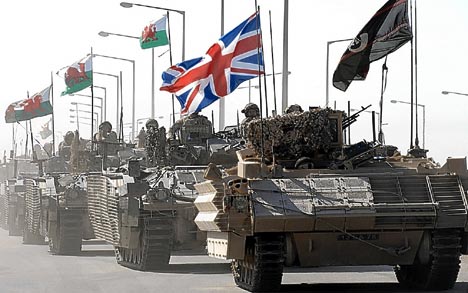
British retreating from Basra in 2007, courtesy of the Daily Mail.
Following or coincident with our own article on the recent Basra violence (The Battle in Basra), there are numerous commentaries and articles on the same subject. We will assess some of the more interesting ones below. In addition to the chaos in Basra, there is chaos in the blogs and main stream media reports.
The Small Wars Journal blog has an interesting roundup of links (Debating Basra) with summary paragraphs for each. As usual, the SWJ editors are on the spot with valuable information.
At Abu Muqawama, Charlie has a post up offering suggestions as to what exactly might have happened to the British in Basra (Abu’s blog is friendly to the Brits and soft COIN doctrine, so this is an interesting take). Charlie blames it on the possibility that “the Brits adopted a “peacekeeping” mindset in Basra and never really engaged in a broader COIN or CT effort. That meant that all the myriad Shi’a groups were able to pursue their (relatively) non-violent political agenda and consolidate control over the political levers of city.”
Relatively non-violent agenda? Charlie has been reading too many books and hasn’t kept up with the goings on in Basra, and later Spencer Ackerman weighs in: “Withdrawing without any political strategy, as the British did from Basra, leads to a vacuum like the one we’re seeing now. Sadr rushes in. The Islamic Supreme Council of Iraq rushes in. The Fadhila party maneuvers between the two. Forces ostensibly loyal to the government, pinioned between all sides, find ways to accommodate the existing power on the streets. In other words: chaos.”
To read these two opinions, it’s as if the British had control of Basra and then for some inexplicable reason left without any political strategy (no military issues, just political machinations). Such a view ignores the reality of the situation. Let’s backtrack a bit and recap what we know (see Calamity in Basra and British Rules of Engagement). In 2003, the British Army fished in the waters of the Shaat al Arab on their days off. In early 2007, all troop movement in and out of the city were conducted at night by helicopter because it was deemed too dangerous to go on the road and it was too dangerous to fly choppers during the day,” said Richard Beeston, diplomatic editor of The Times of London. Today, women in Basra are being beheaded by Islamist gangs by the hundreds.
In mid-2007 when the British retreated from Basra, they did so while telling the tall tale that since the very presence of the British themselves was causing the violence, it would be better if they just left. In other words, no one would shoot at the British Army if the Army wasn’t there. There wasn’t a rush of anyone or any faction into Basra. They were already there and had control of the city. The British never had control of Basra, and from the beginning it was left to Shi’a factions, criminal elements, Iranian proxy fighters (Badr, Quds), and the loss of Basra was a constant diminution of civilization up to the point that the British ended up behind barbed wire at the Basra airport, contributing nothing to the Iraq campaign. We have already linked Nibras Kazimi who, in the update to his post, conveys the Iraqi sentiment concerning the British Army. It isn’t flattering, and British Colonel Tim Collins knows and has said that the retreat from Basra has badly damaged the reputation of the British Army.
From my contacts in the Marines, they had always known that after securing the Anbar province, it was always a possibility that they would have to go in and clean up the mess left by the British in Southern Iraq. There are now published reports that the Marines may get saddled with this chore.
Marc Lynch at Abu Aardvark has a very smart post in which he examines the idea that Iran is liquidating its no longer useful proxies, including Sadr. This idea has some merit, since Moqtada al Sadr is currently in Iran, especially as seen against the backdrop of what Iran did with Hassan Nasrallah last year. Nasrallah was demoted and the responsibility for military operations of Hezbollah were removed from him.
The Belmont Club questions the absurd narrative where Iran is trying to advance peace by restraining Sadr. This theory follows closely in line with Amir Taheri’s silly New York Post article where he promulgated the idea that Tehran now worries about a premature Iraq exit, and wants stability in the region. From the absurd to the sensible.
Reidar Visser has a sophisticated article entitled The Enigmatic Second Battle of Basra, in which he points out something that obviously troubled us when we wrote The Battle in Basra, writing “The Captain’s Journal is as concerned about the SIIC as it is the Sadrists, and maybe more so given how well they have been able to work into the political scene in Iraq.” Visser writes:
… there is a discrepancy between the description of Basra as a city ruled by militias (in the plural) – which is doubtless correct – and the battlefield facts of the ongoing operations which seem to target only one of these militia groups, the Mahdi Army loyal to Muqtada al-Sadr. Surely, if the aim was to make Basra a safer place, it would have been logical to do something to also stem the influence of the other militias loyal to the local competitors of the Sadrists, the Islamic Supreme Council of Iraq (ISCI), as well as the armed groups allied to the Fadila party (which have dominated the oil protection services for a long time). But so far, only Sadrists have complained about attacks by government forces.
This is a powerful point, and undercuts Nibras Kazimi’s narrative of Maliki as in charge and powerful enough to retain control of Iraq and oust the Shi’a militias.
With the threat of a civil war looming in the south, Nouri al-Maliki’s police chief in Basra narrowly escaped assassination in the crucial port city, while in Baghdad, the spokesman for the Iraqi side of the US military surge was kidnapped by gunmen and his house burnt to the ground.
Saboteurs also blew up one of Iraq’s two main oil pipelines from Basra, cutting at least a third of the exports from the city which provides 80 per cent of government revenue, a clear sign that the militias — who siphon significant sums off the oil smuggling trade — would not stop at mere insurrection.
In Baghdad, thick black smoke hung over the city centre tonight and gunfire echoed across the city.
The most secure area of the capital, Karrada, was placed under curfew amid fears the Mahdi Army of Hojetoleslam Moqtada al-Sadr could launch an assault on the residence of Abdelaziz al-Hakim, the head of a powerful rival Shia governing party.
While the Mahdi Army has not officially renounced its six-month ceasefire, which has been a key component in the recent security gains, on the ground its fighters were chasing police and soldiers from their positions across Baghdad.
But Maliki says there will be no retreat. “Iraq’s prime minister vowed Thursday to fight “until the end” against Shiite militias in Basra despite protests by tens of thousands of followers of a radical cleric in Baghdad and deadly clashes across the capital and the oil-rich south.”
Bill Roggio says that the current operation has been in the planning stages since the middle of 2007. This Al Jazeera coverage (h/t Noah Shachtman) gives one the impression that the surge and strategy change had absolutely nothing to do with the the drop in violence across Iraq, but rather, the so-called ceasefire by Sadr is credited, this ceasefire being in danger of breaking down.
One of the many problems with this analysis is that it ignores the role that the British played, unwittingly, in the strengthening of the Sadrists. Further, this analysis treats Basra as if it represents all of Iraq, and clearly it doesn’t. At approximately 17:20 into this Charlie Rose interview of John Burns, you can see for yourself the role the British played in the release of Sadr who was actually in the custody of the 3/2 Marines in 2004.There are troubling aspects of the current campaign, but in the end, the SIIC is too deeply embedded into the political fabric to root out at the moment with military action, or so Maliki may think. This is disconcerting, in that it continues Iran’s influence inside of Iraq. But in the end, it may be too easy to see too many complexities in the campaign, thus missing the forest for the trees.
The British wore soft covers and went into Basra with the counterinsurgency doctrine learned from their experience in Northern Ireland. As we said in COIN is Context-Driven, “whether Protestant or Roman Catholic, greater U.K. or English, the fact of the matter is that this was COIN among their own people. They were the same, at least as compared to Iraq. The religious, cultural, societal, and political framework was the same; the ethical morays were the same; the language was the same; and by and large the history is the same. When the British landed in Basra, they may as well have been placed on a different planet. Nothing was the same, and thus whatever the British learned in Northern Ireland instantly became irrelevant.”
Southern Iraq was not Northern Ireland, and the Shi’a gangs, criminals and Iranian proxy fighters were looking for the stronger tribe to rise to the top. It did, and it wasn’t the British, due to no fault of their enlisted men, a failure that must be laid entirely at the feet of their command. General Jack Keane recommends that the U.K. engage in a “surge” of its own in Basra. But this misses the point. There not only weren’t enough troops, the strategy was mistaken from the beginning and the British have spent their wallet on the campaign. They no longer demand respect from the Iraqi people and thus have become merely baggage.
Today Basra is paying the price for their ill-conceived strategy. The Basra problems are not, as so many main stream media reports have mistakenly said, proof of the failure of the surge, since U.S. troops are not now and have never been in Basra. Nor is Sadr powerful enough to thwart the intentions of U.S. forces in Iraq. It is frankly hard to imagine any more difficult a situation than Anbar a year or two ago. One could have asserted the impossibility of pacification of Anbar because of the competing Sunni factions – al Qaeda, Saddam Fedayeen, Ansar al Sunna, holdover hard line Ba’athists, and all of the other groups – but the Marines prevailed. They did so because they were the stronger horse (a notion that Osama Bin Laden has himself hailed as being important in this region of the world). Until forces enter Basra who are seen as a stronger horse as compared to the Iranian-sponsored criminals, peace will not come to Iraq.
The Shi’ite militias are active, and not just in Basra. Baghdad is under direct attack from the forces of Moqtada al Sadr. “Terrorists launched 12 combined mortar and rocket attacks attacks into Multi-National Division – Baghdad’s operational environment beginning at approximately 6 a.m. March 25. Among the multiple attacks were 107 mm rockets were fired toward Baghdad’s International Zone, 81 mm mortars were fired at Forward Operating Base Falcon, 107 mm rockets were fired at Forward Operating Base Rustamiyah, 60 mm mortars were fired at Joint Security Station Thawra 1, and 60 mm mortars were fired at Joint Security Station SUJ.”
But the bulk of the fighting has been to the South in Basra. Nibras Kazimi calls this Operation Cavalry Charge, and his comments will be used as a launching pad for our own.
Here’s a prediction: the Iraqi Army’s military operation in Basra will be a spectacular win against disorder and Iranian influence.
Today, the Iraqi Army launched its first major military operation to fully control Basra, the second largest city in Iraq, without any—ANY—Coalition assistance. One source tells me that during the preparation phase of this campaign the Americans offered to position some U.S. Special Forces and air-cover near the Basra battle theater to act as back-up if needed but their Iraqi counterparts planning this operation politely turned down the offer.
This is Operation ‘Cavalry Charge’, which is the best translation I could come up with for صولة الفرسان.
Its chief objective is to flush out the organized crime cartels that control the port of Basra and the oil pipelines of the province. One major criminal force in the Basrawi scene are groups that affiliate themselves with the Sadrist movement and its Mahdi Army. Many of these criminal rings are also associated with certain factions of Iran’s Revolutionary Guard that operate in Basra both for intelligence/sabotage purposes as well as enriching themselves. By knocking out these egregious manifestations of lawlessness, Operation Cavalry Charge will have the accrued benefit of mashing up the more subtle patterns of Iran’s malignant influence in Iraqi Shiism’s foremost economic prize, the oil fields and port of Basra.
But is this how this story is being reported by the US and Arab media? Of course not!
The dominant false narrative du jour goes something like this: the Sadrists are angry over a number of things (arrests, political wrangling with the Hakim family and the Da’awa Party, etc.) so they decided to back away from Sadr’s seven-month ‘ceasefire’ (a term invented by the western media as a deliberately wrongful translation of تجميد وإعادة هيكلة جيش المهدي: “freezing and restructuring the Mahdi Army”) by staging ‘civil disobedience’ (…such as shutting down primary schools and shops by threatening teachers, students and the middle class) but things quickly deteriorated into the perpetual cycles violence that these journalists and pundits are mentally wedded to and have staked their thin expertise on predicting as Iraq’s inevitable fate …
If he wins—and I predict that he will—then he’s holding on to the prime minister’s seat from here until the 2010 elections …
Maliki has sent 50,000 Iraqi soldiers to deal with about a dozen criminal cartels. Militarily, this will be an easy fight. Those counseling caution and delay stressed that smashing Sadrist-related criminal cartels would spark a large-scale Sadrist reaction across Iraq at a time when the Bush administration wants to keep Iraq quiet especially with the ‘4000’ milestone that was being approached and got passed a couple of days ago. Another argument against action counseled that the Iranians are angling for a fire-fight to sully any talk of progress that Gen. Petraeus may give in a couple of weeks when he appears before Congress, and that the Democrats and their allies in the US media would take these images out of Basra and elsewhere and package the news as a “security meltdown” (…which they would and have done so, irrespective of reality).
Maliki decided that he doesn’t give a damn about US presidential elections and that the only timeline that concern him are Iraq’s own upcoming elections. Maliki also concluded, from intensive intelligence reporting, that the Sadrists are weak and that Iran doesn’t really have much punch to its supposed influence in Iraq. That’s why he decided to go for it.
Kazimi is a smart and well-connected Iraqi analyst. We are always anxious to study his next commentary, although to our disappointment, there are fewer of them being issued. The Captain’s Journal wants to maintain good relations with Talisman Gate, but one troubling aspect of Kazimi’s analysis emerges. He is almost pathologically sanguine and optimistic, even to the point of arguing that “Iran doesn’t really have much punch to its supposed influence in Iraq.”
Kazimi continues by discussing the softening of the Sadrists, and then divides the ones shooting in Basra into two categories: “organized crime cartels and the Iranian-managed Special Groups.” The Shi’a, says Kazimi, have risen above the infighting and see the need to reject and renounce Sadr and his forces. As for the Iranian-sponsored thugs (presumably here he is discussing other factions such as Badr [SIIC], some Quds fighters, etc.), Kazimi again sees them as being unfruitful for Iran. Sanguine, to say the least. He sums up by saying this.
Remember the time when Maliki was bad-mouthed for being soft on the Sadrists and the dominant false narrative of the time had it that he owed his political power to them? I wonder what all the experts who parroted this claim would have to say about Operation Cavalry Charge and Maliki’s role in it?
The Captain’s Journal still doesn’t like Maliki. This operation should have been conducted years ago, and one troubling aspect of Maliki’s involvement came to light in an ultimatum he issued to the fighters in Basra. “Iraq’s prime minister on Wednesday gave gunmen in the southern oil port of Basra a three-day deadline to surrender their weapons and renounce violence …”
Kazimi has gotten it right. The enemy is comprised of Iranian-sponsored thugs and killers, corrupt Sadrists, and criminals who are after oil money (not to mention the Islamist gangs who have beheaded hundreds of women over the last year). Basra is currently run by a witch’s brew of the worst elements on earth. To be fighting them is a good thing. Far from Iraq slipping into chaos, it was always the case that until the Shi’a fighters were taken out like the Sunni insurgents were, there would be no peace in Iraq.
Yet Maliki has issued an ultimatum to these horrible elements to “renounce violence.” These elements will never renounce violence, but the danger is that they will call Maliki’s bluff and make a show of standing down, only to watch the Iraqi troops redeploy elsewhere and stike up the violence later when they don’t face such trouble. We have seen this scene play out for quite a while now, starting in 2004 with Sadr. If this happens, Maliki will look like an inept stooge.
There can be no negotiations with the criminals and terrorists. They must be captured or killed. There should be no offer of amnesty, and Kazimi’s analysis of optimism suffers in light of the reality of Maliki’s offer of peace. Kazimi later notes that the Iraqi Army was operating with the utmost restraint. The Captain’s Journal responds that the utmost restraint is not called for. To be sure, noncombatants should be secured and protected. But the criminals need to see the Iraqi Army as the stronger horse, just like the Anbaris saw the Marines as the stronger horse. The utmost restraint will not win the campaign.
Kazimi does offer another interesting note. “The Iraqi Army holds the British Forces cowering behind barbed wire in Basra Airport in the lowest regard; the Iraqis hold the British responsible for dropping the ball in Basra and in Amara, allowing the crime cartels to expand and take root. Iraqi officers regularly dismiss the British military as “sissies” and “cowards”. The Americans have never had a military presence in Basra since the war began in 2003.”
The Captain’s Journal responds that the U.S. was not there because the British were. As for the British being “sissies” and “cowards,” this seems like excessive language. We have weighed in before concerning the British strategy, in Calamity in Basra and British Rules of Engagement, The Rise of the JAM, and other subsequent articles. Also, as British Colonel Tim Collins has pointed out, “Britain’s withdrawal from a chaotic Basra has “badly damaged” its military reputation.” Damaged indeed. These Iraqi comments go directly to the Colonel’s point.
But it isn’t the warriors Britain brought to the fight who are to be blamed. They are as brave and disciplined as any in the world, and more so than most. It is the British military leadership who couldn’t relinquish their soft counterinsurgency doctrine taken away from their experience in Northern Ireland. Command is to blame, and the British enlisted men under U.S. leadership would probably have performed as well as the U.S. enlisted men.
On a final note, The Captain’s Journal is as concerned about the SIIC as it is the Sadrists, and maybe more so given how well they have been able to work into the political scene in Iraq. Remember. Some of the worst men in history began as politicians and retained their power through political influence. Being involved in the political scene is not enough. Iranian influence must be gone, and the SIIC is a major broker of Iranian influence peddling.
Bad dreams are scary things. The sweats, the shakes, the bad memories, or whatever. I don’t know. I have never actually had a nightmare before so I wouldn’t know (except maybe the one about failing to turn in my last senior exam and failing to graduate college, thus having to start over again – it was indeed a bad, bad night for The Captain’s Journal, very little sleep). But Bill Lind gives us one to consider. It begins in Iran, with the pitiful U.S. Army and Marines running for cover and trying to escape the horrible wrath of mechanized divisions of the powerful Iranian guard.
Now, to be clear, we have not advocated all out ground war with Iran, but rather, selected air strikes against insurgent training grounds, enhanced border security, more aggressive tactics against Badr (SIIC) and Sadr (actually, we have advocated the assassination of Sadr) and his so-called Mahdi Army, and the fomenting of a full blown insurgency in Iran. But Bill Lind sees a nightmare if we launch air strikes into Iran. Courtesy of a Small Wars Journal discussion thread, here is is. Gird your loins or run for mommy, for it is a bad situation indeed.
The purpose of this column is not to warn of an imminent assault on Iran, though personally I think it is coming, and soon. Rather, it is to warn of a possible consequence of such an attack. Let me state it here, again, as plainly as I can: an American attack on Iran could cost us the whole army we now have in Iraq.
Here’s roughly how it might play out. In response to American air and missile strikes on military targets inside Iran, Iran moves to cut the supply lines coming up from the south through the Persian Gulf (can anyone in the Pentagon guess why it’s called that?) and Kuwait on which most U.S. Army units in Iraq depend (the Marines get most of their stuff through Jordan). It does so by hitting shipping in the Gulf, mining key choke points, and destroying the port facilities we depend on, mostly through sabotage. It also hits oil production and export facilities in the Gulf region, as a decoy: we focus most of our response on protecting the oil, not guarding our army’s supply lines.
Simultaneously, Iran activates the Shiite militias to cut the roads that lead from Kuwait to Baghdad. Both the Mahdi Army and the Badr Brigades — the latter now supposedly our allies — enter the war against us with their full strength. Ayatollah Sistani, an Iranian, calls on all Iraqi Shiites to fight the Americans wherever they find them. Instead of fighting the 20% of Iraqis population that is Sunni, we find ourselves battling the 60% that is Shiite. Worse, the Shiites logistics lie directly across those logistics lines coming up from Kuwait.
U.S. Army forces in Iraq begin to run out of supplies, especially POL [petroleum, oil, and lubricants], of which they consume a vast amount. Once they are largely immobilized by lack of fuel, and the region gets some bad weather that keeps our aircraft grounded or at least blind, Iran sends two to four regular army armor and mech divisions across the border. Their objective is to pocket American forces in and around Baghdad.
The U.S. military in Iraq is all spread out in penny packets fighting insurgents. We have no field army there anymore. We cannot reconcentrate because we’re out of gas and Shiite guerrillas control the roads. What units don’t get overrun by Iranian armor or Shiite militia end up in the Baghdad Kessel. General Petraeus calls President Bush and repeats the famous words of Marshal MacMahon at Sedan: “Nous sorrune dans une pot de chambre, and nous y serron emerdee.” Bush thinks he’s overheard Petraeus ordering dinner — as, for Bush, he has.
U.S. Marines in Iraq, who are mostly in Anbar province, are the only force we have left. Their lines of supply and retreat through Jordan are intact. The local Sunnis want to join them in fighting the hated Persians. What do they do at that point? Good question.
As I have warned before, every American ground unit in Iraq needs its own plan to get itself out of the country using only its own resources and whatever it can scrounge locally. Retreat to the north, through Kurdistan into Turkey, will be the only alternative open to most U.S. Army units, other than ending up in an Iranian POW camp.
Even if the probability of the above scenario is low, we still need to take it with the utmost seriousness because the consequences would be so vast. If the United States lost the army it has in Iraq, we would never recover from the defeat. It would be another Adrianople, another Manzikert, another Rocroi. Given the many other ways we now resemble Imperial Spain, the last analogy may be the most telling.
Waking from the cold sweats, we can now evaluate this nightmare. We re-wrote part of this scenario over the discussion thread something like the following:
“Iran sends two to four mech divisions across the border, and to their surprise are awaited by so many U.S. aircraft monitoring, bombing and firing cannon at their slow, lumbering vehicles that the roads become another “highway of death,” with Iranian dead and vehicles littering roads for miles, great columns of smoke filling the skies, Iranian students protesting in the capital city, and the government in virtual collapse …”
The air power (AF, Navy, and Marines) desperately wants to be unleashed. They ache for it. They pant for it. So, give them the Iranian and Syrian borders. Tell them that unmitigated war makes trade and population migration unreasonable, and so anything that comes across the border is fair game to be utterly destroyed. The AF will unleash their fighters, and their A-10Cs with its faster kill chain (please send us the video). The Navy air craft carriers will be busy. U.S. air power will have a good day, which is about how long it will take to destroy four mechanized divisions and send them to eternity. Literally, all hell would be unleashed upon Iranian forces were they to be sent across the border.
Next, to suppose that the Army could not regroup from counterinsurgency into a conventional fighting force quickly enough is preposterous. From combat outposts they would come from all around, excited with anticipation, and the only question is who could get to the forces of Badr and Sadr the fastest – the Army or Marines in Anbar. The Marines would make a good show of it, making proud to saddle on backpacks, body armor, hydration system, ammunition, weapon and MREs from all over Anbar and using HMMWVs and foot power to get to the fight before the Army did. Patton, the architect of the relief of Bastone, would be proud.
The Marines are bored, bored, bored in Anbar. Any chance to get back into the fray would be met with approval from the rank and file. Lind’s nightmare is scary indeed, but hopefully he is awake now and things look better than they did before. The notion of Marines running for the Jordanian border seems far removed from reality now. It’s better to be awake and in reality than not. The Marines don’t run, Bill.
While General Rodriguez was regurgitating Army intelligence talking points about there being no Taliban spring offensive in Afghanistan in 2008, The Captain’s Journal unequivocally said that there would be not one, but two fronts to the campaign, one in Pakistan and the other in Afghanistan. In Taliban and al Qaeda Strategy in Pakistan and Afghanistan we pointed out the nature of that campaign. Now we find out that “violent attacks are multiplying in the south and east as the winter snows melt, says the BBC’s Alastair Leithead.” Of course, this report is from the BBC, no longer a bastion of honesty. So in order to qualify and validate the data, we can turn to none other than a Taliban spokesman (be patient, the three-way translation becomes somewhat wooden).
Taliban insurgents fighting Afghanistan government have vowed to launch spring offensive against Afghan and international troops stationed in the country, a top commander of the outfit said Tuesday.
Mullah Brother who claims to be deputy to the outfit’s supreme but elusive leader Mullah Mohammad Omar read out a statement to media outlets in south Afghanistan stressed that the Taliban would launch spring operation dubbed “Abrat” or lesson to teach a lesson to foreign forces and force them to pull out from Afghanistan.
“We would launch Abrat operation in this spring and force the foreign troops leave Afghanistan,” the statement said.
It also called on Afghans to join the Islamic Emirate of Afghanistan (former name of Taliban hierarchy) in Jihad or holy war against the government of President Hamid Karzai and foreign troops serving in the country.
One of the duties of Army intelligence is to produce good, compelling and salient analysis of the data. In this case, they missed it in favor of talking points.
The newly appointed governor of Helmand province has vowed to hold face-to-face meetings with Taliban fighters as part of a new strategy to quell the insurgency raging in Afghanistan’s poppy belt.
Gulab Mangal takes up what is perhaps one of the toughest jobs in Afghanistan next week when he will fly to a province that is both the country’s most violent and its biggest opium producer.
In an interview with the Financial Times, the wellregarded former governor of Laghman province said one of his first tasks would be to set up traditional Afghan jirgas – councils or meetings – with “second and third-tier” fighters. He said he hoped to prove to insurgents, and to ordinary Afghans, that only the government could deliver schools, roads and social services.
So who are these tier one, two and three fighters and for what do they fight?
Second and third-tier fighters tend to be either hired guns who fight for pay or bored youths who have drifted into fighting and have been alienated from local government because of corrupt officials.
Tier-one Taliban, the movement’s ideological hard core, which has been heavily influenced by al-Qaeda, are generally considered to be irreconcilable.
The Taliban have been around at least as long as al Qaeda and were in no need of influence to become militant Islamists. As for these second and third-tier fighters, they are bored teenagers or criminals who are nothing more than hired guns. So the new governor of the Helmand province wishes to convince criminals and bored teenagers to relinquish their participation in the Taliban because the government can build better schools and roads? Seriously?
The sad part about this is that this strategy will cost lives and time, neither of which can be spared. If we were to listen to at least one British aid (former aid to Blair), the situation would get even worse.
Western governments should talk to Islamist extremists including Al-Qaeda and the Taliban to end violence, one of former Prime Minister Tony Blair’s closest aides said in comments published Saturday.
“It’s very difficult for democratic governments to do — talk to a terrorist movement that’s killing your people,” Blair’s former chief of staff Jonathan Powell he told The Guardian in an interview.
“(But) if I was in government now I would want to have been talking to Hamas, I would be wanting to communicate with the Taliban and I would want to find a channel to Al-Qaeda.”
This must be the same al Qaeda and Taliban (Baitullah Mehsud) who said that “We want to eradicate Britain and America, and to shatter the arrogance and tyranny of the infidels. We pray that Allah will enable us to destroy the White House, New York, and London.” In this case, the British government should dispatch Powell with haste into the North West Frontier Province to find Mehsud and strike up talks with him. Make sure his insurance is paid up before he goes.
During the war in Iraq, young army and Marine captains have become American viceroys, officers with large sectors to run and near-autonomy to do it. In military parlance, they are the “ground-owners.” In practice, they are power brokers.
“They give us a chunk of land and say, ‘Fix it,’ ” said Captain Rich Thompson, 36, who controls an area east of Baghdad.
The Iraqis have learned that these captains, many still in their 20s, can call down devastating American firepower one day and approve multimillion-dollar projects the next. Some have become celebrities in their sectors, men whose names are known even to children.
Many in the military believe that these captains are the linchpins in the American strategy for success in Iraq, but as the war continues into its sixth year the military has been losing them in large numbers — at a time when it says it needs thousands more.
Most of these captains have extensive combat experience and are regarded as the military’s future leaders. They’re exactly the men the military most wants. But corporate America wants them too. And the hardships of repeated tours are taking their toll, tilting them back toward civilian life and possibly complicating the future course of the war…
Max Boot has recently discussed what he calls The Iraq Recession Fallacy. The thrust of his main argument is not pertinent, but there is one important paragraph for our purposes.
The overall size of our economy is $13.1 trillion. So the Iraq War is costing us less than 1% of GDP (0.91% to be exact). Even if you add in the entire defense budget that still only gets us to roughly 4% of GDP—roughly half of what we spent on average during the Cold War, to say nothing of previous “hot” wars such as World War II (34.5% of GDP), Korea (11.7%), and Vietnam (8.9%).
The force size reduction began under Bush 41 and continued under two consecutive Clinton administrations. Rumsfeld believed his own press and ignored his generals, and went to war with half of the force size needed to secure Iraq. The breaking of the Army and Marines began almost two decades ago. To be successful in the global war, America must once again go on a war footing.
Back to the Captain crisis. These things are also true in the enlisted ranks, not only for recruitment goals but also for reenlistment. In addition to increased reenlistment bonuses, The Captain’s Journal has recommended an across the board 40% increase in salaries for all service members. America needs to increase the force size in order to put an end to continual re-deployments of the same units to the same theater, and make being in the armed forces more lucrative in order to grow the size of the force and retain qualified personnel.
There is another reason that the Captain crisis is important. Not only does the Army and Marines need combat experienced commanders, but it needs the same in the enlisted ranks down to the Lance Corporal and Corporal. America may soon be facing a situation in which the majority of her combat experienced warriors are doing civilian jobs and her active duty warriors are untested. Finally, in order to demand the greatest respect from the enlisted ranks, officers need to have the same combat experience of their reports.



 18 years, 5 months ago