Articles by Herschel Smith


The “Captain” is Herschel Smith, who hails from Charlotte, NC. Smith offers news and commentary on warfare, policy and counterterrorism.


The Role of International Intelligence in the Mughniyeh Assassination

18 years, 3 months ago

As expected, there is world wide buzz over the involvement of the international intelligence community in the assassination of Imad Mughniyeh.  In addition to the public claims by Hezbollah that the Mossad directed the event, there is the assertion that the U.S. masterminded the plan.

A Kuwaiti newspaper reports that Hizbullah terrorist chief Imad Mughniyeh, who was killed in a car-bomb attack in Damascus on Tuesday, was in the midst of planning major terrorist attacks in moderate Arab countries when he was killed. 

Al-Watan reports that American intelligence had learned that Mughniyeh arrived in Damascus three days earlier with instructions from, and in coordination with, the Iranians.  His objective was to meet with Hizbullah leaders and coordinate a mass attack, for which he was to receive help from Syrian intelligence.

The American involvement in the killing is explained as being in retaliation for a recent car bomb attack that targeted a U.S. Embassy vehicle; three passersby (sic).

Another Kuwaiti newspaper, Al-Siasa, reports that Mughniyeh took part, shortly before he was killed, in a secret meeting in the Iranian School in Damascus.  Also participating in the meeting were Syrian Intelligence Chief Gen. Aisaf Shwackath, Hamas chief Khaled Mashaal, and an Islamic Jihad representative.  On the agenda: planned attacks in Arab countries that refuse to take part in the coming Arab League summit in Damascus.  The newspaper entertains the possibility that the meeting was merely a camouflage for Syrian involvement in Mughniyeh’s killing.

In addition to Mughniyeh’s atrocities against America and her interests there is no question that the U.S. administration was desirous of his demise.  Mughniyeh trained Moqtada al Sadr’s forces in Iraq, the Mahdi Army.  In fact, in case there was any remaining doubt as to the inclinations of Sadr and his followers, al Sadr declared three days of mourning after learning of the assassination of Mughniyeh.  As I stated in Assassination of Imad Mughniyeh, I continue to believe that the U.S. was not involved in the assassination plan, at least not directly.  The report of American involvement is possibly disinformation.  If the CIA was involved, it is a good sign of the resurgence of the field capabilities and human intelligence of the CIA.  This report sweeps from blaming the U.S. to Syria.  But Syria either looks inept or complicit.

A Western diplomat based in Damascus said the incident was a double embarrassment for Syria — “on account of (Mughniyeh) being here and because they could not protect him.”

“The Syrian security agencies have a lot of explaining to do as to how a hit like this could be carried out in a city that’s remarkably secure,” said Jon Alterman, head of the Middle East program at Washington’s Center for Strategic and International Studies.

“Some in the security services were either caught unaware or are complicit in the killing,” he said.

Kuwait also had reason to want him dead.

The Interior Ministry confirmed Mughnieh’s role. Interior Minister Sheikh Jaber Khaled al-Sabah was quoted Wednesday that “all of Kuwait is pleased by Mughnieh’s killing.” He was also quoted as saying that “The killing of the criminal Imad Mughniyeh was divine vengeance from those who killed the sons of Kuwait and threw them from planes at Limasol Airport in Cyprus,” the minister said.

Most Kuwaiti dailies welcomed his assassination and recalled the hijackings, the killing of two Kuwaiti passengers and the series of bombings. The 17 prisoners consisted of 12 Iraqis who belonged to the Dawa party of Prime Minister Nuri al-Maliki, and five Lebanese, one of them Ilyas Saab, the brother-in-law of Mughnieh, according to Kuwaiti dailies. Kuwaiti courts convicted three of them to death and the rest to various jail terms. Three others were sentenced to death in absentia, allegedly including Iraq lawmaker Jamal Jafaar Mohammed of the Dawa party.

Yet it doesn’t end there.  Internal Lebanese politics and civil war (due to actions by Hezbollah) has taken its toll on the balance of power in the Middle East, and sabers are rattling.

There was alarm when Walid Jumblatt used the word “war” in a statement on Sunday in Baaqlin. The Druze leader’s words were harsh, even if he did not say that he welcomed war, but only made his willingness to fight one conditional on the opposition’s wanting war. But Lebanon has been split by a cold civil war for over a year now, and as the country commemorates the third anniversary of Rafik Hariri’s assassination today, Jumblatt’s rhetoric may have, paradoxically, helped stabilize the situation – even if stabilization remains a relative concept.

The assassination in Damascus of Imad Mughniyeh, whatever its larger implications, may actually bolster this modest stability. Hizbullah’s leadership will likely need time to assess where it is, and what Mughniyeh’s killing means for the party and its relations with Tehran.

Syrian security forces have arrested several Palestinian suspects in connection with the assassination, but this may be for show.  The smoke still hasn’t cleared concerning this assassination.  However, one thing is clear.  Mughniyeh was considered untouchable and to most unrecognizable,” a senior intelligence source said. “This is a monumental intelligence achievement.”

Update on Iranian Nuclear Weapons Program

18 years, 3 months ago

When the National Intelligence Estimate that was recently released concluded that Iran had suspended its nuclear weapons program, my initial inclination was to summarily ignore it.  It wasn’t that I saw it as a weighty and significant assessment that might challenge my own suspicions concerning Iran.  No, it seemed to me to be a thing of pity.  It was as if a committee had been asked to formulate an assessment that was far beyond their capabilities or knowledge level.  Undaunted, they plowed ahead, pretending they knew something that they didn’t, and the NIE was the product.  It wasn’t right, or wrong, or in between, or important.  It was simply fantasy – irrelevant and not worthy of any time or attention.

Now we are provided clarity concerning the Iranian nuclear weapons program with a recent report from intelligence obtained directly from Iran.

The U.S. has recently shared sensitive information with the International Atomic Energy Agency on key aspects of Iran’s nuclear program that Washington says shows Tehran was directly engaged in trying to make an atomic weapon, diplomats told The Associated Press on Thursday.

The diplomats said Washington also gave the IAEA permission to confront Iran with at least some of the evidence in an attempt to pry details out of the Islamic republic on the activities, as part of the U.N. nuclear watchdog’s attempts to investigate Iran’s suspicious nuclear past.

The decision by the U.S. administration to declassify its intelligence and indirectly share it with Iran through the IAEA was a clear reflection of Washington’s’ drive to pressure Iran into admitting that it had focused part of its nuclear efforts toward developing a weapons program.

While the Americans have previously declassified and then forwarded intelligence to the IAEA to help its investigations, they do so on a selective basis.

Following Israel’s bombing of a Syrian site late last year, and media reports citing unidentified U.S. officials as saying the target was a nuclear installation, IAEA chief Mohamed ElBaradei turned, in vain to the U.S. in asking for details on what was struck, said a diplomat who—like others—asked for anonymity in exchange for divulging confidential information.

Shared in the past two weeks was material on a laptop computer reportedly smuggled out of Iran, said another diplomat, accredited to the IAEA. In 2005, U.S. intelligence assessed that information as indicating that Tehran had been working on details of nuclear weapons, including missile trajectories and ideal altitudes for exploding warheads.

He said that after declassification, U.S. intelligence also was forwarded on two other issues—the “Green Salt Project”—a plan the U.S. alleges links diverse components of a nuclear weapons program, including uranium enrichment, high explosives testing and a missile re-entry vehicle, and material in Iran’s possession showing how to mold uranium metal into warhead form.

It appears as if my initial inclination concerning the NIE was correct.

Proposal for Salary Increase for Armed Forces

18 years, 3 months ago

Our buddy GI at Forward Deployed has an article up on the main stream media demagoging high school recruiting rates, in which he takes direct aim at the notion of recruiting problems due to the global war on terror.

The claim that the wars in Afghanistan and Iraq are responsible for the military accepting more recruits with GEDs is an assumption by the AP writer and not a fact which is something the writer does not make clear.  The Army recruiting spokesman told the writer the difficult recruiting environment had to do with the drop in graduation rates but some how the AP writer contributes it to the war on terror. 

Why didn’t the AP writer disclose what the current high school graduation  rates are?  Could it be because it would sink his article because high school graduation rates are currently hovering around the 70% range, which is nearly identical to what the US military is allowing in?  It is a whole other topic, but I find our US graduation rate highly embarrassing and have heard our politicians say anything about what they are going to do to improve it.  Anyway, it seems like this is a highly pertinent fact that should be included in the article, but it wasn’t probably because it would ruin the AP writer’s narrative that war on terror is responsible for the decline. 

Besides the decline in high school graduation rates the Army is going through a massive increase in soldiers:

Plans are to raise the number of active-duty Army, Army Guard and Army Reserve by 74,000 overall, with the active-duty force rising by 65,000 to a total of 547,000. In October, top Army leaders said they planned to move faster to expand the force by adding the full 74,000 soldiers by 2010, two years earlier than originally planned. [Stars & Stripes]

This increase is on top of the prior increases US military recruiters had to deal with in recent years.  It is extremely impressive that recruiters have been able to meet recruiting goals, but I predicted last year that recruiters will probably have a hard time meeting this latest increase in troops especially if the economy remains strong, which is another fact that was some how missing from the AP article. 

Declining high school graduation rates, an expanding military, and a strong economy all have much more to do with the drop in high school graduates than blaming it on the war on terror, but obviously the AP could care less because the narrative of blaming it on the war on terror fits with their on going theme that the war on terror is breaking the military. 

Finally, I just want to say I find it extremely snobby that because someone has a GED they are considered by the AP to be a poor recruit.  I know plenty of soldiers with GEDs that were much better soldiers than soldier that I had that had college degrees much less a high school diploma.

I agree across the board with GI.  But if we are to grow the military over the next several years, something must be done to encourage not only recruits, but re-enlistments as well.  Jeff Jacoby has a commentary up at the Boston Globe in which he advocates the notion of granting automatic citizenship to illegal aliens for military service.

Flooding our armed forces with illegal aliens is without a doubt a highly draconian and dreadful idea.  I have a better one.  I propose an across the board 40% increase in all salaries for all service members, this proposal having no bearing on other incentives or signing bonuses.  The only assumption behind this proposal is that America cares enough about its own self defense to properly fund the armed forces.

Assassination of Imad Mughniyeh

18 years, 3 months ago

At this point it is not news that someone has assassinated the chief military commander of Hezbollah, Imad Mughniyeh.

Mughniyeh was killed late Tuesday night after a bomb, planted inside the seat of his car, exploded in Damascus’s upscale Kafar Soussa neighborhood. Security forces quickly sealed off the area and removed the destroyed car, which had its driver’s seat and the rear seat blown away by the blast.

Considered Hizbullah’s operations chief, Mughniyeh co-founded the group in 1982 together with Hizbullah chief Hassan Nasrallah, and was a member of its ruling Shura Council. He was in charge of all overseas operations, and as the chief operations officer, coordinated Hizbullah relations with the Iranian Revolutionary Guards.

Not only was he a very bad actor, he was perhaps the smartest terrorist in the Middle East, and getting inside his daily habits is an incredible feat.

As Robert Baer, who hunted Mugniyeh for years as a CIA officer, describes Mughniyeh, ““He is the most dangerous terrorist we’ve ever faced. He is probably the most intelligent, most capable operative we’ve ever run across, including the KGB or anybody else. He enters by one door, exits by another, changes his cars daily, never makes appointments on a telephone, never is predictable. He only uses people that are related to him that he can trust. He doesn’t just recruit people. He is the master terrorist, the grail that we have been after since 1983.”

Haaretz is carrying a short list of his accomplishments (also here), one of which is masterminding the bombing of the Marine barracks in Lebanon in 1983.  Mughniyeh was a major player in the world of terror, and was probably more important than Hassan Nasrallah, the leader of Hezbollah.  The U.S. is welcoming the news of his demise.  Israel is denying any involvement in the assassination, and perhaps the most interesting assessment of who might have done this is given to us by Michael Ledeen.

There will be a lot of speculation about his killers. Hezbollah has already accused the Israelis, which is what you’d expect them to say. But there are many others who hated Mughniyah, ranging from various Lebanese and Saudi groups who held him responsible for the assassination of Rafiq Hariri, to anti-Iranian and anti-Syrian groups, especially some of the Kurds, to our very own spooks and soldiers, who have long yearned for revenge against the man who organized the brutal murder of Robert Stethem, the suicide bombings against the U.S. Marines in Beirut, similar acts against U.S. diplomats and spooks at our Embassies in the same city, and of course Khobar Towers in Saudi Arabia, and the dreadful death-by-torture of our top spy in Beirut in the mid-1980s.

I doubt we did it. Indeed, I rather suspect that CIA was bound and determined NOT to go after Mughniyah, even though there was a bounty on his head. I know of several instances in which CIA vetoed proposals from well-placed people who claimed to be able to kill or capture Mughniyah, and I have spoken to government officials in Washington who were astonished at the Agency’s lack of vigor. Nonetheless, I have no doubt we will hear from several “experts” that it was a CIA operation.

Israel is more likely, and has a proven ability to operate in Damascus, although Olmert has denied any Israeli involvement. On the other hand, it may have been a joint operation involving a European intelligence service (the French, who were big supporters of Hariri, come to mind) and a local group, perhaps Lebanese Druse, perhaps Syrian and/or Iranian Kurds.

There are a number of possibilities, but I agree with Ledeen – the U.S. didn’t do it.  President Gerald R. Ford signed Executive Order 11905 on February 18, 1976, which in part states that “No employee of the United States Government shall engage in, or conspire to engage in, political assassination.”  Whether this was wise is beside the point.  This, in addition to two administrations under President Clinton, stripped the CIA of its human intelligence and also its capability to effect change within the international intelligence community.

In a national atmosphere in which CIA employees are at risk of prosecution for waterboarding – something that wasn’t illegal when it was done, is not illegal now, and only recently received a vote from the Senate – to believe that a CIA employee would either be involved in such a plan or even hire operatives who would be involved in such a plan, is not credible.  This is especially true given that, like the State Department and Department of Homeland Security, there are CIA employees who are actively working for the loss of the global war on terror and would willingly turn over fellow employees if it was found out that an executive order had been violated.

Still, I will observe that this order hamstrings the CIA.  It was succinctly stated by one Israeli commando officer that in order to fight people like this the U.S. needs to “adopt Israel’s assassination policy.”  I am in agreement, and have called for the assassination of both Hassan Nasrallah and Moqtada al Sadr.  Too much can be made of individuals and personalities.  As I have pointed out before, the focus on high value targets can take the focus off of the necessity for kinetic operations against the enemy holistically.  Yet replacing this individual will be difficult for Iran, and the world is a far better place because he is dead.

Concerning Killing Bad Guys and Sacking Worthless Officers

18 years, 3 months ago

In Our Deal with Mullah Abdul Salaam, I concluded the discussion on the British negotiations with erstwhile mid-level Taliban commanders who vowed to “switch sides” and fight against the Taliban, their forces failing to materialize when the battle for Musa Qala began.  From the Oxford Mail we get an update on the situation in and around Musa Qala.

When the British captured Musa Qala, they discovered a heroin refinery in a row of derelict garages – and a stock of opium which would have produced heroin with a street value of £5m. It was burned on a bonfire.

British soldiers are now sheltering in the open-fronted buildings, which offer little protection against the rain, snow and intense cold – night-time temperatures often fall to -10 C.

Up to seven heroin refineries in the district have been destroyed by the allies – depriving the Taliban of vital funds, collected through tithes from farmers and protection money paid by smugglers.

But while Musa Qala’s battered, bullet-holed district centre may have been retaken, the Taliban are still out there in the hills and villages, murdering anyone suspected of collaborating with the British or Afghan government forces, ambushing convoys, firing rockets and mortars, and planting roadside bombs – so-called Improvised Explosive Devices.

This is fine form indeed.  In addition to the Taliban roaming freely about the countryside to perpetrate violence, NATO forces are mixing up the global war on terror with the war on drugs, and destroying the population’s cash crop in their brainy rendition of “winning hearts and minds.”

Fred Kaplan relates a conversation he had with a British officer not too long ago concerning their view of the campaign: “The assumption, on the part of the NATO nations, was that the mission would be shifting away from “counterterrorism” to “counterinsurgency”— that is, from “going after bad guys for the sake of going after bad guys” (as one British officer snidely put it to me when I visited Afghanistan that summer) to securing areas for the sake of promoting economic development.”

Ah yes, the “deep magic” of counterinsurgency.  Enough money, military transition teams and roads, and the insurgency simply disappears.  Military power and kinetic operations is for uneducated knuckle-draggers and brutes – creation of infrastructure is for thinkers and scholars.  A variant of this view is present to the South in Pakistan, where the government is courting the idea of the implementation of sharia law in order to appease the extremist tribes in Waziristan.

As I discussed in Short Lived Ceasefire with the Taliban, a truce, or ceasefire, was negotiated only several days ago between the Taliban and Pakistan, but most good analysts believe that this can only be advantageous for the Taliban.

The same “deep magic” that causes British commanders to mock the idea of killing bad guys in Afghanistan also causes the Pakistani military command to call off military operations against Baitullah Mehsud and his forces in what is becoming a troubling sign of the lack of will concerning the tribal areas.  This lack of will apparently runs up through the highest levels of military command in Pakistan.

The announcement of a cease-fire just a few weeks into a determined military operation against one of Pakistan’s most wanted men, the militant leader Baitullah Mehsud, has once again raised questions about the Pakistani government’s commitment to combating militancy in the country’s tribal areas.

Pakistani analysts said they feared that the cease-fire was reminiscent of past deals that allowed the militants to regroup and fortify their stronghold, turning the tribal areas into a veritable ministate for the Taliban and Al Qaeda. United States officials have long voiced reservations that any further deals with the militants would be counterproductive.

Spokesmen for Mr. Mehsud, who Pakistani and American officials say is linked to Al Qaeda and the attack that killed the opposition leader Benazir Bhutto, announced the cease-fire last week. The government has not confirmed it, and a military spokesman said military operations against Mr. Mehsud and his followers, estimated in the thousands, were continuing.

But two senior security officials, speaking on condition of anonymity because they were not authorized to talk to journalists, said a cease-fire was in place.

The cease-fire announcement followed three weeks of intensive fighting that began in a mountainous part of South Waziristan on Jan. 16, when security forces mounted a large-scale offensive against Mr. Mehsud and his forces. Reports of the clashes said scores of soldiers and militants were killed.

The army imposed a debilitating economic blockade, coupled with a three-pronged operation to box in Mr. Mehsud and his militants, using the full force of the army’s arsenal, including fighter jets and artillery. The blockade was so effective that for weeks little information about the campaign emerged from the area.

The campaign has been part of the most serious push against militants in several years, led by the new army chief, Gen. Ashfaq Parvez Kayani, who Western diplomats had hoped would refocus the military’s effort in the tribal areas.

The acting interior minister, Hamid Nawaz Khan, suggested that military operations were bearing fruit and that the militants were on the run. “They start asking for negotiations themselves after they find themselves weak due to the military operation,” he said.

The reasons for what appears to be a reversal by the government remain unclear. But given the bitter experience of past deals, and the army’s apparent readiness to pursue military operations against Mr. Mehsud this time, the news of the cease-fire has been greeted with dismay by some Pakistani analysts.

In an interview, Mehmood Shah, a retired brigadier who served as the chief civil administrator of the tribal areas after 9/11, said he understood that the military operation was going well and according to plan, despite difficulties because of the terrain and the harsh winter weather.

He warned that any cease-fire or peace deal with Mr. Mehsud, before his forces were sufficiently degraded, would work against the military’s goals. “The army should not be doing a deal, and in the case that they are, it would be a mistake,” he said.

The problem, however, is that ceasefires have never helped the Pakistan military, and the Taliban have always come out better due to such deals.  In Afghanistan, military transition teams who aren’t really looking for a fight are left alone by the Taliban because they aren’t a threat to Taliban ambitions, and the same roads built by NATO are used by the Taliban to emplace IEDs and travel far and wide to kill and maim as part of their intimidation campaign.  Driving the Taliban from the urban centers, rather than a chase by NATO forces, means sending them into the countryside to lie in wait to “murder anyone suspected of collaborating with the British or Afghan government forces, ambush convoys, fire rockets and mortars, and plant roadside bombs.”

The “deep magic” of counterinsurgency fails its advocates, because there is a deeper magic still.  Just as there are some who take counterinsurgency to be equivalent to kinetic operations against the enemy, there are also some who lurch to the other extreme.  COIN is all about hearts and minds, infrastructure, reconstruction and societal stability.  This ‘either-or’ approach jettisons the ‘both-and’ approach to COIN in favor of a sequence rather than a concept.

Leadership is needed in Pakistan where the Taliban are being allowed to regroup and plan for the spring.  Leadership is needed throughout Afghanistan where chasing insurgents brings scoffs among the military elite, and where kinetic operations against the enemy is relegated to special forces operations against high value targets and prominent personalities.

The British officer to whom Kaplan talked snidely ridiculed “going after bad guys for the sake of going after bad guys.”  I might also snidely retort that I do not at all advocate going after bad guys for its own sake either.  Rather, I advocate “going after bad guys” for the same reason that I advocate building infrastructure and sacking totally worthless officers: for the sake of the counterinsurgency campaign and the future of Afghanistan.

Prior: Doctrinal Confusion in COIN: What do you do when your forces no longer want to fight?

2-13-08 Intelligence Roundup

18 years, 3 months ago

Four Arrested in U.S.-China Spy Case

The US on Monday announced a series of arrests in cases involving alleged spying by the Chinese government, including one where a Pentagon official was alleged to have helped Beijing obtain secret information.

The Federal Bureau of Investigation arrested Gregg Bergersen, a Pentagon employee with top secret security clearances, for allegedly providing a Chinese government agent with information about US weapons sales to Taiwan. In another case, Chung Dongfan, a former Boeing employee, was arrested for economic espionage involving US military programmes.

Pakistan Nuclear Technicians Abducted

Two employees of Pakistan’s atomic energy agency have been abducted in the country’s restive north-western region abutting the Afghan border.

Police say the technicians went missing on the same day as Pakistan’s ambassador to Afghanistan, Tariq Azizuddin, was reportedly abducted in the same region.

Russian Bomber Buzzed U.S. Ships

U.S. fighter planes intercepted two Russian bombers flying unusually close to an American aircraft carrier in the western Pacific during the weekend, The Associated Press has learned.

A U.S. military official says that one Russian Tupolev 95 buzzed the aircraft carrier USS Nimitz twice, at a low altitude of about 2,000 feet, while another bomber circled about 50 nautical miles out. The official was speaking on condition of anonymity because the reports on the flights were classified as secret.

Pro-Pakistan Government Tribal Elders Killed by Bomber in Waziristan

A suicide bomber killed six pro-government tribal elders and wounded nine others in Edak village in North Waziristan’s Mirali sub-district on Monday.  Local people said that a pro-government peace committee had been in session when the bomber struck at 12.55pm. Tribal elders were planning to form a force comprising local volunteers to go after foreign militants in the area.

Witnesses said the suicide bomber entered the open courtyard close to Madressah Nizamia and mingled with the people who were attending the meeting.  Haji Nekam, a tribal elder who heads the Edak peace committee, was wounded in the incident. He had survived an earlier bomb attempt on his life by militants.  ANP leader Nisar Ali Khan, who is contesting polls from North Waziristan as an independent candidate, also suffered injuries. He was said to be stable last night.

Muslim Aid Leaving Pentagon

In a stunning turn of events, a high-level Muslim military aide blamed for costing an intelligence contractor his job will step down from his own Pentagon post, WND has learned.

Meanwhile, his rival, Maj. Stephen Coughlin, a leading authority on Islamic war doctrine, may stay in the Pentagon, moving from the office of the chairman of the Joint Chiefs of Staff to the office of the secretary of defense. However, sources say a former U.S. ambassador to Turkey is trying to block his new contract.

The top Pentagon aide, Egyptian-born Hesham H. Islam, came under a cloud of suspicion after reports raised doubt about his resume and contacts he had made with radical Muslims. He is expected to leave the government next month, officials say.

Islam and Coughlin recently quarreled over intelligence briefings Coughlin presented showing a close connection between the religion of Islam and terrorism. Coughlin’s contract with the Joint Chiefs, which ends in March, was not renewed.

Pakistani Army Officers Recalled from Civil Posts

Pakistan Army on Monday called back all its serving officers from 23 civil departments, in what is being termed here as part of a plan to improve the image of the armed forces.

“More than 300 army officers are presently working in various civil departments and majority of them have been asked to report to the General Headquarters (GHQ) immediately,” Inter-Services Public Relations (ISPR) Director General Maj-Gen Athar Abbas told Dawn here on Monday.

He said the army authorities had written a letter to the federal government asking it to relieve all serving military officers from civil departments.

The move is in line with a decision taken by the 106th Corps Commanders’ Conference on Feb 7. The conference was presided over by Chief of the Army Staff Gen Ashfaq Parvez Kayani, who had in an earlier statement, directed army officers to “stay away from political activities.”

The army chief’s decisions about reversal of officers from civil departments and restrictions on meeting politicians have been lauded by the civil society and all major political parties.

The induction of army officers in civil organisations has always been a controversial issue and has been questioned on different forums, including parliament.

The reversal of this policy is part of an ongoing diminution of the preceived power, authority and standing of the Pakistan army.  The army is seen as the center of gravity of Pakistan society, the king-maker, and the stabilizing force.  Or at least, this was once so.

Short Lived Ceasefire with the Taliban

18 years, 3 months ago

A truce, or ceasefire, was negotiated only several days ago between the Taliban and Pakistan, but most good analysts believe that this can only be advantageous for the Taliban.

 … such measures will only increase the influence of the fundamentalist forces and accentuate the process of radicalisation of society. The ceasefire will enable the militants to reinforce their ranks and reorganise their cadres. In a feudal society like Pakistan, the fact that the government has been brought to the negotiating table gives them a modicum of respectability and enhances their stature as a fighting force. Moreover, as in the past, such deals are not going to stop Taliban attacks across the Durand Line in Afghanistan, and may result in reprisal attacks by the NATO, Afghan or the US troops, which may reignite the fires. At best, the Pakistan government might seek reprieve from the US till the polling is over.

Moreover, this ceasefire does not stop militants from carrying out attacks across rest of Pakistan. In fact it might even allow them to divert resources that were tied up in the tribal areas to carry out strikes on security forces across other parts of Pakistan. This period is also likely to result in the elimination of “agents of security forces” in the FATA and Swat Valley, further discouraging the local population from cooperating with the security forces.

It would therefore be correct to conclude that the new ceasefire in FATA may reduce the level of violence in parts of Pakistan’s Pakhtoon belt for a few days. But in the long-term, it will inflict a severe blow to the “War on Terror” in the region.

In fact, Asia Times has an important article on coming Taliban operations and how this ceasefire plays into the overall scheme.

PESHAWAR, North-West Frontier Province – The ceasefire deal between the Pakistani security forces and a leading member of the al-Qaeda-linked Pakistani Taliban, Baitullah Mehsud, brokered by two stalwart Afghan commanders who persuaded Mehsud to stay in Afghanistan, is just the lull before a big storm and the beginning of a new chapter of militancy in Pakistan.

On Thursday, the government officially announced a ceasefire in the restive South Waziristan tribal area on the border with Afghanistan. At the same time, Mehsud’s spokesperson announced a ceasefire throughout the country.

“A ceasefire has been agreed. This is why there has been little by way of major exchange of fire in the past few days,” a senior Pakistani official said on Thursday night.

Over the past few months, Mehsud, a hardline Takfiri – a believer in waging war against any non-practicing Muslims – has become isolated from the Taliban leadership, with Mullah Omar “sacking” him because of his fixation in waging war against the Pakistan state. Mehsud has widely been accused of complicity in the assassination of former premier Benazir Bhutto in Rawalpinidi on December 27.

As an editorial note, the idea that Mullah Omar had the power to “sack” Mehsud is contrary to the best reports about his power in the tribal area, and in fact, this was denied by representatives of Mullah Omar.  Rather, the Taliban have sustained an amicable split, both organizationally and with respect to goals.  Continuing with the Asia Times report:

The ceasefire deal, brokered by Taliban commanders Sirajuddin Haqqani and Maulvi Bakhta Jan, is face-saving for both the militants and the security forces and provides them with breathing space; they had reached a stalemate in South Waziristan.

The militants had laid siege to the main military camps at Razmak Fort and Ladha, and were firing missiles and mortars from three sides into the camps, at the same time cutting off their supply lines.

Earlier, commandos from Pakistan’s Special Services Group launched an operation to catch Mehsud, but the mission only resulted in them losing several score men and the militants about a dozen.

At this point, Islamabad reached the conclusion that its only option was to unleash an aerial assault on suspected militant camps. However, local tribal elders intervened and assured the authorities they would get Mehsud to retreat.

Once this was guaranteed, the authorities accepted with alacrity, mindful of the parliamentary elections scheduled for February 18 and the demoralization of their troops in the bitterly cold weather and harsh terrain.

The Afghan Taliban see the ceasefire as the ideal opportunity to step up their preparations for their annual spring offensive – they rely heavily on the Pakistan border areas for manpower and provisions.

Acutely aware of this, the US State Department has indicated its disapproval of the ceasefire. A ceasefire in North Waziristan in September 2006 – after partial ones beginning in April of that year – led to the Taliban’s strongest showing in the battlefield since being ousted in 2001.

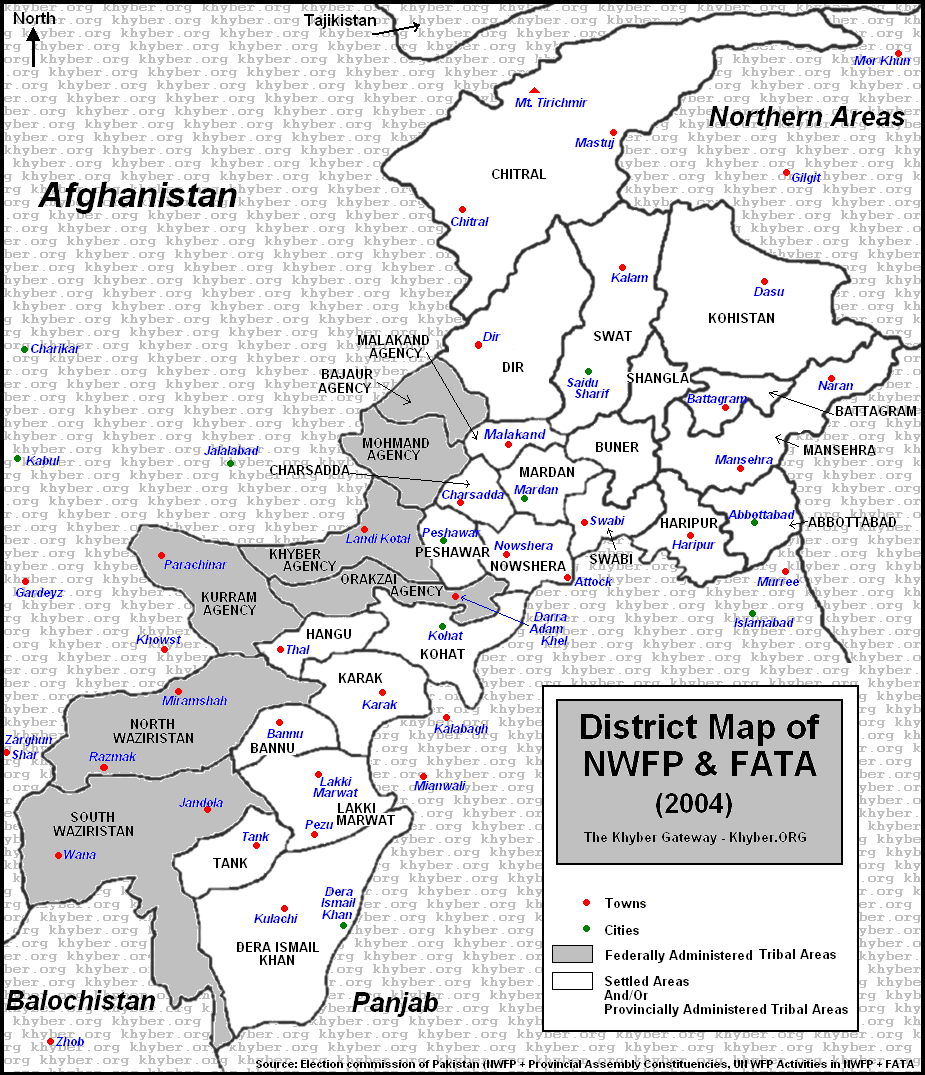
Even before Thursday’s ceasefire, the Taliban’s preparations in the strategic backyard of Pakistan were well underway. This included the isolation of Mehsud and appointing a new team of commanders in the Pakistani tribal areas. Most of the new appointments are Afghans, to signify the importance of fighting a war in Afghanistan rather than in Pakistan. The two main commanders are Abdul Wali in Bajaur Agency and Ustad Yasir in Khyber Agency.

A key component of the Taliban’s offensive this year will be to counter the North Atlantic Treaty Organization’s (NATO’s) plans against them and al-Qaeda.

Last year, the New York Times published a story of a classified US military proposal to intensify efforts to enlist tribal leaders in the frontier areas of Pakistan in the fight against al-Qaeda and the Taliban. This was to be part of a broader effort to bolster the Pakistani forces against an expanding militancy, US military officials said.

This would include pumping more military trainers into Pakistan, providing direct finance to a tribal paramilitary force that until now has proved largely ineffective, and providing funds for smaller militias to fight against the militants. The US currently has only about 50 troops in Pakistan, according to the Pentagon, and this number could grow by dozens under the new approach.

A contact affiliated with al-Qaeda told Asia Times Online on condition of anonymity, “Pakistan has already tried to revive an outdated tribal system to counter the Taliban, but by killing tribal elders in Waziristan, the Taliban effectively stopped that scheme. Now the Americans and the Pakistani government are working on tribal elders of the Shinwari and Afirdi tribes of Khyber Agency, which is the main route of NATO supplies to Afghanistan. Approximately 80% of supplies pass through this route.

“But since the Taliban want to chop off NATO supplies from Pakistan into Afghanistan, the Pakistani Taliban have warned these tribal elders to stay away from the conflict. However, the elders have received huge bribes [funds] from NATO, and so they are obsessed with providing protection to the supply convoys. Therefore, the Taliban will increase their activities in Khyber Agency, which means a war with the elders of the Shinwari and Afirdi tribes,” the contact said.

The second sector of Taliban activity will be in Nooristan and Kunar provinces in Afghanistan, where US forces are conducting huge counter-insurgency operations.

“This year, the Taliban will focus their main attention on a new plan specifically aimed at Kunar and Nooristan. The details of the plan cannot be revealed at this point,” said the contact.

The contact said that the al-Qaeda camp in Pakistan is convinced that American pressure will be so strong that the ceasefire will not be long-term.

This perception is not without substance. Wana military airfield in South Waziristan and Miranshah airfield in North Waziristan have been upgraded from makeshift airstrips into proper runways with backup facilities, which indicate plans for a powerful air operation.

The deployment of US forces at Lowari Mandi and Ghulman Khan checkpoints (both on the Afghan side of the border near North Waziristan) and the construction of a new military camp near Shawal (North Waziristan), on the Afghan side, indicate that the US is not planning on peace for very long.

The only real issue is which side will strike first, and where.

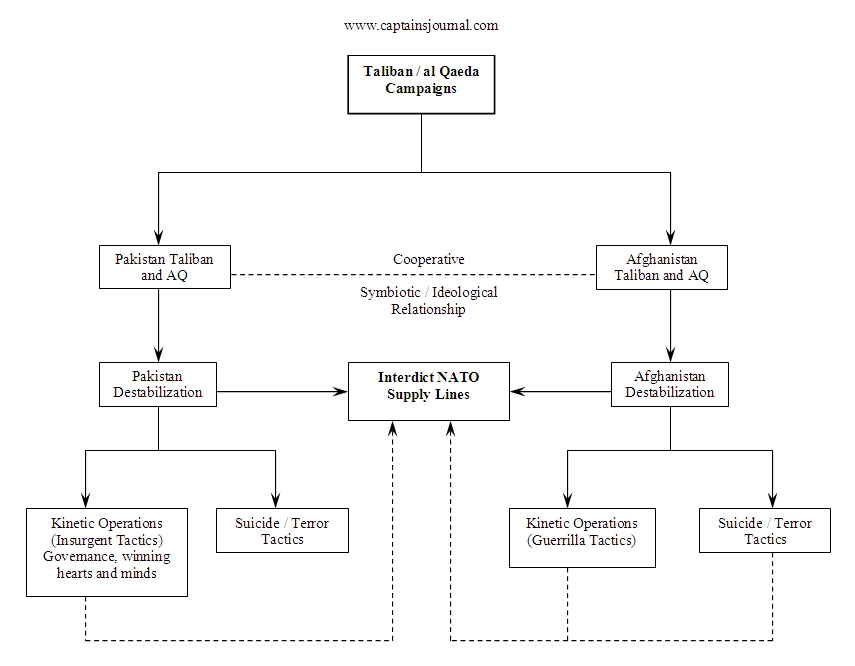
This Asia Times report is a good balance to the reports that the only Taliban campaign this spring will be in Pakistan.  However, in the spirit of balance, I continue to maintain that there will be two Taliban fronts, one in Pakistan (led by Baitullah Mehsud) and the other in Afghanistan (led by Mullah Omar).  I have pointed out the vulnerabilities of the lines of transport through Pakistan relied upon by NATO forces in Afghanistan, and the Pakistan / Afghanistan theater remains symbiotically and physically connected to the point that it is the same counterinsurgency and anti-terrorist campaign.  NATO efforts in Afghanistan will not succeed without clearing the tribal regions of Pakistan as safe havens.

Prior:

Baitullah Mehsud: The Most Powerful Man in Waziristan

U.S. Intelligence Failues: Dual Taliban Campaigns

Taliban Continue Fronts in Pakistan and Afghanistan

Planning for the Spring Offensive in Afghanistan

Al Qaeda Diary Catalogs Organization’s Decline

18 years, 3 months ago

The Washington Post is reporting about a recent significant intelligence coup in an article entitled Diary of an Insurgent in Retreat.

On Nov. 3, U.S. soldiers raided a safe house of the insurgent group al-Qaeda in Iraq near the northern city of Balad. Not a single combatant was captured, but inside the house they found something valuable: a diary and will written in neat Arabic script.

“I am Abu Tariq, Emir of al-Layin and al-Mashadah Sector,” it began.

Over 16 pages, the al-Qaeda in Iraq leader detailed the organization’s demise in his sector. He once had 600 men, but now his force was down to 20 or fewer, he wrote. They had lost weapons and allies. Abu Tariq focused his anger in particular on the Sunni fighters and tribesmen who have turned against al-Qaeda in Iraq and joined the U.S.-backed Sunni Sahwa, or “Awakening,” forces.

This is a stark and telling admission of the demise of the al Qaeda organization in Iraq, and quite obviously was never intended to be studied by U.S. intelligence.  What was once a little less than Battalion strength in this emir’s area of operation is down to less than two squads.  In one sense, this demise was destiny for al Qaeda given the assumption that the U.S. wouldn’t lost hope or sight of the desired end.  Today I had the opportunity to debrief a Marine who has done two combat tours of Iraq, one in the Ramadi area of operations performing mounted patrols and transport interdiction.  One important fact involved knowledge of the typical behavior of the foreign terrorist coming from the Syrian border.

Indigenous Iraqis – insurgent or not – know their way around.  Like any typical citizen of a country, long pauses at intersections and wrong turns are not typical behavior.  One way used to ascertain probable cause for concern was wrong turns off of major thoroughfares.  Whether for directions, shelter, food, money and medical care, perhaps the most significant downfall of al Qaeda has been the utter dependence on indigenous Iraqis, and the violence and extremism of al Qaeda worked to their own disadvantage regarding their relations with the Sunnis in Anbar.  The very nature of the movement sealed its demise.

Even when the concerned local citizens didn’t perform kinetic operations against al Qaeda (but rather, left it to U.S. forces as in Operation Alljah in Fallujah), they turned al Qaeda over to U.S. forces.  When the Iraqis turned on al Qaeda, their fate was ensured even though time and persistence was required to effect this fate.  In this way, the Washington Post title is somewhat misleading, as have been some of my own articles and many others among military blogs.  Al Qaeda in Iraq cannot be characterized as insurgents per se.  They were always and are now foreign terrorists.

The al Qaeda emir also stated that:

“The Islamic State of Iraq [al-Qaeda] is faced with an extraordinary crisis, especially in al-Anbar province. Al-Qaeda’s expulsion from Anbar created weakness and psychological defeat. This also created panic, fear and the unwillingness to fight.

“The morale of the fighters went down and they wanted to be transferred to administrative positions rather than be fighters. There was a total collapse in the security structure of the organization.”

There is debate over whether the Multinational Force is doing enough to publicize the imminent defeat of al Qaeda in Iraq.  The Captain’s Journal has always been able to find the reports and weave together narratives that told the story as it occurred.  We discussed al Qaeda’s demise in Iraq: Al Qaeda’s Quagmire, and in Al Qaeda’s War on Iraq we discussed the death of another emir, Abu Osama al-Tunisi, and the subsequent capture of another internal al Qaeda memorandum, in which he stated that “he’s surrounded, communications have been cut, and he is desperate for help.”

The narrative is clear and available for the self-initiated analyst.  It isn’t clear what more the Multinational Force can do to communicate the facts.  While the fight is not finished, al Qaeda made Iraq the point of departure for their global plans, and their demise is on display for all to see.

Lingering Arguments for the Small Footprint Model of Counterinsurgency

18 years, 3 months ago

The Small Wars Journal editors discuss the views of Mike Vickers, the assistant secretary of defense for special operations / low intensity conflict and interdependent capabilities, concerning the campaign in Afghanistan.

The senior civilian adviser to the defense secretary on special operations says the key to success in Iraq and Afghanistan is through “the indirect approach” — working “by, with and through” host-nation forces — rather than “surges” of U.S. troops.

“Insurgencies have to be won by local capacity,” Mike Vickers, the assistant secretary of defense for special operations/low intensity conflict and interdependent capabilities, told a group of defense reporters in Washington on Feb. 6.

Because “it typically takes a decade or more” to achieve victory in a counterinsurgency, Vickers said, “a key measure of success” for the “supporting country” — in this case, the U.S. — is whether domestic political support for the mission can be sustained for such an extended period.

This view runs parallel to the special forces command views and talking points for Pakistan’s problems (see The Special Forces Plan for Pakistan: Mistaking the Anbar Narrative), and is exactly what I would expect a champion of special forces operations to advocate.  But it is difficult to fathom that there are any advocates of the small footprint model remaining, especially after witnessing the campaigns in Afghanistan and Iraq over the past half decade.  The worn out talking point about COIN taking ten years also ignores the rapidity of change in U.S. politics, something we have discussed before.  It might be the case that U.S. forces will remain in Iraq through another ten years and that Iraq will remain a protectorate of the U.S. for some time into the future.  But this presence will not include constant constabulary operations – or else the force presence will lose popular support.  The notion that any COIN campaign which includes losses from active kinetic operations can maintain popular support over two and a half Presidential administrations simply ignores the realities of American politics.

Further, the small footprint model of COIN (a) is the reason the Afghanistan campaign is languishing to begin with, and (b) almost lost Operation Iraqi Freedom prior to the surge.  Rather than see the surge as a subset of ideas that can work only under certain circumstances, it should be seen as a subset of the larger doctrine of force projection that won the Anbar campaign almost prior to the surge.

Counterinsurgency will never be the same as it was even twenty years ago.  The advent of religious motivation, standoff weapons (such as IEDs), transnational cultural movements, and instantaneous communications and intelligence-gathering through technology, has forever changed the face of low intensity warfare and terrorism.  Even Vickers mentions the situation in Pakistan in troubled language, saying:

“The situation in Pakistan is very worrisome,” he said. “It’s getting worse in Pakistan.”

The Pashtun tribal belt along the Pakistan-Afghanistan border has become a safe haven for al-Qaida’s senior leadership, according to Vickers.

“Al-Qaida’s goals remain to catalyze a global Islamic insurgency against the West and to carry out spectacular attacks against the West and the United States in particular,” he said. “And there really has been no diminishment in those goals … But in the past year-and-a-half or so, there has been an improvement in their capacity to do so as they’ve enjoyed greater sanctuary in western Pakistan.”

Vickers has neatly separated the two problems of Afghanistan and Pakistan, a mistake of huge proportions (I have elsewhere argued that the fates of these two countries are inextricably tied together).  Vickers should be as concerned about Afghanistan as he is about Pakistan.  They are the same campaign.

The focus on personalities and high value targets, special forces operations, and overly heavy reliance on indigenous forces is the Rumsfeld model of COIN.  It is a proven loser.  Standing up the Iraqi and Afghan armies will take time, as will reconstruction and building of infrastructure.  Security is the pretext for the success of either, and this security can only be provided with force projection.  Hope married to bad doctrine is not a plan.

Planning for the Spring Offensive in Afghanistan

18 years, 3 months ago

The News in Pakistan is reporting some interesting developments in the recent engagement of some high value targets in the tribal areas of Pakistan.

PESHAWAR: Following unconfirmed reports of killing of a high-profile al-Qaeda commander Abu Laith al-Libi, there are now rumours that an American al-Qaeda militant Adam Gadahn, also known as Azzam al-Amriki, had been killed in the alleged Predator attack by the US on a house in Mirali, North Waziristan, a few days back.

32-year-old Adam Gadahn, who is American citizen belonging to southern California, has been accused by the US of praising the perpetrators of September 11, 2001 attacks on New York and Washington and attending al-Qaeda training camps in Afghanistan and Pakistani tribal areas.

According to sources, American officials who are yet to publicly confirm the killing of Abu Laith al-Libi, had reportedly sharing information with western media that most likely another most wanted figure, Adam Gadahn, has also been killed in the air strike by the CIA-operated unmanned drone on a house in Khushali Torikhel village near Mirali town.

According to sources, the American al-Qaeda militant, who has been reportedly spending much of his time in Afghanistan and Pakistani tribal areas along the Pakistan-Afghanistan border, had reached Mirali for an important meeting with other senior al-Qaeda commanders for planning the so-called spring offensive against US and Nato troops in Afghanistan.

However, there were no details whether he arrived in the town when a house reportedly housing some senior al-Qaeda operatives including Abu Laith al-Libi, was blitzed. US military officials based in Afghanistan are reportedly collecting details about those killed in the attack on the house and in this regard two of their spy planes continued flying over the same area even after the tragic incident.

Local tribesmen, who were kept at bay by hundreds of armed militants from visiting the house until all the bodies, mostly dismembered, were retrieved, said that US spy planes might have taken pictures of the entire rescue operation as well as of the funeral ceremony.

Like US officials, Pakistani authorities have been constantly keeping silence over what had happened in their jurisdictions. It may be recalled that the US State Department had offered US$ one million reward for capture of Adam Gadahn.

However, some military officials felt that declaring Gadahn as dead in the Mirali incident, the US wanted him to speak for his defence or make some telephone calls so that they target him like rest of al-Qaeda operatives.

The Captain’s Journal is going on record declaring Adam Gadahn to be completely irrelevant to the global war on terror.  The normally clear-headed Threats Watch is focusing on the person of Gadahn, as is the Jawa Report.  We have also focused on individuals, as in Baitullah Mehsud: The Most Powerful Man in Waziristan, but only to the extent that it bears on political and cultural movements and broad strategic analysis that points directly to necessary countermeasures by the U.S.  This silly focus on so-called “high value targets” and special operations to capture or kill them is a waste of resources and energies.  The issue in counterinsurgency is not the personalities, but the people.  This is why special operations cannot win counterinsurgencies.  The recruitment pool never dries up unless force projection provides the security for cultural amelioration and reconstruction to become effective.

Let’s provide a case in point.  The BBC is providing us with an account of why funds for reconstruction isn’t working in Afghanistan, once again giving an example of the need for force projection in counterinsurgency.

Journalist Zaki Shahamat believes Nato should put more money into provinces which have stability.

I have seen dramatic changes in my country since Nato arrived but the changes haven’t been balanced or spread equally throughout the provinces in this country.

It is those provinces where forces are stationed and where there is great turmoil which seem to get more money and reconstruction. Provinces which have seen less turmoil have also seen less funding.

The policy has been to reconstruct unstable areas to provide security. I think this has failed.

There are many reports that the Taleban are approaching Kabul. Another neighbouring province, Wardak, also has a strong Taleban presence.

My family live in Ghazni province and it experienced increased lawlessness. Last year South Korean aid workers were abducted in Ghazni. The Taleban are present but they operate as criminals. The real problems are in the outlying districts.

People who travel from the centre of the province to the districts have to pay – sometimes with their money, their cars, their property and sometimes with their lives.

Nato forces operate mainly in the centre of the province. They can’t and don’t do much for the people outside.

Monies to provinces and areas that are lawless and have no security (due to lack of force projection) go to waste, as does the expensive and time consuming targeting of personalities in the Jihad.  Counterinsurgency is not as simple as throwing money around and sending a JDAM into an enemy home.

But there is something divulged in the press release (other than the useless and boring report about Adam Gadahn) that makes it entirely worthwhile.  It is that the alleged meeting took place to plan the Taliban spring offensive against NATO and U.S. forces in Afghanistan, once again underlining our own analysis of dual Taliban fronts– one in Afghanistan and the other in Pakistan.  This is important intelligence analysis, and again runs directly contrary to the position of Major General Rodriguez and his intelligence apparatus who claim otherwise.  Listening to the details irrespective of the emotional hype has its rewards.


26th MEU (10)
Abu Muqawama (12)
ACOG (2)
ACOGs (1)
Afghan National Army (36)
Afghan National Police (17)
Afghanistan (704)
Afghanistan SOFA (4)
Agriculture in COIN (3)
AGW (1)
Air Force (42)
Air Power (10)
al Qaeda (83)
Ali al-Sistani (1)
America (23)
Ammunition (305)
Animals (328)
Ansar al Sunna (15)
Anthropology (3)
Antonin Scalia (1)
AR-15s (395)
Arghandab River Valley (1)
Arlington Cemetery (2)
Army (91)
Assassinations (2)
Assault Weapon Ban (29)
Australian Army (7)
Azerbaijan (4)
Backpacking (4)
Badr Organization (8)
Baitullah Mehsud (21)
Basra (17)
BATFE (247)
Battle of Bari Alai (2)
Battle of Wanat (18)
Battle Space Weight (3)
Bin Laden (7)
Blogroll (3)
Blogs (24)
Body Armor (23)
Books (3)
Border War (18)
Brady Campaign (1)
Britain (39)
British Army (36)
Camping (5)
Canada (20)
Castle Doctrine (1)
Caucasus (6)
CENTCOM (7)
Center For a New American Security (8)
Charity (3)
China (19)
Christmas (18)
CIA (30)
Civilian National Security Force (3)
Col. Gian Gentile (9)
Combat Outposts (3)
Combat Video (2)
Concerned Citizens (6)
Constabulary Actions (3)
Coolness Factor (3)
COP Keating (4)
Corruption in COIN (4)
Council on Foreign Relations (1)
Counterinsurgency (218)
DADT (2)
David Rohde (1)
Defense Contractors (2)
Department of Defense (220)
Department of Homeland Security (26)
Disaster Preparedness (5)
Distributed Operations (5)
Dogs (15)
Donald Trump (27)
Drone Campaign (4)
EFV (3)
Egypt (12)
El Salvador (1)
Embassy Security (1)
Enemy Spotters (1)
Expeditionary Warfare (18)
F-22 (2)
F-35 (1)
Fallujah (17)
Far East (3)
Fathers and Sons (2)
Favorite (1)
Fazlullah (3)
FBI (39)
Featured (192)
Federal Firearms Laws (18)
Financing the Taliban (2)
Firearms (1,873)
Football (1)
Force Projection (35)
Force Protection (4)
Force Transformation (1)
Foreign Policy (27)
Fukushima Reactor Accident (6)
Ganjgal (1)
Garmsir (1)
general (15)
General Amos (1)
General James Mattis (1)
General McChrystal (44)
General McKiernan (6)
General Rodriguez (3)
General Suleimani (9)
Georgia (19)
GITMO (2)
Google (1)
Gulbuddin Hekmatyar (1)
Gun Control (1,724)
Guns (2,412)
Guns In National Parks (3)
Haditha Roundup (10)
Haiti (2)
HAMAS (7)
Haqqani Network (9)
Hate Mail (8)
Hekmatyar (1)
Heroism (5)
Hezbollah (12)
High Capacity Magazines (16)
High Value Targets (9)
Homecoming (1)
Homeland Security (3)
Horses (2)
Humor (72)
Hunting (62)
ICOS (1)
IEDs (7)
Immigration (123)
India (10)
Infantry (4)
Information Warfare (4)
Infrastructure (4)
Intelligence (23)
Intelligence Bulletin (6)
Iran (171)
Iraq (379)
Iraq SOFA (23)
Islamic Facism (64)
Islamists (98)
Israel (19)
Jaish al Mahdi (21)
Jalalabad (1)
Japan (3)
Jihadists (82)
John Nagl (5)
Joint Intelligence Centers (1)
JRTN (1)
Kabul (1)
Kajaki Dam (1)
Kamdesh (9)
Kandahar (12)
Karachi (7)
Kashmir (2)
Khost Province (1)
Khyber (11)
Knife Blogging (7)
Korea (4)
Korengal Valley (3)
Kunar Province (20)
Kurdistan (3)
Language in COIN (5)
Language in Statecraft (1)
Language Interpreters (2)
Lashkar-e-Taiba (2)
Law Enforcement (6)
Lawfare (14)
Leadership (6)
Lebanon (6)
Leon Panetta (2)
Let Them Fight (2)
Libya (14)
Lines of Effort (3)
Littoral Combat (8)
Logistics (50)
Long Guns (1)
Lt. Col. Allen West (2)
Marine Corps (281)
Marines in Bakwa (1)
Marines in Helmand (67)
Marjah (4)
MEDEVAC (2)
Media (68)
Medical (146)
Memorial Day (6)
Mexican Cartels (47)
Mexico (71)
Michael Yon (6)
Micromanaging the Military (7)
Middle East (1)
Military Blogging (26)
Military Contractors (5)
Military Equipment (25)
Militia (9)
Mitt Romney (3)
Monetary Policy (1)
Moqtada al Sadr (2)
Mosul (4)
Mountains (25)
MRAPs (1)
Mullah Baradar (1)
Mullah Fazlullah (1)
Mullah Omar (3)
Musa Qala (4)
Music (25)
Muslim Brotherhood (6)
Nation Building (2)
National Internet IDs (1)
National Rifle Association (97)
NATO (15)
Navy (31)
Navy Corpsman (1)
NCOs (3)
News (1)
NGOs (3)
Nicholas Schmidle (2)
Now Zad (19)
NSA (3)
NSA James L. Jones (6)
Nuclear (63)
Nuristan (8)
Obama Administration (222)
Offshore Balancing (1)
Operation Alljah (7)
Operation Khanjar (14)
Ossetia (7)
Pakistan (165)
Paktya Province (1)
Palestine (5)
Patriotism (7)
Patrolling (1)
Pech River Valley (11)
Personal (77)
Petraeus (14)
Pictures (1)
Piracy (13)
Pistol (4)
Pizzagate (21)
Police (672)
Police in COIN (3)
Policy (15)
Politics (999)
Poppy (2)
PPEs (1)
Prisons in Counterinsurgency (12)
Project Gunrunner (20)
PRTs (1)
Qatar (1)
Quadrennial Defense Review (2)
Quds Force (13)
Quetta Shura (1)
RAND (3)
Recommended Reading (14)
Refueling Tanker (1)
Religion (501)
Religion and Insurgency (19)
Reuters (1)
Rick Perry (4)
Rifles (1)
Roads (4)
Rolling Stone (1)
Ron Paul (1)
ROTC (1)
Rules of Engagement (76)
Rumsfeld (1)
Russia (37)
Sabbatical (1)
Sangin (1)
Saqlawiyah (1)
Satellite Patrols (2)
Saudi Arabia (4)
Scenes from Iraq (1)
Second Amendment (713)
Second Amendment Quick Hits (2)
Secretary Gates (9)
Sharia Law (3)
Shura Ittehad-ul-Mujahiden (1)
SIIC (2)
Sirajuddin Haqqani (1)
Small Wars (72)
Snipers (9)
Sniveling Lackeys (2)
Soft Power (4)
Somalia (8)
Sons of Afghanistan (1)
Sons of Iraq (2)
Special Forces (28)
Squad Rushes (1)
State Department (23)
Statistics (1)
Sunni Insurgency (10)
Support to Infantry Ratio (1)
Supreme Court (82)
Survival (216)
SWAT Raids (58)
Syria (38)
Tactical Drills (38)
Tactical Gear (17)
Taliban (168)
Taliban Massing of Forces (4)
Tarmiyah (1)
TBI (1)
Technology (21)
Tehrik-i-Taliban (78)
Terrain in Combat (1)
Terrorism (96)
Thanksgiving (13)
The Anbar Narrative (23)
The Art of War (5)
The Fallen (1)
The Long War (20)
The Surge (3)
The Wounded (13)
Thomas Barnett (1)
Transnational Insurgencies (5)
Tribes (5)
TSA (25)
TSA Ineptitude (14)
TTPs (4)
U.S. Border Patrol (8)
U.S. Border Security (22)
U.S. Sovereignty (29)
UAVs (2)
UBL (4)
Ukraine (10)
Uncategorized (105)
Universal Background Check (3)
Unrestricted Warfare (4)
USS Iwo Jima (2)
USS San Antonio (1)
Uzbekistan (1)
V-22 Osprey (4)
Veterans (3)
Vietnam (1)
War & Warfare (435)
War & Warfare (41)
War Movies (4)
War Reporting (21)
Wardak Province (1)
Warriors (6)
Waziristan (1)
Weapons and Tactics (80)
West Point (1)
Winter Operations (1)
Women in Combat (21)
WTF? (1)
Yemen (1)

May 2026
April 2026
March 2026
February 2026
January 2026
December 2025
November 2025
October 2025
September 2025
August 2025
July 2025
June 2025
May 2025
April 2025
March 2025
February 2025
January 2025
December 2024
November 2024
October 2024
September 2024
August 2024
July 2024
June 2024
May 2024
April 2024
March 2024
February 2024
January 2024
December 2023
November 2023
October 2023
September 2023
August 2023
July 2023
June 2023
May 2023
April 2023
March 2023
February 2023
January 2023
December 2022
November 2022
October 2022
September 2022
August 2022
July 2022
June 2022
May 2022
April 2022
March 2022
February 2022
January 2022
December 2021
November 2021
October 2021
September 2021
August 2021
July 2021
June 2021
May 2021
April 2021
March 2021
February 2021
January 2021
December 2020
November 2020
October 2020
September 2020
August 2020
July 2020
June 2020
May 2020
April 2020
March 2020
February 2020
January 2020
December 2019
November 2019
October 2019
September 2019
August 2019
July 2019
June 2019
May 2019
April 2019
March 2019
February 2019
January 2019
December 2018
November 2018
October 2018
September 2018
August 2018
July 2018
June 2018
May 2018
April 2018
March 2018
February 2018
January 2018
December 2017
November 2017
October 2017
September 2017
August 2017
July 2017
June 2017
May 2017
April 2017
March 2017
February 2017
January 2017
December 2016
November 2016
October 2016
September 2016
August 2016
July 2016
June 2016
May 2016
April 2016
March 2016
February 2016
January 2016
December 2015
November 2015
October 2015
September 2015
August 2015
July 2015
June 2015
May 2015
April 2015
March 2015
February 2015
January 2015
December 2014
November 2014
October 2014
September 2014
August 2014
July 2014
June 2014
May 2014
April 2014
March 2014
February 2014
January 2014
December 2013
November 2013
October 2013
September 2013
August 2013
July 2013
June 2013
May 2013
April 2013
March 2013
February 2013
January 2013
December 2012
November 2012
October 2012
September 2012
August 2012
July 2012
June 2012
May 2012
April 2012
March 2012
February 2012
January 2012
December 2011
November 2011
October 2011
September 2011
August 2011
July 2011
June 2011
May 2011
April 2011
March 2011
February 2011
January 2011
December 2010
November 2010
October 2010
September 2010
August 2010
July 2010
June 2010
May 2010
April 2010
March 2010
February 2010
January 2010
December 2009
November 2009
October 2009
September 2009
August 2009
July 2009
June 2009
May 2009
April 2009
March 2009
February 2009
January 2009
December 2008
November 2008
October 2008
September 2008
August 2008
July 2008
June 2008
May 2008
April 2008
March 2008
February 2008
January 2008
December 2007
November 2007
October 2007
September 2007
August 2007
July 2007
June 2007
May 2007
April 2007
March 2007
February 2007
January 2007
December 2006
November 2006
October 2006
September 2006
August 2006
July 2006
June 2006
May 2006

about · archives · contact · register

Copyright © 2006-2026 Captain's Journal. All rights reserved.