Articles by Herschel Smith


The “Captain” is Herschel Smith, who hails from Charlotte, NC. Smith offers news and commentary on warfare, policy and counterterrorism.


Juan Williams On Brian Terry’s Death: “Hey, People Die”

13 years, 10 months ago

Glenn Reynolds calls Juan Williams a crank.  Michelle Malkin is called “just a blogger” by Juan Williams.  Glenn is just being nice.  And Michelle is the one with the class compared to the toad Juan Williams.  Here is Juan Williams on The Five.

H/T Family Security Matters.

Lessons To Draw From Afghanistan (Or, How Obama Really Lost The Campaign)

13 years, 10 months ago

Rajiv Chandrasekaran, writing for The Washington Post, excerpts his book, beginning his article with the following indictment.

The day after he arrived in Kabul in June 2009, Gen. Stanley A. McChrystal, then the top U.S. and NATO commander in Afghanistan, gathered his senior officers to discuss the state of the war. They barraged him with PowerPoint slides — the frequency of Taliban attacks and their impact; the number of local security forces; and an evaluation of the Afghan government’s effectiveness in each province. The metrics were grim, the conclusion obvious: The Americans and their NATO allies were losing.

The part of the country that concerned McChrystal most was the city of Kandahar and the eponymous province that encompasses it. Founded by Alexander the Great in 330 B.C., Kandahar city has long been the symbolic homeland of ethnic Pashtuns. In the 1990s, just as every other band of conquerors had done for the past thousand years, the Taliban used it as a springboard from which they captured Kabul and much of the rest of the nation. If the Americans were going to retake Afghanistan, they needed to start with Kandahar.

But the Pentagon had not sent most of the new U.S. forces that had arrived in Afghanistan to Kandahar. The first wave — a Marine brigade comprising more than half of the 17,000 additional troops President Obama authorized in February 2009 — had been dispatched to neighboring Helmand province, which McChrystal and his top advisers considered of far lower strategic significance.

“Can someone tell me why the Marines were sent to Helmand?” the incredulous McChrystal asked his officers.

The answer — not fully known at the time to McChrystal and his officers — would reveal the dysfunction of the U.S. war effort: a reliance on understaffed NATO partners for crucial intelligence, a misjudgment of Helmand’s importance to Afghanistan’s security, and tribal politics within the Pentagon that led the Marines to insist on confining themselves to a far less important patch of desert.

The consequences were profound: By devoting so many troops to Helmand instead of Kandahar, the U.S. military squandered more than a year of the war. Had the initial contingent of Marines been sent to Kandahar, it could have obviated the need for a full 30,000-troop surge later that year, or it could have granted commanders the flexibility to combat insurgent havens in eastern Afghanistan much sooner, allowing them to meet Obama’s eventual withdrawal deadlines without objection.

Instead, U.S. forces will begin heading home this summer with much of the east in disarray and security improvements in Kandahar still tenuous. Helmand is faring considerably better, but the gains there are having only a modest impact on Afghanistan’s overall stability.

Without the diversion into Helmand, U.S. troops could have pushed into more critical areas of the country before a clear majority of Americans concluded that the war was no longer worth fighting.

Analysis & Commentary

This is horse shit.  Obama and McChrystal have culpability, and we’ll get to that in a moment.  But the tale being spun here makes it sound like a few more sprinkles of magic counterinsurgency pixie dust and the whole thing would have gone much easier.  Perhaps unknown to many who didn’t follow the warp and woof of the campaign, this issue about why the U.S. Marines went to the Helmand Province is not a new debate.  Neither is the story that McChrystal was presented with the decision to send most of the Marines to Helmand as a fait accompli.  Logistical and institutional inertia made it impossible to change things.  Or at least, that’s the story.

Rajiv is telling a tall tale, and the issue was much more complicated than he hints.  I discussed this almost three years ago, and the same thing is true today that was true when I penned the defense of Marines in the Helmand Province.  McChrystal and the Pentagon were under the influence, even control, of the advocates of population-centric counterinsurgency.

Bring stability operations to the population centers, and good governance, goods, services, participation in government on the local level, redress of grievances, and so on, and it will render the outlier Provinces and lower population centers irrelevant, with insurgents unable to topple the central government from those far flung places.

But recall, this is the same Stanley McChrystal that allowed David Rodriguez to micromanage the Marines on their way through Marjah.  “Less than six hours before Marines commenced a major helicopter-borne assault in the town of Marja, Rodriguez’s headquarters issued an order requiring that his operations center clear any airstrike that was on a housing compound in the area but not sought in self-defense.”

Killing the enemy wasn’t a priority.  Rajiv even says so later in the article, exclaiming “the military’s counterinsurgency strategy was supposed to place troops near civilian population centers to protect residents from insurgents, not chase bad guys in the desert or remote valleys.”  But arguing for doing just that, I observed that the insurgents who destabilized Kandahar and other areas of Afghanistan came from Helmand, Kunar, Nuristan and other far flung places where we needed to chase and kill them.

In fact, the larger scale Marine Corps operations in Helmand were predated by intensive fights by the 24th MEU in Garmsir where they killed some 400+ Taliban fighters.  The hue and cry of the people at that time had nothing to do with wells, schooling, governance or anything of the sort.  “We are grateful for the security.  We don’t need your help, just security.”  Similar words were spoken at a meeting in Ghazni with the U.S. Ambassador to Afghanistan: ““We don’t want food, we don’t want schools, we want security!” said one woman council member.”

Corporal William Ash, a squad leader from 1st Platoon, Bravo Company, Battalion Landing Team 1st Battalion, 6th Marine Regiment, 24th Marine Expeditionary Unit, NATO International Security Assistance Force (ISAF), along with a stray dog lead a patrol through a city in Helmand Province, Afghanistan. When the platoon moved into the area, they found two stray dogs, and each time the Marines head out on patrol the dogs are right at the Marines’ side.

In fact, I remarked at one point how ironic it was that McChrystal, who was so concerned about inadvertent casualties that his ROE wouldn’t even allow illumination rounds for night time combat, and who wanted separation of the insurgents from the population in order to engage, was so unpersuaded by the Taliban invitation to join them in a fair fight in Now Zad, where they had completely run off the population and were using the place as an R&R haven.

So did the Marines have enough men to engage Kandahar and Helmand at the same time in order to prevent having to play whack-a-mole counterinsurgency?  Recall that while I was the only blogger at the time covering and commenting on Now Zad that while the men there were losing legs, arms and their lives, living in hobbit holes two or three Marines to a hole, I could not recall any time in the last four years driving across Camp Lejeune when there were so many barracks being built, so many Marines in the states, and so many units living in multiple different locations on the base because there wasn’t enough housing for them in the same barracks.

Recall that I also said that there were Marines who had finished entire periods of enlistment who, while spending time on wasteful MEUs floating across the seas and stopping in every port to become drunk, had neither been to either Iraq nor Afghanistan in the entire four years.

Yes, there were enough Marines to have pulled this off.  A Regimental Combat Team or two could have locked down Kandahar like they did in Fallujah in 2007, conducted census operations, and found and killed the Taliban fighters.  Kandahar could have been essentially cleared with enough focus and effort.

But McChrystal’s strategy not only abandoned far flung Provinces to focus on population centers … leaving the roads to the insurgents just like the Russians did … it abandoned the Pech River Valley in Kunar and Nuristan, along with the entire Hindu Kush mountains.  Every military strategist now acknowledges that this was an error, and we are back into Nuristan.

But only for a while.  After all, we have given a date for withdrawal.  With obfuscation like Rajiv’s article, it’s easy to forget that the administration which began its tenure with a commitment to “the good war” saw that commitment evaporate in the face of hard questions.  What was an effective campaign slogan soon became a byline, and rather than meet the military needs for a full scale surge, we saw a half-ass surge that gave them only some of what had been requested.

At the same time, an end date was set, with the enemy now knowing just how long it would take to run out the clock.  Puerile national security advisers turned Afghanistan into the WTF? war, and men who gave so much in this awful region of the world now see no reason for the loss, and are simply happy to have brought their men home.

There were many mistakes in the campaign: a half-ass surge, a childish national security adviser, McChrystal having surrounded himself with juveniles, overbearing rules of engagement, under-resourcing, strategy that could have been created with a random number generator any given day, poor communication to the American people as to the reasons for the campaign, failure to hold Pakistan accountable for harboring the enemy, loving up on corrupt politicians like Hamid Karzai and his brother Wali Karzai, sending billions of dollars to enlarge and ensure the corruption, and on and on the list goes.

But pointing a finger at the hard work of the U.S. Marines in Now Zad, Musa Qala, Sangin, Garmsir and other places in Helmand isn’t just unfair.  It’s scurrilous and dishonest.   The administration bears the responsibility for the failure.  Campaign slogans aren’t just word games, they are promises to be kept by men in authority and power.  The Soldiers and Marines who have perished demand better of our leaders.

Continuing SWAT Raid Errors And Pranks

13 years, 10 months ago

From CBS Atlanta:

South Fulton County resident, Tim McCullum experienced a wave of emotions after he received a phone call from Fulton County police on Feb. 9.

“I was shook up. I was like, ‘What do I do?’ I was nervous, I’m scared,” McCullum said. “The officer told me they were at my house and that I have a bomb threat. He told me I needed to get here quick as I can.”

But it was more than that just a bomb threat. The caller told the 911 operator he was not alone.

“He said he had two family members in the house with him and that he was going to kill them,” Fulton County police SWAT Captain Wade Yates said.

When that call came in, Yates and his SWAT team responded quickly.

“What scared me the most that night is that all my guys are running in emergency mode. They are running the blue lights and sirens, cutting through traffic to get to this call,” Yates said.

McCullum lives on Topaz Road in Riverdale, where Fulton County fire fighters, patrol officers and the SWAT team all responded to. They shut down Old National and evacuated several homes in McCullum’s neighborhood for four hours.

“We started doing a background investigation to determine who it might be, what their motivation might be and that’s when we discovered the homeowner lived there alone, no one should be in the house and realized it was a ‘SWAT-ing’ incident,” Yates said.

“It takes away the citizen services in South Fulton County. It puts everyone in danger. We had to shut down a major thoroughfare in South Fulton County that people couldn’t get home. It also cost a lot of overtime,” Yates said …

“It was probably like 50 to 60 cops out here. If something was really going on somewhere else, we’re losing out of potential resources because these people are here on a bogus call. If anyone gets caught they definitely need to be prosecuted,” McCullum said.

From WHEC-TV, via Reason:

“I thought it was a family member pulling a joke on me,” Dominicos told WHEC-TV. “And all of the sudden I looked up and they were in my dinning room pointing a loaded gun at me telling me they had a federal warrant to search my premises.”

Not only did they threaten Dominicos, but they come close to using deadly force on her son, who was upstairs when the agents entered his mother’s house:

“My son had heard me arguing with this man and it was not a voice he’d recognize. My son is a hunter, he put a bullet in the chamber of his gun. They heard that, they yelled down long gun, at that point there he told another ATF agent that was with me, handcuff her and take her out,” Dominicos said.

Thankfully Dominicos’ son recognized it was law enforcement and put the gun down right away. Dominicos says the handcuffs caused bruises and as she was going outside with an ATF agent she heard him say they had the wrong house. The ATF and Rochester police executed a number of search warrants Wednesday night. Police sent us a statement, saying they entered the home through an unlocked side door and quote:

“Upon encountering an elderly resident, the team realized that they were at the wrong location at that time and left the premises.”

Charlotte is in the Finger Lakes area of New York, which means that this is the second time in the last four months an elderly person in that region has been a victim of a wrong-door raid. In March, police working under the Finger Lakes Drug Task Force raided the home of 76-year-old Fred Skinner.

Analysis & Commentary

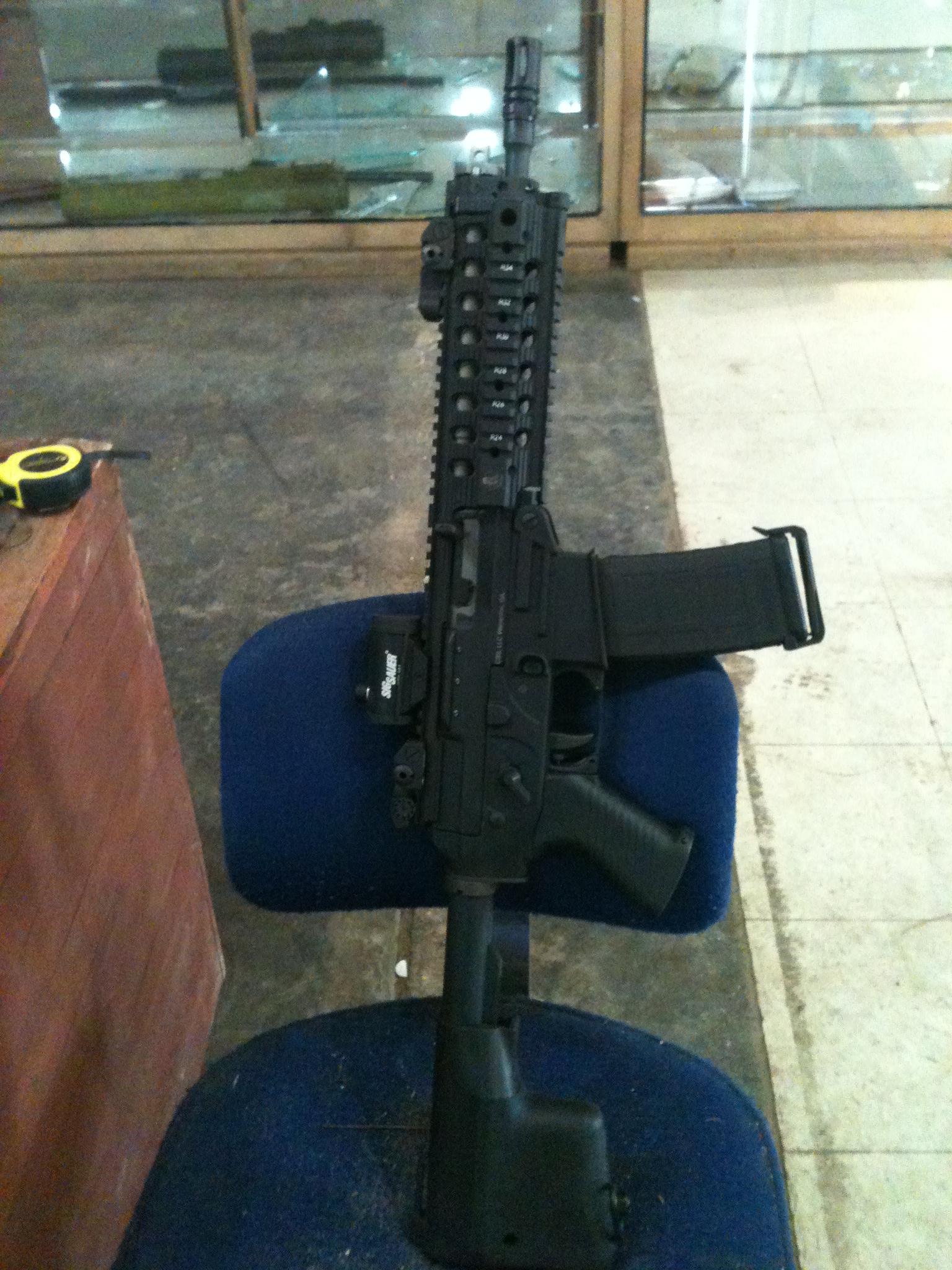
The image above is copied from the video supplied for the Fulton County SWAT.  I didn’t want to link the video because it is so goofy.  Notice what they have done to the M-4 style AR.  They have attached an ammunition box to it, and in the video they are shown carrying drums (like a SAW operator, SAW being Squad Automatic Weapon).  My own son operated a SAW in the 2/6 Marines, with a combat tour in Fallujah in 2007.  He also trained the 2/6 Marines. Golf Company, SAW operators.  Fully automatic weapons like that, needing ammunition drums, are area suppression weapons, and even then, using an open bolt system (unlike the closed bolt design of the weapon in the photograph), it has to be operated judiciously to keep from melting the barrel.  There is no … reason … whatsoever … that a reaction team of any sort (in law enforcement in U.S. cities) needs area suppression fire.  None.

This is yet another indication of just how out of control this militarization of police tactics has become.  The young man who chambered a round in his weapon is very fortunate that he didn’t die.  One never knows, of course, since dressing up in tactical gear and announcing as law enforcement officers has become a tactic for criminals to use in home invasions.  He took his chances that the SWAT team wasn’t a gang of criminals, and this time he was right.  In the future, will the SWAT team be so restrained?  Will the young man guess right and stand down?

These are salient questions as we ponder the fate of poor Mr. Eurie Stamps, who perished when an incompetent SWAT officer stumbled across his prone body and fired his weapon because of sympathetic muscle reflexes (the officer had no trigger discipline and shot Mr. Stamps who was lying on the floor).  Muzzle flagging innocent people would get most ordinary citizens prison time.  And it should.  But the courts do not see law enforcement officers as ordinary citizens.

They should.  The weapon used by LEOs carries no more authority than does the one I carry on my own side.  The Supreme Court decision in Tennessee versus Garner allows LEOs to fire their weapon in self defense, and not to prosecute detentions or arrests.  In other words, they cannot shoot someone who refuses to be arrested.  These military tactics, dangerous because poor training, poor muzzle discipline and poor trigger discipline have caused and will continue to cause needless deaths and injuries, will stop when the public outcry is loud enough.  The courts could also stop it, but their self-proclaimed protections of citizens has proven to ring hollow.

There is an easier way.  Police departments could stop the tactics voluntarily.  As my son has observed, if someone wants to be an “operator,” they should join up, take the training, fly across the pond, and do it for real.  Otherwise, they are peace officers.  Departments can dispatch uniformed officers to disturbances to ascertain the need for any further escalation of force.  Then, in the words of my co-writer, Glen Tschirgi, himself an attorney, the solution is simple.

“STRICT. LIABILITY.

In plain speak, it means, essentially, that if you choose to operate, for instance, an explosives factory, you are going to be held strictly liable for any and every screw up or harm done that results from your activities. No ifs, ands or buts. No defense.

A more common example is the one in Maryland where the courts recently imposed strict liability on owners of pit bulls. If you choose to own one, you are liable for *anything* that dog does. It is basically a four-legged, panting, drooling lawsuit walking around.

Same thing for these SWAT-niks: if a city/county chooses to have a SWAT unit then it (and every member of that unit) will be strictly liable for any and every screw up, wrong raid, wounding, murder, emotional distress and other possible harm that might occur. Yes, massive amounts of money may not make the nightmares for those little girls go away, but it will make cities and counties think long and hard about whether to continue with a SWAT program and, if so, when and how to use it. All you have to do is look at how a few big money lawsuits have changed the face of playgrounds all over the U.S. No more swings, no more jungle gyms, etc.”

Whatever the catalyst, changes must be made.

Prior:

DEA SWAT Raid And Ninth Circuit Ruling

ATF SWAT Failure

D.C. Police Bullies

One Police Officer Dead and Five Wounded From No-Knock Raid

Judges Siding With SWAT Tactics

The Moral Case Against SWAT Raids

Department Of Education SWAT Raid On Kenneth Wright

The Jose Guerena Raid: A Demonstration Of Tactical Incompetence

Coverups Are Ugly: From The D.C. Police To Fast And Furious

13 years, 10 months ago

We have previously discussed the illegal bullying tactics used by the D.C. police to go after second amendment rights.  Now from the most recent reporting by Emily Miller, there is a coverup underway over this incident.

Army 1st Sgt. Matthew Corrigan learned the hard way that the District of Columbia doesn’t believe it has to abide by the Constitution like the 50 states do. For nearly 40 years, the nation’s capital completely ignored the Second Amendment.

(This is the final part of a four-part series. Click here to read part one.)

On Feb. 3, 2010, the Metropolitan Police Department also didn’t give much thought to the Fourth Amendment right of Americans to be free of unreasonable searches and seizures. The department’s SWAT team blew through due process and into the home of Sgt. Corrigan without a warrant because the reservist was suspected of having an unregistered personal gun in his home.

When the incident was taken to court, the city realized its prosecution was jeopardized by the lack of a warrant. Officers came up with various cover stories of “exigent circumstances,” but the scheme unraveled before going to trial. Though all charges were dropped last month, the veteran who volunteered to serve a year in Iraq has suffered immensely. He is suing the city for a minimum of $500,000 in damages. The story of how the city’s case against Sgt. Corrigan fell apart says a lot about the contempt in which the District holds gun owners.

On the night of his arrest, SWAT team members woke Sgt. Corrigan at 4 a.m. and ordered him out of his home. They demanded the keys to his English basement apartment. When the soldier refused, the officers broke down his front door, ransacked his apartment, threw his dog Matrix in the pound, and seized his three personal guns and seven types of ammunition.

The cops zip-tied the first sergeant’s hands and put him into an armored command truck, where he was questioned before any guns were found. They didn’t check with a judge. “When I was secured, a warrant could have been obtained,” Sgt. Corrigan said. “When I offered not to give my consent to enter my place, a warrant could have been obtained. When the first weapon in plain view was allegedly seen, a warrant could have been obtained. … During each of these incidents what was the exigency that prevented a warrant from being obtained?”

Sgt. Corrigan’s attorney, Richard E. Gardiner, filed a motion to suppress the evidence in August 2010, saying the police violated his client’s rights to be free of unreasonable search and seizure. City officials claimed they had to act because Sgt. Corrigan was an expert in planting explosives and there was a smell of gas in the building. According to a November 2010 filing, police “gained intelligence about the defendant, including information that the defendant was an Iraqi war veteran with specialized training (believed to be training in connection with deploying ‘booby traps’).” These factors supposedly created an emergency situation requiring entry without a warrant.

Both exigent circumstances – the smell of natural gas and experience with booby traps – were fabricated.

Well there you have it.  Material false information presented as the truth.  I didn’t say anything in the last post because I wanted to see how all of this shook out, but I knew at that time that the D.C. police were either liars or pathetic idiots.  The smell of gas, as any half-educated person knows, means that one immediately calls the gas company who has people on call 24 hours per day, 365 days per year, for just such emergencies.  Bringing weapons – that were potentially to be discharged – into such an environment, could have been deadly, and at the very best was simply juvenile and stupid.  SWAT raids take a back seat to public health and safety in the case of gas leaks.

Perhaps by assuming that the D.C. police weren’t idiots I assumed too much.  Perhaps they need training in basic health and safety decision-making such as this.  But since they were apparently lying, it was all fabricated.  Being a liar is worse than being stupid.

Eric Holder is at the very minimum a liar, and was stupid to think that tactics such as Fast and Furious wouldn’t be found out.  Now that Mr. Obama has invoked executive privilege over the documents Congressman Issa has requested, his hands are all over this.  Perhaps his hands were all over this well before now.

Either way, for the U.S. Congress to back down now would be a travesty, and cowardly in the superlative.  Eric Holder is apparently a criminal and should spend time in prison.  Hopefully the light will shine into Mr. Obama’s main camp before this is all over.  We will find out if he is merely stupid or a liar and criminal like Mr. Holder.

Regarding truth-telling, it isn’t just what the American people expect.  It’s what God demands.

DEA SWAT Raid and Ninth Circuit Ruling

13 years, 10 months ago

From Reason, via Instapundit:

At 7 a.m. on January 20, 2007, DEA agents battered down the door to Thomas and Rosalie Avina’s mobile home in Seeley, California, in search of suspected drug trafficker Louis Alvarez. Thomas Avina met the agents in his living room and told them they were making a mistake. Shouting “Don’t you fucking move,” the agents forced Thomas Avina to the floor at gunpoint, and handcuffed him and his wife, who had been lying on a couch in the living room. As the officers made their way to the back of the house, where the Avina’s 11-year-old and 14-year-old daughters were sleeping, Rosalie Avina screamed, “Don’t hurt my babies. Don’t hurt my babies.”

The agents entered the 14-year-old girl’s room first, shouting “Get down on the fucking ground.” The girl, who was lying on her bed, rolled onto the floor, where the agents handcuffed her. Next they went to the 11-year-old’s room. The girl was sleeping. Agents woke her up by shouting “Get down on the fucking ground.” The girl’s eyes shot open, but she was, according to her own testimony, “frozen in fear.” So the agents dragged her onto the floor. While one agent handcuffed her, another held a gun to her head.

Moments later the two daughters were carried into the living room and placed next to their parents on the floor while DEA agents ransacked their home. After 30 minutes, the agents removed the children’s handcuffs. After two hours, the agents realized they had the wrong house—the product of a sloppy license plate transcription—and left. 

In 2008, the Avinas—mom, dad, and both daughters—filed a federal suit against the DEA for excessive use of force, assault, and battery in the U.S. District Court for the Southern District of California. That court ruled in favor of the DEA, and the Avinas appealed. Last week, the family got justice.

The Ninth Circuit ruled in favor of the Avinas – at least, somewhat.  But the wording is troubling.  It indicates that the courts, after all of faulty, failed, mistaken and even deadly SWAT raids, still don’t get it.

Viewing the evidence in the light most favorable to the Avinas, a rational trier of fact could find that agents engaged in “extreme or outrageous” conduct when the agents: (1) pointed their guns at the head of eleven-year-old B.S.A. “like they were going to shoot [her]” while B.S.A. was lying on the floor in handcuffs; (2) forced eleven-year-old B.S.A. and fourteen-year-old B.F.A. to lie face down on the floor with their hands cuffed behind their backs; (3) left B.S.A. and B.F.A. in handcuffs for half an hour; and (4) yelled at eleven-year-old B.S.A. and fourteen-year-old B.F.A. to “[g]et down on the f[uck]ing ground.” See Tekle, 511 F.3d at 856 (holding that officers were not entitled to summary judgment on claim for intentional infliction of emotional distress …

There.  That’s all you need to read.  Emotional distress.  That’s it.  No mention or understanding that these officers brandished their weapons at someone, and engaged in muzzle flagging a little girl.  No understanding of the fact that, just as in the case of poor Mr. Eurie Stamps, sympathetic muscle reflexes can lead to inadvertent discharges and kill people.

More people will have to perish at the hands of hot-shot “tacti-cool” SWAT officers discharging their weapons before the public outcry is heard loudly enough to do anything about the militarization of police tactics in America.  The Ninth Circuit, while in the initial stages sympathy with the victims, doesn’t get it.  It’s about the danger of such tactics, not the emotional distress.  At least, one is a primary concern, while the other should be secondary.

Prior: SWAT Raids category

Why I Am A Milblogger

13 years, 10 months ago

Occasionally I receive a note from someone or read something that confirms my hard work as a Milblogger and gives me the energy to move forward.  That recently happened, but more on that in a moment.  I began blogging (and arbitrarily selected a name for my blog) just before my youngest son entered the U.S. Marine Corps.  But after my son’s decision, I began to focus on different things than politics.  I have recently taken to writing about guns, second amendment rights, the militarization of police tactics, the Southern border with Mexico and other things.  But I will always write about the military in one form or another.

It has been a rocky road.  The Milblogger community is a rough bunch, easily drawn into a fight.  So am I, I guess.  I cannot even begin to share the obscenities and ugly names I have been called in both comments and e-mail (some of it over my interactions with and support of Michael Yon), or share the accusations or charges that have been leveled against me (from “stolen valor” because of the name of my blog given that my son served but I didn’t, to violating OPSEC due to my work on trying to change the ROE).  The contact page currently doesn’t work, causing the ugliness to abate a bit.  I have had physical threats (not that I am concerned about those), and one exchange of e-mail with a prominent blogger and writer that to this day, after 32 years in business and industry and 53 years living remains the most bizarre, strange, inexplicable and indiscernible exchange with anyone over anything in my entire life.  I finally inquired into whether the individual had been consuming alcohol, and shared the notes with friend Joshua Foust (to which Foust recommended giving this individual a wide berth).

While the Marines were in the Anbar Province I followed their hard work even on a personal basis.  The U.S. Marines lost just over 1000 men, and I knew many (or most) of their names.  I knew how they had perished, oftentimes, and from press reports I knew how their families reacted.  I wept over many of the lost Marines, and also over many of them who had lost limbs.  Over the years it became so emotionally difficult and taxing that I had to disconnect a little in order to remain sane.  On the other hand, perhaps blogging kept me sane while my son was deployed to Fallujah in 2007.

So why have I done this?  Well, while I know that the standing rules of engagement of the JCS have not changed, or even the theater-specific rules of engagement, I do know that the manner and temperament with which they were applied by JAGs at the unit level was modified over the years in Iraq and Afghanistan.  I would like to think that my work on the ROE added in some small fashion to the feedback to command, both civilian and military.

While General McChrystal’s downfall was his having surrounded himself with adolescents rather than adults, and I’m sure that I didn’t add to his demise in command over the campaign in Afghanistan, I hope that I helped to catalyze the ejection of the Army officers who denied fire support to the Marines and Soldiers at Ganjgal.  McChrystal’s directive was immoral.  But the application of it by officers who should have known better was equally immoral.  In the end, if I didn’t persuade the Army to eject these defective officers, at least I gave the grieving fathers, mothers and wives a chance to express their grief.  The comments in response to Reprimands in Marine Deaths in Ganjgal Engagement are stunning and breathtaking.

I have also been able to make wonderful friends with a man far better than I, and had to watch while he grieved his lost son.  I have grown to know a man whose opinion on Afghanistan (and many other things) I would trust above all others and who has probably been in Afghanistan longer than any English-speaking man alive.  But just when I grow weary of this, someone sends me refreshment to keep me going.  In response to Enemy Sniper at COP Pirtle-King in Kunar I recently received two letters from a friend, summarized below.

I spoke with you months ago but I wanted to attach some photos of the kind of terrain that we had to battle. Granted my unit was mounted most of the deployment but I wanted to illustrate by showing you pictures some of the dismount patrols we did and also mounted patrols. Being on a PRT allowed us the opportunity to travel most of the province so we had to deal with humps up mountains, and traversing one lane roads surrounded by mountains.

I also wanted to attach pictures of what an OP looks. OP Bullrun (the pictures that looked like a bunker) which we manned (I was up there every other week for approx 7 days with a 8 man crew including myself) was a relay station to Camp Wright (or asadabad as some of the saltier guys call it) and also the trip flare if the indians came over the mountain to hit Camp Wright. We were an hour and a half away hump from Camp Wright and we had to rely on ourselves and fires if we came on contact. I currently don’t know if it’s being manned or if it’s an ANA post now.

I’ve also attached pictures that at the time was OP Nevada was an ANA OP across the Asmar/Kunar River from Wright. That was also a two hour hump. Now a lot has changed in two years so I couldn’t tell you it’s current status but I hope the terrain and some of the conditions that you see will further illustrate why in this particular province holding the high ground is a motherf***** (pardon my langauge).

I’m sorry if some of the pictures were “cool guy” pictures. I also wanted to point out that the individuals in most of the pics were my two buddies who I got recalled off IRR with for Obama’s half assed surge. They are [names deleted] from the 82nd Airborne and Spc. [name deleted] from 1st Ranger Battalion. A lot of infantryman got recalled to active duty for the surge to support the national guard operating as manuever elements in RC-East. That’s another story for another time.

I am a big proponent of your blog. I actually discovered your blog October 2009 at the MWR at Ft. Benning when I was recalled to active duty and I was trying to get info on Afghanistan. You actually published an article where my future Squadron Commander (1/221 Cav NV National Guard were the battle space owners for Laghman and provided the manuever element for PRTs Kunar, Nuristan, and Khost) about fighting the taliban. I was originally with 1/221 Cav manuever element that was assigned to PRT Kunar from December 09 to March 2010 and due to man power issues OP Bullrun was originally a 4 man OP. When the boys  went home (I actually moved to Las Vegas from Phoenix when I got back from Afghanistan in Oct 2010 and joined the unit so I can still serve while I go to school full time) PA National Guard and the New PRT took over. Because PA Guard’s manuever element was larger, myself and my three recall buddies pressed the issue to plus the OP to 8 guys.

The reason why we did this is from actually reading your reporting on Wanat, Keating, and various COPs and OPs getting hit in the AO. Because we had increased manpower we made it a point to work on the OP everyday by reinforcing bunkers, adding more C wire and razor wire, filling sandbags, placing claymores with breadth and depth (That was my dad’s advice. He was an Infantry Company Commander in Vietnam with the 101st), getting our Terp fired (we had issues with Claymores being cut and the previous PRT commander stated we needed to catch him in the act but with the new PRT I was able to convince higher to get rid of him), and daily patrols walking the perimeter (we did that to let whoever was watching us know we were active)

Now in terms of OPSEC (Editorial note: In an intervening e-mail we discussed issues of OPSEC) upon further reflection I don’t think that would be an issue because these photos are over 2 years old. From what I’ve heard through the grape vine OP Nevada is run by Americans now and OP Bullrun is an ANA OP now (which means it’s worthless) and apparently Camp Wright is getting shut down in the next 4-6 months.

In terms of losing all the hard work we did to be honest I really don’t care anymore. If there’s no will to secure victory and do it the correct way I see no point in being there. I don’t want anymore of my friends to die because of an incoherent strategy. Myself and countless others busted our ass and we did it for nothing. The only thing that helps me sleep easy at night the fact that I brought all my soldiers home.

And I thank you sir!

UPDATE: Thanks to Michael Yon for the link.

Return To Nuristan – Only To Leave Again

13 years, 10 months ago

An informative report from Reuters:

U.S. troops returned to the area in Afghanistan they call the “dark side of the moon” this week, a remote Hindu Kush region that controls several access routes to Kabul and where the coalition suffered one of its biggest reverses in the decade-long war.

This part of Nuristan province, in the mountainous far east of Afghanistan, could be the target of a planned Taliban offensive, coalition commanders say.

Carrying “speedballs” – black body bags packed with mortars, ammunition and heavy machine guns – a company of U.S. soldiers landed by helicopter on a narrow ridge and trudged up to a tiny Afghan army post overlooking icy peaks and plunging river valleys, as hostile as breathtaking.

With U.S. intelligence pointing to a possible attack by as many as 1,800 Taliban, the soldiers set up weapons over a backyard-sized square, while Afghan army soldiers in camouflage and plastic sandals pointed out fires and torchlight in the distance in the chill night air.

“We’ll get some eyes overhead to check it out. If it’s Taliban, we’ll get a plane up in the morning and drop a bomb on it,” said U.S. Major Jared Bordwell as some of his men from the 1-12 Infantry Regiment dropped down in the dust and tried to get some sleep.

American soldiers withdrew from Nuristan, or the “land of light”, after around 300 insurgents overran an isolated combat outpost near Kamdesh village – below where Bordwell’s men were huddled – on October 3, 2009, killing eight soldiers and wounding 22.

The former U.S. and NATO commander in Afghanistan, General Stanley McChrystal, decided in 2010 to give up remote combat outposts and shift American troops to protect larger population centers.

But it was through here that the Taliban shifted men and weapons for a suicide assault on Kabul’s diplomatic and government quarter in April, circling beyond the reach of U.S. and Afghan army positions to the south in neighboring Kunar province, coalition commanders say.

Stanley McChrystal managed the campaign for just over one year, what we should refer to as “the lost months.”  During this time the Kunar and Nuristan provinces, and all along the Hindu Kush, were left to the Taliban and allied fighters to retrain, regroup, recruit, and raise support, while he played population-centric counterinsurgency in the cities.  The attack on Kabul is minor and had little effect on the city.  And that specific attack will be small compared to the effect these provinces will have on Afghanistan when the U.S. leaves.  Another way of saying this is that the media using the Kabul attack as some sort of benchmark is both mistaken and frightening.  It will get much worse.  Continuing:

With Nuristan now a Taliban staging post and haven, the province is a vital pocket for U.S. forces based in Kunar, with only a few hundred Afghan soldiers and police over an area of 5,800 square km.

“Nuristan remains for me a challenge, a black hole. My line in the sand stops at the Kunar and Nuristan borders,” said Lt-Colonel Scott Green, a wiry former Ranger who oversees Nuristan.

But he will not be in the region for long – NATO troops are due to be withdrawn from north Kunar by October. Green and his men, who are based in Kunar and in Nuristan temporarily, will be among those withdrawn.

So his reduced-strength 1st battalion has to counter insurgents while simultaneously building Afghan capability and “retrograding” – closing up U.S. bases – all within months.

It is one of the most hostile areas in war-torn Afghanistan in a landscape that is equally hostile. Taliban and al Qaeda fighters pass through easily, from either Pakistan or from bases located out of easy NATO reach inside a 4 km-wide border buffer zone.

As many as 2,500 Taliban are thought to be in the province, controlling most districts, and around 300 are foreign, mostly Pakistanis or Chechens, Afghan commanders say.

The insurgents control what few roads there are and have three ways to move deeper into Afghanistan, through either the Kunar, Waygal or Parun valleys, which then wind down into provinces nearer to Kabul.

It is recognized that the surge was under-resourced.  It is recognized that the Kunar and Nuristan Provinces are currently in trouble due to neglect.  It is recognized that they may not survive as nominally Afghan-controlled provinces without U.S. troops.  So U.S. troops are back – and plan to leave within about four months.

This is yet another sad tale of troops who know the value of the Hindu Kush, waning support for the campaign back home, and non-existent (or never-existent) support from the administration to properly prosecute this campaign.

Later in the report, an Afghan militia member shows up to inform them that the locals were very worried about the U.S. troop withdrawal.  Of course they are.  Command attempts to paint a happy face on the overall picture by saying that Kunar may in fact be okay.

Just a happy face couched in a sad report.

Changes In Mexican Border Strategy

13 years, 10 months ago

From Tucson Sentinel:

EL PASO – Border Patrol agents might soon switch from sitting in trucks along the U.S.-Mexico border to helping traffic move more efficiently on the international bridges in this Texas city.

This scenario comes from the idea of Border Patrol agents collaborating with other government agencies.

Border Patrol Chief Michael Fisher in May announced a strategy to fight transnational crimes and drugs, support Homeland Security efforts and aid U.S. Customs and Border Protection.

One possible outcome might be reassigning Border Patrol agents to Customs border crossings to reduce the long wait.

“Currently Customs and Border Protection needs all of the staffing help that they can get – in particular at our ports of entry,” said El Paso City Representative Steve Ortega in an email.

As Border Patrol agents apprehend fewer undocumented people each year, its mission as an agency with resources focused on deterring and apprehending undocumented crossers is being reconsidered.

Currently, Immigration and Customs Enforcement personnel in the El Paso area of responsibility are apprehending and removing more undocumented people through the Secure Communities Program, employment raids and by catching crossers at major ports of entry than the Border Patrol, according to Border Patrol and ICE enforcement and removal figures.

That is why the Border Patrol 2012-2016 Strategic Plan calls for redirecting its agents’ efforts toward relieving congestion and waits at the ports of entry, as well as combating terrorism and transnational crime.

By the close of fiscal year 2011, the typical Border Patrol agent working from Texas to California was apprehending 17.7 undocumented people a year, from a high of 352.2 “illegal alien apprehensions” per agent in 1993. In comparison, the numbers fell even more for agents in the El Paso Sector, from a high of 470 apprehensions per agent in 1993 to only 3.8 apprehensions by 2011.

More agents at entry checkpoints would be a relief for some people of El Paso.

“People would cross to go to work, or to go to restaurants and enjoy the nightlife.  They would cross to see family and they would cross to engage in trade. It used to be pretty easy to cross and it’s gotten more and more difficult,” said border journalist Louie Gilot.

Gilot is the publisher of Newspaper Tree, a nonprofit online news organization in El Paso. Previously, she covered immigration issues as a reporter for the El Paso Times.

For those who cross the border back and forth as part of their daily lives, long waits are too time consuming.

“There used to be no lines when you were going on foot and now there is. I have spent an hour on foot,” Gilot said.

Analysis & Commentary

The reason for the decrease in border apprehensions is more complex than simply painting a picture of success.  The story being peddled here is that border security is improved to the point that the border patrol can now focus on making cross border traffic even easier and more efficient.  The truth is that illegal border traffic is becoming more knowledgeable and efficient, the border patrol (and DHS) is under-reporting “got-aways,” and “soft metrics” are making things look better than they really are.

The U.S. has operational control over only 13% of the Mexican border, regardless of the stories peddled in the media.  This change in strategy has nothing whatsoever to do with being able to focus on efficiency because of improved border security.  It is part of a larger push for more trans-border traffic which has been in the works for some time.

U.S. and Mexican officials are meeting today as a first effort to decide where new border crossings and connecting roads may be necessary, reports HispanicBusiness.com.

At the first Border Master Plan meeting today at the University of Texas at El Paso, representatives will begin identifying future projects, along with project priorities and timelines.

Objectives will also include increasing understanding of the planning process and designing a process that ensures participation from everyone involved in the port of entry projects.

“All sorts of transportation projects and issues will be discussed,” Bob Kaufman, a spokesman for Texas Department of Transportation, told the website. “It will be a binational, multi-government agency meeting. There will be federal, state and local officials that have responsibilities for transportation. The end result will be a list of transportation infrastructure priorities.”

Representatives from the Metropolitan Planning Organization, City of El Paso, the Texas Department of Transportation and the New Mexico Department of Transportation will also be present at the meeting, in addition to U.S. and Mexican federal officials.

“The Border Master Plan is part of a national initiative,” said Roy Gilyard, El Paso’s MPO executive director. “California has a plan and so does Laredo.”

Just to make sure that you understand what is happening, read that last paragraph again: “The Border Master Plan is part of a national initiative.”  Nothing is happenstance or happening by accident.  It’s all part of a larger plan to make the border less significant, make it easier to cross, and raise cross-border shipments of goods and products, especially with Mexican truck drivers.

But take note that ignoring the border (or pretending that is is secure) has its consequences.  The Mexican cartels have the capability to seize control over large geographical areas with great ease.  There is the influence of cartel corruption in New Mexico, and Mexican drug gangs control parts of Arizona.  The cartels have become adept at extreme brutality, but these organizations [previously] “settled matters with a bullet in the head. Not anymore … Now there is a psychopathology at work. Some of these people obviously enjoy this, and they are teaching their surrogates, teenagers, to enjoy it.”

Due to the facts that there are no arming orders for the National Guard troops on the border (causing the troops simply to perform clerical duties), misapplication of the rule of law to these troops (i.e., Supreme Court decision in Tennessee versus Garner), and confusion about the Posse Comitatus Act (i.e., the belief that it applies to border security caused by foreign threats), the law enforcement battle (fought with law enforcement officers, and not enough of them doing the right things) has been substantially lost at the border.

This criminal insurgency crosses the border with as much ease as illegal immigrants, and the lack of border security is as much of a cause of the diminution of U.S. sovereignty and security as it is the increased cost of insurance, health care and other costs associated with illegal immigration and the influx of low skilled workers.

The new strategy at the border isn’t without planning and forethought.  It just isn’t the planning and forethought that one might have guessed would attend issues of national security.  It has more to do with trade, facilitating transcontinental traffic, and enforcing the idea that the United States is an idea rather than a place.

Prior:

Border Lies And What National Guard Troops Do

The Border Is Not Secure

Stability Operations In Mexico

The Texas Border Coalition On Border Security

Losing The Border War

Threat Assessment: Transnational Jihadists and Mexican Cartels

Legalization Of Drugs Won’t End The Border War

Border War

Texas Border Security: A Strategic Military Assessment

Enemy Sniper at COP Pirtle-King in Kunar

13 years, 11 months ago

From the Chicago Tribune, and this will require extensive citation, but it’s well worth it.

“Welcome to Combat Outpost Pirtle-King. Here we only move around at night. If you must move in daytime, make sure you stay close in against the northern walls, as most attacks come from there,” he says. “If you must move in the open, do it at a run.”

NATO commanders cite security gains, eleven years in the war, ahead of a 2014 withdrawal by most foreign combat troops, but there are still pockets like this, where the insurgent threat is so potent that U.S. soldiers can barely move.

COP Pirtle-King, or PK, is a low collection of rockfill walls, trenches and camouflage net, built to help secure the sole road running through the strategic Kunar River Valley and intersect insurgent supply routes from Pakistan.

But the forested mountains on both sides provide perfect cover for the insurgents, including a persistent sniper whose aim has been steadily getting closer to the handful of U.S. and Afghan troops here.

Faced with the threat of so-called plunging fire, soldiers have adjusted routines to carry out most tasks at night, apart from sporadic daytime patrols and manning a trio of guard towers where guns angle up to point high into the rocks above.

When not filling sandbags and extending their walls or doing vehicle maintenance in darkness, they sleep through the daytime heat or just read books and talk within the dusty walkways inside the walls, waiting to repel the next attack.

[ … ]

Dushman shoots from somewhere on a green spur known as “the finger”, above curved hills known as “A Cup” and “C Cup”, but only vaguely similar to breasts. Sometimes fire comes from both sides of the valley, from the south and north.

“That kind of crossfire is usually a sign it’s not Taliban, but more likely Hizb-i-Islami Gulbuddin. They’re a bit more together,” says Danison. “We have pushed them back into the hills though. They used to fire from pretty much right in front.”

U.S. troops in full body armor run across the central vehicle park and any open area to reach their rooms or shift between fortified positions, and use the exposed wooden latrines and showers at their own risk.

“If you have to go, we recommend you wait until night,” Danison says. “Here at Pirtle-King, we’re pretty much in a fishbowl, so we typically operate at night. It just mitigates any exposure during the day.”

In a cluster of small rooms more like a submarine than a ground base, as many as 15 soldiers sleep in bunks stacked four high against a plywood wall marked outside by a target drawn where a Taliban rocket grenade hit but did not detonate.

“Bet you can’t do it again,” reads a sign spray-painted in black. A double-head axe on the wall is called the “Alamo Axe”, in a dark-humored reference to last ditch defense in the unlikely case the Taliban ever tried to overrun the post.

Pirtle-King, named after two soldiers killed at a smaller observation post near here in 2009, is one of a handful of bases here due to be shut down as U.S. troops withdraw from the area and handover to Afghan forces in the Kunar Valley.

Battalion Commander Lt-Col Scott Green says Kunar will make the transition successfully, as Afghan security forces were making strong improvements, including running the majority of patrols beyond the walls of Pirtle-King.

This is simply remarkable.  So here are some questions.  Does the Army send its Soldiers through the equivalent of Marine Corps School of Infantry, where land navigation, map reading, small unit maneuver and other aspects of warfare are learned?  Does the Army continue this training when the Soldier is deployed to his unit (what the Marines would call a fleet Marine)?  So, for example, do Soldiers know how to use night vision, and use that equipment to conduct room clearing operations and night time small unit maneuvers?

If you answered yes to any of the questions above, then the following question is salient.  Why are the Soldiers sitting in the COP?  What a field grade officer (or staff level officer) should have done for the work-up for this deployment is rehearse every one of those things, and live out in the field for most of the work-up.

The next step would be to dispatch small teams of two, three or four Soldiers (what in the Marine Corps would be a fire team) in distributed operations until the COP was emptied out except for a replacement platoon, until the head of that sniper was brought to the CO on a stick.  Of course, he would need the weapon too in order to do ballistic matching and other forensics.  Then, patrols through the valley should be ubiquitous and non-stop to show the population that U.S. Soldiers do not hide in COPs from enemy snipers.

But then, such a field grade or staff officer probably wouldn’t last very long.  Making time.  That’s all these Soldiers are doing.  Punching their time cards.  And it isn’t their fault.  The strategy is unseemly and even immoral because it places Soldier’s lives at risk to do little more than make time.

Here’s hoping that they make their time and come home safely.  No one wants to be the last man out.  As for this area of Kunar, the sniper will make easy work of the ANA.

ATF SWAT Failure

13 years, 11 months ago

We’ve documented and assessed the various SWAT raid failures, from the case of Jose Guerena (shot to death in a demonstration of utter tactical incompetence by the police), to the Department of Education SWAT raid on Kenneth Wright, to the sad case of Mr. Eurie Stamps, a case of mistaken identity, and who was shot to death lying prone because an officer who had no trigger discipline fired his weapon as he tripped due to sympathetic muscle reflexes.  We’ve also seen how these ridiculous military tactics perpetrated on American citizens are dangerous for the police.

And as we’ve seen from fast and furious with the gun walking illegalities, somehow the ATF has “gotten off of the chain,” as it were.  As if on cue so as not to be excluded from the party, the ATF reminds us how detestable they can be with their own SWAT raid bullying.

GREELEY, Colo. – A Colorado woman has filed a lawsuit after agents from the Bureau of Alcohol, Tobacco, Firearms and Explosives, the ATF, entered her home without a warrant and threatened her and her 8-year old-son while looking for a previous tenant who had left the address more than a year earlier.

According to the filing from Linda Griego, it was on June 15, 2010, when officers with the ATF – as part of the Regional Anti-Gang Enforcement Task Force – violently entered her home without a warrant, handcuffed and pointed guns at her and her son, Colby Frias.

“They had multiple machine pistols pointed at my son. I could see the laser sights on his body and he began to freak out. While I was cuffed I had to calm him down while the officers broke down his bedroom door,” she said.

Her legal action is against the Greeley Police Department and the ATF for illegally entering the home without a warrant.

David Lane, Griego’s attorney, told WND that to this day the agency still has not produced a warrant authorizing it to enter her home. He said Frias continues to suffer nightmares about the events of that day.

[ … ]

In the months following the incident, Frias was so scared he had to sleep with his mother.

“Here he is an 8-year-old boy, and he is sleeping with mom again,” she said.

In the months prior to the incident, local authorities had been to Griego’s house several times looking for Angela Hernandez-Nicholson, a former resident.

Each time, Griego told authorities she was no longer living at the address and even provided them with information on how to locate Nicholson.

“I tell them to contact social services because she is getting government benefits. She is on Section 8 housing, if the state is paying her rent, they should be able to find her,” Griego said. “I have even seen her at Wal-Mart all the time. How hard can it be for authorities to track this woman down?”

Griego said when the officers arrived on the day of the incident around 6:30 a.m. she was in the shower getting ready for work with the radio on while her son was sleeping in his bedroom. She had just come out of a nasty divorce, and a restraining order was placed on her ex-husband.

“I heard the knocking and rushed out of the shower dressed only in a towel. I went to the window at the front and saw a man knocking on the door, but I could not make out who he was,” Griego said. “I then went around to the back where they were also knocking. My first concern was for the safety of my son, and what if my ex-husband and friends had come by.”

She then saw one of the officers turn, and she made out part of the word SWAT on the back of his uniform.

“At that point I realized everything would be OK, since we had done nothing wrong. I told the officers I had just come out of the shower and to give me a minute to get dressed.”

After getting dressed, Griego told them she was coming. Once she unlocked the door, the officer forced the door open, causing it to strike her.

According to Griego, she was then violently grabbed and yanked outside where she was pushed up against the house and handcuffed by authorities.

“They had weapons drawn and were pointing them at me. I begged them not to go in because my son was in there.”

When they dragged her back into the house, she saw the officers surrounding Frias with their laser sights pointed at him.

[ … ]

“The last thing they told me was, ‘Well I hope you have a better day than you’ve had so far.’ And then they left,” he said.

Analysis & Commentary

Ms. Griego asks, “How hard can it be for authorities to track this woman down?”  The answer, of course, is that it isn’t hard to track people down.  It requires basic police work, and apprehension can be done safely and without ugly incidents such as this one.  According to my friend, Captain Dickson Skipper of the Charlotte-Mecklenburg Police, most apprehensions can be done physically, or with the really belligerent ones, using pepper spray.  But military tactics have replaced basic police work in America, with the behavior of tacti-cool “operators” justified by judges looking the other way, as if all of this is necessary to maintain order and peace.

With certain very narrow exceptions (such as when a police officer believes that a perpetrator will commit a violent crime against someone), the Supreme Court ruling in Tennessee versus Garner means that the police can use their own weapons in self defense, but they cannot use deadly force as a means to arrest or detain.  Basically, a police officer’s weapon carries no more legal standing than the weapon I carry on my own person, concealed or openly.  Its purpose is self defense.

Yet when the legal system looks the other way and allows this sort of thing to happen with impunity, the lines become blurred and police officers get away with pointing weapons at children.  The implications of this are staggering, from exhibiting poor muzzle discipline to brandishing weapons because they happen to be law enforcement officers.  It is manifestly obvious that an eight year old child isn’t a threat, but tacti-cool operators conducting raids can’t be bothered with such trivialities.

There are those who feel differently.  Having spent time in Fallujah clearing rooms with the U.S. Marines, my own son’s perspective is more peaceful than what he had to perpetrate on that city: “So, you want to be an operator?  Good.  Sign up, take the training, fly across the pond, and do it for real.  If you are a police officer in the U.S., you should first and foremost see yourself as a peace officer.”  When the public outcry is loud enough and law enforcement is held accountable for this kind of behavior, it will stop.  Thus far the outrage simply doesn’t run deep enough – at least, until it happens to you.

UPDATE: Thanks to Michelle Malkin for the link.


26th MEU (10)
Abu Muqawama (12)
ACOG (2)
ACOGs (1)
Afghan National Army (36)
Afghan National Police (17)
Afghanistan (704)
Afghanistan SOFA (4)
Agriculture in COIN (3)
AGW (1)
Air Force (42)
Air Power (10)
al Qaeda (83)
Ali al-Sistani (1)
America (23)
Ammunition (305)
Animals (327)
Ansar al Sunna (15)
Anthropology (3)
Antonin Scalia (1)
AR-15s (394)
Arghandab River Valley (1)
Arlington Cemetery (2)
Army (91)
Assassinations (2)
Assault Weapon Ban (29)
Australian Army (7)
Azerbaijan (4)
Backpacking (4)
Badr Organization (8)
Baitullah Mehsud (21)
Basra (17)
BATFE (247)
Battle of Bari Alai (2)
Battle of Wanat (18)
Battle Space Weight (3)
Bin Laden (7)
Blogroll (3)
Blogs (24)
Body Armor (23)
Books (3)
Border War (18)
Brady Campaign (1)
Britain (39)
British Army (36)
Camping (5)
Canada (20)
Castle Doctrine (1)
Caucasus (6)
CENTCOM (7)
Center For a New American Security (8)
Charity (3)
China (19)
Christmas (18)
CIA (30)
Civilian National Security Force (3)
Col. Gian Gentile (9)
Combat Outposts (3)
Combat Video (2)
Concerned Citizens (6)
Constabulary Actions (3)
Coolness Factor (3)
COP Keating (4)
Corruption in COIN (4)
Council on Foreign Relations (1)
Counterinsurgency (218)
DADT (2)
David Rohde (1)
Defense Contractors (2)
Department of Defense (220)
Department of Homeland Security (26)
Disaster Preparedness (5)
Distributed Operations (5)
Dogs (15)
Donald Trump (27)
Drone Campaign (4)
EFV (3)
Egypt (12)
El Salvador (1)
Embassy Security (1)
Enemy Spotters (1)
Expeditionary Warfare (18)
F-22 (2)
F-35 (1)
Fallujah (17)
Far East (3)
Fathers and Sons (2)
Favorite (1)
Fazlullah (3)
FBI (39)
Featured (192)
Federal Firearms Laws (18)
Financing the Taliban (2)
Firearms (1,873)
Football (1)
Force Projection (35)
Force Protection (4)
Force Transformation (1)
Foreign Policy (27)
Fukushima Reactor Accident (6)
Ganjgal (1)
Garmsir (1)
general (15)
General Amos (1)
General James Mattis (1)
General McChrystal (44)
General McKiernan (6)
General Rodriguez (3)
General Suleimani (9)
Georgia (19)
GITMO (2)
Google (1)
Gulbuddin Hekmatyar (1)
Gun Control (1,722)
Guns (2,412)
Guns In National Parks (3)
Haditha Roundup (10)
Haiti (2)
HAMAS (7)
Haqqani Network (9)
Hate Mail (8)
Hekmatyar (1)
Heroism (5)
Hezbollah (12)
High Capacity Magazines (16)
High Value Targets (9)
Homecoming (1)
Homeland Security (3)
Horses (2)
Humor (72)
Hunting (62)
ICOS (1)
IEDs (7)
Immigration (123)
India (10)
Infantry (4)
Information Warfare (4)
Infrastructure (4)
Intelligence (23)
Intelligence Bulletin (6)
Iran (171)
Iraq (379)
Iraq SOFA (23)
Islamic Facism (64)
Islamists (98)
Israel (19)
Jaish al Mahdi (21)
Jalalabad (1)
Japan (3)
Jihadists (82)
John Nagl (5)
Joint Intelligence Centers (1)
JRTN (1)
Kabul (1)
Kajaki Dam (1)
Kamdesh (9)
Kandahar (12)
Karachi (7)
Kashmir (2)
Khost Province (1)
Khyber (11)
Knife Blogging (7)
Korea (4)
Korengal Valley (3)
Kunar Province (20)
Kurdistan (3)
Language in COIN (5)
Language in Statecraft (1)
Language Interpreters (2)
Lashkar-e-Taiba (2)
Law Enforcement (6)
Lawfare (14)
Leadership (6)
Lebanon (6)
Leon Panetta (2)
Let Them Fight (2)
Libya (14)
Lines of Effort (3)
Littoral Combat (8)
Logistics (50)
Long Guns (1)
Lt. Col. Allen West (2)
Marine Corps (281)
Marines in Bakwa (1)
Marines in Helmand (67)
Marjah (4)
MEDEVAC (2)
Media (68)
Medical (146)
Memorial Day (6)
Mexican Cartels (47)
Mexico (71)
Michael Yon (6)
Micromanaging the Military (7)
Middle East (1)
Military Blogging (26)
Military Contractors (5)
Military Equipment (25)
Militia (9)
Mitt Romney (3)
Monetary Policy (1)
Moqtada al Sadr (2)
Mosul (4)
Mountains (25)
MRAPs (1)
Mullah Baradar (1)
Mullah Fazlullah (1)
Mullah Omar (3)
Musa Qala (4)
Music (25)
Muslim Brotherhood (6)
Nation Building (2)
National Internet IDs (1)
National Rifle Association (97)
NATO (15)
Navy (31)
Navy Corpsman (1)
NCOs (3)
News (1)
NGOs (3)
Nicholas Schmidle (2)
Now Zad (19)
NSA (3)
NSA James L. Jones (6)
Nuclear (63)
Nuristan (8)
Obama Administration (222)
Offshore Balancing (1)
Operation Alljah (7)
Operation Khanjar (14)
Ossetia (7)
Pakistan (165)
Paktya Province (1)
Palestine (5)
Patriotism (7)
Patrolling (1)
Pech River Valley (11)
Personal (77)
Petraeus (14)
Pictures (1)
Piracy (13)
Pistol (4)
Pizzagate (21)
Police (672)
Police in COIN (3)
Policy (15)
Politics (999)
Poppy (2)
PPEs (1)
Prisons in Counterinsurgency (12)
Project Gunrunner (20)
PRTs (1)
Qatar (1)
Quadrennial Defense Review (2)
Quds Force (13)
Quetta Shura (1)
RAND (3)
Recommended Reading (14)
Refueling Tanker (1)
Religion (501)
Religion and Insurgency (19)
Reuters (1)
Rick Perry (4)
Rifles (1)
Roads (4)
Rolling Stone (1)
Ron Paul (1)
ROTC (1)
Rules of Engagement (76)
Rumsfeld (1)
Russia (37)
Sabbatical (1)
Sangin (1)
Saqlawiyah (1)
Satellite Patrols (2)
Saudi Arabia (4)
Scenes from Iraq (1)
Second Amendment (713)
Second Amendment Quick Hits (2)
Secretary Gates (9)
Sharia Law (3)
Shura Ittehad-ul-Mujahiden (1)
SIIC (2)
Sirajuddin Haqqani (1)
Small Wars (72)
Snipers (9)
Sniveling Lackeys (2)
Soft Power (4)
Somalia (8)
Sons of Afghanistan (1)
Sons of Iraq (2)
Special Forces (28)
Squad Rushes (1)
State Department (23)
Statistics (1)
Sunni Insurgency (10)
Support to Infantry Ratio (1)
Supreme Court (81)
Survival (216)
SWAT Raids (58)
Syria (38)
Tactical Drills (38)
Tactical Gear (17)
Taliban (168)
Taliban Massing of Forces (4)
Tarmiyah (1)
TBI (1)
Technology (21)
Tehrik-i-Taliban (78)
Terrain in Combat (1)
Terrorism (96)
Thanksgiving (13)
The Anbar Narrative (23)
The Art of War (5)
The Fallen (1)
The Long War (20)
The Surge (3)
The Wounded (13)
Thomas Barnett (1)
Transnational Insurgencies (5)
Tribes (5)
TSA (25)
TSA Ineptitude (14)
TTPs (4)
U.S. Border Patrol (8)
U.S. Border Security (22)
U.S. Sovereignty (29)
UAVs (2)
UBL (4)
Ukraine (10)
Uncategorized (105)
Universal Background Check (3)
Unrestricted Warfare (4)
USS Iwo Jima (2)
USS San Antonio (1)
Uzbekistan (1)
V-22 Osprey (4)
Veterans (3)
Vietnam (1)
War & Warfare (435)
War & Warfare (41)
War Movies (4)
War Reporting (21)
Wardak Province (1)
Warriors (6)
Waziristan (1)
Weapons and Tactics (80)
West Point (1)
Winter Operations (1)
Women in Combat (21)
WTF? (1)
Yemen (1)

April 2026
March 2026
February 2026
January 2026
December 2025
November 2025
October 2025
September 2025
August 2025
July 2025
June 2025
May 2025
April 2025
March 2025
February 2025
January 2025
December 2024
November 2024
October 2024
September 2024
August 2024
July 2024
June 2024
May 2024
April 2024
March 2024
February 2024
January 2024
December 2023
November 2023
October 2023
September 2023
August 2023
July 2023
June 2023
May 2023
April 2023
March 2023
February 2023
January 2023
December 2022
November 2022
October 2022
September 2022
August 2022
July 2022
June 2022
May 2022
April 2022
March 2022
February 2022
January 2022
December 2021
November 2021
October 2021
September 2021
August 2021
July 2021
June 2021
May 2021
April 2021
March 2021
February 2021
January 2021
December 2020
November 2020
October 2020
September 2020
August 2020
July 2020
June 2020
May 2020
April 2020
March 2020
February 2020
January 2020
December 2019
November 2019
October 2019
September 2019
August 2019
July 2019
June 2019
May 2019
April 2019
March 2019
February 2019
January 2019
December 2018
November 2018
October 2018
September 2018
August 2018
July 2018
June 2018
May 2018
April 2018
March 2018
February 2018
January 2018
December 2017
November 2017
October 2017
September 2017
August 2017
July 2017
June 2017
May 2017
April 2017
March 2017
February 2017
January 2017
December 2016
November 2016
October 2016
September 2016
August 2016
July 2016
June 2016
May 2016
April 2016
March 2016
February 2016
January 2016
December 2015
November 2015
October 2015
September 2015
August 2015
July 2015
June 2015
May 2015
April 2015
March 2015
February 2015
January 2015
December 2014
November 2014
October 2014
September 2014
August 2014
July 2014
June 2014
May 2014
April 2014
March 2014
February 2014
January 2014
December 2013
November 2013
October 2013
September 2013
August 2013
July 2013
June 2013
May 2013
April 2013
March 2013
February 2013
January 2013
December 2012
November 2012
October 2012
September 2012
August 2012
July 2012
June 2012
May 2012
April 2012
March 2012
February 2012
January 2012
December 2011
November 2011
October 2011
September 2011
August 2011
July 2011
June 2011
May 2011
April 2011
March 2011
February 2011
January 2011
December 2010
November 2010
October 2010
September 2010
August 2010
July 2010
June 2010
May 2010
April 2010
March 2010
February 2010
January 2010
December 2009
November 2009
October 2009
September 2009
August 2009
July 2009
June 2009
May 2009
April 2009
March 2009
February 2009
January 2009
December 2008
November 2008
October 2008
September 2008
August 2008
July 2008
June 2008
May 2008
April 2008
March 2008
February 2008
January 2008
December 2007
November 2007
October 2007
September 2007
August 2007
July 2007
June 2007
May 2007
April 2007
March 2007
February 2007
January 2007
December 2006
November 2006
October 2006
September 2006
August 2006
July 2006
June 2006
May 2006

about · archives · contact · register

Copyright © 2006-2026 Captain's Journal. All rights reserved.