
Save The Planet – Buy An AR!
 14 years ago
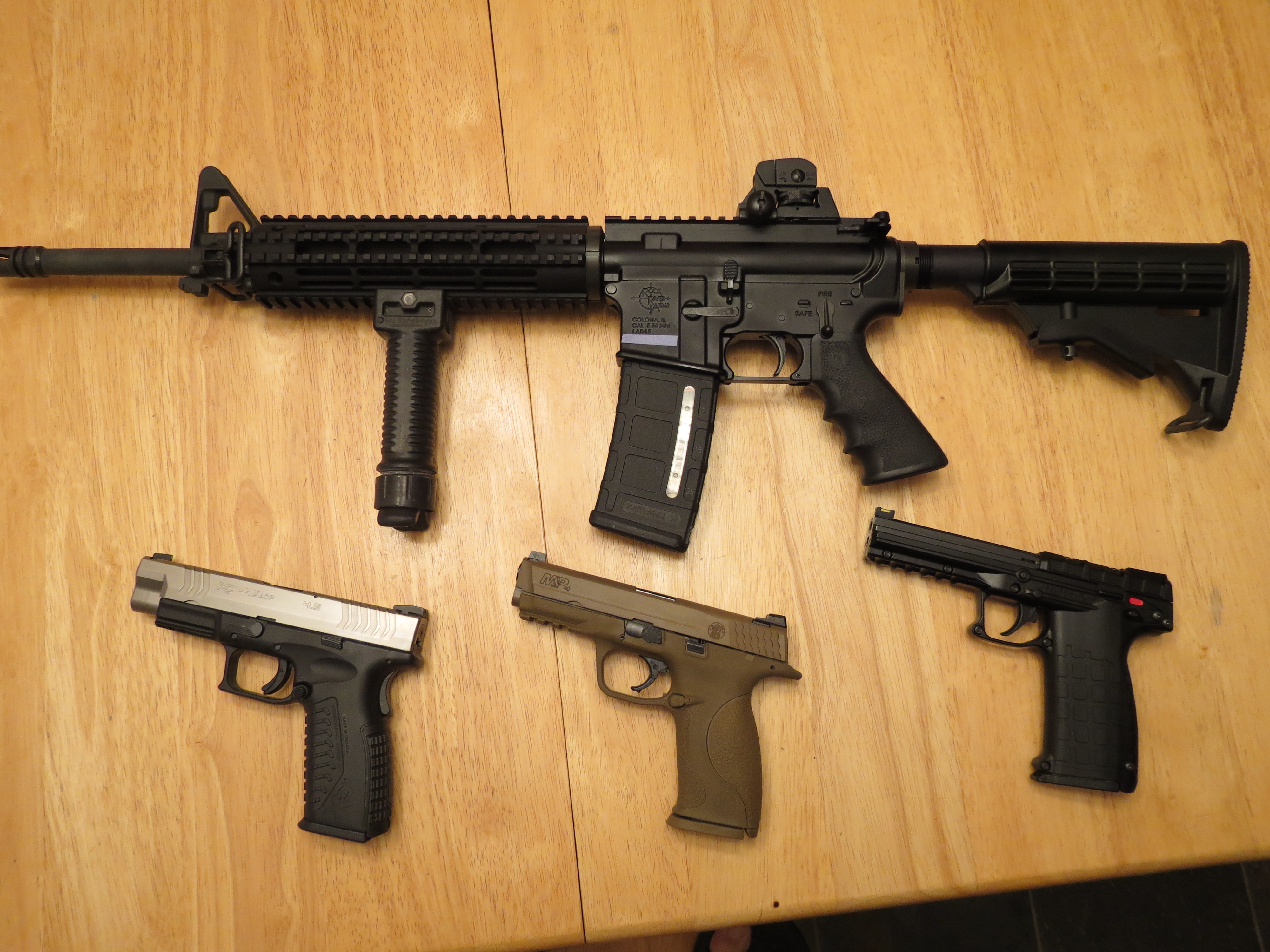
I’ve previously documented how an AR can be useful for entertainment and the study of the science of firearms, defining it this way.
While ATF lawyers might disagree, for something to have a “sporting purpose” means nothing more than it can be taken to the range and operated by the owner to his or her entertainment or training. The shooting skills – whether for official competitions such as IDPA or 3-Gun, or for unofficial activities such as regular range visits for the purpose of betterment at the science of firearms operation – are sports. All of them. Period. This is non-negotiable. If it is a firearm, it has a sporting purpose.
Then again, ARs are useful for hunting as I’ve also shown. I’ve also documented two-, three-, four- and five-man home invasions in which an AR was either used or could have been in self defense.
But that isn’t all. Feral hogs have become a blight on the landscape and terrain of much of America.
What do wild hogs do that’s so bad?
Oh, not much. They just eat the eggs of the sea turtle, an endangered species, on barrier islands off the East Coast, and root up rare and diverse species of plants all over, and contribute to the replacement of those plants by weedy, invasive species, and promote erosion, and undermine roadbeds and bridges with their rooting, and push expensive horses away from food stations in pastures in Georgia, and inflict tusk marks on the legs of these horses, and eat eggs of game birds like quail and grouse, and run off game species like deer and wild turkeys, and eat food plots planted specially for those animals, and root up the hurricane levee in Bayou Sauvage, Louisiana, that kept Lake Pontchartrain from flooding the eastern part of New Orleans, and chase a woman in Itasca, Texas, and root up lawns of condominiums in Silicon Valley, and kill lambs and calves, and eat them so thoroughly that no evidence of the attack can be found.
And eat red-cheeked salamanders and short-tailed shrews and red-back voles and other dwellers in the leaf litter in the Great Smoky Mountains, and destroy a yard that had previously won two “‘Yard of the Month” awards on Robins Air Force Base, in central Georgia, and knock over glass patio tables in suburban Houston, and muddy pristine brook-trout streams by wallowing in them, and play hell with native flora and fauna in Hawaii, and contribute to the near-extinction of the island fox on Santa Cruz Island off the coast of California, and root up American Indian historic sites and burial grounds, and root up a replanting of native vegetation along the banks of the Sacramento River, and root up peanut fields in Georgia, and root up sweet-potato fields in Texas, and dig big holes by rooting in wheat fields irrigated by motorized central-pivot irrigation pipes, and, as the nine-hundred-foot-long pipe advances automatically on its wheeled supports, one set of wheels hangs up in a hog-rooted hole, and meanwhile the rest of the pipe keeps on going and begins to pivot around the stuck wheels, and it continues and continues on its hog-altered course until the whole seventy-five-thousand-dollar system is hopelessly pretzeled and ruined.
They have run farmers in Georgia and Texas completely out of business and threatened men, women and children with injury and loss of income. But now comes an account of the use of ARs to address the problem.
Quite simply, what used to be vast tracks of empty land has filled up with people. The wilds where hunters once roamed now sport tract housing and double wides. It’s a big reason gun ownership is declining in America — down 40 percent since 1977.
But here on Campbell’s big farm is a little piece of what once was. And like many of his peers who came of age in the ’70s and ’80s, Campbell saw no reason for his daughters to be excluded from the rituals he grew up with.
[ … ]
At his farmhouse, Campbell goes to his gun safe.
“It will hold about 40 guns, and I’ve got about 25 in there. But I’ve got some really neat guns,” Campbell says. “I’ve got my grandfather’s .22. I have an STW. I have an AR-15. I have a Smith & Wesson .22-250.”
Some of the rifles are for deer. Campbell has many beautiful shotguns because he is an avid duck hunter. He uses the AR-15, which is essentially the military’s M16, to hunt feral hogs. We go out back, and the judge lets fly with the semiautomatic.
“I’ve got a night vision scope on it. And the hogs only come out at 2 o’clock in the morning. There are certain spots they come out at. I drive up very quietly. I’m normally only 200 yards out, and I turn on my little trusty night vision scope and I smoke ’em. All of ’em,” Campbell says. “I can shoot 30 shots in eight seconds, and I’ve killed as many as 26 out of 30 shots at night with that gun.”
As for any willingness to compromise on something like limiting the size of ammunition clips, Campbell says if Democrats could be trusted not to ask for more and more, he’d consider it. But he says you can’t trust Democrats in general, and you certainly can’t trust Obama. And he says liberals mistake gun owners’ enmity toward the president for something it’s not.
“It’s not a black thing, it’s a liberal thing,” Campbell says.
Well, first in order to correct some misconceptions, it is simply a farce to claim that gun ownership is declining in America. Second – and let me be clear about this – magazine capacity is a non-negotiable. But third, note the use of the AR to save the terrain, protect indigenous species, protect the plant life, prevent erosion, and save the farmers.
It’s like the health benefits of red wine or coffee. Is there anything an AR can’t do?
UPDATE #1: Thanks to Glenn Reynolds for the attention!
UPDATE #2: Thanks to David Codrea for the attention!
UPDATE #3: My friend Joey MacRae, one of the premier quarter horse trainers in America, hunts feral hogs a different way down around Anderson, S.C. He releases his bay dogs to bay up the pigs. When they do he releases his strike dogs, and when the strike dogs get the pig, Joey goes in with a long knife and kills the pig himself with a strike to the heart. Thanks, but if I go hog hunting I’ll stick to a gun.
UPDATE #4: Thanks to New Jovian Thunderbolt for the attention! Maybe Benjamin wants to loan me his M-14 for a while? I’m cool with that too.
UPDATE #5: Thanks to Michael Bane for the attention!
UPDATE #6: Thanks to Bill Quick for the attention!
UPDATE #7: Thanks to Say Uncle for the attention!
UPDATE #8: Thanks to Ace for the attention!
Prior:
Happy Assault Weapons Ban Sunset Provision Day!