New York Court Holds Stun Gun Ban is Not Unconstitutional, in Contravention of Caetano

Herschel Smith · 30 Mar 2025 · 2 Comments

Dean Weingarten has a good find at Ammoland. Judge Eduardo Ramos, the U.S. District Judge for the Southern District of New York,  has issued an Opinion & Order that a ban on stun guns is constitutional. A New York State law prohibits the private possession of stun guns and tasers; a New York City law prohibits the possession and selling of stun guns. Judge Ramos has ruled these laws do not infringe on rights protected by the Second Amendment of the United States Constitution. Let's briefly…… [read more]

Continuing Use of Sand Berms in Counterinsurgency

BY Herschel Smith
17 years ago

In Sand Berms Around Haditha, we discussed instances of the use of sand berms over two years ago to isolate Haditha from insurgents coming across the border from Syria.  The strategy in Haditha also relied on a strong police chief, but the berms were a necessary element that allowed the Marines and police chief to control traffic into and out of Haditha.  Now as Regimental Combat Team 5 comes home, we learn of the continuing use of sand berms in counterinsurgency.

Securing the area involved building large sand berms around cities that would otherwise be easy to approach from any direction in the desert. Doing this limited the number of insurgent strikes and allowed the Iraqis to control the flow of population in their own cities, Malay said.

This, combined with intelligence gathering and cooperation with tribal leaders and Iraqi police forces, helped limit the number of attacks on Marines during the team’s 13-month tour in Iraq. Malay said attacks diminished from 16 a week when the unit arrived to less than two a week when it returned last month.

This tactic has been necessary for cities nearest to the Syrian border.  RCT-5 has been active in the West of Anbar, in and around Rawah, and Rutbah.  Rawah is close to the Syrian border.

Rutbah is close to not only the Syrian border, but the Jordanian border as well.  Whether it is gated communities and biometrics to prevent the flow of insurgents through the city, or the simpler use of sand berms surrounding a city, interdiction of the flow of insurgents through physical terrain has been a key tactic in counterinsurgency as practiced by the Marines in Anbar.

On Patrol in Kunar

BY Herschel Smith
17 years ago

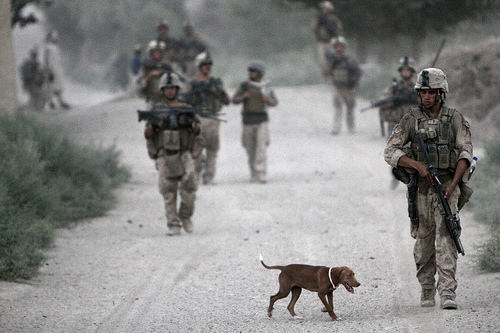
U.S. and Afghan soldiers on patrol in Kunar Province, Afghanistan, April 2009.

Classified Afghanistan Metrics

BY Herschel Smith
17 years ago

The administration is taking a troubling stand on metrics for the campaign in Afghanistan.

Secretary of State Hillary Rodham Clinton wants to keep things secret that Sen. Hillary Rodham Clinton found it expedient to politicize.

The Obama administration wants to keep its metrics of progress for the war in Afghanistan under wraps. Secretary Clinton and Defense Secretary Robert M. Gates told the Senate Appropriations Committee last week that the executive branch, not Congress, should craft the Afghan benchmarks, many of which will be classified. Times certainly have changed – two years ago, then-Sen. Clinton demanded benchmarks be included in the May 2007 Iraq war supplemental appropriation.

Mr. Obama promised a benchmarked war effort in March when he announced his Afghanistan strategy. He rejected “blindly staying the course,” a tart reference to one of Mr. Bush’s pet phrases, and promised instead that there would be “clear metrics to measure progress and hold ourselves accountable.” Perhaps the president could explain how accountability can function if Congress and the public do not know what the clear metrics are.

Mrs. Clinton stated that the government is “going to be measuring from every perspective,” but more metrics are not necessarily better. Once this multitude of measures is set in place, they can calcify thinking and destroy the spirit of innovation that is critical in waging unconventional war. Benchmarks are not a substitute for strategy, but pursuit of them can wind up driving the war effort when they should be a trailing indicator. We saw that in Defense Secretary Robert S. McNamara’s metric-mad approach to fighting the war in Vietnam. A clever enemy will use publicly published metrics to focus its efforts on the things the U.S. government deems to be important, seeking to shape perceptions of failure and defeat by the bureaucracy’s own definition. It is unwise to hand the enemy the ability to create meaningful strategic effects by our own criteria.

Public metrics also can create political problems, as Mrs. Clinton well knows. In September 2007, the Government Accountability Office reported that Baghdad had “met 3, partially met 4, and did not meet 11” of the 18 benchmarks Congress had established the previous May. Opponents of the surge strategy, such as Mrs. Clinton and then-Sen. Obama, seized on the report to declare the surge a failure. But the war was, in fact, being won. Had the United States been guided by congressional politics rather than sound military thinking, we would have withdrawn from Iraq last year and marked it as a defeat (editorial comment, italics mine).

Some learning has occurred over the past two years. The Obama administration does not want to face the kinds of political problems that some of its leading members created for their predecessors. We applaud the administration’s newfound respect for secrecy in warfare and only wish it had dawned on these officials sooner.

Take note of the sophisticated nuance in the editorial above, for while it maintains the appearance of patriotism and support for the campaign, it falls into the trap laid by the administration.  Mr. Obama promised clear metrics to hold ourselves accountable.  Ms. Clinton later promises that the government is going to be “measuring from every perspective.”  But be aware that handing the enemy knowledge of what you think is important tells them where to focus their energies, so many of the metrics used by the government will remain classified, or so we’re told by Ms. Clinton.

This argument is a pig in a poke.  The administration is counting on the unthinking population buying into the notion of the campaign in Afghanistan being similar to, say, the war in the South Pacific with Japan, or D-Day, or the Battle of Inchon, where troop movements, timing of operations and so forth, are operational security, and divulging them to the enemy causes loss of lives and irreparable harm to our own battle plans.

Nothing could be further from the truth.  General deployment plans such as the 10th Mountain Division to the area around Kabul in order to stabilize the ring of security around the central government are well known and laid out for us by not only open source information but official military sources as well.

Counterinsurgency has its moments (such as troop movements and intelligence-driven raids) that fall into the OPSEC category, but comprehensive battle space metrics is not one of them.  In fact, note the very specific data given to us in the most recent report on Iraq by the DoD.

Note that the title of this report is Measuring Stability and Security in Iraq: March 2009 Report to Congress.  Very specific metrics indeed, collected and collated by the executive branch and presented to the legislative branch, and for very good reason.  The legislative branch controls the money.

We have made it an obvious priority to train and stand up the Afghan forces, a strategy that the Bush administration pursued in Iraq.  It didn’t work in Iraq until force projection by the U.S. forces provided security for the population, and so concerns like drug use by the Afghan police and army are serious issues that must be tracked and communicated to planners and legislators; that rate of casualties, trust in government, and fidelity of internal governmental systems are important metrics to be studied and communicated to the voters.  The voters get the final say.

A communist system controls the flow, rate, quality, quantity and target of information.  In the free market of ideas, the U.S. stands alone as the nation most willing to let the people themselves judge the rightness or wrongness of things.

What the administration doesn’t like is not the potential operational security concerns associated with metrics in the Afghanistan campaign.  That’s a pitifully crafted argument that can be dismissed rather quickly by most thinking men and women.  They fear that there are forces out there who might use the metrics in the same dark and ill-intentioned manner that those in this current administration used them to undercut and under-resource the campaign in Iraq.

For the record, The Captain’s Journal isn’t among those detractors who would undercut the campaign because we weren’t meeting targets.  We would propose funding and resourcing the forces better so that we could meet those targets, while also analyzing the reasons for failure.  It would appear that this administration doesn’t hold to similar thinking.

Arguments Over the EFV and V-22

BY Herschel Smith
17 years ago

In Gates Reshapes DoD Budget Plans we observed that the Expeditionary Fighting Vehicle (EFV) had gotten off unscathed.  It’s budget dollars remained intact, or so it seemed.  It’s a little more murky now with Marine Corps Commandant Conway publicly arguing for the EFV.

U.S. Marines must be able to storm enemy shores in amphibious vehicles such as those being built by General Dynamics Corp, the top Marine said, defending a $13.2 billion program called into question by Defense Secretary Robert Gates.

General Dynamics’ Expeditionary Fighting Vehicle, or EFV, “is inextricably linked to that capability and an absolutely critical requirement for us,” General James Conway, the Marine Corps commandant, told reporters at a Pentagon briefing on Wednesday.

“And, by the way, China has already fielded a similar vehicle and is building more,” he said.

As conceived by the Marine Corps, the EFV is to be able to transport up to 18 combat-ready Marines at high speeds on both land and sea. It would have advanced communications capabilities, provide increased armored protection against rocket-propelled grenades and improvised explosive devices, and deliver lethal firepower up to 2,000 meters (2,200 yards).

Part of the argument is based on the intent of the Navy and its reluctance to engage and support near the coastline.

Conway said he believes strongly the military needs the forcible entry capability provided by the EFV, particularly as the Navy plans to operate at least 25 miles from the shoreline.

“That’s a 25-mile bridge that has to be managed somehow and you’re not going to do it with our current set of vehicles,” the four-star general said. “We think the best way to do that is with a vehicle that can do it in a couple of hours, not in a day. And that’s what it would virtually take with our existing fleet” of amphibious assault vehicles.

But Secretary Gates apparently is still considering what to do with the program.

Defense Secretary Robert Gates, who has announced major changes to many of the military’s largest development and procurement projects, has put off making a decision on the EFV, a program with a troubled history, until the completion of the Quadrennial Defense Review next year. Costs on the General Dynamics program have soared 43 percent to an estimated $13 billion while the Marine Corps has been trying over the last two years to correct reliability problems.

“We have to take a hard look at where it would be necessary or sensible to launch another major amphibious action again,” Gates said during an April 17 visit to the Naval War College in Newport, R.I. “In the 21st century, how much amphibious capability do we need?” But Conway said he believes the EFV is essential not just for a major amphibious assault, which the Marine Corps has not done since 1950, but also for humanitarian assistance and evacuation operations. “It really runs the whole gamut from peacetime sort of engagement all the way up to forcible entry,” he said. “And we think that that’s what the nation really needs.”

We also get some news on the V-22 Osprey.

Conway said he expects the Marine Corps to deploy a squadron of MV-22 Osprey helicopters to Afghanistan before the end of the year. The next deployment for the Osprey, which was first used operationally in Iraq in 2007, will be aboard a ship to test the aircraft’s “seaworthiness,” Conway said.

But then a squadron will head to Afghanistan. “We have had issues with our current medium-lift capability” in Afghanistan, Conway said. “The old CH-46 has run up against age and altitude and environment and is not doing the job that we need for our medium lift squadrons to do.”

The CH-46 will be in service for a long time to come, and is currently the only platform from which Marines can fastrope.  As Colonel Desens put it, “I think the last 46 pilot may have been born, but not yet commissioned.”  On the whole the Osprey has performed well in Iraq, but it will be the true test of its worthiness to test it both at sea in a maritime environment and in the high plains, deserts and mountains of Afghanistan.

Analysis & Commentary

Humanitarian assistance is an absolutely horrible misuse of U.S. Marines.  It’s like driving a corvette on a speedway to deliver pizza.  The Marine expeditionary concept is a good one, with all needed billets and specializations embedded with and assigned to the force.  The expeditionary, quick strike, rapid deployment concept is a good use of the Corps, as long as this use doesn’t detract from the essential deployments in support of the long war, and in the current case, Operation Enduring Freedom.

We have been moderately to strongly supportive of the Osprey V-22 program, but dismissing the helicopter fleet too soon is a monumental error.  In fact, the question necessarily arises “do we need two means of forcible entry – air and sea?”  If we continue support of the V-22 program as well as maintain the existing fleet of helicopters, along with commissioning a new fleet soon, is this a better expenditure of money than the EFV would be?  Note that we aren’t questioning the expeditionary concept or the need for forcible entry.  The question is by what means.

Finally, the Navy must be pressed to strategically engage in 21st century warfare.  The horizon – 25 miles – is a pointless distance given the increasingly available missile technology.  The Navy must find a way to counter this threat and shoulder some of the burden.

In summary, we recommend continued viability of the Amphibious Assault Docks, maintaining the existing helicopter fleet, commissioning a new helicopter fleet, continuation of testing of the Osprey V-22, and high intensity warfare and quick strike use of the Corps (as opposed to humanitarian assistance).  We remain skeptical of the EFV.

The Fifth Deployment

BY Jim Spiri
17 years ago

The Fifth Deployment

April 27, 2009.  My son, CW2 Jimmy Spiri, deployed again to the war zone.  This makes the fifth time in his 9-year career. He is an Army aviator.  As usual, he goes willingly.  It’s his job.  And, as usual, as his father, I and the rest of the family say, “Amen”.  But this time, it is not any easier than before.  It is actually harder.  One would think we would get used to it.  No one gets used to sending their son to war.

We’ve been there, in the war zone.  Both my wife and myself.  We have spent over three years there.  We are parents that actually got see our son in the war zone.  I actually got to fly with him on missions.  I’m a combat photographer. My wife and I both have worked for the military on numerous flight lines doing a variety of ground operations. I’ve seen a lot and know what happens in war.  I’ve never met anyone that actually gets used to war.

This time, I know I have at least one more tour in me.  Somewhere, somehow, I will find a way to visit my son during his tour as well as many, many other sons and daughters of America currently serving in harms way.  It is what I do.  I just cannot stay away.  Parents are depending on me to tell them that their sons and daughters are fine and strong and doing their jobs, willingly.  It is what warriors do.  It is the least I can do to stand in the gap for all the parents that cannot be there.  I never tire of wanting to be there and relay back home, “well done, soldier, marine, sailor, airman”.  Mother, father, relax! They are fine.  They are holding and carrying the torch we’ve passed to them well, very well.  I never will stop getting used to this.

I know loss.  I buried one son, a Marine, in 2001.  His name was Jesse.  From that suffering has grown a deep commitment to all the troops deployed and an even deeper commitment to the families at home awaiting their safe return.  My wife and I have been blessed to have worked with America’s finest since 2004 in the Iraq theatre of operations.  We’ve been there loading the wounded; we’ve been present during patriot details as fallen angels make their final journey home; we’ve loaded personal effects with great care and sent them home to the families; we’ve ushered in thousands of incoming troops and ushered home thousands more back stateside; we’ve seen them come on one, two, three and more tours; we’ve been there during attacks and been there on the front lines during extremely tense moments; and much, much more, too numerous to list.

The fifth time sending my son is harder than all the previous ones.  Not that the times are better or worse.  Rather, it’s the war zone and anything can happen as all who’ve been there know all too well.  It is all part of the job.  But this time, my son has triplet boys at home who will be awaiting his return.  They are 10-months old as he leaves this time, and when their father returns, they will be more than twice their current age, and they will not know their father other than email photos.  This hurts me for my son.  And my son will have another child born to him and his wife less than two months after he has deployed.  This time, this deployment is more than just a tour of duty.  It is a real life family affair with suffering already taking place just by the nature of the duration and the everyday life experiences of a young family growing as daddy goes off to war, again.

It is all part of the job.  But it does not make it any easier.  But we are all patriots who see the bigger picture.  The entire Spiri family marches in unison when duty calls, both in the war zone and on the homefront.  We are in one accord.  It is what we all must do.

This is not now nor never has been a time to debate the right or wrong of the mission those in authority over us have tasked us all with.  My son taught me long ago, early in his military career that I, as his father am always on a need to know basis.  And most of the time, I just don’t need to know.  However, I also taught my son early on from his youth that I have been in war zones since the time he was very, very young and that I am the one that told him daddy would come to the war zone should he ever get the call.  He now knows this by our joint experiences that this has come to pass and will come to pass once again.  Like I said earlier, this deployment is a family affair for the Spiris.

Our other children along with their children, (our grandchildren) support their uncle by writing letters, sending care packages from their school classrooms and adopting whole units who are my sons’ comrades in arms serving in harms way.  And as such, it stretches not just from a family affair, but all the way to a nation’s affair.  This is the reality of how a nation supports its warriors at war.  It starts at home and grows to the neighborhood and to the schools and eventually all across the nation support gains for those young warriors defending freedom a half a world away in very dangerous situations.  This is not just a theory, rather, it has been and will continue to be our experience.  It is the part we’ve all recited since our youth, “One nation, under God…”  It is real to the Spiri family.

My son’s young wife, Pamela, will be delivering our next grandchild in mid June.  She already is missing the love of her life, my son.  And he’s only been gone two days as of this writing.  But she is a strong young woman who knows the phrase, “When duty calls.”  She is the daughter of an Army aviator and now the wife of one.  She knew what she was up against before she married.  But it does not make it any easier.  She will be fine.  There is a strong family network of support on both sides.  My son can rest assured that the support network is up and running and in full active mode, already.  It is what our families do.

The reason I’m writing this to all who will take the time to read it is this: Our nation is at war.  It is never time to let up on supporting the troops.  I can surely testify to this as one who is now in the current experience of sending my son to war, again.  But I know from past experiences that relaying the current experience as a fellow citizen to the rest of the citizens of our nation will in fact strengthen us all in a positive fashion.  This in turn will strengthen our troops abroad.  And even more importantly, it will result in comforting me as I know the rest of you will be on your knees praying throughout this deployment for ALL of America’s sons and daughters currently in harms way, of which, my son, CW2 Jimmy Spiri, is one.  He just happens to be my son.

Sincerely,

Jim Spiri

Albuquerque, New Mexico, USA

Iran and Taliban Missiles

BY Herschel Smith
17 years ago

In July 2007 the Washington Times reported that the Taliban first used missiles against U.S. air assets.

Taliban militants used a heat-seeking, surface-to-air missile to attack a Western aircraft over Afghanistan for the first time last week, coalition military sources say.

The attack with a weapon thought to have been smuggled across the border with Iran represents a worrisome increase in the capability of the militants that Western commanders had long feared.

The sources said the Taliban attempted to bring down an American C-130 Hercules airplane flying over the southwestern province of Nimroz on July 22. The crew reported that a missile system locked on to their aircraft and that a missile was fired.

It closed in on the large C-130, pursuing it as the pilots made a series of violent evasive maneuvers and jettisoned flares to confuse the heat sensors in the nose of the surface-to-air missile, or SAM.

In April 2008 the Telegraph reported that the Afghan Taliban had used Iranian-made missiles on UK troops.

British troops in Afghanistan are being targeted by surface-to-air missiles supplied by Iran, a senior Army source said yesterday.

Officers in the Iranian Revolutionary Guard are supplying hundreds of weapons, including the missiles, to Taliban insurgents, it is believed.

Most worrying is the news that SA7 Strella anti-aircraft missiles have been supplied to the Taliban. The weapons are a serious threat to helicopters supplying more than 6,000 troops.

It is not thought the Taliban are well trained in how to use the weapons most effectively. In southern Helmand yesterday they fired an anti-aircraft weapon at an American F18 fighter without hitting it.

Other weapons being smuggled in include plastic explosives, anti-tank mines, AK47s, mortars, rocket-propelled grenades and machine guns.

These two attacks were apparently done with SA-7 missiles, one type of MANPAD system.  As of March 2009, U.S. intelligence believes that the successor to the SA-7, the SA-14 Gremlin, has been procured by the Taliban.

IRAN is supplying the Taliban in Afghanistan with surface-to-air missiles capable of destroying a helicopter, according to American intelligence sources.

They believe the Taliban wants to use the SA-14 Gremlins missiles to launch a “spectacular” attack against coalition forces in Helmand, where insurgents claim to be gaining the upper hand.

Although British and American helicopters operating in southern Afghanistan are equipped with defensive systems to deflect an attempted strike, the SA-14 can evade such counter-measures …

Special forces have previously intercepted arms shipments from Iran that would have helped the Taliban intensify a roadside bombing campaign that has killed 40 British troops over the past 18 months, including three last week.

However, coalition forces only became aware of the presence of SA14s two weeks ago when parts from two of them were discovered during an American operation in western Afghanistan.

In April 2009, U.S. forces destroyed even heavier anti-aircraft weapons.

The US-led coalition troops in a … air strike knocked down two anti-aircraft missile launchers in Nad Ali district, where Taliban militants have a significant influence.

The press release said locals informed security forces about the heavy guns installed on a truck to hunt down choppers of the international forces.

This appears to be something heavier than MANPADS, and the Taliban certainly are not capable of fielding this kind of weaponry themselves.  Iranian hands are all over the supply of the SA-7 and SA-14 to the Taliban, and while it is unknown where these specific heavier weapons came from, one thing is clear.  If the Taliban are armed with anti-aircraft ordnance and the know-how to use it, the campaign in Afghanistan has gotten a lot more dangerous and problematic.

So much for Obama’s attempt to pursue constructive ties with Iran.

Nicholas Schmidle on How to Save Pakistan

BY Herschel Smith
17 years ago

Nick Schmidle has written an essay in Slate on How to Save Pakistan.  Nick, with whom I have exchanged e-mail, is not only a first rate Pakistan and Taliban scholar (see his work on Next-Gen Taliban), but an all around nice guy (and if he sends me a copy of his new book, I would give it a great review).  He deserves to be read by anyone interested in the future of Asia and its implications for our own security.  Parts of his piece are reproduced below.

This is the only country in the Islamic world where tens of thousands protest in the streets for the rule of law. Sure, there’s some support for the Taliban and their ilk, but as last year’s election, in which the Islamist parties were drubbed, showed, the Islamists don’t enjoy as much grass-roots support as their American-flag-burning rallies would suggest. (Unfortunately, the civilian government that took power last spring has squandered much of its goodwill and is, like Pervez Musharraf’s government before it, increasingly seen as toadying to the Americans.) So what can Washington do to save Pakistan?

For starters, it can ignore the tribal areas, NWFP, and regions already under Taliban control. The Taliban cannot be defeated militarily, as the Americans have learned in Afghanistan. You kill one of them and immediately create 10 or 20 or 50 more. Bombing their strongholds merely breathes life into the insurgency. It is not just that ordinary Pakistanis tend to sympathize with the Taliban when they are under attack but also that the Taliban ably turn each bombardment into propaganda, play themselves up as victims, and attract more foot soldiers. Moreover, the Pakistani army usually, if not always, loses. Groomed to battle columns of Indian tanks, the army is untrained to wage a counterinsurgency against a bunch of rebel bumpkins.

… there is a critical ethnic difference between these areas under already Taliban control and Punjab: The NWFP and FATA are mostly Pashtun, while Punjab is populated mostly by Punjabis. The Taliban have succeeded in part by marrying their religious and political program with an ethnic and nationalist agenda. While not every Pashtun belongs to the Taliban, nearly every member of the Taliban is a Pashtun. Punjabis, on the other hand, are one of the only ethnic groups that identify first and foremost as Pakistanis. Besides the ethnic distinctions, there are physical ones, too: The Indus River divides the two provinces.

If there’s any hope of containing the insurgency, it’s by building a wall along the Indus River. Not a physical wall, like the one Musharraf proposed constructing along the Pakistani-Afghanistan border, but an imaginary barrier that the Taliban wouldn’t be able to breach. How would you go about building such a thing? First of all, the United States would immediately divert much of the $1.5 billion it is planning to spend annually in FATA and NWFP to Punjab. While development projects in South Waziristan are futile at this point in terms of building confidence in the state, they may still accomplish that goal in the villages and towns of Punjab, and even down in Karachi. Since these places are the next battlegrounds between the Taliban and the Pakistani state, U.S. funds could also be diverted to train the Punjab police, who will probably become embroiled in the insurgency over the coming months.

First of all, Nick is right that the province of Punjab is the next battle space.  And in Karachi more than 100 Taliban fighters launched an attack on a Christian neighborhood, killing some, burning homes and brutalizing others.  Nick is right to be concerned about the most central and important province in Pakistan.

But is his solution the right one?  To say that the Islamist parties were drubbed in the last election misses the point, in my opinion.  The elections were more about rejection of the old guard’s ability to govern rather than their view of the Taliban (who completely sat out and ignored the elections based on theological principle).  But we may overlook this point since this is still in the provinces that Nick is recommending we abandon.  His focus is on Punjab.  His recommendation is basically geographic seclusion.

Will it work to isolate the Federally Administered Tribal Areas and North West Frontier Province?  My sense is that it won’t.  Nick is smart and does mention right up front that there are dangers with this approach, such as the fact that the Taliban won’t be content with holding this terrain.  Their goals have been both regional and global.  He also mentions that the Taliban will continue to have sanctuary for attacks against NATO troops from these regions of Pakistan.

AM mentions that Dave Kilcullen also raised the question of logistical routes which flow from Karachi to either the Khyber pass or Chaman, yet another risk with this approach.  So did I by telling you that the Taliban strategy included interdiction of logistical routes – more than one year ago (then also covering logistics issues for the last year).  I also recommended an alternative route through the Caucasus, although as mentioned earlier, it might require hitting the “make my day” button with Russia rather than the more effeminate “reset” button.

Either way, Nick is interesting and compelling reading.  He seems to have landed on the last option before I have, and unless we can project increased force into the near regions of Afghanistan (Helmand, Nuristan and Kunar Provinces) and convince the Pakistan Army to conduct counterinsurgency in Pakistan, Nick’s recommendations may indeed be our last and best option.  I don’t think it is lost yet.

I can do counterinsurgency in one week!

BY Herschel Smith
17 years ago

From VOA:

Pakistan’s military has opened a new front in its offensive against Taliban militants in the country’s northwest. Troops are pursuing an estimated 500 militants in Buner district, a region just 100 kilometers from the capital.

Army spokesman Major General Athar Abbas says security forces, backed by attack helicopters and jets have moved into Buner district. He says the operation is focused on the estimated 500 Taliban militants now camped out in the mountainous terrain.

“First and foremost is to eliminate them or to expel them out of the area,” said Abbas. “So therefore we will start from various positions and will move forward with our firepower and clear the valley of militants.”

Abbas declined to give details about the numbers of troops involved, but said planners expect the operation to last about one week.

Er … is this some kind of joke?  Is he a stand-up comic?  One week?  Seriously?  Do they not understand that they cannot accomplish this mission?  The Taliban would simply melt away, wait for the Pakistan Army to leave, and then re-enter the area and kill anyone who cooperated with the Army.  Or if they stand and fight, the history of the Pakistan Army indicates that they will simply pull back and sign a new peace deal.

No concept of clear, hold and build.  No concept of staying in the area and providing security.  No concept of intelligence driven raids, learning the population and enabling them to resist the Taliban, no concept at all of modern counterinsurgency tactics, techniques and procedures.

My God.  This is awful.  Does the Pakistan Army have any idea what they’re doing?  This statement by their Army spokesman is perhaps the most serious indicator yet that the answer to the previous question is a resounding no.  They don’t even have doctrine to support counterinsurgency in this region, much less strategy or TTP.  Will the Punjab Province be next?

Taliban Attack Christians in Karachi

BY Herschel Smith
17 years ago

In news that is both remarkable and under-reported, the Taliban have launched an attack against Christians in the major Pakistan port city of Karachi.

The Taliban, emboldened by their success in Swat Valley and advance near Islamabad, have attacked a Christian neighborhood and executed two residents after Christians held a rally protesting graffiti ordering them to convert to Islam or die.

On April 20, residents of Taseer Town in Karachi woke up to find pro-Taliban messages chalked onto the walls of two churches.  The messages included, “Long Live the Taliban,” “Talibanization is our goal,” and “Embrace Islam or Prepare to Die.”  The next day, the Christian residents staged a protest in the hopes of attracting the attention of the local government to provide protection.  Officials, however, did nothing.

The night of the protest, April 21, more than 100 masked terrorists invaded Taseer Town with automatic rifles.  The terrified Christian residents ran to their homes and locked themselves inside.  According to Asif Stephen, a Christian politician, one of the protestors said, “We were protesting peacefully and all of sudden (sic), a few militants carrying the latest weapons rushed in.  Some of the attackers entered homes and pillaged money and jewelry and abused the women and burned their properties.  The elderly were injured and one child fell to the ground and died in my friend’s arms.”

The Taliban militants went door to door, breaking into Christian homes and dragging the elderly and women out into the street by their hair.  The Taliban leaders shouted, “You infidels have to convert to Islam or die.  Why did you wash up warnings inscribed on walls of church and home doors?  How dare you are (sic) to take out procession against Taliban?”

The terrorists sexually assaulted several women and physically abused dozens more with clubs, iron rods, and whips.  They set a number of homes on fire.  When two Christians resisted, the militants killed them execution-style directly in front of their families.  The identity of those killed has not yet been confirmed.

According to AsiaNews, police have arrested seven of the Taliban militants involved in the attack.  However, they are unsure who was behind the incident.

This is yet another example of the Talibanization of Karachi, something we have discussed before.  The number of Taliban fighters in Karachi is unknown, but we do know that vast parts of the inner city are practically off limits for Westerners.  Assuming the accuracy of this report, to field more than 100 fighters in an attack as brazen as this one demonstrates proof of principle.  The Taliban are strong enough to be considered to be a legitimate insurgency in Karachi, hundreds of miles from the North West Frontier Province.

It should also be mentioned again that Karachi is the port city through which NATO supplies come (except for some small part that is transported by air).  If the Taliban manage to shut down shipping traffic in Karachi, the logistical routes into Afghanistan are all but dried up (unless the U.S. pursues the line of logistics we recommended through the Caucasus).

Finally, in another indication of the vacillation of the Pakistan police, the Christians were completely helpless in the face of the Taliban onslaught.  Lesson learned.  Purchase guns and ammunition, learn to shoot, and defend family and property.  It’s their God-given right.

Taliban Expansion and Nuclear Weapons: Where is the Pakistan Army?

BY Herschel Smith
17 years ago

Ms. Clinton recently weighed in on the awful prospects of a nuclear Taliban.

Secretary of State Hillary Clinton says the U.S. is worried about the “unthinkable” in Pakistan – – that the Taliban and al-Qaeda could topple the government, giving them “the keys to the nuclear arsenal.”

Clinton told Fox that “we can’t even contemplate” the consequences if the Taliban were permitted to overrun nuclear- armed Pakistan because of the failure of the government “to beat them back.”

This thinking is directly contrary to that recommended by The Captain’s Journal in Is Pakistan the Next Failed State?

Somewhere in the recesses of the Pentagon, gaming should be occurring concerning use of U.S. military assets to ensure the security of the Pakistani nuclear ordnance, because if it becomes necessary to implement these plans, it will be no game.  But the continual degradation of logistics through Pakistan has led us to strongly recommend another route, free from influence by Russia.

From nuclear assets to logistics, to potential Taliban operations in Kashmir and certainly the affects to the campaign in Afghanistan, the failure of Pakistan will indeed dwarf the previous problems that we have seen in that region of the world.  Comprehensive planning should be underway to address the exigency of Pakistan as the next failed state.

Unthinkable?  We had better be thinking about it, and very extensively at that.  So in the face of the Taliban expansion towards the centers of power (e.g., Peshawar, Islamabad, Karachi), where is the Pakistan Army?

Five thousand square kilometres of Swat are now under Taliban control — de jure. Chitral (14,850 sq km), Dir (5,280 sq km), Shangla (1,586 sq km), Hangu (1,097 sq km), Lakki Marwat (3,164 sq km), Bannu (1,227 sq km), Tank (1,679 sq km), Khyber, Kurram, Bajaur, Mohmand, Orkzai, North Waziristan and South Waziristan are all under Taliban control — de facto. That’s a total of 56,103 square kilometres of Pakistan under Taliban control — de facto.

Six thousand square kilometres of Dera Ismail Khan are being contested. Also under ‘contested control’ are Karak (3,372 sq km), Kohat (2,545 sq km), Peshawar (2,257 sq km), Charsada (996 sq km) and Mardan (1,632 sq km). That’s a total of 16,802 square kilometres of Pakistan under ‘contested control’ — de facto. Seven thousand five hundred square kilometres of Kohistan are under ‘Taliban influence’. Additionally, Mansehra (4,579 sq km), Battagram (1,301 sq km), Swabi (1,543 sq km) and Nowshera (1,748 sq km) are all under ‘Taliban influence’. That’s a total of 16,663 square kilometres of Pakistan under ‘Taliban influence’ — de facto. All put together, 89,568 square kilometres of Pakistani territory is either under complete ‘Taliban control’, ‘contested control’ or ‘Taliban influenced’; that’s 11 per cent of Pakistan’s landmass.

Where is Pakistan army? To be fair, under our constitution law enforcement — and establishing the writ of the state — is the responsibility of our civil administration. Yes, under Article 245, the federal government can call in the army “in aid of civil power” but the overall strategy has to be devised by our politicians. Counter-terrorism and counter-insurgency are very specialised operations. Textbook counter-insurgency has three elements: Clear-Hold-Build (C-H-B). The army may be required to ‘clear’ insurgents from a particular area but every army operation creates a vacuum that has to be filled by a civil-political administration. After the ‘clearing’ of insurgents it has to be the politicians to ‘hold’ that area and then fulfil the social contract — dispensation of justice, municipal services etc — between the ruled and the rulers (classic counter-insurgency is DDD, disrupt, dismantle and defeat).

At least 11 per cent of Pakistan’s landmass has been ceded to the Taliban. Where is the Pakistan army? I Corps is in Mangla, II Corps is in Multan, IV Corps in Lahore, V Corps in Karachi, X Corps in Rawalpindi, XI Corps in Peshawar, XII Corps in Quetta, XXX Corps in Gujranwala and XXXI is in Bahawalpur, In effect, some 80 to 90 per cent of our military assets are deployed to counter the threat from India. The Pakistan army looks at the Indian army and sees its inventory of 6,384 tanks as a threat. The Pakistan army looks at the Indian air force and sees its inventory of 672 combat aircraft as a threat. The Pakistan army looks at the Indian army and notices that six out of 13 Indian corps are strike corps. The Pakistan army looks at the Indian army and finds that 15, 9, 16, 14, 11, 10 and 2 Corps are all pointing their guns at Pakistan. The Pakistan army looks at the Indian army and discovers that the 3rd Armoured Division, 4 RAPID Division and 2nd Armoured Brigade have been deployed to cut Pakistan into two halves. The Pakistan army looks at the Taliban and sees no Arjun Main Battle Tanks (MBT), no armoured fighting vehicles, no 155 mm Bofors howitzers, no Akash surface-to-air missiles, no BrahMos land attack cruise missiles, no Agni Intermediate Range Ballistic Missiles, no Sukhoi Su-30 MKI air superiority strike fighters, no Jaguar attack aircraft, no MiG-27 ground-attack aircraft, no Shakti thermonuclear devices, no Shakti-II 12 kiloton fission devices and no heavy artillery.

Pakistan is on fire and our fire-fighters are on the Pakistan-India border

That the Indian troops are on the Pakistan border because the Pakistan troops are on the Indian border doesn’t occur to the Pakistan Army.  But with this sad and dangerous Pakistani obsession with India, the U.S. must not rely on Pakistan for either logistical routes for Afghanistan or protection of its nuclear assets.

So in spite of Ms. Clinton saying that we can’t even contemplate the consequences of the Taliban taking control of Pakistani nuclear assets, somewhere in the bowels of the Pentagon, we had better be contemplating exactly this exigency.

Whether an expeditionary unit of Marines, Rangers, some combination, or whatever, insertion by air, Osprey V-22, Helicopters and fast-roping, the short term and long term security of the weapons grade fissile material in Pakistan warheads had better be front and center of some tactician’s planning.  We had better know where all of the nuclear assets are and have a plan to confiscate them.  As for this tactician or group of them, it had better dominate their day and night, control their thought processes, and govern their priorities.  We’d better have a plan.


26th MEU (10)
Abu Muqawama (12)
ACOG (2)
ACOGs (1)
Afghan National Army (36)
Afghan National Police (17)
Afghanistan (704)
Afghanistan SOFA (4)
Agriculture in COIN (3)
AGW (1)
Air Force (42)
Air Power (10)
al Qaeda (83)
Ali al-Sistani (1)
America (23)
Ammunition (305)
Animals (327)
Ansar al Sunna (15)
Anthropology (3)
Antonin Scalia (1)
AR-15s (394)
Arghandab River Valley (1)
Arlington Cemetery (2)
Army (91)
Assassinations (2)
Assault Weapon Ban (29)
Australian Army (7)
Azerbaijan (4)
Backpacking (4)
Badr Organization (8)
Baitullah Mehsud (21)
Basra (17)
BATFE (247)
Battle of Bari Alai (2)
Battle of Wanat (18)
Battle Space Weight (3)
Bin Laden (7)
Blogroll (3)
Blogs (24)
Body Armor (23)
Books (3)
Border War (18)
Brady Campaign (1)
Britain (39)
British Army (36)
Camping (5)
Canada (20)
Castle Doctrine (1)
Caucasus (6)
CENTCOM (7)
Center For a New American Security (8)
Charity (3)
China (19)
Christmas (18)
CIA (30)
Civilian National Security Force (3)
Col. Gian Gentile (9)
Combat Outposts (3)
Combat Video (2)
Concerned Citizens (6)
Constabulary Actions (3)
Coolness Factor (3)
COP Keating (4)
Corruption in COIN (4)
Council on Foreign Relations (1)
Counterinsurgency (218)
DADT (2)
David Rohde (1)
Defense Contractors (2)
Department of Defense (220)
Department of Homeland Security (26)
Disaster Preparedness (5)
Distributed Operations (5)
Dogs (15)
Donald Trump (27)
Drone Campaign (4)
EFV (3)
Egypt (12)
El Salvador (1)
Embassy Security (1)
Enemy Spotters (1)
Expeditionary Warfare (18)
F-22 (2)
F-35 (1)
Fallujah (17)
Far East (3)
Fathers and Sons (2)
Favorite (1)
Fazlullah (3)
FBI (39)
Featured (192)
Federal Firearms Laws (18)
Financing the Taliban (2)
Firearms (1,873)
Football (1)
Force Projection (35)
Force Protection (4)
Force Transformation (1)
Foreign Policy (27)
Fukushima Reactor Accident (6)
Ganjgal (1)
Garmsir (1)
general (15)
General Amos (1)
General James Mattis (1)
General McChrystal (44)
General McKiernan (6)
General Rodriguez (3)
General Suleimani (9)
Georgia (19)
GITMO (2)
Google (1)
Gulbuddin Hekmatyar (1)
Gun Control (1,722)
Guns (2,412)
Guns In National Parks (3)
Haditha Roundup (10)
Haiti (2)
HAMAS (7)
Haqqani Network (9)
Hate Mail (8)
Hekmatyar (1)
Heroism (5)
Hezbollah (12)
High Capacity Magazines (16)
High Value Targets (9)
Homecoming (1)
Homeland Security (3)
Horses (2)
Humor (72)
Hunting (62)
ICOS (1)
IEDs (7)
Immigration (123)
India (10)
Infantry (4)
Information Warfare (4)
Infrastructure (4)
Intelligence (23)
Intelligence Bulletin (6)
Iran (171)
Iraq (379)
Iraq SOFA (23)
Islamic Facism (64)
Islamists (98)
Israel (19)
Jaish al Mahdi (21)
Jalalabad (1)
Japan (3)
Jihadists (82)
John Nagl (5)
Joint Intelligence Centers (1)
JRTN (1)
Kabul (1)
Kajaki Dam (1)
Kamdesh (9)
Kandahar (12)
Karachi (7)
Kashmir (2)
Khost Province (1)
Khyber (11)
Knife Blogging (7)
Korea (4)
Korengal Valley (3)
Kunar Province (20)
Kurdistan (3)
Language in COIN (5)
Language in Statecraft (1)
Language Interpreters (2)
Lashkar-e-Taiba (2)
Law Enforcement (6)
Lawfare (14)
Leadership (6)
Lebanon (6)
Leon Panetta (2)
Let Them Fight (2)
Libya (14)
Lines of Effort (3)
Littoral Combat (8)
Logistics (50)
Long Guns (1)
Lt. Col. Allen West (2)
Marine Corps (281)
Marines in Bakwa (1)
Marines in Helmand (67)
Marjah (4)
MEDEVAC (2)
Media (68)
Medical (146)
Memorial Day (6)
Mexican Cartels (47)
Mexico (71)
Michael Yon (6)
Micromanaging the Military (7)
Middle East (1)
Military Blogging (26)
Military Contractors (5)
Military Equipment (25)
Militia (9)
Mitt Romney (3)
Monetary Policy (1)
Moqtada al Sadr (2)
Mosul (4)
Mountains (25)
MRAPs (1)
Mullah Baradar (1)
Mullah Fazlullah (1)
Mullah Omar (3)
Musa Qala (4)
Music (25)
Muslim Brotherhood (6)
Nation Building (2)
National Internet IDs (1)
National Rifle Association (97)
NATO (15)
Navy (31)
Navy Corpsman (1)
NCOs (3)
News (1)
NGOs (3)
Nicholas Schmidle (2)
Now Zad (19)
NSA (3)
NSA James L. Jones (6)
Nuclear (63)
Nuristan (8)
Obama Administration (222)
Offshore Balancing (1)
Operation Alljah (7)
Operation Khanjar (14)
Ossetia (7)
Pakistan (165)
Paktya Province (1)
Palestine (5)
Patriotism (7)
Patrolling (1)
Pech River Valley (11)
Personal (77)
Petraeus (14)
Pictures (1)
Piracy (13)
Pistol (4)
Pizzagate (21)
Police (672)
Police in COIN (3)
Policy (15)
Politics (999)
Poppy (2)
PPEs (1)
Prisons in Counterinsurgency (12)
Project Gunrunner (20)
PRTs (1)
Qatar (1)
Quadrennial Defense Review (2)
Quds Force (13)
Quetta Shura (1)
RAND (3)
Recommended Reading (14)
Refueling Tanker (1)
Religion (501)
Religion and Insurgency (19)
Reuters (1)
Rick Perry (4)
Rifles (1)
Roads (4)
Rolling Stone (1)
Ron Paul (1)
ROTC (1)
Rules of Engagement (76)
Rumsfeld (1)
Russia (37)
Sabbatical (1)
Sangin (1)
Saqlawiyah (1)
Satellite Patrols (2)
Saudi Arabia (4)
Scenes from Iraq (1)
Second Amendment (713)
Second Amendment Quick Hits (2)
Secretary Gates (9)
Sharia Law (3)
Shura Ittehad-ul-Mujahiden (1)
SIIC (2)
Sirajuddin Haqqani (1)
Small Wars (72)
Snipers (9)
Sniveling Lackeys (2)
Soft Power (4)
Somalia (8)
Sons of Afghanistan (1)
Sons of Iraq (2)
Special Forces (28)
Squad Rushes (1)
State Department (23)
Statistics (1)
Sunni Insurgency (10)
Support to Infantry Ratio (1)
Supreme Court (81)
Survival (216)
SWAT Raids (58)
Syria (38)
Tactical Drills (38)
Tactical Gear (17)
Taliban (168)
Taliban Massing of Forces (4)
Tarmiyah (1)
TBI (1)
Technology (21)
Tehrik-i-Taliban (78)
Terrain in Combat (1)
Terrorism (96)
Thanksgiving (13)
The Anbar Narrative (23)
The Art of War (5)
The Fallen (1)
The Long War (20)
The Surge (3)
The Wounded (13)
Thomas Barnett (1)
Transnational Insurgencies (5)
Tribes (5)
TSA (25)
TSA Ineptitude (14)
TTPs (4)
U.S. Border Patrol (8)
U.S. Border Security (22)
U.S. Sovereignty (29)
UAVs (2)
UBL (4)
Ukraine (10)
Uncategorized (105)
Universal Background Check (3)
Unrestricted Warfare (4)
USS Iwo Jima (2)
USS San Antonio (1)
Uzbekistan (1)
V-22 Osprey (4)
Veterans (3)
Vietnam (1)
War & Warfare (435)
War & Warfare (41)
War Movies (4)
War Reporting (21)
Wardak Province (1)
Warriors (6)
Waziristan (1)
Weapons and Tactics (80)
West Point (1)
Winter Operations (1)
Women in Combat (21)
WTF? (1)
Yemen (1)

April 2026
March 2026
February 2026
January 2026
December 2025
November 2025
October 2025
September 2025
August 2025
July 2025
June 2025
May 2025
April 2025
March 2025
February 2025
January 2025
December 2024
November 2024
October 2024
September 2024
August 2024
July 2024
June 2024
May 2024
April 2024
March 2024
February 2024
January 2024
December 2023
November 2023
October 2023
September 2023
August 2023
July 2023
June 2023
May 2023
April 2023
March 2023
February 2023
January 2023
December 2022
November 2022
October 2022
September 2022
August 2022
July 2022
June 2022
May 2022
April 2022
March 2022
February 2022
January 2022
December 2021
November 2021
October 2021
September 2021
August 2021
July 2021
June 2021
May 2021
April 2021
March 2021
February 2021
January 2021
December 2020
November 2020
October 2020
September 2020
August 2020
July 2020
June 2020
May 2020
April 2020
March 2020
February 2020
January 2020
December 2019
November 2019
October 2019
September 2019
August 2019
July 2019
June 2019
May 2019
April 2019
March 2019
February 2019
January 2019
December 2018
November 2018
October 2018
September 2018
August 2018
July 2018
June 2018
May 2018
April 2018
March 2018
February 2018
January 2018
December 2017
November 2017
October 2017
September 2017
August 2017
July 2017
June 2017
May 2017
April 2017
March 2017
February 2017
January 2017
December 2016
November 2016
October 2016
September 2016
August 2016
July 2016
June 2016
May 2016
April 2016
March 2016
February 2016
January 2016
December 2015
November 2015
October 2015
September 2015
August 2015
July 2015
June 2015
May 2015
April 2015
March 2015
February 2015
January 2015
December 2014
November 2014
October 2014
September 2014
August 2014
July 2014
June 2014
May 2014
April 2014
March 2014
February 2014
January 2014
December 2013
November 2013
October 2013
September 2013
August 2013
July 2013
June 2013
May 2013
April 2013
March 2013
February 2013
January 2013
December 2012
November 2012
October 2012
September 2012
August 2012
July 2012
June 2012
May 2012
April 2012
March 2012
February 2012
January 2012
December 2011
November 2011
October 2011
September 2011
August 2011
July 2011
June 2011
May 2011
April 2011
March 2011
February 2011
January 2011
December 2010
November 2010
October 2010
September 2010
August 2010
July 2010
June 2010
May 2010
April 2010
March 2010
February 2010
January 2010
December 2009
November 2009
October 2009
September 2009
August 2009
July 2009
June 2009
May 2009
April 2009
March 2009
February 2009
January 2009
December 2008
November 2008
October 2008
September 2008
August 2008
July 2008
June 2008
May 2008
April 2008
March 2008
February 2008
January 2008
December 2007
November 2007
October 2007
September 2007
August 2007
July 2007
June 2007
May 2007
April 2007
March 2007
February 2007
January 2007
December 2006
November 2006
October 2006
September 2006
August 2006
July 2006
June 2006
May 2006

about · archives · contact · register

Copyright © 2006-2026 Captain's Journal. All rights reserved.