New York Court Holds Stun Gun Ban is Not Unconstitutional, in Contravention of Caetano

Herschel Smith · 30 Mar 2025 · 2 Comments

Dean Weingarten has a good find at Ammoland. Judge Eduardo Ramos, the U.S. District Judge for the Southern District of New York,  has issued an Opinion & Order that a ban on stun guns is constitutional. A New York State law prohibits the private possession of stun guns and tasers; a New York City law prohibits the possession and selling of stun guns. Judge Ramos has ruled these laws do not infringe on rights protected by the Second Amendment of the United States Constitution. Let's briefly…… [read more]

General McChrystal to go on Afghanistan Public Relations Offensive

BY Herschel Smith
17 years, 1 month ago

Gareth Porter has penned a commentary in the Asia Times on several subjects.  It’s long and much of it not very worthwhile reading.  But it’s necessary to read it entirely in order to understand his mistaken calculus.

At his confirmation hearings as the new commander in Afghanistan two weeks ago, General Stanley McChrystal said reducing civilian deaths from air strikes in Afghanistan was “strategically decisive” and declared his “willingness to operate in ways that minimize casualties or damage, even when it makes our task more difficult”.

Some McChrystal supporters hope he will rein in the main source of civilian casualties: Special Operations Forces (SOF) units that carry out targeted strikes against suspected “Taliban” on the basis of doubtful intelligence and raids that require air strikes when they get into trouble.

But there are growing indications that his command is preparing to deal with the issue primarily by seeking to shift the blame to the Taliban through more and better propaganda operations and by using more high-tech drone intelligence aircraft to increase battlefield surveillance rather than by curbing the main direct cause of civilian casualties.

United States officials at a North Atlantic Treaty Organization (NATO) conference in Brussels last Friday told reporters that “public relations” were now considered “crucial” to “turning the tide” in Afghanistan, according to an Agence-France Presse story on June 12.

Central Command chief General David Petraeus also referred to the importance of taking the propaganda offensive in a presentation to the pro-military think-tank the Center for a New American Security (CNAS) on June 11. “When you’re dealing with the press,” he said, “when you’re dealing with the tribal leaders, when you’re dealing with host nations … you got to beat the bad guys to the headlines.”

The new emphasis on more aggressive public relations appears to respond to demands from US military commanders in Afghanistan to wrest control of the issue of civilian casualties from the Taliban. In a discussion of that issue at the same conference, General David Barno, the commander of US forces in Afghanistan from 2003 to 2005, said, “We’ve got to be careful about who controls the narrative on civilian casualties.”

United States military commanders in Afghanistan “see the enemy seeking to take air strikes off the table” by exaggerating civilian casualties, Barno said. He objected to making civilian casualties an indicator of success or failure, as a CNAS paper has recommended.

The US command in Afghanistan has already tried, in fact, to apply “information war” techniques in an effort to control the narrative on the issue. The command has argued both that the Taliban were responsible for the massive civilians casualties in a US air strike on May 4 that killed 147 civilians, including 90 women and children, and that the number of civilian deaths claimed has been vastly exaggerated, despite detailed evidence from village residents supporting the casualty figures.

Colonel Greg Julian, the command’s spokesman, said in late May that a “weapon-sight” video would show that the Taliban were to blame. However, Nancy A Youssef reported on June 15 in McClatchy newspapers that the video in question showed that no one had checked to see if women and children were in the building before it was bombed, according to two US military officials.

The Afghan government has highlighted the problem of SOF units carrying out raids that result in air strikes against civilian targets. Kai Eide, the chief of the United Nations mission in Afghanistan, has now publicly supported that position, saying in a video conference call from Kabul to NATO defense ministers meeting in Brussels on June 12 that there is an “urgent need” to review raids by SOF units, because the civilian casualties being created have been “disproportionate to the military gains”.

But McChrystal hinted in his confirmation hearing that he hoped to reduce civilian casualties by obtaining more intelligence, surveillance and reconnaissance aircraft. Petraeus confirmed that approach to the problem in remarks at the CNAS conference last week, announcing that he was planning to shift some high-tech intelligence vehicles from Iraq to Afghanistan.

Petraeus referred to “predators, armed full motion video with Hellfire missiles”, “special intelligence birds”, and unmanned intelligence vehicles called Shadows and Ravens, which fly 24 hours a day.

Although such intelligence aircraft may make US battlefield targeting more precise, Petraeus’ reference to drones equipped with Hellfire missiles suggests that US forces in Afghanistan may now rely more than previously on drone strikes against suspected Afghan insurgents. Given the severe lack of accurate intelligence on the identity of insurgent leaders, that would tend to increase civilian casualties.

Petraeus’ past reluctance to stop or dramatically reduce such SOF operations, despite the bad publicity surrounding them, suggests that high level intra-military politics are involved.

The Marine Corps Special Operations Command (MarSOC) has been involved in the most highly publicized cases of massive civilian casualties in Afghanistan. MarSOC was only established by the Marine Corps in February 2006 and the first company arrived in Afghanistan just a year later.

MarSOC was unable to recruit the more mature officers and troops needed for cross-cultural situations, and its recruits had only a few months of training before being sent to Afghanistan.

The unit’s commanding officer had been warned by one participant in the training before the unit had arrived in Afghanistan that his troops were too young and too oriented toward killing to serve in Afghanistan, according to Chris Mason, a former US official in Afghanistan familiar with the unit’s history.

In March 2007, a company of MarSOC troops which had only arrived in the country the previous month were accused of firing indiscriminately at pedestrians and cars as they sped away from a suicide bomb attack, killing as many as 19 Afghan civilians. Five days later the same unit reportedly fired on traffic again.

As a result, a powerful Pashtun tribe, the Shinwari, demanded to the governor of Nangahar province and Afghan President Hamid Karzai that US military operations in the province be terminated. Within a month, the 120-man MarSOC company was pulled out of Afghanistan.

Significantly, however, a new MarSOC unit was sent back to Afghanistan only a few weeks later, assigned to Herat province. Last August, a MarSOC unit launched an attack against a preplanned target in Azizabad that combined unmanned drones, attack helicopters and a Spectre gunship. More than 90 civilians were killed in the attack, including 60 children, but not a single Taliban fighter was killed, according to Afghan and UN officials.

Karzai said the operation had been triggered by false information given by the leader of a rival tribe, and no US official contradicted him.

When Petraeus took command at CENTCOM just a few weeks later, Afghans were still seething over the Azizabad massacre. That would have been the perfect time for him to take decisive action on MarSOC’s operations.

But Petraeus took no action on MarSOC. Meanwhile, other SOF units were continuing to carry out raids that did not get headlines but which regularly killed women and children, stirring more Afghan anger. Petraeus may have been confronted with the necessity of stopping all the operations if he wished to discipline MarSOC, which would have been too serious a blow to the reputation of US Special Operations Forces.

For two weeks, from mid-February to early March, the rate of SOF raids was reduced. But in early March, they were resumed, despite the near certainty that there would be more embarrassing incidents involving SOF operations. The worst case of massive civilian deaths in the war would come just two months later, and involved the MarSOC unit.

Analysis & Commentary

Right up front let’s deal with the issue of casualties caused by SOF raids – again.  The Captain’s Journal is generally opposed to high value target raids since an insurgency must be defeated from the bottom up rather than the top down.  The HVT campaign has been a remarkable failure, and should serve as a lesson in military doctrine and strategy classes for the foreseeable future.  We warned you years ago.

But this is not the same thing as saying that casualties – unintended casualties, counterproductive casualties – won’t occur regardless of the tactics being used.  Cessation of the SOF high value target campaign won’t end unintended casualties.  Either Porter’s argument is a non sequitur, or he knows this and he is simply being dishonest.  So he’s either stupid or a liar.

All one must do to understand that the limited force size requires other tactics to prevent U.S. forces from being overrun is read Taliban Tactics: Massing of Troops (you won’t find this kind of analysis anywhere on the web, which is why it is still up as a featured article).  TCJ has opposed the separation of Force Recon into MARSOC, believing that it is better for the Corps in particular to keep them attached to infantry.  The same goes for Army SOF and Army infantry.  They should be re-attached.

But while we have been critical of SOF and their use, Porter is mistaken if he believes that we will turn on McChrystal and SOF when he charges McChrystal with dealing with the issue of civilian casualties “primarily by seeking to shift the blame to the Taliban through more and better propaganda operations and by using more high-tech drone intelligence aircraft to increase battlefield surveillance rather than by curbing the main direct cause of civilian casualties.”

This is stupid, and in a single article Porter has penned a hit job on McChrystal, U.S. air power, U.S. special operations forces, and especially MARSOC (of which he knows absolutely nothing).  Frankly, The Captain’s Journal doesn’t appreciate it one bit.  Furthermore, his radical bias leads him to miss the point, a point that was well taken and which would have been a worthwhile article had he drawn this point out and done some investigative labor.  He started well.  It didn’t take him long to crash and burn.

The U.S. is poor when it comes to releasing information, even information that demonstrates that enemy propaganda is false.  It’s OPSEC, or it’s FOUO (for official use only), or it’s has to make its way through a hundred layers of approval to be released.  Meanwhile, the enemy has already released their talking points.

We lose.  Game over.  We must do better at releasing the right information, and we must do it quickly.  Time is of the essence.  This goes contrary to the bureaucracy inherent in the U.S. military, and it will be a hard change to bring to the institution.  Can McChrystal accomplish this?  Time will tell.  But Porter missed the chance at a good article because he is stolid.

The Right Response to Iran

BY Herschel Smith
17 years, 1 month ago

The Obama administration is struggling to find the right response to the elections and aftermath in Iran.

The political unrest in Iran presents the Obama administration with a dilemma: keep quiet to pursue a nuclear deal with Ayatollah Ali Khamenei, the country’s supreme leader, or heed calls to respond more supportively to the protesters there — and risk alienating the Shiite cleric.

President Obama and his advisers have struggled to strike the right tone, carefully calibrating positive messages about the protests in an effort to avoid giving the government in Tehran the excuse to portray the demonstrators as pro-American. Nevertheless, the Iranian Foreign Ministry yesterday summoned the Swiss ambassador, who represents American interests in Tehran, to complain of “interventionist” comments by U.S. officials, the official Islamic Republic News Agency reported.

In an apt summation of the administration’s position yesterday, Secretary of State Hillary Rodham Clinton told reporters: “We are obviously waiting to see the outcome of the internal Iranian processes, but our intent is to pursue whatever opportunities might exist in the future with Iran.”

The explanations for this reticence are mainly twofold.  First there is the romantic belief in the virtue of the vote.  As long as it can be demonstrated that the consequences resulted from free and fair elections, then the goal has been met to reflect the will of the people.  But the notion that it is the duty of the U.S. to spread democracy across the globe doesn’t have many supporters, and rightly so.

History has shown that democracy doesn’t always yield results that are in the interests of our own security, and the pursuit of ambitions that would have a deleterious affect on our sovereignty and security would make a two-headed monster of U.S. foreign policy.  It is – or should be – the duty of the State Department, the Armed Forces, and the intelligence community to further the security of U.S., not to sacrifice it for romantic ideals.  The administration’s observations that Ahmadinejad may have actually won the election or that we should not involve ourselves in Iran’s electoral politics are a ruse.  Even if Bush flirted with pressing the growth of democracy throughout the world, the Obama administration has demonstrated absolutely no such tendencies.

The second explanation for this reticence has to do with seeing the world through pragmatic eyes.  Oddly enough, with the silence of the administration this argument has primarily been advanced by Bill O’Reilly on behalf of the Obama administration over the past several nights.  If we are seen as taking sides against the Iranian regime, the argument goes, then the power centers of Iran (the Mullahs, Iranian Revolutionary Guard) can make things much more difficult in Iraq and Afghanistan, and thus we have had to walk circumspectly.

The problem is that this argument presupposes that Iran has made a deliberate choice to stand down in military actions in both countries as a result of some good will towards the U.S., while the very same choice is simultaneously contrary to the best interests of the Iranian regime.  This behavior, if true, would go directly against history and everything we know about the Mullahs.  There is absolutely no evidence whatsoever to suggest that the Mullahs have made such a good will gesture concerning either Iraq or Afghanistan.

But the likelihood is that neither of these two explanations comes anywhere close to being right.  The deep confusion, the dumbfounded silence, the childish bewilderment, betrays a more serious problem.  The administration doesn’t know how to respond because this isn’t supposed to be happening.

Rather than there being evil inherent in other regimes, it’s supposed to be the heavy-handed meddling, the arrogance and the poor foreign policy of the U.S. that has caused the problems throughout the Middle East and Central Asia.  The world is supposed to be populated by good people who have only the best of intentions, and with enough coaxing, explanations, good will, promises, arguments and lawyerly presentations, peace and cooperation will be and must be brought to the world.

Only when Obama looks across the scene, the vote has obviously been rigged, the IRG stands ready to brutalize its own people, the Mullahs still want nuclear weapons, and the Mullahs have cast their lot with Ahmadinejad as the puppet du jour.  The fruitful negotiations that the administration so desperately wants show no hope of getting off the ground, and even if they did, they would be with an illegitimate regime.

None of this comports with the world view.  As Netanyahu was recently told by an American official, “We are going to change the world. Please, don’t interfere.”  But as we are beginning to see, situations that contradict the world view don’t result in amending that world view.  They simply stupefy the administration.  Thus they stare in disbelief and silence as Iran goes up in flames.  It’s all a matter of presuppositions and world view.

Tired Narratives on Afghanistan: Holy Warriors, Militias and SOF

BY Herschel Smith
17 years, 1 month ago

Jonathan Kay has been to a conference of “experts” on the border areas of Afghanistan and Pakistan.  Here is the narrative.

I’ve spent the last two days at a conference in Freeport, Bahamas, sponsored by the Foundation for the Defense of Democracies, listening to dozens of specialists discuss the best way to pacify the Taliban-infested border areas of Afghanistan and Pakistan.

It’s been a humbling experience, as well as an educational one: I seemed to have been the only person on the speaking roster who hadn’t spent a good chunk of his or her life in south Asia. (Emphasis on “or her”: It surprised me how many women have adopted this remote, misogynistic corner of the globe as their focus of study.) Alongside the various ambassadors – current and former – there was a former police chief from Pakistan’s North-West Frontier Province, a former CIA operative, and a variety of brand-name global terrorism experts. Other speakers had done in-depth reporting from the region for Western publications, or run grass-roots NGOs. Most of the attendees agreed that the Taliban was strong, and getting stronger — and not one offered a simple solution.

A basic problem, it emerged, is the sheer complexity of the military dynamic in eastern Afghanistan and northwestern Pakistan. While journalists often talk about the Taliban as if it were a single, unified force, there are in fact many Talibans.

On the highest level are the hard-core, mass-murdering jihadis — men whose cause is inseparable from that of al-Qaeda; who are intermarried into al-Qaeda, and have even adopted Arabic as their primary language. Everyone in the room agreed that ordinary politics means little to these men: Holy War is in their blood.

In the middle tier are the tribal militias, village-defense forces, drug gangs and other Taliban-of-convenience. These groups shift their allegiance around opportunistically depending on who seems to be winning at any given moment.

Finally comes the hapless foot soldiers — illiterate peasants paid by the month to tote a gun and go where they’re told.

Each group calls out for a different strategy. In the case of the dedicated jihadis, the only thing to be done is kill them — which means boots on the ground, special forces, and drones. The militias, by contrast, respond quickly to shifts in popular opinion, propaganda and outreach. And the low-level foot-soldiers can be lured away by jobs — which means economic projects and nation-building.

Who has taught them this narrative?  Where did they get it?  As for Pakistan, Baitullah Mehsud’s fighters have proven resilient despite repeated operations against them.  No turning to the right or to the left.  As for Afghanistan, the indigenous insurgency in the South has proven resilient enough that the U.S. Marines in Garmser had to kill some 400 of them before relative peace came to the city in what at times was described as full bore reloading (only to be lost later because the British couldn’t hold the area).

Where is this group of hard core holy warriors which is so small that drones and SOF can take them out, and the multitudinous groups of militia that turn on a dime to shifts in opinion (rather than extort monies and enforce Sharia at the point of a gun)?

The conference of “experts” is parroting wishful thinking rather than realities on the ground in Afghanistan, in which the U.S. Marines are having to engage in heavy combat in order to pacify an indigenous insurgency in the South.  There’s nothing like a conference of “experts” in a tropical getaway to make things interesting for us.  Unfortunately, it would have been better for them to have had the conference in Now Zad.

The more interesting and relevant narrative for us comes from the Strategy Page.  Note before we get to it that The Captain’s Journal called the interdiction of supplies through Khyber and Chaman before it was in vogue, called for engaging the Caucasus before Russia, called the campaign stalled (and even losing) in 2008 while General Rodriguez waxed on about how the U.S. was taking the fight to the Taliban.

Now finally, remember that we have called repeatedly (there are too many articles to link) for re-attachment of the SOF to the infantry, getting the infantry out of their FOBs into kinetics, classical counterinsurgency and population engagement, everywhere, all of the time with all resources.

Now to the Strategy Page.

Many in the Special Forces and regular forces have urged that there be more operations featuring closer cooperation and coordination between Special Forces and the more traditional combat troops. It’s expected that this will now be happening in Afghanistan.

In addition, Special Forces (and special operations troops in general) will get more resources. This is part of a trend, as commanders have found that efforts are more successful when Special Forces personnel are taking the point. This has led to some special operations troops getting special privileges, like wider authority to call in artillery fire and air strikes. Thus this “unleashing” of the Special Forces and other special ops units (SEALs and foreign commandos) will lead to some interesting situations.

They’re listening, and we’re partly there folks.  No special privileges though.  Re-attach them to infantry, just like Force Recon is attached to Marine infantry.  Just another billet to do specialized things.  The Army is dumbing down their expectations and taking the vast majority of their fighters out of the fight while also taking their SOF fighters out of the counterinsurgency operations.  Time to end that nonsense.  Get back to the basics.

The Captain’s Journal and the Zionist Conspiracy

BY Herschel Smith
17 years, 1 month ago

Abu Muqawama believes that he has found the greatest blog ever.  We aren’t quite so sure.  This blog links TCJ, and surely must be able to lay some claim to being the greater than the greatest blog ever.  The greatest-est blog.

The End of Korengal

BY Herschel Smith
17 years, 1 month ago

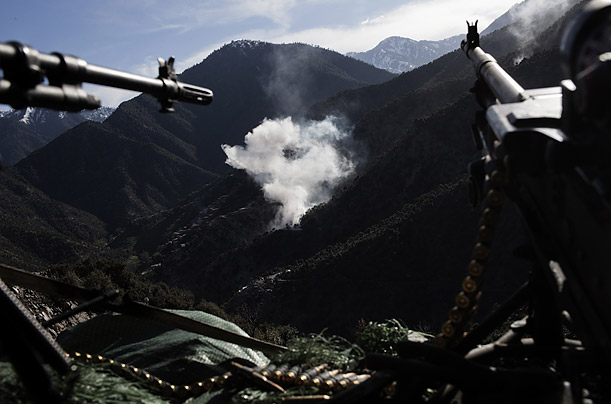
From Time’s Adam Ferguson.

The enemy routinely fires on the soldier’s positions from perches in the gorge. No one knows what — or who — lies at the end of the 6-mile-long valley because no one has been able to make it that far. In this photo, smoke rises from a mortar fired by American troops.

“No one has been able to make it that far.”  Too few troops, says The Captain’s Journal.  Korengal Valley is there as the prize for successful counterinsurgency with enough troops to take and hold the terrain, win the population and enforce authority.

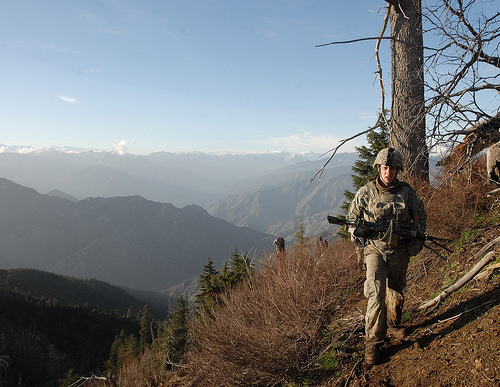
A different view of the valley.

Spc. Andrew Harvey, a 1st Infantry Soldier, patrols along steep cliffs of the Korengal Valley’s surrounding mountains during Operation Viper Shake, Afghanistan, April 21, 2009.

General McChrystal Maps New Course for Afghan War

BY Herschel Smith
17 years, 1 month ago

From the WSJ:

After watching the U.S. try and fail for years to put down insurgencies in both countries, Gen. McChrystal said he believes that to win in Afghanistan, “You’re going to have to convince people, not kill them.

“Since 9/11, I have watched as America tried to first put out this fire with a hammer, and it doesn’t work,” he said last week at his home at Fort McNair in Washington. “Decapitation strategies don’t work.”

In the interview, Gen. McChrystal noted he’s unsure whether the planned troop levels for the job he envisions will be adequate — despite the Obama administration’s commitment to raise the U.S. presence to 68,000 by year’s end, to go along with 35,000 allied forces. Iraq surge commanders had more than 170,000 U.S. forces.

“I know that I want it to be an effective traditional or classic counterinsurgency campaign by getting people down in among the population,” the general said. “I know that’s easier said than done with a limited-sized force.”

And thus do we have in four short paragraphs some revealing and even some troubling information.  When General McChrystal says that “decapitation strategies don’t work,” if he means that the high value target campaign is a failure, The Captain’s Journal most heartily agrees.  It has always been, it forever will be.  We have spoken against it for months and even years.  The design of the campaign should be to destroy the insurgency from the bottom up, not from the top down.

Hopefully McChrystal doesn’t mean that he wishes to convince the mid- or high-level Taliban commanders to join with the government.  In fact, we are heartened to hear that he is no big fan of the reconciliation program.  But what does he think that the balance of the forces have been doing while as a SOF commander he has targeted, captured and killed some HVT?  Does he believe that they have been engaged in only the softer side of counterinsurgency?

Surely he must know that both kinetics and population engagement have been included in the campaigns in Iraq and Afghanistan, and continue to be?  Surely he knows this, doesn’t he?  Doesn’t he know that the Marines killed 400 Taliban in Helmand?  What does he mean when he says that we can’t kill people, we must convince them?  Surely he knows that there are irreconcilables that must be killed, and that his SOF cannot be engaged in doing this everywhere, all of the time?  His SOF must be attached to infantry units, and they must all be engaged in all aspects of counterinsurgency, everywhere, all of the time, including killing and road construction.  Right?

And finally he puts his finger on the root problem.  Doing this with a “limited-sized force.”  So when will he inform the administration that he needs more troops?  Sooner (preferably) or later?

Marine Corps Commandant and Colonel Gentile Agree

BY Herschel Smith
17 years, 1 month ago

Friend of The Captain’s Journal Colonel Gian Gentile is well known for his arguments that the traditional warfighting skills should not be allowed to atrophy.  He strikes back at those who simplistically claim that this means turning the clock back a quarter century or more.

Arguing for rebuilding the Army’s capacity for conventional operations does not mean taking the Service back to 1986 in order to recreate the old Soviet Union so we can prepare to fight World War II all over again in the Fulda Gap. Such accusations have become the standard—and wrongheaded—critique that purveyors of counterinsurgency dogma like to throw at anybody who argues for a renewed focus on conventional capabilities. The Army does need to transform from its antiquated Cold War structure toward one that can deal with the security challenges of the new millennium and one focused primarily on fighting as its core competency (italics mine).

U.S. Marine Corps Commandant Conway apparently agrees, at least as it pertains to skills he sees being at risk to atrophy.

The Marine Corps hopes to give Marines 14 months at home after deployments by mid-2010, Corps Commandant Gen. James Conway said Thursday.

Currently, Marines spend seven months deployed and seven months home, but that could change now that the Corps has grown to 202,000 ahead of schedule, and with almost all Marines expected to leave Iraq next spring, Conway said.

“That’s going to be very helpful, we think, for our families,” he said. “We think that young Marines who maybe haven’t had a chance to meet someone are going to be afforded that opportunity.”

Marines will also use that extra time to train for amphibious landings and to fight conventional wars, two types of skill-sets that have deteriorated as the Corps has focused on counterinsurgency, he said.

“We believe very strongly in this capacity of the Marine Air Ground Task Force,” Conway said. Its core competency is maneuvering under its own fires and rolling up on an enemy just as the smoke lifts. We used to do 10 of those [exercises] a year at Twentynine Palms. Today we do none.”

The importance of Marines getting back to their traditional warfighting skills is underscored by current tensions on the Korean peninsula, he said.

If a conflict broke out, Marines would likely be called upon to launch amphibious operations, he said.

Defense Secretary Robert Gates implied in April that amphibious landings might be a thing of the past, noting that the Corps’ last major landing was in 1950.

Asked about Gates’ comments later that month, Conway said the Corps had launched amphibious operations since then, most notably when Marines helped to evacuate U.S. citizens from Lebanon in 2006.

Conway quickly added Thursday that the Corps would be able to do the job eventually.

“But I’m simply arguing we can do it better when we’re trained to it, and that’s the value of this 1:2 deployment to dwell: to give us the opportunity to give those young Marines more time with the families and more time to, again, relax at home, but also to get on these training fields and get back some of these core competencies that have withered over time,” he said.

Analysis & Commentary

It’s very difficult to imagine a near-peer or even a nuclear-armed state (whether near-peer or not) settling for massive human casualties in a conventional war without invoking the nuclear option (which is not quite the same thing as saying that it’s hard to imagine a conventional campaign in the future).  Contrary to what many think, the best use for nuclear weapons is not using them – it is in creating a situation in which they don’t have to be used.

There is also no question that while counterinsurgency involves the application of soft power, it also includes quite conventional warfighting skills at times (as these two videos show).  We have discussed the Taliban tactic of massing troops against smaller units of U.S. forces, up to and including half-Battalion size engagements.  The lessons learned from one such engagement with a Marine Force Recon company was to remember the tactics taught in School of Infantry, because they will be used in such fights.

Involvement in counterinsurgency campaigns has brought U.S. forces to the point of being the most combat experienced fighters on earth, contrary to the example of the appalling performance turned in by the Russian troops against the Georgian Army (an Army, by the way, which had come back from Iraq with recent experience).

It is also very difficult to imagine that the Marine Corps will ever launch another large scale amphibious assault involving high numbers of casualties.  Other ways will be found – and should be found – leading us to recommend replacement of the EFV and the notion of sea-based assault with more air power and delivery aboard Amphibious Assault Docks.

Either way, talk of amphibious assaults clouds the main point, and it is one on which both Colonel Gentile and the Commandant have settled.  We must not let our warfighting skills atrophy.  With the Commandant, The Captain’s Journal also believes very strongly in the concept of the Air Ground Task Force, as well as teaching all Marines to perform squad rushes and other conventional tactics as well as the room clearing and constabulary operations more focused on counterinsurgency.

Quite obviously, if the Marines are not performing these field exercies and maneuvers, then it’s high time to get back to them.  This is equally true for the Army.  One need not posit the near-peer conflict in order to see the usefulness of warfighting skills if these very tactics are being used in the counterinsurgency campaigns in which we are now engaged.

Al Qaeda Safe Haven in the Hindu Kush

BY Herschel Smith
17 years, 1 month ago

Rich Lowry with National Review is encouraged at the signs of tribal uprising against the Pakistan Taliban.  The Captain’s Journal is far less encouraged.  We have pointed out that Baitullah Mehsud specifically targeted tribal elders in his rise to power, killing some 600 elders after they spoke out against him.  Mehsud has globalist intentions, and now the distinction between al Qaeda and the Tehrik-i-Taliban has been all but erased.  The Taliban fighters shout to passersby in Khyber “We are Taliban! We are mujahedin! “We are al-Qaida!”

Philip Smucker recently observed that al Qaeda has essentially chosen Baitullah as their front man in Pakistan, and further observed that:

Most Afghanistan-Pakistan insurgent groups, led by Mahsud and Mullah Omar’s Afghan Taliban, have not officially adopted the “al-Qaeda” brand name, but they have essentially sworn their allegiance to bin Laden, say leading experts on the terror network.  They claim that al-Qaeda has learned from the mistake of going into business under its own name in Iraq and it prefers, instead, to remain behind the scenes, protected by local gunmen on the one hand, but capable of influencing the fight against US and foreign “infidels” in South Asia on the other hand.

This alliance knows no borders, and hence it’s pointless to refer to the campaign as Afghan, Pakistan or otherwise as pertaining to nation-states.  Syed Saleem Shahzad has recently described the safe haven that al Qaeda has created for itself throughout the Hindu Kush.

The Eastern Hindu Kush range, also known as the High Hindu Kush range, is mostly located in northern Pakistan and the Nuristan and Badakhshan provinces of Afghanistan.

This chain of mountains connects with several smaller ranges, such as Spin Ghar, the Tora Bora, the Suleman Range, Toba Kakar, and creates a natural corridor that passes through the entire Pakistani tribal areas and the Afghan border provinces all the way to the Pakistani coastal area in Balochistan province.

By 2008, al-Qaeda had taken control of the 1,500-square-kilometer corridor – something it had planned to do since fleeing Afghanistan when the Taliban were defeated by US-led forces in December 2001.

Al-Qaeda decided then to build a regional ideologically motivated franchise in South Asia to thwart the strategic designs of Western powers in the area.

While US forces were vainly trying to hunt down al-Qaeda in the Tora Bora mountains, the group was focused on establishing links with organizations such as the Jaishul al-Qiba al-Jihadi al-Siri al-Alami and Jundallah in the Pakistani tribal areas and organizing the recruitment of Pakistanis and Afghans to those organizations. The underlying reason for doing this was to destroy the local political and social structures and in their place establish an al-Qaeda franchise.

The plan worked. Today, in many parts of the Hindu Kush corridor, centuries-old tribal systems and their connections with the Pakistani establishment through an appointed political agent have been replaced by a system of Islamic warlordism.

The old breed of tribal elders, religious clerics and tribal chiefs, loyal to Pakistan and its systems, has been wiped out, to be replaced by warlords such as Haji Omar, Baitullah Mehsud, (slain) Nek Mohammad and (slain) Abdullah Mehsud. They are all al-Qaeda allies, and allow al-Qaeda freedom of movement in their areas within the corridor.

Al-Qaeda members from abroad also use the corridor to enter the Pakistani tribal areas.

This sounds very much like our observation in Games of Duplicity and the End of Tribe in Pakistan, and serves as an even more recent warning that the desired tribal military action against the Taliban probably won’t materialize.  Dead elders, a separate political system, a separate legal system, and terror plus patronage have almost ensured that if the Taliban are to be defeated, it won’t be at the hands of indigenous fighters.

Further Thoughts on the Uighurs

BY Herschel Smith
17 years, 1 month ago

In Palau Taking the Uighurs for 200,000,000 Dollars, The Captain’s Journal noted the absurdity of spending this kind of money on a handful of Chinese Muslim terrorists.  It amounted to the cost of more than 100,000 sets of body armor for our troops, and the Chinese are going to a tropical paradise on the Island of Palau.  At any rate, we called them “terrorists.”

Joshua Foust took issue with this characterization, and sent a link to Obsidian Wings along (noting that it wasn’t my “cup of tea” – and he is certainly right), as well as a few other links.  He asked if I had any more data on them to justify calling them terrorists?

I must confess that I know between little and nothing about them (although I do know that there is a budding Chinese Muslim insurgency in Western China).  I have better things to do than spend my time studying this particular group.  The choice of words was instantaneous (in a post that took five minutes to write) and not meant to convey a wealth of knowledge about the Uighurs.  Michael Yon and I were also chatting about this, and Michael wondered if they happened to be in the wrong place at the wrong time.

Perhaps so.  But Michael and I certainly agree on one thing.  Give them to me (Michael and I will have to fight over them).  LT Nixon also wants them.  Catch: we get the $200,000,000 too.  So I’ve got to throw down with Michael and LT Nixon over the Uighurs.  They are younger than me, but I have wisdom and treachery working on my side.

Keeping the Uighurs would actually be easy I think.  I would just hire a few of the bad dudes I work out with (I still hurt from all of those inclined bench presses I did on Friday), and let them hang with me along with the bad dudes.  We could chain ourselves together and make field trips to the grocery store and gym).  I think $200,000,000 would handle the expenses.  Oh, and picking up TVs and heaving them across the room would be off limits – and I would implement that rule by use of force if necessary.  Neither would I allow discussions of Muslim separatist movements, and yes, I do consider that to be a bad policy, one that I would have a right to control.

Concerning the money the U.S. government paid to get this done, as LT Nixon said – “Uncle Sucker.”

Postscript: Based on where he is, you should expect interesting things coming from Michael Yon in the near future.

Video of U.S. Marine Operations in Helmand and Now Zad

BY Herschel Smith
17 years, 1 month ago

Given the obvious importance of the ring road to our campaign in Afghanistan, it’s good to see the U.S. Marines engaging the local Afghans in activity that will both keep them away from the Taliban and help them earn some of their own money.

Next is a video of combat action in and around Now Zad.  There is some dumb propaganda at the beginning based on a bad rendering of Psalm 23.  Rightly understood, the Marines should fear no evil because our lives and times are in God’s hands.  A good antidote to this poor rendering of Psalm 23 can be found here.  That said, this video shows a useful contrast to the softer side of counterinsurgency found in the first video.


26th MEU (10)
Abu Muqawama (12)
ACOG (2)
ACOGs (1)
Afghan National Army (36)
Afghan National Police (17)
Afghanistan (704)
Afghanistan SOFA (4)
Agriculture in COIN (3)
AGW (1)
Air Force (42)
Air Power (10)
al Qaeda (83)
Ali al-Sistani (1)
America (23)
Ammunition (305)
Animals (336)
Ansar al Sunna (15)
Anthropology (3)
Antonin Scalia (1)
AR-15s (397)
Arghandab River Valley (1)
Arlington Cemetery (2)
Army (91)
Assassinations (2)
Assault Weapon Ban (29)
Australian Army (7)
Azerbaijan (4)
Backpacking (4)
Badr Organization (8)
Baitullah Mehsud (21)
Basra (17)
BATFE (247)
Battle of Bari Alai (2)
Battle of Wanat (18)
Battle Space Weight (3)
Bin Laden (7)
Blogroll (3)
Blogs (24)
Body Armor (23)
Books (3)
Border War (18)
Brady Campaign (1)
Britain (39)
British Army (36)
Camping (5)
Canada (20)
Castle Doctrine (1)
Caucasus (6)
CENTCOM (7)
Center For a New American Security (8)
Charity (3)
China (19)
Christmas (18)
CIA (30)
Civilian National Security Force (3)
Col. Gian Gentile (9)
Combat Outposts (3)
Combat Video (2)
Concerned Citizens (6)
Constabulary Actions (3)
Coolness Factor (3)
COP Keating (4)
Corruption in COIN (4)
Council on Foreign Relations (1)
Counterinsurgency (218)
DADT (2)
David Rohde (1)
Defense Contractors (2)
Department of Defense (220)
Department of Homeland Security (26)
Disaster Preparedness (5)
Distributed Operations (5)
Dogs (15)
Donald Trump (27)
Drone Campaign (4)
EFV (3)
Egypt (12)
El Salvador (1)
Embassy Security (1)
Enemy Spotters (1)
Expeditionary Warfare (18)
F-22 (2)
F-35 (1)
Fallujah (17)
Far East (3)
Fathers and Sons (2)
Favorite (1)
Fazlullah (3)
FBI (39)
Featured (192)
Federal Firearms Laws (18)
Financing the Taliban (2)
Firearms (1,876)
Football (1)
Force Projection (35)
Force Protection (4)
Force Transformation (1)
Foreign Policy (27)
Fukushima Reactor Accident (6)
Ganjgal (1)
Garmsir (1)
general (15)
General Amos (1)
General James Mattis (1)
General McChrystal (44)
General McKiernan (6)
General Rodriguez (3)
General Suleimani (9)
Georgia (19)
GITMO (2)
Google (1)
Gulbuddin Hekmatyar (1)
Gun Control (1,730)
Guns (2,416)
Guns In National Parks (3)
Haditha Roundup (10)
Haiti (2)
HAMAS (7)
Haqqani Network (9)
Hate Mail (8)
Hekmatyar (1)
Heroism (5)
Hezbollah (12)
High Capacity Magazines (16)
High Value Targets (9)
Homecoming (1)
Homeland Security (3)
Horses (2)
Humor (72)
Hunting (65)
ICOS (1)
IEDs (7)
Immigration (123)
India (10)
Infantry (4)
Information Warfare (4)
Infrastructure (4)
Intelligence (23)
Intelligence Bulletin (6)
Iran (171)
Iraq (379)
Iraq SOFA (23)
Islamic Facism (64)
Islamists (98)
Israel (19)
Jaish al Mahdi (21)
Jalalabad (1)
Japan (3)
Jihadists (82)
John Nagl (5)
Joint Intelligence Centers (1)
JRTN (1)
Kabul (1)
Kajaki Dam (1)
Kamdesh (9)
Kandahar (12)
Karachi (7)
Kashmir (2)
Khost Province (1)
Khyber (11)
Knife Blogging (7)
Korea (4)
Korengal Valley (3)
Kunar Province (20)
Kurdistan (3)
Language in COIN (5)
Language in Statecraft (1)
Language Interpreters (2)
Lashkar-e-Taiba (2)
Law Enforcement (6)
Lawfare (14)
Leadership (6)
Lebanon (6)
Leon Panetta (2)
Let Them Fight (2)
Libya (14)
Lines of Effort (3)
Littoral Combat (8)
Logistics (50)
Long Guns (1)
Lt. Col. Allen West (2)
Marine Corps (281)
Marines in Bakwa (1)
Marines in Helmand (67)
Marjah (4)
MEDEVAC (2)
Media (68)
Medical (146)
Memorial Day (6)
Mexican Cartels (48)
Mexico (72)
Michael Yon (6)
Micromanaging the Military (7)
Middle East (1)
Military Blogging (26)
Military Contractors (5)
Military Equipment (25)
Militia (9)
Mitt Romney (3)
Monetary Policy (1)
Moqtada al Sadr (2)
Mosul (4)
Mountains (25)
MRAPs (1)
Mullah Baradar (1)
Mullah Fazlullah (1)
Mullah Omar (3)
Musa Qala (4)
Music (25)
Muslim Brotherhood (6)
Nation Building (2)
National Internet IDs (1)
National Rifle Association (97)
NATO (15)
Navy (31)
Navy Corpsman (1)
NCOs (3)
News (1)
NGOs (3)
Nicholas Schmidle (2)
Now Zad (19)
NSA (3)
NSA James L. Jones (6)
Nuclear (63)
Nuristan (8)
Obama Administration (222)
Offshore Balancing (1)
Operation Alljah (7)
Operation Khanjar (14)
Ossetia (7)
Pakistan (165)
Paktya Province (1)
Palestine (5)
Patriotism (7)
Patrolling (1)
Pech River Valley (11)
Personal (77)
Petraeus (14)
Pictures (1)
Piracy (13)
Pistol (4)
Pizzagate (21)
Police (673)
Police in COIN (3)
Policy (15)
Politics (999)
Poppy (2)
PPEs (1)
Prisons in Counterinsurgency (12)
Project Gunrunner (20)
PRTs (1)
Qatar (1)
Quadrennial Defense Review (2)
Quds Force (13)
Quetta Shura (1)
RAND (3)
Recommended Reading (14)
Refueling Tanker (1)
Religion (501)
Religion and Insurgency (19)
Reuters (1)
Rick Perry (4)
Rifles (1)
Roads (4)
Rolling Stone (1)
Ron Paul (1)
ROTC (1)
Rules of Engagement (76)
Rumsfeld (1)
Russia (37)
Sabbatical (1)
Sangin (1)
Saqlawiyah (1)
Satellite Patrols (2)
Saudi Arabia (4)
Scenes from Iraq (1)
Second Amendment (715)
Second Amendment Quick Hits (2)
Secretary Gates (9)
Sharia Law (3)
Shura Ittehad-ul-Mujahiden (1)
SIIC (2)
Sirajuddin Haqqani (1)
Small Wars (72)
Snipers (9)
Sniveling Lackeys (2)
Soft Power (4)
Somalia (8)
Sons of Afghanistan (1)
Sons of Iraq (2)
Special Forces (28)
Squad Rushes (1)
State Department (23)
Statistics (1)
Sunni Insurgency (10)
Support to Infantry Ratio (1)
Supreme Court (84)
Survival (216)
SWAT Raids (58)
Syria (38)
Tactical Drills (38)
Tactical Gear (17)
Taliban (168)
Taliban Massing of Forces (4)
Tarmiyah (1)
TBI (1)
Technology (21)
Tehrik-i-Taliban (78)
Terrain in Combat (1)
Terrorism (96)
Thanksgiving (13)
The Anbar Narrative (23)
The Art of War (5)
The Fallen (1)
The Long War (20)
The Surge (3)
The Wounded (13)
Thomas Barnett (1)
Transnational Insurgencies (5)
Tribes (5)
TSA (25)
TSA Ineptitude (14)
TTPs (4)
U.S. Border Patrol (8)
U.S. Border Security (22)
U.S. Sovereignty (29)
UAVs (2)
UBL (4)
Ukraine (10)
Uncategorized (107)
Universal Background Check (3)
Unrestricted Warfare (4)
USS Iwo Jima (2)
USS San Antonio (1)
Uzbekistan (1)
V-22 Osprey (4)
Veterans (3)
Vietnam (1)
War & Warfare (435)
War & Warfare (41)
War Movies (4)
War Reporting (21)
Wardak Province (1)
Warriors (6)
Waziristan (1)
Weapons and Tactics (80)
West Point (1)
Winter Operations (1)
Women in Combat (21)
WTF? (1)
Yemen (1)

August 2026
July 2026
June 2026
May 2026
April 2026
March 2026
February 2026
January 2026
December 2025
November 2025
October 2025
September 2025
August 2025
July 2025
June 2025
May 2025
April 2025
March 2025
February 2025
January 2025
December 2024
November 2024
October 2024
September 2024
August 2024
July 2024
June 2024
May 2024
April 2024
March 2024
February 2024
January 2024
December 2023
November 2023
October 2023
September 2023
August 2023
July 2023
June 2023
May 2023
April 2023
March 2023
February 2023
January 2023
December 2022
November 2022
October 2022
September 2022
August 2022
July 2022
June 2022
May 2022
April 2022
March 2022
February 2022
January 2022
December 2021
November 2021
October 2021
September 2021
August 2021
July 2021
June 2021
May 2021
April 2021
March 2021
February 2021
January 2021
December 2020
November 2020
October 2020
September 2020
August 2020
July 2020
June 2020
May 2020
April 2020
March 2020
February 2020
January 2020
December 2019
November 2019
October 2019
September 2019
August 2019
July 2019
June 2019
May 2019
April 2019
March 2019
February 2019
January 2019
December 2018
November 2018
October 2018
September 2018
August 2018
July 2018
June 2018
May 2018
April 2018
March 2018
February 2018
January 2018
December 2017
November 2017
October 2017
September 2017
August 2017
July 2017
June 2017
May 2017
April 2017
March 2017
February 2017
January 2017
December 2016
November 2016
October 2016
September 2016
August 2016
July 2016
June 2016
May 2016
April 2016
March 2016
February 2016
January 2016
December 2015
November 2015
October 2015
September 2015
August 2015
July 2015
June 2015
May 2015
April 2015
March 2015
February 2015
January 2015
December 2014
November 2014
October 2014
September 2014
August 2014
July 2014
June 2014
May 2014
April 2014
March 2014
February 2014
January 2014
December 2013
November 2013
October 2013
September 2013
August 2013
July 2013
June 2013
May 2013
April 2013
March 2013
February 2013
January 2013
December 2012
November 2012
October 2012
September 2012
August 2012
July 2012
June 2012
May 2012
April 2012
March 2012
February 2012
January 2012
December 2011
November 2011
October 2011
September 2011
August 2011
July 2011
June 2011
May 2011
April 2011
March 2011
February 2011
January 2011
December 2010
November 2010
October 2010
September 2010
August 2010
July 2010
June 2010
May 2010
April 2010
March 2010
February 2010
January 2010
December 2009
November 2009
October 2009
September 2009
August 2009
July 2009
June 2009
May 2009
April 2009
March 2009
February 2009
January 2009
December 2008
November 2008
October 2008
September 2008
August 2008
July 2008
June 2008
May 2008
April 2008
March 2008
February 2008
January 2008
December 2007
November 2007
October 2007
September 2007
August 2007
July 2007
June 2007
May 2007
April 2007
March 2007
February 2007
January 2007
December 2006
November 2006
October 2006
September 2006
August 2006
July 2006
June 2006
May 2006

about · archives · contact · register

Copyright © 2006-2026 Captain's Journal. All rights reserved.