New York Sun on Nuclear Iran
Nuclear yield within six to twelve months.
McNeill ties length to Pakistan tribal region, likely to be protracted anyway.
Multinational force press release on Sadr City operations and seizure of weapons and munitions.
"We will fight them to the end."
War on terror not popular with Pakistani population.
U.S. presence expanding Southward in Iraq.
Its full steam ahead for Iran.
And SECDEF Gates continues to press this issue.
Pajamas Media exclusive: how your tax dollars fund terror.
Southwestern Baptist Theological Seminary Graduate executed in Afghanistan.
Nearly 1000 dead from harshest Afghan winter in 30 years.
Attacks in Baghdad down 80% according to Iraqi Army.
Lack of appropriate defense spending a grave situation.
Olmert claims Iran still on target to construct nuclear weapon.
Promoted to Army Vice Chief of Staff. Well deserved.
Must read on Israeli Army shame and lawyer happiness with war against Hezbollah.
Libyans joining jihad in increasing numbers.
How relevant will Maliki be to Iraq's future?
Maj. Gen. Gaskin: "The positive trends are permanent."
Abizaid questions whether Maliki can bring unity to Iraq.
From the Multinational Force, more on Operation Lion Pounce.
An important ally in Iraq has been assassinated.
Israel to show Chairman of Joint Chiefs of Staff nuclear intelligence on Iran.
Cabinet approves proposed agreement with U.S.
Prof. Kingsley Browne on his new book.
Major General Robert Scales: "Outcome is irreversible"
Mullen says military needs larger slice of GNP to modernize.
For siding with the U.S. against al Qaeda.
Terrorist poses as bride. Ugh!
Legislation in trouble.
Al Qaeda documents discovered near Syrian border.
Shameful people jeer disabled veterans in swimming pool.
Saudi jihadist in Iraq tells his personal story.
Concerning Iranian meddling and Quds.
Michael Yon breaks bread with General Petraeus.
Ralph Peters on the advancements in Iraq.
War between al Qaeda and Hezbollah.
Traumatic brain injury not recognized.
Ballistic Sensor Fused Munition.
High intensity electronic warfare.
Iranian weapons are a sign of continued Iranian meddling in Iraq.
U.S. forces in Iraq are using a high-resolution, thermal/infrared sensor system.
Washington Post profiles AQI (al Qaeda in Iraq, or al Qaeda in Mesopotamia).
Taiwan may not be as secure as we would like to think.
Be thankful your daughter isn't be raised in Basra.
Pastor discusses rules of engagement and sacrificial U.S. deaths.
In counterinsurgency (COIN), patience is a virtue. But violence has decreased so fast in
Marines do seven month tours. Changing this is a big deal. A big deal has occurred, and the 24th MEU has had their tour of Afghanistan extended by one month.
In a decision reflecting the shortage of available combat troops, more than 2,000 Marines fighting the Taliban will be kept in Afghanistan 30 days beyond their original seven-month tour, the Marine Corps said yesterday.
The decision by Defense Secretary Robert M. Gates to extend the Marines’ tour was confirmed a day after Adm. Mike Mullen, chairman of the Joint Chiefs of Staff, said that more troops are needed in Afghanistan but that he didn’t have more troops to send.
Gates had said several times in recent months that he had “no plans” to extend the Marines’ tour. But U.S. officials, including Mullen, have said recently that the situation in Afghanistan is worsening and that the Taliban-led insurgency is gaining ground and influence.
At present there are 32,000 U.S. troops in Afghanistan, of which 14,000 are assigned to work under the International Security Assistance Force, the 40-nation coalition led by U.S. Army Gen. David McKiernan.
The other 18,000 U.S. troops are fighting directly under U.S. command, mostly in eastern Afghanistan along the border with Pakistan, where violent attacks by insurgents have risen 40 percent from a year ago, according to a U.S. commander there.
In addition to U.S. forces, about 29,000 troops from 40 countries are serving in Afghanistan, although some are restricted by their home commands from combat.
Maj. David Nevers, a Marine Corps spokesman, confirmed that Gates had authorized an extension for up to 30 days for the 24th Marine Expeditionary Unit, an air-ground task force that deployed to Afghanistan in February and March.
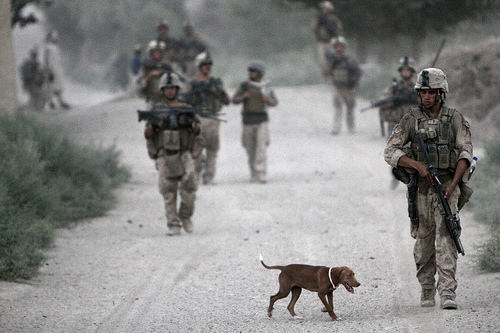
The unit’s air squadron of jet fighters and attack helicopters, and its reinforced infantry battalion, the 1st Battalion, 6th Marine Regiment, have been fighting Taliban and other extremists around the southern Helmand province town of Garmser, a major poppy-growing region and insurgent stronghold, since late March.
Nevers said the Marines are needed “to continue full-spectrum operations as they have been doing” in southern Afghanistan.
The Captain’s Journal has noted too many times to cite that Operation Enduring Freedom needs forces and force projection. The more acceptable way to say it this.
The nation’s top military officer said yesterday that more U.S. troops are needed in Afghanistan to tamp down an increasingly violent insurgency, but that the Pentagon does not have sufficient forces to send because they are committed to the war in Iraq.
Navy Adm. Michael G. Mullen, chairman of the Joint Chiefs of Staff, said insurgent Taliban and extremist forces in Afghanistan have become “a very complex problem,” one that is tied to the extensive drug trade, a faltering economy and the porous border with Pakistan. Violence in Afghanistan has increased markedly over recent weeks, with June the deadliest month for U.S. troops since the war began in 2001.
“I don’t have troops I can reach for, brigades I can reach, to send into Afghanistan until I have a reduced requirement in Iraq,” Mullen told reporters at the Pentagon. “Afghanistan has been and remains an economy-of-force campaign, which by definition means we need more forces there.”
This sounds so much nicer than the way we have described it. “Economy of force.” But then Mullen, who cares about both the troops and the campaigns, felt that he needed to say it bluntly like The Captain’s Journal does … “which by definition means we need more forces there.”
While The Captain’s Journal has many tears invested in Iraq (specifically, Anbar), there is a half life to insurgencies - and conversely, counterinsurgencies. They can only go on so long. Columbia hates the FARC, and their doom is sure to come. Marines have handed over control of Anbar to Iraq, and while we have noted our objections to the failure of the Maliki administration to reconcile with the Sunni awakening movement, the Marines have completed their work in Anbar. There will be no further Marine engagement in that province. It isn’t a matter of wishes or needs. It’s a matter of the nature of the campaign. It’s finished in Anbar.
The Marines must move on, and while the Commandant wants an MEU focus (and we understand this desire), Afghanistan needs the troops. A month won’t do it. One month might close out the summer fighting where the Taliban won’t come back in during 2008 and kill those in the Helmand province who cooperated with the Marines. Maybe. But we’re talking about slicing the salami pretty thin here. Economy of force indeed. It’s time for Gates and Mullen to recognize that the Marines’ mission in Iraq is essentially completed, and to turn them loose in Afghanistan. The world will understand.
Jcustis of the Small Wars Council recently started a SWC discussion thread that should have gotten more attention than it did. He linked a previously unknown (to the SWC) Wikipedia entry on suicide bombings in Iraq since 2003. Right behind this entry, Schmedlap made the following observation:
One thing that I would point out, that is illustrated well by the article if you look for it - note the suicide attacks in the summer of 2007, particularly July and August. Contrary to the narrative that the dip in violence after August was due to a Sadr militia “ceasefire,” the dip was actually due to a significant drop in the number and effectiveness of AQI mass casualty attacks. In particular, note that hundreds of those victims were in northern Iraq (Kirkuk, Tal Afar, predominantly Sunni Arab areas of Diyala, etc), not in Sadrist strongholds. Violence from Sadr’s militia dropped two months prior to him calling the “ceasefire.” The only thing that kept the death toll high in the interim between June/July 07 and the “ceasefire” in late August was the rate of murders by AQI. Take out the AQI murders and you have a steady drop in civilan deaths beginning in June/July, not late August. The credit for this reduction goes to MNF-I and the ISF, not Sadr.
This is an interesting and important point, one that bears detailing a bit more. The EXCEL graph below shows the suicide bombings per month based on the Wikipedia entry (click to enlarge).
One possible defeater argument for the hypothesis would be that the discussion so far only deals with suicide bombings and not overall security incidents. Care of the Mudville Gazette, an EXCEL graph of the weekly security incidents is found in the June 2008 Multinational Force Report to Congress.
The look of the trends is basically the same. In 2006 and into 2007, the tribal revolt against al Qaeda was in full swing, with AQ losing badly in the Western part of Anbar, most importantly in Ramadi, the capital of Anbar. AQ was pushed Eastward towards Fallujah, and had made this area (and into Baghdad) their final stand in Anbar. Operation Alljah (which began in April of 2007 and ended in the late summer of 2007) essentially ended the AQ presence in Fallujah, at which point they were on the run Northward into the Diyala Province and towards Mosul.
Along with this evolution, the Baghdad security plan was implemented early in 2007, pressuring AQ in and around the capital city. This continual pressure on AQ caused a precipitous decrease in not only suicide bomgings, but overall security incidents (the basic trends mirroring each other). The point is that while good body armor is desirable against snipers, it can only accomplish so much. While MRAPs are desirable to ameliorate the affect of IEDs, they are only so good - dismounted patrols have to be conducted as well.
In the end, one of the most important lessons of Operation Iraqi Freedom is that presence with the population, intelligence-driven raids, and pressure on the enemy are the best tools against IEDs and bombings. Military pressure is proactive, while all other tools are defensive and reactive.
There has begun to be a steady flow of horrific reports of bombs, IEDs and Marines who have perished or become wounded in Afghanistan. Four Marines deployed out of Twentynine Palms died from a roadside bomb. Marine Sgt. Justin Clenard - badly wounded - was on foot patrol with his platoon when they were hit by a mortar round or a land mine. Clenard lost his right leg from the knee down and his lower left leg as well. Lance Corporal Justin Rokohl entered his ninth hour of surgery in a military hospital in Germany on Monday night, being wounded from a roadside bomb. Navy Corpsman Dustin Burnett died from a roadside bomb in Afghanistan. And Lance Cpl. Andrew Francis Whitacre has died in Afghanistan. He had one last wish.
“I want to take a second and thank all of you who support us in what we do,” Andrew wrote two months before his death. “I know many of you do not believe in the wars we are fighting in. Just remember that all the men and women who are here are here because at one point they took an oath to protect and serve YOU. The support of the citizens of the country we fight and die for is all that we ask.”
There are more than mentioned above. The support of our warriors means the proper resourcing of the campaign. Germany is deploying more troops to Afghanistan, but their rules of engagement are not changing and they will not be allowed to participate in combat except in self defense, and they will not be deployed to the most violent parts of Afghanistan.
This isn’t enough. There will continue to be a dreadful flow of reports from the Afghanistan theater until force projection is applied. Common sense suggests it, and the data proves it. This means more troops, and more robust force presence with the population and the enemy, including the ROE to get the job done. This is the last wish of one Marine and his parents who have given everything.
The Captain’s Journal doesn’t like to be negative, but it is necessary to engage in truth-telling. For more than half a year The Captain’s Journal has been in a state of near despair over the failure of NATO to deploy forces to Afghanistan, employ a realistic set of rules of engagement, and implement a coherent, consistent counterinsurgency strategy. There are seasons in counterinsurgency, and the campaign will soon suffer under the weight of U.S. and NATO being viewed as occupiers rather than liberators. Timeliness is everything in COIN.
The Pentagon is months behind us, but it appears that the sentiment is now mutual.
American officials are in a state of near despair about the failure of Britain’s European allies to do more to beef up Nato combat power in Afghanistan.
A Pentagon adviser told The Telegraph that US commanders wish they had never agreed to Nato taking charge of major combat operations against the Taliban in the lawless south of the country.
They believe that different military rules of engagement and different approaches to reconstruction have made it impossible to devise a unified strategy for fighting and nation building, leaving the way open for the resurgence of the Taliban.
So what do rules of engagement have to do with the campaign in Afghanistan? The Germans know full well what a restrictive set of ROE can do to efforts to militarily defeat the enemy. Not long ago they had to allow a Taliban commander to escape because he wasn’t brandishing a weapon while escaping. Troops can act in self defense, but many cannot conduct offensive operations. Continuing with the Telegraph report:
The Pentagon consultant pointed to the different national rules which mean that troops from several Nato allies like Germany are banned from conducting offensive military operations, or conducting patrols at night.
The adviser said: “There’s frustration, there’s irritation. The mood veers between acceptance and despair that nothing is changing. We ask for more troops and they’re not forthcoming in the numbers we need.
“The mistake was handing it over to Nato in the first place. For many countries being in Afghanistan seems to be about keeping up appearances, rather than actually fighting a war that needs to be won.
“Was that necessary diplomatically? Probably. Is it desirable militarily? I don’t think so and nor do most others who are involved with Afghanistan,” he said.
The consultant, who advises the Pentagon on security coordination with the Afghan military, said American ire is not directed at the British, who are “doing what they can”.
Ali Jalali, the Afghan interior minister between 2003 and 2005 endorsed that view that the Taliban can only be defeated and marginalised from Afghan life if there is a new strategy and a unified military command.
In an interview with The Telegraph he said: “In the absence of an overall counterinsurgency strategy, what the international community and the Afghan government are doing is not designed to win the war, rather not to lose.
“That is a major problem. There’s no campaign plan. We need a unified command of all forces that can do three things: fighting, stabilising and peacekeeping. Unless you speak with one voice it is not going to work. We need more troops to stabilise the country.”
There has been a serious strategic malaise in Afghanistan since the inception of NATO presence. So in addition to advocating more troops, we have advocated a division of command, with the U.S. taking over at least the Southern region (or permanent command of the campaign). But the same countries who know that there is strategic malaise continue to encourage it by refusing to adopt any other strategy or ROE, or even consider a reorganization of forces.
It gets worse. Even among the staunchest of allies there is a reluctance to face the real causes of failure.
“The problem,” says one officer, “is that we are focusing on protective mobility. We are definitely going down the road the Russians went in the Eighties, with over-reliance on massive armoured vehicles.”
The debate is starting on the ground because soldiers are frustrated that they can march their hearts out all day to track the enemy, only to be blown up by a mine. They query how a lumbering convoy of 100 armoured vehicles can ever surprise an enemy who knows every rock and cave in his own back yard. The time has come, suggest some, to fight the way the enemy fights – but smarter.
In the Rhodesian insurgency, tiny units called fire forces, working in groups of four or eight, would drop into enemy territory by parachute or helicopter, unheard and unseen.
With the aid of local trackers, they remained concealed for days, watching the enemy’s movements and waiting patiently for the optimum time to strike. Again and again the guerrillas were horrified as their safety cordon unravelled, with colleagues falling dead around them.
By contrast, our strategy is static, based on bases in fixed locations. Troops leave them to go on patrol in full view of the enemy – which had fatal consequences this month. “It’s bloody hard to deceive the enemy with a column of ground movement that can be picked up 500 metres beyond the base,” says one veteran. “The effect of four helicopters disgorging 100 soldiers from an unexpected direction would have a huge impact, and would lead to a reduction in the opportunities to blow us up with mines.”
So the British are advocating distributed operations now. Then, they point the finger of blame at the lack of air transport.
The reason why the US Marines were so successful in southern Helmand this spring was because they were able to land 600 troops in one lift in one night. In the two weeks I was with them, the Paras could only muster one air assault of two helicopters that had to go in three lifts, hugely increasing the risk of the enemy assembling an anti-aircraft team to attack them.
Landing so many Marines had nothing whatsoever to do with their success in Helmand. The Marines stayed around to conduct continued counterinsurgency operations, as we discussed in U.S. Marine Style Counterinsurgency. If the Marines had all marched on foot to Garmser - not, by the way, a ridiculous notion - it wouldn’t have mattered. They could have sent word to the Taliban by courier that they were coming. The Taliban were dug in and waiting for the fight. Helicopters simply made it easier on the infantry.
The British are pointing to distributed operations, air power, discrete mobility, and all manner of tricks and toys that they believe will enhance the campaign. To be sure, we also believe that materiel availability should be increased, and we have been a proponent of distributed operations in the past, along with the robust projection of air power.
But it should be remembered that upon the initial engagement of the Marines in Garmser, the British complained about the hard tactics by the Corps. More helicopters can be supplied to the theater, but without force projection and an increase in troops, the materiel won’t matter. Ali Jalali is right. NATO is in the theater to keep from losing. This very strategy will ensure loss.
We have covered the hard core, robust kinetic engagement of the U.S. Marines in the Helmand Province in and around the city of Garmser, Afghanistan. The British drove them to the fight, everyone else watched and the Taliban died. But is this all there is to U.S. Marine style counterinsurgency? Not even nearly. Michael M. Phillips of the Wall Street Journal has given us a thinking man’s discussion of counterinsurgency in After Battle in Afghanistan Villages, Marines Open Complaint Shop.
During a month of house-to-house combat, First Lt. Steven Bechtel’s men fired about 500 mortar rounds at Taliban insurgents.
Now, he’s paying the price.
Just two days after the main Taliban force was routed, Lt. Bechtel put aside his weapons and opened what amounts to a wartime complaints desk in a mud-brick hut. The lieutenant and his men spend their time cataloging the destruction and issuing vouchers to compensate villagers for their losses, whether caused by U.S. missiles or Taliban grenades.
“We’re very sorry for the damage to your doors, but we had to make sure the Taliban didn’t leave any bombs or weapons inside,” Lt. Bechtel last week told Abdul Majid, a 70-year-old with a weathered face, a dense white beard and a cane made from a tree limb.
“It’s no problem,” Mr. Majid responded. “You’re paying for it.”
The First Battalion of the Sixth Marine Regiment was recently deployed to Afghanistan as part of a force, 3,000-strong, helping to turn the tide against a resurgent Taliban. What resulted was a conventional battle that raged through the villages and poppy fields of Garmsir District, a major waypoint for insurgents leaving safe havens in Pakistan, a sign of how far Western gains have slipped recently.
The fighting sent civilians fleeing into the surrounding desert. After the violence ebbed, the villagers returned, in many cases to homes cracked open by artillery, bombs, missiles and rocket-propelled grenades. Soon they were lined up at Lt. Bechtel’s door, testing the Marines’ ability to shift gears on the fly, from combat to the struggle for popular allegiance. Winning over the locals has always been a goal; now, it’s happening in double-quick time.
“It just switched suddenly one day,” says Lt. Bechtel, a soft-spoken 24-year-old from Naples, Fla., who decided in the eighth grade that he wanted to be a Marine. “All of the sudden there were civilians in the area.”
More than 200 villagers have applied for compensation already, and a vendor has set up shop outside the coiled razor-wire barrier selling cigarettes and soda to the petitioners. At the first coils, the villagers, all men or boys, must lift their shirts or robes to show that they aren’t wearing suicide vests. At the guard post, a Marine sentry pats them down before they’re allowed to approach the office.
The walls inside are adorned with posters of sumptuous feasts and the holy city of Medina. They’re property of the compound’s owner. The Marines commandeered the man’s residence during the fighting, and now scores of men from the battalion’s Alpha Company camp in his buildings and sandy yard, for which they pay the equivalent of $60 a month in rent. The troops promise to leave as soon as they have built a base of their own. But the owner comes by almost daily to demand his house back, or at least more rent.
The first time a villager comes to the complaint office, the lieutenant or his No. 2, Sgt. James Blake, a 25-year-old from Merrimack, N.H., jots down the claim on a piece of yellow legal paper. The petitioner takes the note to a Marine patrol in his neighborhood. The Marines verify the damage and send the man back to Lt. Bechtel.
At the second meeting, the Marines tally up the cost, using data on an Excel spreadsheet that the lieutenant, who majored in mechanical-engineering at Virginia Military Institute, compiled using prices gathered from the local market.
The Marines have a penchant for personal responsibility and equipment and ordnance accountability. Every round is intended to kill the enemy, and yet every round is tracked for its affect. Tear down a door? We pay. Kill a goat? We pay. Break a window? We replace it. And … we track it all in EXCEL. The same thing was done in Fallujah during Operation Alljah.
The tired and badly simplistic phrase “winning hearts and minds” should be forever forgotten in favor of what they Marines have done in Anbar, Iraq and Helmand, Afghanistan. It is about kinetics, security for the population, cultural understanding, family honor, property ownership, boundaries of behavior, and holding the terrain to ensure long term stability and governance.
Today’s warriors not only have to be qualified at warcraft, they must be warrior scholars, capable of cultural assimilation, at least pseudo-qualified in anthropology and psychology, and prepared for stability operations. And the Marines are not only up to the task, they are the best in the world.
Lastly, the WSJ article leaves this account with a caveat.
On a single day last week , the Marines pledged $12,100 in reparations. “I’d rather be shooting mortars,” says Sgt. Blake. “But I understand why we’re doing this, paying for the damage we caused. And I like helping people out as much as we can.”
Mr. Majid, the elderly petitioner, patted Lt. Bechtel on the shoulder and removed his own blue turban — gestures of gratitude — when offered 36,000 afghanis, or about $720, to repair his house and restore his fields. Afterward, he requested medicine for his headaches and help feeding his family. By the time he left, Mr. Majid had a new radio, a few packaged military meals, Tylenol for his head and antidiarrhea medicine for his grandson.
There’s one flaw in the Marines’ campaign. While they freely issue compensation vouchers, they don’t have any actual money to give out yet. The cash, the Marines tell the villagers, will be here on July 1. The date has already slipped once, from mid-June, and some people doubt they’ll ever see the money. “If we don’t pay them on the first,” Sgt. Blake said, “it’s going to be bad.”
You better believe it. The money had better be there because it affects the reputation of the U.S. Marines and the COIN effort underway in Afghanistan. Time for the DoD to “belly up to the bar.”
Prior:
Report (from the New York Times)
United States marines pushed the Taliban out of this village and the surrounding district in southern Helmand Province so quickly in recent weeks that they called the operation a “catastrophic success.”
Yet, NATO troops had conducted similar operations here in 2006 and 2007, and the Taliban had returned soon after they left. The marines, drawing on lessons from Iraq, say they know what to do to keep the Taliban at bay if they are given the time.
“There is definitely someone thinking out there,” said Capt. John Moder, commander of Company C of the 24th Marine Expeditionary Unit, speaking of the Taliban. “That’s why we need these people to be at least neutral to us,” he said, gesturing to the farmers who have been slowly filtering back to harvest their fields.
Originally sent to Garmser District on a three-day operation to open a road, the marines have been here a month and are likely to stay longer. The extension of the operation reflects the evolving tactics of the counterinsurgency effort in Afghanistan, building on the knowledge accumulated in recent years in Anbar Province in Iraq.
The district of Garmser, a fertile valley along the Helmand River, had been under control of the Taliban and members of Al Qaeda for most of the last two years and much of it had become a war zone, as the Taliban traded fire with British troops based in the district center. One of the largest poppy-growing areas in the country, Garmser District has been an important infiltration route for the insurgents, sending weapons and reinforcements to the north and drug shipments to the south to the border with Pakistan.
Previous operations by NATO forces to clear the area of Taliban had yielded short-lived successes, as the Taliban have re-established control each time, Afghans from the area said. It is a strategy the insurgents have employed all over Afghanistan, using roadside and suicide bombs as well as executions to terrorize the people and undermine the authority of foreign forces and fledgling local governments.
In Garmser those with the means gave up and fled to the provincial capital, Lashkar Gah. Interviewed there by telephone, they said they had been living as refugees for almost two years and were still afraid to return — and to be identified, for fear of retribution from the Taliban.
But Company C served in Anbar Province, once one of the most intractably violent areas of Iraq, which quieted last year under a new strategy of empowering local groups called Awakening Councils, which now provide security. The marines were confident they could put that experience to good use here.
Only when you win over a critical balance of the local population and empower them to stand up to the insurgents can you turn the situation around, several marines said.
First Lt. Mark Matzke led a platoon for nine months last year in the Anbar city of Ramadi, where he said he got to know every character in a small neighborhood, both the troublemakers and the power brokers. But it was only when he sneaked in after dark and listened to people’s grievances in private that he was able to work out a strategy for protecting them from the insurgents.
“Through listening to their grievances, you could figure out that the people did not like the insurgents,” he said. But their biggest fear was that the marines would pull out, he said, leaving them at the mercy of insurgents who would treat them as collaborators.
As trust was built up, the people began to side with the marines and started to tip them off about who the insurgents were and where to find them. “You just need to give them confidence,” he said.
In this village, only the poorest laborers and farmers have started filtering back, Lieutenant Matzke said, adding, “These people are completely broken.” They refused all assistance at first, he said, but after talking for a couple of hours they admitted they could use the help, but were afraid to accept it for fear of the Taliban.
The people were glad when the Taliban were driven away, the marines said, and that is a sentiment they need to nurture. “We need to convince the people we are here to help, and to exploit the fact that we can help,” Captain Moder said.
As a first step, the marines promised to provide a strong security cordon so those villagers who had fled could return without fear to rebuild their homes and reopen the bazaar.
When on patrol, the marines carry a small gadget the size of an old Polaroid camera that takes fingerprints, photos and an iris scan of people they meet. It is used to build a database of the residents so they can easily spot strangers, the marines say. The Afghans accepted the imposition without protest.
Observation on the ground, information from the populace and control of key commerce and transportation routes are all ways to prevent the Taliban from seeping back into the area, Col. Peter Petronzio, commander of the 24th Marine Expeditionary Unit, said in an interview.
“You need physically to be there,” he said. “You need to continue to move about the population, let your presence be known, but do it in a way so that you are not smothering and overwhelming. You have got to let life go on.”
But the villagers remain scared, uncertain how long the marines will stay and who will follow in their wake.
“I don’t think I will go back until complete peace and security comes,” said one elder, who said he had heard his house had collapsed under bombardment. “This is not the first time we have suffered. Several times we have seen such operations against the Taliban, and after some time the forces leave the area and so the Taliban find a way to return.”
“If NATO really wants to bring peace and make us free from harm from the Taliban,” he said, “they must make a plan for a long-term stay, secure the border area, install security checkpoints along the border area, deploy more Afghan National Army to secure the towns and villages, and then the people will be able to help them with security.”
Analysis & Commentary
The statement about Anbar being quieted by empowering local groups is a bit of a dumbed down version of the Anbar campaign, and doesn’t do justice to the kinetic fight against both al Qaeda and the Sunni insurgency. It also doesn’t do justice to the fight between the Sunni insurgency and al Qaeda even before being empowered by the U.S. (much later in the campaign). Its continual repetition implies that all NATO has to do is have a few meetings with tribal elders and arm their sons, and the Taliban problem will suddently be over. It is doltish.
The Sunnis in Anbar are stubborn people (according to Iraqis with whom we have spoken), and much more secular that the al Qaeda jihadists who flooded from across the globe to fight (Shiekh Abdul Sattar abu Risha was a chain smoker). Al Qaeda’s brutality, U.S. kinetic operations, relationships built with tribal leaders (viz. Captain Travis Patriquin), a string of combat outposts in Ramadi, biometrics and gated communities in Fallujah, sand berms around Haditha, and a complex puzzle of other factors made up the campaign in Anbar. The Anbar narrative is too complex to throw a few words at it in an article about Afghanistan. If a journalist cannot draw this out in a single article, they s/he shouldn’t try.
Nonetheless, security does play a premier role in the discussion above, and in earlier reports about the Marines in Helmand it had been stated that the Marines were to continue through Afghanistan on a NATO command wish list of chores. Apparently the idea of secure, hold and build has dawned on command and they are allowing the Marines to stay as they should.
It’s just not correct to say that the COIN tactics are evolving in Afghanistan. U.S. Army units have been at combat outposts for quite a while, and the Marines are simply conducting well-rehearsed and finely-tuned COIN learned in the school of hard knocks in Anbar. For the most part NATO forces are still conducting force protection at FOBs, with each country’s forces undermanned. As for evolving tactics, there is no comprehensively agreed to strategy or set of tactics or even rules of engagement; there is merely an aggregate of disparate missions and strategies thrown together into a messy brew.
It is interesting that biometrics is being used - albeit on a small scale - in a tip of the hat to Operation Alljah. Without biometric and census data the Marines won’t know who is who, and without the Marines, biometric data is useless.
The people have spoken to let us know what will be necessary to return en masse to their homes and rebuild society. Security. It is a theme we have discussed before, and shows once again that long term force projection is required.
Finally, it really is annoying to see ‘marines’ misspelled (a capital M should be used), and since the article is not discussing marine life in the sea and the spelling rules are fairly simple, it is profoundly poor that this kind of mistake continually makes it through journalists and editors.
Prior: Marines in Helmand
Prev | List | Random | Next · Join Powered by RingSurf! |