New York Court Holds Stun Gun Ban is Not Unconstitutional, in Contravention of Caetano

Herschel Smith · 30 Mar 2025 · 2 Comments

Dean Weingarten has a good find at Ammoland. Judge Eduardo Ramos, the U.S. District Judge for the Southern District of New York,  has issued an Opinion & Order that a ban on stun guns is constitutional. A New York State law prohibits the private possession of stun guns and tasers; a New York City law prohibits the possession and selling of stun guns. Judge Ramos has ruled these laws do not infringe on rights protected by the Second Amendment of the United States Constitution. Let's briefly…… [read more]

Concerning Don’t Ask, Don’t Tell

BY Herschel Smith
16 years, 6 months ago

Admiral Mullen weighed in with the Senate Armed Services Committee today on DADT:

Adm. Michael G. Mullen, chairman of the Joint Chiefs of Staff, said in an appearance before the Senate Armed Services Committee that the military would follow the 1993 law known as “don’t ask, don’t tell.” Nonetheless, he said, his personal views were firm.

“Speaking for myself and myself only, it is my personal belief that allowing gays and lesbians to serve openly would be the right thing to do,” Mullen said …

“No matter how I look at the issue,” he said, “I cannot escape being troubled by the fact that we have in place a policy which forces young men and women to lie about who they are in order to defend their fellow citizens.” he said.

An impassioned plea, it was.  Of course, this is technically incorrect.  Don’t ask don’t tell (DADT) means that no one lies.  You aren’t asked, and you don’t discuss it.  I have been loath to weigh in on the  issue as it has come to the forefront over the last couple of years, and I will do so only tangentially now (not weighing in on the merits or lack thereof in a particular lifestyle choice).  I have many things for which I want to be an advocate, and many notions I wish to deconstruct (such as the unproven and unsubstantiated doctrine that softer ROE necessarily wins hearts and minds).  Hot button social issues such as DADT can tend to cloud one’s judgment, making the reader dismissive to other arguments about very different and very important things.  So I don’t want you to dismiss my views on other important things because we don’t see eye to eye on DADT.

But in the end, DADT has been a mainstay of operations for a while now, and revoking this policy might mean more than a little change to the military.  It’s appropriate to convey the thoughts of at least a few contacts active in the military.  My contacts – who by the way aren’t opposed in principle to the idea of gays serving alongside them – seem to pan the idea pretty much across the board.

DADT is the perfect policy, they say.  It doesn’t prevent gays from serving in the military.  That’s just a mythical talking point of those who advocate its revocation.  DADT only prevents open discussion or practice of such things.  It is, by the way, similar to the way heterosexual relations are treated as well.  Men stay away from women altogether in uniform.  It isn’t practiced, it isn’t discussed, it is frowned upon – in theory.  This isn’t to say that it doesn’t happen, any more than DADT would imply that gay sexual relations don’t happen.  It does mean that there are certain requirements in the military that comport with good discipline, and they are enforced to the extent possible.  For a branch like the Marines which has as their cornerstone removing differences and enforcing sameness (or at least relegating them to unimportant status – e.g., no one can remove language barriers), it probably will have a significant affect.

Now for my own views.  I thought about this position within the context of the only exception that I can think of, namely, marriage.  Men and women are allowed to be married in the military.  But marriage is not performed by the Marine Corps or Army.  It is performed and recognized within and by states which have laws that govern such things.  Imposing homosexual marriage on a branch of the service just to say that there is no exception to the way gays and heterosexuals are treated under DADT is a false dilemma.  It is imposing a foreign problem on the military – a consideration that should be irrelevant to the conversation.

In a republic such as ours, laws are changed by legislative process which usually begins with advocacy.  One group or another wants a law changed or enacted, and that group presses the issue.  If gays want to marry, changing DADT isn’t the way to go.  Changing laws is the way to go.  No gay marriage (insofar as DADT applies) in the military (similar to no gay marriage in most states)  is an output (or outcome) of the debate, not an input to it.

In summary, DADT is the perfect solution to the issue.  There is to be no sexual relations with other service members, and no discussion of it.  This is true regardless of orientation.  DADT is a subset of that regulation, not an exception to it.  It doesn’t prevent gays from serving in the military.  Its revocation would serve no useful function, and therefore TCJ opposes its revocation unless someone can come up with something better than the false mantra that some service members must “lie about who they are.”

Are the rules of engagement making any difference?

BY Herschel Smith
16 years, 6 months ago

Are the rules of engagement making any difference?  They are with the Marines in Helmand.

On a base near Marjah, a Taliban stronghold in Helmand province, Marines are grieving the deaths of a sergeant and corporal killed by the remote-controlled bombs that have become the scourge of the long-running conflict.

Commanders try to keep the men’s rage in check, aware that winning over an Afghan public wary of the foreign military presence and furious about civilian casualties is as important as battlefield success.

“It causes a lot of frustration. My men want revenge – that is only natural,” says First Lieutenant Aaron MacLean, 2nd Platoon commander of the 1st Battalion, 6th Regiment Charlie company.

“But I keep telling them that the rules are the rules for a reason. If we simply go crazy and start shooting at everything, in the long run we will lose this war because we will lose the support of the population.”

He too is frustrated, accusing the Taliban of manipulating the rules of engagement by using women and children as shields and shooting from hidden positions before dropping their weapons and standing out in the open.

To regular readers of The Captain’s Journal, this isn’t news.  Recall that we said:

Based on recent communications with enlisted Marines (of various ranks), a perspective is developing around the current rules of engagement for Afghanistan.  There is no such thing as air or artillery support any more.  The ROE General McChrystal has set in place is killing Marines.  Sure, there was the ROE in Iraq, but Marines were genuinely encouraged to think for themselves, assess the situation, and ascertain the best course of action independently.  This is not being done in Afghanistan, where rules are micromanaging the tactical situation.  Many Marines with combat experience in Iraq are leaving the Corps for various reasons, but at least one reason for the exit can be traced to a lack of willingness to deploy to Afghanistan under the current circumstances.  Deploying Marines to Afghanistan are mostly inexperienced.

I stated that the ROE was causing a deleterious affect on morale in November 2009.  So as for whether the ROE are having their desired affect and winning hearts and minds of the locals, there is this report.

NANGARHAR PROVINCE, Afghanistan — As his commander greeted a local leader in a district government building recently, Air Force Technical Sgt. Tyler Woodson, 20, scurried past them and ran up three flights of stairs to the roof.

There, Woodson, of Macon, Ga., surveyed the town. He saw children playing soccer in an adjacent field, trucks traveling on the main highway and, several hundred yards away, a glorious range of mountains.

He was looking for the best place to drop a bomb from an F-16, where there was no chance of striking anyone or anything.

“See over there,” he said, pointing. “It’s flat, so there’s no chance of debris falling on anyone.”

This is the new U.S. air campaign in much of Afghanistan.

Six months after Army Gen. Stanley McChrystal, the top U.S commander in Afghanistan, issued a directive urging troops to walk away from a fight rather than risk killing civilians, the Air Force is engaging in a campaign of restraint.

Instead of airstrikes, airmen increasingly are searching for places they can drop bombs that can be heard and felt, but where they’re unlikely to damage buildings or hurt people.

It isn’t a universal effort. In Afghanistan’s Khost and Helmand provinces, Afghanistan’s most violent, U.S. jets more frequently drop bombs that are intended to maim and kill.

In less-conflicted areas such as Nangarhar, however, soldiers are increasingly seeking tactics other than air attacks to get them out of hairy situations. Among the alternative uses of air power: buzzing enemy positions in a show of force and shooting flares or dropping warning bombs instead of directly engaging the enemy.

Privately, ground troops see that the restraint is putting them in greater danger, and they aren’t seeing results.

Afghans seem no more willing to provide information to U.S. forces, the troops say, despite U.S. efforts to minimize civilian casualties, even in a province such as Nangarhar, where education levels are relatively high.

Dropping bombs on unoccupied terrain to make loud noises, walking away from fire fights.  But the population is no more willing to help than before.  Remember that we have discussed the unintended consequences of less robust ROE, and even recently in the context of events in Garmsir, Afghanistan.

… the Taliban feel utterly protected by being amidst the population.  While it may be backed with all of the nice intentions mankind can muster, the unintended consequences of less robust rules of engagement are that more noncombatants die.  Many, if not most, of these townsfolk would never have been there if they had believed that they were in mortal danger, and the Taliban wouldn’t have been there to instigate the event(s) if we were giving chase to them and they were running for their lives.

When townsfolk can pelt the Marines with rocks and Taliban fighters can run amok in the crowds, U.S. forces are not respected.  It’s an ominous sign – that the most feared fighting force on earth, the 911 forces of America, the most deadly, rapid and mobile strike forces of any nation anywhere, can be pelted with rocks and hit with sticks without any fear whatsoever.  This isn’t likely to ensure belief by the population that they will be “protected” by our forces.

In order to believe that the ROE is beneficial, one must believe that the higher casualties suffered now will redound to less in the future.  But this is unproven doctrine, with the ROE is Iraq more robust than it has been thus far in Afghanistan.

Loss of troop morale and no resultant benefit with the population.  You heard it here before you saw it in the battle space.

Crisis averted, or more of the same in Iraq?

BY Herschel Smith
16 years, 6 months ago

Glenn Reynolds links Paul Mirengoff at Powerline, who infers that a crisis has been averted in Iraq.

I wrote  here about the disturbing prospect that the disqualification of hundreds of Sunni candidates in the unpcoming Iraqi elections would degrade those elections and perhaps prompt a surge of sectarian violence. But now, as  Max Boot reports based on statements by  General Petraeus, it appears that, not for the first time, Iraqi politicians have averted the crisis through a compromise. According to Petraeus, the disqualfication list is no longer weighted against the Sunnis. (There are no doubt many Iraqi figures who richly deserve to be disqualified).

But the Fadhil brothers who write for Iraq the Model are as good of Iraq political analysts as can be found anywhere.  Mohammed writes:

Feeling the need to provide an explanation, Prime Minister Nouri Al-Maliki asserted that the decision to ban 500 candidates from general elections is not targeting Sunni Arabs. He said that Sunni Arabs are more than necessary as partners in the political process and that their participation in the March elections is even more important than it was in 2005.

Maliki told al-Iraqia TV on Tuesday night that although the list of banned candidates includes many Sunni names, it also includes Shiites, perhaps in greater numbers, according to Maliki. He also pointed out that 70% of the Ba’ath Party members were Shiite.

Maliki might be right in saying that more Shiites were banned than Sunnis. However, it is obvious now that, unlike with Sunni candidates, none of the banned Shiite candidates is a prominent political figure. In fact, the media so far has not mentioned the names of any of those disqualified Shiite candidates. I suspect that even of the names are made public no one would recognize them nor would I expect their disqualification affect their blocs in any significant manner.

The other important and suspicious point about the ban is that the banned politicians have been part of the political process for several years. This and the timing raise suspicion about the intentions of the Maliki government and the “justice and accountability commission.” While major existing partners in the political process are banned over alleged ties to the Ba’ath Party, the government is at the same time making deals with hostage killers like the group known as Asaib Ahl Al-Haq and is trying to persuade them to join the political process.

In light of these facts and suspicions, the ban is perceived by some in Iraq as a systematic targeting of the Sunni political class. Others think the target is nationalist non-sectarian blocs. I agree more with the latter in that the targets are actually blocs that identify themselves as nationalist/anti-sectarian.

This is yet another example of the limits of the power of nation-building and alignment with corrupt politicians who have their own power as their first priority.  My opposition to Maliki is well known, and although Iraq is not falling apart, it is still suffering from the same sectarian struggles with which it began.

Support of sectarian leaders in positions of national power is a path fraught with many problems.  This is a lesson that should not be learned again the hard way in Afghanistan in our haste to build a nation-state suitable for our departure.

Obama Reverses Nuclear Weapons Rhetoric

BY Herschel Smith
16 years, 6 months ago

We previously noted that Obama campaign rhetoric on nuclear weapons relied on ending the global threat via negotiations rather than refurbishment and development.  In a reversal of that rhetoric, the administration is targeting nuclear refurbishment with new dollars.

President Obama is planning to increase spending on America’s nuclear weapons stockpile just days after pledging to try to rid the world of them.

In his budget to be announced on Monday, Mr Obama has allocated £4.3billion to  maintain the U.S. arsenal – £370million more than George Bush spent on nuclear weapons in his final year.

The Obama administration also plans to spend a further £3.1billion over the next five years on nuclear security.

The announcement comes despite the American President declaring nuclear weapons were the ‘greatest danger’ to U.S. people during in his State of the Union address on Wednesday.

And it flies in the face of Obama’s Nobel Peace Prize, awarded to him in October for ‘his extraordinary efforts to strengthen international diplomacy and cooperation between peoples’.

The Nobel committee was attacked at the time for bestowing the accolade on a new president whose initiatives are yet to bear fruit – which included reducing the world stock of nuclear arms.

The budget is higher than that allocated by George Bush – who was seen by many as a warmongering president in the wake of the Iraq invasion in 2003 – during his premiership.

During his 70-minute State of the UNion speech on Wednesday, which marked his first year in office, Obama said: ‘I have embraced the vision of John F. Kennedy and Ronald Reagan through a strategy that reverses the spread of these weapons, and seeks a world without them.’

This represents an important reversal of position regarding the nuclear weapons stockpile.  His supporters (who don’t realize – or admit – the half century of deterrence and peace that nuclear weapons have afforded) must surely feel betrayed, but before heaping scorn on him from the left or accolades from the right, it’s best to recall the state of nuclear weapons in the U.S.

As noted in National Security and Nuclear Weapons in the 21st Century (DoD and DoE):

… quite unlike the United States, Russia maintains a fully functional nuclear weapons design, development, test and manufacturing infrastructure capable of producing significant quantities of nuclear warheads per year.  For a variety of reasons, Russia has explicitly placed increased emphasis on nuclear weapons in its national security policy and military doctrine, and has re-incorporated theater nuclear options into its military planning …

… the current path for sustaining the warhead stockpile—successive refurbishments of existing Cold War warheads designed with small margins of error—may be unsustainable in the future. Specifically, the directors of the nation’s nuclear weapons laboratories have expressed concern about the ability to ensure confidence in the reliability of the legacy stockpile over the long term, without nuclear testing.

Successive efforts at extending the service life of the current inventory of warheads will drive the warhead configurations further away from the original design baseline that was validated using underground nuclear test data. Repeated refurbishments will accrue technical changes that, over time, might inadvertently undermine reliability and performance. The skills, materials, processes, and technologies needed to refurbish and maintain these older warhead designs are also increasingly difficult to sustain or acquire.  Some of the materials employed in these older warheads are extremely hazardous.  Moreover, it is difficult to incorporate modern safety and security features into Cold War era weapon designs.

As a consequence, the stockpile stewardship program is expanding its range of component and material testing and analysis, and is likely to identify more areas of concern. However, without nuclear testing, at some time in the future the United States may be unable to confirm the effect of the accumulation of changes to tested warhead configurations. As the United States continues to observe a moratorium on underground nuclear testing, certification of the safety, surety, and reliability of the existing stockpile of weapons (with their narrow performance margins) will become increasingly difficult.  In the near-term, the United States has no choice but to continue to extend the life of these legacy warheads.

However, the Departments of Defense and Energy are pursuing an alternative to this strategy of indefinite life extension; namely, the gradual replacement of existing warheads with warheads of comparable capability that are less sensitive to manufacturing tolerances or to aging of materials. The generic concept is often referred to as the Reliable Replacement Warhead (RRW). The RRW concept promises other attractive benefits such as improved safety and security, production processes that are less complex, elimination of many hazardous materials in existing warheads, and production of less hazardous waste.  The directors of the nuclear weapons laboratories believe that modern scientific tools developed for the stockpile stewardship program, including advanced computer modeling and experimental facilities, will enable design and certification of the RRW without nuclear testing.

In addition to the technological problems associated with maintenance of older nuclear weapons, the Air Force and Navy have both treated nuclear weapons billets as second class occupations, and have allowed the doctrinal understanding (and availability of the fraction of nuclear weapons that are deployable) to atrophy over the last couple of decades.

Obama has spent approximately what Bush did on nuclear weapons refurbishment.  In order to ensure a viable nuclear deterrent into the 21st century, much more needs to be done.  The U.S. must restart the manufacture and design of a new generation of nuclear weapons.  Without this, the RRW program cannot go forward.  That will be the test of Obama’s vision and fortitude.  This allocation of money is just kicking the can down the road.  The left will want to heap scorn upon him, the right will want to praise him for his wise decision.  He deserves neither.

Pakistani Pathologies

BY Herschel Smith
16 years, 6 months ago

We have discussed before the notion of the Pakistani pathological preoccupation with India, coupled at least in part with its negligence to see the existential threat to its own state by the Taliban.  But every once in a while a report comes along that almost needs no other data, commentary or elucidation in order to demonstrate the point.  The Sri Lanka Guardian has such a report.

Waziristan is a rugged mountainous area in the remote part of Pakistan. Its inhabitants, tribal people, have been devout Muslims. Over the years they learnt to blend their centuries old tribal traditions with Islamic teachings and thus their life was shaped both by Islam and tribal traditions.

As fiercely independent people they maintained their own legal system based on tribal traditions for centuries and the Pakistani laws do not apply there. However their loyalty to Pakistan remain unquestioned .Under such circumstances the question is how come these peace loving people suddenly became radicals and militants to fight their own country’s armed forces killing their own Muslim brothers and sisters.

The answer lies in the shocking discovery by the Pakistani armed forces of sophisticated weapons, besides large amount of foreign currencies, from United States, NATO, Israel and India following recent military operations to flush out what the West describe as Pakistani Talebans. However the most startling discovery was the presence of uncircumcised, non Muslim, Talebans among those killed raising eye brows though everyone knows who they are and what they were doing in South Waziristan.

An Islamabad datelined report by Akhtar Jamal on Wednesday, 21 October 2009 disclosed that hundreds of militants from Tehreek-i-Taliban Pakistan (TTP) and other associated groups are equipped with most sophisticated American, Indian and German weapons.

The weapons in their possession included U.S. made M249 automatic machine guns, and Glock pistols, Indian hand guns, FN Browning GP35 9mmx19mm, Indian automatic machine pistols GLOCK 17 9mmx19mm, Indian machine guns Heckler & Koch MP5A3 9mmx19mm, Indian made Sterling L2A1 sub machine guns, Israeli licensed Indian made UZI 9mmx19mm sub machine guns and German Walther-P1 pistols.

Pakistanis in general believe that the “Americans are not interested in Pakistan or its people despite their so called generous aid packages. The American strategy in Pakistan is to put Pakistani government against Pakistanis, provoke civil war and plunge the country into chaos to neutralize its nuclear arsenal that has been US neoconservatives’ urgent priority”.

Under the circumstance Pakistanis consider America to be the greatest threat, worse than the arch rival India, to their sovereignty and independence .They are aware that already a map showing a truncated Pakistan has been in circulation and the ever growing collaborations among India, Afghanistan US, Europe and Israel …

Recently, in the officer’s mess in Bajaur, the northern tribal region where the Pakistani Army is tied down fighting the militants, one officer told a visiting journalist that” Osama bin Laden does not exist”. It was something extremely exaggerated by Anglo American war mongers to justify their conspiracies to destabilize Muslim countries and loot their wealth. This is the reason why Pakistanis suspect that the wave of disappearances, torture and death squad assassinations in Pakistan are also “made in the US”.

Meanwhile American mercenaries were accused of bombing and killing innocent Pakistanis in their drive to put the Pakistani armed forces and the people of South Waziristan against each other in their design to do what they did in Iraq and Afghanistan-aggravate the conflict.

It is worthy to note that ,according to a former employee, Erik Prince, the founder and the boss of Blackwater, world’s most powerful mercenary army, accused in court papers of seeking to wipe out Muslims, views himself as a Christian crusader tasked with eliminating Muslims and the Islamic faith from the planet. These Blackwater mercenaries are in Pakistan and many suspect that they were behind most of the deadly attacks blamed on the Pakistani Taleban who promptly denied responsibility.

Thus the name of the game is same-destabilize Pakistan in the way Anglo American warmongers destabilized and virtually turned Iraq and Afghanistan into wastelands under the guise of fighting terrorism.

Meanwhile in a report presented to the UN General Assembly on Tuesday 26 October 2009, UN Special Rapporteur on Extrajudicial Executions Philip Alston described US drone strikes against suspected terrorists in Afghanistan and Pakistan may well violate international humanitarian law and international human rights law …

It is common knowledge that India wanted to destabilize and partition Pakistan from the day it came into being in 1947.India played a crucial role in breaking up Pakistan and creating Bangladesh in its eastern wing exploiting the blunders of the Pakistani’s ruling elite.

Three decades later today India, hand in glove with American installed Hamid Karzai’s puppet regime, has 14 consulates in Afghanistan from which RAW operates The US has turned a blind eye. Pakistan has stockpiles of evidence against Indian consulates in Afghanistan used to fund terrorism in Pakistan through Baitullah Mehsud’s TTP as well as Brahamdagh Bugti and his Baluch Liberation Army-BLA.

According to Pakistani daily DAWN, a dossier containing proof of India’s involvement in “subversive activities” in Pakistan was handed over by Prime Minister Yousuf Raza Gilani to his Indian counterpart Manmohan Singh during their meeting at Sharm el-Sheikh in July 2009.The dossier, broadly covering the Indian connection in terror financing in Pakistan, is also said to list the safe houses run by RAW in Afghanistan where terrorists are trained and launched for missions in Pakistan. The dossier also mentions an India-funded training camp in Kandahar where Baluch insurgents were being trained and provided arms and ammunition for sabotage activities in the Pakistani province.

Confirming the Indian support to TTP in Pakistan the Foreign Policy magazine said: “the Indians are up to their necks in supporting the Taliban against the Pakistani government in Afghanistan and Pakistan. “The same anti-Pakistani forces in Afghanistan also shoot at American soldiers getting support from India which should close its diplomatic establishments in Afghanistan and get the Christ out of there.”

“Afghan officials have also confirmed that India is using Afghanistan to stir trouble and destabilize Pakistan and Afghan security agencies are unable to stop Indian intervention due to absence of centralized government mechanism”, said Afghan Government’s Advisor, Ehsanullah Aryanzai on sidelines of Pak-Afgan Parliamentary Jirga at a local hotel on April 2, 2009.

The RAW is operating out of U.S. bases, Erik Prince is a Christian crusader on a mission to kill Muslims (rather than a clever businessman), the U.S. is funding the Mehsuds (while we also killed Baitullah by a drone strike), the U.S. (who already has quite enough nuclear weapons) is after Pakistan’s nuclear arsenal, UBL doesn’t exist but is a fabricated figment of our imaginations as a surrogate for a war that is really designed to destroy Pakistan – and so on – and on – and on.

One wonders when the author is going to claim that he was abducted by Martians and taken for interrogation by green men with big heads.  This is so bad that it should be embarrassing, and I actually wonder why the Sri Lanka Guardian published it, except to demonstrate the extreme pathologies that reside just next door in Pakistan.

F-35 Over Budget and Behind Schedule

BY Herschel Smith
16 years, 6 months ago

Matthew Potter has penned a very important article at BNET concerning the F-35.  I will cite it at length.

Veteran newspaper reporter George C. Wilson asked in a recent column that appeared in CongressDaily why rush the F-35 into production? In that gentleman’s eyes the program is experiencing delays in testing and development as well as overall cost to product and operate. In Wilson’s view it might make sense to save the whole $298 billion planned to procure the F-35 since there may not be the necessary threat to justify its purchase.

Wilson compares the F-35 to a similar program from the 1960’s where an attempt was made to develop one aircraft for the U.S. Air Force and Navy. This TFX program did result in the F-111 supersonic bomber used by the Air Force and Australia. The Navy rejected the aircraft and went on to purchase the F-14 Tomcat long range fighter. The F-111 had a drawn out development and the desire to have it due multiple missions for different services increased this and the cost increases reflected this.

In the upcoming 2011 defense budget the F-35 program will be restructured again to delay production and extend development. Money will have to be reprogrammed from buying aircraft to paying for this development extension. Lockheed Martin (LMT) the lead contractor on the program has offered up taking some money out of its fee from the development phase but the extended production run will only add money to the back end. Lockheed will make up some of the money lost in 2011 – 2013 through these quantities.

Of course the question to ask if Wilson’s suggestion was acted on would be what to do for a new fighter? The F-35 is it. It will replace F-16, A-10, F-18 and AV-8 aircraft in service with the U.S. Air Force, Marines, Navy and allied inventories. The F-22 is a purer, long range fighter that was supposed to replace the F-15. Now less then 200 will be built and they cannot supplant the large numbers of other aircraft. It also doesn’t exist in a carrier based version so it cannot do the F-18 or AV-8 mission. There had been attempts to restart the F-15 production line in the early part of this decade but nothing came of that. Perhaps the F-18E/F/G could be built for the Air Force as well as the Navy and Marines?

So if an existing aircraft cannot be produced to replace the aging F-16, F-18 and AV-8 force then a new replacement program will have to be started. Even if there are no advanced requirements but a straight replacement there will be the great cost of beginning again a development program and ramping up a production capability. It would also make little sense in building a new aircraft without adding advances in sensors, weapons, survivability and electronics. This will increase the cost to both produce and operate the aircraft.

I know one officer whose way was paid through the Air Force Academy, who trained other fighter pilots for several years, and who now wears shorts and a polo shirt and works on finish carpentry every day for his base because the Air Force has no fighter for him to fly and nothing else for him to do.  The existing fleet of aircraft is aging.  This means that stress corrosion cracking and fatigue on structural members and rotating parts has begun to take its toll.  Aircraft cannot fly forever, and while it was in vogue to bash the F-22 several months ago, remember what The Captain’s Journal said.

Basically, this amounts to crafting a model of hybrid wars as the primary mission (along with jettisoning the two-war paradigm under the QDR), and telling the Air Force to plan for it.  This is circular, and proves little if anything regarding whether the F-22 is needed.  It may not matter, since Obama has apparently won this victory, calling the F-22 wasteful and threatening a veto of any legislation that includes more F-22s …

The Captain’s Journal would feel better about the F-35 as the next generation all purpose fighter aircraft if it had seen production and flying hours.  But it is inferior in air-to-air combat and yet to be flown by U.S. AF pilots.  Also note that in spite of what the QDR might conclude, we have recommended replacement of the sea-based expeditionary model for forcible entry with a combined sea-based and air-based approach that doesn’t rely on the Expeditionary Fighting Vehicle.

We have recommended heavier reliance, not less reliance, on manned air power both from land bases and sea-based craft as an important leg of conventional, expeditionary, counterinsurgency and hybrid warfare.  We will grant the point that the VTOL F-35 will be a mainstay in the Marines’ model rather than the F-22, but if the skies are controlled by rockets and enemy aircraft, the sinking of an Amphibious Assault Dock with an entire Battalion of Marine infantry on board would end whatever expeditionary entry that was planned.  Air power is critical to the success of every form of warfare mentioned above.

It may be that the F-35 will come along in time to contribute to interim needs, and that its inferiority to the F-22 won’t do harm to the conduct of its mission.  But this hasn’t been proven to our standards.

I sounded the alarm, but Mr. Potter is placing meat on the skeleton.  Listen carefully to what he is saying.  This will become an urgent situation without action.  The F-35 is behind schedule, so the DoD is rearranging the deck chairs.

The U.S. Defense Department is slowing Lockheed Martin Corp’s $300 billion F-35 fighter jet program, a multinational effort, to stabilize its schedule and costs, according to draft budget documents obtained by Reuters.

The department’s fiscal 2011 budget will request $10.7 billion to continue the F-35’s development and to procure 42 aircraft, a budget overview shows.

Overall, the plan is to cut planned purchases by 10 aircraft in fiscal 2011 and a total of 122 through 2015.

The Pentagon “has adjusted F-35 procurement quantities based on new data on costs and on likely orders from our foreign nations partners and realigned development and test schedules,” the document said without giving details.

“Stabilize its schedule and costs …”  This is a euphemism to indicates that the DoD won’t outspend the development capabilities of the program, and since the program is behind schedule, the development dollars will decrease.

All the while, aircraft are being retired, trained pilots are busy doing carpentry work on board their base, and as The Captain’s Journal pointed out, the F-35 has yet to log a single flying hour – even though it is supposed to be the cornerstone of the U.S. air fleet.  There is trouble in the air, and it isn’t of the sort that can be solved by wishful thinking about future weapons systems or flying gadgets that have yet to be designed or tested.  We told you so.

About those Biblical ACOG Sights

BY Herschel Smith
16 years, 6 months ago

“So I can hear it now – the First Sergeant says, ‘Okay.  Instead of practicing room clearing exercises, today and tomorrow we have a work party at the armory to remove certain inscriptions on your ACOGs.’  Rather than training to do your job and save your life, you spend your time making somebody happy who has nothing to do with any of this.  The dude who is worried about this needs to find something else to do with his life”  –  A certain Marine

“I foresee ACLU involvement.

I also can foresee the Troops being told to remove the offending ‘codes’ and several filing through the outer casing of their sights causing a subsequent blanket order to cease filing and directing Cdrs to turn all the sights in to DS Maintenance for removal of the offending characters IAW MWO 9-236-10 followed by a GAO audit to determine how much the whole drill cost.

Oh. And the media report of J Troop, 10-73d Cav taking excess casualties due to the lack of optical sights, all having been in Maintenance for over three months, in the big fire fight at Fetterman’s Sangar…

All for something that doesn’t approach, much less pass the ‘so what’ test” – Ken White, Small Wars Council

ACOGs

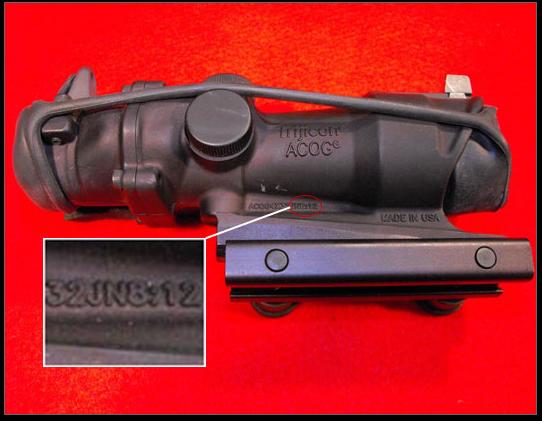
So by now you are all aware of the Biblical inscriptions on ACOGs sights sold by Trijicon to the U.S. Marines and Army.  Without rehearing the details, the owner of the company who makes the ACOGs sights for the U.S. Marines is a Christian, and he has found a unique way to take pride in his work.  He has tooled his factories to inscribe certain Biblical passages on the ACOGs sights.

General Petraeus is disturbed over the inscriptions.  The U.S. Marine Corps is concerned, and Trijicon has agreed to remove them.  Even the washed up, burned out, pacifist hippies at Creative Loafing have weighed in with indignation over the inscriptions (and Muslims with faux outrage after this was hyped in the American media).  The Huffington Post has their usual knee jerk reaction.  Kits have been distributed to remove the inscriptions from those sights which are currently in service (even though, rather surprisingly, the British Ministry of Defence has refused this remedy because it will remove weapons from the field where they are needed).  They’ve taken a pass.

Now, I would never have included the inscriptions on the sights, but not because I disagree with the inscriptions.  In general, I’m a boring kind of guy and just not creative enough to have come up with the idea.  With General Petraeus, I am “disturbed” about a great many things: that we initiated Operation Iraqi Freedom with fewer troops than necessary to maintain the peace once the regime fell – that we have too few troops now in Afghanistan – that we may be losing our conventional capabilities as we necessarily focus on irregular warfare – that our warriors need an entirely new generation of  weapons that won’t be funded – and so on the list could go.  But “disturbed” over these inscriptions?  Not even nearly.  Generals should worry over things that warrant worry, such as micromanaging the campaign.

As for Trijicon, they have behaved admirably throughout this silly ordeal.  If it had been me, I would have let the Marine Corps explain to parents and spouses of Marines why they rejected the best optical sights on the planet because someone who wasn’t involved in this objected to my world view.  I would have responded, ‘Oh, go blow it out your …..,”  well, never mind, that wouldn’t be very Christian.

Hekmatyar Comes Sweetly?

BY Herschel Smith
16 years, 6 months ago

From the WSJ:

One of the three main leaders of the Afghan insurgency, mercurial warlord Gulbuddin Hekmatyar, has a long history of switching sides, and once fought against his current Taliban allies.

Now, he has held out the possibility of negotiating with Afghan President Hamid Karzai and outlined a roadmap for political reconciliation, opening what could be the most promising avenue for Mr. Karzai’s effort to peacefully resolve the conflict.

It is far from certain that any talks with Mr. Hekmatyar will begin, let alone succeed. But in contrast to Taliban leader Mullah Omar and allied insurgent chief Sirajuddin Haqqani, who refuse any talks with Kabul as long as foreign troops remain in the country, Mr. Hekmatyar took a much more conciliatory line in a recent video.

“We have no agreement with the Taliban—not for fighting the war, and not for the peace,” said Mr. Hekmatyar, who commands the loyalty of thousands of insurgents. “The only thing that unites the Taliban and [us] is the war against the foreigners.”

Unlike in previous videos, where Mr. Hekmatyar used a Kalashnikov rifle as a prop and expressed support for al Qaeda, in the latest tape, recorded in late December and provided to The Wall Street Journal by his aides in Pakistan, he assumed a professorial tone, wearing glasses and a black turban as he spoke in a quiet, soft voice.

Mr. Hekmatyar, who is 59 years old and lived in exile in Iran when the Taliban ruled Afghanistan, built his movement over the last three years into a formidable force. His men dominate the insurgency in several eastern and central Afghan provinces, such as Kunar, Laghman and Kapisa, according to American intelligence estimates.

At the same time, a legal wing of Hizb-e-Islami, an Islamist party that Mr. Hekmatyar founded in the 1970s, participates in the Afghan parliament, with 19 of 246 seats. One of its leaders is minister of the economy in Mr. Karzai’s new cabinet. Though the legal Hizb-e-Islami denies formal links with Mr. Hekmatyar, many of its senior members are believed to maintain communications with the grizzled warlord, and openly support the idea of bringing him into the government.

Mr. Hekmatyar’s “reported willingness to reconcile with the Afghan government” has already become a key factor working against the militancy because it “causes concern that others may follow,” the U.S.-led international forces’ intelligence chief, Maj. Gen. Michael Flynn, noted in a recent presentation. In addition to subtracting fighters from the battlefield, such a reconciliation would boost the legitimacy of the Kabul government.

Currently, fighters of the three main groups—Mullah Omar’s Taliban in the south, where the bulk of combat takes place, the Haqqani network in the southeast, and Mr. Hekmatyar’s men in its strongholds—cooperate with each other, at least on the tactical level, American intelligence officials say.

But, while Mr. Haqqani made a formal oath of allegiance to Mullah Omar, recognizing him as his overall leader, Mr. Hekmatyar repeatedly refused to make such a pledge. In the tape, he said he spent “a couple of months” with Mullah Omar and al Qaeda leaders Osama bin Laden and Ayman al Zawahri in 2002, but insisted that he “had no direct or indirect contact with them since then.”

McChrystal says that there has been enough fighting.  This so-called reconciliation is being pressed from the Afghan – ISAF – U.S. side.  Hekmatyar appears to be seizing the opportunity being presented to him.  But he has become a powerful warlord, and I predict that if the Taliban prevails in Afghanistan, Hekmatyar and they will come sweetly with each other.  He will be nice with whomever he needs at the moment, and the Taliban won’t take up an unnecessary fight.

My point is that the payoff of any alliance with Hekmatyar will ultimately depend on other things that we must do, such as militarily defeat the Taliban.  Either way, this process is backwards from what it was in the Anbar Province of Iraq.  The first alliance between the U.S. Marines and Iraqis occurred after they had already started opposing AQI.  Concerning Abdul Sattar Abu Risha, he was negotiating with U.S. forces while we were killing his tribal members who were part of his smuggling ring.  In Operation Alljah, invitations were opened for indigenous Fallujans to join the IPs only after an utterly massive application of military force within the city and surrounding locations.

No one wants to see more death and bloodshed of U.S. or ISAF forces, or of Afghan noncombatants.  The best way to ensure that this is minimized may be to kill more insurgents.  If they come to the table, it should be they who request it – while we sit in a position of strength.

Terrain Problems and Combat Outposts in Afghanistan

BY Herschel Smith
16 years, 6 months ago

Do you recall our coverage of the Battle of Wanat?  In our several articles on the subject (And specifically, Analysis of the Battle of Wanat), we have had reader / commenter Slab state:

Herschel,
I don’t think your comparisons to Anbar and Helmand Provinces really bear out. I’ve been to Kunar Province, and in the vicinity of Wanat. The terrain is vastly different. The terrain in Helmand allowed the MEU to employ a completely different approach.

Also, I don’t really think your points on ROE are particularly germane to the discussion of Wanat. If the platoon had engaged those personnel, I don’t believe it would have changed the outcome of the battle one bit. Positive identification is as difficult as it is critical in a counterinsurgency environment. I can think of numerous instances where I thought someone was an enemy combatant, when in fact they were not.

Where I think you hit the nail on the head is when you mention the terrain. The platoon in Wanat sacrificed control of the key terrain in the area in order to locate closer to the population. This was a significant risk, and I don’t see any indication that they attempted to sufficiently mitigate that risk. I can empathize a little bit – I was the first Marine on deck at Camp Blessing back when it was still Firebase Catamount, in late 2003. I took responsibility for the camp’s security from a platoon from the 10th Mountain Div, and established a perimeter defense around it. Looking back, I don’t think I adequately controlled the key terrain around the camp. The platoon that replaced me took some steps to correct that, and I think it played a significant role when they were attacked on March 22nd of 2004. COIN theorists love to say that the population is the key terrain, but I think Wanat shows that ignoring the existing natural terrain in favor of the population is a risky proposition, especially in Afghanistan.

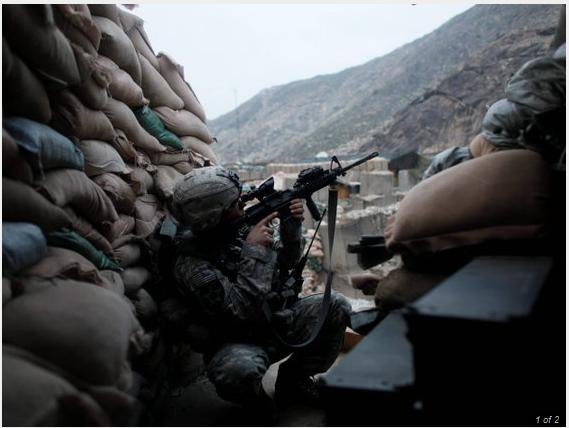
The application of the ROE discussion has taken a different turn, and my point may be correct.  But Slab’s point is still valid, and our discussion of the Battle of Kamdesh bears out the point about terrain (see also Video of COP Keating).  Now comes a picture via The Washington Times.

COP_Michigan

Sgt. David Nix aims toward the hills as incoming fire hits inside Command Outpost Michigan in Kunar province

Two questions.  Can someone tell me when Combat Outposts became “Command Outposts?”  Why the name change and what does it mean?  Second, exactly why is this COP located on low terrain?  Given the lessons we have learned from Wanat and Keating, why is COP Michigan located on low terrain?

Whitewashing the Fort Hood Shootings: Redux on Christian Terrorism

BY Herschel Smith
16 years, 6 months ago

From the Weekly Standard:

While we should be thankful that various individuals at Fort Hood acted in a “prompt and courageous” manner thereby preventing “greater losses,” it should never have gotten to that point. The Defense Department’s system is not working if it is left to first responders to stop a terrorist. A traitor within the military’s ranks, with compromised loyalties that had been known about for years—as was the case with Hasan—should be stopped before his finger is on the trigger.

Therein lies the central problem with the Pentagon’s report. It says nothing of consequence about Hasan or how to stop individuals like him in the future. Hasan is not even named in the report, but instead referred to as the “alleged perpetrator.” The report’s authors contend that the sanctity of the criminal investigation into the shooting needs to be upheld. But this is not an excuse for failing to name the attacker. The whole world knows that Major Nidal Malik Hasan did it.

Nor is the ongoing criminal investigation a valid reason for avoiding a serious discussion of Hasan’s ideological disposition. The report’s authors instead go to lengths to whitewash Hasan’s beliefs.

The report lumps all sorts of deviant and problematic behaviors together as if they have the same relevance to the events of November 5. Thus, we find a discussion of alcohol and drug abuse, sexual violence, elder abuse, and the disgusting methods employed by child molesters. We also learn of the deleterious effects of events “such as divorce, loss of a job, or death of a loved one,” all of which “may trigger suicide in those who are already vulnerable.”

Was Major Nidal Malik Hasan a child molester, a drug addict, or suicidal because of a recent divorce? No. So what does any of this have to do with the attack at Fort Hood? Absolutely nothing.

What is relevant is Hasan’s religious and political beliefs. He is a jihadist, although you would never know it by reading the Pentagon’s report. Instead in the report’s “literature review of risk factors for violence,” one comes across this sentence:

Religious fundamentalism alone is not a risk factor; most fundamentalist groups are not violent, and religious-based violence is not confined to members of fundamentalist groups.

This is a true statement; it is also completely meaningless in respect to the Fort Hood massacre. The brand of religious fundamentalism practiced by Hasan is specifically devoted to violence.

This article by Thomas Joscelyn rehearses some of the things we discussed in Radicalized Christian Terrorism.  On a complex topic it’s easy to misunderstand truncated prose.  This is the kind of topic that is better carried out as a series of conversations.

A number of readers / commenters conflated boundary conditions.  This comment comes to us from Aristekrat:

I think it would certainly be fair to name any abortion bombing or killing as Christian terrorism. Admittedly, that is not near the problem that exists in Islam, but I disagree that is because Christianity is inherently peaceful and Islam is violent. At one time Christianity was not at all peaceful; surprisingly no one has mentioned the reformation and the wars of religion that lasted an extraordinarily long time, tore Europe apart, and were monstrously violent. That violence ultimately exhausted Europe and led to the Peace of Westphalia, the first harbinger of secularism. As secularism (and nationalism) ascended so religious violence in Europe dropped. Are you comfortable with the idea that the greater prevalence of religious violence in Islam might not be due to Islam being a more violent religion but because western civilization has embraced the (now) leftist doctrine of secularism and Islamic countries have not?

This is a very far reaching and broad comment and we will have to deal with aspects of it in later conversations.  Suffice it to say that the proposition that secularism is related to a reduction in violence is incorrect from my vantage point, and the author of the comment is advised to study the following two texts:

Carl Becker, The Heavenly City of the Eighteenth-Century Philosophers

Douglas F. Kelly, The Emergence of Liberty in the Modern World: The Influence of Calvin on Five Governments from the 16th Through 18th Centuries

Any conversation on this that begins without these two texts as a backdrop is a waste of time.  So moving back to the issue of  “any abortion bombing or killing as Christian terrorism,” this is once again a conflation of issues, a confusion of boundary conditions for my thought experiment.

We absolutely must get definitions and boundaries right for the conversation to have a common language.  Without rehearsing the boundaries I laid down in the original article, let’s approach this from a different perspective, i.e., the perspective of Islamic terrorism.

A quick survey of my articles on Iraq and counterinsurgency shows without equivocation that I did not believe during the height of the insurgency, and do not believe now, that all insurgents in Iraq fought for religious motivation.  In fact, most of them didn’t.  To be sure, the several hundred per month who crossed the Syrian border coming from Somalia, Chechnya, Saudi Arabia, Jordan and other locales, included many who did fight predominately for religious motivation.  But the indigenous insurgency primarily did not.

During Operation Alljah loud speakers were used by U.S. forces to address the public at Mosques, and even though this is a religious gathering, per se, I do not include this as religious-based insurgency or counterinsurgency.  The Mosques were targeted as being the center of public activity and philosophy.

Again, a survey of my posts reminds the reader of just how involved we have been in attempting to understand how to separate an indigenous insurgency – who fights for many reasons, including money, youthful exuberance, boredom, etc. – from the religiously- based leadership.

Not all shootings in Iraq were a result of jihad.  Nor have I categorized religious-on-religious violence (e.g., Shi’a on Sunni and vice versa) within the rubric of jihad or religiously-based violence.  My definitions were very specific, and included the notion that one believes that his specific religious views warranted propagation via violence or subjugation of unbelievers.

Wars of power, convenience, tribe, family, wealth-seeking, and so on, do not qualify under this rubric.  As for Islam, I have dealt with the competing hermeneutics within the Muslim world before by addressing stolid comments by Professor Steve Metz of the U.S. Army War College.  Feel free to go study them in some detail.

I am left in this thought experiment without any compelling evidence whatsoever that anyone can come up with a single example of Christian terrorism that meets my definition – a definition, by the way, that I have consistently applied to Islamic terrorism as well.

You may disagree, you may respond with fury and fist.  But what you cannot do is charge me with inconsistency.  I have treated both Islam and Christianity with the same standards.  In the mean time, I continue to be amused at the felt-need to legitimize moral-equivalency arguments, and even if you can find an example of Christian inspired terrorism, I have made you search hard.  The search is hard because Christian Biblical hermeneutics doesn’t support terrorism.



26th MEU (10)
Abu Muqawama (12)
ACOG (2)
ACOGs (1)
Afghan National Army (36)
Afghan National Police (17)
Afghanistan (704)
Afghanistan SOFA (4)
Agriculture in COIN (3)
AGW (1)
Air Force (42)
Air Power (10)
al Qaeda (83)
Ali al-Sistani (1)
America (23)
Ammunition (305)
Animals (336)
Ansar al Sunna (15)
Anthropology (3)
Antonin Scalia (1)
AR-15s (397)
Arghandab River Valley (1)
Arlington Cemetery (2)
Army (91)
Assassinations (2)
Assault Weapon Ban (29)
Australian Army (7)
Azerbaijan (4)
Backpacking (4)
Badr Organization (8)
Baitullah Mehsud (21)
Basra (17)
BATFE (247)
Battle of Bari Alai (2)
Battle of Wanat (18)
Battle Space Weight (3)
Bin Laden (7)
Blogroll (3)
Blogs (24)
Body Armor (23)
Books (3)
Border War (18)
Brady Campaign (1)
Britain (39)
British Army (36)
Camping (5)
Canada (20)
Castle Doctrine (1)
Caucasus (6)
CENTCOM (7)
Center For a New American Security (8)
Charity (3)
China (19)
Christmas (18)
CIA (30)
Civilian National Security Force (3)
Col. Gian Gentile (9)
Combat Outposts (3)
Combat Video (2)
Concerned Citizens (6)
Constabulary Actions (3)
Coolness Factor (3)
COP Keating (4)
Corruption in COIN (4)
Council on Foreign Relations (1)
Counterinsurgency (218)
DADT (2)
David Rohde (1)
Defense Contractors (2)
Department of Defense (220)
Department of Homeland Security (26)
Disaster Preparedness (5)
Distributed Operations (5)
Dogs (15)
Donald Trump (27)
Drone Campaign (4)
EFV (3)
Egypt (12)
El Salvador (1)
Embassy Security (1)
Enemy Spotters (1)
Expeditionary Warfare (18)
F-22 (2)
F-35 (1)
Fallujah (17)
Far East (3)
Fathers and Sons (2)
Favorite (1)
Fazlullah (3)
FBI (39)
Featured (192)
Federal Firearms Laws (18)
Financing the Taliban (2)
Firearms (1,876)
Football (1)
Force Projection (35)
Force Protection (4)
Force Transformation (1)
Foreign Policy (27)
Fukushima Reactor Accident (6)
Ganjgal (1)
Garmsir (1)
general (15)
General Amos (1)
General James Mattis (1)
General McChrystal (44)
General McKiernan (6)
General Rodriguez (3)
General Suleimani (9)
Georgia (19)
GITMO (2)
Google (1)
Gulbuddin Hekmatyar (1)
Gun Control (1,730)
Guns (2,416)
Guns In National Parks (3)
Haditha Roundup (10)
Haiti (2)
HAMAS (7)
Haqqani Network (9)
Hate Mail (8)
Hekmatyar (1)
Heroism (5)
Hezbollah (12)
High Capacity Magazines (16)
High Value Targets (9)
Homecoming (1)
Homeland Security (3)
Horses (2)
Humor (72)
Hunting (65)
ICOS (1)
IEDs (7)
Immigration (123)
India (10)
Infantry (4)
Information Warfare (4)
Infrastructure (4)
Intelligence (23)
Intelligence Bulletin (6)
Iran (171)
Iraq (379)
Iraq SOFA (23)
Islamic Facism (64)
Islamists (98)
Israel (19)
Jaish al Mahdi (21)
Jalalabad (1)
Japan (3)
Jihadists (82)
John Nagl (5)
Joint Intelligence Centers (1)
JRTN (1)
Kabul (1)
Kajaki Dam (1)
Kamdesh (9)
Kandahar (12)
Karachi (7)
Kashmir (2)
Khost Province (1)
Khyber (11)
Knife Blogging (7)
Korea (4)
Korengal Valley (3)
Kunar Province (20)
Kurdistan (3)
Language in COIN (5)
Language in Statecraft (1)
Language Interpreters (2)
Lashkar-e-Taiba (2)
Law Enforcement (6)
Lawfare (14)
Leadership (6)
Lebanon (6)
Leon Panetta (2)
Let Them Fight (2)
Libya (14)
Lines of Effort (3)
Littoral Combat (8)
Logistics (50)
Long Guns (1)
Lt. Col. Allen West (2)
Marine Corps (281)
Marines in Bakwa (1)
Marines in Helmand (67)
Marjah (4)
MEDEVAC (2)
Media (68)
Medical (146)
Memorial Day (6)
Mexican Cartels (48)
Mexico (72)
Michael Yon (6)
Micromanaging the Military (7)
Middle East (1)
Military Blogging (26)
Military Contractors (5)
Military Equipment (25)
Militia (9)
Mitt Romney (3)
Monetary Policy (1)
Moqtada al Sadr (2)
Mosul (4)
Mountains (25)
MRAPs (1)
Mullah Baradar (1)
Mullah Fazlullah (1)
Mullah Omar (3)
Musa Qala (4)
Music (25)
Muslim Brotherhood (6)
Nation Building (2)
National Internet IDs (1)
National Rifle Association (97)
NATO (15)
Navy (31)
Navy Corpsman (1)
NCOs (3)
News (1)
NGOs (3)
Nicholas Schmidle (2)
Now Zad (19)
NSA (3)
NSA James L. Jones (6)
Nuclear (63)
Nuristan (8)
Obama Administration (222)
Offshore Balancing (1)
Operation Alljah (7)
Operation Khanjar (14)
Ossetia (7)
Pakistan (165)
Paktya Province (1)
Palestine (5)
Patriotism (7)
Patrolling (1)
Pech River Valley (11)
Personal (77)
Petraeus (14)
Pictures (1)
Piracy (13)
Pistol (4)
Pizzagate (21)
Police (673)
Police in COIN (3)
Policy (15)
Politics (999)
Poppy (2)
PPEs (1)
Prisons in Counterinsurgency (12)
Project Gunrunner (20)
PRTs (1)
Qatar (1)
Quadrennial Defense Review (2)
Quds Force (13)
Quetta Shura (1)
RAND (3)
Recommended Reading (14)
Refueling Tanker (1)
Religion (501)
Religion and Insurgency (19)
Reuters (1)
Rick Perry (4)
Rifles (1)
Roads (4)
Rolling Stone (1)
Ron Paul (1)
ROTC (1)
Rules of Engagement (76)
Rumsfeld (1)
Russia (37)
Sabbatical (1)
Sangin (1)
Saqlawiyah (1)
Satellite Patrols (2)
Saudi Arabia (4)
Scenes from Iraq (1)
Second Amendment (715)
Second Amendment Quick Hits (2)
Secretary Gates (9)
Sharia Law (3)
Shura Ittehad-ul-Mujahiden (1)
SIIC (2)
Sirajuddin Haqqani (1)
Small Wars (72)
Snipers (9)
Sniveling Lackeys (2)
Soft Power (4)
Somalia (8)
Sons of Afghanistan (1)
Sons of Iraq (2)
Special Forces (28)
Squad Rushes (1)
State Department (23)
Statistics (1)
Sunni Insurgency (10)
Support to Infantry Ratio (1)
Supreme Court (84)
Survival (216)
SWAT Raids (58)
Syria (38)
Tactical Drills (38)
Tactical Gear (17)
Taliban (168)
Taliban Massing of Forces (4)
Tarmiyah (1)
TBI (1)
Technology (21)
Tehrik-i-Taliban (78)
Terrain in Combat (1)
Terrorism (96)
Thanksgiving (13)
The Anbar Narrative (23)
The Art of War (5)
The Fallen (1)
The Long War (20)
The Surge (3)
The Wounded (13)
Thomas Barnett (1)
Transnational Insurgencies (5)
Tribes (5)
TSA (25)
TSA Ineptitude (14)
TTPs (4)
U.S. Border Patrol (8)
U.S. Border Security (22)
U.S. Sovereignty (29)
UAVs (2)
UBL (4)
Ukraine (10)
Uncategorized (107)
Universal Background Check (3)
Unrestricted Warfare (4)
USS Iwo Jima (2)
USS San Antonio (1)
Uzbekistan (1)
V-22 Osprey (4)
Veterans (3)
Vietnam (1)
War & Warfare (435)
War & Warfare (41)
War Movies (4)
War Reporting (21)
Wardak Province (1)
Warriors (6)
Waziristan (1)
Weapons and Tactics (80)
West Point (1)
Winter Operations (1)
Women in Combat (21)
WTF? (1)
Yemen (1)

August 2026
July 2026
June 2026
May 2026
April 2026
March 2026
February 2026
January 2026
December 2025
November 2025
October 2025
September 2025
August 2025
July 2025
June 2025
May 2025
April 2025
March 2025
February 2025
January 2025
December 2024
November 2024
October 2024
September 2024
August 2024
July 2024
June 2024
May 2024
April 2024
March 2024
February 2024
January 2024
December 2023
November 2023
October 2023
September 2023
August 2023
July 2023
June 2023
May 2023
April 2023
March 2023
February 2023
January 2023
December 2022
November 2022
October 2022
September 2022
August 2022
July 2022
June 2022
May 2022
April 2022
March 2022
February 2022
January 2022
December 2021
November 2021
October 2021
September 2021
August 2021
July 2021
June 2021
May 2021
April 2021
March 2021
February 2021
January 2021
December 2020
November 2020
October 2020
September 2020
August 2020
July 2020
June 2020
May 2020
April 2020
March 2020
February 2020
January 2020
December 2019
November 2019
October 2019
September 2019
August 2019
July 2019
June 2019
May 2019
April 2019
March 2019
February 2019
January 2019
December 2018
November 2018
October 2018
September 2018
August 2018
July 2018
June 2018
May 2018
April 2018
March 2018
February 2018
January 2018
December 2017
November 2017
October 2017
September 2017
August 2017
July 2017
June 2017
May 2017
April 2017
March 2017
February 2017
January 2017
December 2016
November 2016
October 2016
September 2016
August 2016
July 2016
June 2016
May 2016
April 2016
March 2016
February 2016
January 2016
December 2015
November 2015
October 2015
September 2015
August 2015
July 2015
June 2015
May 2015
April 2015
March 2015
February 2015
January 2015
December 2014
November 2014
October 2014
September 2014
August 2014
July 2014
June 2014
May 2014
April 2014
March 2014
February 2014
January 2014
December 2013
November 2013
October 2013
September 2013
August 2013
July 2013
June 2013
May 2013
April 2013
March 2013
February 2013
January 2013
December 2012
November 2012
October 2012
September 2012
August 2012
July 2012
June 2012
May 2012
April 2012
March 2012
February 2012
January 2012
December 2011
November 2011
October 2011
September 2011
August 2011
July 2011
June 2011
May 2011
April 2011
March 2011
February 2011
January 2011
December 2010
November 2010
October 2010
September 2010
August 2010
July 2010
June 2010
May 2010
April 2010
March 2010
February 2010
January 2010
December 2009
November 2009
October 2009
September 2009
August 2009
July 2009
June 2009
May 2009
April 2009
March 2009
February 2009
January 2009
December 2008
November 2008
October 2008
September 2008
August 2008
July 2008
June 2008
May 2008
April 2008
March 2008
February 2008
January 2008
December 2007
November 2007
October 2007
September 2007
August 2007
July 2007
June 2007
May 2007
April 2007
March 2007
February 2007
January 2007
December 2006
November 2006
October 2006
September 2006
August 2006
July 2006
June 2006
May 2006

about · archives · contact · register

Copyright © 2006-2026 Captain's Journal. All rights reserved.