Is it logistically possible to deploy more troops to Afghanistan?
BY Herschel Smith 16 years, 3 months ago
Richard North at Defence of the Realm engages in a little gloating (and frustration as well).
Referring to the daily stream of truck convoys that bring supplies into the landlocked nation, Hilary Clinton said to the Senate Armed Services Committee:
“You know, when we are so dependent upon long supply lines – as we are in Afghanistan, where everything has to be imported — it’s much more difficult than it was in Iraq, where we had Kuwait as a staging ground.
You offload a ship in Karachi. And by the time whatever it is – you know, muffins for our soldiers’ breakfast or anti-IED equipment – gets to where we’re headed, it goes through a lot of hands. And one of the major sources of funding for the Taliban is the protection money. That has nothing to do with President Karzai.”
Yup! That’s precisely what we said on 3 September and then again on 13 September of this year , on the blog and in the Booker column …
As we pointed out – it is all done under a doctrine of “plausible deniability”. We do not pay the Taliban – oh no! But we build their payments into the contractors’ fees, which they then pass on, to ensure safe passage.
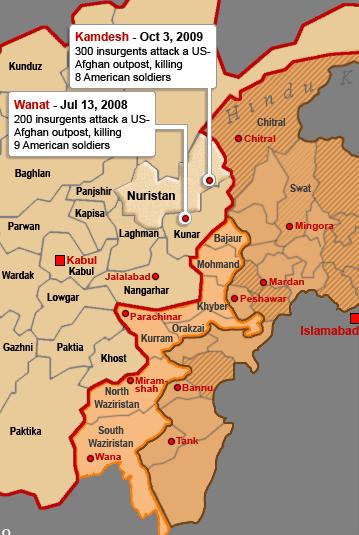
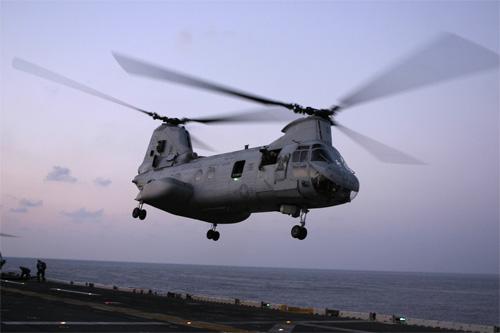
And well deserved gloating it is. I will engage in a little myself. And … much frustration. One year and eight months ago I described the Taliban and al Qaeda strategy of interdiction of supply routes from the Pakistan port city of Karachi to the Khyber pass (and through the Torkham Crossing) or Chaman towards Kandahar (a smaller percentage of our supplies goes through Chaman than Khyber). In fact, my Logistics category is well populated with studies of supply problems – larger scale through Pakistan, and smaller scale logistics to remote combat outposts in which the helicopter is king because we don’t own the roads and can’t ensure security. It costs $400 to get a single gallon of gasoline to the Helmand Province.
Approximately one year ago I recommended an alternative logistics route, and nine months ago I concluded that it was time to engage the Caucasus in order to make this happen. The proposed route: through the Caucasus region, specifically, from the Mediterranean Sea through the Bosporus Strait in Turkey, and from there into the Black Sea. From the Black Sea the supplies would go through Georgia to neighboring Azerbaijan. From here the supplies would transit across the Caspian Sea to Turkmenistan, and from there South to Afghanistan.
Difficult? Certainly. Riddled with political problems and in need of security? Sure. But better than what we have with Pakistan if we had worked to make it happen. Instead, we courted the Russians for a route through their territory, and thus far to no one’s surprise there has been precious little in the way of real cooperation or significant amounts of supplies going through Russia.
As if this issue has not been developing and growing for the last several years, senior Pentagon officials now face a dilemma. Deploy additional troops, but supply those troops with currently unknown logistical routes.
The White House has settled on sending additional troops to Afghanistan, and now the Pentagon must grapple with another thorny problem: how to support them once they get there.
For Ashton Carter, the top Pentagon official in charge of weapons purchases, that has meant focusing on the concrete — literally. Basic materials for building bases are in short supply or nonexistent in Afghanistan, so U.S. officials must search for staples like concrete next door in Pakistan.
Another priority: Getting thousands of blast-resistant trucks from Oshkosh Corp.’s factory in Oshkosh, Wis., to U.S. forces in the Afghan hinterlands.
“At this phase, Afghanistan is a logistics war as much as any other kind of war,” said Mr. Carter, whose formal title is under secretary of defense for acquisition, technology and logistics, in a recent interview.
Unlike Iraq, Afghanistan has no modern infrastructure. Critical supplies such as fuel must be imported. The country is landlocked and has just three major overland routes. Enormous distances separate bases and outposts. High mountains and valleys, as well as extreme weather, make air travel difficult.
Defense Secretary Robert Gates has pushed the Pentagon to stay on a wartime footing rather than focus on preparing for future conflicts. Top officials have shifted their priorities.
“Everything is…more expensive, but that’s not really as much the issue as whether you can get it done at all,” Mr. Carter said.
Mr. Carter’s predecessor had a full plate dealing with defense-industry programs such as the $300 billion Joint Strike Fighter and the sprawling $200 billion Army modernization effort known as Future Combat Systems. Mr. Carter, by contrast, is entrenched in the minutiae of Iraq and Afghanistan, as well as big weapons programs.
The author of the article, Mr. August Cole, makes excuses for the current administration in the last three paragraphs. Busy, they are. Finally focused on the details unlike their predecessors in the Bush administration who were focused on defense industry programs. Except that this is a false narrative. Obama’s defense team has been in place long enough to decipher the problems. If a Milblog can pick up on the problems and alternatives, so can the DoD.
The Bush team failed in terms of setting up conditions for logistical success in Afghanistan. But this doesn’t obviate or justify the current failure to plan for supplies. The Bush team never planned for more troops in Afghanistan. The Obama team did, and is just now stumbling over the most important element of any campaign – logistics.
Is it too late to engage the Caucasus? Is it too late for the Obama team to start thinking ahead or at least reading the Milblogs?