Articles by Herschel Smith


The “Captain” is Herschel Smith, who hails from Charlotte, NC. Smith offers news and commentary on warfare, policy and counterterrorism.


Russia Invades Georgia

17 years, 9 months ago

Ralph Peters has the best analysis of the situation I can find.  All of Ralph’s commentary is worth studying, but the summary is that Russia planned this in advance.  They cannot move that much armor without pre-deploying the right equipment and troops.  The military materiel is too dilapidated.

Vladimir Putin is a criminal and thug, and also has a heavy hand in the parent company of Airbus, erstwhile winner of the tanker contract (which is reason enough to reject out-of-hand any proposal made by this company).  But leave it to some shallow thinkers to romanticize the issue.  Courtesy of the Small Wars Journal Blog, Gordon Chang has a short piece in Commentary Magazine, and following the comments leads to this jaw-dropping statement:

I’m a great admirer of the Georgians, their music and their traditions. They poked a stick in the bear’s eye. It’s not up to us to tell the bear what to do right outside his lair.

That way, madness lies. Thank God we never admitted Georgia into NATO. This crisis would prove that obsolete entity a toothless cat, indeed.

Good grief.  Say what you will about American self-protection by imperial presence across the globe, but she has never forced anything upon a population except its own will.  Russia is still communist, and communism imposes the will of the government regardless of the will of the people.  It’s evil to the core, lest we forget the lessons taught to us by 60+ years of watching Russian brutality, or the lessons taught to us by our great leader Ronald Reagan.

The “bear” is evil, and we should be working towards the diminution of his “lair,” romantic stupidity and inane blog comments notwithstanding.

Friday Night Music Continued

17 years, 9 months ago

We’ll return to the heavy articles on Monday.  Until then, enjoy a very sophisticated rock tune by the Doobie Brothers entitled Clear as the Driven Snow.  There is an older (and better) version on video, but it was pulled from Youtube.

Made famous by other tunes such as “China Grove,” this goes to show what a diverse and talented group the Doobies were.  You won’t find tunes like this on many web sites.  We bring you the best, and as always, something very interesting.  The Captain’s Journal likes to supply you with nuggets of gold in a wasteland of prose and video across the globe.

Ingress to Afghanistan

17 years, 9 months ago

India has long been very wary of the Taliban, having fought Islamic extremists in the Kashmir region for years. Hence, they knew long before the U.S. did that political and security problems would cast doubt on the supply of arms and other military materiel to NATO forces in Afghanistan. Karachi is the next target of the Tehrik-i-Taliban, and it is the port city of entry for NATO supplies. We predicted Karachi would be at risk months ago. India also stands to lose with the ascendancy of the Taliban, i.e., India itself is at risk. So India has been busy, but on what?

KABUL, August 07, 2008 (AFP) – India has almost completed a key road linking Afghanistan to Iranian sea ports despite Taliban attacks that claimed more than 100 lives in two years, the deputy public works minister said.

The 217-kilometre (134-mile) route connects a nearly completed ring road around Afghanistan to the Iranian port cities of Bandar-i-Abas and Chabahar, the official told AFP.

Eight Indian engineers and more than 100 Afghan workers were killed in Taliban attacks since the construction of the road began more than two years ago, said Minister Wali Mohammad Rasouli.

There were a few sections of route that had to be touched up before a handing over ceremony was held in a few weeks, he said.

Landlocked Afghanistan relies mostly on Pakistan’s port of Karachi for goods arriving by sea, including supplies for the nearly 70,000 international soldiers helping to fight a Taliban-led insurgency.

The road was initially budgeted at 80 million dollars but is reported to have cost 185 million dollars, in part because of the high security risks of operating in southern Afghanistan.

The route, already open to traffic, is a welcome alternative, since goods can sometimes be held up on alternate routes from Pakistan, where they are also often subjected to high taxes, Rasouli said.

“The new road is very important for us,” he said. “Now we have an alternative road to use when Pakistan creates problems and obstacles for our traders on their ports.”

Islamabad also does not allow goods from India — its enemy — to transit through Pakistan into Afghanistan.

Kabul has a good relationship with New Delhi, one of the main financers of its efforts to rebuild from decades of war although it has not sent troops to join the international military effort against the resurgent Taliban.

However its ties with Islamabad are strained, notably over the unrest.

Kabul alleges that elements in Pakistan, including its government, are supporting the Taliban. Islamabad was one of only three countries that recognised the 1996-2001 Taliban regime.

A road to Iran. This is truly bizarre. A sworn enemy of the U.S. and perpetrator of all manner of anti-Western military operations through its proxy Syria and Hezbollah, the idea that Iran would ever knowingly allow support for NATO forces in Afghanistan to transit through its borders, while also actively working for the defeat of the very same forces in both Afghanistan and Iraq, calls this report into serious suspicion. If it’s true, it isn’t readily apparent why India would have worked for such a road.

It would have been easier to secure disputed areas of Kashmir (or construct air fields to supply NATO via flights over the Northern region of Kashmir) than to get Iranian agreement to assist NATO forces in Afghanistan. To make this report make any sense whatsoever requires a better analyst than The Captain’s Journal. We believe that India has wasted its time and money.

The Globalization of Jihad in Palestine

17 years, 9 months ago

The danger in Pakistan negotiating with Tehrik-i-Taliban is the presumption that they’re interested in accommodation, local or national politics. We have previously pointed out regarding the internet interview of Ayman al-Zawahiri that “Over the past year, Zawahiri and other senior al-Qa’ida figures have been waging a vigorous propaganda campaign against the Palestinian organization HAMAS. Although Jihadists unanimously denounce Israel they continue to disagree over whether HAMAS should be considered a legitimate Islamic movement. For Zawahiri, HAMAS’ embrace of nationalism, democracy, and its legacy in the Muslim Brotherhood — arguably the three things al-Qa’ida hates most — delegitimizes the group.”

We also observed that “What we see as a transnational insurgency is to the jihadists simply a world wide struggle. They don’t recognize nation-states as legitimate.” In recent Internet postings we have now learned that:

Sheikh Hamid al-Ali, based in Kuwait, is a leading Islamist ideologue whose teachings are often posted on Islamist Web sites.

“Lebanon is a vivid example of the Iranian expansionist scheme at the expense of real Arab causes, which are exploited by Shi’ite sects,” Ali said in a recently posted message on an al-Qaida affiliated Web forum. “The jihadi movement has to be aware of the reality of the size of Iran’s influence, and must not allow Iran to exploit legitimate causes.”

Al-Qaida ideologues have also expressed deep disappointment with Hamas, which they accuse of being too nationalist and provincial. Al-Qaida members routinely condemn Hamas for failing to declare an Islamic emirate in Gaza, an entity they say could link up with other pockets of Islamist rule in a future caliphate state.

One message, posted on the jihadi al-Firdaws forum several months ago by a user who identified himself as Palestinian, read, “When Hamas took over Gaza, we eagerly anticipated their announcement of the establishment of an Islamic emirate, as was the case in Afghanistan and in Somalia. But this did not happen.”

There is the recurring theme of condemnations of Hamas (to which we have pointed), but in reality the situation is far more dire for this region of the world.

The Hamas regime has been alarmed by a new Islamic revivalist movement that eschews politics.

The movement, known as Salafis, was said to receive funds from the Gulf as well as sources within the Gaza Strip. The Salafis, who appear to resemble the Taliban and Al Qaida, have established a mosque and religious school and were believed to number up to 50,000.

“They have become the new rival of Hamas and are supported by very powerful sheiks in the Gulf,” a Palestinian security source said.

The source said the Salafis have become established in every major town in the Gaza Strip. Salafi members, dressed in robes and long beards, spend their evenings going from door to door in efforts to recruit Muslims to attend mosque on a daily basis. The Salafis have their own mosque, A-Sahabah, as well as an elementary and high school in Gaza City, Middle East Newsline reported.

The Salafis have urged Gazans to live a modesty lifestyle and throw away their television, alcohol, pictures and cosmetics. Recruits to the movement have been encouraged to spread these principles and influence mosques, schools and the work place.

Hamas has sought to limit the Salafi influence. Palestinian sources said Hamas security forces raided mosques under the influence of the Salafis.

Several militias have derived their inspiration from the Salafis. They include the Army of Islam and the Army of the Nation — the former sponsored by the Dughmoush clan and the latter comprised of former members of Hamas and Islamic Jihad.

Palestinian sources said the Salafis were said to have participated in or inspired a series of strikes on Internet cafes and cellular phone stores around Gaza City. They said Salafis were also involved in a grenade strike at a United Nations-sponsored festival in Rafah in 2007.

“Hamas has been very careful in dealing with the Salfis, fearing that any crackdown will anger its supporters in Qatar and the United Arab Emirates,” the source said.

There’s that same theme: eschewing politics for transnational interests and global aspirations. The Captain’s Journal predicts that within short order Hamas will either be completely absorbed within the Salafist movement in Palestine or disappear.

In the mean time this also points to another, perhaps much larger, problem. Not only are radicals in Palestine being supported by oil-engorged sheiks, the Taliban and al Qaeda are similarly recipients of oil wealth. Whether there is any concerted effort – financial pressure, black operations, or covert warfare – to dry up these funds and take out the leaders is not currently known to us. What is clear, however, is that one of the quickest ways to kill the evil progeny is to dry up the support.

The British Deal with the Mahdi Militia

17 years, 9 months ago

The Times Online has given us a further glimpse into secret deals between the British and the Mahdi militia that kept the Brits out of the recent battle for Basra.

A secret deal between Britain and the notorious al-Mahdi militia prevented British Forces from coming to the aid of their US and Iraqi allies for nearly a week during the battle for Basra this year, The Times has learnt.

Four thousand British troops – including elements of the SAS and an entire mechanised brigade – watched from the sidelines for six days because of an “accommodation” with the Iranian-backed group, according to American and Iraqi officers who took part in the assault.

US Marines and soldiers had to be rushed in to fill the void, fighting bitter street battles and facing mortar fire, rockets and roadside bombs with their Iraqi counterparts.

Hundreds of militiamen were killed or arrested in the fighting. About 60 Iraqis were killed or injured. One US Marine died and seven were wounded.

US advisers who accompanied the Iraqi forces into the fight were shocked to learn of the accommodation made last summer by British Intelligence and elements of al-Mahdi Army, the militia loyal to Moqtada al-Sadr, the radical Shia Muslim cleric.

The deal, which aimed to encourage the Shia movement back into the political process and marginalise extremist factions, has dealt a huge blow to Britain’s reputation in Iraq.

A spokesman for the MoD said that the reason why troops were not sent immediately into Basra was because there was “no structure in place” in the city for units to go back in to start mentoring the Iraqi troops.

Colonel Imad, who heads the 2nd Battalion, 1st Brigade, 1st Iraqi Army Division, the most experienced division, commanded one of the quick-reaction battalions summoned to assist British-trained local forces, who faltered from the outset because of inexperience and lack of support.

He said: “Without the support of the Americans we would not have accomplished the mission because the British Forces had done nothing there …

You can accuse the Americans of many things [said one MoD source], such as hamfistedness, but you can’t accuse them of not addressing a situation when it arises. While we had a strategy of evasion, the Americans just went in and addressed the problem.”

Another British official said that the deal was intended as an IRA-style reconciliation. “That is what we were trying to do but it did not work.” The official added that “accommodation” had become a dirty word.

US officials knew of the discussions, which continued until March this year. They facilitated the peaceful exit of British troops from a palace compound in Basra last September in return for the release of a number of prisoners. The arrangement fell apart on March 25 when Mr al-Maliki ordered his surprise assault on Basra, catching both the Americans and British off-guard.

Let’s observe at the outset what we have observed before in British Rules of Engagement and Brave Warriors. The British armed forces contains some of the best grunts on earth. It’s the leadership that’s the problem, as it has always been.

Next, there are so many layers of MoD subterfuge in this piece that the gullible would become confused. Fortunately, we at The Captain’s Journal aren’t gullible. The article makes it sound as if the once peaceful Basra allowed the Jaish al Mahdi and the British to cut a deal, allowing the Brits to “peacefully” redeploy to the airport. This is pure fabrication and fairy tales. From the beginning of the British effort in Basra there has been a continual degradation of security (see Calamity in Basra and British Rules of Engagement).

Concerning the MoD accusation of American “hamfistedness,” this tactic has become comical if not completely tired and worn out. The U.S. Marines won Anbar. The British lost Basra. For the Brits to wax eloquent about American hamfistedness is rather like complaining that the Little British Car doesn’t go as fast as the American Muscle Car. It’s prideful whining while brave men die and lose limbs, brain function, hearing and eyesight. It’s sickening.

As for the IRA-style reconciliation, it has been long known that the British pulled their irrelevant experience from Northern Ireland into the campaign for Iraq. It failed them from the outset, but the outmoded paradigm was never relinquished by British senior military leadership. Again, it’s the leadership (from Des Browne on down) that is to blame.

Finally, reputations are quick to be lost and hard to gain back. The British have come away from the campaign badly damaged, and yet they still carry forward the failed policies of negotiations – this time with the Taliban in Afghanistan. The British reputation can be rebuilt, but not like that.

Prior:

The Example of Musa Qala

British Leadership Without a Clue

Competing Strategies in Afghanistan

The Good and Bad in Basra

More British Trouble in Basra

Flushing Out the British Narrative

Continued Chaos in Basra

Talking with the Enemy

Calamity in Basra and British Rules of Engagement

The Rise of the JAM

The Brutality of the Taliban

17 years, 9 months ago

The New York Times is carrying an article on the Taliban that for readers of The Captain’s Journal, tells us little new information. Our readers are usually at least a month ahead of the news cycle, and sometimes much more. However, there is one nugget of gold in the article.

Known for their harsh rule when in power, the Taliban have turned even more ruthless out of power, and for the first time they have shown great cruelty even toward their fellow Pashtun tribesmen.

The Taliban have used terrorist tactics — which include beheadings, abductions, death threats and summary executions of people accused of being spies — as well as a skillful propaganda campaign, to make the insurgency seem more powerful and omnipresent than it really is.

“The increasing use of very public attacks has had a striking effect on morale far beyond the immediate victims,” the International Crisis Group, a nonprofit group that seeks to prevent and resolve deadly conflicts, said in a recent report.

Some of that brutality may be attributed to the growing influence of Al Qaeda, but much of it has by now taken root within the insurgents’ ranks.

The Taliban have evolved into what Nicholas Schmidle calls the Next-Gen Taliban. This brutality spills over directly into the family units as well. Pakistan’s The News carried an article a couple of weeks ago that is a must read for the understanding the conditions around Peshawar and the NWFP, entitled An Encounter With the Taliban. But in this article we learn just how far the Taliban have evolved in recent years regarding their notions of authority of the family unit – or lack thereof.

“Every person in the tribal areas owns a gun and has fighting abilities. The Taliban force each family to send one of their members to join their fight against their rival group. Those who refuse, risk having their homes demolished and a heavy fine is imposed on them,” he claimed. Sultan Akbar said that earlier people used to get spared from fighting by paying Mangal Bagh’s men money but now they don’t take money for this.

“They compel our youth to join their fight or face penalties that may vary from losing their home, a heavy fine or going into exile,” he told us.

This brutality means that al Qaeda and the Taliban — including and perhaps even especially the Next Gen Taliban such as under the umbrella of Baitullah Mehsud’s Tehrik-i-Taliban — haven’t learned from the failure of this tactic in the Anbar Province.

This is a shining ray of hope. It means that if the U.S. can provide the force projection to ensure security for the population, they may turn on the Taliban much as the Anbaris turned on al Qaeda.  It’s what one elder in Garmser, Afghanistan said to the Marines: “When you protect us, we will be able to protect you.”  And that’s how it works, isn’t it?

Abu Ahmed and the Fight for Anbar

17 years, 9 months ago

There are many (sometimes competing) versions of the campaign for Anbar, which is why The Captain’s Journal has a category for The Anbar Narrative.  We hope to bring some clarity to this part of Operation Iraqi Freedom.  While we have covered many nuances of the campaign in Western Iraq, one theme is irrefutable, consistent and prominent. It is that security trumps everything else in counterinsurgency. An important account from the very Western reaches of Anbar was recently published by AFP entitled Abu Ahmed, a ‘sheriff’ in Iraq’s far west.

AL-QAIM, Iraq (AFP) — The midday sun turns the dusty streets of the Iraqi frontier town of Al-Qaim into a furnace. It’s a heat that keeps many people inside, but it fails to deter the man known as “the sheriff” on whom a fragile peace seems to depend.

Wearing a saffron-coloured shirt, a 16-shot Beretta strapped to his hip and a shaved head, Abu Ahmed patrols Al-Qaim in a new Japanese all-terrain vehicle, surrounded by bodyguards toting assault rifles.

“The law here is the law of the tribes,” he said. “The rule of the tribes is stronger than that of Baghdad.”

Abu Ahmed belongs to the Bou Mahal, the most powerful clan in this isolated region of Iraq, some 400 kilometres (250 miles) northwest of the capital. Exclusively Sunni, the tribe controls the nearby porous frontier with Syria — a kingdom for those who smuggle cigarettes, fuel and weapons.

“We are ready to respect the law of Baghdad, but the government has to represent the people,” he said in a scarcely veiled criticism of the central power, dominated by Shiites.

This reticence to acknowledge the state as the legitimate centre of authority and power illustrates the fragility of a nation in which people prefer to put their trust in the hands of men like Abu Ahmed.

The 40-year-old is a hero to the 50,000 residents of Al-Qaim for having chased Al-Qaeda from the agricultural centre where houses line the green and blue waters of the Euphrates.

In the main street, with its fruit and vegetable stalls, its workshops and restaurants, men with pistols in their belts approach Abu Ahmed to kiss his cheek and right shoulder in a mark of respect.

It was not always this way.

He tells how one evening in May 2005 he decided that the disciples of Osama bin Laden went too far — they killed his cousin Jamaa Mahal.

“I started shooting in the air and throughout the town bursts of gunfire echoed across the sky. My family understood that the time had come. And we started the war against Al-Qaeda.”

It took three battles in the streets of Al-Qaim — in June, in July and then in November 2005 — to finish off the extremists who had come from Arab countries to fight the Americans.

Abu Ahmed, initially defeated by better equipped forces, had to flee to the desert region of Akashat, around 100 kilometres (60 miles) southwest of Al-Qaim. There he sought help from the US Marines.

“With their help we were able to liberate Al-Qaim,” he said, sitting in his house with its maroon tiled facade.

This alliance between a Sunni tribe and American troops was to be the first, and it give birth to a strategy of other US-paid Sunni fighters ready to mobilise against Al-Qaeda.

It resulted in the Sunni province of Al-Anbar being pacified in two years.

The US military, which since it led the Spring 2003 invasion of Iraq had sought to control the frontier with Syria, found in the men of Abu Ahmed an auxiliary force completely au fait with all the routes used by the smugglers.

And while Abu Ahmed has been able to receive the homage and rewards which are seen as his right as a warlord, he is very aware that the current calm is a fragile one.

“I’ve drawn up my will several times,” he said. “I expect to die.”

Notice that the Marines needed Abu Ahmed, and Ahmed needed the Marines. Without involvement with the population, resilience and persistence of the Marines in kinetic operations, and coupling with the leaders to ensure security, Anbar wouldn’t have been won. Ahmed was initially defeated, a similar story to the one delivered by Colonel Sean MacFarland concerning Ramadi.

Not coincidentally, this message is also the same one delivered by the people of Afghanistan. “We don’t want food, we don’t want schools, we want security!” said one woman council member.” The force projection necessary to bring security will be necessary in Afghanistan just as it was in Anbar. It’s a proven recipe, and there are no replacements or substitutes.

Degrading Afghanistan Security Situation Points to Pakistan

17 years, 9 months ago

There is no better indicator of the security situation than the ability of NGOs to operate and bring reconstruction, aid, medicine and others necessities. The security situation is spiraling back to the days of the Taliban, says one important organization.

“There has been a surge in the number of civilian casualties caused by all sides, a spread of insecurity to previously stable areas, and increasing attacks on aid agencies and their staff,” the statement from their umbrella organisation Acbar said.

The group represents 64 international aid groups with projects inside the warring country, including Oxfam, Mercy Corps and Save the Children, as well as 36 Afghan charities.

In what is more than just a report or opinion, this formal position seems to indicate a reduction in operations of the NGOs.

Aid agencies warned today that parts of Afghanistan are becoming too dangerous to operate in after an upsurge in violence.

NGOs were attacked more times in June than in any month since the Taliban was overthrown in 2001 and the violence has forced some agencies to scale back operations, according to a group representing more than 100 aid agencies in Afghanistan.

The Agency Co-ordinating Body for Afghan Relief (Acbar) expressed its “grave concern about the deteriorating security situation in Afghanistan and the serious impact on civilians”.

Fighters are coming across the Pakistani border in increasing numbers, but the problem runs far deeper than cross border operations. In what is finally a good report about the depth of the problem in the Pakistani ISI, we are hearing that the involvement with the Taliban is by more than just rogue elements of the ISI.

ISLAMABAD — For a covert spy agency, Pakistan’s Directorate of Inter-Services Intelligence has been attracting a lot of attention. It’s been rebuked by the U.S. government for failing to curb terrorism, accused in The New York Times of involvement in an international bombing, and targeted by the government it’s supposed to serve — first for increased oversight, and now for a purge of its more extremist elements.

After years of denials, Pakistan admitted yesterday for the first time what others have been saying: There are “probably” still agents of Inter-Services Intelligence who are sympathetic to the Taliban and “act on their own in ways that are not in convergence” with Pakistan’s interests or policies, Pakistani government minister Sherry Rehman said. “We need to identify these people and weed them out.”

Anyone who has tracked the history of the ISI knows this is not a revelation, but a half truth. It’s not individuals in the ISI that are rogue and working with the Taliban, but the ISI itself. The ISI, and the Pakistani army it serves, don’t want to see the United States, and the government of Hamid Karzai, win in Afghanistan because they believe it would fatally undermine Pakistan’s own national security, analysts say. The army does not trust U.S. intentions in the region, and it does not trust the Karzai government, which is close to India, Pakistan’s giant and hostile neighbour.

“Nobody in Pakistan wants to see America win,” said Hameed Gul, a retired general who is the most infamous former director-general of the ISI. “That would spell danger to Pakistan in the long run. They, America, want to make us subservient to India.”

Also note how reliant the U.S. is on Pakistan for Operation Enduring Freedom. “Every meal we eat, and every bullet we shoot arrives in Afghanistan courtesy of the Pakistani military,” Riedel said. “If they want to put pressure on us, it is very easy for them to do that. They just slow down approvals, slow down convoys, and American and NATO soldiers will start to get hungry very fast.”

As we have pointed out before, Pakistan cannot be relied upon to be a true ally in the campaign in Afghanistan. Even though it makes the campaign profoundly more difficult to have safe have for the Taliban in the FATA and NWFP of Pakistan, the primary terrain for operations against the Taliban is Afghanistan.

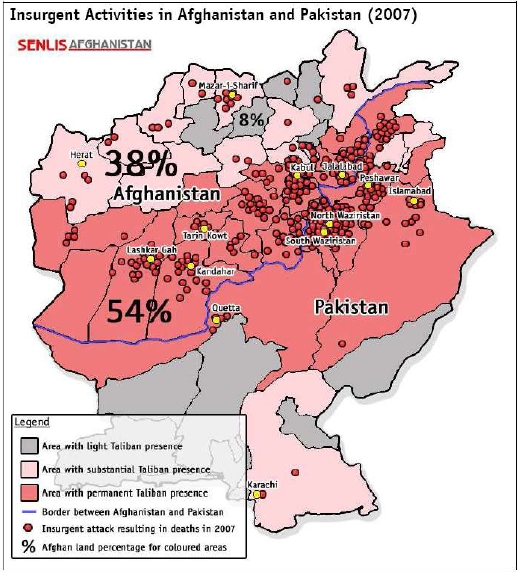
If we wish for an opportunity to kill the enemy, we have no clearer picture of that opportunity than in Afghanistan. Complaints that the Taliban have safe haven in Pakistan are less than compelling if the U.S. doesn’t employ the necessary force projection in Afghanistan first.  But given the necessity of ingress through Pakistan to Afghanistan along with the degrading security situation in the port city of entry – Karachi – action is needed sooner rather than later.

Welcome to New Pakistani Readers

17 years, 9 months ago

The Captain’s Journal would like to welcome all of our new Pakistani readers, from (according to Google Analytics) cities such as Faisalabad, Lahore, Ralwapindi, Islamabad, Karachi, and even Peshawar and Quetta. We are truly glad to have you visiting, even if we don’t see eye to eye on the solution to the problems of FATA and NWFP, al Qaeda, Mullah Omar, and Baitullah Mehsud and the evil empire of the Tehrik-i-Taliban.

Since we are crossing cultural barriers, it might be nice to introduce something of American culture – while also wisely combining it with the Friday night music feature we provide to unwind a bit from the week. Or perhaps you are associated with the Tehrik-i-Taliban, in which case you shouldn’t listen to this music lest your brethren cut off your ears and punish you with lashes (we’ve noted how you have burned CDs and threatened store owners). In either case, you’ve been warned.

One nursery rhyme little children learn is Mary Had a Little Lamb. It’s a curious assortment of words and ideas about a little lamb following children to school and making their day rather enjoyable. Or … we can let Stevie Ray Vaughan tell us the story himself.

Another Disappointing RAND Counterinsurgency Study

17 years, 9 months ago

In RAND Study on Counterinsurgency in Afghanistan we disapproved of the small footprint model for counterinsurgency advocated by Seth G. Jones. Another RAND study has been issued entitled How Terrorists Groups End: Lessons for Countering al Qa’ida, by Seth G. Jones and Martin C. Libicki. The report is available for download, so the reader can study it later (or perhaps has already studied it). But the summary statement reads thusly:

All terrorist groups eventually end. But how do they end? The evidence since 1968 indicates that most groups have ended because (1) they joined the political process (43 percent) or (2) local police and intelligence agencies arrested or killed key members (40 percent). Military force has rarely been the primary reason for the end of terrorist groups, and few groups within this time frame have achieved victory. This has significant implications for dealing with al Qa’ida and suggests fundamentally rethinking post-9/11 U.S. counterterrorism strategy: Policymakers need to understand where to prioritize their efforts with limited resources and attention. The authors report that religious terrorist groups take longer to eliminate than other groups and rarely achieve their objectives. The largest groups achieve their goals more often and last longer than the smallest ones do. Finally, groups from upper-income countries are more likely to be left-wing or nationalist and less likely to have religion as their motivation. The authors conclude that policing and intelligence, rather than military force, should form the backbone of U.S. efforts against al Qa’ida. And U.S. policymakers should end the use of the phrase “war on terrorism” since there is no battlefield solution to defeating al Qa’ida.

This amounts to 83% – according to Jones and Libicki – of terrorists who either joined the political process or were arrested by the police. So then the solution must be non-military, or so Jones and Libicki conclude.

But they fundamentally fail to understand the nature of the enemy, and so it’s not surprising that the study reaches the wrong conclusions. In Why is there Jihad, we linked a recent report by the Combating Terrorism Center at West Point that studied the internet interview of Ayman al-Zawahiri. They noted many interesting things, but one crucial point to understanding their global movement.

Over the past year, Zawahiri and other senior al-Qa’ida figures have been waging a vigorous propaganda campaign against the Palestinian organization HAMAS. Although Jihadists unanimously denounce Israel they continue to disagree over whether HAMAS should be considered a legitimate Islamic movement. For Zawahiri, HAMAS’ embrace of nationalism, democracy, and its legacy in the Muslim Brotherhood—arguably the three things al-Qa’ida hates most—delegitimizes the group.

To which we observed:

Nationalism is evil and out of accord with the global aspirations of al Qaeda. Nation-states are not just not helpful, or even a necessary evil. They are quite literally an obstacle to jihad, not because they share the loyalties of jihadists, but rather, because they fundamentally don’t acquiesce to the vision of world conquest in the name of Islam and the forcible implementation of Sharia law. What we see as a transnational insurgency is to the jihadists simply a world wide struggle. They don’t recognize nation-states as legitimate.

This is the Sunni perspective, but the radical Shi’a perspective is the same. From Michael Ledeen’s The Iranian Time Bomb, Khomeini succinctly states their view:

“We do not worship Iran. We worship Allah. For patriotism is another name for paganism. I say let this land [Iran] burn. I say let this land go up in smoke, provided Islam emerges triumphant in the rest of the world.”

Ledeen summarizes their views: “Without exception, their core beliefs are totally contrary to the notion that they are a traditional nation-state” [page 17]. Baitullah Mehsud has also shown that his perspective is global, contrary to the views of earlier generations of Taliban. Neither al Qaeda nor the Taliban are about to engage in local or even national politics. It violates the stipulations of their faith.

As for the high value target initiative, the U.S. has been engaged in this for six or more years in both Afghanistan and Iraq (and now Pakistan). It has consumed an incredible amount of money, time, resources, intelligence assets, and firepower, but has only moderate results to show for the expenditure.

The security situation in Afghanistan is headed in the wrong direction, while Iraq has been secured. Counterinsurgency requires force projection, a doctrine we have argued for two years. It has worked in Iraq, and will be required in Afghanistan. A few more policing assets in Afghanistan and Pakistan would mean simply a few more policing assets to die at the hands of Taliban and al Qaeda.

The answer is not black or special operations, police, surreptitious behind-the-scenes deals, prison cells, interrogations, incorporation of the enemy into politics, or negotiations. The immediate answer to the problem of an enemy who would kill you is to kill the enemy with fire and maneuver.


26th MEU (10)
Abu Muqawama (12)
ACOG (2)
ACOGs (1)
Afghan National Army (36)
Afghan National Police (17)
Afghanistan (704)
Afghanistan SOFA (4)
Agriculture in COIN (3)
AGW (1)
Air Force (42)
Air Power (10)
al Qaeda (83)
Ali al-Sistani (1)
America (23)
Ammunition (305)
Animals (328)
Ansar al Sunna (15)
Anthropology (3)
Antonin Scalia (1)
AR-15s (395)
Arghandab River Valley (1)
Arlington Cemetery (2)
Army (91)
Assassinations (2)
Assault Weapon Ban (29)
Australian Army (7)
Azerbaijan (4)
Backpacking (4)
Badr Organization (8)
Baitullah Mehsud (21)
Basra (17)
BATFE (247)
Battle of Bari Alai (2)
Battle of Wanat (18)
Battle Space Weight (3)
Bin Laden (7)
Blogroll (3)
Blogs (24)
Body Armor (23)
Books (3)
Border War (18)
Brady Campaign (1)
Britain (39)
British Army (36)
Camping (5)
Canada (20)
Castle Doctrine (1)
Caucasus (6)
CENTCOM (7)
Center For a New American Security (8)
Charity (3)
China (19)
Christmas (18)
CIA (30)
Civilian National Security Force (3)
Col. Gian Gentile (9)
Combat Outposts (3)
Combat Video (2)
Concerned Citizens (6)
Constabulary Actions (3)
Coolness Factor (3)
COP Keating (4)
Corruption in COIN (4)
Council on Foreign Relations (1)
Counterinsurgency (218)
DADT (2)
David Rohde (1)
Defense Contractors (2)
Department of Defense (220)
Department of Homeland Security (26)
Disaster Preparedness (5)
Distributed Operations (5)
Dogs (15)
Donald Trump (27)
Drone Campaign (4)
EFV (3)
Egypt (12)
El Salvador (1)
Embassy Security (1)
Enemy Spotters (1)
Expeditionary Warfare (18)
F-22 (2)
F-35 (1)
Fallujah (17)
Far East (3)
Fathers and Sons (2)
Favorite (1)
Fazlullah (3)
FBI (39)
Featured (192)
Federal Firearms Laws (18)
Financing the Taliban (2)
Firearms (1,873)
Football (1)
Force Projection (35)
Force Protection (4)
Force Transformation (1)
Foreign Policy (27)
Fukushima Reactor Accident (6)
Ganjgal (1)
Garmsir (1)
general (15)
General Amos (1)
General James Mattis (1)
General McChrystal (44)
General McKiernan (6)
General Rodriguez (3)
General Suleimani (9)
Georgia (19)
GITMO (2)
Google (1)
Gulbuddin Hekmatyar (1)
Gun Control (1,724)
Guns (2,412)
Guns In National Parks (3)
Haditha Roundup (10)
Haiti (2)
HAMAS (7)
Haqqani Network (9)
Hate Mail (8)
Hekmatyar (1)
Heroism (5)
Hezbollah (12)
High Capacity Magazines (16)
High Value Targets (9)
Homecoming (1)
Homeland Security (3)
Horses (2)
Humor (72)
Hunting (62)
ICOS (1)
IEDs (7)
Immigration (123)
India (10)
Infantry (4)
Information Warfare (4)
Infrastructure (4)
Intelligence (23)
Intelligence Bulletin (6)
Iran (171)
Iraq (379)
Iraq SOFA (23)
Islamic Facism (64)
Islamists (98)
Israel (19)
Jaish al Mahdi (21)
Jalalabad (1)
Japan (3)
Jihadists (82)
John Nagl (5)
Joint Intelligence Centers (1)
JRTN (1)
Kabul (1)
Kajaki Dam (1)
Kamdesh (9)
Kandahar (12)
Karachi (7)
Kashmir (2)
Khost Province (1)
Khyber (11)
Knife Blogging (7)
Korea (4)
Korengal Valley (3)
Kunar Province (20)
Kurdistan (3)
Language in COIN (5)
Language in Statecraft (1)
Language Interpreters (2)
Lashkar-e-Taiba (2)
Law Enforcement (6)
Lawfare (14)
Leadership (6)
Lebanon (6)
Leon Panetta (2)
Let Them Fight (2)
Libya (14)
Lines of Effort (3)
Littoral Combat (8)
Logistics (50)
Long Guns (1)
Lt. Col. Allen West (2)
Marine Corps (281)
Marines in Bakwa (1)
Marines in Helmand (67)
Marjah (4)
MEDEVAC (2)
Media (68)
Medical (146)
Memorial Day (6)
Mexican Cartels (47)
Mexico (71)
Michael Yon (6)
Micromanaging the Military (7)
Middle East (1)
Military Blogging (26)
Military Contractors (5)
Military Equipment (25)
Militia (9)
Mitt Romney (3)
Monetary Policy (1)
Moqtada al Sadr (2)
Mosul (4)
Mountains (25)
MRAPs (1)
Mullah Baradar (1)
Mullah Fazlullah (1)
Mullah Omar (3)
Musa Qala (4)
Music (25)
Muslim Brotherhood (6)
Nation Building (2)
National Internet IDs (1)
National Rifle Association (97)
NATO (15)
Navy (31)
Navy Corpsman (1)
NCOs (3)
News (1)
NGOs (3)
Nicholas Schmidle (2)
Now Zad (19)
NSA (3)
NSA James L. Jones (6)
Nuclear (63)
Nuristan (8)
Obama Administration (222)
Offshore Balancing (1)
Operation Alljah (7)
Operation Khanjar (14)
Ossetia (7)
Pakistan (165)
Paktya Province (1)
Palestine (5)
Patriotism (7)
Patrolling (1)
Pech River Valley (11)
Personal (77)
Petraeus (14)
Pictures (1)
Piracy (13)
Pistol (4)
Pizzagate (21)
Police (672)
Police in COIN (3)
Policy (15)
Politics (999)
Poppy (2)
PPEs (1)
Prisons in Counterinsurgency (12)
Project Gunrunner (20)
PRTs (1)
Qatar (1)
Quadrennial Defense Review (2)
Quds Force (13)
Quetta Shura (1)
RAND (3)
Recommended Reading (14)
Refueling Tanker (1)
Religion (501)
Religion and Insurgency (19)
Reuters (1)
Rick Perry (4)
Rifles (1)
Roads (4)
Rolling Stone (1)
Ron Paul (1)
ROTC (1)
Rules of Engagement (76)
Rumsfeld (1)
Russia (37)
Sabbatical (1)
Sangin (1)
Saqlawiyah (1)
Satellite Patrols (2)
Saudi Arabia (4)
Scenes from Iraq (1)
Second Amendment (713)
Second Amendment Quick Hits (2)
Secretary Gates (9)
Sharia Law (3)
Shura Ittehad-ul-Mujahiden (1)
SIIC (2)
Sirajuddin Haqqani (1)
Small Wars (72)
Snipers (9)
Sniveling Lackeys (2)
Soft Power (4)
Somalia (8)
Sons of Afghanistan (1)
Sons of Iraq (2)
Special Forces (28)
Squad Rushes (1)
State Department (23)
Statistics (1)
Sunni Insurgency (10)
Support to Infantry Ratio (1)
Supreme Court (82)
Survival (216)
SWAT Raids (58)
Syria (38)
Tactical Drills (38)
Tactical Gear (17)
Taliban (168)
Taliban Massing of Forces (4)
Tarmiyah (1)
TBI (1)
Technology (21)
Tehrik-i-Taliban (78)
Terrain in Combat (1)
Terrorism (96)
Thanksgiving (13)
The Anbar Narrative (23)
The Art of War (5)
The Fallen (1)
The Long War (20)
The Surge (3)
The Wounded (13)
Thomas Barnett (1)
Transnational Insurgencies (5)
Tribes (5)
TSA (25)
TSA Ineptitude (14)
TTPs (4)
U.S. Border Patrol (8)
U.S. Border Security (22)
U.S. Sovereignty (29)
UAVs (2)
UBL (4)
Ukraine (10)
Uncategorized (105)
Universal Background Check (3)
Unrestricted Warfare (4)
USS Iwo Jima (2)
USS San Antonio (1)
Uzbekistan (1)
V-22 Osprey (4)
Veterans (3)
Vietnam (1)
War & Warfare (435)
War & Warfare (41)
War Movies (4)
War Reporting (21)
Wardak Province (1)
Warriors (6)
Waziristan (1)
Weapons and Tactics (80)
West Point (1)
Winter Operations (1)
Women in Combat (21)
WTF? (1)
Yemen (1)

May 2026
April 2026
March 2026
February 2026
January 2026
December 2025
November 2025
October 2025
September 2025
August 2025
July 2025
June 2025
May 2025
April 2025
March 2025
February 2025
January 2025
December 2024
November 2024
October 2024
September 2024
August 2024
July 2024
June 2024
May 2024
April 2024
March 2024
February 2024
January 2024
December 2023
November 2023
October 2023
September 2023
August 2023
July 2023
June 2023
May 2023
April 2023
March 2023
February 2023
January 2023
December 2022
November 2022
October 2022
September 2022
August 2022
July 2022
June 2022
May 2022
April 2022
March 2022
February 2022
January 2022
December 2021
November 2021
October 2021
September 2021
August 2021
July 2021
June 2021
May 2021
April 2021
March 2021
February 2021
January 2021
December 2020
November 2020
October 2020
September 2020
August 2020
July 2020
June 2020
May 2020
April 2020
March 2020
February 2020
January 2020
December 2019
November 2019
October 2019
September 2019
August 2019
July 2019
June 2019
May 2019
April 2019
March 2019
February 2019
January 2019
December 2018
November 2018
October 2018
September 2018
August 2018
July 2018
June 2018
May 2018
April 2018
March 2018
February 2018
January 2018
December 2017
November 2017
October 2017
September 2017
August 2017
July 2017
June 2017
May 2017
April 2017
March 2017
February 2017
January 2017
December 2016
November 2016
October 2016
September 2016
August 2016
July 2016
June 2016
May 2016
April 2016
March 2016
February 2016
January 2016
December 2015
November 2015
October 2015
September 2015
August 2015
July 2015
June 2015
May 2015
April 2015
March 2015
February 2015
January 2015
December 2014
November 2014
October 2014
September 2014
August 2014
July 2014
June 2014
May 2014
April 2014
March 2014
February 2014
January 2014
December 2013
November 2013
October 2013
September 2013
August 2013
July 2013
June 2013
May 2013
April 2013
March 2013
February 2013
January 2013
December 2012
November 2012
October 2012
September 2012
August 2012
July 2012
June 2012
May 2012
April 2012
March 2012
February 2012
January 2012
December 2011
November 2011
October 2011
September 2011
August 2011
July 2011
June 2011
May 2011
April 2011
March 2011
February 2011
January 2011
December 2010
November 2010
October 2010
September 2010
August 2010
July 2010
June 2010
May 2010
April 2010
March 2010
February 2010
January 2010
December 2009
November 2009
October 2009
September 2009
August 2009
July 2009
June 2009
May 2009
April 2009
March 2009
February 2009
January 2009
December 2008
November 2008
October 2008
September 2008
August 2008
July 2008
June 2008
May 2008
April 2008
March 2008
February 2008
January 2008
December 2007
November 2007
October 2007
September 2007
August 2007
July 2007
June 2007
May 2007
April 2007
March 2007
February 2007
January 2007
December 2006
November 2006
October 2006
September 2006
August 2006
July 2006
June 2006
May 2006

about · archives · contact · register

Copyright © 2006-2026 Captain's Journal. All rights reserved.