New York Court Holds Stun Gun Ban is Not Unconstitutional, in Contravention of Caetano

Herschel Smith · 30 Mar 2025 · 2 Comments

Dean Weingarten has a good find at Ammoland. Judge Eduardo Ramos, the U.S. District Judge for the Southern District of New York,  has issued an Opinion & Order that a ban on stun guns is constitutional. A New York State law prohibits the private possession of stun guns and tasers; a New York City law prohibits the possession and selling of stun guns. Judge Ramos has ruled these laws do not infringe on rights protected by the Second Amendment of the United States Constitution. Let's briefly…… [read more]

Musharraf Chides U.S. for Lack of Force

BY Herschel Smith
18 years, 6 months ago

President Pervez Musharraf recently discussed the relationship between U.S. and Pakistani military forces.

Pakistan’s president said Friday U.S. troops cannot do a better job than his forces in routing the Taliban and al-Qaida, and the United States should increase its presence in Afghanistan instead to deal with the growing insurgency there.

Pervez Musharraf reiterated that Pakistan opposes any foreign forces on its soil and said “the man in the street will not allow this — he will come out and agitate.”

Musharraf was responding to a question about reports that the U.S. government was considering far more aggressive covert operations in Pakistan along the border with Afghanistan, and Defense Secretary Robert Gates’ offer Thursday to send a small number of combat troops to Pakistan to help fight the insurgency there if Pakistani authorities ask for help.

“This cannot be done by any U.S. force,” Musharraf told several hundred VIPs at a breakfast on the sidelines of the World Economic Forum. “Please don’t think that the U.S. forces have some kind of a magic wand and they’ll come and lead to success.”

“This environment is worse than what they’re facing in Afghanistan. The mountains are higher, and there is no communications infrastructure,” he said.

Musharraf said President Bush told him he respects Pakistan’s sovereignty and “is not asking me, and he’s the most important.”

He stressed that there is “total” U.S.-Pakistani cooperation on military tactics and strategy on both sides of the border, and “good coordination” on intelligence.

“They wouldn’t be able to achieve anything that we haven’t been able to achieve, so let them handle Afghanistan,” Musharraf said. “They need more force there, by the way. So therefore, please add force there before you think of sending them across into our borders,” he said.

Musharraf is chiding the U.S. strategy for lack of force projection, something we have discussed here before for Afghanistan and also for the Iraq counterinsurgency campaign (focusing also on the Anbar Province as its strategy relates to Pakistan).  But this is a pitiful instance of the pot calling the kettle black.  At the moment, Musharraf’s army has sent 600 troops against Baitullah Mehsud’s forces in the tribal region, less than a battalion.

But Pakistan has suffered “more than 50 suicide bombings in the past 12 months, killing at least 800 people.”  She is in the middle of a full blown insurgency, this insurgency affecting the U.S. as well since the Taliban and al Qaeda have safe haven inside Pakistan to regroup after attacks and terrorist operations in Afghanistan.  Furthermore, supplies intended for use by NATO are being attacked inside Pakistan with Mehsud’s well-crafted network of roadway interdiction.  Force projection is needed by the U.S. in Afghanistan, but Musharraf has no room to chide the U.S.  The Pakistani army should practice what Musharraf preaches.

Prior: Taliban Campaigns in Afghanistan and Pakistan

Taliban Campaigns in Afghanistan and Pakistan

BY Herschel Smith
18 years, 6 months ago

Background

With over 3000 Marines headed for Afghanistan in the coming months to help with spring counterinsurgency operations, The Asia Times gives us a glimpse inside the Taliban leadership.

With the Taliban’s spring offensive just months away, the Afghan front has been quiet as Taliban and al-Qaeda militants have been heavily engaged in fighting security forces in Pakistan’s tribal regions.

But now Taliban leader Mullah Omar has put his foot down and reset the goals for the Taliban: their primary task is the struggle in Afghanistan, not against the Pakistan state.

Mullah Omar has sacked his own appointed leader of the Pakistani Taliban, Baitullah Mehsud, the main architect of the fight against Pakistani security forces, and urged all Taliban commanders to turn their venom against North Atlantic Treaty Organization (NATO) forces, highly placed contacts in the Taliban told Asia Times Online. Mullah Omar then appointed Moulvi Faqir Mohammed (a commander from Bajaur Agency) but he refused the job. In the past few days, the Pakistani Taliban have held several meetings but have not yet appointed a replacement to Mehsud.

This major development occurred at a time when Pakistan was reaching out with an olive branch to the Pakistani Taliban. Main commanders, including Hafiz Gul Bahadur and the main Afghan Taliban based in Pakistan, Sirajuddin Haqqani, signed peace agreements. But al-Qaeda elements, including Tahir Yuldashev, chief of the Islamic Movement of Uzbekistan, undermined this initiative.

“We refused any peace agreement with the Pakistani security forces and urged the mujahideen fight for complete victory,” Yuldashev said in a jihadi video message seen by Asia Times Online. Yuldashev’s closest aide and disciple, Mehsud, last week carried out an attack on a Pakistani security post and then seized two forts in the South Waziristan tribal area.

As a result, Pakistan bombed South Waziristan and sent in heavy artillery and tanks for a major operation against Mehsud. Other important commanders are now in North Waziristan and they support the peace agreements with the Pakistani security forces.

Pakistan’s strategic quarters maintain the planned operation in South Waziristan is aimed particularly at eliminating Mehsud.

“While talking to government representatives in the jirga [peace council] we could clearly discern a grudge against Baitullah Mehsud and the Mehsud tribes by the security forces. And there are signs that the government is obsessed with a military operation to make Baitullah Mehsud a martyr,” a leading member of the peace jirga in South Waziristan, Maulana Hisamuddin, commented to Voice of America.

Mehsud came into the spotlight after Taliban commander Nek Mohammed was killed in a missile attack in South Waziristan in mid-2004. Nek was from the Wazir tribe, which is considered a rival tribe of the Mehsud. Haji Omar, another Wazir, replaced Nek, but support from Yuldashev and Uzbek militants strengthened Mehsud’s position. He rose through the ranks of the Taliban after becoming acquainted with Mullah Dadullah (killed by US-led forces in May 2007) and Mehsud supplied Dadullah with many suicide bombers.

Dadullah’s patronage attracted many Pakistani jihadis into Mehsud’s fold and by 2007 he was reckoned as the biggest Taliban commander in Pakistan – according to one estimate he alone had over 20,000 fighters.

The link to Dadullah also brought the approval of Mullah Omar, and when the Taliban leader last year revived the “Islamic Emirates” in the tribal areas, Mehsud was appointed as his representative, that is, the chief of the Pakistani Taliban.

Mehsud was expected to provide valuable support to the Taliban in Afghanistan, but instead he directed all his fighters against Pakistani security forces.

With Mehsud now replaced, Mullah Omar will use all Taliban assets in the tribal areas for the struggle in Afghanistan. This leaves Mehsud and his loyalists completely isolated to fight against Pakistani forces.

According to Taliban quarters in Afghanistan that Asia Times Online spoke to recently, the Taliban have well-established pockets around Logar, Wardak and Ghazni, which are all gateways to the capital Kabul.

Many important districts in the southwestern provinces, including Zabul, Helmand, Urzgan and Kandahar, are also under the control of the Taliban. Similarly, districts in the northwestern, including Nimroz, Farah and Ghor, have fallen to the Taliban.

Certainly, the Taliban will be keen to advance from these positions, but they will also concentrate on destroying NATO’s supply lines from Pakistan into Afghanistan. The Taliban launched their first attack in Pakistan’s southwestern Balochistan province on Monday, destroying a convoy of oil tankers destined for NATO’s Kandahar air field.

“If NATO’s supply lines are shut down from Pakistan, NATO will sweat in Afghanistan,” a member of a leading humanitarian organization in Kabul told Asia Times Online on condition of anonymity. “The only substitute would be air operations, but then NATO costs would sky-rocket.”

Discussion and Commentary

This description points to fractures within the Taliban organization.  But rather than simply sacking Mehsud and replacing him with someone loyal to Mullah Omar, it is more likely that the Taliban will continue in two different factions, with Mullah Omar leading the faction associated primarily with Afghanistan, while Mehsud continues to lead his fighters in an insurgency within Pakistan proper.  Mehsud is a powerful man and has been blamed for the assassination of Benazir Bhutto.  He is careful and evasive; “he travels in a convoy of pickups protected by two dozen heavily armed guards, he rarely sleeps in the same bed twice in a row, and his face has never been photographed.”   Assassination of Bhutto is part of a larger plan.

Baitullah and his allies have even grander plans, the Afghan source says. Her assassination is only part of Zawahiri’s long-nurtured plan to destabilize Pakistan and Musharraf’s regime, wage war in Afghanistan, and then destroy democracy in other Islamic countries such as Turkey and Indonesia.

Baitullah’s alleged emergence as the triggerman in this grand scheme illustrates the mutability of the jihadist enemy since 9/11. As recently as June 2004, Iraq was said to be Al Qaeda’s main battleground, and Abu Mussab al-Zarqawi was the terror chieftain whom US authorities worried about most. Baitullah was then a largely unknown subcommander in South Waziristan. But that same month, a US Hellfire missile fired from a Predator drone killed Nek Mohammad, the young, dashing and publicity-hungry tribal leader in Waziristan.

Al Qaeda and tribal militants promoted the young Baitullah to a command position … Since then, Zarqawi has been killed by US forces, Iraq has receded as a haven for Al Qaeda, and Baitullah has come into his own as a terrorist leader in newly unstable Pakistan. Last month a council of militant leaders from the tribal agencies and neighboring areas named Baitullah the head of the newly formed Taliban Movement in Pakistan, a loose alliance of jihadist organizations in the tribal agencies.

Taliban sources who would speak only on condition of anonymity describe Baitullah as a key middleman in the jihadist network: his tribesmen provide security for Al Qaeda’s rough-hewn training compounds in the tribal area as well as foot soldiers for Qaeda-designed attacks. With a long tradition as smugglers, the tribals (most of whom, like Baitullah, take Mehsud as their surname) run an extensive nationwide trucking and transport network that reaches from the borderlands into teeming cities like Karachi, allowing Baitullah to easily move men and weapons throughout Pakistan.

Baitullah has clearly outsmarted the unpopular Musharraf, whom President George W. Bush praised again last week as an “ally” who “understands clearly the risks of dealing with extremists and terrorists.” In February 2005, with his military getting bloodied in the tribal areas, the Pakistani president decided to strike a peace deal with Baitullah and other militant leaders and their frontmen.

Under the terms of the deal the militants agreed not to provide assistance or shelter to foreign fighters, not to attack government forces, and not to support the Taliban or launch cross-border operations into Afghanistan. As part of the deal, Baitullah coaxed the government into giving him and the other leaders $540,000 that they supposedly owed to Al Qaeda.

The large cash infusion bolstered the jihadist forces, and under cover of the ceasefire Baitullah’s territory became an even more secure safe haven. He and other militant leaders have assassinated some 200 tribal elders who dared to oppose them. The Pakistani government struck a similar peace agreement with militants in North Waziristan in September 2006, transforming much of that tribal area into a militant camp as well …

In his few statements to the press, Baitullah has made his agenda frighteningly clear. He vowed, in a January 2007 interview, to continue waging a jihad against “the infidel forces of American and Britain,” and to “continue our struggle until foreign troops are thrown out” of neighboring Afghanistan.

From these accounts it is clear that both Mullah Omar and Baitullah Mehsud will likely continue operations, even if Omar intends to focus on Afghanistan and Mehsud intends to carry out operations first in Pakistan.  Even if there are fractures at the top levels of the organization, the loyalty of the fighters to the cause will supersede and overcome personality differences.  The fight, they say, will continue unabated, having temporarily subsided in the winter.  This emphasis is a necessary product of the extremism within the current generation of Taliban.  The New York Times recently discussed the relationship of a long-time, elderly religious extremist in Pakistan to the current generation of extremists.

“The religious forces are very divided right now,” I was told by Abdul Hakim Akbari, a childhood friend of Rehman’s and lifelong member of the J.U.I. (Jamiat Ulema-e-Islam) I met Akbari in Dera Ismail Khan, Rehman’s hometown, which is situated in the North-West Frontier Province. According to this past summer’s U.S. National Intelligence Estimate, approved by all 16 official intelligence agencies, Al Qaeda has regrouped in the Tribal Areas adjoining the province and may be planning an attack on the American homeland. “Everyone is afraid,” Akbari told me. “These mujahedeen don’t respect anyone anymore. They don’t even listen to each other. Maulana Fazlur Rehman is a moderate. He wants dialogue. But the Taliban see him as a hurdle to their ambitions. ”

Rehman doesn’t pretend to be a liberal; he wants to see Pakistan become a truly Islamic state. But the moral vigilantism and the proliferation of Taliban-inspired militias along the border with Afghanistan is not how he saw it happening. The emergence of Taliban-inspired groups in Pakistan has placed immense strain on the country’s Islamist community, a strain that may only increase with the assassination of Bhutto. As the rocket attack on Rehman’s house illustrates, the militant jihadis have even lashed out against the same Islamist parties who have coddled them in the past … For now, it is Islamist violence that seems to have the political upper hand rather than the accommodation of Islamist currents within a democratic society …

The jihadist websites haven’t given up on Afghanistan, with Jihad Unspun claiming that “The Taliban have already made it clear that despite the US troop increase in Afghanistan and the new equipment they may be using, it will not deter the increasing number of their attacks. As the harsh Afghan winter retires and the annual spring offensive gets underway, the Taliban are poised for the most aggressive fighting yet.”

But U.S. command in Afghanistan is conveying a far different message than either the Pentagon (which is deploying Marines to deal with the spring offensive) or the Taliban themselves.  Army Major General David Rodriguez has flatly stated that NATO won’t have to fight Taliban this spring.

The Taliban insurgency in Afghanistan is unlikely to stage a spring offensive in the volatile eastern region bordering Pakistan, the commander of U.S. forces in that area said Wednesday.

Army Maj. Gen. David Rodriguez told a Pentagon news conference that Taliban and al-Qaida fighters operating from havens in the largely ungoverned tribal areas of western Pakistan appear to have shifted their focus toward targets inside Pakistan rather than across the border in Afghanistan.

“I don’t think there’ll be a big spring offensive this year,” Rodriguez said.

That is partly due to ordinary Afghans’ disillusionment with the Taliban movement, he said, and partly because the Taliban and al-Qaida fighters see new opportunities to accelerate instability inside Pakistan. He also said Afghan security forces are becoming more effective partners with U.S. forces.

The Taliban has generally staged stepped-up offensives each spring, when the weather is more favorable for ground movement, although an anticipated offensive last spring did not materialize.

U.S. officials have said in recent days that they do expect a spring offensive in the southern area of Afghanistan, a traditional Taliban stronghold where fighting is most intense. That is one reason why Defense Secretary Robert Gates last week approved the deployment of an additional 2,200 Marines to the southern sector where NATO forces are in command.

Unstated in this account is that the Taliban didn’t need to stage a spring offensive in 2007 because they have transitioned to insurgency and terrorist tactics rather than more conventional kinetic engagements with U.S. forces.  According to the Afghanistan NGO Security Office, the counterinsurgency campaign in Afghanistan is “just beginning.”  They further state that “We totally disagree with those who assert that the spring offensive did not happen and would instead argue that a four-fold increase in armed opposition group initiated attacks between February to July constitutes a very clear-cut offensive.”

It isn’t clear why Rodriguez is singing the praises of the campaign in Afghanistan when the recent battle for Musa Qala failed to provide proof of principle for the British strategy of trying to negotiate with the Taliban, and there are shattered illusions of peace in Kabul after the recent bombing of the Serena hotel.  “The Taliban are following a new strategy, their spokesman announced. They will go after civilians specifically, and will bring their mayhem to places where foreigners congregate.”

But what is clear is that the Taliban have safe haven in the tribal area of Pakistan, and the recent launch of a Pakistani offensive against them with approximately 600 troops – less than a Battalion sized force – will be met with stiff resistance from Mehsud, who has warned them to stay away.  Mehsud himself will avoid capture, and whether the Taliban launch a spring “offensive,” they will certainly continue the insurgency within both Pakistan and Afghanistan until the U.S. employs significant force projection.

The Role of Electricity in State Stabilization

BY Herschel Smith
18 years, 6 months ago

Not too many months ago, one of al Qaeda’s tactics to create chaos in Iraq was to attack the infrastructure (e.g., water supplies and the electricity grid).  With the retreat of al Qaeda from Anbar and the constant combat they sustain in the North, there are fewer oppotunities for them to attack the grid, and power is being consumed at higher rates in the large urban areas, while outlier cities are starved.

Residents in the battered city receive just a couple of hours of mains power a day, and in the depths of winter US soldiers are facing a whole new array of challenges, said Captain Dan Gaskell.

Violence in Ramadi, provincial capital of Anbar Province about 100 kilometers west of Baghdad, has fallen significantly over the past year after local tribal leaders turned against Al-Qaeda and formed a tribal front to pursue the militants.

Attacks have dropped from 25-30 every day to less than one a week, and the numbers of roadside bombs have declined by 90 percent, according to US military figures.

“We are dealing with a new dynamic now,” said Gaskell, company commander at the Ma’Laab Joint Security Station (JSS) in West Ramadi, one of about 30 such bases now operating in the city.

But Ramadi’s 400,000 residents, almost exclusively Sunnite, are getting far less electricity than they were in the summer.

“Mains electricity is between one and three hours a day,” said Gaskell, explaining that Ramadi has suffered as Baghdad’s needs have increased.

“The power is coming from the Haditha [hydroelectric] dam. Baghdad and Fallouja take their power before it comes out here, so it gets degraded and degraded.”

Six months ago Ramadi got eight to 15 hours of electricity a day, but improvements in Baghdad’s infrastructure mean the capital is now drawing far more power.

Plans are being drawn up for a new power line to be built from Fallouja directly to the Ramadi area.
“There is no real power coming into the city,” said Gaskell. “But the central government is doing all the upgrade work so when they do turn on the switch, the city will be fully operational.”

Kerosene, used for portable heaters, has also been a major concern this winter, with corruption and theft undermining supply.

“The distribution has been on an old ration card system but it works at our local level,” said Gaskell. “The problem we have is with missing kerosene higher up the chain: a truck driver shows up and 3,000 liters are missing.”

Nothing could be worse for the perception of fairness and stability than official overuse of resources by one segment of the population.  Civil strife and unrest will eventually result from this inequity.  Institutionalized corruption cannot be rooted out overnight, but the planning for electrical generation, transmission and distribution assets should have been in the works more than two years ago.  Transmission of power from the Haditha dam to Baghdad and then back again to Falujah and then to Ramadi is a huge loss of voltage and ridiculous transmission plan.  The Army Corps of Engineers should be all over this.  State stabilization hangs in the balance, and this shows yet again that counterinsurgency is not just about kinetic operations.

Prior: Targeting the Insurgency Versus Protecting the Infrastructure

**** update **** 

LT Nixon, currently deployed, writes the following comment: “That’s one of the biggest beefs the Iraqis have had. You all-powerful Americans can’t even keep the lights on at my house? It doesn’t help that insurgents are still wreaking havoc on the grid up north. It’s gotten better, but it has a long, long way to go.”

It should be mentioned that there is not only a disparity between what we should do and have done (if we plan ahead, have the right NGO involvement, and fund reconstruction the way we should), but there is also a disparity between what we should do and are seen as capable of doing (which is what Nixon is speaking to).  This is the man on the moon perception problem.

The troubles of the United States in Iraq have been blamed on many causes: too few troops, wrong strategies, flawed intelligence, a very stubborn commander-in-chief.

The Man on the Moon rarely rates a public mention.

But the Man on the Moon looms so large in relations between the U.S. and 28 million Iraqis that every U.S. field commander knows his job would be easier if no American had ever set foot on the moon.

The Man on the Moon even gets a specific mention in the counterinsurgency manual the U.S. Army and the Marine Corps adopted last December. It is now taught at every U.S. military college and has the following passage:

“U.S. forces start with a built-in challenge because of their reputation for accomplishment, what some call ‘the man on the moon syndrome.’ This refers to the expressed disbelief that a nation able to put a man on the moon cannot quickly restore basic services.

“In some cultures, failure to deliver promised results is automatically interpreted as deliberate deception rather than good intentions gone awry.”

The “expressed disbelief” is voiced in such questions in Iraq as “how come the Americans could send a man on the moon but can’t bring us power. Or water. Or jobs. Or security.

So reconstruction efforts have as obstacles not only institutionalized corruption, lack of funding, lack of proper NGO support, and insurgent activity, but perception as well.

The Few, the Proud!

BY Herschel Smith
18 years, 6 months ago

The United States Marines have launched video that captures the spirit of the nation and the heart, commitment, bravery and courage of those who have earned the distinctive right to call themselves the greatest warriors on earth: The United States Marines.

It is very Americana in its feel, and it reminds the viewer of not only what a great country God has bestowed on us, but also of the great men who sacrifice to keep it safe.  This ‘footage’ is worthy of the Corps.  The Captain’s Journal approves.

You can read the announcement of the Corps (Our Marines Blog) when they launched this commercial spot, and then their followup discussion called the Rest of the Story.

Now enjoy the Marine Corps band as they play Aaron Copland’s Fanfare for the Common Man.  He composed it for four French Horns, three Trumpets, three Trombones, Tuba, Timpani, Bass Drum, and Gong.

Marine Corps Band: Fanfare for the Common Man.

Major General Benjamin Mixon Reports on Counterinsurgency

BY Herschel Smith
18 years, 6 months ago

Major General Benjamin Mixon recently reported on counterinsurgency in the Northern Province of Diyala to Fort Leavenworth officers.

Iraqis could be chiefly in control of the security in the north of their country within a year, says the general recently returned from commanding forces there.

Army Maj. Gen. Benjamin Mixon told officers at Fort Leavenworth last week that he expected Iraqi security forces to take the lead in day-to-day patrols in the northern provinces within 12 to 18 months if U.S. commanders continue to build up the capabilities of the Iraqis and the population’s confidence in them.

The first province transferred to Iraqi security was Muthanna in July 2006, followed by Dhi Qar, An Najaf, Maysan, part of Irbil, Sulaymaniyah, Dahuk, Karbala and Basra. The general thinks Diyala, Salah ad Din, Ninawa, Al Tameen provinces and the rest of Irbil could see Iraqis assuming the lead in security in little over a year.

Mixon said gains in the north came ahead of last year’s U.S. troop surge and before the rewriting of American doctrine for fighting the insurgency.

As early as November 2006, he said, his troops were setting up smaller remote bases more in touch with the lives of ordinary Iraqis and courting tribal sheikhs and provincial officials.

“I don’t know what’s new about counterinsurgency,” Mixon said.

That runs counter to enthusiasm generated among officers by a new and much-lauded counterinsurgency manual published in 2006 under the direction of Gen. David Petraeus when he was the commander at Leavenworth. It was the first revision of U.S. counterinsurgency doctrine in decades, and was notable for the way it valued collaboration with a civilian population and de-emphasized the use of brute military power.

The adoption of the manual was followed quickly by President Bush sending a surge of 30,000 troops into Iraq and putting Petraeus in charge of troops in the country.

“It’s a myth that all of a sudden we published the manual, then all of a sudden we got counterinsurgency,” Mixon told a handful of officers from Leavenworth’s counterinsurgency center.

Urban warfare studies at Fort Polk, La., for years have underscored the importance of winning the support of civilians in an occupied country through negotiation, he said. The military has long urged understanding local culture and improving people’s living conditions.

When Mixon was the top commander in northern Iraq for a 15-month stretch that ended late last year, troops worked to secure the region’s bountiful oil fields — although the general said exports could still be stifled by a single terrorist explosion — rebuilt schools, and repaired water and power facilities.

The effort included public relations work, from military commanders hosting regular radio call-in shows to arranging the telecasts of widows of suicide bombing victims receiving suitcases full of Iraqi currency in compensation.

“We’re not going to win by killing everybody,” the general said. “You’ve got to kill the right people — the leaders, the bomb makers and the people who just don’t want to give up the fight.

“But you can’t kill everybody. You have to win them over.”

Since the narrative carried forward matters to history for the purposes of training young officers and assisting the population to understand what counterinsurgency requires, and since I have been concerned about the lack of clarity of the Anbar narrative, I began the category The Anbar Narrative.  It is true that the success in Anbar came as a result of hard work prior to the so called “surge,” and that Marines were doing combat outposts (later combined with Iraqi Police Precincts) prior to the command of General Petraeus or the Petraeus / Nagl / Kilcullen doctrine promulgated in FM 3-24.  But The Captain’s Journal isn’t sure what to make of the claims by Major General Mixon regarding the Diyala Province, especially since this report differs at least moderately from previous reports by Mixon.

Maintaining security in Diyala province north of Baghdad will be impossible if U.S. troops are withdrawn from Iraq, according to a U.S. senior ground commander there.

“We obviously cannot maintain that if the forces are withdrawn — and that would be a very, very bad idea, to do a significant withdrawal immediately,” Maj. Gen. Benjamin Mixon, commander of U.S. forces in northern Iraq, told CNN’s Jamie McIntyre on CNN.com Live.

In September, the top U.S. commander in Iraq, Gen. David Petraeus, is to brief Congress on the progress of operations involving the recent increase of U.S. troops in Iraq — a buildup the Bush administration calls a “surge.” The briefing could determine how long the additional troops will stay.

Mixon’s troops are working with Iraqi forces fighting entrenched al Qaeda forces in Baquba and around Diyala province in an operation dubbed “Arrowhead Ripper.”

U.S. troop casualties have been high in the province, according to U.S. commanders, because insurgent forces are using the area as a base and have booby-trapped it with “deeply buried” roadside bombs that have killed entire Humvee crews.

Diyala became the home base for many al Qaeda forces when U.S. troops clamped down on Baghdad in February with increased troop levels, the military says.

Once a model of how the United States was clearing violence from parts of Iraq, Baquba, the capital of Diyala province, has become a ghost town except for the pockets of fighting between coalition and al Qaeda forces.

Mixon said the U.S. military strategy of “clear, hold and retain” was not possible when his troops arrived in Baquba last September because he did not have enough forces.

“I only had enough forces initially when I arrived here last September to clear Baquba. I did that many times, but I was unable to hold it and secure it,” Mixon said.

“Now I have enough force to go in, establish permanent compound outposts throughout the city that will be manned by coalition forces, Iraqi army, and Iraqi police, and maintain a permanent presence.

But all of this has been made possible with the additional forces that have been given to me as a result of the surge,” Mixon said.

This kind of odd inconsistency helps neither the training of young officers trying to learn to lead their units nor the narrative of history.  The longer the time delay before a concerted effort is made to catalog the campaign, the less clear the narrative becomes.  Let’s hope that the battalion, regiment and division historians are busy about their business.

The Role of Force Projection in Counterinsurgency

BY Herschel Smith
18 years, 6 months ago

 Introduction and Background

 Regarding the resurgence of the Taliban, Lt. Gen. David Barno has an interesting perspective on his time in Afghanistan, as well as the evolution of the campaign since.

More than six years after they were toppled in Afghanistan, Taliban forces are resurgent. An average of 400 attacks occurred each month in 2006. That number rose to more than 500 a month in 2007.

“It appears to be a much more capable Taliban, a stronger Taliban than when I was there,” says retired Lt. Gen. David Barno, who was the top commander in Afghanistan from 2003 through 2005. “Just the size of engagements, the casualties reflected in the Taliban [attacks] show a stronger force.”

And Barno says that the United States may have unwittingly contributed to that resurgence beginning in 2005 — first, by announcing it was turning over responsibility for the Afghan military operation to NATO and second, by cutting 2,500 American combat troops. That sent a message to friend and foe alike, Barno says, that the U.S. was moving for the exits.

NATO commands most of the 54,000 soldiers in Afghanistan, nearly half of whom are American. Defense Secretary Robert Gates wanted NATO to send 7,000 more troops.

Appearing before Congress just last month, Gates wasn’t ready to mince words: American troops were stretched in Iraq, and NATO troops were needed in Afghanistan for combat duty and for training Afghan forces.

“I am not willing to let NATO off the hook in Afghanistan at this point,” Gates said.

By last week, Gates was ready to do just that. On his desk was a plan to send several thousand U.S. Marines to Afghanistan for combat and training duty. The proposal made him even more worried about the NATO alliance.

“I am concerned about relieving the pressure on our allies to fulfill their commitments,” Gates said.

But with violence flaring in Afghanistan, Gates had little choice but to turn to the Marines.

Meanwhile, other defense officials complain that NATO is not focused enough on the most important part of winning the insurgency in Afghanistan: Making life better by creating jobs, clinics and roads.

That left Gates in a recent appearance before Congress to question the future of NATO, an alliance created to fight the Soviets.

“The Afghan mission has exposed real limitations in the way the alliance is organized, operated and equipped,” Gates said. “We’re in a post-Cold War environment. We have to be ready to operate in distant locations against insurgencies and terrorist networks.”

Those problems are spurring several Pentagon reviews about the way ahead in Afghanistan. One option being discussed would give the U.S. an even greater combat role in the country’s restive south, now patrolled by Canadian, British and Dutch forces.

At the same time, there is talk of appointing a high-level envoy to better coordinate international aid for Afghanistan. One name being mentioned is Paddy Ashdown, a former member of the British Parliament who held a similar post in Bosnia.

That makes sense to American officers like Col. Martin Schweitzer, who commands the 4th Brigade Combat Team in Khost province in eastern Afghanistan. He says more experts are needed to give Afghans a better life.

“Specifically, we need assistance with agrarian development, natural resource development, like natural gas, etc., because there’s natural gas in the ground here,” Schweitzer said. “And we need those smart folks to come over here and help us get it out, so you can turn it into a product that can help sustain the government and the country.”

A more robust Afghan economy may help cut into Taliban recruitment of a large pool of the unemployed. But Barno and others caution that the Taliban are a regional problem. There’s a steady flow of radicalized recruits pouring over the border from Pakistan.

Analysis and Commentary

This account is pregnant with salient and important observations.  It is supplemented by Barno’s analysis Fighting the Other War: Counterinsurgency Strategy in Afghanistan, 2003-2005.  Only a short quote pertinent to our point will be cited below.

As we switched our focus from the enemy to the people, we did not neglect the operational tenet of main¬taining pressure on the enemy. Selected special operations forces (SOF) continued their full-time hunt for Al-Qaeda’s senior leaders. The blood debt of 9/11 was nowhere more keenly felt every day than in Afghanistan. No Soldier, Sailor, Airman, or Marine serving there ever needed an explanation for his or her presence—they “got it.” Dedicated units worked the Al-Qaeda fight on a 24-hour basis and continued to do so into 2004 and 2005.

In some ways, however, attacking enemy cells became a supporting effort: our primary objective was maintaining popular support. Thus, respect for the Afghan people’s customs, religion, tribal ways, and growing feelings of sovereignty became an inherent aspect of all military operations. As well, the “three-block war” construct became the norm for our conventional forces.  Any given tactical mission would likely include some mixture of kinetics (e.g., fighting insurgents), peacekeeping (e.g., negotiating between rival clans), and humanitarian relief (e.g., digging wells or assessing local needs). 2001-2003 notion of enemy-centric counterterrorist operations now became nested in a wholly different context, that of “war amongst the people,” in the words of British General Sir Rupert Smith.

General Barno poses and answers his objections in these two commentaries.  The debate between “enemy-centric” counterinsurgency and “population-centric” counterinsurgency is old and worn, and highly unnecessary and overblown.  It has never been and is not now an either-or relationship.  It is a both-and relationship, and this truth requires force projection.  Notice what Barno tells us regarding even the intial stages of the campaign in Afghanistan; special operations continued kinetic operations against the Taliban, and the balance of forces launched into the subsequent stages of COIN.  Yet his initial analysis charged that the U.S. contributed to the resurgence of the Taliban by the quick exit and trooper drawdown in Afghanistan.

NGOs can support the effort, but if terrorist activities are perpetrated on the infrastructure, it is to no avail.  Similarly, the Taliban and al Qaeda can be killed or captured, but if they are left unmolested on the other side of the Afghan-Pakistan border, the campaign goes on forever.  Also, if the infrastructure languishes, the insurgent recruiting field expands.

Force projection is not a mere byword.  It is literally the foundation upon which counterinsurgency is built.  The circumstances surrounding commanders in the field (along with political realities at home) convince them to believe that transition to phases can occur before doctrine would suggest, and also convinces them to believe that smaller force size can succeed in what really requires a much larger force size.  In other words, the small footprint model of counterinsurgency is tempting, but wrongheaded and terribly corrupting to a campaign.  Force projection doesn’t just include kinetic operations, although it does includes it.  The notion that killing or capturing the enemy is the sole province of a few special force operators is one key reason for the failure of the campaign in Afghanistan.  Yet apologies for failures to rebuild infrastructure are inappropriate.  We need them both, we needed them then, and we need them now.  This is the way it worked in Anbar, and it it will work in Afghanistan.

The Afghanistan Strategy Debate Continues

BY Herschel Smith
18 years, 6 months ago

Wretchard of the Belmont Club weighs in on the British -American debate over strategy in Afghanistan.  It is a lengthy and involved post, and in order to avoid republishing it here, the reader should follow the link to the full article.  His summary follows:

Robert Gates’ remarks ripped the lid off a simmering disagreement between NATO allies and the US over Afghan strategy. The differences are not simply over troop levels and counterinsurgency competencies but at the level of basic national interest. For some NATO countries there is nothing in Afghanistan worth fighting for at all for except the maintenance of good diplomatic relationships with America and the preservation of the Atlantic Alliance. But that will only go so far; and at any rate America can be counted on to carry the load alone because in contrast, the United States which directly suffered the September 11 attacks, sees a victory in the Afghan/Pakistani theater as a matter of vital interest. Therefore the US will carry on regardless. Even Hillary Clinton and Barack Obama periodically declare their commitment to winning in that theater. The US and the European NATO countries may differ even in their conception of victory. For the US, victory is defined as creating and maintaining friendly governments in both Kabul and Islamabad by defeating al-Qaeda and its allies. For the Europeans it may mean bringing the Taliban to power in exchange for giving up its support of al-Qaeda.

Which side of the debate is correct I leave the reader to decide. But so far as I can tell this is what the debate is about.

The focal point of his analysis is the different conceptions of victory and what these conceptions mean to the methods and strategy by which it is pursued.  His point that the coalition is fractured is correct, and the British are looking for finality sooner than traditional counterinsurgency doctrine allows.  Thus, victory is redefined, i.e., the bar is lowered.  However, because he fails to interact with my own analyses, or at least the line of thought I advocate in this series of posts, his analysis is shortsighted and impoverished.

It is true that there is currently a clamour in Britain to jettison duties in both Iraq and Afghanistan, but this has not always been the case.  Soon after Phase 1 of Operation Iraqi Freedom, the British in Basra had a high time of it, working under the quiet confidence that regarding counterinsurgency, they had a few things to teach the Americans.  They implemented very restrictive rules of engagement, wore soft covers, had minimal force projection, and fished the waters of the Shaat al Arab on their days off.  Before too long under under these conditions, troop movement into and out of the AO was done only at night and via helicopter because travel by day was too dangerous.

The British ended their campaign in Basra by evacuating the city because they believed that their lack of presence in Basra would stop the shooting at their soldiers.  In other words, if they weren’t around to shoot at, they would’nt receive fire.  The AO was turned over to sectarian thieves, thugs and Iranian henchmen, and the Police chief in Basra has sustained seven assassination attempts.

In contrast to this, the Anbar province is pacified, and contrary to the Shi’a militia who drove the British out of Basra, Sheikh Ahmed Abu Reesha has said that the U.S. must stay in Anbar in order to help maintain security.  Force projection won Anbar and created the conditions under which it is safe for the U.S. to garrison forces there, and lack of force projection lost Basra.  Yet the British have not lost their penchant for seeing counterinsurgency through a different lens than the U.S.  The debate began in Basra before any part of the campaigns in Iraq or Afghanistan became problematic and before the British public was searching for a way out.

The debate continues, and the recent deals with the Taliban are a continuing function of the strategy promulgated by the British.  It may be the case that the public pressure to disengage has become more prominent, but the strategy the British are pursuing is not a function of this public pressure.  Only the speed with which they employ the strategy needs to change in order to acquiesce to the public pressure.  The fracture in the coalition is deeper than mere public perception at home.

Prior:

British Versus Americans: The War Over Strategy

Our Deal with Mullah Abdul Salaam

Pakistani Paramilitary Overrun by Taliban at Border Fort

BY Herschel Smith
18 years, 6 months ago

A fort dating back to the British colonial period was recently attacked and overrun by a disputed number of Taliban fighters.  The Christian Science Monitor discusses:

Hundreds of armed militants stormed a border fort overnight Wednesday in Pakistan’s tribal belt, killing at least seven border guards. The militants then abandoned the colonial-era fort on the border in South Waziristan, a lawless zone that US officials say is a launching pad for Taliban and Al Qaeda attacks on Western troops in neighboring Afghanistan.

Islamic militants used explosives to breach the fort where about 40 guards were stationed, according to the Pakistan Army. Most of the guards fled, and others were reported missing after the firefight. The militants left the fort later the same day, melting back into the rugged mountains of northwest Pakistan.

The attack is a setback for Pakistan’s Army the Associated Press reports. Fifteen guards fled to safety at another Army base. Another 20 were listed as missing, but five were later found. The military claimed that 50 militants died in the firefight, a claim denied by a militant spokesman who said two had died in the assault.

The insurgents who seized the Sararogha Fort were said to be followers of Baitullah Mehsud, an Islamic hard-liner. Since December, Mr. Mehsud has been the sole leader of an umbrella group of Taliban sympathizers and is also thought to have links to Al Qaeda.

Musharraf has blamed Mehsud’s movement, Tehrik-e-Taliban, for 19 suicide attacks that killed more than 450 people over the last three months. Mehsud, labeled enemy No. 1 by the government, also masterminded the brazen capture of 213 Pakistani soldiers last August.

The Washington Post said Pakistani authorities have also linked Mehsud to the Dec. 27 assassination of former Prime Minister Benazir Bhutto. Mehsud’s fighters have targeted Pakistani troops in South Waziristan with hit-and-run attacks and suicide bombings as the battle for territory intensifies.

“It really carries a lot [of] significance,” said Fazal Rahim Marwat, a professor at Peshawar University who has studied the Taliban movement in Pakistan. “This is another daring step on the part of the militants, and it seems that they are getting stronger and bolder with the passage of time.”

While an Army spokesman said the number of militants was around 200, the BBC said that local officials and other reports indicate an attack force closer to 1,000. This is the first time that militants have captured a fort in Pakistan and that is unsettling for authorities as they prepare to hold parliamentary elections next month, the BBC said.

The militants took several of the guards hostage and seized weapons and communication equipment from the fort, the Pakistani daily newspaper Dawn reported. The assault began around 9 p.m. Tuesday with rocket and mortar fire and continued during the night, the newspaper reported.

“Soldiers put up a good fight, but couldn’t hold out for long in the face of an overwhelming militant force,” a source said.

The last distress radio message, according to him, was made at around 3 am to the Ludda Fort, asking for artillery fire at the militants who had broken through the defences and begun pouring into the base.

The fort was manned by the Frontiers Corps, an 80,000-strong paramilitary force recruited from local tribesmen. The US military has announced plans to train and equip these forces as part of a strategy to counter militancy in the semiautonomous tribal region, said The Globe and Mail.

Reuters reports that Navy Adm. William Fallon, head of the US Central Command, said Wednesday that he believed Pakistan was ready for greater US counterinsurgency assistance. But he gave no details of that support, which is politically sensitive in Pakistan, where many strongly oppose the deployment of US troops. Admiral Fallon said he was encouraged by his conversations with Pakistan’s new Army chief, Gen. Ashfaz Kayani, who took over in November after President Pervez Musharraf resigned from the post.

“I was very heartened by his understanding of what the problems are and what he’s going to need to do to meet those, so we want to try and help that,” said Fallon, who plans to visit Pakistan later this month.

Wretchard at the Belmont Club observes that the Taliban and al Qaeda are acting like an army of state, and wonders whether the Pakistani military can conduct conventional operations against them.  To be clear, the Taliban are neither a regular army, nor is it to their advantage to behave as one.  Holding the fort that they took is not to their advantage.

So true to form, they abandoned it as soon as they took it.  Holding territory is the behavior of conventional armies.  The Taliban are indigenous, and live in this area.  There is no reason and no strategic value to having a border fort.  The Taliban own this area, and traffic freely across the Afghan border to conduct operations.  But this points to larger problems.  The Pakistani army is a conventional one, and doesn’t behave like it.

Whether considering regular or irregular (counterinsurgency and guerrilla) warfare, force size and force protection are critical elements of doctrine.  The Pakistani military at this border fort effected neither.  The force size was at least equivalent to a platoon, and the notion that a platoon of U.S. Marines would have been routed from this fort is of course preposterous.

I have observed before that the key to Pakistan is Afghanistan and more specifically the border region, and vice versa.  The key to Afghanistan is Pakistan.  The U.S. has a once-in-a-generation opportunity to engage in warfare against radical militants unimpeded, since Pakistan is acting approvingly of a larger role for the U.S.  NATO cannot be relied upon to contribute to the campaign.  Neither does the U.S. owe any debts to cold war thinking.  Not only Iraq, but also the Afghanistan-Pakistan border region beckons all U.S. forces to their mission.  The Marines soon to deploy to Afghanistan from Camp LeJeune are badly needed, and will fulfil their calling.

Urban Warfare Simulator

BY Herschel Smith
18 years, 6 months ago

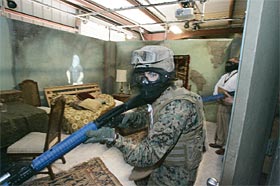
The U.S. Marines have commissioned an Infantry Immersion Trainer system for the purpose of training in MOUT prior to deployment.

infantry_immersion_trainer.jpg

The Marine Corps is embracing breakthrough holographic technology to teach combat tactics and battlefield ethics at Camp Pendleton as troops there begin another major round of deployments to Iraq.

Marine officials yesterday unveiled the Infantry Immersion Trainer, a high-tech prototype simulator that resides in a former – and decidedly low-tech – tomato-packing plant that still bears directions for truck drivers.

Marines trained yesterday in Camp Pendleton’s high-tech prototype simulator, designed to evoke the conditions that U.S. troops face in Iraq.

The 32,000-square-foot, $2.5 million training ground became reality after a request from Gen. James Mattis, former commander of the 1st Marine Expeditionary Force at Camp Pendleton. The program capitalizes on 15 years of Navy and Marine research on everything from body movements to urban warfare, coupled with the latest advancements in simulation from defense companies such as Lockheed Martin.

The new training area is “a pretty big deal . . . that’s expected to save lives,” said Col. Clarke Lethin, chief of staff for the 1st Marine Expeditionary Force.

He added that it also could help guide Marines through the tough process of making split-second battle decisions involving morality and legality.

“As we go through the war, it’s changing out there. There are more no-shoots than shoots,” Lethin said. “We want to make sure that we are shooting the right people.”

It takes its inspiration from a city block in Iraq that U.S. troops typically would patrol, complete with a warren of shops and houses. Hardly a detail is overlooked among the props, modeled with Hollywood set-design techniques: Laundry hangs on the clotheslines. A grill sits against a wall. Propane tanks are placed here and there amid the musky scent of unpaved streets and alleys.

Perched in the rafters are projectors that cast life-size images of civilians and insurgents on wall after wall in the building. Live actors and pyrotechnics round out the integration of sight, sound and smell.

There is an argument to be made that this is two to three years later than needed.  Additionally, the system isn’t perfect.

One of the Marines showing how the troops react in the various scenarios was Lance Cpl. Jason Trehan, a 24-year-old Ohio native who returned from his fourth Iraq assignment in November.

“It’s pretty realistic and a lot like what we do face,” Trehan said. “It could be bigger, though. Bigger is always better,” he said, in reference to the somewhat cramped series of rooms and low ceilings.

Trehan said a higher ceiling that would accommodate rooftops would more accurately depict a typical Iraqi village.

There is always justification for including Lance Corporals in the design review of all training and combat systems.  Lance Corporals are the core of the Corps, but like our friends at OpFor, we are huge fans of General James Mattis, and this brainchild of Mattis will evolve.

Col. Lethin said the Camp Pendleton virtual trainer was in part the brainchild of Gen. James Mattis, who until recently was head of the I Marine Expeditionary Force and commander of Marine Corps Forces Central Command.

Mattis is now working with NATO and as head of the Joint Forces Command based at Norfolk, Va.

“General Mattis said that if we can train a pilot to fly a 747 in a simulator, we owe that same kind of training to our ground forces that are bearing the brunt of the casualties today,” Lethin said.

The local troops now deploying are finding a much more stable and calm environment in the former insurgent stronghold west of Baghdad along the Syrian and Jordanian border, Lethin said. But it remains a dangerous place.

“It’s a lot better today than it was, but there’s still bad guys to be killed,” Lethin said. “The training we now can offer here is good, but I want it to get even better.”

And get better it will.  While no simulator can duplicate the reality of combat, all attempts to train warriors better should be met with appreciation as well as constructive criticism.

Iraq: For Ten Years

BY Herschel Smith
18 years, 7 months ago

I have previously predicted that Iraq would not only be a protectorate of the U.S. for another decade, but pseudo-permanent bases would eventually be constructed and garrisoned in Iraq – most likely in Northern Iraq – at some point, sooner rather than later.  Coupled with this, I have argued, would be a stand-down in constabulary operations, along with a focus on kinetic operations resulting from intelligence-driven raids.  I had also predicted that the chest butts and posturing by Iraq about U.S. forces standing down in a year was all show, and that sooner rather than later a longer term deal would be struck between the U.S. and Iraq to ensure the national security of Iraq.

Lo and behold, the Iraqi Defense Minister sees the need for U.S. help in Iraq until 2018.

The Iraqi defense minister said Monday that his nation would not be able to take full responsibility for its internal security until 2012, nor be able on its own to defend Iraq’s borders from external threat until at least 2018.

Those comments from the minister, Abdul Qadir, were among the most specific public projections of a timeline for the American commitment in Iraq by officials in either Washington or Baghdad. And they suggested a longer commitment than either government had previously indicated.

Pentagon officials expressed no surprise at Mr. Qadir’s projections, which were even less optimistic than those he made last year.

President Bush has never given a date for a military withdrawal from Iraq but has repeatedly said that American forces would stand down as Iraqi forces stand up. Given Mr. Qadir’s assessment of Iraq’s military capabilities on Monday, such a withdrawal appeared to be quite distant, and further away than any American officials have previously stated in public.

This level of commitment should force a view to the larger picture.  The U.S. is requesting that NATO send more forces to Afghanistan, forces that cannot fire a weapon due to restrictive rules of engagement, while the U.S. garrisons forces in Germany.  This backwards, cold war mentality is a drain on resources and an artifact of half century old thinking.  It has got to go if the West is to survive.


26th MEU (10)
Abu Muqawama (12)
ACOG (2)
ACOGs (1)
Afghan National Army (36)
Afghan National Police (17)
Afghanistan (704)
Afghanistan SOFA (4)
Agriculture in COIN (3)
AGW (1)
Air Force (42)
Air Power (10)
al Qaeda (83)
Ali al-Sistani (1)
America (23)
Ammunition (305)
Animals (337)
Ansar al Sunna (15)
Anthropology (3)
Antonin Scalia (1)
AR-15s (397)
Arghandab River Valley (1)
Arlington Cemetery (2)
Army (91)
Assassinations (2)
Assault Weapon Ban (29)
Australian Army (7)
Azerbaijan (4)
Backpacking (4)
Badr Organization (8)
Baitullah Mehsud (21)
Basra (17)
BATFE (247)
Battle of Bari Alai (2)
Battle of Wanat (18)
Battle Space Weight (3)
Bin Laden (7)
Blogroll (3)
Blogs (24)
Body Armor (23)
Books (3)
Border War (18)
Brady Campaign (1)
Britain (39)
British Army (36)
Camping (5)
Canada (20)
Castle Doctrine (1)
Caucasus (6)
CENTCOM (7)
Center For a New American Security (8)
Charity (3)
China (19)
Christmas (18)
CIA (30)
Civilian National Security Force (3)
Col. Gian Gentile (9)
Combat Outposts (3)
Combat Video (2)
Concerned Citizens (6)
Constabulary Actions (3)
Coolness Factor (3)
COP Keating (4)
Corruption in COIN (4)
Council on Foreign Relations (1)
Counterinsurgency (218)
DADT (2)
David Rohde (1)
Defense Contractors (2)
Department of Defense (220)
Department of Homeland Security (26)
Disaster Preparedness (5)
Distributed Operations (5)
Dogs (15)
Donald Trump (27)
Drone Campaign (4)
EFV (3)
Egypt (12)
El Salvador (1)
Embassy Security (1)
Enemy Spotters (1)
Expeditionary Warfare (18)
F-22 (2)
F-35 (1)
Fallujah (17)
Far East (3)
Fathers and Sons (2)
Favorite (1)
Fazlullah (3)
FBI (39)
Featured (192)
Federal Firearms Laws (18)
Financing the Taliban (2)
Firearms (1,876)
Football (1)
Force Projection (35)
Force Protection (4)
Force Transformation (1)
Foreign Policy (27)
Fukushima Reactor Accident (6)
Ganjgal (1)
Garmsir (1)
general (15)
General Amos (1)
General James Mattis (1)
General McChrystal (44)
General McKiernan (6)
General Rodriguez (3)
General Suleimani (9)
Georgia (19)
GITMO (2)
Google (1)
Gulbuddin Hekmatyar (1)
Gun Control (1,731)
Guns (2,416)
Guns In National Parks (3)
Haditha Roundup (10)
Haiti (2)
HAMAS (7)
Haqqani Network (9)
Hate Mail (8)
Hekmatyar (1)
Heroism (5)
Hezbollah (12)
High Capacity Magazines (16)
High Value Targets (9)
Homecoming (1)
Homeland Security (3)
Horses (2)
Humor (72)
Hunting (65)
ICOS (1)
IEDs (7)
Immigration (123)
India (10)
Infantry (4)
Information Warfare (4)
Infrastructure (4)
Intelligence (23)
Intelligence Bulletin (6)
Iran (171)
Iraq (379)
Iraq SOFA (23)
Islamic Facism (64)
Islamists (98)
Israel (19)
Jaish al Mahdi (21)
Jalalabad (1)
Japan (3)
Jihadists (82)
John Nagl (5)
Joint Intelligence Centers (1)
JRTN (1)
Kabul (1)
Kajaki Dam (1)
Kamdesh (9)
Kandahar (12)
Karachi (7)
Kashmir (2)
Khost Province (1)
Khyber (11)
Knife Blogging (7)
Korea (4)
Korengal Valley (3)
Kunar Province (20)
Kurdistan (3)
Language in COIN (5)
Language in Statecraft (1)
Language Interpreters (2)
Lashkar-e-Taiba (2)
Law Enforcement (6)
Lawfare (14)
Leadership (6)
Lebanon (6)
Leon Panetta (2)
Let Them Fight (2)
Libya (14)
Lines of Effort (3)
Littoral Combat (8)
Logistics (50)
Long Guns (1)
Lt. Col. Allen West (2)
Marine Corps (281)
Marines in Bakwa (1)
Marines in Helmand (67)
Marjah (4)
MEDEVAC (2)
Media (68)
Medical (146)
Memorial Day (6)
Mexican Cartels (48)
Mexico (72)
Michael Yon (6)
Micromanaging the Military (7)
Middle East (1)
Military Blogging (26)
Military Contractors (5)
Military Equipment (25)
Militia (9)
Mitt Romney (3)
Monetary Policy (1)
Moqtada al Sadr (2)
Mosul (4)
Mountains (25)
MRAPs (1)
Mullah Baradar (1)
Mullah Fazlullah (1)
Mullah Omar (3)
Musa Qala (4)
Music (25)
Muslim Brotherhood (6)
Nation Building (2)
National Internet IDs (1)
National Rifle Association (97)
NATO (15)
Navy (31)
Navy Corpsman (1)
NCOs (3)
News (1)
NGOs (3)
Nicholas Schmidle (2)
Now Zad (19)
NSA (3)
NSA James L. Jones (6)
Nuclear (63)
Nuristan (8)
Obama Administration (222)
Offshore Balancing (1)
Operation Alljah (7)
Operation Khanjar (14)
Ossetia (7)
Pakistan (165)
Paktya Province (1)
Palestine (5)
Patriotism (7)
Patrolling (1)
Pech River Valley (11)
Personal (77)
Petraeus (14)
Pictures (1)
Piracy (13)
Pistol (4)
Pizzagate (21)
Police (673)
Police in COIN (3)
Policy (15)
Politics (999)
Poppy (2)
PPEs (1)
Prisons in Counterinsurgency (12)
Project Gunrunner (20)
PRTs (1)
Qatar (1)
Quadrennial Defense Review (2)
Quds Force (13)
Quetta Shura (1)
RAND (3)
Recommended Reading (14)
Refueling Tanker (1)
Religion (501)
Religion and Insurgency (19)
Reuters (1)
Rick Perry (4)
Rifles (1)
Roads (4)
Rolling Stone (1)
Ron Paul (1)
ROTC (1)
Rules of Engagement (76)
Rumsfeld (1)
Russia (37)
Sabbatical (1)
Sangin (1)
Saqlawiyah (1)
Satellite Patrols (2)
Saudi Arabia (4)
Scenes from Iraq (1)
Second Amendment (715)
Second Amendment Quick Hits (2)
Secretary Gates (9)
Sharia Law (3)
Shura Ittehad-ul-Mujahiden (1)
SIIC (2)
Sirajuddin Haqqani (1)
Small Wars (72)
Snipers (9)
Sniveling Lackeys (2)
Soft Power (4)
Somalia (8)
Sons of Afghanistan (1)
Sons of Iraq (2)
Special Forces (28)
Squad Rushes (1)
State Department (23)
Statistics (1)
Sunni Insurgency (10)
Support to Infantry Ratio (1)
Supreme Court (84)
Survival (216)
SWAT Raids (58)
Syria (38)
Tactical Drills (38)
Tactical Gear (17)
Taliban (168)
Taliban Massing of Forces (4)
Tarmiyah (1)
TBI (1)
Technology (21)
Tehrik-i-Taliban (78)
Terrain in Combat (1)
Terrorism (96)
Thanksgiving (13)
The Anbar Narrative (23)
The Art of War (5)
The Fallen (1)
The Long War (20)
The Surge (3)
The Wounded (13)
Thomas Barnett (1)
Transnational Insurgencies (5)
Tribes (5)
TSA (25)
TSA Ineptitude (14)
TTPs (4)
U.S. Border Patrol (8)
U.S. Border Security (22)
U.S. Sovereignty (29)
UAVs (2)
UBL (4)
Ukraine (10)
Uncategorized (107)
Universal Background Check (3)
Unrestricted Warfare (4)
USS Iwo Jima (2)
USS San Antonio (1)
Uzbekistan (1)
V-22 Osprey (4)
Veterans (3)
Vietnam (1)
War & Warfare (435)
War & Warfare (41)
War Movies (4)
War Reporting (21)
Wardak Province (1)
Warriors (6)
Waziristan (1)
Weapons and Tactics (80)
West Point (1)
Winter Operations (1)
Women in Combat (21)
WTF? (1)
Yemen (1)

August 2026
July 2026
June 2026
May 2026
April 2026
March 2026
February 2026
January 2026
December 2025
November 2025
October 2025
September 2025
August 2025
July 2025
June 2025
May 2025
April 2025
March 2025
February 2025
January 2025
December 2024
November 2024
October 2024
September 2024
August 2024
July 2024
June 2024
May 2024
April 2024
March 2024
February 2024
January 2024
December 2023
November 2023
October 2023
September 2023
August 2023
July 2023
June 2023
May 2023
April 2023
March 2023
February 2023
January 2023
December 2022
November 2022
October 2022
September 2022
August 2022
July 2022
June 2022
May 2022
April 2022
March 2022
February 2022
January 2022
December 2021
November 2021
October 2021
September 2021
August 2021
July 2021
June 2021
May 2021
April 2021
March 2021
February 2021
January 2021
December 2020
November 2020
October 2020
September 2020
August 2020
July 2020
June 2020
May 2020
April 2020
March 2020
February 2020
January 2020
December 2019
November 2019
October 2019
September 2019
August 2019
July 2019
June 2019
May 2019
April 2019
March 2019
February 2019
January 2019
December 2018
November 2018
October 2018
September 2018
August 2018
July 2018
June 2018
May 2018
April 2018
March 2018
February 2018
January 2018
December 2017
November 2017
October 2017
September 2017
August 2017
July 2017
June 2017
May 2017
April 2017
March 2017
February 2017
January 2017
December 2016
November 2016
October 2016
September 2016
August 2016
July 2016
June 2016
May 2016
April 2016
March 2016
February 2016
January 2016
December 2015
November 2015
October 2015
September 2015
August 2015
July 2015
June 2015
May 2015
April 2015
March 2015
February 2015
January 2015
December 2014
November 2014
October 2014
September 2014
August 2014
July 2014
June 2014
May 2014
April 2014
March 2014
February 2014
January 2014
December 2013
November 2013
October 2013
September 2013
August 2013
July 2013
June 2013
May 2013
April 2013
March 2013
February 2013
January 2013
December 2012
November 2012
October 2012
September 2012
August 2012
July 2012
June 2012
May 2012
April 2012
March 2012
February 2012
January 2012
December 2011
November 2011
October 2011
September 2011
August 2011
July 2011
June 2011
May 2011
April 2011
March 2011
February 2011
January 2011
December 2010
November 2010
October 2010
September 2010
August 2010
July 2010
June 2010
May 2010
April 2010
March 2010
February 2010
January 2010
December 2009
November 2009
October 2009
September 2009
August 2009
July 2009
June 2009
May 2009
April 2009
March 2009
February 2009
January 2009
December 2008
November 2008
October 2008
September 2008
August 2008
July 2008
June 2008
May 2008
April 2008
March 2008
February 2008
January 2008
December 2007
November 2007
October 2007
September 2007
August 2007
July 2007
June 2007
May 2007
April 2007
March 2007
February 2007
January 2007
December 2006
November 2006
October 2006
September 2006
August 2006
July 2006
June 2006
May 2006

about · archives · contact · register

Copyright © 2006-2026 Captain's Journal. All rights reserved.