Ms. Clinton recently weighed in on the awful prospects of a nuclear Taliban.
Secretary of State Hillary Clinton says the U.S. is worried about the “unthinkable” in Pakistan – – that the Taliban and al-Qaeda could topple the government, giving them “the keys to the nuclear arsenal.”
Clinton told Fox that “we can’t even contemplate” the consequences if the Taliban were permitted to overrun nuclear- armed Pakistan because of the failure of the government “to beat them back.”
This thinking is directly contrary to that recommended by The Captain’s Journal in Is Pakistan the Next Failed State?
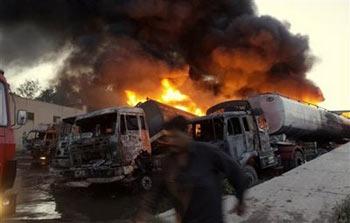
Somewhere in the recesses of the Pentagon, gaming should be occurring concerning use of U.S. military assets to ensure the security of the Pakistani nuclear ordnance, because if it becomes necessary to implement these plans, it will be no game. But the continual degradation of logistics through Pakistan has led us to strongly recommend another route, free from influence by Russia.
From nuclear assets to logistics, to potential Taliban operations in Kashmir and certainly the affects to the campaign in Afghanistan, the failure of Pakistan will indeed dwarf the previous problems that we have seen in that region of the world. Comprehensive planning should be underway to address the exigency of Pakistan as the next failed state.
Unthinkable? We had better be thinking about it, and very extensively at that. So in the face of the Taliban expansion towards the centers of power (e.g., Peshawar, Islamabad, Karachi), where is the Pakistan Army?
Five thousand square kilometres of Swat are now under Taliban control — de jure. Chitral (14,850 sq km), Dir (5,280 sq km), Shangla (1,586 sq km), Hangu (1,097 sq km), Lakki Marwat (3,164 sq km), Bannu (1,227 sq km), Tank (1,679 sq km), Khyber, Kurram, Bajaur, Mohmand, Orkzai, North Waziristan and South Waziristan are all under Taliban control — de facto. That’s a total of 56,103 square kilometres of Pakistan under Taliban control — de facto.
Six thousand square kilometres of Dera Ismail Khan are being contested. Also under ‘contested control’ are Karak (3,372 sq km), Kohat (2,545 sq km), Peshawar (2,257 sq km), Charsada (996 sq km) and Mardan (1,632 sq km). That’s a total of 16,802 square kilometres of Pakistan under ‘contested control’ — de facto. Seven thousand five hundred square kilometres of Kohistan are under ‘Taliban influence’. Additionally, Mansehra (4,579 sq km), Battagram (1,301 sq km), Swabi (1,543 sq km) and Nowshera (1,748 sq km) are all under ‘Taliban influence’. That’s a total of 16,663 square kilometres of Pakistan under ‘Taliban influence’ — de facto. All put together, 89,568 square kilometres of Pakistani territory is either under complete ‘Taliban control’, ‘contested control’ or ‘Taliban influenced’; that’s 11 per cent of Pakistan’s landmass.
Where is Pakistan army? To be fair, under our constitution law enforcement — and establishing the writ of the state — is the responsibility of our civil administration. Yes, under Article 245, the federal government can call in the army “in aid of civil power” but the overall strategy has to be devised by our politicians. Counter-terrorism and counter-insurgency are very specialised operations. Textbook counter-insurgency has three elements: Clear-Hold-Build (C-H-B). The army may be required to ‘clear’ insurgents from a particular area but every army operation creates a vacuum that has to be filled by a civil-political administration. After the ‘clearing’ of insurgents it has to be the politicians to ‘hold’ that area and then fulfil the social contract — dispensation of justice, municipal services etc — between the ruled and the rulers (classic counter-insurgency is DDD, disrupt, dismantle and defeat).
At least 11 per cent of Pakistan’s landmass has been ceded to the Taliban. Where is the Pakistan army? I Corps is in Mangla, II Corps is in Multan, IV Corps in Lahore, V Corps in Karachi, X Corps in Rawalpindi, XI Corps in Peshawar, XII Corps in Quetta, XXX Corps in Gujranwala and XXXI is in Bahawalpur, In effect, some 80 to 90 per cent of our military assets are deployed to counter the threat from India. The Pakistan army looks at the Indian army and sees its inventory of 6,384 tanks as a threat. The Pakistan army looks at the Indian air force and sees its inventory of 672 combat aircraft as a threat. The Pakistan army looks at the Indian army and notices that six out of 13 Indian corps are strike corps. The Pakistan army looks at the Indian army and finds that 15, 9, 16, 14, 11, 10 and 2 Corps are all pointing their guns at Pakistan. The Pakistan army looks at the Indian army and discovers that the 3rd Armoured Division, 4 RAPID Division and 2nd Armoured Brigade have been deployed to cut Pakistan into two halves. The Pakistan army looks at the Taliban and sees no Arjun Main Battle Tanks (MBT), no armoured fighting vehicles, no 155 mm Bofors howitzers, no Akash surface-to-air missiles, no BrahMos land attack cruise missiles, no Agni Intermediate Range Ballistic Missiles, no Sukhoi Su-30 MKI air superiority strike fighters, no Jaguar attack aircraft, no MiG-27 ground-attack aircraft, no Shakti thermonuclear devices, no Shakti-II 12 kiloton fission devices and no heavy artillery.
Pakistan is on fire and our fire-fighters are on the Pakistan-India border …
That the Indian troops are on the Pakistan border because the Pakistan troops are on the Indian border doesn’t occur to the Pakistan Army. But with this sad and dangerous Pakistani obsession with India, the U.S. must not rely on Pakistan for either logistical routes for Afghanistan or protection of its nuclear assets.
So in spite of Ms. Clinton saying that we can’t even contemplate the consequences of the Taliban taking control of Pakistani nuclear assets, somewhere in the bowels of the Pentagon, we had better be contemplating exactly this exigency.
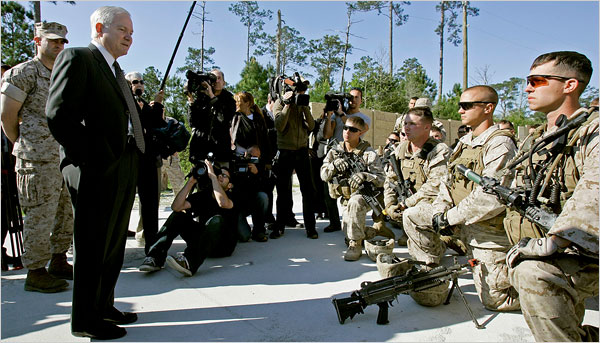
Whether an expeditionary unit of Marines, Rangers, some combination, or whatever, insertion by air, Osprey V-22, Helicopters and fast-roping, the short term and long term security of the weapons grade fissile material in Pakistan warheads had better be front and center of some tactician’s planning. We had better know where all of the nuclear assets are and have a plan to confiscate them. As for this tactician or group of them, it had better dominate their day and night, control their thought processes, and govern their priorities. We’d better have a plan.