An interesting report from the WSJ (h/t Spencer Ackerman):
“How many people do you bring in before the Afghans say, ‘You’re acting like the Russians’?” said one senior military official, referring to the Soviet occupation of Afghanistan in the 1980s. “That’s the big debate going on in the headquarters right now.”
Afghan President Hamid Karzai has said publicly during his campaign for the approaching Aug. 20 elections that he wants to negotiate new agreements giving the Afghan government more control over the conduct of the foreign troops currently in the country.
Gen. McChrystal, however, says too many troops aren’t a concern. “I think it’s what you do, not how many you are. It’s how the force conducts itself.”
Regardless of how he resolves the internal debate on troop numbers, Gen. McChrystal’s coming report won’t include any specific requests for more U.S. troops. Those numbers would instead be detailed in a follow-on document that is set to be delivered to Washington a few weeks after the assessment.
The timing of Gen. McChrystal’s primary assessment remains in flux. It was initially due in mid-August, but the commander was summoned to a secret meeting in Belgium last week with Defense Secretary Robert Gates and Adm. Mike Mullen, the chairman of the Joint Chiefs of Staff, and told to take more time. Military officials say the assessment will now be released sometime after the Aug. 20 vote.
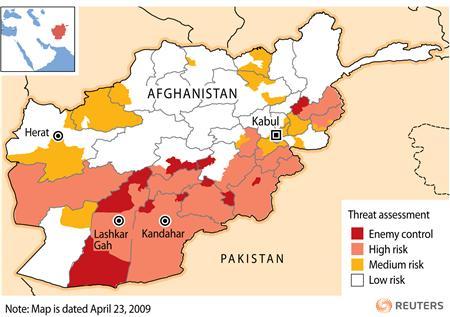
The shift came amid signs of growing U.S. unease about the direction of the war effort. Initial assessments delivered to Gen. McChrystal last month warned that the Taliban were strengthening their control over Kandahar, the largest city in southern Afghanistan.
American forces have been waging a major offensive in the neighboring southern province of Helmand, the center of Afghanistan’s drug trade. Some U.S. military officials believe the Taliban have taken advantage of the American preoccupation with Helmand to infiltrate Kandahar and set up shadow local governments and courts throughout the city.
“Helmand is a sideshow,” said the senior military official briefed on the analysis. “Kandahar is the capital of the south [and] that’s why they want it.”
First of all let’s deal with this issue of acting like Russians with too many troops. If this debate is actually “going on in headquarters right now,” wherever headquarters is (the report doesn’t say – CENTCOM, the Pentagon, Kabul, Kandahar Air Field, etc.), whomever is in charge should tell the boys to get back to work and quit wasting time. We won’t be acting like the Russians unless we cloister in the cities, refuse to engage the countryside, turn over the road to the Taliban, fail to beat the Taliban in fire fights, and fail to provide the population security. More troops will get us further away from being like the Russians, not more like them. Such childish debates are a sign of a military establishment which refuses to tell the administration the truth.
Second, Spencer Ackerman responds by saying:
“Helmand is a sideshow,” said the senior military official briefed on the analysis. “Kandahar is the capital of the south [and] that’s why they want it.”
That’s your Whiskey Tango Foxtrot moment right there. We sent thousands of Marines to a sideshow? Thousands of Marines, a meager complement of civilians, and barely any Afghan capacity? For a sideshow? A place McChrystal recently called a “critical area“? The general tells Dreazen and Spiegel that Helmand was, in fact, critical to focus on first, in order to disrupt the opium trade in the province that helps bankroll the Taliban. But then how could any halfway-responsible military official come away thinking that Helmand is a sideshow?
Perhaps even more alarming is this analysis:
Some U.S. military officials believe the Taliban have taken advantage of the American preoccupation with Helmand to infiltrate Kandahar and set up shadow local governments and courts throughout the city.
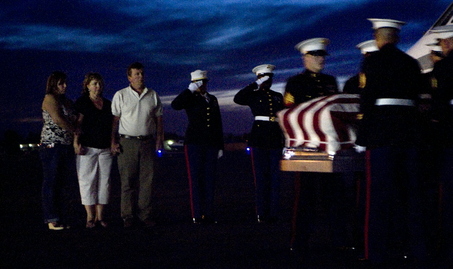
To begin with, this kind of comment (“Helmand is a sideshow) is profoundly insulting and troubling to parents, spouses and loved ones of Marines who are fighting in the Helmand Province. So it’s simply inappropriate to let such loose words slip from the tongue. “Anonymous” sources are cowards who like to see their words in print, but the words of these cowards sometimes hurt. As for the issue of allowing the Taliban to come in and set up a shadow government, they have already had that in Kandahar for over a year.
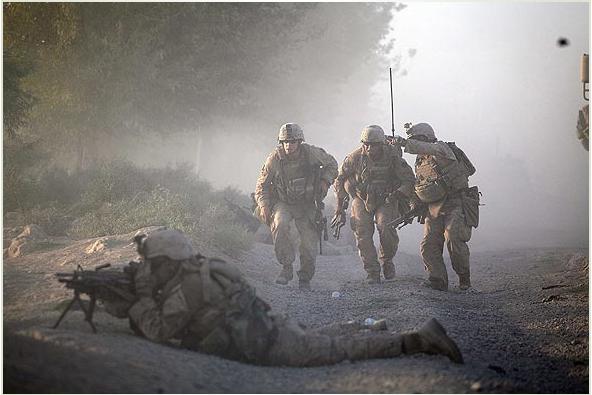
More troops are needed, and taking them away from Helmand is not the answer. To be sure, allowing the Taliban to come into an urban area and go uncontested is poor strategy, but this strategy calls for a stronger force. Given the problem of Kandahar v. Helmand, the stupid argument over force size and being like the Russians sounds rather adolescent, doesn’t it?
Continuing, is Helmand really a side show?
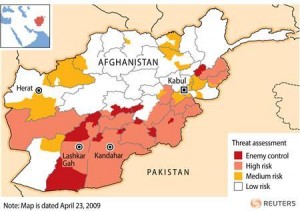
The Helmand Province is the home of the indigenous insurgency, the Afghanistan Taliban, and its capital is Lashkar Gah. Without hitting the Taliban’s recruiting grounds, fund raising and revenue development, training grounds, and logistical supply lines, the campaign cannot be won. Focusing on the population centers is a loser strategy, doomed to sure failure. Controlling the cities as some sort of prison while the roads are all controlled by Taliban is just what the Russians did, only to withdraw in ignominy. The Marines are in Helmand because just like Anbar, Iraq at the time, it is the worst place on earth.
Yochi J. Dreazen and Peter Spiegel wrote an interesting article, but it is badly flawed because they got poor contacts and resources. Even if Kandahar is of interest, taking and securing it will be but a temporary notch in our belts unless the insurgency is defeated in his own back yard. Helmand is his back yard.
Prior: Operation Khanjar category