The BCM Test Continues At Military Arms Channel
BY Herschel Smith 7 years, 2 months ago
5010 rounds so far. No cleaning.
 7 years, 2 months ago
5010 rounds so far. No cleaning.
7 years, 2 months ago
I have never replaced a barrel myself, but one day I might, and if you have, he gives some useful tips.
Here’s what you’ll need: upper receiver fixture; barrel nut wrench head; 1/2-inch drive torque wrench; 1/2-inch drive breaker bar; anti-seize; gas-tube alignment tool. And, of course, a sturdy vise.
To secure the upper receiver I prefer a “pins”-style block, because it gives easy and clear access to the upper interior to make gas tube alignment checks easier. On these, the receiver lugs nestle into the block and 1/4-inch pins, just like the takedown and pivot pins on the gun itself, fix the receiver in place.
The wrench head can be variable. If you’re working with a GI-standard-style barrel nut (has the spiny scallops all around it), there are many to choose from. I prefer one that engages full-circle; most are half-circle. The more scallops engaged, the more secure the connection is under pressure. Otherwise, the head depends on the particular barrel nut that shipped with the handguard rail you chose. If it’s proprietary, most will provide a wrench head along with the package.
Torque wrench: bigger the better, I say. More leverage is easier to operate. Speaking of leverage, adding the extra length of a wrench head requires an offset adjustment. Torque wrenches are accurate and calibrated at a point halfway up the handle (there’s a mark there) to the center of the drive socket. Measure from the center of the handle to the center of the drive socket. Measure then from the center of the drive socket to the center of the wrench attachment. Add those together.
Now divide that total length figure by the length of the handle to drive center. Multiply that by the torque level you want to apply. The answer is then where to set the torque index. For instance, if you have a 15-inch long wrench, center of handle to center of drive, and attach a wrench head that extends 2 more inches beyond the drive socket center, and you’re looking for that standard 35 foot-pounds — 15 + 2 = 17. 15 divided by 17 = 0.882. 0.882 x 35 foot-pounds = 30.87. So, dial the wrench handle to “31.”
He said that backwards (divide the length of the handle to drive center by the total to get the ratio, not the other way around), although his example calculation is fine. Make sure to read carefully and think it through.
About the gas-tube alignment tool: this can be either ready-made or homemade. I use one that’s a solid steel rod 0.180-inch diameter. If you make one from an old gas tube, for a more precise fit take a section from the gas tube body, not the portion that fits into the carrier key, and make it 3-4 inches long. This is an important tool to have.
The anti-seize comes from an auto parts store and is a copper-based lubricant that does what it suggests it does: it prevents galling. It also protects against dissimilar metals corrosion, and that includes aluminum against steel. It makes the barrel nut easier to install and then uninstall.
Get the upper fixed into whichever fixture you choose. Get your barrel. Wipe down the soon-to-be-mated surfaces to remove any residue or debris. There’s a pin on the barrel extension that fits into a corresponding slot on the threads surrounding the barrel extension receptacle in the upper. Seat the barrel into this receptacle. It usually will slip back and seat fully. If it doesn’t, don’t worry, because the barrel nut will seat it.
Next, get the anti-seize. Put a thin, even coat on the receiver threads. A flat artist’s brush works dandy.
Now get a barrel nut. I use one that I keep separate just for this next job. It’s a USGI-pattern nut that fits snugly and securely into my wrench attachment. The reason I have one that’s separate is because I sometimes “save” the supplied handguard nut until final install (I encounter proprietary aluminum wrench heads that get loose with use, as well as others that aren’t super-solid in engagement with the nut).
Fix the wrench head onto a breaker bar. Why? A torque wrench should not be used to loosen. Run the barrel nut on and tighten it firmly. Give it a yank. Then back it off, and snug it down again, firmly again. After experience you get a calibrated forearm, and you’ll get a feel for how much equals what. I take it to at least the 35 foot-pounds I’ll end up with on final install, but I’m not using a torque wrench for this step. You will, by the way, feel the effects and wisdom of anti-seize in this process. Do that a couple more times. This has seated the surfaces. It’s a sort of “truing,” but it’s really more of a mating. It’s facing down slight surface imperfections on the receiver, mostly.
Now, get your torque wrench and install the wrench head. Tighten the barrel nut until the wrench clicks. Only do this once. Don’t continue to repeat the clicks (you’re adding additional torque when you do).
Now. Here’s the trick: The gas tube has to be dead-centered in whatever it passes through. That might be one of the scallops on the barrel nut or a passage in the barrel nut, and, ultimately, the passage through the upper receiver. On some systems, there’s no association between gas tube and barrel nut. Those are bliss.
I’ve never seen a good torque wrench that would “add” torque if you repeat the clicks.
At any rate, feel free to weigh in with your own experience if you’ve done this before.
7 years, 2 months ago
I had never seen this and Kyle does a good job of showing how to do it, but I’d want to practice it if I ever thought I was going to need it.
7 years, 2 months ago
SUMMERFIELD – Marion County sheriff’s officials say a homeowner armed with an AR-15 shot and killed two intruders and was injured himself during a home invasion robbery in Summerfield Wednesday night.
Two other robbery suspects Robert John Hamilton, 19, of Ocala, and Seth Adam Rodriguez, 22, of Belleview were detained near the scene, according to the Marion County Sheriff’s Office.
Nigel Doyle, 22, of Summerfield, and Keith Jackson Jr., 21, Ocala, were killed. The homeowner, whose name was not released by the Sheriff’s Office, was in stable condition at a hospital Thursday afternoon.
Rodriguez was arrested on charges of murder and home invasion robbery with a firearm. Hamilton faces home invasion robbery with a firearm. Both men were being held in the Marion County Jail without bond.
Deputies got the call at 8:21 p.m. Wednesday and went to the home at 14999 SE 32nd Court Road in response to a report of shots fired.
Sgt. Micah Moore found Doyle with a gunshot wound and a shotgun next to him on the ground. Deputies entered the home and found Jackson dead on the dining room floor. Detectives said he was wearing a “Jason” mask on top of his head, gloves on both hands, jeans and a black shirt.
They all look so nice, don’t they?
So you can tally yet another multi-intruder home invasion where an AR-15 and [presumably] standard capacity magazine saved a life.
7 years, 2 months ago
John Lovell gives a tutorial. I still consider the Magpul “Art of the Tactical Carbine” to be the best. However, John provides some helpful tips.
Finding the “small of he shoulder” is difficult if you lift weights. What happens is that the butt always lands on the pec.
Also, the thumb-over-bore grip is cool, but my son said what John did. My son conducted room clearing for hours and days, and the only grip that works for that long is a much closer one.
7 years, 3 months ago
In case you’re an idiot and were wondering.
Two Senate Democrats falsely claimed Monday that the AR-15 is not used for hunting and isn’t “viable for home protection” in a tweet promoting gun control proposals.
Sen. Dianne Feinstein (D., Calif.) and Sen. Chris Murphy (D., Conn.) penned an op-ed in TIME calling for the banning of AR-15s and similar assault weapons.
“Guns like the AR-15 aren’t used for hunting and they’re not viable for home protection. They have only one purpose, and that’s to fire as many rounds as possible, as quickly as possible,” they wrote. “Outlawing these weapons, an action supported by 60 percent of Americans, will bring down the number of mass shootings and reduce the number of casualties, just as it did when the ban first passed in 1994.”
However, the AR-15, the most popular rifle in America, is used for hunting and home defense. MRC-TV noted a poll showing more than 25 percent of hunters reported using the rifle to hunt big game. In addition, the rifle is popular for home defense given its light weight and limited recoil, making it easier for owners to handle.
It’s only good for shooting at multiple home invaders, and managing recoil while regaining sight picture quickly, and ease of handing, and so on, and cops use them all the time, but they are no good.
Every day is opposite day, I guess. I feel like I’m listening to a child explain calculus.
7 years, 3 months ago
The competitor, Sgt. Benjamin Cleland of Swanton, Ohio, pulled off the feat at the National Rifle Association’s 2019 Charlie Smart Memorial Regional in Oak Ridge, Tennessee on June 2, with a score of 800-34x. This means Cleland not only notched 80 back-to-back hits in the 10-ring but that 34 of those nailed the even smaller “X” ring at the target’s dead center. For reference, at 600 yards, the 10-ring measures 12 inches while the “X” is 6 inches.
[ … ]
The 80-shot course is fired in four stages. This begins by firing 20 rounds from 200 yards in a standing position, followed by 20 sitting/kneeling, rapid-fire rounds before delivering 20 rounds from a prone position at 300 yards. The final stage, at 600 yards, consists of a further 20 rounds. A perfect score is 800, or 10 points for each round in the 10 ring.
The previous high score with a service rifle was a 798 set by Marine Gunnery Sgt. Julia L. Watson.
Service rifles in the match are limited to M16s, M14s and M1 Garands with a maximum of a 4.5x power scope.
That’s 1-2 MOA shooting for 80 straight rounds, some of it rapid fire. That’s extremely consistent shooting. That’s something we should all be striving for.
7 years, 3 months ago
From the comments, “And He spoke to his disciples, saying “nay, it cannot be direct impingement, for behold… there is a piston.” Thence He demonstrated the operation of Stoner’s rotating-bolt gas-key system, and they beheld his truth with their own eyes,” and “Saint Stoner of Armalite.”
Tim Harmsen of MAC had something similar a while back.
7 years, 4 months ago
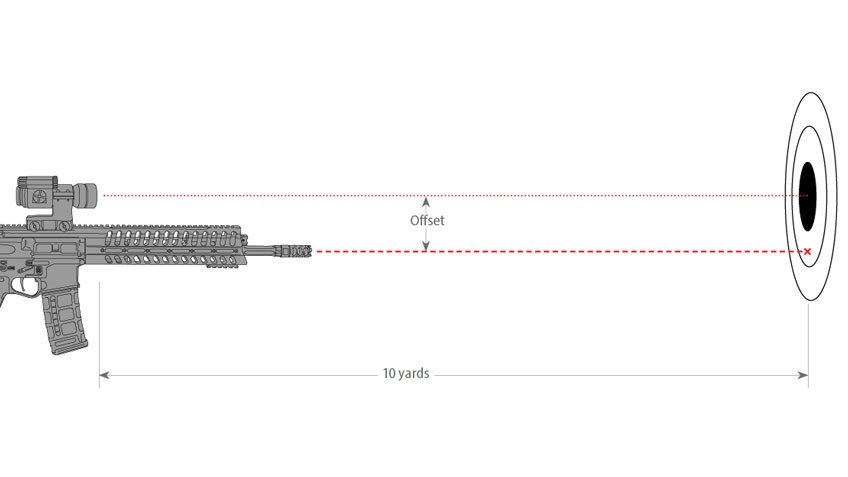
What’s mechanical offset and how do you deal with it? If you have an optic on a firearm, particularly a rifle, the line-of-sight through the scope is higher than the center of the bore, and that difference is what we call offset. In other words, when you take a shot the bullet is going to exit the barrel as much as several inches lower than the line of sight.
[ … ]
To check this out, you’re going to need about 50 rounds of ammunition and a target. I suggest you fire three-shot groups, holding center, from 3, 7, 10, 15 and 25 yards. I think you’ll discover that your rounds are striking somewhere around 2 to 3 inches low at 3, 7 and 10 yards. At 15 yards, the group will still be low, but a little closer to point-of-aim. At 25 yards, point-of-aim and your three-shot group should be pretty close to coinciding.
Next, try shooting those same three-shot groups at 3, 7, 10 and 15 yards again, but this time hold high to account for the offset you observed the first time around (remember, the 25-yard group should be close enough to the center to not warrant significant correction). If you hold correctly, you should end up with centered hits at each of the distances. One quick example might be holding 3 inches high at 3 yards. Continue to practice getting used to the various mechanical offsets by shooting snaps—one shot standing from ready—at each of the various ranges until you thoroughly understand your offset holds.
Travis Haley refers to this as “height over bore” in the Magpul Dynamics “Art of the Tactical Carbine,” which is a very good video series. I highly recommend it.
If this matters to you in CQB, you should check out your correction on a short range.





