Articles by Herschel Smith


The “Captain” is Herschel Smith, who hails from Charlotte, NC. Smith offers news and commentary on warfare, policy and counterterrorism.


MRAPs Being Re-Evaluated for Afghanistan Due to Rollover

17 years, 4 months ago

With the road infrastructure and the relatively stable terrain in Iraq, MRAPS have been a huge success in protection against IEDs. They do have their difficulties with low hanging power lines and therefore some limitations in highly urban settings, but this is area in which dismounted patrols must be used anyway to contact the population. But with the undulations in the terrain in Afghanistan, as reported in June, the MRAPs are having some problems due to their high center of gravity.

Three Green Berets drowned Saturday when their Mine-Resistant Ambush-Protected vehicle rolled into a river in Afghanistan. The deaths come amid growing concerns about the threat of catastrophic rollovers in the military’s silver bullet solution to improvised explosive devices.

Two military reports issued in June indicate growing problems associated with the MRAPs’ potential for rollover — as well as electrocution, when the vehicle snags low-hanging power lines — and an emerging threat from the vehicle’s glass dissolving into a cancer-causing powder when struck with explosively formed projectiles.

Saturday’s accident occurred in volatile Kandahar province and killed three members of Company A, 1st Battalion, 7th Special Forces Group, based at Fort Bragg, N.C., according to a Defense Department statement.

Anticipating a more active role on Afghanistan, the Marine Corps is busy investigating alternative solutions.

With plans to redeploy more Marines to Afghanistan later this fall, companies like General Dynamics Corp. and Force Protection Inc. are being asked to re-engineer mine-resistant vehicles that can traverse the war-ravaged country’s mountainous terrain while offering even greater protection.

High altitudes, dispersed battalions and restricted travel zones are among the serious challenges facing the service as it weighs the resources needed to perform its missions in Afghanistan where violence has escalated, senior Marine Corps officials told defense industry executives at the service’s annual expo Thursday.

Senior Marine Corps officials are concerned the current MRAPS are ill-equipped to handle the rocky terrain in Afghanistan, and are too heavy to easily transport to areas where they are needed.

“It’s OK in Iraq, but it’s not OK in Afghanistan,” said Dillon. “It’s got to have off-road capability and all the survivability.”

Blasts from roadside bombs are the leading cause of combat deaths and injuries in Iraq and have become a growing threat in Afghanistan, but it’s unclear whether the Marine Corps will buy more of the same vehicles, said Dillon. Currently, there are more than 900 MRAPs in Afghanistan, and close to 8,000 in Iraq. To date, the Pentagon has spent $22.4 billion on the program.

Instead, the service hopes to approve a hybrid armored vehicle that would provide the same type of protection as an MRAP, but would be more agile and provide improved maneuverability, Marine Corps officials said.

It’s more than just rollover concerns that are driving this innovation.  It is maneuverability, off road terrain capabilities and transportability.  The Marines may not be pursuing the hottest next-gen warrior trappings such as the exoskeleton, but when it comes to realistic battle space needs and possibilities, they have always been on top of their game.  Let’s hope that this program is off to a good and quick start.  Perhaps some representative of General Dynamics can contact The Captain’s Journal to give an update on the progress and goals.

Pirates in the Gulf of Aden

17 years, 5 months ago

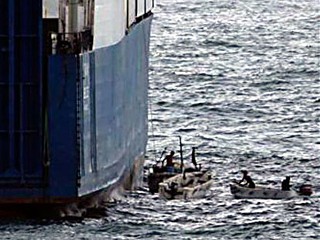
Somali pirates in small boats can be seen alongside the hijacked MV Faina. The captain of the hijacked ship off the coast of Somalia said one crew member had died (U.S. Navy/AP Photo).

The U.S. Navy and Marines have surrounded some very important cargo in the Gulf of Aden near the Somalian coast.

U.S. warships have surrounded the MV Faina, a Belize-registered ship that was hijacked by pirates off the lawless coast of Somalia last week.

While there’s no gold or precious jewels onboard, this buccaneer’s booty has the international community racing to intercept the boat before its cargo can be offloaded.

The Ukrainian-owned ship is carrying 33 Russian-made T-72 tanks, anti-aircraft guns, multiple-launch rocket systems and thousands of rounds of tank ammunition. Initial reports indicated the Ukrainian arms were destined for Kenya. But U.S. officials now say it appears they were to be shipped to Sudan, although it is unclear if they are headed to the central government in Khartoum or the government of Southern Sudan, which has purchased such tanks in the past.

The U.S. Navy has dispatched several destroyers and cruisers, as well as an amphibious ship with a complement of helicopters and Marines aboard, to ensure the hijacked arms don’t fall into the hands of terrorists in the power vacuum of the Horn of Africa region, particularly in Somalia, where al Qaeda-linked groups operate.

“We are not going to allow the offload of the ship’s cargo,” warned Lt. Nathan Christensen, a spokesman for the U.S. Navy’s Fifth Fleet, which has sent ships to the scene.

The U.S. ships are stationed in a 10-mile radius around the hijacked vessel to prevent it from escaping.

“We are deeply concerned about the safety of the crew as well as the cargo onboard MV Faina,” Christensen said, adding that the U.S. presence “represents the U.S. resolve to ensure safety and security in the region. Piracy is a problem that starts ashore and requires an international solution to this international problem.”

A senior U.S. defense official says the American ships’ main mission is to prevent the pirates aboard the freighter from being resupplied from shore. The MV Faina is anchored off the Somali port of Hoybyo, along with two other freighters that had been hijacked by pirates previously.

Also of immediate concern is the well-being of the ship’s crew of Ukrainians, Latvians and Russians, totaling 21. A Russian crewman is reported to have died from hypertension. A Russian naval ship is also on its way to the scene from the Baltic and is estimated to arrive off Somalia in a week, at the earliest.

The U.S. Navy says it has had no coordination with the Russians on the matter.

“The Russians, I believe, are trying to lend their support,” State Department deputy spokesman Robert Wood told reporters today, declining to comment further.

The modern-day swashbucklers were armed with automatic weapons when they boarded the ship Thursday. They are demanding a $20 million ransom for return of the cargo, down from an initial demand of $35 million.

The region off the coast of Somalia is well-known for pirate activity where cargo ships are regularly hijacked for ransom. Indeed, the number of vessels hijacked this year, and the ransoms demanded for their safe return, have risen dramatically.

Robert Kaplan gives us a little more on the pirates and their methods.

I spoke recently with several U.S. Navy officers who had been involved in anti-piracy operations off Somalia, and who had interviewed captured pirates. The officers told me that Somali pirate confederations consist of cells of ten men, with each cell distributed among three skiffs. The skiffs are usually old, ratty, and roach-infested, and made of unpainted, decaying wood or fiberglass. A typical pirate cell goes into the open ocean for three weeks at a time, navigating by the stars. The pirates come equipped with drinking water, gasoline for their single-engine outboards, grappling hooks, short ladders, knives, AK-47 assault rifles, and rocket-propelled grenades. They bring millet and qat (the local narcotic of choice), and they use lines and nets to catch fish, which they eat raw. One captured pirate skiff held a hunk of shark meat so tough it had teeth marks all over it. With no shade and only a limited amount of water, their existence on the high seas is painfully rugged.

The classic tactic of Somali pirates is to take over a slightly larger dhow, often a fishing boat manned by Indians, Taiwanese, or South Koreans, and then live on it, with the skiff attached. Once in possession of a dhow, they can seize an even bigger ship. As they leapfrog to yet bigger ships, they let the smaller ships go free. Because the sea is vast, only when a large ship issues a distress call do foreign navies even know where to look for pirates. If Somali pirates hunted only small boats, no warship in the international coalition would know about the piracy.

Off-hand cruelty is the pirates’ signature behavior. In one instance, they had beaten, bullied, and semi-starved an Indian merchant crew for a week, and thrown overboard a live monkey that the crew was transporting to Dubai. “Forget the Johnny Depp charm,” one Navy officer told me. “Theirs is a savage brutality not born of malice or evil, like a lion killing an antelope. There is almost a natural innocence about what they do.”

The Captain’s Journal has no idea what this Navy officer is talking about. He needs to go back and re-evaluate his own morality and ethics, if he has any. Piracy, theft and cruelty are most certainly born out of evil, and the pirates themselves are reprehensible along with their actions. Right and wrong, good and bad, righteousness and evil, are not merely conventions.  They are universal and invariant.  There is nothing romantic about this.

This isn’t about learning a language to communicate with a population, or identifying an indigenous insurgency, or befriending a tribal sheikh, or employing gated communities, or any of the complicated counterinsurgency tactics we’ve had to employ in Iraq or Afghanistan.

This is easy. We tell the LOAC and ROE lawyers that they’re special and that they should go to their rooms and write high-sounding platitudes about compassion in war so that they’re out of the way, we land the Marines on the ship, and we kill every last pirate. Then we hunt down his domiciles in Somali and destroy them, and then we find his financiers and buyers and kill them. Regardless of the unfortunate potential loss of Ukrainian or Russian civilian life upon assaulting the ship, this weaponry and ordnance should never have been shipped in this part of the world without escort (and perhaps it shouldn’t have been shipped even with escort).

Negotiations will only serve to confirm the pirates in their methods. It’s killing time. It’s time to turn the United States Marines loose.

Marine Operations in Now Zad, Afghanistan

17 years, 5 months ago

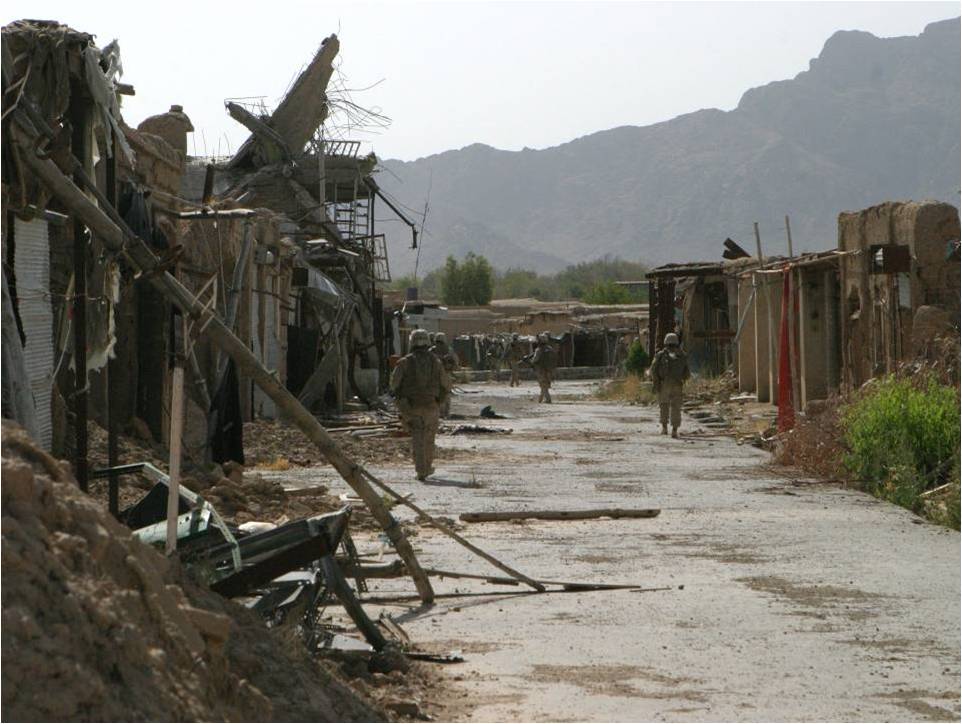
Marines of 3rd platoon 1st squad, Fox Company, 2nd Battalion 7th Marines, conduct a local security patrol in the city of Now Zad, Afghanistan to ensure the safety of the forward operating base on June 08, 2008.

Friend of The Captain’s Journal Major Cliff Gilmore (USMC) is in Afghanistan and sends an anecdotal update on Marines in Now Zad that makes him proud to be a Marine.

I did make a short trip “up north” to a fun little place called Now Zad where a company of Marines have been slogging it out. I don’t like to bring politics into these e-mails, but in general I can comfortably say that those who beat the “support our troops, bring them home now” drum clearly haven’t talked to the warriors I mixed with out there. Several have died. More have lost limbs to improvised explosive devices (IED). All of their corpsmen (medics) have received one or more Purple Heart Medals for injuries sustained in combat and not a one of them talked about wanting to go home. When I arrived at Now Zad I came in with approximately 30 combat replacements. New Marines in to take the place of those already killed or injured. They were all volunteers and left their various units to re-enforce the Marines at Now Zad because, according to one Marine, “…we heard this was where the bad guys are.”

I talked with numerous Marines and hovered in the pre-dawn shadows of the moonscape listening to their chatter for hours and heard only about what they had learned, how they were getting better at this kind of fighting, and how they couldn’t wait to get back outside the wire and “…hunt the scrappy little @&%!ers down.” Point here being, I’m not at all confident the boys in the middle of the fight are thinking in terms of how the folks back Stateside might be able to support them by bringing them home. Mostly they just want more bullets.

I ran into one young Marine who has already been shot twice and blown up by an IED once and came away essentially unscathed both times. The IED resulted in a sprained ankle which he taped up and strapped back into his boot. The two shots came while he was on the radio calling for medevac for a fellow Marine. As the story goes — told the same way by numerous Marines out at Now Zad — he was kneeling beside the wounded Marine, radio in one hand, assisting the corpsmen in treating the wounded Marine with the other. Calm as could be his conversation on the radio went something like “…sir, we have a Marine down and need a medevac immediately. We are located at grid 123456. He looks stable but his injuries are serious. We need you to come and get him now. Oh, and I just got shot too so you’ll have to come get me as well.”

He took two 7.62 AK-47 rounds to the left side under his arm. His armor stopped the bullets, but he didn’t realize that at first. As he described it, the force of the rounds hitting him felt “…pretty much real enough at the time…” As others described it, he didn’t even flinch when the shots came, did not skip a beat on his evac call, and once he had a chance to inspect his bruised ribs simply asked the doc to tape him up and then went back into the fight.

He didn’t ask to go home.

Proud indeed. Thanks to Major Gilmore for this update, and watch your six, friend.

Tribal Awakening in Pakistan?

17 years, 5 months ago

The Wall Street Journal recently carried a news item on Pakistan’s turn to tribal militias to help in the fight against the Taliban.

The Pakistani army is backing tribal militias that are rising to battle pro-Taliban groups, a development that the government hopes will turn the tide against insurgents here in the embattled northwest.

Pakistan’s military and intelligence agencies say recent antigovernment violence, including last week’s deadly bombing of the Marriott Hotel in Islamabad, is rooted in Islamist strongholds along the border with Afghanistan, in districts like Bajaur.

The militant groups here — Pakistanis allied with Taliban and al Qaeda guerrillas in Afghanistan — are trying to carve out Islamist enclaves along the border. To fight them, the government has deployed more than 8,000 troops in the Bajaur region. The army says it has killed 1,000 militants in the six weeks since the campaign started. But a steady supply of Islamist guerillas is pouring in from Pakistan and Afghanistan, and the fighting shows little sign of abating.

The tribal militias could provide a counterweight. “The tribesmen have risen against the militants. It could be a turning point in our fight against militancy,” says Owais Ghani, governor of North West Frontier Province. The province is “providing them financial as well as moral support,” he says.

Military commanders say the struggle for control of the tribal region is crucial to containing the spread of Islamist militancy to other parts of northwestern Pakistan.

“The threat of Bajaur radiates in all directions and affects the entire region,” said Maj. Gen. Tariq Khan, the commanding officer of the military campaign in the region, last week.

The army-backed militia movement has similarities with the Sunni awakening in Iraq, where U.S.-supported Arab tribesmen turned against al Qaeda fighters, says Tanveer Ahmed Khan, chairman of the Pakistan Institute of Strategic Studies.

Indeed, the U.S. has also been assisting the tribes with money and training, and has been ever since it was determined that the Khyber pass and Torkham Crossing were problematic and could be lost to the Taliban (one of two main supply routes through Pakistan to NATO forces in Afghanistan; the other border crossing is at the southwestern town of Chaman). Shoring up relations with the tribes in Khyber is one reason for Deputy Secretary of State John D Negroponte’s visit to Khyber earlier in the year (although it should be pointed out that out of fear of the Taliban, only six tribal elders showed up at the meeting).  The Captain’s Journal predicted over six months ago that interdiction of these supply routes would be one leg of the Taliban strategy against NATO.

But the last statement by Khan is troubling, inasmuch as it betrays a fundamental misunderstanding of the tribal awakening in Anbar. The Anbar awakening can be succinctly characterized by Abu Ahmed’s experience as the Sheriff of al-Qaim, Iraq.

The 40-year-old is a hero to the 50,000 residents of Al-Qaim for having chased Al-Qaeda from the agricultural centre where houses line the green and blue waters of the Euphrates.

In the main street, with its fruit and vegetable stalls, its workshops and restaurants, men with pistols in their belts approach Abu Ahmed to kiss his cheek and right shoulder in a mark of respect.

It was not always this way.

He tells how one evening in May 2005 he decided that the disciples of Osama bin Laden went too far — they killed his cousin Jamaa Mahal.

“I started shooting in the air and throughout the town bursts of gunfire echoed across the sky. My family understood that the time had come. And we started the war against Al-Qaeda.”

It took three battles in the streets of Al-Qaim — in June, in July and then in November 2005 — to finish off the extremists who had come from Arab countries to fight the Americans.

Abu Ahmed, initially defeated by better equipped forces, had to flee to the desert region of Akashat, around 100 kilometres (60 miles) southwest of Al-Qaim. There he sought help from the US Marines.

“With their help we were able to liberate Al-Qaim,” he said, sitting in his house with its maroon tiled facade.

This alliance between a Sunni tribe and American troops was to be the first, and it give birth to a strategy of other US-paid Sunni fighters ready to mobilise against Al-Qaeda.

It resulted in the Sunni province of Al-Anbar being pacified in two years.

The fundamental difference is that the Pakistani troops have withdrawn from their offensive in Bajaur. Pakistan has made it clear through threats and firing on U.S. troops – causing a stand down of U.S. operations across the Pakistan border – that Pakistan will not tolerate the presence of U.S. forces in spite of its duplicity towards the Taliban and reluctance to engage them in combat.

So by expecting the tribes to stand up to the Taliban and al Qaeda without the presence or protection of the U.S. Marines or even Pakistani forces, we are expecting something that an even more proud and obstinate people, the Anbaris, couldn’t manage on their own. This is why there isn’t any real similarity between the Anbar awakening and the tribal actions in Pakistan. One might surmise what the outcome will be.

I dream of a conversation

17 years, 5 months ago

The last exchange between Katie Couric and Governor Sarah Palin didn’t go as well as it should have. Therefore, I am laying this out there as my conversational dream – the one that should have happened the last time, and the one that surely must happen the next time.

Katie: I asked you last time, Governor, give me one example of effort to increase regulation by John McCain.  You didn’t, and you said that you would get back to me. So I am giving you one last chance here. Can you give me just one …

Sarah: Hold on Katie. Sorry to interrupt you – well, actually, no I’m not.  Let’s get one thing clear. I’m not going to play your stupid little quiz game. This isn’t twenty one questions with a right or wrong answer. I have no more intention of answering your quiz questions than I do of demanding that you tell me about my reform efforts in Alaska, or telling me what it feels like to deploy a son to Iraq.  This is supposed to be an investigative and analytical interview. We all know what John is about. If you want to know something about one of his reform efforts, then ask him. Don’t ask me. If you want to know something about my reform efforts in my home state, then ask me. But either way, prove yourself to be something other than just another talking head. I’ll give you one last chance to conduct a meaningful interview that is useful to the citizens of America. One more chance. Now, I’m the Governor of a state of 700,000 citizens who has the reputation for taking on waste and bureaucracy. Don’t you have a single heavyweight question you want to ask me about my record? Huh, Katie? One last chance.

The Coming Winter Combat Between Taliban and U.S. Forces

17 years, 5 months ago

It was Maj. Gen. Jeffery J. Schloesser who initially pointed out that the Taliban would be active this winter despite the common perceptions of a stand down in operations due to the weather.

American troops in Afghanistan will step up offensive operations this winter because insurgents are increasingly staying in the country to prepare for spring attacks, a U.S. commander told The Associated Press.

Maj. Gen. Jeffery J. Schloesser said a 40 percent surge in violence in April and May was fueled in part by militants preparing stores of weapons during the winter, which generally is a slow period for fighting, particularly in snowy Afghan mountainous areas.

“If we don’t do anything over the winter the enemy will more and more try to seek safe haven in Afghanistan rather than going back to Pakistan,” Schloesser said …

He said the U.S. military realized more militants spent last winter in Afghanistan after speaking with elders and villagers who had been pushed out of their homes. The spike in violence in the spring occurred because insurgents were already in position to unleash attacks, though U.S. officials didn’t know it at the time, he said.

“They didn’t have to come over the passes, they were already here,” Schloesser said during an interview while flying in a Black Hawk helicopter Monday to a small U.S. outpost in Nuristan, a province that borders Pakistan.

Now he is reiterating this position, but adding a new twist concerning the capabilities of U.S. forces and the intent to interdict Taliban operations.

A top U.S. general said he expects militant violence in Afghanistan to rise some 30 percent this winter compared with last year, but that he does not think insurgents have the ability to mount a massive campaign during the country’s harsh weather.

Maj. Gen. Jeffrey J. Schloesser said the U.S. will attack militant cells in areas of Afghanistan where U.S. forces in some cases haven’t operated before but where officials now realize “the enemy is seeking to remain as a rest and facilitation area in the winter.”

Winter has traditionally been seen as a down time for fighting in Afghanistan, but Schloesser said offensive operations by U.S. troops this year could dispel that notion.

U.S. troops will “take advantage of our mobility and capacity to operate in the snow and to be able to find the enemy,” he told The Associated Press in a telephone interview Thursday.

Militants will have the option to be “captured, killed, to reconcile or flee,” the general said. “And I think fleeing will be very hard in the winter, especially if they’re in flip flops or sandals.”

In January 2007, U.S. airstrikes killed some 120 militants crossing the border on foot from Pakistan into Afghanistan, and a video of the attack taken by a drone showed that many of the insurgents — who were walking in a single-file line through mountainous terrain — were barefoot.

Schloesser said he thinks militants are now better equipped with boots and sleeping bags but don’t have the ability to conduct complex operations in deep snow or freezing weather.

Schloesser clearly intends to use the weather as a force multiplier. But many of the insurgents are at home in Kandahar or other smaller villages in Southern Afghanistan, with families, history, homes and experience in the bitter winters. For these fighters there is no need to traipse through the countryside looking for a place to throw a sleeping bag for the night.

Time will tell if the these good intentions come to pass, but expect it to be a tough winter for U.S. troops – frostbite, frost-jamming of the tight tolerances of the action in the M16A2 and SAWs, and the inability to detect IED emplacements due to muddy and snow-covered terrain. On this last example, the Taliban have shown an adaptability that can prove menacing. “Western field commanders readily acknowledge that the Taliban and their allies learn from failures as well as successes. When Taliban fighters noticed that western forces were jamming the signals they used to detonate roadside bombs, they switched back to pressure plates that would be set off by a passing convoy.”

But scores of Taliban have been killed too. If the U.S. command has their way, it’ll be a tougher winter for the Taliban.

Finalized Command Structure Changes for Afghanistan

17 years, 5 months ago

Regular readers of The Captain’s Journal know that we’ve been critical of NATO. As far back as five months ago we were discussing and advocating a reorganization of NATO to report to U.S. CENTCOM, or at a minimum, removing U.S. troops from NATO command in Afghanistan. We also pointed out the red tape and utter confusion in NATO in everything from strategy to radio frequencies. As characterized by one Marine officer prior to operations in the Helmand Province, they had to “wait for the Elephants to stop dancing.”

Four months ago The Captain’s Journal continued to advocate realignment of forces, saying that “promotion of General Petraeus to Commander of CENTCOM without a realignment of U.S. troops to his direct command (they currently report to NATO command) removes the possibility for any strategic changes needed to make the campaign successful.”

One week ago we discussed the potential realignment in the works for the campaign, but continued to advocate more U.S. troops since many NATO troops are bound by overly restrictive rules of engagement. Now we learn that the realignment we have recommended is underway.

The BBC has learnt that a new-look command structure will drive the continuing fight against the Taleban in Afghanistan. will (sic) now be led by a change in the existing command structure.

US General David McKiernan will now command both the US and Nato forces who are currently based in Afghanistan.

General McKiernan told the BBC’s John Simpson that the move would create “a greater unity” among the forces. But the British Army has criticised the move, arguing that any big decisions will now be taken primarily by the US.

As we recently said, “Petraeus must have access to resources that will operate with regard to unity of command, unity of strategy and unity of mission. Time is short in the campaign, Pakistan’s intentions cannot be trusted, and the security situation is degrading.”

We’re thrilled that what we have advocated has come to pass.  Does CENTCOM read this blog?  As for the overall command structure change, regular readers of The Captain’s Journal heard it advocated here first, heard it announced here first, and studied the reasons for our advocacy.

Pakistan Army Fires on U.S.

17 years, 5 months ago

It’s significant because it is not the first time it has happened.  Once might point to a misunderstanding.  But the Pakistan Army has again fired on U.S. troops.

Pakistani and American ground troops exchanged fire along the border with Afghanistan on Thursday after the Pakistanis shot at two American helicopters, ratcheting up tensions as the United States increases its attacks against militants from Al Qaeda and the Taliban, who are being sheltered in Pakistan’s restive tribal areas.

The two American OH-58 Kiowa reconnaissance helicopters were not damaged and no casualties were reported on either side from the ground fire. But American and Pakistani officials agreed on little else about what happened in the fleeting mid-afternoon clash between the allied troops.

American and NATO officials said that the two helicopters were flying about one mile inside Afghan air space to protect an American and Afghan patrol on the ground when the aircraft were fired on by small-caliber arms fire from a Pakistani military checkpoint near Tanai district in Khost Province.

In response, the American ground troops shot short bursts of warning fire, which hit well shy of the rocky, hilltop checkpoint, and the Pakistanis fired back, said Rear Adm. Gregory Smith, a spokesman for the Central Command.

But a spokesman for the Pakistani army, Maj. Gen. Athar Abbas, said Pakistani forces fired warning shots at the American aircraft after they crossed into Pakistan’s territory in the area of Saidgai, in North Waziristan’s Ghulam Khan region. “On this, the helicopters returned fire and flew back,” General Abbas said.

Local residents said that one of the two helicopters had entered inside Pakistan territory by about a mile, while the other hovered on the Afghan side of the border.

“When our forces fired warning shots, we were a little scared of a possible retaliatory fire from the helicopters,” said one of the residents, Haji Said Rehman Gorbaz. “But we were happy to see the helicopter flying back into Afghanistan. We were happy that our forces fired at the helicopter.”

There was disagreement between nations, but the Pakistani position concerning U.S. troops seems certain.

“Just as we will not let Pakistan’s territory be used by terrorists for attacks against our people and our neighbors, we cannot allow our territory and our sovereignty to be violated by our friends,” Pakistani President Asif Ali Zardari said in New York on Thursday.

But in Washington, Pentagon spokesman Bryan Whitman insisted the helicopters had not entered Pakistan. He described the incident as “troubling” and called on Islamabad for an explanation.

“The flight path of the helicopters at no point took them over Pakistan,” he said. “The Pakistanis have to provide us with a better understanding of why this took place.”

Pakistan later amended their position.  “Pakistan’s new president said Thursday his military fired only “flares” at foreign helicopters that he claimed had strayed across the border from Afghanistan into his country.  Pakistani President Asif Ali Zardari said his forces fired only as a way “to make sure that they know that they crossed the border line.”

It makes no difference.  We believe that Pakistan lost its claim to sovereignty over the tribal regions when it ceded its authority and failed to enforce writ in the area.  The time should soon be coming that Pakistan chooses sides in the conflict.  More money cannot continue to pour into the war on the Taliban through Pakistani hands, with Pakistani troops firing on U.S. troops while also failing to enforce writ in the region.

Finally, every minute spent on worrying over U.S. incursions into the tribal areas is a minute wasted, better spent on Pakistan crafting a plan to continue to exist and do so without total surrender to Sharia and Taliban rule.  Pakistan is on a precarious perch, and is in dire trouble concerning its future.  The focus on U.S. troops shows that it does not yet comprehend the trouble at hand.  When the Pakistan Army sees U.S. forces flying overhead, they should wonder where the U.S. is going and why they aren’t participating.  So is Pakistan a friend or enemy of the U.S.?  It is a dangerous thing to be an enemy of the U.S.

Blunt Instruments in Afghanistan

17 years, 5 months ago

The Herald Sun has an article from an Australian perspective on the campaign in Afghanistan. Recall as you read this that based on discussions in The Cult of Special Forces, the Australians do not allow their infantry to engage in combat operations, and in fact require that they sign formal agreements stating that they haven’t provoked kinetic engagements. They allow only their special forces to engage in kinetic operations.

The ambush and serious wounding of nine elite Australian soldiers in Afghanistan this month showed just how tenuous the coalition’s hold is over most of the troubled country.

Despite the advanced weapons and remote technology waged against them by the world’s top military powers, including unmanned spy planes that escort most patrols, Taliban fighters backed by their comrades in Pakistan and Iran just keep on coming.

The situation is so confused that highly trained Australian special forces troops have been implicated in the death of a district governor during a firefight between the Diggers and Afghan police.

For one British attack helicopter crew the reality of this bitter war reflected the fantasy of a Terminator movie during a recent operation in the restive Helmand province.

After firing a Hellfire missile from their Apache chopper to level a building housing key Taliban leaders, they were astonished to see several men escaping from the smouldering pile of rubble in a sports utility vehicle.

The pilots tuned their high-tech optical equipment, which can focus on an individual face from several kilometres away, onto the speeding utility and positively identified a prime target inside.

Another Hellfire reduced the Toyota to scrap metal, but, amazingly, one of the insurgents had survived and what was left of him began crawling away, Terminator -like, from the carnage.

The coup de grace was delivered by a short burst from the chopper’s lethal 30mm chain gun.

The Taliban might be unable to drive foreign forces out with a decisive military offensive, but they are determined to win this war of attrition.

From the heavily fortified United Nations, American, NATO and Afghan government citadels in the capital Kabul to the bloody frontline “green zones” in Helmand and Oruzgan provinces, this is a war that could last for decades and may never be won.

As the coalition death toll mounts and the Western political landscape changes, the question being asked across Afghanistan is not how the military campaign is going but rather what are the alternatives.

The 70,000 foreign troops in the country, including 1100 Australians, represent the blunt instrument of international policy.

But the force is nowhere near big enough to actually defeat the enemy, train the Afghan army and secure desperately needed infrastructure development.

Indeed, the war may never be won, and the last paragraph explains exactly why. Not enough troops. Interestingly, the author calls the 70,000 troops in Afghanistan a “blunt instrument.”

With many of these troops unable to perform offensive or kinetic operations due to rules of engagement, and with strategic incoherence keeping them on FOBs rather than contacting the population, the remaining troops that can engage in combat do so with heavy use of air power with its collateral damage and raids against high value targets.

This is a blunt instrument indeed. While counterintuitive, one lesson learned from Operation Iraqi Freedom is that while some old school counterinsurgency thinkers advocated the small footprint, it is precisely this that causes convulsive contact with the population. The more productive, precise and surgical operations require time and infantry. Infantry contacts both the population and the enemy constantly, with enough force projection to provide security and gain intelligence.  The Captain’s Journal has repeatedly stated a maxim: the necessity to apply force is inversely proportional to the force projection.

So while the pedestrian version of kinetic operations has special forces raids as surgical and infantry operations as blunt, in counterinsurgency exactly the opposite is true. Australia’s political leadership would do well to learn this, and also surmise that in the end, the small footprint model will be more costly. Australia’s military leadership already knows this.

Operations in Bajaur Causes Decrease in Afghan Attacks

17 years, 5 months ago

In the spirit of our own Games of Duplicity, prominent Pakistani Irfan Husain upbraids Pakistan and her leadership, and concludes with the following:

Another factor that has thwarted a more effective response to the Taliban threat is Pakistan’s preoccupation with India. Generations of army officers have been taught that Pakistan’s giant neighbor is the real enemy, and this doctrine is reflected in the disposition and concentration of the country’s half-million-strong army. Troops have been trained to fight a conventional war on the plains of Punjab and Sindh. After 9/11, around 80,000 troops were deployed along the Afghan border, but even this number was insufficient to seal it. Currently, a military alliance between Afghanistan and India is Pakistani military planners’ worst nightmare. To thwart such a possibility, the Pakistani Army wants to retain the Taliban as proxies and is therefore reluctant to crush them.

Finally, Pakistan has not yet worked out a political consensus about who the real enemy is. Until the day he left office in early August, Musharraf was regularly castigated in the media as Bush’s poodle doing America’s dirty work by killing his own people. Pakistani TV networks are forever churning out talk shows in which so-called experts criticize the government for fighting fellow Muslims. They conveniently overlook the fact that these same Muslims are responsible for killing hundreds of innocent Pakistanis and Afghans.

In post-Musharraf Pakistan, the newly-elected government is struggling to find its feet. The coalition of the two largest parties has already split up. Nawaz Sharif, leader of his faction of the Pakistan Muslim League, has made clear his intention to talk to the Taliban rather than fight them. But Asif Zardari, widower of Benazir Bhutto and now president of Pakistan, has declared his intention to take the fight to the terrorists who threaten to seize control. In a recent article in The Washington Post, Zardari called this the “battle for Pakistan’s soul.” Clearly, this is a battle Pakistan cannot afford to lose.

In fact, a U.S. Marine Lt. Col. has recently gone on record saying that Pakistani troops were have at times actively resupplied the Taliban during combat operations.

Pakistani military forces flew repeated helicopter missions into Afghanistan to resupply the Taliban during a fierce battle in June 2007, according to a U.S. Marine lieutenant colonel, who says his information is based on multiple U.S. and Afghan intelligence reports.

The revelation by Lt. Col. Chris Nash, who commanded an embedded training team in eastern Afghanistan from June 2007 to March 2008, adds a new twist to the controversy over a U.S. special operations raid into Pakistan Sept. 3.

Pakistani officials strongly protested that raid, with a statement issued by the foreign ministry calling it a “gross violation of Pakistan’s territory.”

But fewer than 15 months earlier, Pakistani forces were flying cross-border missions in the other direction to resupply a “base camp” in Nangarhar Province occupied by fighters from the Taliban, al-Qaida and the Hezb-i-Islami faction led by Afghan warlord Gulbuddin Hekmatyar, Nash told Army Times in a Sept. 17 telephone interview.

He had previously alluded to the episode in a PowerPoint briefing he had prepared to help coalition forces headed to Afghanistan. The briefing, titled “Observations and Opinions IRT Operations in Afghanistan by a Former ETT OIC” and dated August 2008, has circulated widely in military circles. Military Times obtained a copy.

Nash said his embedded training team, ETT 2-5, and their allies from the Afghan Border Police’s 1st Brigade fought “a significant fight” in late June 2007 in the Agam Tengay and Wazir Tengay valleys in the Tora Bora mountains of southern Nangarhar – the same region in which al-Qaida forces fought a retreat into Pakistan from prepared defenses in the winter of 2001-2002.

“I had six [Marine] guys on a hill,” Nash said. “They weren’t surrounded, but in the traditional sense they might have been.”

At a critical point in the battle, the Pakistanis flew several resupply missions to a Taliban base about 15 to 20 kilometers inside Afghanistan, Nash said. None of the Marines witnessed the helicopter flights during the four days they were there, he said in a Sept. 19 email. Rather, the supply flights had been reported to them by Afghan soldiers and local civilians in the village of Tangay Kholl.

Versus this picture of active assistance to the Taliban, Pakistan has recently conducted heavy operations in Bajaur, and these operations are having a tangible effect inside Afghanistan.

[The] operation, which began in early August, has won praise from U.S. officials worried about rising violence in Pakistan and Afghanistan but has triggered retaliatory suicide bombings elsewhere in Pakistan. Some officials believe that the weekend bombing of the Marriott Hotel may have been a response to the Bajaur operations, which the army says have left more than 700 suspected militants dead.

Washington says the operation in Bajaur, rumored to be the hiding place of Osama bin Laden, the leader of Al Qaeda, appears to have reduced violence across the border in Afghanistan.

A Pakistani Army spokesman, Major General Athar Abbas, has said that Bajaur has been turned into a “mega-sanctuary” for militants and that the military is determined to flush them out.

But a rash of U.S. cross-border operations in neighboring tribal regions, including suspected missile strikes and a ground assault, underscore Washington’s concerns that Pakistan is either unwilling or incapable of rooting out extremists on its own.

There is still reason to be concerned. The intransigence of the world view and bureaucracy in the Pakistan military will be difficult to repair. Also, The Captain’s Journal still advocates the idea that the first place for NATO confrontation of the Taliban is Afghanistan. Security must be provided for the population in a counterinsurgency. However, if Pakistan can turns its attention away from India and towards the real threat – the Taliban – the effectiveness of the campaign will increase by an order of magnitude.


26th MEU (10)
Abu Muqawama (12)
ACOG (2)
ACOGs (1)
Afghan National Army (36)
Afghan National Police (17)
Afghanistan (704)
Afghanistan SOFA (4)
Agriculture in COIN (3)
AGW (1)
Air Force (41)
Air Power (10)
al Qaeda (83)
Ali al-Sistani (1)
America (22)
Ammunition (304)
Animals (323)
Ansar al Sunna (15)
Anthropology (3)
Antonin Scalia (1)
AR-15s (393)
Arghandab River Valley (1)
Arlington Cemetery (2)
Army (91)
Assassinations (2)
Assault Weapon Ban (29)
Australian Army (7)
Azerbaijan (4)
Backpacking (4)
Badr Organization (8)
Baitullah Mehsud (21)
Basra (17)
BATFE (246)
Battle of Bari Alai (2)
Battle of Wanat (18)
Battle Space Weight (3)
Bin Laden (7)
Blogroll (3)
Blogs (24)
Body Armor (23)
Books (3)
Border War (18)
Brady Campaign (1)
Britain (39)
British Army (36)
Camping (5)
Canada (19)
Castle Doctrine (1)
Caucasus (6)
CENTCOM (7)
Center For a New American Security (8)
Charity (3)
China (19)
Christmas (18)
CIA (30)
Civilian National Security Force (3)
Col. Gian Gentile (9)
Combat Outposts (3)
Combat Video (2)
Concerned Citizens (6)
Constabulary Actions (3)
Coolness Factor (3)
COP Keating (4)
Corruption in COIN (4)
Council on Foreign Relations (1)
Counterinsurgency (218)
DADT (2)
David Rohde (1)
Defense Contractors (2)
Department of Defense (220)
Department of Homeland Security (26)
Disaster Preparedness (5)
Distributed Operations (5)
Dogs (15)
Donald Trump (27)
Drone Campaign (4)
EFV (3)
Egypt (12)
El Salvador (1)
Embassy Security (1)
Enemy Spotters (1)
Expeditionary Warfare (18)
F-22 (2)
F-35 (1)
Fallujah (17)
Far East (3)
Fathers and Sons (2)
Favorite (1)
Fazlullah (3)
FBI (39)
Featured (192)
Federal Firearms Laws (18)
Financing the Taliban (2)
Firearms (1,867)
Football (1)
Force Projection (35)
Force Protection (4)
Force Transformation (1)
Foreign Policy (27)
Fukushima Reactor Accident (6)
Ganjgal (1)
Garmsir (1)
general (15)
General Amos (1)
General James Mattis (1)
General McChrystal (44)
General McKiernan (6)
General Rodriguez (3)
General Suleimani (9)
Georgia (19)
GITMO (2)
Google (1)
Gulbuddin Hekmatyar (1)
Gun Control (1,717)
Guns (2,406)
Guns In National Parks (3)
Haditha Roundup (10)
Haiti (2)
HAMAS (7)
Haqqani Network (9)
Hate Mail (8)
Hekmatyar (1)
Heroism (5)
Hezbollah (12)
High Capacity Magazines (16)
High Value Targets (9)
Homecoming (1)
Homeland Security (3)
Horses (2)
Humor (72)
Hunting (61)
ICOS (1)
IEDs (7)
Immigration (123)
India (10)
Infantry (4)
Information Warfare (4)
Infrastructure (4)
Intelligence (23)
Intelligence Bulletin (6)
Iran (171)
Iraq (379)
Iraq SOFA (23)
Islamic Facism (64)
Islamists (98)
Israel (19)
Jaish al Mahdi (21)
Jalalabad (1)
Japan (3)
Jihadists (82)
John Nagl (5)
Joint Intelligence Centers (1)
JRTN (1)
Kabul (1)
Kajaki Dam (1)
Kamdesh (9)
Kandahar (12)
Karachi (7)
Kashmir (2)
Khost Province (1)
Khyber (11)
Knife Blogging (7)
Korea (4)
Korengal Valley (3)
Kunar Province (20)
Kurdistan (3)
Language in COIN (5)
Language in Statecraft (1)
Language Interpreters (2)
Lashkar-e-Taiba (2)
Law Enforcement (6)
Lawfare (14)
Leadership (6)
Lebanon (6)
Leon Panetta (2)
Let Them Fight (2)
Libya (14)
Lines of Effort (3)
Littoral Combat (8)
Logistics (50)
Long Guns (1)
Lt. Col. Allen West (2)
Marine Corps (281)
Marines in Bakwa (1)
Marines in Helmand (67)
Marjah (4)
MEDEVAC (2)
Media (68)
Medical (146)
Memorial Day (6)
Mexican Cartels (47)
Mexico (71)
Michael Yon (6)
Micromanaging the Military (7)
Middle East (1)
Military Blogging (26)
Military Contractors (5)
Military Equipment (25)
Militia (9)
Mitt Romney (3)
Monetary Policy (1)
Moqtada al Sadr (2)
Mosul (4)
Mountains (25)
MRAPs (1)
Mullah Baradar (1)
Mullah Fazlullah (1)
Mullah Omar (3)
Musa Qala (4)
Music (25)
Muslim Brotherhood (6)
Nation Building (2)
National Internet IDs (1)
National Rifle Association (97)
NATO (15)
Navy (31)
Navy Corpsman (1)
NCOs (3)
News (1)
NGOs (3)
Nicholas Schmidle (2)
Now Zad (19)
NSA (3)
NSA James L. Jones (6)
Nuclear (63)
Nuristan (8)
Obama Administration (222)
Offshore Balancing (1)
Operation Alljah (7)
Operation Khanjar (14)
Ossetia (7)
Pakistan (165)
Paktya Province (1)
Palestine (5)
Patriotism (7)
Patrolling (1)
Pech River Valley (11)
Personal (76)
Petraeus (14)
Pictures (1)
Piracy (13)
Pistol (4)
Pizzagate (21)
Police (672)
Police in COIN (3)
Policy (15)
Politics (998)
Poppy (2)
PPEs (1)
Prisons in Counterinsurgency (12)
Project Gunrunner (20)
PRTs (1)
Qatar (1)
Quadrennial Defense Review (2)
Quds Force (13)
Quetta Shura (1)
RAND (3)
Recommended Reading (14)
Refueling Tanker (1)
Religion (499)
Religion and Insurgency (19)
Reuters (1)
Rick Perry (4)
Rifles (1)
Roads (4)
Rolling Stone (1)
Ron Paul (1)
ROTC (1)
Rules of Engagement (75)
Rumsfeld (1)
Russia (37)
Sabbatical (1)
Sangin (1)
Saqlawiyah (1)
Satellite Patrols (2)
Saudi Arabia (4)
Scenes from Iraq (1)
Second Amendment (708)
Second Amendment Quick Hits (2)
Secretary Gates (9)
Sharia Law (3)
Shura Ittehad-ul-Mujahiden (1)
SIIC (2)
Sirajuddin Haqqani (1)
Small Wars (72)
Snipers (9)
Sniveling Lackeys (2)
Soft Power (4)
Somalia (8)
Sons of Afghanistan (1)
Sons of Iraq (2)
Special Forces (28)
Squad Rushes (1)
State Department (23)
Statistics (1)
Sunni Insurgency (10)
Support to Infantry Ratio (1)
Supreme Court (79)
Survival (214)
SWAT Raids (58)
Syria (38)
Tactical Drills (38)
Tactical Gear (17)
Taliban (168)
Taliban Massing of Forces (4)
Tarmiyah (1)
TBI (1)
Technology (21)
Tehrik-i-Taliban (78)
Terrain in Combat (1)
Terrorism (96)
Thanksgiving (13)
The Anbar Narrative (23)
The Art of War (5)
The Fallen (1)
The Long War (20)
The Surge (3)
The Wounded (13)
Thomas Barnett (1)
Transnational Insurgencies (5)
Tribes (5)
TSA (25)
TSA Ineptitude (14)
TTPs (4)
U.S. Border Patrol (8)
U.S. Border Security (22)
U.S. Sovereignty (29)
UAVs (2)
UBL (4)
Ukraine (10)
Uncategorized (105)
Universal Background Check (3)
Unrestricted Warfare (4)
USS Iwo Jima (2)
USS San Antonio (1)
Uzbekistan (1)
V-22 Osprey (4)
Veterans (3)
Vietnam (1)
War & Warfare (432)
War & Warfare (41)
War Movies (4)
War Reporting (21)
Wardak Province (1)
Warriors (6)
Waziristan (1)
Weapons and Tactics (80)
West Point (1)
Winter Operations (1)
Women in Combat (21)
WTF? (1)
Yemen (1)

February 2026
January 2026
December 2025
November 2025
October 2025
September 2025
August 2025
July 2025
June 2025
May 2025
April 2025
March 2025
February 2025
January 2025
December 2024
November 2024
October 2024
September 2024
August 2024
July 2024
June 2024
May 2024
April 2024
March 2024
February 2024
January 2024
December 2023
November 2023
October 2023
September 2023
August 2023
July 2023
June 2023
May 2023
April 2023
March 2023
February 2023
January 2023
December 2022
November 2022
October 2022
September 2022
August 2022
July 2022
June 2022
May 2022
April 2022
March 2022
February 2022
January 2022
December 2021
November 2021
October 2021
September 2021
August 2021
July 2021
June 2021
May 2021
April 2021
March 2021
February 2021
January 2021
December 2020
November 2020
October 2020
September 2020
August 2020
July 2020
June 2020
May 2020
April 2020
March 2020
February 2020
January 2020
December 2019
November 2019
October 2019
September 2019
August 2019
July 2019
June 2019
May 2019
April 2019
March 2019
February 2019
January 2019
December 2018
November 2018
October 2018
September 2018
August 2018
July 2018
June 2018
May 2018
April 2018
March 2018
February 2018
January 2018
December 2017
November 2017
October 2017
September 2017
August 2017
July 2017
June 2017
May 2017
April 2017
March 2017
February 2017
January 2017
December 2016
November 2016
October 2016
September 2016
August 2016
July 2016
June 2016
May 2016
April 2016
March 2016
February 2016
January 2016
December 2015
November 2015
October 2015
September 2015
August 2015
July 2015
June 2015
May 2015
April 2015
March 2015
February 2015
January 2015
December 2014
November 2014
October 2014
September 2014
August 2014
July 2014
June 2014
May 2014
April 2014
March 2014
February 2014
January 2014
December 2013
November 2013
October 2013
September 2013
August 2013
July 2013
June 2013
May 2013
April 2013
March 2013
February 2013
January 2013
December 2012
November 2012
October 2012
September 2012
August 2012
July 2012
June 2012
May 2012
April 2012
March 2012
February 2012
January 2012
December 2011
November 2011
October 2011
September 2011
August 2011
July 2011
June 2011
May 2011
April 2011
March 2011
February 2011
January 2011
December 2010
November 2010
October 2010
September 2010
August 2010
July 2010
June 2010
May 2010
April 2010
March 2010
February 2010
January 2010
December 2009
November 2009
October 2009
September 2009
August 2009
July 2009
June 2009
May 2009
April 2009
March 2009
February 2009
January 2009
December 2008
November 2008
October 2008
September 2008
August 2008
July 2008
June 2008
May 2008
April 2008
March 2008
February 2008
January 2008
December 2007
November 2007
October 2007
September 2007
August 2007
July 2007
June 2007
May 2007
April 2007
March 2007
February 2007
January 2007
December 2006
November 2006
October 2006
September 2006
August 2006
July 2006
June 2006
May 2006

about · archives · contact · register

Copyright © 2006-2026 Captain's Journal. All rights reserved.