Articles by Herschel Smith


The “Captain” is Herschel Smith, who hails from Charlotte, NC. Smith offers news and commentary on warfare, policy and counterterrorism.


Wanat Video

16 years, 4 months ago

CBS News has come into possession of video taken before and after the Battle of Wanat that in my opinion adds a significant amount to our understanding of the physical circumstances and surrounding terrain of the outpost.  It also contains an interview with Sergeant David Dzwik and David Brostrom, Jonathan Brostrom’s father.

David Brostrom cogently questions the tactics (i.e., he questions the heavy kinetics as does the Cubbison report), but I seriously doubt whether he is correct in saying that “you just lost that village.”  Protecting the population meant heavy kinetics early on in the campaign for Anbar (and even later in 2007), and it certainly meant having more troops than they had at Wanat.

In fact, this sad story is a testimony to silly, religiously-held counterinsurgency doctrine and what it can mean to a campaign.  The notion that deploying a platoon of Soldiers amongst hundreds of Taliban will invite anything other than heavy kinetics is absurd.  It certainly won’t invite the confidence of the population.


Watch CBS News Videos Online

Prior: Battle of Wanat category

McChrystal v. Obama

16 years, 4 months ago

Jules Crittenden notes that General McChrystal’s speech to London’s Institute for Strategic Studies caused a disturbance in the administration, especially because of McChrystal’s categorical rejection of the small footprint counter-terrorism model (advocated by Senator Kerry and VP Joseph Biden), saying that it would lead to Afghanistan becoming Chaos-istan (also see NYT).

Obama is said to be angry with McChrystal, and the never-serious National Security Adviser Jim Jones responded to McChrystal by saying that it’s better for military advice to come up through the chain of command.  Secretary of Defense Gates said he would salute and carry out whatever orders Obama gives.  Of course … he must do so or resign.

But there is something else in the wind concerning McChrystal and Obama having nothing to do with McChrystal.  Spencer Ackerman attempts to align McChrystal with Obama’s strategic vision (h/t Greyhawk), but he’s stretching and embellishing the case.  McChrystal has now gone on record basically saying that the small footprint model is stupid and won’t work, no matter how long Obama’s review takes.

A more emotional reaction comes from the Huffington Post, where they believe that McChrystal’s speech is an assault on the chain of command and the constitution (and the sky is falling and the world is coming to an end tomorrow).  On the other side of the isle, a bellicose reaction comes from Mackubin Thomas Owens at NRO’s Corner.  The reactions range from attempting to align McChrystal’s vision with Obama’s to almost-horror, even among ostensibly conservative commentators, that McChrystal would have “circumvented” the chain of command.

I won’t comment here on the issue of Generals offering counsel in a public manner because there is too much history to rehearse.  But in order to place this in context, remember that Obama campaigned almost constantly on the dearth of focus on Afghanistan and how the campaign in Iraq was usurping much-needed resources.  The campaign hasn’t stopped, and as late of March 2009 Obama was saying the same things from the offices of the White House: “To focus on the greatest threat to our people, America must no longer deny resources to Afghanistan because of the war in Iraq.”

Obama has the authority to lay out whatever communication protocol he wishes, but the American people have a right to know and approve strategy.  Yes – approve strategy.  Americans do that by the vote.  It might be done after the fact, during the next Presidential race or even before that when Senators and Congressmen are elected.  Or it might be done by public opinion swaying the political winds of the day.  Either way, America has a right to know about strategy whether the conversation is initiated by McChrystal or someone else.

When sons of America are sacrificed to a cause, it has always been and still is part of the warp and woof of the national conversation.  It should be so.  Obama can politicize the war in Afghanistan, but what he cannot consistently and legitimately do is complain when the same national conversation he initiated turns the question on him.  The Presidency is not a monarchy.

The Battle of Wanat, Massing of Troops and Attacks in Nuristan

16 years, 4 months ago

After the Army’s AR 15-6 investigation, General Petraeus has ordered a new investigation of the Battle of Wanat, in what may be deemed a victory for the fathers of both 1st Lt. Jonathan Brostrom and Private Gunnar Zwilling who had requested such an investigation.

The increased attention brought to bear on the Battle of Wanat comes partially as a result of an unpublished study by an Army Historian at the Combat Studies Institute at Fort Leavenworth named Douglas R. Cubbison which I have reviewed as I stated two months ago.

I found that Mr. Cubbison did a remarkably able job of laying out the framework, historical and military, for the engagement, and made careful use of the facts to weave a narrative together of the event and things that lead to it.  Where I found Mr. Cubbison’s study lacking was his focus on heavy kinetics and the lack of meetings with elders.  In other words, the failure at Wanat had to do with the failure to implement proper counterinsurgency, i.e., winning hearts and minds, or so much of his study concluded.

To be sure, Mr. Cubbison does outline a number of tactical failures, but as I stated two months ago, in my humble opinion Mr. Cubbison’s analysis goes awry when tackling the elements of population-centric counterinsurgency.  Colonel William B. Ostlund documents the kinetic engagements during the deployment in his analysis of lessons learned.

Ultimately, the task force was involved in 1,100 enemy contacts. Those engagements required:
●5,400 fire missions (expending 36,500 rounds).
●3,800 aerial deliveries (bombs and gun runs).
●23 Javelin anti-tank missiles.
●108 TOW missiles.
●Hundreds of grenades thrown.
The enemy routinely engaged at the maximum effective
range, but on at least five occasions were close enough to touch Americans. Twenty-six members of Task Force Rock gave their lives in Kunar Province. Other noteworthy Soldier statistics include:
●143 wounded.
●Three nominated for the Medal of Honor.
●Two nominated for the Distinguished Service Cross (one awarded by the time of this publication).
●25 Silver Stars awarded.
●90 Bronze Star Medals with Valor awarded.
●Over 300 Army Commendation Medals with Valor awarded.

Mr. Cubbison reviews this data and remarks that:

“TF Rock was unable to provide commensurate statistics for Shuras conducted, VETCAPS and MEDCAPS performed, quantities of Humanitarian Supplies distributed, economic development projects initiated, schools constructed, or similar economic, political and diplomatic initiatives.”

Later, he also concludes that population-centric counterinsurgency is not consistent with such heavy kinetics.  I have always attempted to be open, honest and clear with my readers on this issue.  I reject the single center of gravity focus of the Clausewitz school and favor the notion of lines of effort in any counterinsurgency campaign.  There is absolutely no reason to place protecting the population over against killing the enemy.  Moreover, many COIN campaigns can be more neatly placed into phases, with heavier kinetics dominating the initial stages and more population-centric tactics dominating the subsequent stages.

The Washington Post has a recent article that, while initially pointing to under-resourcing of the efforts in the smaller, less population-heavy provinces, nonetheless steps on the same terrain as the Cubbison study.

Before Brostrom moved to Wanat, he went home on leave to see his parents in Hawaii, where they had settled after his father retired from the Army. One evening, he showed his father videos from Afghanistan. Most of the clips were of Brostrom and his troops under fire at the Bella outpost.

In one video, Brostrom’s battalion fired artillery and white phosphorus, an incendiary weapon, at a distant campfire in the mountains where it had killed insurgents earlier that day. Someone had come to collect the bodies. The soldiers were determined to kill them.

“Here comes a mighty big explosion on this little candlelight ceremony that the Taliban is having for their buddies that died there earlier,” one of the soldiers says on the video. “This is going to be glorious. It is going to be a bloodbath.”

A few seconds later, the mountainside exploded with fire, and the soldiers let up a raucous cheer.

Human rights groups have criticized the United States for employing white phosphorus to kill enemy fighters, but this type of use is permitted under military rules. The elder Brostrom weighed his words carefully before he spoke. “How do you know those people dragging the bodies away weren’t villagers coming to get their relatives?” he asked.

“They are all [expletive] Taliban up there,” the son replied.

The father continued to press his doubts. The son maintained that the hard-nosed approach was the only thing keeping him alive in a hopeless corner of Afghanistan. Finally, the young lieutenant snapped. “You don’t understand,” he said.

“You’re right, son. I don’t,” the father replied. “I don’t understand it. But I am worried. I am really worried.”

[ … ]

A few days after the platoon arrived, a Wanat village elder gave Brostrom a list of Afghans who had been killed in a helicopter attack the previous week. The dead included insurgents but also several local medical personnel who had worked closely with U.S. soldiers. The incident had infuriated people throughout the valley.

On July 13, their fifth day at the Wanat base, Brostrom and Dzwik ordered all of the soldiers to rise at 3:30 a.m. and man their fighting positions. In Afghanistan, the hours just before dawn are typically the most deadly.

Shortly after 4 a.m., an estimated 200 insurgents let loose a torrent of rocket-propelled-grenade fire, destroying the base’s anti-tank missile system and its mortar tubes. Then they trained their guns on the observation post.

The Washington Post makes it seem as if the ham handedness of the U.S. efforts was at least a contributing cause of the event.  But there are many things that this account doesn’t tell us.  For instance, the town elders had tried to tell the U.S. troops for months that a large scale attack was imminent, and had in fact requested that the Army, which had tried for eleven months to get jirga approval for Vehicle Patrol Base Wanat, simply ignore the highly political inner workings of the jirga and put up the base without approval.

Eleven months delay allowed the Taliban to mass troops, and this plus the horrible terrain of Observation Post Top Side allowed the Taliban to successfully attack with some 300 fighters – near half Battalion size force.  Whether the people of the valley were infuriated or not had nothing to do with the massing of Taliban forces, the fact that the people had no control over the Taliban, or the fact that the elders had already informed the American troops that an attack was coming based on their own observations.

We have previously discussed the Taliban tactic of massing of forces to outnumber U.S. Soldiers or Marines.  The Battle of Wanat occurred in the Nuristan Province.  Not twenty miles from this battle and in the same Province, the Taliban have massed troops once again, killing eight American Soldiers and two Afghan troops.

Eight American soldiers and two Afghan troops have been killed in the deadliest attack on coalition troops for more than a year, officials say.

The battle happened in Nuristan province in the remote east of the country when military outposts were attacked, a Nato statement said.

The Taliban said it carried out the attack. Reports say local officials including a police chief were captured.

Violence has escalated in the east as insurgents relocate from the south.

In a statement, Nato’s International Security Assistance Force (Isaf) said that tribal militia launched attacks on the foreign and Afghan military outposts from a mosque and a nearby village.

The attack is thought to have taken place in the Kamdesh district of Nuristan, and lasted several hours.

About 300 militants attacked one outpost at the foot of a hill, before turning their fire on a US base on higher ground, attacking from two sides, a provincial police chief said.

One Nato spokesman called it a “complex attack in a difficult area”.

Counterinsurgency doctrine says that you must have the support of the population in order to flush out the insurgents.  But what the doctrine doesn’t mention is that force projection is the necessary pre-condition for any of that other doctrine to obtain.  The population will not ally with the weaker side, and not only are heavy kinetics necessary up front in any such campaign, but the troops necessary to pull this off must be in place.

While it might be easy to point the finger at failing to win hearts and minds, it’s much more difficult (and more salient) to ask why any counterinsurgent would be able to win hearts and minds by continually placing platoon-size forces into hostile provinces to be overrun by half-Battalion size enemy forces?

Prior:

Taliban Tactics: Massing of Troops

The Contribution of the Afghan National Army in the Battle of Wanat

Investigating the Battle of Wanat

Analysis of the Battle of Wanat

Packing Army (Marine) Style

16 years, 4 months ago

From Islandpacket.com:

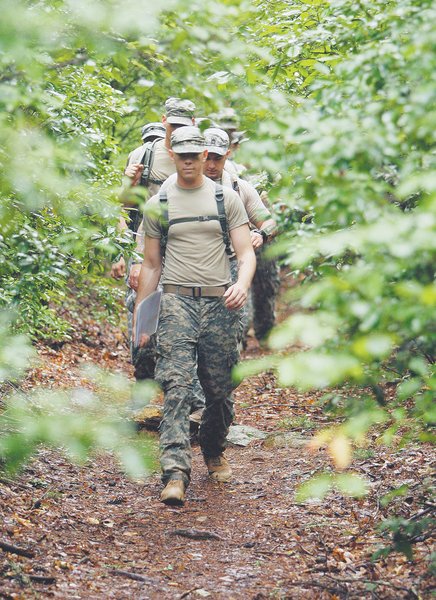
Army_Training_AT

Drenched in sweat, Army Capt. Aaron Hall peeled off his soggy socks and applied a liberal dose of foot powder before slipping on a dry pair and rallying his troops back to their throbbing feet. For an outfit used to being ferried from fight to fight in armored vehicles, a 50-mile march through the Appalachians was a little much.

Perhaps no unit better exemplifies the challenges presented by the Army’s transition from desert warfare in Iraq to rugged mountain campaigns in Afghanistan than the 3rd Infantry Division’s 4th Brigade, whose tanks and Bradley assault vehicles were among the first to rumble into Baghdad in the 2003 invasion.

Under a 2007 plan to grow the Army and diversify its forces, 4th Brigade is the only mechanized unit being ordered to ditch its tanks and Bradleys and relearn how to move through a war zone on foot.

Which is how Hall and his soldiers found themselves zigzagging through the mountains of north Georgia, trying to cover 50 miles in three days. Even after serving last year as a platoon leader in Iraq, Hall wasn’t used to that kind of exertion.

“Whenever they said ‘road march,’ it was pretty much get in your Bradleys and ride 20 miles,” said Hall, 28, of Canton, N.C. “Now, it’s put on your boots and your rucksack and start walking. We’re our own transportation.”

Commanders say the retooled brigade should be ready to deploy again late next year.

About 40 percent of the 3rd Battalion, 15th Infantry Regiment’s soldiers are holdovers from the unit’s previous incarnation as the 4th Battalion, 64th Armor Regiment.

After the unit returned from its third Iraq deployment in December, its tank drivers, gunners and mechanics transferred to other units as the switch to light infantry took hold. Many infantrymen trained to fight with Bradleys, tracked vehicles that resemble small tanks, stayed and now are getting used to fighting on foot.

As a mechanized infantry unit, each soldier had a designated seat in a vehicle. As light infantry, a rifle company of 135 troops has just five vehicles — Humvees and trucks — to share.

1st Sgt. Chad Brown learned to count on the Bradley’s speed and lethal weaponry during his three tours in Iraq. His soldiers would travel to drop-off points shielded by the vehicle’s thick armor, then conduct foot patrols under cover of its mounted machine gun and 25 mm cannon.

“Going from mech my whole career to light infantry, there is a concern of, ‘Oh man, where is the heavy firepower?'<2009>” said Brown, 34, of Kingsley, Mich. “I’ve been shot at sitting in Humvees and in Bradleys, and obviously I feel much more comfortable sitting in a Bradley.”

For soldiers used to the protection of armored vehicles, getting them comfortable with the added exposure of maneuvering on foot is mostly about back-to-basics training, as that’s how troops just entering the Army learn to fight, said Maj. John Grantz, executive officer of the 3-15 Infantry.

Captain Hall is doing Marine-style humping.  But wait … WAIT … WAIT!  Maybe not.

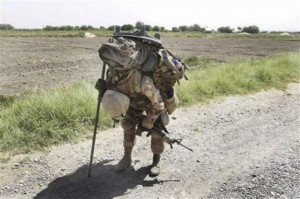
In the interests of prompting, promulgating, promoting, protracting and prolonging highly destructive inter-service rivalries, I must ask the question, “where is the body armor?”  You know, that extra 32 pounds of weight (with the IBA) that drags you down?  And I see a day-pack (with hydration), but not the full backpack that comes in at 75+ pounds.  Tisk … tisk …

Recall our Marine in Helmand with 120 pounds plus a mortar plate? khanjar_ii

Okay, so much for the internecine rivalries.  I will be out of pocket for the weekend carrying a little bit less weight on my back through the Pisgah National Forrest and avoiding anything electronic or web-based including this web site.  Have a great weekend.  Go Army!  Go Marine!

The MEK, Iran and Iraq

16 years, 4 months ago

Tom Ricks has a depressing and saddening post on the influence of Iran in Iraq relying on a first hand account by an Army officer.

Ghaz, as you may know, is mainly Shia in the northern half and Sunni in the southern half. We closed the last JSS in Ghaz on Sept. 7 (it had been allowed to stay open past the 30 June deadline) and the day after it was closed the Iraqi army battalion in south Ghaz raided the South Ghaz (Sunni) SOI headquarters, confiscating weapons and equipment a US unit had supplied them back in 2007-2008. The JSS, which straddled the Shia-Sunni fault line across the middle of Ghaz, was basically the buffer for the Sunni in the south. SOI and local council leaders were reported to have fled the neighborhood, citing Shia militia threats. Keep in mind, directly to Ghaz’s north is the Shia enclave of Shulla, a mini-Sadr City that is basically controlled by JAM remnant groups (and a heavily complicit Iraqi Army battalion). This Shia influence spills into north Ghaz and has been encroaching upon south Ghaz over the past several months.

For various reasons I am not concerned about Sunni-controlled areas like Anbar in Western Iraq (I am convinced that the Iraqi Police in Sunni-controlled areas have the upper hand).  But I am very concerned about the degree to which Iran controls the politics inside of Iraq, and no President since Carter has seriously confronted the Iranian Mullahs.  This was the great risk in Operation Iraqi Freedom, and we have not acted to in any way ameliorate that risk.

A good indication should be forthcoming as to where Iraq stands in its independence from Iran.  The MEK (People’s Mujahedin of Iran) had previously been in some trouble with the advent of the Status of Forces Agreement (SOFA).

An Iraqi judge ruled that the 36 dissidents, who went on a hunger strike in captivity, should be released. But Iraqi Interior Ministry officials, using new tactics, have argued that the dissidents entered the country illegally and should be expelled — obviously to Iran. If this tactic is successful, it could be applied to the 3,400 or so PMOI members remaining in Camp AshrafThe National Council of Resistance of Iran bluntly warned of the then-imuienant problem.

With the signing of a Status of Forces Agreement and the beginning withdrawal this year of American forces to their bases, the United States ceded sovereignty over Camp Ashraf to the Iraqis. The United States sought, and received, promises from the Iraqi government that Camp Ashraf’s population would be protected after the handover.

But Iran has been pressuring sympathetic Iraqi politicians to close the camp and expel the PMOI members. On July 28, Iraqi forces, saying they were establishing a police presence in the camp, launched an attack, killing 11 dissidents, wounding 450 and taking 36 hostages. U.S. forces nearby remained aloof.

The National Council of Resistance of Iran bluntly warned of the then-imminent problem.

Mohaddessin told Aftenposten, “We warned the United States that if the responsibility to protect Camp Ashraf is transferred to Iraq a humanitarian catastrophe would occur because the Iraqi government does Iran’s bidding. The forces’ attack against the camp did not surprise us; What we didn’t expect was the degree of brutality.”

There may be a reprieve coming.

Wednesday, Iraq’s chief prosecutor, Ghadanfar Mahmoud, issued a blanket order for police to release 36 members of an Iranian opposition group who were detained during a raid on their camp in northern Iraq in July.

The People’s Mujahedeen of Iran has claimed Iraqi security forces have refused to free the men even though they have not been charged by judicial authorities.

The group operated for years in Iraq under Saddam Hussein, but nearly 3,500 members have been confined to a camp since the U.S.-led invasion in 2003. The U.S. military turned over responsibility for Camp Ashraf to the Iraqis on Jan. 1.

“(The detainees) should have been released by now … We have issued orders to all police stations to release them wherever they are,” said Mahmoud.

As they have had in so many instances before, the Iraqi government has yet another opportunity to demonstrate that they aren’t lap dogs for the Iranian Mullahs.  If it weren’t so sad and so worn by now, the same thing could be said of the U.S. “negotiations” with Iran which have been going on for 30 years.

The Obama administration’s talks with Iran—set to take place tomorrow in Geneva—are accompanied by an almost universally accepted misconception: that previous American administrations refused to negotiate with Iranian leaders. The truth, as Secretary of Defense Robert Gates said last October at the National Defense University, is that “every administration since 1979 has reached out to the Iranians in one way or another and all have failed.”

After the fall of the shah in February 1979, the Carter administration attempted to establish good relations with the revolutionary regime. We offered aid, arms and understanding. The Iranians demanded that the United States honor all arms deals with the shah, remain silent about human-rights abuses carried out by the new regime, and hand over Iranian “criminals” who had taken refuge in America. The talks ended with the seizure of the American Embassy in November.

The Reagan administration—driven by a desire to gain the release of the American hostages—famously sought a modus vivendi with Iran in the midst of the Iran-Iraq War during the mid-1980s. To that end, the U.S. sold weapons to Iran and provided military intelligence about Iraqi forces. High-level American officials such as Robert McFarlane met secretly with Iranian government representatives to discuss the future of the relationship. This effort ended when the Iran-Contra scandal erupted in late 1986.

The Clinton administration lifted sanctions that had been imposed by Messrs. Carter and Reagan. During the 1990s, Iranians (including the national wrestling team) entered the U.S. for the first time since the ’70s. The U.S. also hosted Iranian cultural events and unfroze Iranian bank accounts. President Bill Clinton and Secretary of State Madeleine Albright publicly apologized to Iran for purported past sins, including the overthrow of Prime Minister Mohammed Mossadegh’s government by the CIA and British intelligence in August 1953. But it all came to nothing when Supreme Leader Ali Khamenei proclaimed that we were their enemies in March 1999.

Most recently, the administration of George W. Bush—invariably and falsely described as being totally unwilling to talk to the mullahs—negotiated extensively with Tehran. There were scores of publicly reported meetings, and at least one very secret series of negotiations. These negotiations have rarely been described in the American press, even though they are the subject of a BBC documentary titled “Iran and the West.”

At the urging of British Foreign Minister Jack Straw, the U.S. negotiated extensively with Ali Larijani, then-secretary of Iran’s National Security Council. By September 2006, an agreement had seemingly been reached. Secretary of State Condoleezza Rice and Nicholas Burns, her top Middle East aide, flew to New York to await the promised arrival of an Iranian delegation, for whom some 300 visas had been issued over the preceding weekend. Mr. Larijani was supposed to announce the suspension of Iranian nuclear enrichment. In exchange, we would lift sanctions. But Mr. Larijani and his delegation never arrived, as the BBC documentary reported.

My friend and fellow Marine father Michael Ledeen then goes on to describe the decades-long failure of sanctions against Iran.  It is must reading – especially for the current administration.  It remains to be seen whether Iraq fails as an independent state in light of the Iranian pressure from within and without.  It also remains to be seen what role the U.S. will play in regional stability.  Will we continue the same pattern of failed negotiations, or will we bring enough pressure to cause regime change – the only hope of avoiding war?

Generals Who Talk Tactics Rather Than Strategy

16 years, 5 months ago

The inability of the Afghan National Army or the Afghan National Police to independently create the conditions for stability and security in Afghanistan at the present (or anytime in the near future) has been a recurrent theme here at The Captain’s Journal (see Here is your Afghan National Army and Afghan National Police category).  Yet the strategy being implemented (i.e., heavy use of trainers and less U.S. troops than needed to secure the population) implicitly relies on this very strategy.  The fact that so few are seriously calling into question the basic tenets of the plan makes it unnecessary to defend it.

But Steve Coll gives us yet another reason for concern over the strategy.

I can think of three cases during the last four decades in which programs to strengthen Afghan security forces to either serve the interests of an outside power or suppress an insurgency or both failed because of factionalism and disunity in Kabul.

During the nineteen-seventies, the Soviet Union tried to build communist cells within the Army in order to gradually gain influence. The cells, unfortunately, split into two irreconcilable groups, and their squabbling became so disabling that the Soviets ultimately decided they had no choice but to invade, in 1979, to put things in order.

Then, during the late nineteen-eighties, faced with a dilemma similar to that facing the United States, the Soviets tried to “Afghan-ize” their occupation, much as the U.S. proposes to do now. The built up Afghan forces, put them in the lead in combat, supplied them with sophisticated weapons, and, ultimately, decided to withdraw. This strategy actually worked reasonably well for a while, although the government only controlled the major cities, never the countryside. But the factional and tribal splits within the Army persisted, defections were chronic, and a civil war among the insurgents also played out within the Army, ensuring that when the Soviet Union fell apart, and supplies halted, the Army too would crack up and dissolve en masse. (I happened to be in Kabul when this happened, in 1992. On a single day, thousands and thousands of soldiers and policemen took off their uniforms, put on civilian clothes, and went home.)

Finally, during the mid-nineteen-nineties, a fragmented and internally feuding Kabul government, in which Karzai was a participant for a time, tried to build up national forces to hold off the Taliban, but splits within the Kabul coalitions caused important militias and sections of the security forces to defect to the Taliban. The Taliban took Kabul in 1996 as much by exploiting Kabul’s political disarray as by military conquest. The history of the Afghan Army since 1970 is one in which the Army has never actually been defeated in the field, but has literally dissolved for lack of political glue on several occasions.

None of these examples offers a perfect analogy for the present, but the current situation in Kabul does contain echoes of this inglorious history.

But if we won’t openly question the strategy, we will issue tactical directives changing the rules of engagement.  It’s questionable whether the Afghans really even want this counsel to be implemented, but that doesn’t stop our generals from issuing tactical orders to Lance Corporals and Sergeants in the field.

The counter-example is given to us by the enemy.  The Washington Post has a provocative article concerning safe haven for the Quetta Shura in Pakistan (a subject our readers know well), but one particular nugget can be gleaned from this article that is salient to the discussion.

Virtually all of the Afghan Taliban’s strategic decisions are made by the Quetta Shura, according to U.S. officials. Decisions flow from the group “to Taliban field commanders, who in turn make tactical decisions that support the shura’s strategic direction,” a counterterrorism official said.

It would be better if General Stanley McChrystal didn’t try to tell combat-seasoned veterans when they could and couldn’t use fires.  But Mullah Omar has better things to do.  He sets strategy rather than dictates tactics.  While we are immersed in a sea of micromanagement and details, the enemy and his organization is beating us at the fundamentals.

The troops are available for Afghanistan

16 years, 5 months ago

Washington Post Associate Editor Rajiv Chandrasekaran penned an article entitled Go all-in or fold.  In it he touched on recurring themes here at The Captain’s Journal.  Excerpts are reproduced below.

There were two battalions to the north of Kandahar city. Another to the far south. Canadian forces were going to swing to the west. About 5,000 new U.S. troops in all.

“But there, there and there,” the officer said, pointing to towns just outside a belt where the Americans and Canadians were stationed, “and there,” putting his fist on the city, which with 800,000 residents is the country’s second-largest population center, “we don’t have anyone.”

If more forces are not forthcoming to mount counterinsurgency operations in those parts of the province, he concluded, the overall U.S. effort to stabilize Kandahar — and by extension, the rest of Afghanistan — will fail.

“We might as well pack our bags and go home . . . and just keep a few Predators flying overhead to whack the al-Qaeda guys who return,” he said, speaking on the condition of anonymity because of the sensitivity of the issue. “There’s no point in doing half-measures here” …

McChrystal’s 66-page confidential assessment makes the case for a far more expansive counterinsurgency mission, one that would involve sending more troops and civilian reconstruction personnel to Kandahar and other key population centers to improve security, governance and economic opportunities for Afghans. Although the general never used the term in the assessment, his strategy amounts to a comprehensive nation-building endeavor.

He wants U.S. and NATO personnel to expand training programs for Afghan soldiers and policemen, reform the justice system, promote more effective local administration and ramp up reconstruction. If that occurs, he and other counterinsurgency experts contend, then Afghans who have sided with the Taliban out of fear or necessity will eventually switch sides and support the government. Building an effective state, in McChrystal’s view, is the only way to defeat the insurgency.

The opposite view, espoused for some time by Vice President Biden and a growing number of liberal Democrats, is that such an effort has a slim chance of success given Afghanistan’s size and complexities: the suspicion of outsiders, the harsh terrain, the lack of an educated civil service, the endemic corruption and the tribal rivalries. Instead, they argue, the United States should scale back its operations and focus directly on trying to “disrupt, dismantle and defeat” al-Qaeda, the core counterterrorism goals for Afghanistan that Obama endorsed this spring. Special Forces teams and combat aircraft would remain at the ready to target any terrorists with international ambitions who seek to set up shop in the country.

Such an approach, proponents say, would result in far fewer U.S. casualties in Afghanistan, and it would reduce the strain of repeated deployments on the American military.

Given the profound gulf between those options, and the political risks entailed by either, some in the Obama administration, as well as Democratic leaders in Congress, have begun to look for a way to split the difference, to do “counterinsurgency light” or “counterterrorism plus” …

The fold approach — to engage simply in counterterrorism operations — is riddled with its own drawbacks: The Taliban would effectively control the country’s south and east, and a civil war would probably resume among it and ethnic Tajiks, Uzbeks and Hazaras for control of the west and the north. Counterterrorism missions would be hindered by a lack of on-the-ground intelligence. Pakistan could be further destabilized as the Taliban reverses its operations and starts using Afghanistan as a base from which to launch attacks across the border.

The last paragraph is the most salient and clear-headed.  As we pointed out with Senator Kerry’s approach and many times before, the light footprint will end in danger for SOF troopers who cannot get logistics, supplies or reliable air support.

With a small footprint of only SOF located in Afghanistan, logistics would be the first to go, and our troops wouldn’t have supplies for more than a couple of months.  Every person who has ever driven a fuel supply truck for us will have been beheaded.  The Afghan National Police will be killed by the population within a few months as retribution for the corruption, and the Afghan National Army will last a little longer – maybe three months.  Rescues will be attempted as a means of egress for the American HK (hunter-killer) teams lest they die.

The proposal to conduct mini-COIN operations from offshore “assumes first that in using SF and SOF we have the actionable intelligence and logistics to support their interdictions, raids and HVT killings.  We will not have that with a small footprint.  Intelligence sources are killed in small footprint campaigns because their is no force projection on the ground.  Logistics would be nonexistent because every participant in trucking supplies into the FOBs or launch points for these operations would have been beheaded or shot.  Thinking that this can all be done from offshore platforms is not serious analysis.  It’s wishful and even mythical thinking.”

As one of the first to predict the Tehrik-i-Taliban focus on the Khyber pass and Torkham Crossing to interdict logistics, I have watched as NATO lethargically engaged Russia, refusing to engage the Caucasus in order to create new lines of logistics.  The Northern logistics route into Afghanistan is now beginning to suffer from security problems due to the lack of NATO force projection and troop presence.

But an important question comes up for Rajiv Chandrasekaran during an online chat about this very article.

Fort Dix, N.J.: Sir,

Does the U.S. Army even have 45,000 troops available to send to Afghanistan?

ArmyVet

Rajiv Chandrasekaran: Good question. I’ve heard different things from different folks at the Pentagon. Some contend that we don’t have those forces at the ready. That’s true, but could some units being readied for Iraq, and others on training rotations, be quickly retooled to go to Afghanistan? Probably. A ramp-up in Afghanistan would also probably mean a modest acceleration in the withdrawal from Iraq.

It’s important to parse the arguments and objections.  The conversation becomes confused when too many objections are thrown out without the proper response – perhaps something at which the opponents of the campaign in Afghanistan are aiming.

I have addressed the issue of force availability before, but let’s do it again for good measure.  Not since before Operation Iraqi Freedom have so many Marines been aboard Camps Lejeune and Pendleton.  The Marines are essentially out of Anbar (except for a few remaining at places like al Asad air base).  The Marines have more than met their recruiting goals, and there are currently so many Marines at Camp Lejeune that many units cannot be garrisoned in the same barracks.  More barracks are being constructed, but not fast enough.  If Marines are not at Camps Lejeune or Pendleton, they (entire Battalions of Marine infantry) are aboard Amphibious Assault Docks as forces in readiness, awaiting orders that never come because of policy decisions that orient the U.S. away from using our forces in readiness.

The forces are available to pacify Afghanistan.  Several more Marine Regimental Combat Teams and/or air-ground tack forces could be deployed to the Helmand Province, and even several more to Kandahar.  The two provinces that constitute the home of the insurgency could be pacified by the U.S. Marines with the right commitment of resources.

So if the objection is that the campaign will incur losses, then the national conversation should be preoccupied with that problem.  The rules of engagement are another issue entirely, and without changes it’s doubtful that even the Afghans will believe that will be protected from the Taliban.  But the national conversation should forthwith jettison the notion that America doesn’t have the forces.

McChrystal, Troop Levels and Rules of Engagement

16 years, 5 months ago

60 Minutes did a report on General Stanley McChrystal in which the main theme was that General McChrystal is trying to deprogram eight years of bad habits in Afghanistan.  Killing civilians, running drivers off of the road, and generally being insensitive to the human terrain have kept us from winning the campaign.  It’s the ham handedness that is killing the effort – or so the report goes.  The exercise of air power has come to a virtual standstill in Afghanistan, and to contrast the current state of affairs with the previous, 60 minutes shows McChrystal visiting a town’s marketplace versus what I recognized to be a YouTube video of an A-10 run against a Taliban hideout.

The interviewer presses the issue of combat power.

“The hallmark of American military power was its overwhelming firepower. Now you’re describing a situation in which firepower is almost beside the point?” Martin asked.

“You know, the favorite saying of, ‘To a man with a hammer, everything looks like a nail.’ We can’t operate that way. We can’t walk with only a hammer in our hands,” McChrystal replied.

Thus McChrystal has issued a tactical directive that has essentially redounded to revised rules of engagement.  But this narrative is not compelling to those who have followed the campaign.  True enough, there are too many troops at large megabases in Afghanistan who ought to be on FOBs.  True enough, the campaign has had to rely very heavily on air power.  The large megabases can be emptied, but the need for air power still exists due to the force size.

The Taliban now have a permanent presence in 80% of Afghanistan due to lack of forces to counter their efforts and provide security.  While improvements can be made in the efficiency of the campaign, the narrative that bad habits have caused the diminution of the effort thus far is made-for-television theater, ending perfectly with a champion general who can repair the broken campaign and snatch victory from the jaws of defeat.

But it isn’t that simple, and McChrystal know it.  His request for more troops is meeting electoral politics head on, with political advisers being lined up to bolster a potential coming decision not to send more troops.  The never serious National Security Advisor Jim Jones has said of the deadline for deciding more troop levels “I don’t have a deadline in my mind. I think the most important thing is to do it right. But it is going to have a high priority in the administration to do this pretty relentlessly. We have a lot of other things on the table as well.”

Since no thinking American wants the National Security Advisor to worry about “other things on the table” as opposed to national security, the administration knows that it needs more firepower if it’s to deny McChrystal his troops.  Enter Colin Powell, who went on record saying “The question the president has to answer is, ‘What will more troops do?’ ” You have to not just add troops. You need a clear definition of your mission and then you can determine whether you need more troops or other resources.”

As if on cue, Jones warns that “it remains possible that, after a decision on strategy by the president, McChrystal might change his mind about the need for more troops. “We will ask General McChrystal, and say, ‘Okay, now that you’ve heard what our strategy is, does this affect your thinking in terms of your resources and, if so, how?’ ”

What would that strategy be?  As advocated by Senator Kerry, it’s likely to be a small footprint model, more oriented towards counterterrorism rather than counterinsurgency, thus returning us to the initial stages of Operation Enduring Freedom and the main reason we have watched the slow demise of the campaign.

McChrystal wants to conduct counterinsurgency, but not just any kind of counterinsurgency.  He has made protecting the population the center of gravity, the be all and end all of our efforts.  This has led to the tactical directive concerning kinetics when civilians could possibly be present.  The McChrystal interview with 60 minutes focused on the issue of civilian deaths above every other aspect of the effort.

But in a report that got almost no attention in military blogs, the locals aren’t giving this message to McChrystal.  Concerning the recent targeting of a stolen fuel tanker by an F-15, McChrystal found unexpected support from the Afghans.

At midday Saturday, after visiting the hospital and flying over the bombing site in a helicopter, the team met with two local officials. The NATO officers were expecting anger and calls for compensation. What they received was a totally unanticipated sort of criticism.

“I don’t agree with the rumor that there were a lot of civilian casualties,” said one key local official, who said he did not want to be named because he fears Taliban retribution. “Who goes out at 2 in the morning for fuel? These were bad people, and this was a good operation.”

A few hours later, McChrystal arrived at the reconstruction team’s base in Kunduz. A group of leaders from the area, including the chairman of the provincial council and the police chief, were there to meet him. So, too, were members of an investigative team dispatched by President Hamid Karzai.

McChrystal began expressing sympathy “for anyone who has been hurt or killed.”

The council chairman, Ahmadullah Wardak, cut him off. He wanted to talk about the deteriorating security situation in Kunduz, where Taliban activity has increased significantly in recent months. NATO forces in the area, he told the fact-finding team before McChrystal arrived, need to be acting “more strongly” in the area.

His concern is shared by some officials at the NATO mission headquarters, who contend that German troops in Kunduz have not been confronting the rise in Taliban activity with enough ground patrols and comprehensive counterinsurgency tactics.

“If we do three more operations like was done the other night, stability will come to Kunduz,” Wardak told McChrystal. “If people do not want to live in peace and harmony, that’s not our fault.”

McChrystal seemed to be caught off guard.

“We’ve been too nice to the thugs,” Wardak continued.

As McChrystal drove to the bombing site — defying German suggestions that the area was too dangerous — one senior NATO official noted that the lack of opposition from local officials, despite relatively clear evidence that some civilians were killed, could help to de-escalate tensions.

“We got real lucky here,” the official said.

But McChrystal still had a message to deliver. Even if the Afghan officials were not angry, he certainly did not seem pleased.

After fording the muddy river to see the bombing site — getting his pants wet up to his knees — he addressed a small group of journalists at the reconstruction team headquarters and said it was “clear there were some civilians harmed at that site.” He said NATO would fully investigate the incident.

“It’s a serious event that’s going to be a test of whether we are willing to be transparent and whether we are willing to show that we are going to protect the Afghan people,” he said.

McChrystal was caught off guard because what he heard from the Afghans doesn’t match the doctrine.  McChrystal knows doctrine, and the Afghans know unintended consequences.  They know that Taliban theft of fuel tankers meets with doom to the people around the tanker (unless McChrystal has his way).  They know that if the rules say that no fires can be directed towards domiciles that could potentially have noncombatants, even in self defense, the Taliban will surround themselves with noncombatants, in the end making it more dangerous for everyone.

To run the campaign as McChrystal wants – with diminished air support, with no fires towards areas where noncombatants could be located, with extensive dismounted patrols, and with no artillery support – means that he probably needs even more troops than he has requested.  It may not matter if the Obama administration has its way.

Insufficient Numbers of Marines

16 years, 5 months ago

Greyhawk (in a smart read that addresses the slow fall of Kandahar to the Taliban) comments on Why are we in the Helmand Province (where I was nonplussed by Nagl’s comparison of Fallujah 2004 to Kandahar 2009 and lobbied for seeing Helmand as a necessary element of the campaign) that Kandahar isn’t as bad as Fallujah was, nor should we allow it to get to that point.

Granted.  But the argument focused on the concept of center of gravity, and I still see the campaign as needing multiple lines of effort.  That brings me to the main point since more Marines would be required to address the campaign in this manner.  Greyhawk also comments:

Mr Smith has never noted a problem whose cause couldn’t be traced to insufficient numbers of Marines – and fixed by more. That last part has a kernel of truth, but there are other considerations.

Greyhawk understands me well … but perhaps a clarification is needed.  There are always other considerations, and so it would be more accurate to say that “Mr. Smith has never noted a problem in which a contributing cause couldn’t be traced to insufficient numbers of Marines – and fixed by more.”

The Marines can’t fix every problem, but lack of them in counterinsurgency dooms even the possibility of other lines of effort to be successful because of lack of force projection.

Update on Bank of America and Flag Controversy

16 years, 5 months ago

In Bank of America Removes American Flags Honoring Dead Marine and More on Bank of America Dishonoring the U.S. Marine Corps we covered a Bank of America branch in Gaffney, S.C. whose manager apparently followed corporate policy and removed American flags honoring a funeral procession for fallen Marine Lance Cpl. Chris Fowlkes.

This issue went viral and not only was this topic covered at many web sites and in many discussion forums, but one thing is clear beyond mere lack of patriotism.  Bank of America got caught in a lie.  They have said that there was a miscommunication in corporate policy that caused a branch worker to remove the flags, but that explanation doesn’t pass muster.  It might have been plausible if the branch wasn’t able to explain the reasoning behind it, but the justification for the action was that some of their customers “might be offended.”  The corporate communication also equivocates concerning the action itself.  It wasn’t merely a branch worker who said that the flags violated corporate policy.  It was the branch manager.

Furthermore, The Captain’s Journal had some hard questions for Bank of America in our original article, and after publication of this article, Bank of America network domains from across the country visited this page.  We demanded that a full account be given and no company executive has weighed in and given one.  They have had the chance to provide more than the lame excuse that they originally gave and have refused.  In separate but related news, the Cherokee County Council voted to close their Bank of America accounts.

Finally, we appreciate the attention and links that this article got, including but not limited to:

Mudville Gazette

Oklahoma Shooters discussion forum

FFCobra discussion forum

SCHotline Mobile

Patriot Guard Riders

Jenny Marie’s Blog

Glock Talk

The Gill Report (archived)

Michael Brown Today

The Guns Network

Frisco Online

AR15 Armory


26th MEU (10)
Abu Muqawama (12)
ACOG (2)
ACOGs (1)
Afghan National Army (36)
Afghan National Police (17)
Afghanistan (704)
Afghanistan SOFA (4)
Agriculture in COIN (3)
AGW (1)
Air Force (41)
Air Power (10)
al Qaeda (83)
Ali al-Sistani (1)
America (22)
Ammunition (304)
Animals (322)
Ansar al Sunna (15)
Anthropology (3)
Antonin Scalia (1)
AR-15s (393)
Arghandab River Valley (1)
Arlington Cemetery (2)
Army (91)
Assassinations (2)
Assault Weapon Ban (29)
Australian Army (7)
Azerbaijan (4)
Backpacking (4)
Badr Organization (8)
Baitullah Mehsud (21)
Basra (17)
BATFE (246)
Battle of Bari Alai (2)
Battle of Wanat (18)
Battle Space Weight (3)
Bin Laden (7)
Blogroll (3)
Blogs (24)
Body Armor (23)
Books (3)
Border War (18)
Brady Campaign (1)
Britain (39)
British Army (36)
Camping (5)
Canada (19)
Castle Doctrine (1)
Caucasus (6)
CENTCOM (7)
Center For a New American Security (8)
Charity (3)
China (19)
Christmas (18)
CIA (30)
Civilian National Security Force (3)
Col. Gian Gentile (9)
Combat Outposts (3)
Combat Video (2)
Concerned Citizens (6)
Constabulary Actions (3)
Coolness Factor (3)
COP Keating (4)
Corruption in COIN (4)
Council on Foreign Relations (1)
Counterinsurgency (218)
DADT (2)
David Rohde (1)
Defense Contractors (2)
Department of Defense (220)
Department of Homeland Security (26)
Disaster Preparedness (5)
Distributed Operations (5)
Dogs (15)
Donald Trump (27)
Drone Campaign (4)
EFV (3)
Egypt (12)
El Salvador (1)
Embassy Security (1)
Enemy Spotters (1)
Expeditionary Warfare (18)
F-22 (2)
F-35 (1)
Fallujah (17)
Far East (3)
Fathers and Sons (2)
Favorite (1)
Fazlullah (3)
FBI (39)
Featured (192)
Federal Firearms Laws (18)
Financing the Taliban (2)
Firearms (1,867)
Football (1)
Force Projection (35)
Force Protection (4)
Force Transformation (1)
Foreign Policy (27)
Fukushima Reactor Accident (6)
Ganjgal (1)
Garmsir (1)
general (15)
General Amos (1)
General James Mattis (1)
General McChrystal (44)
General McKiernan (6)
General Rodriguez (3)
General Suleimani (9)
Georgia (19)
GITMO (2)
Google (1)
Gulbuddin Hekmatyar (1)
Gun Control (1,717)
Guns (2,406)
Guns In National Parks (3)
Haditha Roundup (10)
Haiti (2)
HAMAS (7)
Haqqani Network (9)
Hate Mail (8)
Hekmatyar (1)
Heroism (5)
Hezbollah (12)
High Capacity Magazines (16)
High Value Targets (9)
Homecoming (1)
Homeland Security (3)
Horses (2)
Humor (72)
Hunting (60)
ICOS (1)
IEDs (7)
Immigration (123)
India (10)
Infantry (4)
Information Warfare (4)
Infrastructure (4)
Intelligence (23)
Intelligence Bulletin (6)
Iran (171)
Iraq (379)
Iraq SOFA (23)
Islamic Facism (64)
Islamists (98)
Israel (19)
Jaish al Mahdi (21)
Jalalabad (1)
Japan (3)
Jihadists (82)
John Nagl (5)
Joint Intelligence Centers (1)
JRTN (1)
Kabul (1)
Kajaki Dam (1)
Kamdesh (9)
Kandahar (12)
Karachi (7)
Kashmir (2)
Khost Province (1)
Khyber (11)
Knife Blogging (7)
Korea (4)
Korengal Valley (3)
Kunar Province (20)
Kurdistan (3)
Language in COIN (5)
Language in Statecraft (1)
Language Interpreters (2)
Lashkar-e-Taiba (2)
Law Enforcement (6)
Lawfare (14)
Leadership (6)
Lebanon (6)
Leon Panetta (2)
Let Them Fight (2)
Libya (14)
Lines of Effort (3)
Littoral Combat (8)
Logistics (50)
Long Guns (1)
Lt. Col. Allen West (2)
Marine Corps (281)
Marines in Bakwa (1)
Marines in Helmand (67)
Marjah (4)
MEDEVAC (2)
Media (68)
Medical (146)
Memorial Day (6)
Mexican Cartels (47)
Mexico (71)
Michael Yon (6)
Micromanaging the Military (7)
Middle East (1)
Military Blogging (26)
Military Contractors (5)
Military Equipment (25)
Militia (9)
Mitt Romney (3)
Monetary Policy (1)
Moqtada al Sadr (2)
Mosul (4)
Mountains (25)
MRAPs (1)
Mullah Baradar (1)
Mullah Fazlullah (1)
Mullah Omar (3)
Musa Qala (4)
Music (25)
Muslim Brotherhood (6)
Nation Building (2)
National Internet IDs (1)
National Rifle Association (97)
NATO (15)
Navy (31)
Navy Corpsman (1)
NCOs (3)
News (1)
NGOs (3)
Nicholas Schmidle (2)
Now Zad (19)
NSA (3)
NSA James L. Jones (6)
Nuclear (63)
Nuristan (8)
Obama Administration (222)
Offshore Balancing (1)
Operation Alljah (7)
Operation Khanjar (14)
Ossetia (7)
Pakistan (165)
Paktya Province (1)
Palestine (5)
Patriotism (7)
Patrolling (1)
Pech River Valley (11)
Personal (76)
Petraeus (14)
Pictures (1)
Piracy (13)
Pistol (4)
Pizzagate (21)
Police (672)
Police in COIN (3)
Policy (15)
Politics (998)
Poppy (2)
PPEs (1)
Prisons in Counterinsurgency (12)
Project Gunrunner (20)
PRTs (1)
Qatar (1)
Quadrennial Defense Review (2)
Quds Force (13)
Quetta Shura (1)
RAND (3)
Recommended Reading (14)
Refueling Tanker (1)
Religion (499)
Religion and Insurgency (19)
Reuters (1)
Rick Perry (4)
Rifles (1)
Roads (4)
Rolling Stone (1)
Ron Paul (1)
ROTC (1)
Rules of Engagement (75)
Rumsfeld (1)
Russia (37)
Sabbatical (1)
Sangin (1)
Saqlawiyah (1)
Satellite Patrols (2)
Saudi Arabia (4)
Scenes from Iraq (1)
Second Amendment (708)
Second Amendment Quick Hits (2)
Secretary Gates (9)
Sharia Law (3)
Shura Ittehad-ul-Mujahiden (1)
SIIC (2)
Sirajuddin Haqqani (1)
Small Wars (72)
Snipers (9)
Sniveling Lackeys (2)
Soft Power (4)
Somalia (8)
Sons of Afghanistan (1)
Sons of Iraq (2)
Special Forces (28)
Squad Rushes (1)
State Department (23)
Statistics (1)
Sunni Insurgency (10)
Support to Infantry Ratio (1)
Supreme Court (79)
Survival (214)
SWAT Raids (58)
Syria (38)
Tactical Drills (38)
Tactical Gear (17)
Taliban (168)
Taliban Massing of Forces (4)
Tarmiyah (1)
TBI (1)
Technology (21)
Tehrik-i-Taliban (78)
Terrain in Combat (1)
Terrorism (96)
Thanksgiving (13)
The Anbar Narrative (23)
The Art of War (5)
The Fallen (1)
The Long War (20)
The Surge (3)
The Wounded (13)
Thomas Barnett (1)
Transnational Insurgencies (5)
Tribes (5)
TSA (25)
TSA Ineptitude (14)
TTPs (4)
U.S. Border Patrol (8)
U.S. Border Security (22)
U.S. Sovereignty (29)
UAVs (2)
UBL (4)
Ukraine (10)
Uncategorized (105)
Universal Background Check (3)
Unrestricted Warfare (4)
USS Iwo Jima (2)
USS San Antonio (1)
Uzbekistan (1)
V-22 Osprey (4)
Veterans (3)
Vietnam (1)
War & Warfare (432)
War & Warfare (41)
War Movies (4)
War Reporting (21)
Wardak Province (1)
Warriors (6)
Waziristan (1)
Weapons and Tactics (80)
West Point (1)
Winter Operations (1)
Women in Combat (21)
WTF? (1)
Yemen (1)

February 2026
January 2026
December 2025
November 2025
October 2025
September 2025
August 2025
July 2025
June 2025
May 2025
April 2025
March 2025
February 2025
January 2025
December 2024
November 2024
October 2024
September 2024
August 2024
July 2024
June 2024
May 2024
April 2024
March 2024
February 2024
January 2024
December 2023
November 2023
October 2023
September 2023
August 2023
July 2023
June 2023
May 2023
April 2023
March 2023
February 2023
January 2023
December 2022
November 2022
October 2022
September 2022
August 2022
July 2022
June 2022
May 2022
April 2022
March 2022
February 2022
January 2022
December 2021
November 2021
October 2021
September 2021
August 2021
July 2021
June 2021
May 2021
April 2021
March 2021
February 2021
January 2021
December 2020
November 2020
October 2020
September 2020
August 2020
July 2020
June 2020
May 2020
April 2020
March 2020
February 2020
January 2020
December 2019
November 2019
October 2019
September 2019
August 2019
July 2019
June 2019
May 2019
April 2019
March 2019
February 2019
January 2019
December 2018
November 2018
October 2018
September 2018
August 2018
July 2018
June 2018
May 2018
April 2018
March 2018
February 2018
January 2018
December 2017
November 2017
October 2017
September 2017
August 2017
July 2017
June 2017
May 2017
April 2017
March 2017
February 2017
January 2017
December 2016
November 2016
October 2016
September 2016
August 2016
July 2016
June 2016
May 2016
April 2016
March 2016
February 2016
January 2016
December 2015
November 2015
October 2015
September 2015
August 2015
July 2015
June 2015
May 2015
April 2015
March 2015
February 2015
January 2015
December 2014
November 2014
October 2014
September 2014
August 2014
July 2014
June 2014
May 2014
April 2014
March 2014
February 2014
January 2014
December 2013
November 2013
October 2013
September 2013
August 2013
July 2013
June 2013
May 2013
April 2013
March 2013
February 2013
January 2013
December 2012
November 2012
October 2012
September 2012
August 2012
July 2012
June 2012
May 2012
April 2012
March 2012
February 2012
January 2012
December 2011
November 2011
October 2011
September 2011
August 2011
July 2011
June 2011
May 2011
April 2011
March 2011
February 2011
January 2011
December 2010
November 2010
October 2010
September 2010
August 2010
July 2010
June 2010
May 2010
April 2010
March 2010
February 2010
January 2010
December 2009
November 2009
October 2009
September 2009
August 2009
July 2009
June 2009
May 2009
April 2009
March 2009
February 2009
January 2009
December 2008
November 2008
October 2008
September 2008
August 2008
July 2008
June 2008
May 2008
April 2008
March 2008
February 2008
January 2008
December 2007
November 2007
October 2007
September 2007
August 2007
July 2007
June 2007
May 2007
April 2007
March 2007
February 2007
January 2007
December 2006
November 2006
October 2006
September 2006
August 2006
July 2006
June 2006
May 2006

about · archives · contact · register

Copyright © 2006-2026 Captain's Journal. All rights reserved.