Dean Weingarten has a good find at Ammoland.
Judge Eduardo Ramos, the U.S. District Judge for the Southern District of New York, has issued an Opinion & Order that a ban on stun guns is constitutional. A New York State law prohibits the private possession of stun guns and tasers; a New York City law prohibits the possession and selling of stun guns. Judge Ramos has ruled these laws do not infringe on rights protected by the Second Amendment of the United States Constitution.
Let's briefly…… [read more]
Main stream media reports almost across the board are gushing at the rejection of Islamism that allegedly dominated the recent Pakistani elections. There are too many such reports to enumerate here, but one extreme example will suffice from McClatchy.
Pakistani voters have handed Islamist political parties a massive defeat, virtually eliminating them from regional parliaments.
The election Monday is likely to have a wide-ranging effect on efforts to rein in growing Taliban and al-Qaida influence in Pakistan’s North West Frontier province.
In 2002, fundamentalist religious parties, some openly sympathetic to the Taliban, won 12 percent of the national vote. That was enough to form a regional government in the province that borders Afghanistan. It also allowed the parties to become part of the ruling coalition in Baluchistan, another province, and to hold 57 seats in the 342-member national Parliament.
But unofficial results of Monday’s vote indicate that religious parties won only five seats in the national Parliament. In North West Frontier province, where the country’s Islamic insurgency is strongest, religious parties won just nine seats in the 96-seat provincial assembly. In 2002, they won 67.
“This is a sea change,” said Khalid Aziz, a political analyst based in the province’s capital, Peshawar. “The people have rejected the much-hyped Islamic nation concept.”
This is strong analysis – “sea change,” and “massive defeat.” Yet this doesn’t even qualify as good surface level cursory analysis. In order to understand what the Pakistani voters rejected and what they didn’t, it is important to go backwards in time to understand what is being called the “next generation Taliban” by the smarter analysts. For this we must turn to Nicholas Schmidle. His most extensive commentary and analysis from his time spent in Pakistan is entitled Next-Gen Taliban in the New York Times Magazine (a small portion of this important analysis is included below).
Efforts at democratic integration by parties like the J.U.I. have now been overshadowed by the violence of their antidemocratic Islamist colleagues – a network of younger Taliban fighting on both sides of the Afghan-Pakistani border, jihadis pledging loyalty to Al Qaeda and any number of freelancing militants. Disrupting and discrediting democracy may, of course, be the point. The Bhutto assassination could well make moderation impossible, as Islamist radicals savor their disruptive power – and enraged mainstream parties threaten the stability of the government itself …
In Quetta, Maulvi Noor Muhammad, who is 62, sat on the madrassa’s cold concrete floor wrapped in a wool blanket as he leafed through a newspaper. Speaking in Pashto through an interpreter, he said that Maulana Fazlur Rehman, the J.U.I. chief, had visited three times in the previous few weeks to persuade him to enter the election. Muhammad claimed to have refused each time because he believed the J.U.I. had drifted from its core mission: to lead an aggressive Islamization campaign and provide political support to what he referred to as the mujahedeen, a term for Muslim fighters that can shift in meaning depending on who is speaking. “Participating in this election would amount to treason against the mujahedeen,” he said. I asked about the others in the party who had decided to run for office. Muhammad shook his head in disappointment and explained how, following the government operation against the Red Mosque rebels in Islamabad, Pakistan’s capital city, in July, President Musharraf put religious leaders under tremendous pressure. “Musharraf threatened to raid several madrassas,” Muhammad said. “The political mullahs got scared.”
Maulana Fazlur Rehman is exactly the sort of “political mullah” whom Muhammad portrayed as running scared. In the past year, the J.U.I. chief has tried to disassociate himself from the new generation of Taliban wreaking havoc not only across the border in Afghanistan, as they have for years, but also increasingly in Pakistan. At the same time, Rehman has been trying to persuade foreign ambassadors and establishment politicians here that he is the only one capable of dealing with those same Taliban. (Rehman told me that he never offered Muhammad a chance to enter the election; he even added that the J.U.I. had already expelled the Taliban guru “on disciplinary grounds.” ) In the process, some Islamists maintain that Rehman has sold them out. Last April, a rocket whistled over the sugarcane fields that separate Rehman’s house from the main road before crashing into the veranda of his brother’s home next door. A few months later, Pakistani intelligence agencies discovered a hit list, drafted by the Afghan and Pakistani Taliban, with Rehman’s name on it.
“The religious forces are very divided right now,” I was told by Abdul Hakim Akbari, a childhood friend of Rehman’s and lifelong member of the J.U.I. I met Akbari in Dera Ismail Khan, Rehman’s hometown, which is situated in the North-West Frontier Province. According to this past summer’s U.S. National Intelligence Estimate, approved by all 16 official intelligence agencies, Al Qaeda has regrouped in the Tribal Areas adjoining the province and may be planning an attack on the American homeland. “Everyone is afraid,” Akbari told me. “These mujahedeen don’t respect anyone anymore. They don’t even listen to each other. Maulana Fazlur Rehman is a moderate. He wants dialogue. But the Taliban see him as a hurdle to their ambitions. ”
Rehman doesn’t pretend to be a liberal; he wants to see Pakistan become a truly Islamic state. But the moral vigilantism and the proliferation of Taliban-inspired militias along the border with Afghanistan is not how he saw it happening. The emergence of Taliban-inspired groups in Pakistan has placed immense strain on the country’s Islamist community, a strain that may only increase with the assassination of Bhutto. As the rocket attack on Rehman’s house illustrates, the militant jihadis have even lashed out against the same Islamist parties who have coddled them in the past.
The next generation Taliban, unlike their predecessors in the tribal region who also want total Islamism in Pakistan and Afghanistan, completely reject democratic means to accomplish such change. They are also more savvy technically and have no theological baggage regarding reluctance to suicide missions. The Taliban in Afghanistan are learning from the jihadists across the globe who have travelled to Pakistan to fight, and suicide missions in Afghanistan are increasing, and increasingly carried out by Afghanis themselves.
Does this mean the end of Islamism in Pakistan? Not quite. In fact, while the defeat of Musharraf’s political allies in the PML (Q) signals a new political leadership in Islamabad, the defeat of the MMA could also signal a new political and religious leadership in the troubled areas along the border with Afghanistan. In the North West Frontier Province, where the MMA formed the provincial government last term, the Islamists’ vote bank was a combination of die-hards who desired the creation of an Islamic state and those less ideologically driven who were attracted to the MMA’s promises of justice, economic renewal, and security. This time around, the latter voted for the Awami National Party. The former, such as Iqbal Khan of the Swat Valley, joined the Taliban.
Note well Schmidle’s analysis. The less ideologically driven voter abandoned the Islamist party, but then, he never voted for that party for the purposes of institution of sharia law anyway. He voted for jobs, sewers, electricity, water supply and good governance several years ago and got none of what he voted for. Hence, he overthrew the clerics this time around. The die-hards joined the Taliban. There are various colors and stripes of jihadists the world over, from Salafism to Wahhabism, from the purist Sunni radicals in Saudi Arabia to the Shi’a Mullahs and their followers in Iran. But one common element among them all is the utter rejection of democracy. Democracy is deemed to be directly contrary to Islam, and the Taliban, al Qaeda and their sympathizers and advocates sat out the election. They had no stake in it.
So what will be the likely outcome of the Pakistani elections? No military action against the Taliban, just more talk, based on sentiment expressed just prior to the election.
“We must sit with [the Taleban], we must talk to them, we are from the same origin, we are from the same people, we’ve got the same language.”
Mardan candidates also believe a democratic, civilian government would have more legitimacy to negotiate with the Taleban than one led by a former general, like President Musharraf.
That has yet to be proven, says Rahimullah Yusufzai, an expert on the Taleban.
“I don’t think they have a strategy to deal with this,” he says.
“All are saying that if they’re in power they will negotiate with the Taleban, the extremists. That policy has been tried by Mr Musharraf. So I think the same policy will continue: military operations, peace accords, ceasefires, I think this trend will continue.”
The situation is even more shaky than that. Combined U.S.-Pakistani operations were planned in the tribal region prior to the election and are now cancelled. Further, the U.S. finds herself in the position of needing Pakistan more than she needs the U.S.
“Americans cannot do anything if we stop the operations in tribal areas. If they stop military aid, they are welcome to do so. We don’t need military aid. All we need is economic aid and they just cannot afford to stop it. Why? Because all NATO supply lines pass through Pakistan and if they stop economic aid, Pakistan can stop supply lines which would end their regional war on terror theater once and for all. This is the biggest crime of Musharraf – that he could not understand the strategic value of Pakistan in the region and could not exploit it.”
There are strategically difficult and tenuous times ahead for Pakistan-U.S.-Afghanistan relations. The existence and strength of the Taliban and al Qaeda and the future of the counterinsurgency campaign in Afghanistan hangs in the balance. Whatever the future holds, the Pakistani voters have not rejected Islamism. They have rejected lack of jobs and financial security because leaders of the Madrasah didn’t know what they were doing when they tried to govern a society. Islamism has nothing whatsoever to do with it. Making up fairy tales about what they meant when they cast their vote doesn’t help the counterinsurgency campaign in this troubled region of the world.
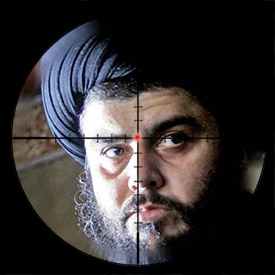
It has been speculated that Moqtada al Sadr would not renew his cease fire with U.S. troops (and opposing Shi’a elements). It is well known that I have strongly advocated the assassination of Mookie, and I have cried buckets of tears over my schemes for his demise. Because of this interest (obsession?), an individual (unnamed shooter from an undisclosed location – a buddy of mine) sends me this shot … um, picture, with Mookie in his sights as I write. As he sent it we were both repeating deep and meaningful chants and congratulating each other on this lifetime achievement.
Contact. Contact with the enemy. Counterinsurgency includes security for the population, construction of infrastructure, amelioration of community problems, and good governance. It cannot ultimately be won without these (and other) elements. But it also cannot be won without contact with and defeat of the enemy. The Marines have participated in untold meals with families, construction of sewage and water systems, and other things that brought them into contact with the population in Anbar. But contact with the enemy has been a staple of Marine operations in Anbar, and one result is that there are few if any insurgents left to carry on the fight. It has been many months since a Marine casualty resulting from combat operations. One can argue with the warrior ethos, but the results speak for themselves and need no apology.
When the Marines of 2nd Battalion, 6th Regiment, conducting Operation Alljah in Fallujah, turned over to their replacement unit, most Marines headed for Camp Baharia but a few stayed behind to complete the turnover to their replacements. During mounted patrols, one SAW gunner / machine gunner drilled one particular message home every day and on every mission: “If you make contact with the enemy and withdraw or retreat, you have lost. You might wait until later and use night vision, or use satellite patrols now, or use flanking maneuvers, or some other tactic. But if you don’t engage, you have lost. Period. Don’t ever pull back from contact. It only makes them stronger.”
Pajamas Media gives us an account of the current situation in Afghanistan, and the observations are important and instructive.
Here’s a verbal snapshot of Kabul today. It was written by an American businessman who wrote to a friend of mine who forwarded his words to me. He has a dry and ironic wit and a keen eye. His information is accurate and utterly heartbreaking.
“First of all, the roads aren’t paved. Also, there are no street lights. Not a lot of trees. That’s because almost all of the trees in the country have been cut down for firewood. They’re digging up the roots now. That’s in Kabul.
Second, there must be something strange about the gene pool there because there aren’t any women. I was there six days and there are 100 men in the streets for every woman. And most of them are completely covered. I didn’t see one Afghani couple on a date. In fact, I didn’t see anybody on a date. The restaurants have guards with Ak47’s and double sets of walls to avoid the car bombers. In case you don’t speak Pushto or English, there are big signs with pictures of AK47s x’d out in red just so everybody understand the dress code if you want to eat.
Third, nobody can read. And there is not a lot of room for improvement there because I saw an awful lot of kids in the street begging or working. It was reassuring that none of them were younger then 5. Well, I’m not sure, some of them might have been 4.”
Fourth, no one in the American Embassy is allowed to leave. To eat, to go shopping, even to fool around—assuming that there was anyone to fool around with or someplace to go. They can go to a private house if there is enough security.
Fifth, the Army allows it’s personnel to leave to go out, but they have to be in an armored vehicle. The part about that is that the tactics seem to be completely different from the Petreaus handbook which is a work of genius. Even the soldiers say they are going out of their minds. Its really hard to stay fit and alert in a compound.
The use of trees (and now roots) for firewood to stay warm has been going on for quite a while, and shows that the U.S. has done little if anything to ameliorate the sad power and fuel conditions. Crop rotation, good agricultural practices and proper land management cannot hope to take hold unless basic necessities are addressed. The important observations here are too numerous to fully discuss.
The one salient observation for our purposes is the notion of force protection versus contact with the population … and the enemy. This theme seems to be prominent in the Afghanistan theater. The Australians – who have been a staunch ally in both the Afghanistan and Iraq campaigns – have recently remarked that contact may make their jobs more dangerous.
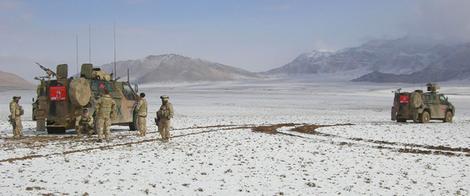
An Australian patrol from the Reconstruction Task Force takes a break in the Chora valley in Afghanistan (theage.com.au)
AUSTRALIAN instructors working with Afghan army units will be in greater danger as they go into action further from their home bases, says Defence Force chief Angus Houston.
Defence Minister Joel Fitzgibbon announced on Tuesday that Australia was establishing a 70-strong training team in Afghanistan.
Air Chief Marshal Houston told a Senate estimates hearing in Canberra yesterday that Australian soldiers building a forward operating base for the Afghan Army in the Chora Valley were fired on yesterday by insurgents using rockets. No one was hurt.
Air Chief Marshal Houston said the biggest danger in Afghanistan now was not a wave of Taliban fighters coming over a hill but “very lethal” home-made bombs, which were becoming common. The improvised explosive devices now caused 70% of coalition casualties in Afghanistan, Air Chief Marshal Houston said.
He supported Mr Fitzgibbon’s concerns that Australia was not being given enough information about the conflict by NATO, which largely controls the war against the Taliban.
He said he was satisfied with the information relevant to operations in Oruzgan Province, where most Australians are based.
“The problem has been the higher-level NATO work, because fundamentally NATO is set up to deal with NATO members, NATO countries — not participating members such as ourselves.”
He said he hoped that now Australia would gain full access to strategic plans for southern Afghanistan and it was likely that the international security forces would be better co-ordinated during the campaign season following the Afghan winter’s end.
The Marines in Anbar know all about the IEDs, as well as fighters hiding in rooms and on the rooftops. The only way to defeat them is through contact – contact that Fitzgibbon knows brings additional risk. IEDs can only be defeated by killing or capturing the IED-makers. But without sustaining this risk, the result is loss of the campaign. As for the NATO strategy, force protection is not a strategy, and hope is not a plan. Thus there is no strategy.
As for the 3200 Marines who will soon deploy to the Afghan theater, their doctrine can be summed up as “close with and destroy the enemy by fire and maneuver or repel the enemy’s assault by fire and close combat.” This is not mere sloganeering. The ethos of the Marines runs directly counter to the current malaise that grips the NATO project in Afghanistan. Without entering into whether the MARSOC unit that deployed to Afghanistan was disciplined enough or the particulars of the engagement in which civilians perished (there is reason to believe that the charges may be dismissed), the reports by Army leadership are more telling on the Marines’ departure than any element of the particular engagement.
A big issue was that the Marines seemed to be dissatisfied with the reconnaissance missions that the Army commanders envisioned for them, even though the Marines, with their heavy Force Recon background, were supposed to be reconnaissance experts.
“They resisted it and kept wanting to go do the direct [action] missions,” he said. They strayed from their area, looking for bad guys.
“They never went in their assigned battle space,” the field-grade Army officer said. “They were always looking for missions outside of their battle space.”
Before they leave Camp Pendleton, Marines are getting an advanced course in tracking — taught by a big-game hunter from South Africa.
The Combat Hunter course at the School of Infantry is meant to teach Marines how to notice the slightest change in the landscape that shows a person has passed by, no easy trick in a desert where winds erase footprints in an instant.
The Marines are taught to be hyper-aware of their environment: What’s there that should not be there? What isn’t there that should?
The project is the brainchild of the Marine Corps commandant, Gen. James Conway. “If we create the mentality in our Marines of the hunter, and take on some of those skills, then we’ll be able to increase our combat effectiveness,” he has said.
While Iraq is the immediate focus, the course is also applicable to Afghanistan, where several thousand Marines will soon be deployed. But while the ways of the hunter may be old, the instructional methods have been updated. Each Marine, along with lectures and field work, gets a 15-minute CD: “Every Marine a Hunter.”
The current institutional and strategic malaise in the NATO project in Afghanistan is about to be stirred up with the presence of 3200 warrior-hunters who want to make contact with the enemy. The real re-examination of the campaign won’t come as a result of the addition of 3200 troops. It will come with the addition of a completely different ethos than has previously been in theater. Re-examination should be a healthy process, even if a difficult one.
In Looming Battle for Mosul we discussed Mosul as the last major stronghold of al Qaeda (after their being routed from Anbar and Baghdad) and the Iraqi Security Forces plans to retake Mosul. The reports were short on details, but we observed that:
… the battle would fare better if al Qaeda and the remaining Ba’athists are rendered unable to flee and relocate prior to this battle, as happened at the onset of the “surge” and security plan for Baghdad when the U.S. announced the plan. Checkpoints should already be operational, and the ISF should make significant use of barricades, roadblocks, gated communities and other elements of counterinsurgency that have proven valuable in the battles for Fallujah and Baghdad.
From Azzaman, we learn that al Qaeda may have already fled.
U.S. and Iraqi troops are carrying out military operations in heavily populated areas of the northern city of Mosul to flush out insurgents.
And in their bid they are separating and isolating residential quarters with security barriers and walls making movement rather difficult.
Some quarters like Yarmouk, Thawar and Siha are completed isolated.
The city, Iraq’s second largest with nearly three million people, has turned into a major stronghold for the Iraqi branch of Qaeda and anti-U.S. rebels.
But provincial officials, speaking on condition of anonymity, say the Qaeda and other groups opposing U.S. occupation have either fled or merged with the population.
With no guarantees given that the troops would not repeat the mistake committed in other rebel cities in the subjugation of which the U.S. employed warplanes and heavy artillery, tens of thousands of residents are fleeing to safer areas.
The U.S. military says the massive airstrike it launched on Thursday was a success. The attack was directed against suspected al-Qaida in Iraq weapons depots outside of Baghdad. VOA’s Deborah Block has details from the Iraqi capital.
Military officials say U.S. bombers and fighter jets dropped a total of 48 bombs on 47 targets used by insurgents to store weapons. The airstrike was one of the largest in the war. Officials say the attack destroyed what they describe an an insurgent “defensive belt” around Baghdad. The attack in Arab Jabour, just south of Baghdad, is part of a large-scale operation launched this week against al-Qaida in Iraq by U.S. and Iraqi forces.
Air power has become extremely precise in Operation Iraqi Freedom, even on urban terrain. If residents are fleeing, it is more than likely due to the desire to avoid conflict, and this last statement by Azzaman is probably just propaganda. But the balance of the report is interesting in that the same affects resulted from preparations to launch operations as with the initial phases of the surge, i.e., the enemy flees.
All is not lost, however. The installation of gated communities is a positive development, as long as the troop commitment can leverage them to the advantage of the coalition. In other words, the troops necessary to take, hold and rebuild must be necessary, and as long as this precondition obtains, al Qaeda has lost one of its last holdouts. They might congregate in another area, but troop commitment can accomplish the same thing there. Time will tell how many al Qaeda remain in Mosul and how serious the kinetic operations become to root them out of the city.
Michael Semple is the one who coordinated the turnover of Musa Qala to Mullah Abdul Salaam. Salaam is the erstwhile mid-level Taliban ‘commander’ who promised to field military forces (from among the tribes) to battle the Taliban, and who then retreated to his domicile and screamed for help when the battle between British / U.S. forces and the Taliban started. This same Michael Semple believes that we can persuade the Taliban to show good form and play nice.
Two-thirds of the Taliban-led insurgents in Afghanistan can be persuaded to abandon violence, according to a British aid worker expelled from the country for opening talks with some of those allied to the militant group.
Michael Semple, a UN official arrested by the Afghan government on Christmas Day last year, said he was confident that most Taliban-linked insurgents could be absorbed into Afghanistan’s reconciliation process.
In his first interview with a British news organisation since he was forced to leave Afghanistan by the government of President Hamid Karzai, Semple defended his role in talking to elements linked to the Taliban. Until 2003 he had been a senior political adviser to the British embassy in Kabul.
Semple told the Guardian that he and the EU official Mervyn Patterson, who was also expelled, were victims of local politics. He said a local leader in Helmand province falsely blamed them for talking to what he described as “one of the irreconcilables” in the conflict. They had, he said, opened no such channel to al-Qaida-linked Taliban.
“There is a critical difference between what is discreet and what is covert,” Semple said. “What we were doing was simply discreet because that was what was required. But it was totally in line with official policy to bring people in from the cold.”
Describing the process of wooing Taliban-linked elements away from the insurgency, he cited the example of a leader in Helmand named Mullah Mamuk, whose regional enemies told western forces in 2001 that he was a terrorist, leading to his appearing on a most wanted poster.
“So naturally Mamuk goes to the Taliban to feel safe and takes those men he commands who are loyal to him with him, shows Taliban commanders the poster and says ‘It looks like I am now with you,’ Semple said.
“The authorities simply got the wrong guy and drove him into the Taliban’s hands. Now he is currently fighting against the British in Helmand but in my opinion local leaders like Mamuk can be won back over again.” Semple advocated creating a “network of patronage” to lure men like Mamuk away from the Taliban.
“It’s worth remembering there are an awful lot of Mullah Mamuks out there who can easily switch sides away from the Taliban and that is why I firmly believe that with good management you could break two-thirds of the insurgents away from those irreconcilables,” he said. He added that some of those arrested and taken to Guantánamo Bay during the early period of the US-led invasion had switched sides to the Karzai government.
“Take Haji Naeem Kochi, someone I have known for a very long time in Afghanistan. After 9/11 and the invasion he ended up doing time in Guantánamo Bay,” Semple said.
“When he came back … I met up with him. The first thing I asked him was did he learn any English and he replied: ‘Yes, but all I learned was sit up and sit down from the American guards.’ Yet despite doing time in Guantánamo he is now a member of the peace commission aimed at reconciling all Afghans.”
Semple described the controversy that led to his expulsion as “totally manufactured” by a local political leader jealously guarding resources given to him by the central government. This leader feared for his power base if ex-insurgents and former Taliban were brought into the peace process, Semple said.
“We were victims of local politics initially and being seen to take on the foreigners – in this case us – is seen as very popular in many places in Afghanistan. We were soft targets and the whole thing was spun well by him.”
He drew a comparison between what he and Patterson were seeking to achieve in Helmand and what the US had done in Anbar province in Iraq, where American forces opened talks with Sunni insurgents which resulted in setbacks for al-Qaida.
Michael Semple is stolid, and his reduction of the Anbar campaign to persuading the Sunnis to play nice is absurd and doesn’t even rise to the level of a childlike understanding of what happened in Anbar. Semple should have fought alongside the Marines in 2004 – 2007 when they lost men to IEDs, snipers rounds, and RPGs, while continuing to force contact with the enemy until the enemy was persuaded that the choice for them was to play nice or die at the hands of the Marines.
To see the Anbar narrative as a few special forces operations against high value targets and talky-talk with the enemy is utterly to mistake the Anbar narrative. For all of his evil, Osama bin Laden is strategically brilliant, and understood the value the population places on being the stronger horse: ” … when people see a strong horse and a weak horse, by nature, they will like the strong horse.” Relentless kinetic operations and patient counterinsurgency won Anbar, and the notion of a tribal chief one day waking up and “flipping” sides is foolish nonsense. Even Sheikh Abdul Sattar Abu Reesha had to have his smuggling lines cut and dismembered by specially designed kinetic operations before he would “see the light” and decide that it was better to side with the U.S. In Anbar, the Marines were the stronger horse.
Semple is ignoring other differences between some of the Sunni insurgency in Anbar (i.e., the indigenous fighters) and the Taliban and al Qaeda. That is, the fighters in the Afghanistan / Pakistan theater fight more for religious persuasion than did the indigenous Sunnis in Anbar (the Taliban are more like al Qaeda in Anbar who had to be defeated militarily). Semple’s plan is nothing more than a simpleton’s (or shyster’s) “get rich quick” scheme for counterinsurgency. No troops, no fighting, no kinetic operations, no force projection, no public commitment, and no hard decisions. Just talk and persuasion. You may as well go purchase snake oil from the local street peddler. Michael Semple is weaving fairy tales and daydreaming of butterflies and pretty flowers. Meanwhile, if one of Mullah Omar’s men finds Michael Semple in the countryside somewhere in Afghanistan, they would be happy to slice him open from throat to belly. Such is the difference between Semple and the Taliban. Semple doesn’t understand this – but the Taliban do.
Admiral Michael Mullen recently made serious and ominous predictions in recent congressional testimony. “Defense Department officials told members of Congress on Wednesday that Al Qaeda was operating from havens in “undergoverned regions” of Pakistan, which they said pose direct threats to Europe, the United States and the Pakistani government itself. Admiral Michael Mullen, chairman of the Joint Chiefs of Staff, predicted in written testimony that the next attack on the United States probably would be made by terrorists based in that region.”
In order for this testimony to be seen in its proper context, some background is necessary. Relentless kinetic and nonkinetic operations in Anbar by U.S. forces has accomplished two things throughout late 2006 and 2007. First, al Qaeda has taken a heavy toll among its numbers. The recent capture of an al Qaeda Emir’s diary catalogs the decline in fighers in one area of operation from slightly less than a Battalion to less than two squads. Prime Minister Maliki recently announced that al Qaeda had been routed from Baghdad due to the security plan the U.S. launched a year ago. The second affect of intensive U.S. operations is the co-opting of erstwhile indigenous insurgents into the concerned local citizens program. There are still ongoing operations in Mosul, but the al Qaeda campaign in Iraq is an abysmal failure.
There has also been an increased difficulty in deploying to the Iraq theater. According to General David Petraeus, the influx of foreign fighters into Iraq is down, but not just due to any actions by Syria. “Much of the fall in numbers was due to countries barring young men from flying to the Syrian cities of Damascus and Aleppo on one-way tickets.” Conversely, Admiral J. Michael McConnel recently testified before Congress that “we have seen an influx of new Western recruits into the tribal areas [in Pakistan] since mid-2006.” But Western recruits are not the only ones who have traveled to the tribal regions of Pakistan and Afghanistan to join with Taliban and al Qaeda fighters (the so-called Federally Administered Tribal Areas).
The Combating Terrorism Center at West Point has recently released Issue 3 of the CTC Sentinel, which includes an important article by Brian Glyn Williams entitled “Return of the Arabs: Al-Qa’ida’s Current Military Role in the Afghan Insurgency.” Within the context of the Iraq campaign, Williams sets up the coming Taliban / al Qaeda operations in Afghanistan as beginning in Iraq.
By 2007, jihadist websites from Chechnya to Turkey to the Arab world began to feature recruitment ads calling on the “Lions of Islam” to come fight in Afghanistan. It appears that many heeded the call. This was especially true after the Anbar Awakening of anti-al-Qa`ida tribal leaders and General David Petraeus’ “surge strategy” made Iraq less hospitable for foreign volunteers.
Since 2002, one of al-Qa`ida’s main roles has been diverting wealth from the Arab Gulf States to funding the struggling Taliban. One recently killed Saudi shaykh named Asadullah, for example, was described as “the moneybags in the entire tribal belt.” Men like Asadullah have paid bounties for Taliban attacks on coalition troops, provided money to Taliban commanders such as Baitullah Mehsud to encourage them to attack Pakistani troops and launch a suicide bombing campaign in that country, and used their funds to re-arm the Taliban. Local Pashtuns in Waziristan and in Afghanistan’s Kunar Province have claimed that the Arab fighters pay well for lodging and food and provide money for the families of those who are “martyred” in suicide operations. According to online videos and local reports, al-Qa`ida is also running as many as 29 training camps in the region, albeit less elaborate than those found in Afghanistan in the 1990s.
The Arabs have also played a key role in “al-Qa`idifying” the Taliban insurgency and importing the horror tactics of the Iraqi conflict to Afghanistan. Key Taliban leaders, such as the recently slain Mullah Dadullah, have claimed that they learned suicide bombing techniques from their Arab “brothers.” Al-Qa`ida has also distributed tutorial jihadist videos throughout the Pashtun regions that give instructions on how to build car bombs, IEDs and inspirational “snuff film” images of U.S. troops being killed in Iraq. The first wave of suicide bombings in Afghanistan seems to have been carried out by Arabs, and it appears clear that it was al-Qa`ida—which has long had an emphasis on istishhad (martyrdom) operations—that taught the local Taliban this alien tactic. Arabs such as Abu Yahya al-Libi have also been influential in encouraging the technophobic Taliban fundamentalists to create “Islamic Emirate of Afghanistan” online videos of Zarqawi style beheadings, IED attacks and suicide bombings.
Furthermore, it appears that Arab fighters have actively partaken in insurgent activities within Afghanistan itself in increasing numbers. Insurgents in the Kunar Valley in Nuristan, for example, have chosen Abu Ikhlas al-Masri, an Egyptian who speaks Pashtu and is married to a local woman, to lead a group of as many as 170 fighters. Arab operations in this area are facilitated by its cross-border proximity to Bajaur Agency and support from a local Taliban leader named Ahmad Shah and insurgent leader Gulbuddin Hekmatyar, the latter of which has a long history of working with Arabs. Arabs have also filmed themselves attacking coalition targets in Nangarhar, Paktia, Paktika, Khost, Uruzgan, Logar and Zabul provinces.
Most recently, Arabs have also been sighted farther afield fighting in the unstable southern province of Helmand under a first generation Arab Afghan leader named Abu Haris. Local Helmandi villagers also reported seeing Arab fighters in the village of Musa Qala, a town that was occupied by the Taliban for most of 2007. They reported that the Arab fighters set up suicide bombing facilities and were extremely brutal. As in previous eras where they earned a reputation for butchery (in 1991, for example, Arab fighters hacked captured Communist Afghan Army soldiers to pieces following the capture of Jalalabad), the Taliban’s Arab allies were reported to have executed locals they suspected of being “spies.”
Such actions hardly endeared the locals to the Taliban, and there are bound to be future tensions between the Arabs and the Taliban that echo those that often caused “red on red” conflict between Afghan mujahidin and Arab Wahhabis in the 1980s. The distrust between the Arabs—who come to the “backward” lands of Afghanistan from the comparatively developed Gulf States—are said to stem from the Arab puritans’ disdain for local Afghan Sufi “superstitions,” their most un-Afghan desire to achieve “martyrdom” and their wish to lead their own fighting units.
A local Taliban commander captured the ambiguous nature of the Taliban-al-Qa`ida alliance when he claimed of the Arabs: “They come for the sacred purpose of jihad. They fight according to Shari`a law.” He then, however, added an important caveat: “No foreign fighter can serve as a Taliban commander.” Even key al-Qa`ida field commanders, such as the recently slain Libyan leader Abu Laith al-Libi (the commander who led al-Qa`ida’s retreat from Afghanistan in 2001), operated under the command of Mullah Omar.
Despite the potential for tensions, al-Qa`ida’s head of operations in Afghanistan, an Egyptian named Mustafa Abu’l-Yazid, who is said to have good relations with the Taliban, has proclaimed that al-Qa`ida in Afghanistan recognizes the authority of Mullah Omar. For its part, the Taliban has charged one Mehmood Haq Yar, a Taliban commander who has allegedly been to Iraq to learn the Iraqi insurgents’ tactics, with making sure Arabs play a role in the Afghan jihad. It appears that both sides are united in their desire to topple the Hamid Karzai government and carve out an Islamic state in the tribal areas of Pakistan.
While it is difficult to estimate the number of Arab fighters in the region, it seems obvious that al-Qa`ida central is determined to play a key role as a fundraiser, recruiter and direct contributor to the military efforts in both Afghanistan and Pakistan. Moreover, unlike the earlier generation of “gucci jihadists” who made little if any real contribution to the jihad against the Soviets, the current generation seems determined to remind the West that the “Lions of Islam” have not forgotten the “Forgotten War” in Afghanistan.
The Afghanis are learning (ideologically) from the foreigners coming in to help the campaign, and also (tactically) from the Iraq campaign.
In Afghanistan, the Taleban now claim to have influence across most of the country and have extended their area of control from their traditional heartland in the south.
They are able to operate freely even in Wardak Province, neighbouring the capital Kabul, as a BBC camera crew who filmed them recently found.
One of their commanders in Wardak, Mullah Hakmatullah, said they do not control the roads nor the towns, but they hold the countryside and have increasing support because of the corruption of the administration.
“The administration do not solve people’s problems. People who go there with problems have to give a lot of money in bribes and then they get stuck there,” Mullah Hakmatullah said.
Support from villagers is essential to their ability to continue operations through the winter months.
The overall military commander of the Taleban in Wardak, Mullah Rashid Akhond, claimed to have 2,000 active fighters.
The fighters say locals support their brand of justice.
He said that he was operating an administrative system with orders coming from Kandahar in the south, just like during the days of the Taleban government that fell in 2001.
He said that the Taleban were running their own courts. “People are taking their cases away from the government courts and coming to us. Now there is no robbery in our area.”
Many of the suicide bombers who go to Kabul come from this area, just an hour’s drive away. Mullah Akhond justified them, saying that most of the attacks are now carried out by Afghans themselves, not foreign fighters.
Afghanistan and Pakistan face the next generation Taliban, who unlike their predecessors, are more savvy concerning technology, but just as radical in ideology and without the baggage of the theological reluctance of suicide (or martyrdom) missions. Most recently, a suicide bomb was used to conduct offensive operations against Taliban enemies in Afghanistan, killing at least 80 men and boys.
A suicide bomber blew himself up at a tribal festival near the southern city of Kandahar yesterday, killing at least 80 men and boys and wounding about 90 more in the bloodiest bombing in Afghanistan since 2001.
Officials said the target was a key anti-Taleban commander who played a vital role in keeping the guerrillas out of a district they have been fighting to take over for more than two years. Abdul Hakim, who died in the attack, was a staunchly independent commander with the Alokozai tribe whose private army of 500 men had fought the Taleban and sometimes clashed with Afghan security forces as well.
Mr Hakim, a former guerrilla in his late forties who had fought the Russians before serving for a while as the police chief of Kandahar, was one of the Taleban’s oldest and toughest foes in the Arghandab district west of the city. He first fought Mullah Omar, the Taleban leader, in 1994.
Although too independent to be a formal ally of the Kabul Government, he had been credited with helping to hold back Taleban fighters in one of the most strategically important regions of southern Afghanistan. The Taleban have pledged to conquer Kandahar, their old capital, and have fought bloody battles with Canadian and Afghan forces in the Arghandab, an area of orchards and farms which is one of the main approach routes to the city.
Mr Hakim’s death could be a heavy blow to attempts to hold them back. Dozens of his Alokozai tribesmen were also killed when the suicide bomber blew himself up at the tribal festival about 15 minutes’ drive from the city.
The same tactics are in use in Pakistan, and Taliban operations in Pakistan and Afghanistan should be seen as fronts in the same war. The campaign in Afghanistan is utterly dependent upon supply routes through Pakistan. This video below shows the torturous mountain passes through which some supplies must travel and the enemy operations against these supply lines.
More recently, Baitullah Mehsud’s forces have begun effectively to target main arteries through Pakistan to interdict these same supplies. Danger is on the rise in both Pakistan and Afghanistan, and yet the Afghan government is stolid and obstinate in its denial of the need for more forces, while this same government’s corruption is hindering counterinsurgency efforts.
The campaign in Afghanistan drew down from conventional operations too soon, and yet this mistake is being repeated by drawing down from kinetic operations against the Taliban and al Qaeda in favor of military transition teams and road construction. The forces to effect both are apparently not in place, and there is an ever shrinking window of opportunity to win the campaign in the region, while also acknowledging the difficulty of drawing down in Iraq.
In a winter that is worse than any in recent memory in Afghanistan, Taliban operations have been kept to a minimum. We should expect to see a resurgence in operations commensurate with the number of forces and motivation of the enemy.
As expected, there is world wide buzz over the involvement of the international intelligence community in the assassination of Imad Mughniyeh. In addition to the public claims by Hezbollah that the Mossad directed the event, there is the assertion that the U.S. masterminded the plan.
A Kuwaiti newspaper reports that Hizbullah terrorist chief Imad Mughniyeh, who was killed in a car-bomb attack in Damascus on Tuesday, was in the midst of planning major terrorist attacks in moderate Arab countries when he was killed.
Al-Watan reports that American intelligence had learned that Mughniyeh arrived in Damascus three days earlier with instructions from, and in coordination with, the Iranians. His objective was to meet with Hizbullah leaders and coordinate a mass attack, for which he was to receive help from Syrian intelligence.
The American involvement in the killing is explained as being in retaliation for a recent car bomb attack that targeted a U.S. Embassy vehicle; three passersby (sic).
Another Kuwaiti newspaper, Al-Siasa, reports that Mughniyeh took part, shortly before he was killed, in a secret meeting in the Iranian School in Damascus. Also participating in the meeting were Syrian Intelligence Chief Gen. Aisaf Shwackath, Hamas chief Khaled Mashaal, and an Islamic Jihad representative. On the agenda: planned attacks in Arab countries that refuse to take part in the coming Arab League summit in Damascus. The newspaper entertains the possibility that the meeting was merely a camouflage for Syrian involvement in Mughniyeh’s killing.
In addition to Mughniyeh’s atrocities against America and her interests there is no question that the U.S. administration was desirous of his demise. Mughniyeh trained Moqtada al Sadr’s forces in Iraq, the Mahdi Army. In fact, in case there was any remaining doubt as to the inclinations of Sadr and his followers, al Sadr declared three days of mourning after learning of the assassination of Mughniyeh. As I stated in Assassination of Imad Mughniyeh, I continue to believe that the U.S. was not involved in the assassination plan, at least not directly. The report of American involvement is possibly disinformation. If the CIA was involved, it is a good sign of the resurgence of the field capabilities and human intelligence of the CIA. This report sweeps from blaming the U.S. to Syria. But Syria either looks inept or complicit.
A Western diplomat based in Damascus said the incident was a double embarrassment for Syria — “on account of (Mughniyeh) being here and because they could not protect him.”
“The Syrian security agencies have a lot of explaining to do as to how a hit like this could be carried out in a city that’s remarkably secure,” said Jon Alterman, head of the Middle East program at Washington’s Center for Strategic and International Studies.
“Some in the security services were either caught unaware or are complicit in the killing,” he said.
The Interior Ministry confirmed Mughnieh’s role. Interior Minister Sheikh Jaber Khaled al-Sabah was quoted Wednesday that “all of Kuwait is pleased by Mughnieh’s killing.” He was also quoted as saying that “The killing of the criminal Imad Mughniyeh was divine vengeance from those who killed the sons of Kuwait and threw them from planes at Limasol Airport in Cyprus,” the minister said.
Most Kuwaiti dailies welcomed his assassination and recalled the hijackings, the killing of two Kuwaiti passengers and the series of bombings. The 17 prisoners consisted of 12 Iraqis who belonged to the Dawa party of Prime Minister Nuri al-Maliki, and five Lebanese, one of them Ilyas Saab, the brother-in-law of Mughnieh, according to Kuwaiti dailies. Kuwaiti courts convicted three of them to death and the rest to various jail terms. Three others were sentenced to death in absentia, allegedly including Iraq lawmaker Jamal Jafaar Mohammed of the Dawa party.
Yet it doesn’t end there. Internal Lebanese politics and civil war (due to actions by Hezbollah) has taken its toll on the balance of power in the Middle East, and sabers are rattling.
There was alarm when Walid Jumblatt used the word “war” in a statement on Sunday in Baaqlin. The Druze leader’s words were harsh, even if he did not say that he welcomed war, but only made his willingness to fight one conditional on the opposition’s wanting war. But Lebanon has been split by a cold civil war for over a year now, and as the country commemorates the third anniversary of Rafik Hariri’s assassination today, Jumblatt’s rhetoric may have, paradoxically, helped stabilize the situation – even if stabilization remains a relative concept.
The assassination in Damascus of Imad Mughniyeh, whatever its larger implications, may actually bolster this modest stability. Hizbullah’s leadership will likely need time to assess where it is, and what Mughniyeh’s killing means for the party and its relations with Tehran.
Syrian security forces have arrested several Palestinian suspects in connection with the assassination, but this may be for show. The smoke still hasn’t cleared concerning this assassination. However, one thing is clear. Mughniyeh was considered untouchable and to most unrecognizable,” a senior intelligence source said. “This is a monumental intelligence achievement.”
When the National Intelligence Estimate that was recently released concluded that Iran had suspended its nuclear weapons program, my initial inclination was to summarily ignore it. It wasn’t that I saw it as a weighty and significant assessment that might challenge my own suspicions concerning Iran. No, it seemed to me to be a thing of pity. It was as if a committee had been asked to formulate an assessment that was far beyond their capabilities or knowledge level. Undaunted, they plowed ahead, pretending they knew something that they didn’t, and the NIE was the product. It wasn’t right, or wrong, or in between, or important. It was simply fantasy – irrelevant and not worthy of any time or attention.
The U.S. has recently shared sensitive information with the International Atomic Energy Agency on key aspects of Iran’s nuclear program that Washington says shows Tehran was directly engaged in trying to make an atomic weapon, diplomats told The Associated Press on Thursday.
The diplomats said Washington also gave the IAEA permission to confront Iran with at least some of the evidence in an attempt to pry details out of the Islamic republic on the activities, as part of the U.N. nuclear watchdog’s attempts to investigate Iran’s suspicious nuclear past.
The decision by the U.S. administration to declassify its intelligence and indirectly share it with Iran through the IAEA was a clear reflection of Washington’s’ drive to pressure Iran into admitting that it had focused part of its nuclear efforts toward developing a weapons program.
While the Americans have previously declassified and then forwarded intelligence to the IAEA to help its investigations, they do so on a selective basis.
Following Israel’s bombing of a Syrian site late last year, and media reports citing unidentified U.S. officials as saying the target was a nuclear installation, IAEA chief Mohamed ElBaradei turned, in vain to the U.S. in asking for details on what was struck, said a diplomat who—like others—asked for anonymity in exchange for divulging confidential information.
Shared in the past two weeks was material on a laptop computer reportedly smuggled out of Iran, said another diplomat, accredited to the IAEA. In 2005, U.S. intelligence assessed that information as indicating that Tehran had been working on details of nuclear weapons, including missile trajectories and ideal altitudes for exploding warheads.
He said that after declassification, U.S. intelligence also was forwarded on two other issues—the “Green Salt Project”—a plan the U.S. alleges links diverse components of a nuclear weapons program, including uranium enrichment, high explosives testing and a missile re-entry vehicle, and material in Iran’s possession showing how to mold uranium metal into warhead form.
It appears as if my initial inclination concerning the NIE was correct.
Our buddy GI at Forward Deployed has an article up on the main stream media demagoging high school recruiting rates, in which he takes direct aim at the notion of recruiting problems due to the global war on terror.
The claim that the wars in Afghanistan and Iraq are responsible for the military accepting more recruits with GEDs is an assumption by the AP writer and not a fact which is something the writer does not make clear. The Army recruiting spokesman told the writer the difficult recruiting environment had to do with the drop in graduation rates but some how the AP writer contributes it to the war on terror.
Why didn’t the AP writer disclose what the current high school graduation rates are? Could it be because it would sink his article because high school graduation rates are currently hovering around the 70% range, which is nearly identical to what the US military is allowing in? It is a whole other topic, but I find our US graduation rate highly embarrassing and have heard our politicians say anything about what they are going to do to improve it. Anyway, it seems like this is a highly pertinent fact that should be included in the article, but it wasn’t probably because it would ruin the AP writer’s narrative that war on terror is responsible for the decline.
Besides the decline in high school graduation rates the Army is going through a massive increase in soldiers:
Plans are to raise the number of active-duty Army, Army Guard and Army Reserve by 74,000 overall, with the active-duty force rising by 65,000 to a total of 547,000. In October, top Army leaders said they planned to move faster to expand the force by adding the full 74,000 soldiers by 2010, two years earlier than originally planned.[Stars & Stripes]
This increase is on top of the prior increases US military recruiters had to deal with in recent years. It is extremely impressive that recruiters have been able to meet recruiting goals, but I predicted last year that recruiters will probably have a hard time meeting this latest increase in troops especially if the economy remains strong, which is another fact that was some how missing from the AP article.
Declining high school graduation rates, an expanding military, and a strong economy all have much more to do with the drop in high school graduates than blaming it on the war on terror, but obviously the AP could care less because the narrative of blaming it on the war on terror fits with their on going theme that the war on terror is breaking the military.
Finally, I just want to say I find it extremely snobby that because someone has a GED they are considered by the AP to be a poor recruit. I know plenty of soldiers with GEDs that were much better soldiers than soldier that I had that had college degrees much less a high school diploma.
I agree across the board with GI. But if we are to grow the military over the next several years, something must be done to encourage not only recruits, but re-enlistments as well. Jeff Jacoby has a commentary up at the Boston Globe in which he advocates the notion of granting automatic citizenship to illegal aliens for military service.
Flooding our armed forces with illegal aliens is without a doubt a highly draconian and dreadful idea. I have a better one. I propose an across the board 40% increase in all salaries for all service members, this proposal having no bearing on other incentives or signing bonuses. The only assumption behind this proposal is that America cares enough about its own self defense to properly fund the armed forces.
Mughniyeh was killed late Tuesday night after a bomb, planted inside the seat of his car, exploded in Damascus’s upscale Kafar Soussa neighborhood. Security forces quickly sealed off the area and removed the destroyed car, which had its driver’s seat and the rear seat blown away by the blast.
Considered Hizbullah’s operations chief, Mughniyeh co-founded the group in 1982 together with Hizbullah chief Hassan Nasrallah, and was a member of its ruling Shura Council. He was in charge of all overseas operations, and as the chief operations officer, coordinated Hizbullah relations with the Iranian Revolutionary Guards.
Not only was he a very bad actor, he was perhaps the smartest terrorist in the Middle East, and getting inside his daily habits is an incredible feat.
As Robert Baer, who hunted Mugniyeh for years as a CIA officer, describes Mughniyeh, ““He is the most dangerous terrorist we’ve ever faced. He is probably the most intelligent, most capable operative we’ve ever run across, including the KGB or anybody else. He enters by one door, exits by another, changes his cars daily, never makes appointments on a telephone, never is predictable. He only uses people that are related to him that he can trust. He doesn’t just recruit people. He is the master terrorist, the grail that we have been after since 1983.”
Haaretz is carrying a short list of his accomplishments (also here), one of which is masterminding the bombing of the Marine barracks in Lebanon in 1983. Mughniyeh was a major player in the world of terror, and was probably more important than Hassan Nasrallah, the leader of Hezbollah. The U.S. is welcoming the news of his demise. Israel is denying any involvement in the assassination, and perhaps the most interesting assessment of who might have done this is given to us by Michael Ledeen.
There will be a lot of speculation about his killers. Hezbollah has already accused the Israelis, which is what you’d expect them to say. But there are many others who hated Mughniyah, ranging from various Lebanese and Saudi groups who held him responsible for the assassination of Rafiq Hariri, to anti-Iranian and anti-Syrian groups, especially some of the Kurds, to our very own spooks and soldiers, who have long yearned for revenge against the man who organized the brutal murder of Robert Stethem, the suicide bombings against the U.S. Marines in Beirut, similar acts against U.S. diplomats and spooks at our Embassies in the same city, and of course Khobar Towers in Saudi Arabia, and the dreadful death-by-torture of our top spy in Beirut in the mid-1980s.
I doubt we did it. Indeed, I rather suspect that CIA was bound and determined NOT to go after Mughniyah, even though there was a bounty on his head. I know of several instances in which CIA vetoed proposals from well-placed people who claimed to be able to kill or capture Mughniyah, and I have spoken to government officials in Washington who were astonished at the Agency’s lack of vigor. Nonetheless, I have no doubt we will hear from several “experts” that it was a CIA operation.
Israel is more likely, and has a proven ability to operate in Damascus, although Olmert has denied any Israeli involvement. On the other hand, it may have been a joint operation involving a European intelligence service (the French, who were big supporters of Hariri, come to mind) and a local group, perhaps Lebanese Druse, perhaps Syrian and/or Iranian Kurds.
There are a number of possibilities, but I agree with Ledeen – the U.S. didn’t do it. President Gerald R. Ford signed Executive Order 11905 on February 18, 1976, which in part states that “No employee of the United States Government shall engage in, or conspire to engage in, political assassination.” Whether this was wise is beside the point. This, in addition to two administrations under President Clinton, stripped the CIA of its human intelligence and also its capability to effect change within the international intelligence community.
In a national atmosphere in which CIA employees are at risk of prosecution for waterboarding – something that wasn’t illegal when it was done, is not illegal now, and only recently received a vote from the Senate – to believe that a CIA employee would either be involved in such a plan or even hire operatives who would be involved in such a plan, is not credible. This is especially true given that, like the State Department and Department of Homeland Security, there are CIA employees who are actively working for the loss of the global war on terror and would willingly turn over fellow employees if it was found out that an executive order had been violated.
Still, I will observe that this order hamstrings the CIA. It was succinctly stated by one Israeli commando officer that in order to fight people like this the U.S. needs to “adopt Israel’s assassination policy.” I am in agreement, and have called for the assassination of both Hassan Nasrallah and Moqtada al Sadr. Too much can be made of individuals and personalities. As I have pointed out before, the focus on high value targets can take the focus off of the necessity for kinetic operations against the enemy holistically. Yet replacing this individual will be difficult for Iran, and the world is a far better place because he is dead.