Dean Weingarten has a good find at Ammoland.
Judge Eduardo Ramos, the U.S. District Judge for the Southern District of New York, has issued an Opinion & Order that a ban on stun guns is constitutional. A New York State law prohibits the private possession of stun guns and tasers; a New York City law prohibits the possession and selling of stun guns. Judge Ramos has ruled these laws do not infringe on rights protected by the Second Amendment of the United States Constitution.
Let's briefly…… [read more]
As we had previously discussed, a recent visit by National Security Advisor Jim Jones to the front lines in Afghanistan was an opportunity to say, one Marine to another, you get no more support from us. You’re on your own.
During the briefing, (Brig. Gen. Lawrence) Nicholson had told Jones that he was “a little light,” more than hinting that he could use more forces, probably thousands more. “We don’t have enough force to go everywhere,” Nicholson said.
But Jones recalled how Obama had initially decided to deploy additional forces this year. “At a table much like this,” Jones said, referring to the polished wood table in the White House Situation Room, “the president’s principals met and agreed to recommend 17,000 more troops for Afghanistan.” The principals — Secretary of State Hillary Rodham Clinton; Gates; Mullen; and the director of national intelligence, Dennis C. Blair — made this recommendation in February during the first full month of the Obama administration. The president approved the deployments, which included Nicholson’s Marines.
Soon after that, Jones said, the principals told the president, “oops,” we need an additional 4,000 to help train the Afghan army.
“They then said, ‘If you do all that, we think we can turn this around,’ ” Jones said, reminding the Marines here that the president had quickly approved and publicly announced the additional 4,000.
Now suppose you’re the president, Jones told them, and the requests come into the White House for yet more force. How do you think Obama might look at this? Jones asked, casting his eyes around the colonels. How do you think he might feel?
Jones let the question hang in the air-conditioned, fluorescent-lighted room. Nicholson and the colonels said nothing.
Well, Jones went on, after all those additional troops, 17,000 plus 4,000 more, if there were new requests for force now, the president would quite likely have “a Whiskey Tango Foxtrot moment.” Everyone in the room caught the phonetic reference to WTF — which in the military and elsewhere means “What the [expletive]?”
Nicholson and his colonels — all or nearly all veterans of Iraq — seemed to blanch at the unambiguous message that this might be all the troops they were going to get.
To which The Captain’s Journal responded:
It’s his job – while all of the other principals are outlining a strategy and force projection that they believe will be endorsed by the President – to be whispering in the ear of the President: “Listen to them, but only so far. Iraq has taught us that this is harder than we think it will be on our first or even second or third take. If they’re telling you that the Afghan National Army can substitute for our own troops, they aren’t accounting for the drug addiction, incompetence and treachery of the Afghan Army. This will be long term, protracted, part of the long war. Iraq was long and hard, and Petraeus rightly said that Afghanistan would be the longest engagement in the long war. Fully expect for them to come back asking for more troops, because they will need them. You are a wartime President, sir.”
But his malfeasance in office gets even worse, and we recently learned about the apparently extent of the error in his Afghanistan narrative.
How this is Obama’s war as opposed to America’s war we aren’t told. Nor are we told how sending more troops to kill Taliban and secure Afghanistan is risky to the campaign in this horrible report. The report is mostly worthless, except for what we learn about Jones, who said:
The arrival of new troops, coupled with a strategy that is much broader, and that is more multifaceted, has the potential to turn this thing around in reasonably short order.
Really? Seriously? In reasonably short order? Remember those words. So what is this new strategy?
“This will not be won by the military alone,” Jones said in an interview during his trip. “We tried that for six years.” He also said: “The piece of the strategy that has to work in the next year is economic development. If that is not done right, there are not enough troops in the world to succeed.”
This statement is remarkable not for what it advocates – the softer side of counterinsurgency and nation building – but for what it doesn’t. Michael Yon’s most recent report from Afghanistan shows the need for a vibrant economy in order to prevent low level insurgents from earning money by working for the hard core Taliban. But Jones misleads us when he states that we have tried military action alone for six years.
There has been significant effort put into construction, projects (consider for instance the Kajaki Dam and the effort placed into reclaiming the ring road), and nation building (see The U.S. Department of Agriculture Does COIN). More could be done, but it isn’t correct to assert that there has been no effort placed into economic development.
It is equally incorrect to say that the military option has been tried. No, the high value target campaign conducted by clandestine SF operators against mid-level Taliban commanders has been tried. Classical counterinsurgency with significant military force projection (like with the Marines in the Anbar Province of Iraq) hasn’t been tried until now. And hence, the reason the Marine Colonels went ashen when they heard Jones say that they had all of the troops they were going to get. They come from the Anbar Province, and they thought that they were going into the Helmand Province of Afghanistan to conduct classical counterinsurgency. Apparently not, and so there will remain vast amounts of territory in the hands of the Taliban.
As for economic revitalization while the Taliban still roam free, Philip Smucker gives us a look into what this means.
QALA-I-NAW, Badghis province – At dusk when the sun slips over the parched hills in northwestern Afghanistan, spreading a pink hue over the land, families and caravans stop to spend the night in the poorest province in the poorest country of Asia. The wells are dry, lights do not burn and hopes remain muted.
This is a story about people living in an arid, unforgiving moonscape; one that could be mistaken for the middle of nowhere, but could one day be a major stop on one of the most important highways in Asia.
For three years, the United States, China, the Asian Development Bank and the North Atlantic Treaty Organization (NATO) have promised the residents of Badghis province integration with the rest of Asia. They have vowed to complete the last link of Afghanistan’s national ring road, which will connect western China and Central Asian countries through Afghanistan with Iranian seaports and world markets.
Blocking the way, however, is an expanding Taliban insurgency, which feeds off the idea that the world does not care enough to complete the work. As attacks on road workers have increased and US-led NATO offensives have failed to pacify the region, the stakes have grown ever higher.
“Promises have been given and most of them have been broken,” said Monshi Ramazan, the embittered head of the Badghis’ provincial council. Meanwhile, Taliban attacks on government and NATO’s mostly-Spanish forces are up by 300% in the past three years.
Halima Ralipaima, the head of Badghis’ Women’s Affairs Department, said that she had been “unable to travel in the province for two years” and that her workers were now being kidnapped and held hostage by the Taliban. She said the Taliban were threatening to destroy even small educational gains for girls made since late 2001 when the Taliban were driven from power.
Delays in completing the road – effectively managed by insurgents determined to stop it – have led Western analysts and NATO officials to warn that the Taliban are gaining steady support across Badghis. Once far-removed from the fighting elsewhere in Afghanistan, Badghis, they say, has become a new insurgent base and the Taliban’s “gateway to the north” – the same route to conquest that the insurgents took in the mid-1990s when they rose to power.
There are signs, however, that with an estimated 1,000 to 1,500 Taliban fighters now lying in wait for Chinese and Afghan road workers, NATO and the United States military are finally taking the threat – and their own promises – seriously.
… it wasn’t until five months on the job, last September, that 55-year-old Tucker of Charlotte, North Carolina, realized that “we had given the highways away to the enemy. I was shocked,” he said in an interview.
Tucker found out the hard way when he asked for air support in northwest Afghanistan from the massive NATO and US base in Kandahar and was told that the helicopters he needed were required for southern resupply operations. “I told them that they should resupply by vehicle and the answer back was that, ‘we don’t control the roads’,” said Tucker, who sniped that the Kandahar base had become little more than a NATO “R&R facility”.
“That is what happens when you are running around trying to kill the enemy in a zero-sum game and you don’t have enough troops,” he said.
Worse still, even though Jones knows that the Colonels need more troops and that economic revitalization won’t occur without security, his narrative is that some economic development can “turn this thing around in reasonably short order.”
If we have learned anything from the experience in Iraq, it is that there must be national and institutional patience. Counterinsurgency done right takes a long time, and Petraeus himself said that of the campaigns in the so-called long war, Afghanistan would be longest.
I did a week-long assessment in 2005 at (then Defense Secretary Donald) Rumsfeld’s request. Following our return, I told him that Afghanistan was going to be the longest campaign of what we then termed “the long war.” Having just been to Afghanistan a month or so ago, I think that that remains a valid assessment. Moreover, the trends have clearly been in the wrong direction.
So not only has James Jones told the Colonels that they don’t really need the troops they say they need, and not only is he purveying the wrong narrative about what we have done in Afghanistan, he is asserting that the “new strategy” will turn the campaign around in reasonably short order with Petraeus asserting that it would be the longest of the campaigns in the long war.
Jim Jones is not a serious man. He is clearly way over his head in the office of National Security Advisor, and the narrative that he is peddling is not just wrong – it is dangerous because it is so misleading. It’s time for Jones to tender his resignation as National Security Advisor and allow someone to tackle the job who is up to the job. It’s time for the General to retire.
Richard at Defence of the Realm is furious over British warriors perishing in Afghanistan, because they didn’t have to die. They were killed by an IED while aboard a Viking Amphibious Vehicle.
I am sorry if it offends – and it certainly does upset some of the military types, and the “consultants” and designers responsible for the Viking and the decision to deploy it to Afghanistan – but, on the basis of all the evidence we have, Booker and I both have come to the conclusion that Lieutenant-Colonel Rupert Thorneloe and Trooper Joshua Hammond should not have died.
That they did die is the greater offence and, while it must always be remembered that the proximate cause was a Taleban bomb, in a cold-blooded act of murder, the neglect of the MoD and all those involved with the deployment of this vehicle is a contributory factor. Thus does Booker in his column today point the finger squarely at the MoD.
From Mick Smith (and others) in The Sunday Times, we get the first published confirmation of that which we had already worked out, that Lt-Col Thorneloe was riding in the front passenger seat of the Viking. With his driver, they were in two of the most vulnerable positions in a dangerously vulnerable vehicle.
In other circumstances, writes Smith, Thorneloe would have travelled by helicopter; but it appears none was available. He notes, however, that the MoD declined to confirm or deny this.
Without this facility, and wanting to “get up among his boys at the first possible opportunity,” Thorneloe found that, “A resupply convoy was going up there and he hitched a lift on that.” As the Viking approached a canal crossing, it passed over a hidden IED which destroyed the front cab. Thorneloe and the driver, Hammond, died instantly.
The lack of helicopter notwithstanding, if Thorneloe had not been in the vehicle, someone else would have died. And the incident would already have been a footnote in the history of the campaign, blanked out by the operations being mounted, not least the big push by the US Marines further south.
As for the Viking, this was originally produced as an amphibious assault vehicle and delivered to the Royal Marines in 2001, for use in the Arctic Circle as a mobility platform when reinforcing the Nato northern flank, assisting the Norwegians against a Soviet invasion. It was a Cold War machine, designed for a different purpose.
In that role, the question of protection had been considered – and the machine was armoured against ballistic threats. However, within the “Littoral Manoeuvre” parameters set at the time, a decision was made deliberately to skimp on mine protection to save weight. This was to enable the machine to be lifted by a Chinook helicopter and to maintain the amphibious free board clearances.
Richard goes on to point out that the Viking doesn’t have a V-hull like the more modern MRAPs fielded by the U.S. forces.
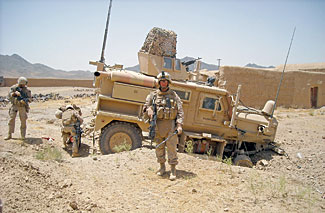
Big fan: Marine 1st Sgt. Eric Rummel stands near a Mine Resistant, Ambush Protected (MRAP) truck in which he survived a blast from a roadside bomb in Afghanistan in 2008.Courtesy of Eric Rummel
Eric Rummel knows just how effective the V-hull can be at directing the force of the blast away from the vehicle.
It took a matter of seconds to make 1st Sgt. Eric Rummel a true believer.
The marine was driving through southern Afghanistan last year when his truck hit a roadside bomb buried in a gulch. The vehicle shuddered, popped into the air, and settled back down again in a cloud of desert dust.
The whole thing was over before he knew what happened, but Sergeant Rummel and the two other men in the truck that day all walked away. The truck was a Mine Resistant, Ambush Protected truck (MRAP) – a 16-ton behemoth that came to be regarded as the soldier’s lifeboat in Iraq, its V-shaped hull saving lives by deflecting the blast of roadside bombs.
Rummel’s story points to the same success in Afghanistan. “God bless the MRAP and what it does,” he says.
But the mammoth trucks are built for Iraq, where troops are fighting a largely urban insurgency on city streets. Afghanistan’s insurgency is rural, and the Pentagon is in a race to completely redesign the MRAP for its new duty, making it lighter, with a beefier suspension and better off-road capabilities for troops who launch missions into fields and up hillsides – often with no roads.
The effort, however, calls into question one of the bedrock tenets of Defense Secretary Robert Gates’s regime: He wants to prioritize equipment that saves troops’ lives. But experts wonder if, in the process, he is saddling the military for years to come with a fleet of vehicles that can be used in only one spot on the globe.
“It’s not so clear that we can develop a new class of vehicles every time we go to a new country,” says Loren Thompson, chief operating officer of the Lexington Institute, a policy group in Washington.
The initial program to come up with a new breed of Afghan-friendly MRAPs, called Multi-Purpose All Terrain Vehicles, or M-ATVs, will cost $2 billion. The MRAP program has produced more than 16,000 vehicles in two years. This month, the Pentagon is expected to finalize a contract that would put more than 2,000 M-ATVs in Afghanistan – some by this fall.
The logic is clear: Roadside bomb attacks in Afghanistan are up some 80 percent over last year.
The day Rummel’s truck was hit, he was using his MRAP as an ambulance to evacuate war wounded near the town of Now Zad in Helmand Province in southern Afghanistan, an area of intense fighting. Before his truck had even arrived in the gulch, four other improvised explosive devices had detonated in that area; two marines later needed amputations.
The explosion surprised Rummel, particularly because the Humvee in front of him had just driven through the same gulch unscathed.
As much as he loves the truck that protected his life, Rummel says the current MRAP isn’t the right truck for Afghanistan, adding: “It’s just too big of a vehicle.”
The Captain’s Journal hasn’t any wisdom to convey regarding whether the newer all terrain MRAP should go forward, or whether the existing MRAPs should be made to work. But either way, the use of amphibious vehicles in Afghanistan is about as stolid as I can imagine. At least the MRAPs have been relocated to Afghanistan, and more and better ones are on the way.
Ultimately though, the best counterinsurgency is done on the ground. Dismounted patrols must be conducted in force, by more troops that we currently have (or have planned) in order to ensure an acceptable outcome. Infantry belongs on foot.
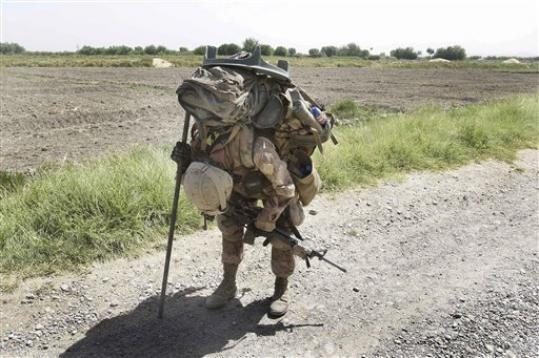
U.S. Marine Cpl. Brian Knight, of Cincinnati, Ohio, with the 2nd Marine Expeditionary Brigade, 1st Battalion 5th Marines, pauses briefly in the heat to rest with his heavy pack filled with mortar equipment, ammunition, food, and water in the Nawa district in Afghanistan’s Helmand province Saturday, July 4, 2009.
This Marine is carrying his backpack filled with food, hydration system, clothing, etc., and is also carrying ammunition, weapon, body armor, and other equipment. He is likely going “across the line” at 120 to 130 pounds. He is suffering in heat and with heavy battle space weight. For weight lifters like me, let’s put this in terms we can understand. This is like putting three York 45 pound plates in a backpack and humping it for ten or fifteen miles in 100+ degree Fahrenheit weather.
Battle space weight is a recurring theme at The Captain’s Journal, and will remain so. Money should be devoted to the weight reduction of SAPI plates in body armor and other low and even high hanging fruit. The weight of water is decided by God and cannot be altered.
Another salient point bears down on us. This is why women are not allowed in Marine infantry (or Army Special Forces), and why women suffered an inordinately high number of lower extremity injuries (leading to ineffective Russian units) when they deployed with the Russian Army in their losing campaign in Afghanistan. Just like God decides the weight of water, He also decides the physiques of men and women.
Jules Crittenden has an important report concerning the view of Operating Enduring Freedom from inside the administration.
During the briefing, (Brig. Gen. Lawrence) Nicholson had told Jones that he was “a little light,” more than hinting that he could use more forces, probably thousands more. “We don’t have enough force to go everywhere,” Nicholson said.
But Jones recalled how Obama had initially decided to deploy additional forces this year. “At a table much like this,” Jones said, referring to the polished wood table in the White House Situation Room, “the president’s principals met and agreed to recommend 17,000 more troops for Afghanistan.” The principals — Secretary of State Hillary Rodham Clinton; Gates; Mullen; and the director of national intelligence, Dennis C. Blair — made this recommendation in February during the first full month of the Obama administration. The president approved the deployments, which included Nicholson’s Marines.
Soon after that, Jones said, the principals told the president, “oops,” we need an additional 4,000 to help train the Afghan army.
“They then said, ‘If you do all that, we think we can turn this around,’ ” Jones said, reminding the Marines here that the president had quickly approved and publicly announced the additional 4,000.
Now suppose you’re the president, Jones told them, and the requests come into the White House for yet more force. How do you think Obama might look at this? Jones asked, casting his eyes around the colonels. How do you think he might feel?
Jones let the question hang in the air-conditioned, fluorescent-lighted room. Nicholson and the colonels said nothing.
Well, Jones went on, after all those additional troops, 17,000 plus 4,000 more, if there were new requests for force now, the president would quite likely have “a Whiskey Tango Foxtrot moment.” Everyone in the room caught the phonetic reference to WTF — which in the military and elsewhere means “What the [expletive]?”
Nicholson and his colonels — all or nearly all veterans of Iraq — seemed to blanch at the unambiguous message that this might be all the troops they were going to get.
Jules goes on to cite some “folksy” counterinsurgency quotes, something with which we have also dealt concerning Operation Khanjar. He also mentions that Woodward buried and obfuscated his lede. True words – let’s unpack them a bit.
We learn several things from this article. First we learn the limitations of Woodward’s reporting, or the editing at the Washington Post, or both. This report is monumental. Obama ran against the campaign in Iraq, unequivocally stating that the troops needed to be in Afghanistan. This was stated too many times to count, in too many different venues and publications to recite. It’s now clear that he will allow somewhat less than 70,000 U.S. troops to deploy to Afghanistan at any one time, regardless of what might have been advocated half a year earlier.
In a separate but roughly parallel evolution, Dr. John Nagl was advocating 600,000 troops for Afghanistan based on the model in FM 3-24. The Center for a New American Security saw the advent of Dr. Nagl as its President, along with Andrew Exum as a fellow. CNAS now advises the Obama administration, and will likely never again advocate 600,000 troops for Afghanistan. They are assisting the administration in the development of a strategy that doesn’t rely on the force size advocated in FM 3-24, regardless of what might have been advocated half a year ago.
There is his story. Woodward has written books on less than this, but the main story gets buried in the balance of the report.
Next, we learn that National Security Advisor James Jones isn’t qualified for the job. It’s his job – while all of the other principals are outlining a strategy and force projection that they believe will be endorsed by the President – to be whispering in the ear of the President: “Listen to them, but only so far. Iraq has taught us that this is harder than we think it will be on our first or even second or third take. If they’re telling you that the Afghan National Army can substitute for our own troops, they aren’t accounting for the drug addiction, incompetence and treachery of the Afghan Army. This will be long term, protracted, part of the long war. Iraq was long and hard, and Petraeus rightly said that Afghanistan would be the longest engagement in the long war. Fully expect for them to come back asking for more troops, because they will need them. You are a wartime President, sir.”
But he didn’t whisper these things in the ear of the President. Instead, he sat at a table with Marine Colonels who didn’t give input to the strategy and told them that to Obama, Afghanistan is a WTF? war. Learning and evolution by the administration or troops in the field are not options. You get no more forces. It’s time to put a serious man in the office of National Security Advisor. Jones isn’t it.
Finally, most of America doesn’t listen or know what is going on in either Operation Iraqi Freedom or Operation Enduring Freedom, and certainly they wouldn’t be able to describe the differences between the U.S. and the ISAF. All they see are the reports on Television, and even the military families don’t know the real status of things in Afghanistan, most of them. But CNAS has no excuse. They know.
Like us, they know that the Afghan National Army is shot through with drug use, even during combat operations and patrols. For a pictorial depiction of what Exum himself called depressing, see this video of the incompetence and drug use. Like us, they also know that Afghanistan may not be able financially to support an Army as large as the one envisioned as the replacement for U.S. forces. Then there is the treachery, such as at the Battle of Bari Alai where it is believed that Afghan troops colluded with the Taliban to kill U.S. troops. CNAS knows that the Afghan National Army is no replacement for U.S. troops, and that the campaign in Afghanistan is under-resourced. Jim Jones knows it too, as the Colonels have told him so, even if he chose not to hear it.
So we now know that the current administration sees Operation Enduring Freedom as the WTF? war. We know that the National Security Advisor doesn’t have the fortitude to whisper the hard things in the ear of the President. We know that the President doesn’t really want to deploy more troops to Afghanistan, and we also know that the Colonels want more troops to cover their area of operations.
This sets the stage for the coming phase of the campaign. We have seen this before in Iraq: hasty turnover to the ISF and more difficult counterinsurgency than had previously been planned. The dissimilarity is a President who was willing to send the necessary forces to get the job done.
The Huffington Post links our Operation Khanjar category in their coverage of the most recent Marine Corps operations in the Helmand Province, as well they should. We have extensively covered, analyzed and commented on the campaign in Afghanistan for several years now, including detailed coverage of Marine Corps operations in Garmser and Now Zad for about a year (and beginning with reports that couldn’t be found in the MSM).
One Twitter post is interesting: “It is cool that the new Afghan operation is named “Khanjar“, an Arabic word. Anyone else think this will drive the right-wing media crazy??” Drive the right-wing media crazy as it did with Operation Al Fajr, or Operation Alljah? Seriously? Does anyone know any media analyst or reporter, right or left wing, who is driven crazy by the names of operations?
But continuing with our main point, the commenters extend the love to the U.S. Marines.
I’ve said before that our combat Marines are doing a job that 99.99% of us are either unwilling or incapable of doing ourselves. They’re doing a great job and I hope their mission is successful …
Get some, Marines! I wish I could be there with you …
Hooah! …
Maybe, finally my friends and neighbors will rest in peace …
There are a few dubious comments too. But another Huffington Post article early in 2008 (linking the LA Times) cited Marine Major General Gaskin saying that the gains in Anbar were permanent. Essentially, mission accomplished. No comments, except one asking if we were “Tired of the NeoCons getting away with their crimes?”
Some of this love would have been nice in 2004 – 2008 when more than 1000 Marines perished in the Anbar Province of Iraq. Ah, but that wasn’t Obama’s war, was it?
As for Obama’s war, Jules Crittenden has linked and commented on a Washington Post article that is stunning in its revelation about how the Obama administration sees this and similar Afghanistan operations.
During the briefing, (Brig. Gen. Lawrence) Nicholson had told Jones that he was “a little light,” more than hinting that he could use more forces, probably thousands more. “We don’t have enough force to go everywhere,” Nicholson said.
But Jones recalled how Obama had initially decided to deploy additional forces this year. “At a table much like this,” Jones said, referring to the polished wood table in the White House Situation Room, “the president’s principals met and agreed to recommend 17,000 more troops for Afghanistan.” The principals — Secretary of State Hillary Rodham Clinton; Gates; Mullen; and the director of national intelligence, Dennis C. Blair — made this recommendation in February during the first full month of the Obama administration. The president approved the deployments, which included Nicholson’s Marines.
Soon after that, Jones said, the principals told the president, “oops,” we need an additional 4,000 to help train the Afghan army.
“They then said, ‘If you do all that, we think we can turn this around,’ ” Jones said, reminding the Marines here that the president had quickly approved and publicly announced the additional 4,000.
Now suppose you’re the president, Jones told them, and the requests come into the White House for yet more force. How do you think Obama might look at this? Jones asked, casting his eyes around the colonels. How do you think he might feel?
Jones let the question hang in the air-conditioned, fluorescent-lighted room. Nicholson and the colonels said nothing.
Well, Jones went on, after all those additional troops, 17,000 plus 4,000 more, if there were new requests for force now, the president would quite likely have “a Whiskey Tango Foxtrot moment.” Everyone in the room caught the phonetic reference to WTF — which in the military and elsewhere means “What the [expletive]?”
Nicholson and his colonels — all or nearly all veterans of Iraq — seemed to blanch at the unambiguous message that this might be all the troops they were going to get.
So much for the love from the Huffington Post to the Marines – they only love them sometimes. And it appears that Obama doesn’t share the same love, at least in terms of supplying them with troops … even if they ask for more.
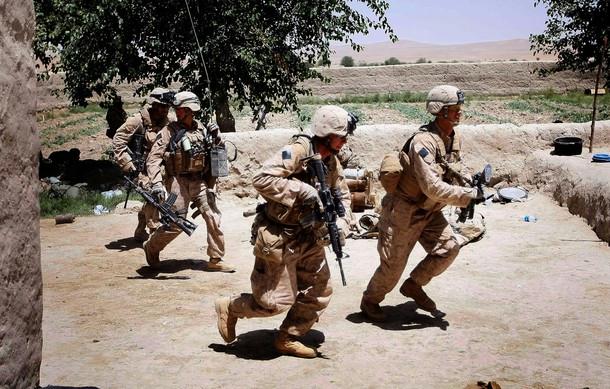
U.S. Marines from 2nd Marine Expeditionary Brigade, RCT 2nd Battalion 8th Marines Echo Co. run to a new position as they take enemy fire during the start of Operation Khanjari on July 2, 2009 in Main Poshteh, Afghanistan.
About 4000 U.S. Marines have been unleashed from Camp Leatherneck into the Helmand Province, Afghanistan. The Marines have been in the Helmand Province, home of the indigenous insurgency, for more than a year, in both the districts of Garmser and Now Zad. But Operation Khanjar – “strike of the sword” – is the largest one time systematic deployment of U.S. Marines since Vietnam.
There are various (perhaps slightly conflicting) narratives. On the one hand, “Our focus is not the Taliban,” Nicholson told his officers. “Our focus must be on getting this government back up on its feet.” But it will be a long, long time before the Afghanistan government is on its feet and relatively free of corruption, and perhaps even longer before the Afghan National Army is not deeply affected by drug use and addiction, even during patrols and other operations. It is also believed that at the battle of Bari Alai the Afghan Army was treacherous in their behavior, even colluding with Taliban fighters to kill help U.S. troops.
It has also been said of the new operations that “the measure of success will not be enemy killed. It will be shielding the Afghan population from violence.” But population-centric counterinsurgency suffers from a singular focus rather than allowing many different focii in the campaign, including killing the enemy.
Our job is to get in there and get it back [from the Taliban] … We don’t want to give the enemy one second to think about what he’s going to do. Because we’re going to be pushing so goddamn hard on the enemy. Our job is to go in there and make contact with the enemy — find the enemy, make contact with the enemy and then we’ll hold on. This is an enemy that’s used to having small-scale attacks and having the coalition pull back. There is no pullback. We will stay on him, and we will ride him until he’s either dead or surrenders …
There’s a hell of a lot of IEDs out there. As we get in there, we’re going to get a better feel for who these people are who are putting them out. We’re going to work the networks. And we’re going to kill the guys that have a chance to go out there and lay them …
We’ll kill and capture a hell of a lot of enemy over these next couple of weeks, I’m confident of that. And I hope the enemy does try to go chest-to-chest with you. It would be a hell of a big mistake …
Good. The Marines come from their experience in the Anbar Province, Iraq. Stay out of their way, don’t burden them with excessive red tape, provide them with logistics, and just sit and watch. The story is about to get interesting.
We have been covering and analyzing U.S. Marine Corps operations in Now Zad, Afghanistan, for nine months, ever since our friend Major Cliff Gilmore (USMC) sent us a direct and unpublished report on his visit to Now Zad. Three months ago we observed that Now Zad was abandoned, and questioned the strategic significance of holding it. More than two months ago we got our answer: the Marines were working to shape the battle space by moving insurgents into disposable positions.
Insurgents are there even though the population isn’t. There is major combat action in Now Zad as demonstrated by this video. We discussed the fact that there aren’t enough troops to clear and hold, and as it turns out, Now Zad was being used as a place for R&R for insurgents. Now this AP video gives us an even clearer description of the need for additional Marines.
This is simply remarkable. Much of the time conducting counterinsurgency is devoted to extracting and isolating the insurgents from the population and protecting the population from violence from insurgents. It is costly, requires patience, and is very expensive and inefficient. But every once in a while the insurgents do us a favor and isolate themselves from the population. These are the instances for which we pray.
Yet when the 2/7 Marines deployed to Now Zad in the spring only to find no noncombatants, it was as if an apology was necessary. “They saw what they wanted to achieve but didn’t realize fully what it would take,” Task Force 2/7’s commander, Lt. Col. Richard Hall, said at the time. “There were no intel pictures where we are now because there were few or no coalition forces in the areas where we operate. They didn’t know what was out there. It was an innocent mistake.”
Mistake or not, the Marines hit a gold mine, with the possibility for significantly increased productivity in kinetic operations and kill ratio as compared to the alternative. But while Now Zad is important enough to take, it isn’t important enough to hold significant portions or even kill all of the insurgents in the AO. Why wouldn’t more Marines be deployed to the area to kill insurgents before they return to their own area of operations to wreak havoc?
Enter population-centric counterinsurgency doctrine. Rather than seeing protection of the population as one potential line of operation or line of effort in the campaign, it is the sole focus of the campaign. Rather than killing insurgents, we hear a constant parroting of the meme that for every insurgent we kill, greater than or equal to one insurgent pops up in his place (we’ll call this the dilemma).
Obviously we cannot deny that in some instances the dilemma presents itself, because denying it would be doctrinal stubbornness and inflexibility. But also just as obviously, this does not obtain in every situation. There were a huge number of indigenous insurgents killed in the Anbar Province, and if greater than one replaced every dead insurgent, the campaign wouldn’t be over. While Captain Travis Patriquin was courting the tribes in Anbar, U.S. forces were targeting his smuggling lines by killing smugglers and shutting down his means of transit with kinetic operations. In some cases, it would seem, nothing is a better inducement to negotiate than seeing dead friends and family members.
But the proponents of population-centric counterinsurgency doctrine, i.e., those who proclaim that it should be the sole focus of the campaign, have been so effective that the U.S. Marine Corps is apologizing for being deployed in an area of operations where they can kill the enemy unimpeded, and then refusing to deploy more Marines there because the population cannot be protected.
In fact, nothing would lead to better protection of the population than killing insurgents who will later go back to their area of operations and kill, maim, extort and threaten their own countrymen. But our population-centric COIN experts are so blinded by ideological commitment to a set of axioms that they cannot see the value of kinetics even when the insurgents give us the option of doing it without even so much as a single noncombatant loss.
Doctrinal stubbornness and inflexibility. It might just be our undoing.
Graeme Wood at The Atlantic pens a piece that questions what Fallujah will be like when the Marines leave Anbar.
A dispatch by Rod Nordland of the New York Times asks whether the violence in Fallujah — lately viewed as a model of an Anbar city pacified and handed over to the Iraqis — is really in remission. His excellent report, filed from Fallujah and from the even more restive nearby town of Karmah, where I just spent two days, leaves the question unanswered but suggests a reality darker than the version the Marines describe.
Stop there. Let’s go take a look at the New York Times article.
Falluja was supposed to be a success story, not a cautionary tale.
After all, by last year the city, a former insurgent stronghold, was considered one of the safest places in the country. Local Sunni sheiks had driven out the insurgent group Al Qaeda in Mesopotamia and held successful elections, and American engineers were hard at work on a showcase reconstruction project: a $100 million wastewater treatment plant meant to be a model for civilian advances in Iraq.
Then a series of troubling attacks began cropping up this year. One in particular, at the end of May, seemed to drive home the possibility that things were changing for the worse. On a heavily patrolled military road between a Marine camp and the wastewater plant, a huge buried bomb tore through an armored American convoy, killing three prominent reconstruction officials and striking at hopes that the way was completely clear for peacetime projects.
We covered some of this in The Violence Belongs to Iraq Now. But dissecting the NYT article a little further, even the initial part stumbles into problems. Local Sunni sheiks didn’t drive anyone from Fallujah. The author is confusing what happened in Ramadi, where a combination of tribes and Marines drove al Qaeda from there, and in Fallujah, where al Qaeda went after they were driven from Ramadi.
Tribe had little affect in Fallujah, and the notion of Muktars held much more sway. When the 2/6 Marines deployed to Fallujah in April of 2007, the population was so afraid of al Qaeda that they would send their children out to surround Marines on patrol, waving black balloons so that al Qaeda mortars could target the Marines. The children were at risk as much as the Marines, but this speaks volumes about the condition of Fallujah early in 2007.
Forward Operating Base Reaper was constructed, at least in part, with Marines lying on their back passing sand bags over their heads from Marine to Marine to avoid sniper fire. The U.S. Marines drove al Qaeda from Fallujah, not the tribes. There is no tribe in Fallujah. So even the background of the NYT article is mistaken. Returning to the Atlantic article:
On my first afternoon, I spoke with the base’s senior Marine, Lt. Peter Brooks, about the chagrin his men felt at having to serve as a withdrawal force, rather than a high-intensity killing force like the more fortunate Marines currently machine-gunning Taliban in Afghanistan. They spent their days working out, conducting mock exercises with scale models in the sand next to their hut, and guarding their static and rather sleepy position.
Midway through our chat, we heard small-arms fire, full automatic and not a thousand meters from where we stood. I expected a reflex dash into response mode: a quick reaction force, sets of eyes and weapons scanning the horizon for threats. In fact the response was orderly but serene. Rather than scramble into action, Iraqi police looked around unhurriedly, eventually spied a convoy of vehicles, and determined that the automatic bursts were “probably” just a wedding party. The alarm was canceled before being sounded.
By now few foreigners in Iraq have failed to register that blasting the sky with machine-gun fire is the Iraqi chivaree, and that weddings are wonderful events — symbols of peace and unleashed merry-making — at which normal rules of social decorum don’t apply. But if I were an Iraqi best man, I think I would probably have refrained from firing wildly into the air until my convoy traveled at least a few hundred meters past the station filled with ill-trained Iraqi cops and tightly coiled US Marines. The atmosphere seemed not so much one of safety or celebration but of impunity. Whatever the base’s function, it was not for community policing, and certainly not for aggressive patrols by Marines preserving the peace from carloads of young men with weapons.
Several thoughts come to mind. First, a police force that does not respond to unexplained gunfire is not a police force.
Okay. Stop again. The gunfire could have been anything, including shooting dogs. A breed of wild dogs has taken to residing in Fallujah, and each block has its own pack that relies on food it can get from the area to survive. Residents of Fallujah routinely have to defend themselves against these dogs. These are not domesticated animals. These are several-generation wild dog packs that have no inhibitions regarding humans.
The narrative is that the Marines leaving will cause problems for security and that the Iraqi Police are not up to the job. True or not, the Marines must leave. It isn’t within the Marines’ mission to remain a large, heavy land based occupation force. Rapid deployment strike troops must return to their primary mission. Anbar is better for having the Marines there, but even if security degrades, it will recover. The Iraqi Police are up to the task, or shortly will be.
A more sophisticated understanding is given to us in the comments section of the Atlantic article by Jon Schroden.
I have several words of caution for anyone who reads this article:
– This piece fails (as does the NYT piece) to paint a truly comprehensive picture of the security situation in Al Anbar because it presents but a single data point. To get a truly balanced sense of security there, the author should have also traveled to Ramadi, Hadithah, and Al Qaim, at a minimum. Each of these cities is different in multiple ways, so reporting on those differences and how they translate into the varying security situations amongst the cities would have been much more enlightening and comprehensive.
– No one who has seriously studied the situation in Al Anbar or spent significant time there would hold up Fallujah as the shining example of a city that has been turned around. Ramadi is typically the example cited, and for good reasons – it truly was a hot-bed of insurgent activity that was pacified through sound counterinsurgency methods, changes in local attitudes and working with the tribes (to wit, Ramadi was once the declared capital of AQI’s “Islamic State of Iraq,” but was also where the Awakening began). Fallujah has always been trouble. Even after two full-on, line-em-up and knock-em-down clearings of the city, it was still rough-and-tumble, so in late 2007 the Marines began a district-by-district clearing of the city again, using the types of less-kinetic techniques that worked in Ramadi (this was called Operation Alljah). That worked to a large extent, and the city was better for it, but the fact remains that the people in Fallujah have always viewed themselves as a special case (in part b/c Saddam treated them that way) and as such they will always be hard to deal with. They feel that Fallujah, not Ramadi, should be the capital of Anbar, and are disgruntled because of it. Also, Fallujah is a lot “less tribal” than Ramadi, so it’s more difficult for local power-brokers to control the people there.
– As for the Karmah region, the description in this article shows a lack of understanding of the tribal dynamics there. Karmah, and its surrounding areas to the east of Fallujah, sit astride the boundary between two tribal confederations – the Dulaimi Confederation to the west (which includes almost all of the Al Anbar tribes), and the Zobai Confederation to the east (which stretches into and around Baghdad). The main tribe in Karmah belongs to the Zobai Confederation. As such, Karmah represents a “special case” when it comes to dealing with tribal alliances, because the people there don’t really fit in to the rest of Anbar and so feel they aren’t represented well in the provincial government. The main sheikh in Karmah is also a coward, who fled Anbar and would only return in 2007 after heavy lobbying by the Marines and with guaranteed security measures in place. Hence he is of little utility in helping to control the situation there.
– Finally, to the line “a police force that does not respond to unexplained gunfire is not a police force,” I would simply respond that we need to be very careful in our tendencies to apply western standards when it comes to things like quality of police, levels of security, etc. Iraq is not America. Our goal in Iraq is not to build Fallujah into a shining example of a modern city. As long as it’s reasonably peaceful and isn’t serving as a safehaven for AQI (which it isn’t), then we’ve accomplished our mission and the Marines should come home. And they are.
This comment might have been left by Dr. Jonathan Schroden of CNA, who has also penned an interesting article entitled What Went Right in Iraq. It is an interesting read and requires our attention.
The Marines have a vested interest in the Anbar Province, having lost more than 1000 warriors to the fight. Much blood has been spilled on Anbari soil. But other fights and other missions beckon the Marines. May the Anbaris find their peace and security. We will pray that the security infrastructure is up to the task of providing it.
Marcus at Justbarkingmad has responded to our Afghanistan Rules of Engagement Redux. I won’t recapitulate his arguments here, but he has put some time and effort into his post and it is well worth a read. A few concluding thoughts follow (concluding until I see the new “rules” or “guidance” in action).
First, Marcus shouldn’t be so quick to lecture us on the merits of FM 3-24. War – and insurgencies and counterinsurgency warfare – has been around far longer than FM 3-24. And as I have stated before, I consider the recent overhaul of Army Field Manual 3-0 to be superior to FM 3-24 and a doctrinal step forward.
Second, the narrative at the moment is that these “adjustments” to the rules involve mostly Close Air Support (CAS). We’ll take a wait-and-see approach. The discussion thus far from General McChrystal doesn’t restrict his changes to CAS.
Third, Marcus brings up our example, U.S. Marine Corps operations in Garmser in 2008, and asks if there were noncombatants involved?
Mr. Smith fails to provide the reader with any evidence that McChrystal’s proposed policy would have affected the inevitable outcome there. Were human shields used systematically in Helmand Province to prevent the Marines from accomplishing their mission? We are left only assuming that it must have occurred—maybe.
He has utterly missed the point. McChrystal’s stipulation was, or is going to be, that if it is possible that noncombatants could be involved, back away from the fire fight. The Marines could not possibly have had comprehensive knowledge of the situation inside Garmser upon arrival, and thus to the Marines, “it could have been possible.” Thus the operation would not have been conducted. It is verifying the conditionals that is problematic here.
And speaking of Garmser, concerning our point:
Just how our critic supposes that the Marines could have protected the population of Garmser, while several hundred Taliban fighters were dug in and waiting for the Marines, he doesn’t say. But he makes the mistake of conflating phases of the campaign, and also of failing to understand that the campaign will require various lines of operation or lines of effort.
Marcus demurs to other doctrinal considerations but fails to answer the question. Here it is again. The British assisted the Marines in transit to the Garmser area of operations. There is no electricity. There is no sewage. There is no running water. There are sand storms. Water and other supplies are dropped via air supply. When the Marines get to Garmser in order to “protect the population,” they find that several hundred Taliban are dug in and waiting for them, requiring fire fights that at times was described as “full bore reloading.” If Marcus wants to protect the population, how does he dislodge the Taliban entrenched in Garmser without kinetic operations?
Finally, I do not believe that protection of the population comes first or is most important in counterinsurgency. Rather, I believe that protection of the population is one line of effort that should be pursued. If, as our friend Gian Gentile would point out, one line appears to be more productive and/or efficient, then let’s allow the troops to discover the center of gravity of the particular insurgency that they are dealing with.
Following this line of thought, Marcus should be careful to give himself maximum latitude to learn (including the situation in the next counterinsurgency he faces) without being restricted to one narrative. We should all be able to study the sources, glean the beneficial aspects, jettison the others, and be able to keep from being in bondage to history or any one particular school of thought. In the words of our friend Gian, “history should inform the commander’s judgment but never accompany him to the battlefield.”