The Taliban has been building simpler, cheaper anti-personnel bombs made of hard-to-detect nonmetal components, increasing the number of lethal attacks on NATO forces in Afghanistan, according to a confidential military report.
The shift in the use of improvised explosive devices (IEDs) away from larger anti-armor bombs has allowed the Taliban to produce more weapons and hide them in more places as they strive to kill larger numbers of American forces in southern Afghanistan’s Helmand province and other contested regions.
The change in production from metal-dominated explosives to devices made of plastic is making it more difficult for ground troops to detect the buried IEDs with portable mine-detectors, creating an “urgent need” inside the Pentagon for better detection devices, the report said.
The new Taliban tactics are disclosed in a confidential report from the Pentagon’s Joint Improvised Explosive Device Defeat Organization, portions of which were obtained by The Washington Times.
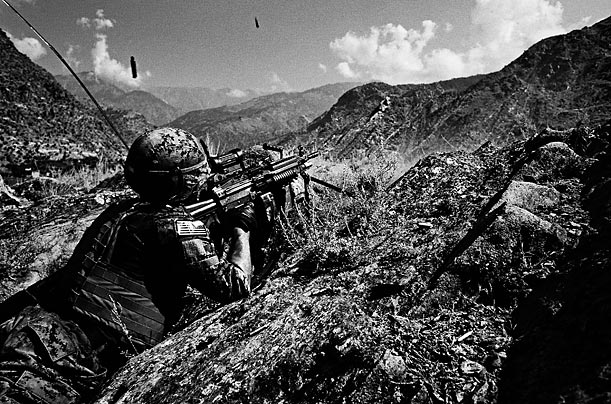
The area around Now Zad, northwest of Kandahar, has experienced some of the most ferocious fighting for control of southern Afghanistan since the surge of 21,000 U.S. troops began last spring. News reports and military bloggers say Marines on patrol face a constant threat from hidden IEDs.
“Although the Taliban still fights with small-arms, rocket-propelled grenades and improvised explosive devices, they have increasingly focused the role of IEDs as antipersonnel devices,” the report said. “Smaller, lighter, more quickly constructed and quite often triggered by a victim-operated switch [booby trap], these antipersonnel IEDs have been a significant factor in labeling Now Zad the most dangerous location with the highest U.S. casualty rate in either the Afghan or Iraq theaters.”
The Aug. 11 report, titled, “The Taliban’s Emerging IED TTPs in the Proving Grounds of Now Zad, Helmand Province,” was written by an analyst at U.S. Central Command, which oversees troops in the Middle East and Afghanistan. TTPs is short for tactics, techniques and procedures …
In the past two months, more than half of the battlefield deaths suffered by NATO troops were caused by IEDs. This month, of 31 fatalities, 15 came from IEDs; in August, 46 of the 77 coalition deaths resulted from these devices, according to icasualties.org.
The Pentagon report said the Taliban IED research-and-development program used the Now Zad region to show that smaller, more numerous IEDs kill more people. The rate for dead and wounded for the 2nd Battalion, 7th Marine Regiment stood at one-third of the unit in August, the report said. A typical Marine battalion has 800 to 1,000 troops.
A military official, who monitors Afghanistan and asked not to be named because he was not authorized to speak to the media, said the Taliban is shifting to small IEDs for a number of reasons.
“You’ve got the fear factor,” the source said. “It’s also less costly. It’s easier for them to build those things and use them as opposed to running the risk of getting in firefights and losing people. The cost is relatively low. We’re fighting guys who from all appearances are from three centuries ago, but we can’t figure out how to beat them.”
The Pentagon report said the Taliban has become adept at mining a road called the “Pakistani Alley” — so-named because Taliban militants use it to ferry in new fighters from the neighboring country.
“U.S. troop movements are split between foot and mounted patrols,” the report said. “The terrain and deplorable road conditions often necessitate that foot patrols be conducted on uneven terrain. The Taliban have taken advantage of this by littering the area north of ‘Pakistani Alley’ with numerous antipersonnel IEDs to maintain control over their northern buffer-zone.”
Robert Maginnis, a military analyst and Army adviser, said IEDs are tailor-made for Afghanistan.
“IEDs are effective in Afghanistan in part because of the terrain,” Mr. Maginnis said. “There are few paved roads, which means planting a device in or near a road is easier and harder to detect by visual inspection. The increase in Taliban use of IEDs is due to the increased coalition forces in country, which forced the relatively small Taliban force to adjust its tactics. It stretches the force’s impact.”
Lt. Col. Edward Sholtis, a spokesman for Gen. Stanley McChrystral, the top commander in Afghanistan, told The Times the general has stepped up efforts to disrupt networks before they can plant bombs, and get better intelligence on where they are embedded in light of “the weapons’ increasing use against coalition forces and because of the impact of a larger number of indiscriminate, victim-operated IEDs on the Afghan people.”
I would like to get a copy of this report, but my web-based e-mail for the web site (contact information) isn’t currently working. No one has covered Now Zad like I have, and that merits some consideration. Either way, it’s good to get better intelligence, and the article ends with technological advancements that may help in the detection of IEDs of this kind, but these are only half-way measures. As we discussed in On the Front Lines with the Marine in Helmand, there aren’t enough Marines in place to prevent Taliban brutality towards the Afghans who would otherwise want to cooperate. Intelligence to shut down the traffickers in IEDs will only go so far. Force Projection is necessary.
We must go after them where they live, where they traffic their supplies, and where they recruit and train. We must shut down their logistics, kill their fighters, and cause them to live in fear. We must cause them to stay on the run such that they have neither the time nor supplies to construct or emplace IEDs. Only then will they be so preoccupied with staying alive that they forget the population. Then we will have won. IEDs will no longer be a problem because the Taliban aren’t a problem. They go hand in hand, and one will not be defeated without the other. We cannot first defeat IEDs and then the Taliban – just like it was in Iraq.