Dean Weingarten has a good find at Ammoland.
Judge Eduardo Ramos, the U.S. District Judge for the Southern District of New York, has issued an Opinion & Order that a ban on stun guns is constitutional. A New York State law prohibits the private possession of stun guns and tasers; a New York City law prohibits the possession and selling of stun guns. Judge Ramos has ruled these laws do not infringe on rights protected by the Second Amendment of the United States Constitution.
Let's briefly…… [read more]
For weeks, the United States public followed the biggest offensive of the Afghanistan war against what it was told was a “city of 80,000 people” as well as the logistical hub of the Taliban in that part of Helmand. That idea was a central element in the overall impression built up in February that Marjah was a major strategic objective, more important than other district centers in Helmand.
It turns out, however, that the picture of Marjah presented by military officials and reported by major news media is one of the clearest and most dramatic pieces of misinformation of the entire war, apparently aimed at hyping the offensive as an historic turning point in the conflict.
Marjah is not a city or even a real town, but a few clusters of farmers’ homes amid a large agricultural area that covers much of the southern Helmand River Valley …
The ISAF official said the only population numbering tens of thousands associated with Marjah is spread across many villages and almost 200 square kilometers, or about 125 square miles (editorial note, approximately eleven miles squared) …
So how did the fiction that Marjah is a city of 80,000 people get started?
The idea was passed onto news media by the US Marines in southern Helmand. The earliest references in news stories to Marjah as a city with a large population have a common origin in a briefing given on February 2 by officials at Camp Leatherneck, the US Marine base there.
The Associated Press published an article the same day quoting “Marine commanders” as saying that they expected 400 to 1,000 insurgents to be “holed up” in the “southern Afghan town of 80,000 people”. That language evoked an image of house-to-house urban street fighting.
The same story said Marjah was “the biggest town under Taliban control” and called it the “linchpin of the militants’ logistical and opium-smuggling network”. It gave the figure of 125,000 for the population living in “the town and surrounding villages”.
The war in Afghanistan, as we have written here and in Military Review (pdf), is indeed a near replication of the Vietnam War, including the assault on the strategically meaningless village of Marjah, which is itself a perfect re-enactment of Operation Meade River in 1968.But the callous cynicism of this war, which we described here in early December, and the mainstream media’s brainless reporting on it, have descended past these sane parallels. We have now gone down the rabbit hole.
Two months ago, the collection of mud-brick hovels known as Marjah might have been mistaken for a flyspeck on maps of Afghanistan. Today the media has nearly doubled its population from less than 50,000 to 80,000 — the entire population of Nad Ali district, of which Nad Ali is the largest town, is approximately 99,000 — and portrays the offensive there as the equivalent of the Normandy invasion, and the beginning of the end for the Taliban. In fact, however, the entire district of Nad Ali, which contains Marjah, represents about 2 percent of Regional Command (RC) South, the U.S. military’s operational area that encompasses Helmand, Kandahar, Uruzgan, Zabul, Nimruz, and Daikundi provinces. RC South by itself is larger than all of South Vietnam, and the Taliban controls virtually all of it. This appears to have occurred to no one in the media.
Nor have any noted that taking this nearly worthless postage stamp of real estate has tied down about half of all the real combat power and aviation assets of the international coalition in Afghanistan for a quarter of a year. The possibility that wasting massive amounts of U.S. and British blood, treasure, and time just to establish an Afghan Potemkin village with a “government in a box” might be exactly what the Taliban wants the coalition to do has apparently not occurred to either the press or to the generals who designed this operation.
In reality, this battle — the largest in Afghanistan since 2001 — is essentially a giant public affairs exercise, designed to shore up dwindling domestic support for the war by creating an illusion of progress. In reporting it, the media has gulped down the whole bottle of “drink me” and shrunk to journalistic insignificance.
Analysis & Commentary
The U.S. Marine Corps over the last several years in Iraq and Afghanistan has customarily been engaged in heavy combat operations. More than 1000 Marines perished in Iraq, most in the Anbar Province. Regardless, whatever the Marines are engaged in, they will officially hype their exploits and stretch the narrative, always redounding to the benefit of the Marines. It’s part of the history, mystique and political strategy of the Corps. The U.S. Marines are the best strike fighters and shock troops in the world. No matter, this narrative isn’t enough, and it is crafted and molded until the Corps takes on mythical proportions. The fact that their reputation precedes them and intimidates the enemy only justifies the strategy.
That most so-called journalists don’t know enough to be able to effectively cover the Marines is amusing, but reaches the point of being sad for analysts who spend time asking the wrong questions and reiterating what we all already know. Marjah is an approximately eleven mile squared area of operations comprising tens of thousands of farmers rather than an urban setting. So who didn’t already know that? The closest thing to a major urban center in Helmand is Now Zad. How is this “revelation” significant to worthwhile analysis of what the Marines are doing?
In Why are we in the Helmand Province? I addressed the notion that Marjah is a “worthless postage stamp” of land by pointing out that targeting Kandahar (as a population center) without a coupled effort to shut down the Taliban recruiting grounds and support network (as well as means of financing) would be analogous to giving the Taliban free sanctuary in Pakistan, just on a moderately smaller scale.
U.S. counterinsurgency strategists can claim until their last breath that counterinsurgency should be “population-centric,” but if we honestly believed that axiom we wouldn’t care about sanctuary in Pakistan. Control over population centers and good governance would be enough to marginalize the insurgents and render them powerless in spite of their sanctuaries – or so the doctrine claims.
But we know that the enemy must be stalked and killed, so we are in the Helmand Province, and Marjah was the last battle space for heavy kinetics. Policing of the population must now ensue in these areas. Kandahar will be next, and the buildup will be slow and deliberate, after, of course, we have finished with major operations in Helmand.
But if it isn’t one thing it’s another, and in addition to enduring bad analysis we must also deal with incomplete analysis that stops short of asking the hardest of questions. Consider this recent Washington Times editorial.
The recent battle in Marjah in Afghanistan’s Helmand province was a key test case for new rules of engagement that emphasized protecting civilians rather than killing insurgents. The town was taken, but whether that was because of the new rules or despite them remains to be seen.
The rules of engagement are probably the most restrictive ever seen for a war of this nature. NATO forces cannot fire on suspected Taliban fighters unless they are clearly visible, armed and posing a direct threat. Buildings suspected of containing insurgents cannot be targeted unless it is certain that civilians are not also present. Air strikes and night raids are limited, and prisoners have to be released or transferred within four days, making for a 96-hour catch-and-release program.
In Marjah, the enemy quickly adapted to the rules, which led to bizarre circumstances such as Taliban fighters throwing down their weapons when they were out of ammunition and taunting coalition troops with impunity or walking in plain view with women behind them carrying their weapons like caddies …
The fighting has wound down in Marjah, which may or may not validate the rules of engagement. Most of the local Taliban either melted away to the frontier or simply put down their weapons and are still there. The true test will come when NATO implements rules of disengagement. When coalition forces pull out, Marjah may well go back to being the Taliban stronghold it always has been, and those who cooperated with NATO and Afghan government authorities will be held to account.
True enough with respect to the rules of engagement (as we have pointed out before), this commentary ends with a non sequitur. It was predestined – the Marines were going to take Marjah, and there was nothing that the Taliban could do about it. The conclusion of the battle was firm and fixed regardless of the rules of engagement, and they have won Marjah in spite of the ROE and not because it it. The outcome of the operation says nothing to validate the ROE.
On the other hand, we all know that the Marines announced their offensive prior to its start for the specific reason of avoiding noncombatant casualties. That Taliban escaped was irrelevant. But is it? Will the Taliban simply slither away only to come back later and cause long term counterinsurgency problems in this area?
Will our focus on the population (to the detriment of killing insurgents) come back to haunt the campaign? Will we be dealing with these same insurgents later, walking with their women holding their weapons, knowing that the U.S. troops will not fire on them? What do the people of Marjah think about the rules of engagement? How long will this operation last, and will the horrible Afghan National Army and Afghan National Police be able to fill in behind the Marines?
The analysts at Foreign Policy called Marjah a “Potemkin village.” John Robb did this as well with Fallujah in a post entitled Potemkin Pacification (as best as I can tell, he took it down about as soon as it went up). There were a number of reductionist articles that sounded about the same when Operation Alljah began in Fallujah early in 2007. Most of these articles focused on the “horrible” conditions of Fallujah when the Marines locked it down.
In April – June of 2007 heavy kinetics ensued between the Marines and insurgents in Fallujah. The follow-on work involved heavy policing, gated communities, biometrics and neighborhood programs to watch and defend their turf. It was found that most IEDs were vehicle-borne, so the decision was made to prohibit vehicle traffic. When the population in a major urban center must walk everywhere, it provides a significant incentive to find and turn in insurgents and their weapons.
One narrative for counterinsurgency is that it must focus on turning the human and physical terrain into Shangri La, and if it doesn’t, it’s fake. Of course, it is the narrative that is fake. There will be heavy lifting in Marjah still to come, for it isn’t Shangri La. Fake narratives by so-called analysts will continue. But for the motivated journalist there are salient questions that must be answered.
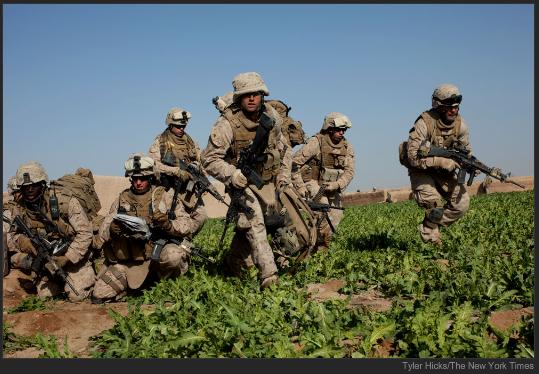
As usual, Tyler Hicks is providing the best pictorial documentaries of Marine Corps operations in Helmand, and C. J. Chivers’ coverage is indispensable. But the Marjah narrative is yet to be written, much less the narrative for the Helmand Province (Now Zad claimed many Marine lives). Other than C. J. Chivers, we have yet to even approach anything that could be considered good analysis of the Marine Corps campaign in the Helmand Province, and Marjah remains fertile ground for reporting and analysis.
Boeing wins by default. Northrup Grumman has pulled out of the refueling tanker competition. Apparently they won low bid about two years ago, but the stipulations and structure of the contract is suspect. Northrup Grumman has pulled out because they have decided that they can’t make any money.
Defense giant Northrop Grumman said Monday that it is pulling out of the $40 billion competition to build aerial refueling tankers for the Air Force, a move that defense analysts and procurement specialists say leaves its rival Boeing as the likely winner.
Northrop’s decision marked the latest twist in the nearly decade-long fight over one of the Pentagon’s biggest and most controversial contracts and raised questions about the impact of procurement reforms proposed by the Obama administration.
In announcing its withdrawal, Northrop said that the government’s requirements did not recognize the value of the larger refueling platform it had proposed and instead favored Boeing’s proposal to build a smaller tanker using a prototype of its 767 aircraft.
Wes Bush, chief executive of Los Angeles-based Northrop, said that under those conditions, it no longer made financial sense to stay in the competition …
Northrop executives and defense industry analysts have questioned how profitable the tanker contract would be, given the Pentagon’s push for setting a fixed price for the contract before design and testing of the aircraft are completed.
I had previously weighed in against the awarding of contracts based solely on low bid because of the requirements of the awful Sarbanes-Oxley Act. Bidders learn to game the system. Northrup Grumman had previously won under the provisions of Sarbanes-Oxley, but this time around apparently wanted to perform design and testing under a time and materials arrangement.
Things are often not quite what they seem, and the big, bad, evil defense contractors occupy the same space as the big, bad, evil health insurance companies and other corporations. There are some of them, and their senior management makes way more money than they’re worth. But in the end, that is oftentimes an accidental rather than an essential feature of the problem. Giddiness over the demise of a major defense contractor can mean joy over lost jobs in the U.S., technology transfer to foreign companies, and unintended consequences of our decisions.
Northrup Grumman surely has many highly skilled people in the U.S., and I hope that they fare well through subsequent competitions. We need good competition to keep our contractors honest. Northrup Grumman folks can’t help that Vladimir Putin holds a significant interest in their company. But as for the apparent Boeing success in the tanker wars, it appears that the best candidate has won (from technological capabilities to national security), and the U.S. military will be better off for it.
I weighed in over three years ago on the merits (or lack thereof) of the M-16 (although not comprehensively). Since then, a certain Marine I know had to put a nine round burst (from a SAW) into an insurgent in Fallujah in 2007, only to see him keep advancing (they suspect that he was high on morphine and epinephrine like so many others at that time). There are advantages (lighter ammunition leading to more ammunition carried on patrols) and disadvantages, e.g., lack of killing power at long range, to the Stoner system of weapons. C. J. Chivers also has two very good articles on the same subject, and much more comprehensive than I have time for (Part 1 and Part 2).
But there is an interesting graduate paper from Leavenworth by Major Thomas P. Ehrhart entitled Increasing Small Arms Lethality in Afghanistan: Taking Back the Infantry Half-Kilometer (PDF here). It is causing a stir, and is more applicable to Afghanistan than Iraq due to the protracted distances of fire fights (as opposed to the MOUT in Iraq). We have covered some of this in our ongoing analysis of the Battle of Wanat (where the limitations of the M-4 figured prominently) and Kamdesh (where terrain loomed large, so to speak, similar to the situation at Wanat).
I observed of the Cubbison study that training is paramount for clearing jams and ensuring proper functioning of this system of weapons.
Mr. Cubbison also goes into some detail considering other tactical and weapons failures (specifically at OP Top Side). Due to rate of fire issues, there were numerous weapons systems failures (e.g., jamming) of SAWs, M4s and M16A2s. I know one Marine who has trained his “boots” hard in the art of rate of fire and other measures to keep their SAWs from jamming and the barrels from melting. Clearing jams within mere seconds is necessary for proper functioning of the Soldier and Marine and his .223 closed bolt system of arms, and Soldiers and Marines must be extensively trained to accomplish this under duress.
However, there is also truth to the notion that this training is necessitated by the weaknesses in the system of weapons. Another way to say it is that when fire fights have to depend heavily on the art of weapon jam-clearing, something is fundamentally wrong.
I agree with the recommendations of Major Ehrhart to tool the fire team and squad with greater latitude and more available weapons depending upon the situation and their own choice. But aside from this, two other observations are appropriate. First, leaving aside the issue of lethal range for a moment, there is no reason whatsoever that the Army and Marines can’t replace the current M-4 / M-16A2 system of arms with an open bolt or gas piston system like the H&K 416. This may not affect range, but it would go directly to the issue of reliability which was paramount at Wanat.
Second, it occurs to me that the Army (with their much more vehicle-borne approach) could take a page from the Marines (who are more foot-bound). The Marines qualify (iron sights) at 500 yards, or around 457 meters. The Army could as well, and it has to do with a strategic choice, not capabilities. This might go a long way towards a remedy for the infantry half-kilometer.
The Small Wars Journal has a paper up entitled The Tribal Path – a Better Alternative? I think there are a whole host of problems with this paper, not the least of which is that I stop listening when someone implies that everyone else is wrong and they have the only true solution to our counterinsurgency ills, a sort of Gnostic insight that everyone else is lacking.
But this stunning statement appears in the paper: “Greater tribal cooperation and understanding would further allow the government to appeal to the Taliban nationalists, (the Afghans), whose only real concern and cause is a free and peaceful Afghanistan, without the presence of foreign troops.”
Uh huh. The rights of women is high on the Taliban’s list of things to work on, and hiding behind women and children so that they die instead of the Taliban certainly ensures the peace of Afghanistan. What a foolish statement. Then there is this: “Afghanistan is much more complicated than Iraq with many more tribes to study and understand.”
This is a tip of the hat to the Iraq narrative for idiots, you know, the one that goes like this. In 2003 – 2006 we were stepping on our crank, couldn’t do anything right, and were totally confused. Along came General Petraeus who implemented a brand new counterinsurgency strategy, and we suddenly reduced the kinetics, made friends with the tribal leaders, and Iraq became Shangri La.
Anbar was won due to a number of different things. Tribes were indeed important, but only in Ramadi. In Haditha policing and pacifying the population required sand berms to prevent the influx of fighters from Syria, along with a police strong man named Colonel Faruq. In Al Qaim it required a police strong man named Abu Ahmed aligning with the U.S. Marines, and heavy kinetics by the Marines. In Fallujah in 2007 it required heavy kinetics, biometrics, gated communities and concrete barriers, census taking and aggressive policing.
What was going on in Anbar happened as a result of Marines and many casualties. It was going on prior to General Petraeus’ arrival and continued after it. More than 1000 Marines perished in Iraq, many of them in the Anbar Province. Many tens of thousands more were wounded and maimed. I have read the names of many of them, and read the stories of their wives and parents.
Iraq wasn’t easy, and its success remains a testimony to the hard work, blood, sweat and tears of U.S. Servicemen. It’s offensive when I hear dumbed down narratives, but Marines Corps and Army parents can at least rest assured that some of us understand the truth.
As a Milblog I don’t often weigh in on matters solely political, but in instances where I have predicted it right, I like to brag to readers (even if I have to go back some four years ago to find my prediction).
I had told my oldest son, Josh, a while back after he predicted a total debacle for the health care bill that it didn’t matter. Obama’s aims are much more nefarious than just a socialization of our health care system. He knows that he doesn’t have the soul of the American people with this scheme, but that is America as it is currently constituted.
America could change with “immigration reform,” with more of the votes going democratic. And despite the current political difficulties, Obama is going for broke, sooner rather than later.
Despite steep odds, the White House has discussed prospects for reviving a major overhaul of the nation’s immigration laws, a commitment that President Obama has postponed once already.
Obama took up the issue privately with his staff Monday in a bid to advance a bill through Congress before lawmakers become too distracted by approaching midterm elections.
In the session, Obama and members of his Domestic Policy Council outlined ways to resuscitate the effort in a White House meeting with two senators — Democrat Charles E. Schumer of New York and Republican Lindsey Graham of South Carolina — who have spent months trying to craft a bill.
According to a person familiar with the meeting, the White House may ask Schumer and Graham to at least produce a blueprint that could be turned into legislative language.
The basis of a bill would include a path toward citizenship for the 10.8 million people living in the U.S. illegally.
If this succeeds, 10 – 15 million new voters will be added to the roles, most of them voting democratic. The current objections to socialization of our society and nationalization of our industries won’t matter. It will be an artifact of history, and Obama will have thus ensured that his party remains in power in perpetuity.
One final note. With people like Lindsey Graham in the Senate, Obama doesn’t even need total control over the legislative process. The GOP will apparently help him do it. Maybe the GOP is on a suicide mission for some reason or other?
In keeping with our running coverage and commentary on the ANA, from AFP.
For Lieutenant Ed Maloney, the most difficult part of leading a four-day mission in eastern Afghanistan was persuading Afghan soldiers to leave their base in the first place.
It took three hours of negotiations on the night before departure to convince the Afghans the expedition to Sherzad district in Nangarhar province was worthwhile.
“Their predecessors had a tough time in this district, and these soldiers thought it was unnecessary and too risky,” Maloney said.
“Of course we can’t order them to do things, but we told them it was exactly the sort of security mission they needed to do and which should impress their bosses.”
Let’s leave behind the issue of tactical capabilities, corruption, drug use, officer entitlement and all of the other bad traits we have seen in the ANA. Force projection and assessment of atmospherics are the most important aspects of counterinsurgency. In the absence of U.S. forces to persuade them to work at the right things, with the ANA sitting on their FOBs afraid to go on patrol, the Taliban have nothing to fear.
The issues go well beyond knowing how to do what they are supposed to be doing. The root of the problem is that they don’t even understand what they are supposed to be doing and why they are supposed to be doing it.
A man who was freed from Guantanamo after he claimed he only wanted to go home and help his family is now a senior commander running Taliban resistance to the U.S.-led offensive in southern Afghanistan, two senior Afghan intelligence officials say.
Abdul Qayyum is also seen as a leading candidate to be the next No. 2 in the Afghan Taliban hierarchy, said the officials, interviewed last week by The Associated Press.
Qayyum’s key aid in plotting attacks on Afghan and international forces is another former Guantanamo prisoner, said the Afghan intelligence officials as well as a former Helmand governor, Sher Mohammed Akundzada. Abdul Rauf, who told his U.S. interrogators that he had only loose connections to the Taliban, spent time in an Afghan jail before being freed last year.
He rejoined the Taliban, they said. Akundzada said he warned the authorities against releasing both him and Qayyum.
Like Qayyum, Rauf is from Helmand province in southern Afghanistan. During the Taliban’s rule, which ended in 2001, Rauf was a corps commander in the western province of Herat and in the Afghan capital, Kabul, said Akhundzada.
The intelligence officials were interviewed in Helmand, where the Taliban control several districts, and spoke on condition of anonymity lest they attract the militia’s attention.
They said Qayyum was given charge of the military campaign in the south about 14 months ago, soon after his release from the Afghan jail to which he had been transferred from Guantanamo. That includes managing the battle for the town of Marjah, where NATO troops are flushing out remaining militants.
Qayyum, whose Taliban nom de guerre is Qayyum Zakir, is thought to be running operations from the Pakistani border city of Quetta. A Pakistani newspaper report that he was recently arrested was denied by Abdul Razik, a former governor of Kajaki, Qayyum’s home district, which is under extensive Taliban control.
One of the intelligence officials also questioned the report. He said a house Qayyum was in was raided about two weeks ago and three assistants were arrested but he escaped. A week ago he was seen in Pishin, a Pakistani border town about 50 kilometers (30 miles) from Quetta, the official said.
“He’s smart and he is brutal,” said Abdul Razik. “He will withdraw his soldiers to fight another day,” he said, referring to the Marjah campaign.
Qayyum, who is about 36 years old, is close to the Taliban’s spiritual leader, Mullah Mohammed Omar. He has been tipped as a candidate to replace the militia’s second-in-command, Mullah Abdul Ghani Baradar, who was among several Taliban leaders arrested recently in Pakistan.
So much for the notion of harmless, innocuous prisoners at Guantanamo. Also, so much for the silly notion that in arresting Mullah Baradar the Pakistanis and CIA took out one of the prime prospects for reconciliation – as if the Quetta Shura would ever reconcile anyway. If Baradar was so anxious to reconcile, had the approval of Mullah Omar, and had the ear of the Karzai government, then replacing him with a hard core, brutal commander would be inconsistent and illogical.
The serious Taliban will not reconcile, and Guantanamo wasn’t such a bad idea after all, was it? As it turns out, Guantanamo has some very bad actors, and releasing them is a worse idea than having a potential recruiting ploy for the enemy. Pity – such a quick, bleak and remarkable end to what was from the beginning very misguided strategic ideas.
U.S. commanders say they are unsure about who is responsible for the persistent violence in Iraq, underscoring the challenge they face trying to keep a lid on it amid parliamentary elections this weekend.
While security has improved significantly across Iraq in recent years, in the weeks leading up to the March 7 vote, U.S. commanders have reported an increase in low-level violence: kidnappings, assassinations, and mortar attacks against Baghdad’s heavily fortified Green Zone, the seat of government power.
And since August, a series of large-scale bombings aimed at government buildings have ripped through Baghdad, killing several hundred people and shaking confidence in Prime Minister Nouri al-Maliki’s security services, following the withdrawal of most U.S. combat forces from major Iraqi cities last summer.
Commanders worry the violence could spike further after the election if parties feel there was fraud or if negotiations to form a government after the vote break down.
U.S. and Iraqi successes cracking down on organized insurgent groups have caused the groups to splinter into an ill-defined web of smaller, often independent, groups with widely divergent motives, ranging from the ideological to the purely material, according to American military officials.
“There is definitely less clarity as to who the enemy is,” says a U.S. Special Forces officer in Baghdad. “The big-time players aren’t there anymore. The organized terrorists aren’t there anymore.”
Iraqi officials are blaming al Qaeda-linked terrorists and loyalists to Saddam Hussein’s Baath Party for the attacks. Iraq officials said Tuesday the number of Iraqis killed in February was twice as high as in January and 40% higher than a year earlier.
But U.S. military officers, working in Baghdad and Anbar provinces, say the real picture is less clear, making effective countermeasures more difficult.
“Whether or not the violence is extremist, political or tribal is not clear at this point,” says U.S. Army Brig. Gen. Kevin Mangum, the deputy commanding general of U.S. forces in Baghdad and Anbar. “We’re not being evasive; it’s just really hard to figure out.”
Of course the situation is hard to figure out. It’s no wonder that the U.S. Marines are now gone from the Anbar Province. The Status of Forces Agreement tied their hands to the point that they were required to give the Iraqis 72 hours notice prior to troop movements outside of their bases, and then only with Iraqi escort. According to one honest Iraqi Colonel, “They are now more passive than before,” he said of U.S. troops. “I also feel that the Americans soldiers are frustrated because they used to have many patrols, but now they cannot. Now, the American soldiers are in prison-like bases as if they are under house-arrest.”
When no patrols can be conducted and no force projected, the atmospherics of the population cannot be assessed. There is no way to perform counterinsurgency under these conditions, and the best hope is that a political solution can be worked out between sects and political parties. Based on what has been demonstrated to date, this may be a forlorn hope in the short term.
Marine Corps Commandant Conway opposes the repeal of Don’t Ask Don’t Tell (DADT). Spencer Ackerman weighs in with the point that “Conway is implicitly assuming that the interests of the Corps and the interests of gays and lesbians are two different things. But there are, in fact, gay Marines.”
It’s his right. But if he opposes repeal, it’s curious that he doesn’t evidently explain why open gay service is bad for military readiness. (I am having a hard time finding the hearing transcript, but none of the reports I’ve seen indicate that Conway offered an argument for repeal’s negative impact on core military capabilities.) The U.S. military would be unique amongst the 20-odd militaries that have embraced open gay service over the past 25 years if somehow combat readiness declined as a result. I have every confidence, thanks to the gay servicemembers I know and have been lucky enough to befriend, that what gay Marines want is to do their jobs without fear of persecution or discharge on the basis of their identity. They’ll want to send the same ribald messages to their intended hook-ups and jump-offs through social-networking sites that straight soldiers, sailors, airmen and Marines get to send during downtime. And when it’s time for them to do their jobs, they’ll do their jobs. Period. Because they want to be Marines, and if they’ve made it into combat situations, they’ve earned it.
Well, the U.S. Marine Corps isn’t like 20 other militaries on earth. They are the best. But aside from false comparisons, I don’t believe that Spencer fundamentally understands where Conway is coming from. The Corps operates as a very base and basic level. It has no interest whatsoever in fomenting societal change of any sort. Its interests intersect nowhere and with no one, save that of the security of the U.S. The Marine Corps cares about no one and nothing except the Marine Corps.
The Marine Corps needs no one. They have met their recruiting goal every year, and when the mandate to increase the size of the services came down, the Corps met their goals before the Army. Large reenlistment bonuses shrank to nothing after having been implemented a few short months because the Corps became bloated with NCOs. Everyone wanted to reenlist.
For Commandant Conway to favor repeal of DADT, someone would have to explain to him why this policy change would be in the interests of the Corps, not gays or lesbians, or societal harmony, or societal change, or anything else of the sort.
In order properly to understand DADT and any change to it, we must first of all jettison personal feelings concerning the subject, but (and this is important) we must also throw the Red Herring back into the sea, or burn the straw man, or betray the canard, depending upon your choice.
It doesn’t prevent gays from serving in the military. That’s just a mythical talking point of those who advocate its revocation. DADT only prevents open discussion or practice of such things. It is, by the way, similar to the way heterosexual relations are treated as well. Men stay away from women altogether in uniform. It isn’t practiced, it isn’t discussed, it is frowned upon – in theory. This isn’t to say that it doesn’t happen, any more than DADT would imply that gay sexual relations don’t happen. It does mean that there are certain requirements in the military that comport with good discipline, and they are enforced to the extent possible. For a branch like the Marines which has as their cornerstone removing differences and enforcing sameness (or at least relegating them to unimportant status – e.g., no one can remove language barriers), it probably will have a significant affect.
Now for my own views. I thought about this position within the context of the only exception that I can think of, namely, marriage. Men and women are allowed to be married in the military. But marriage is not performed by the Marine Corps or Army. It is performed and recognized within and by states which have laws that govern such things. Imposing homosexual marriage on a branch of the service just to say that there is no exception to the way gays and heterosexuals are treated under DADT is a false dilemma. It is imposing a foreign problem on the military – a consideration that should be irrelevant to the conversation.
In a republic such as ours, laws are changed by legislative process which usually begins with advocacy. One group or another wants a law changed or enacted, and that group presses the issue. If gays want to marry, changing DADT isn’t the way to go. Changing laws is the way to go. No gay marriage (insofar as DADT applies) in the military (similar to no gay marriage in most states) is an output (or outcome) of the debate, not an input to it.
No one has to hide or lie. Gays can still serve, but they must follow the same rules as everyone else. Don’t fraternize. Period. End of discussion.
Spencer goes on with Conway’s testimony to outline troubling statements concerning his focus on expeditionary warfare.
Other elements of Conway’s testimony have fulsome praise for the Marine Corps’ history of involvement in counterinsurgency, so I don’t wish to caricature what he’s saying. And I make no argument against the need for amphibious assault capabilities. As Conway says very well, the “littoral domain … where the land and sea meet [is]… where most of the world lives.” But if Afghanistan (a mission that will continue for years) and Iraq (a mission that the Marines have pretty much entirely concluded) are most likely models of future combat, then it raises the question whether the Corps’ “designed missions” ought to look more like the “assigned missions.” It’s a balance, and I get that, and perhaps Conway doesn’t share the view that hybrid and land-intensive close fights are the near-term future of combat. But he suggests in his testimony that he does (“The current transnational struggle against violent extremism will not end anytime soon…”) and if so, then the question about designed-mission priorities returns.
Spencer’s comments are well taken, and Conway’s focus on expeditionary warfare are well rehearsed over this site. My objections to Conway’s views have always come at a very fundamental level. When Marines were losing their legs in Now Zad and we had Battalions of Marine Infantry on board Amphibious Assault Docks, I complained loudly.
I do not now and have never advocated that the Marine Corps jettison completely their notion of littoral readiness and expeditionary warfare capabilities, but I have strongly advocated more support for the missions we have at hand.
Finally, it occurs to me that the debate is unnecessary. While Conway has famously said that the Corps is getting too heavy, his program relies on the extremely heavy Expeditionary Fighting Vehicle, that behemoth that is being designed and tested because we want forcible entry capabilities – against who, I frankly don’t know.
If it is a failing state or near failing state, no one needs the capabilities of the EFV. If it is a legitimate near peer enemy or second world state, then the casualties sustained from an actual land invasion would be enormous. Giving the enemy a chance to mine a beach, build bunkers, arm its army with missiles, and deploy air power, an infantry battalion would be dead within minutes. 1000 Marines – dead, along with the sinking of an Amphibious Assault Dock and its associated EFVs.
No one has yet given me a legitimate enemy who needs to be attacked by an EFV. On the other hand, I have strongly recommended the retooling of the expeditionary concept to rely much more heavily on air power and the air-ground task force concept. It would save money, create a lighter and more mobile Marine Corps (with Amphibious Assault Docks ferrying around more helicopters rather than LCACs), and better enable the Marines to perform multiple missions. I have also recommended an entirely new generation of Marine Corps helicopters. There is more than one way to skin a cat, and forcible entry can be effected in many ways.