New York Court Holds Stun Gun Ban is Not Unconstitutional, in Contravention of Caetano

Herschel Smith · 30 Mar 2025 · 2 Comments

Dean Weingarten has a good find at Ammoland. Judge Eduardo Ramos, the U.S. District Judge for the Southern District of New York,  has issued an Opinion & Order that a ban on stun guns is constitutional. A New York State law prohibits the private possession of stun guns and tasers; a New York City law prohibits the possession and selling of stun guns. Judge Ramos has ruled these laws do not infringe on rights protected by the Second Amendment of the United States Constitution. Let's briefly…… [read more]

Detention Policy in Afghanistan: Micromanaging the Military

BY Herschel Smith
16 years, 2 months ago

From Justin Fishel:

One week into the invasion of Marjah, Afghanistan Marines and NATO forces are beginning to feel the restrictions put on them by their own rules of engagement. The roughly 800 Taliban insurgents who decided to stay and fight need to be carefully distinguished from tens of thousands of innocent civilians before they can be engaged by coalition forces. The goal, says NATO’s top general in Afghanistan, is to win the hearts and minds of the population, not to decimate it.

But the Taliban know the rules. They know that Marines aren’t allowed to fire on them if they don’t have a weapon. Marines have struggled with Taliban snipers who lay down their rifles after they run out of bullets, taunting the American forces as they walk away from the buildings they used for cover. Fox’s Conner Powell is embedded with a Marine unit in the region. “We’ve seen them be extremely disciplined with their fire”, Powell said. “They’ve not returned fire when they’ve been attacked by Taliban insurgents unless they can confirm in fact that it was Taliban insurgents or snipers shooting at them.”

NATO forces are also hampered by what’s known as the “96 hour rule”. Last summer NATO instituted a new detainee policy which says that if any NATO or International Security Assistance Force soldiers, including Americans, can’t transfer captured terrorists or enemy combatants to the Afghan justice system within 96 hours, they have to be released. The problem is that in many cases there isn’t enough time or resources to move detainees, and they end up going free. Some in the military are calling it the “catch and release rule.”

[ … ]

There are some exceptions to the rules. If a wanted terrorist is picked up by a U.S. Special Forces unit working under the confines of Operation Enduring Freedom, rather than NATO, that prisoner would be sent to a detention facility at Bagram Air Base, where U.S. interrogators would be free to question him within the guidelines of the Army Field Manual.

Justin is behind the times (see ROE category).  The Marines aren’t just now beginning to feel the restrictions of ROE.  But the last paragraph is particularly troubling, because it means that [1] we are still pursuing the silly HVT campaign in Afghanistan with our special operations forces, and [2] apparently, the Marines engaged in fighting in Marjah are under the purview of the ISAF and not Operation Enduring Freedom.  Thus, they are subject to the detention policy.

As for the use of SOF, the Marines had them (Recon, and likely Scout Sniper) inside Marjah before the infantry moved in, directly supporting the campaign on the ground.  The Army could take a page from the Marines in terms of how to use SOF.  As for the ridiculous detention policy, it’s one more example of micromanaging the campaign in Afghanistan.

Staff and flag officers don’t trust field grade officers and NCOs enough to give them the latitude to make extemporaneous decisions in the battle space which are conducive to the proper conduct of the campaign.  It’s no different than the tactical directive on ROE issued by McChrystal, as if Lance Corporals and Sergeant Majors under fire need his counsel on who the enemy is – or how long they can detain them in the absence of a judge or a judge advocate.

Prior:

Micromanaging the Campaign in Afghanistan II

Micromanaging the Campaign in Afghanistan

AR 15-6 Investigation of Marine Deaths in Kunar Province

BY Herschel Smith
16 years, 2 months ago

September 8, 2009, a deadly engagement occurred in the Kunar Province, in which three Marines and one Navy Corpsman perished in a well planned and coordinated ambush.  I had predicted that the field grade officers responsible for the call to withhold artillery and air support had better be about their business finding new employment because their careers in the military were over.  No AR 15-6 investigation would find fault with the tactical directive of a four star general.  I was right.

The absence of experienced senior leaders and inadequate action by officers in a tactical operations center, including a failure to provide effective artillery and air support, contributed to the deaths of five U.S. troops and nine Afghans in a Sept. 8 battle, an official investigation has found.

Three unidentified officers from the 10th Mountain Division from Fort Drum, N.Y., received official reprimands following the inquiry into the clash, which erupted after Afghan security forces and U.S. Army and Marine trainers were ambushed in the Ganjgal Valley, near the border with Pakistan in northeastern Kunar province …

The names of the colonels and the troops were redacted from the summary, which hasn’t been released publicly.

A McClatchy correspondent was embedded with the U.S. trainers for the operation, which was launched after elders in the village of Ganjgal publicly disavowed the Taliban and agreed to accept the authority of local Afghan officials …

The investigation found that numerous oversights contributed to the deaths of the U.S. and Afghan forces. Most involved 10th Mountain Division officers assigned to Forward Operating Base Joyce, the U.S. outpost that had tactical control of the operation.

The base commander was on leave, his deputy was deployed elsewhere and the response to the ambush by the officers who manned the tactical operations center in their absence was “inadequate and ineffective, contributing directly to the loss of life,” the report said.

Two majors, the senior officers there, “were not continually present” in the operations center. They left a captain who’d been on the overnight shift in charge of the center for more than four hours after the fighting began.

The officers’ names were redacted from the report that McClatchy obtained.

“The absence of senior leaders in the operations center with troops in contact … and their consequent lack of situational awareness and decisive action was a key failure,” it said.

Another major factor, it said, was the operations center officers’ failure to provide “effective” artillery fire on the insurgents, despite repeated requests from the battlefield.

The acting commander and “all commissioned staff officers” failed to “monitor a rapidly degenerating tactical situation,” the report said. That mistake “prevented timely supporting fires in the critical early phases of the operation and ensured that higher headquarters did not grasp the tactical situation.”

Only four artillery salvoes were fired in the first hour of the operation; three were ineffective and no more salvoes were authorized from 6:39 a.m. to 4:15 p.m., the report said.

One of the majors told the investigators that he denied further requests for fire support “for various reasons including: lack of situational awareness of locations of friendly elements; proximity to the village; garbled communications; or inaccurate or incomplete calls for fire.”

The inquiry, however, found that too many calls over a radio network “may account for some confusion in the conduct of fires, but in our judgment is not an adequate explanation for the complete lack of fires from 0639 until 1615.”

The report found that the failure to provide adequate artillery support wasn’t due to a tactical directive issued by Army Gen. Stanley McChrystal that was designed to avert civilian casualties, as officers involved in the battle had believed.

“A second key failure was the lack of timely air support,” the report said.

An unidentified officer denied requests from the battlefield to send a helicopter gunship that was minutes away because the requests weren’t sent through his brigade headquarters and the aircraft was assigned to another operation, the report said.

You can read the redacted executive summary of the AR 15-6 report below. [Editorial comment: I wish Congress would pass a law against the existence of executive summaries in any situation – they tend to make readers dumber rather than smarter, and in this case, the military has learned far too much from corporate America]

Ganjgal Report

It states that “our investigation did not reveal any violations of the ISAF tactical directive.  [redacted] stated that he did not feel constrained by the tactical directive in employing indirect fires.  However, that perception clearly existed in the minds of the ETT leaders during and after the battle.”

So that’s how it ends.  During and after the battle, those under fire might claim that they said certain things over the radio, and they might claim that they heard certain responses back, but if any blame redounds to the tactical directive, we can rest assured that those under fire that day are merely confused because we know better than they do.  We have read the AR 15-6 investigation, and it says that this was all just a perception on their part.

On the other hand, the McClatchy reporter, Jonathan S. Landay, was there as well, and under fire.  He reported that “U.S. commanders, citing new rules to avoid civilian casualties, rejected repeated calls to unleash artillery rounds at attackers dug into the slopes and tree lines — despite being told repeatedly that they weren’t near the village.”  Everything else reported that day Landay, the NCOs and field grade officers present in the fire fight was correct, including no response to requests for air support due to the unavailability of assets.  Artillery was available to fire white phosphorus smoke rounds to cover their retreat.

But when it comes to the issue of refusal of artillery to fire anything but white phosphorus smoke rounds due to the rules of engagement, the Marines were just dead wrong that day.  No one who refused to allow artillery support of the engagement did so as a result of McChrystal’s tactical directive.  The 10th Mountain officers and NCOs “failed to monitor a rapidly degenerating (sic, degrading?) tactical situation,” but apparently had no problem supporting the Marines with white phosphorus smoke rounds that couldn’t possibly cause any collateral damage to noncombatants.

I believe everything I read in AR 15-6 investigations.  And pigs fly.

Mullah Abdul Ghani Baradar’s Capture: What Does it Mean?

BY Herschel Smith
16 years, 2 months ago

Of the recent capture of Mullah Abdul Ghani Baradar, Dana Perino and Bill Burck observed:

Today, the Times is reporting that the real story behind Baradar’s capture is that Pakistan wanted to gain a place at the table in negotiations between the U.S. and Karzai and the Taliban.

Specifically, Baradar, it turns out, was one of Karzai’s main contacts with the Taliban for years, and he was at the center of efforts to negotiate a peace with the Taliban. Pakistan was frustrated at being excluded from the talks, so it snatched up Baradar to gain an advantage.

The Times quotes an unnamed American intelligence official: “I know that our people had been in touch with people around [Baradar] and were negotiating with him. So it doesn’t make sense why we bite the hand that is feeding us. And now the Taliban will have no reason to negotiate with us; they will not believe anything we will offer or say.” If this is true, then the capture of Baradar is not exactly what it first appeared. And if Baradar was as central to Karzai’s and America’s efforts to negotiate with the Taliban as the article suggests, then there appears to be significant costs to the capture. Perhaps it was even unhelpful to Karzai and the U.S.

Does capturing Baradar really further U.S. strategy? (Perhaps the administration did not view him as a valuable contact and thought he would be more useful in custody and subject to interrogation.) Or does it actually harm U.S. strategy? Was it forced on the Obama administration by the Pakistanis? If so, does the administration’s triumphant tone reflect its true feelings about the importance of capturing Baradar, or is it a smokescreen?

The fact that the New York Times, not known for its strength of objectivity in covering the Obama administration, is reporting this suggests to us that there’s a better-than-even chance that the administration is trying to turn a lemon into lemonade.

So this analysis relies on the notion that this is more Pakistani duplicity.  Ralph Peters, on the other hand, sees the world with much more intrigue (I must quote at length).

The capture of Mullah Abdul Ghani Baradar — the Taliban’s equivalent of Gen. Stan McChrystal — by Pakistani agents and CIA operatives is a big win.

Subordinate only to Mullah Omar, the Taliban’s CEO, Baradar ran the Taliban’s military operations in Afghanistan. Responsible for the upgrade in insurgent tactics — fighting smart, rather than just fighting — he also created the Taliban’s hearts-and-minds campaign.

For two weeks, he’s been under interrogation by Pakistan’s Inter Services Intelligence agency. The CIA’s also involved in the questioning on some level — but the ISI always holds back some chips.

The grab won’t affect the ongoing fight for Marjah in Afghanistan, but the loss of Baradar’s operational savvy could degrade future Taliban operations. And if he sings — as we’re told he’s doing — it could be the biggest anti-Taliban bonanza since 2001.

Or maybe not. While it’s excellent news that Baradar’s been nabbed, his capture in Pakistan’s largest city, Karachi, raises questions Washington yearns to ignore:

* Why did the ISI and its overseers agree to bust him now? They’ve known his whereabouts for years — intermittently, if not consistently — just as they monitor the movements of most insurgent bigwigs.

* Did the Pakistanis act at last because the CIA cornered them into it? Or is this a deeper tale of rivalries, betrayals and Pakistan’s long-term ambitions? Perhaps Baradar was too effective a commander for Islamabad’s plans — or too independent for the ISI.

Reportedly, Baradar had been defying commands from Mullah Omar, who the ISI has backed for almost 20 years. Was this the intel equivalent of a gangland hit?

And what role did the other insurgent groups play? Pledged to cooperate with the Taliban, the savage Haqqani network based in North Waziristan is protective of its turf. Was Baradar’s growing power a threat to Maulavi Jalajuddin Haqqani and his bloodthirsty son, Sirajuddin? Did they rat him out?

Then there’s the Hezb-e-Islam, the durable mujaheddin outfit of warlord Gulbuddin Hekmatyar, a ruthless survivor of decades of Afghan conflict. He spent years fighting the Taliban (and just about everybody else), but has cooperated with the Taliban in the wake of 9/11 on the principle of “the enemy of my enemy is my friend.”

Behind his displays of Muslim piety, Hekmatyar’s an opportunist out for Hekmatyar. He’s also the figure the ISI is most confident it can control (the Taliban’s become annoyingly independent). The Pakistanis may foresee a deal between Hekmatyar and President Hamid Karzai, which would get the Americans out — then leave the hapless Karzai dangling from a lamp post like Najibullah, Moscow’s last man in Kabul.

To make that work, the Taliban would have to be under control: still a menace to Americans, but manageable for Pakistan, once our troops and NATO’s go home (the Obama administration would leap at the chance to recognize “Afghan reconciliation”).

This is a crime-family power struggle — “The Godfather,” AfPak style. The ISI may have pretended to roll over for us on Baradar, when Pakistan’s generals wanted him out of the picture, anyway. If he turns stoolie (angered by his betrayal) and the ISI finally does move against the Taliban, it signals they’ve tipped decisively toward Hekmatyar.

This is a lot of complex intrigue, but a cursory review of my advocacy shows that not only have I not supported “negotiations” with the Taliban, I have not supported the same with Hekmatyar.  It may take a long time for the truth to be told concerning this capture and surrounding events – or, we may never know the complete truth.  Either way, I still don’t buy into the notion of the high value of high value targets.

I see all of this mainly as a momentarily intriguing distraction.  We might get some good intelligence for a while, at least until his knowledge base becomes dated and useless.  The Pakistani ISI (and some Army) is duplicitous, regardless of whether Peters’ account is correct.  Hekmatyar is trouble, and negotiations with him will come to no good end.  Anyone in Mullah Omar’s circle cannot be trusted, and negotiations with his shura will come to no good end.

If the sum total of Baradar’s capture is to end these juvenile and ill-conceived negotiations with the Taliban and ensure that they don’t trust us, then so much the better.  As I said before, I’m in the school which advocates killing the enemy in large numbers.

Prior:

Mullah Abdul Ghani Baradar Captured

Rules of Engagement Slow Progress in Marjah

BY Herschel Smith
16 years, 2 months ago

In combat action near Marjah:

Spc. Andrew Szala of Newport, R.I., tried to keep the injured man talking, conscious. He chatted about the plot of a season of the American comedy series, “The Office,” a send-up of white-collar life.

“Michael starts his own paper company. Pam goes with him. Jim stays behind,” Szala said as the battle raged.

In the new ambush, a man was firing from above a green door. Spc. Richard French of Indianapolis was in the hatch of a Stryker, an American military vehicle, that pulled up on the canal road. He saw the man and opened fire with his M4 rifle.

“My first three rounds were tracers. I watched them go right into him. I watched him fall,” French said later. “First time I ever killed anybody. That was interesting.”

Close to the road and relative safety, soldiers saw a man in black walking. He was unarmed. They watched him in their scopes but did not shoot. Western forces in Afghanistan are operating under rules of engagement, or ROE, that restrict them from acting against people unless they commit a hostile act or show hostile intent. American troops say the Taliban can fire on them, then set aside their weapon and walk freely out of a compound, possibly toward a weapons cache in another location.

In combat action in Marjah:

With gunfire coming from several directions all day long, troops managed to advance just 500 yards deeper as they fought off small squads of gunmen.

US military spokesman Captain Abraham Sipe said: “There’s still a good bit of the land still to be cleared. We’re moving at a very deliberative pace.”

Western soldiers complained about rules of engagement that are supposed to prevent them firing at people unless they commit a “hostile act” or show “hostile intent.”

US Lance Corporal Travis Anderson from Iowa alleged that Marjah residents are “using our rules of engagement against us,” stating that his platoon had repeatedly seen men dropping their guns into ditches before walking away to melt among civilians.

13_Marines_Marjah

1/3 Marines Mortar Crew in combat in Marjah, Afghanistan

Analysis & Commentary

Recall that the standing rules of engagement (ROE) are modified by theater-specific ROE, such as the rules for Operation Iraqi Freedom (at one time on Wikileaks) and more recently a tactical directive promulgated under the authority of General McChrystal.  There are parts of the directive (perhaps large parts) that have not been divulged to the public, but we do know that there are some significant restrictions on troop movement, cordons and searches and kinetic operations.  For instance, the ROE prohibits night or surprise searches, and firing at the enemy unless the enemy is preparing to fire first.  Pentagon officials have admitted that these rules have opened up new space for the insurgents.  In McChrystal’s own words, “If you are in a situation where you are under fire from the enemy… if there is any chance of creating civilian casualties or if you don’t know whether you will create civilian casualties, if you can withdraw from that situation without firing, then you must do so.”

I had predicted that these rules would have the opposite affect from that intended, i.e., that they would fail to prevent noncombatant deaths and might even cause more than if we were to implement a more robust set of ROE or simply leave the rules unchanged.  Strategy Page sources explain a bit more about the unintended consequences of the restrictive ROE.

The fighting in Marjah would be going more quickly were it not for the more strict ROE (Rules Of Engagement), intended to minimize civilian casualties. The Taliban and drug gangs have invested a lot in the local media, to make each civilian death, at the hands of foreign troops, a major story. The majority of civilian combat deaths are at the hands of the Taliban or drug gangs, and the local media plays those down (or else). It’s a sweet deal for the bad guys, and a powerful battlefield tool. The civilians appreciate the attention, but the ROE doesn’t reduce overall civilian deaths, because the longer the Taliban have control of civilians in a combat situations, the more they kill. The Taliban often use civilians as human shields, and kill those who refuse, or are suspected of disloyalty. In places like Marjah, civilians are eager to get the Taliban killed or driven away, as quickly as possible. The number of civilian deaths, at the hands of NATO/Afghan forces, in the operations around Marhah, are spectacularly low by historical standards. The troops know this, some of the civilians know this, but the media doesn’t care and the Taliban need a media win, as a way to extract something that is, otherwise, a military disaster for them.

Some of this is the tendency to micromanage the campaign on the part of field grade and staff officers, an evolution that appears to have been going on for years.  But despite the best of intentions, the current rules place U.S. troops in greater danger than before, removes battle space latitude and decision-making from the enlisted men, NCOs and lower ranking officers who are in the actual combat, and add absolutely nothing to the good will of the Afghans who are noncombatants because no lives are being saved as a result of the rule changes.  The rules are a spectacular failure.  It sounds like a government program, no?

Takeover of Marjah

BY Herschel Smith
16 years, 2 months ago

Oftentimes I disagree with Ralph Peters.  I have disagreed with him vehemently on how to conduct the campaign for Afghanistan (among other things), with Peters advocating the small footprint model with SOF killing HVTs.  It would have been a worse logistical nightmare than what we have now, with SOF having to be sent in later to rescue the SOF who had been relegated to large bases for force protection, unable to gain any actionable intelligence for their HVT raids because no one would cooperate with them.  But occasionally Ralph gets it right.

Attacking behind a vanguard of special operators and backed by an Army Stryker battalion, the 6th Marine Regiment has been conducting a textbook takeover of the Afghan city of Marjah.

Meticulously planned and methodical in its execution, the operation is well on its way to fulfilling its goals of driving the Taliban out of this opium-poppy center of 80,000 souls, while minimizing casualties and destruction.

In dramatic night helicopter assaults, lead Marine elements cordoned off Marjah, setting the stage for follow-on waves to maneuver into the city.

That’s not as easy as it sounds: The Taliban, knowing the attack was coming, planted roadside bombs, mines and booby traps by the hundreds — forcing frequent pauses to disarm them. And broad irrigation canals (funded by US taxpayers back in the 1950s, the last time we tried to modernize Afghanistan), also impede progress, requiring the emplacement of tactical bridges.

For the Marine infantryman shouldering a 100-pound ruck, there can be a lot of hurry-up-and-wait.

But these obstacles were foreseen by the planning staff, and the 6th Marines’ motto is “Keep Moving.” One by one, the IEDs are dismantled as the Marines push deeper into the city. There’ve been some foiled ambushes, as well as firefights with Taliban stay-behinds. But the gunmen are no match for our Marines.

Our troops are doing everything asked of them superbly. But as they take control of the city, the question becomes, “Now what?”

This is a major operation, involving over 15,000 US, British, other NATO and Afghan troops. Marjah’s the main objective, but not the only one. The mission is to wrest a key opium-growing, income-producing region from the Taliban — and keep it.

Once our fighters have done their part, though, the Afghan government has to step up. Thousands of Afghan troops are “participating,” but, thus far, the heavy lifting’s been done by the US and our NATO allies. Afghan soldiers tagged along to show the flag, learn how to operate, and help us deal with the locals. They still can’t do any of this stuff on their own.

Yet ultimate success in the Marjah district depends on the Kabul government delivering meaningful aid programs at the pick-and-shovel level. Above all, it has to impose its authority with competent, reasonably honest police and Afghan National Army soldiers capable of protecting the surrounding countryside. That’s a tall order for the troubled regime of President Hamid Karzai.

The Marjah operation’s a prototype — the first big test of Gen. Stan McChrystal’s refurbished approach that emphasizes cutting back combat actions focused on killing Taliban fighters in favor of securing population centers and bidding for popular support.

The unanswered question is whether you can win a war of any kind without killing your enemies in large numbers. Can this population really be won over? Can the Karzai government gain and sustain the people’s loyalty? Or do the Taliban merely rally elsewhere, denying us decisive results? Stay tuned.

It isn’t over yet, but when it is, it will have been a textbook takeover.  I’m in the school which advocates killing the enemy in large numbers.

Prior:

The Battle for Marjah

Announcing the Marjah Offensive

No Secrets to Marine Plans for Marjah

Mullah Abdul Ghani Baradar Captured

BY Herschel Smith
16 years, 2 months ago

Mullah Abdul Ghani Baradar has been captured.

The Taliban’s top military commander was captured several days ago in Karachi, Pakistan, in a secret joint operation by Pakistani and American intelligence forces, according to American government officials.

The commander, Mullah Abdul Ghani Baradar, is an Afghan described by American officials as the most significant Taliban figure to be detained since the American-led war in Afghanistan started more than eight years ago. He ranks second in influence only to Mullah Muhammad Omar, the Taliban’s founder and a close associate of Osama bin Laden before the Sept. 11 attacks.

Mullah Baradar has been in Pakistani custody for several days, with American and Pakistani intelligence officials both taking part in interrogations, according to the officials …

American officials believe that besides running the Taliban’s military operations, Mullah Baradar runs the group’s leadership council, often called the Quetta Shura because its leaders for years have been thought to be hiding near Quetta, the capital of Baluchistan Province in Pakistan.

One of the more intriguing elements of this report is where he has been detained: Karachi.  I can be counted among that group who believes that the Quetta Shura is based in Quetta.  But the theory has been floated for a while now that Mullah Omar was in Karachi, and now his second in command has been detained there.

This follows on soon after logistics attacks occurred in Karachi, not too long after attacks directly against Christians, shootouts between the Taliban and Pakistani police, and about a year and a half after I noted the Talibanization of Karachi.  This is yet another data point arguing for the importance of focus on Karachi, the port city through which the vast majority of logistics flows to Afghanistan.

The other interesting thing about this detainment is that it is of a Taliban leader in Pakistan, not a Tehrik-i-Taliban, or Pak-Taliban.  This is actually a good sign from Pakistan.

The Battle for Marjah

BY Herschel Smith
16 years, 2 months ago

The battle for Marjah is underway, apparently thus far without serious resistance from the Taliban.  So what is going on in Marjah?  Our friend Tim Lynch at Free Range International gives us his perspective.

Operation Moshtarak, the assault on the Marjah District in the Helmand Province started today.  The press has been looking at it for months from various angles with stories stressing that secrecy has been lost, or that civilians will be killed, or with speculation on why the military is publicizing Operation Moshtarak in the first place. These stories all contain grains of truth but none of them is even close to telling the real story.  Here it is: when the Marines crossed the line of departure today, the battle for Marjah had already been won.

That is not to say there will be no fighting – there will be – pockets of Taliban will need to be cleared out along with a ton of IED’s.  Just as they did last summer in Now Zad the Marines spent months talking about what they were going do in Marjah while focusing their efforts at shaping the fight behind the scene.  Like a master magician General Nicholson mesmerized the press with flashy hand movements to draw attention away from what was important.  The press then focused on the less important aspects of the coming fight.  Just like a magic show the action occurred right in front of the press in plain view yet remained out of sight …

The current Marjah operation is a replay of the Now Zad operation last summer.  Back then the Marines were in the news, constantly saying they did not have enough Afghan security forces (Karzai sent a battalion the day he read that story despite virulent protests from RC South) and that they didn’t have enough aid money (the embassy responded by sending more money and FSO’s).  Those complaints were faints – the Marines welcomed the Afghans, ignored most of the FSO’s and because they have their own tac air, artillery, and rocket systems they were able to cut out both the big army command and control apparatus in Bagram and the Brits who head RC South at the Kandahar Airfield.

Okay, stop there.  Let’s briefly assess what Tim is saying.  I don’t believe this analysis.  Not that I know enough to dispute it, but it isn’t compelling – not yet.  Tim goes on to explain that Scout snipers and Recon have been in Marjah killing Taliban for quite a while, and many or most of the bad guys are already dead.  Shaping the battle space, we are.

SOF cannot kill enough Taliban (or any other enemy) to win a campaign.  As for killing HVTs, regular readers know what I think about that tactic.  It remains an unimpressive distraction.  The Taliban – all of them – need to be killed, not chased away only to come back later.  With Lt. Col. Allen West, I don’t believe in holding terrain.  And it would be better to leave the mid-level commanders alive and let his troops see him fail rather than give new Taliban a chance to prove their mettle at being a new commander.

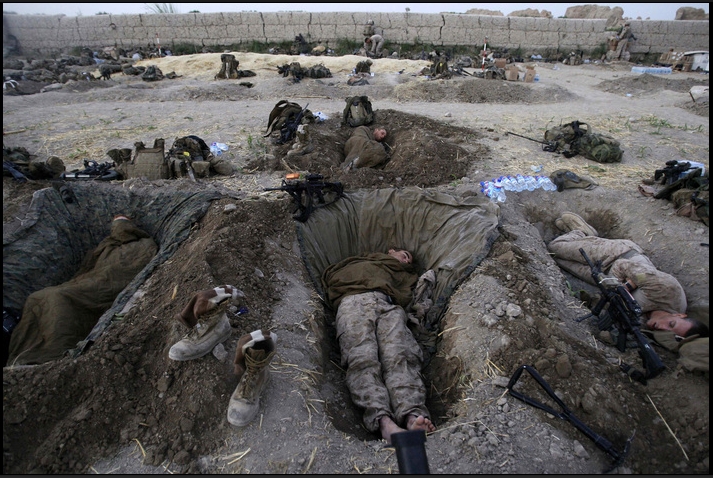
Shaping the battle space.  It sounds nice, and it’s what we claimed we were doing in Now Zad.  But go back and study my Now Zad category, the most comprehensive coverage of Now Zad anywhere.  We weren’t shaping the battle space.  We were losing Marines and Marines’ legs to IEDs, Marines were sleeping in Hobbit Holes at night, and for more than one year we had inadequate force projection – all of this while the population had left, the Taliban were using Now Zad as an R&R area and daring us to a fight, and we had an unmitigated opportunity to kill the enemy without even so much as a chance of killing noncombatants.  Yet in a tip of the hat to population-centric COIN, we refused because there was no population to protect – as if the Taliban wouldn’t leave Now Zad and go back to the population.

The Marines who bravely fought in Now Zad are heroes and the fact that we own it now is a testimony to their skills, courage and honor.  The brass who developed the strategy (or lack thereof) superintended a failure.  Now Zad was a failure entirely because brass didn’t resource the effort.  We let the Marines in Now Zad suffer while we sent infantry battalions to sea on wasted MEUs.  Finally, as to this notion that the Marines constantly complained that they didn’t have enough ANA in Now Zad, there wasn’t any ANA – period.  There was no ANA in Now Zad.  It was all Marines.

Back to Marjah.  Tim gives me pause if he claims that Marjah is a repeat of Now Zad.  Joshua Foust compares and contrasts coverage of Marjah, and concludes that there are contradictory reports from even reporters in the same locale and talking to the same people.  One report stands out, though.  This campaign is heralded as the point at which the ANA stands up.

For a second day US marines and Afghan troops have been clearing houses one by one of explosives.

One villager says they knocked on his door this morning and he saw Afghan soldiers in the lead and Americans following. He says he thinks the operation is going well.

But what is the ANA really doing?  “As Marines unloaded equipment needed to build an outpost at Five Points, others manned “fighting holes” — what the Army calls foxholes. Most of the Afghan soldiers sat in their trucks, with the engines running and the heaters at full blast.”

Last, it would appear that the only thing consistent about the reports is that a dozen noncombatants have been killed.  Predictably, McChrystal has prostrated himself before Karzai.  To be sure, we should pay the family, Marine officers should sit with surviving kin, and so on and so forth.  But the public nature of the posturing after such events is becoming a silly overreach, as if we are attempting to convince the American or Afghan public that there is any such thing as riskless war – war conducted in laboratories by men wearing white coats, where mistakes are mere failures to follow procedure and can be fixed by retraining men and retooling paperwork.  It’s all a lie.  The noncombatant deaths aren’t a mistake in procedure or protocol.  They are a tragedy of war, a tragedy that can only be avoided by losing the campaign or losing our own warriors.

Prior:

Announcing the Marjah Offensive

No Secrets to Marine Plans for Marjah

Atmospherics, Intelligence and Local Spotters

BY Herschel Smith
16 years, 2 months ago

One of our favorite war correspondents, C.J. Chivers, gives us a view of the U.S. Marines’ fight in the Helmand Province against a shadowy insurgency which uses centuries-old communications techniques.

KARARDAR, Afghanistan — The Marine infantry company, accompanied by a squad of Afghan soldiers, set out long before dawn. It walked silently through the dark fields with plans of arriving at a group of mud-walled compounds in Helmand Province at sunrise.

The company had received intelligence reports that 40 to 50 Taliban fighters had moved into this village a few days before, and the battalion had set a cordon around it. The Marines hoped to surprise any insurgents within.

But as the company moved, shepherds whistled in the darkness, passing warning of the Americans’ approach. Dogs barked themselves hoarse. The din rose in every direction, enveloping the column in noise. And then, as the Marines became visible in the bluish twilight, a minivan rumbled out of one compound. Its driver steered ahead of the company, honking the van’s horn, spreading the alarm. Spotters appeared on roofs.

Marine operations like this one in mid-January, along with interviews with dozens of Marines, reveal the insurgents’ evolving means of waging an Afghan brand of war, even as more American troops arrive.

Mixing modern weapons with ancient signaling techniques, the Taliban have developed the habits and tactics to evade capture and to disrupt American and Afghan operations, all while containing risks to their ranks.

Bruce Rolston reacts with some head-shaking at one of the supposed signaling techniques – kite flying.

The only quibble I have is with some of of the low-tech “signals” Chivers offers. One of the photo captions refers to shepherd’s whistles, and the article refers to kites. This is probably an indication either Chivers or someone he interviewed has been paying too much attention to the fever-dreams of fobbits.*

Kite flying is ubiquitous in Afghanistan, but it would be a lousy choice of signal of an enemy presence, relying for success in a pinch on two fairly unreliable things: wind, and boys (not to mention daylight). Even if it worked, presumably you’d have to do something special, like fly a different kite, to distinguish it from all the other kites. Its use as a signal of the presence of troops seems to be another one of those Afghan “urban legends,” a classic example of false correlation in intelligence reporting. Kite flying is fairly unusual to Westerners, so patrol reports can often mention it just as an observation …

I once made the rare mistake of passing on an RFI on local kite-flying patterns along these lines from a higher headquarters to our guys uncritically. I was rapidly slapped down by one of the guys in Tacnet email for passing on a junk request, something along the lines of “the kids are flying kites around me now. They were flying them yesterday. If I walk to the next village they’ll be flying there. They’ll be flying them tomorrow if there’s any wind… tell them to factor that into their analysis and get back to me when they have something useful to ask me.”

Bruce goes on to point out that infrequent patrols can lead to misunderstanding of the atmospherics.  Valid point.  But the Marines – the ultimate foot warrior – are not usually bound to vehicles, and are more diligent still to ensure contact with the population (even if they ensure force protection for sleep or down time).  More likely, they will soon learn that kite flying is more common in Afghanistan than the U.S.

That doesn’t detract from the salient point of the article and it shouldn’t cause us to lose attention to a critical aspect of these engagements, namely that these networks must be dismantled.  A well placed sniper’s bullet to a spotter on the roof or the arrest of one of the farmers or shepherds (and long term detention) should convince them that there isn’t any mileage in siding with the insurgents.

What evidence do I have that such an approach would work?  It should be remembered that the usual objection to robust tactics is that they don’t comport with population-centric counterinsurgency doctrine.  It should also be remembered that the doctrine is, after all, just doctrine.  It’s usually left to the Lance Corporals and Sergeants in the field to find what works.  In Ramadi as I have pointed out before, it was robust tactics.

Costa … dedicated a portion of his time to cracking the insurgents’ methods of communication.

“Generally there was a guy putting up gang signs, which could either send a rocket-propelled grenade through your window or some other attack your way,” said Costa, who began to realize the significance of unarmed people on Ramadi’s streets providing information via visual cues.

“You’re watching something on the street like that happening, and you’re like, ‘What the hell is that guy doing?’” he recalled. “And then the next thing you know, insurgents start coming out of the woodwork.”

“Signalers” — the eyes and ears of insurgent leaders — informed the insurgent strategists who commanded armed fighters by using hand and arm gestures. “You could see the signaler commanding troops,” Costa recalled. “He just doesn’t have a weapon.”

To curb insurgents’ ability to communicate, Costa decided on a revolutionary move: He and his unit would dismantle the enemy’s communication lines by neutralizing the threat from signalers. Sparing no time, he set a tone in Ramadi that signalers would be dealt with no differently from their weapon-wielding insurgent comrades.

“We called it in that we heard guys were signaling, and the battalion would advise from there,” he said, recalling the first day of the new strategy. “We locked that road down pretty well that day.”

In ensuing weeks, coalition forces coordinated efforts to dismember the insurgent signal patterns entrenched in Ramadi. This helped tamp down violence and create political breathing room, which in turn allowed the forging of key alliances between local tribal sheiks and coalition operators. The subsequent progress was later dubbed the “Anbar Awakening,” a societal purging of extremism by Anbaris that ushered in a level of stability unprecedented since U.S. operations in Iraq began.

With insurgents, there is nothing new under the sun (Eccl 1:9).  With counterinsurgents, we seem to want to reinvent our doctrine when it isn’t necessary.  Just ask the enlisted men what they did “back in the olden days.”

Remembering the Battle at COP Keating

BY Herschel Smith
16 years, 2 months ago

The video below is well worth the study time, and tells us even more first hand information about the battle at Kamdesh, and specifically how the Soldiers at COP Keating responded to the attack.  It would be good if the Army released the AR 15-6 investigation, but in lieu of that we can piece together enough information to draw conclusions regarding terrain, combat readiness of the U.S. Army, combat readiness of the Taliban, etc.

Obviously, this was an intense fire fight with ammunition being fired so quickly that shooters were unloading weapons as fast as re-loaders could work.  The Taliban were very effective, and notice that one of the first things they did was to render the mortar pits incapable of use due to suppressing fire.  They were good shots, had large weaponry (e.g., recoilless rifles), and were very well prepared to occupy good terrain and engage in serious conventional-style combat with U.S. forces.

Prior:

Second Guessing the Battles of Wanat and Kamdesh

Covering for the Rules of Engagement?

BY Herschel Smith
16 years, 2 months ago

It is important to recall the incident in the Kunar Province of Afghanistan that occurred approximately five months ago in which three Marines and one Navy Corpsman were killed in an Ambush.  They twice requested air support and artillery, only to be twice denied it from hundreds of miles away because noncombatants may have been in the area.

Taking a slight detour back to General McChrystal’s tactical directive, the new rules place a premium on protection of the population, even to the extent of backing away from fire fights if it is possible that noncombatants will be involved.  In McChrystal’s own words, “If you are in a situation where you are under fire from the enemy… if there is any chance of creating civilian casualties or if you don’t know whether you will create civilian casualties, if you can withdraw from that situation without firing, then you must do so.”

I later predicted as a result of the investigation conducted as part of the follow-on to this incident:

… here is something that has no chance of happening.  No investigation will find that a tactical directive written or endorsed by a four star general was responsible for anything bad.  The directive will be exonerated and the field grade officers responsible for denying artillery had better begin looking for another line of work.

Doing daily searches of ROE, the Kunar Province and other specific keywords it has taken a while to find anything related to this incident.  I have spoken with the McClatchy reporter who covered this incident, Jonathan Landay, and we have both been waiting for release of the investigation (AR 15-6).  As a related issue, I had also stated that I got independent confirmation of the truthfulness of Landay’s report.   The Washington Post has given us the first (and maybe only) look into the findings.

In the third incident that has resulted in a reprimand, four Marines were killed near the eastern Afghanistan village of Ganjgal when they were ambushed on their way to a meeting with local villagers. Senior Marine officials alleged that the Army battalion in the area was slow to provide artillery support to ward off the attack. After an investigation, the battalion executive officer, who was the senior officer on duty at the time, received a letter of reprimand, Army officials said.

The next promotion board will not go well for this field grade officer, and probably the next, and the next.  His career in the Army is essentially over – just as I predicted.  But he was following the spirit (and even the letter) of McChrystal’s rules.  Remember that my objection to the tactical directive isn’t that there is a proviso for protection of noncombatants.  No Marine or Soldier wants to kill noncombatants.  That isn’t what he’s trained to do.

My objection goes to the notion that a four star general is in any position to write an authoritative tactical directive for Lance Corporals and Sergeants in the field under fire, thus removing their judgment from consideration.  It is the ultimate “I don’t trust you” insult, and it kills troops.  “I support the troops” isn’t just a lie for the Daily Kos folks.  It’s the ugly secret for some flag officers.

And you heard the prediction here first.  Here is another prediction.  We won’t see the release of the full AR 15-6 investigation so that we can learn the full truth about the failures that fateful day which killed three Marines and a Navy Corpsman.

Prior:

Rules of Engagement category

Micromanaging the Campaign in Afghanistan II

Micromanaging the Campaign in Afghanistan


26th MEU (10)
Abu Muqawama (12)
ACOG (2)
ACOGs (1)
Afghan National Army (36)
Afghan National Police (17)
Afghanistan (704)
Afghanistan SOFA (4)
Agriculture in COIN (3)
AGW (1)
Air Force (42)
Air Power (10)
al Qaeda (83)
Ali al-Sistani (1)
America (23)
Ammunition (305)
Animals (327)
Ansar al Sunna (15)
Anthropology (3)
Antonin Scalia (1)
AR-15s (394)
Arghandab River Valley (1)
Arlington Cemetery (2)
Army (91)
Assassinations (2)
Assault Weapon Ban (29)
Australian Army (7)
Azerbaijan (4)
Backpacking (4)
Badr Organization (8)
Baitullah Mehsud (21)
Basra (17)
BATFE (247)
Battle of Bari Alai (2)
Battle of Wanat (18)
Battle Space Weight (3)
Bin Laden (7)
Blogroll (3)
Blogs (24)
Body Armor (23)
Books (3)
Border War (18)
Brady Campaign (1)
Britain (39)
British Army (36)
Camping (5)
Canada (20)
Castle Doctrine (1)
Caucasus (6)
CENTCOM (7)
Center For a New American Security (8)
Charity (3)
China (19)
Christmas (18)
CIA (30)
Civilian National Security Force (3)
Col. Gian Gentile (9)
Combat Outposts (3)
Combat Video (2)
Concerned Citizens (6)
Constabulary Actions (3)
Coolness Factor (3)
COP Keating (4)
Corruption in COIN (4)
Council on Foreign Relations (1)
Counterinsurgency (218)
DADT (2)
David Rohde (1)
Defense Contractors (2)
Department of Defense (220)
Department of Homeland Security (26)
Disaster Preparedness (5)
Distributed Operations (5)
Dogs (15)
Donald Trump (27)
Drone Campaign (4)
EFV (3)
Egypt (12)
El Salvador (1)
Embassy Security (1)
Enemy Spotters (1)
Expeditionary Warfare (18)
F-22 (2)
F-35 (1)
Fallujah (17)
Far East (3)
Fathers and Sons (2)
Favorite (1)
Fazlullah (3)
FBI (39)
Featured (192)
Federal Firearms Laws (18)
Financing the Taliban (2)
Firearms (1,873)
Football (1)
Force Projection (35)
Force Protection (4)
Force Transformation (1)
Foreign Policy (27)
Fukushima Reactor Accident (6)
Ganjgal (1)
Garmsir (1)
general (15)
General Amos (1)
General James Mattis (1)
General McChrystal (44)
General McKiernan (6)
General Rodriguez (3)
General Suleimani (9)
Georgia (19)
GITMO (2)
Google (1)
Gulbuddin Hekmatyar (1)
Gun Control (1,722)
Guns (2,412)
Guns In National Parks (3)
Haditha Roundup (10)
Haiti (2)
HAMAS (7)
Haqqani Network (9)
Hate Mail (8)
Hekmatyar (1)
Heroism (5)
Hezbollah (12)
High Capacity Magazines (16)
High Value Targets (9)
Homecoming (1)
Homeland Security (3)
Horses (2)
Humor (72)
Hunting (62)
ICOS (1)
IEDs (7)
Immigration (123)
India (10)
Infantry (4)
Information Warfare (4)
Infrastructure (4)
Intelligence (23)
Intelligence Bulletin (6)
Iran (171)
Iraq (379)
Iraq SOFA (23)
Islamic Facism (64)
Islamists (98)
Israel (19)
Jaish al Mahdi (21)
Jalalabad (1)
Japan (3)
Jihadists (82)
John Nagl (5)
Joint Intelligence Centers (1)
JRTN (1)
Kabul (1)
Kajaki Dam (1)
Kamdesh (9)
Kandahar (12)
Karachi (7)
Kashmir (2)
Khost Province (1)
Khyber (11)
Knife Blogging (7)
Korea (4)
Korengal Valley (3)
Kunar Province (20)
Kurdistan (3)
Language in COIN (5)
Language in Statecraft (1)
Language Interpreters (2)
Lashkar-e-Taiba (2)
Law Enforcement (6)
Lawfare (14)
Leadership (6)
Lebanon (6)
Leon Panetta (2)
Let Them Fight (2)
Libya (14)
Lines of Effort (3)
Littoral Combat (8)
Logistics (50)
Long Guns (1)
Lt. Col. Allen West (2)
Marine Corps (281)
Marines in Bakwa (1)
Marines in Helmand (67)
Marjah (4)
MEDEVAC (2)
Media (68)
Medical (146)
Memorial Day (6)
Mexican Cartels (47)
Mexico (71)
Michael Yon (6)
Micromanaging the Military (7)
Middle East (1)
Military Blogging (26)
Military Contractors (5)
Military Equipment (25)
Militia (9)
Mitt Romney (3)
Monetary Policy (1)
Moqtada al Sadr (2)
Mosul (4)
Mountains (25)
MRAPs (1)
Mullah Baradar (1)
Mullah Fazlullah (1)
Mullah Omar (3)
Musa Qala (4)
Music (25)
Muslim Brotherhood (6)
Nation Building (2)
National Internet IDs (1)
National Rifle Association (97)
NATO (15)
Navy (31)
Navy Corpsman (1)
NCOs (3)
News (1)
NGOs (3)
Nicholas Schmidle (2)
Now Zad (19)
NSA (3)
NSA James L. Jones (6)
Nuclear (63)
Nuristan (8)
Obama Administration (222)
Offshore Balancing (1)
Operation Alljah (7)
Operation Khanjar (14)
Ossetia (7)
Pakistan (165)
Paktya Province (1)
Palestine (5)
Patriotism (7)
Patrolling (1)
Pech River Valley (11)
Personal (77)
Petraeus (14)
Pictures (1)
Piracy (13)
Pistol (4)
Pizzagate (21)
Police (672)
Police in COIN (3)
Policy (15)
Politics (999)
Poppy (2)
PPEs (1)
Prisons in Counterinsurgency (12)
Project Gunrunner (20)
PRTs (1)
Qatar (1)
Quadrennial Defense Review (2)
Quds Force (13)
Quetta Shura (1)
RAND (3)
Recommended Reading (14)
Refueling Tanker (1)
Religion (501)
Religion and Insurgency (19)
Reuters (1)
Rick Perry (4)
Rifles (1)
Roads (4)
Rolling Stone (1)
Ron Paul (1)
ROTC (1)
Rules of Engagement (76)
Rumsfeld (1)
Russia (37)
Sabbatical (1)
Sangin (1)
Saqlawiyah (1)
Satellite Patrols (2)
Saudi Arabia (4)
Scenes from Iraq (1)
Second Amendment (713)
Second Amendment Quick Hits (2)
Secretary Gates (9)
Sharia Law (3)
Shura Ittehad-ul-Mujahiden (1)
SIIC (2)
Sirajuddin Haqqani (1)
Small Wars (72)
Snipers (9)
Sniveling Lackeys (2)
Soft Power (4)
Somalia (8)
Sons of Afghanistan (1)
Sons of Iraq (2)
Special Forces (28)
Squad Rushes (1)
State Department (23)
Statistics (1)
Sunni Insurgency (10)
Support to Infantry Ratio (1)
Supreme Court (81)
Survival (216)
SWAT Raids (58)
Syria (38)
Tactical Drills (38)
Tactical Gear (17)
Taliban (168)
Taliban Massing of Forces (4)
Tarmiyah (1)
TBI (1)
Technology (21)
Tehrik-i-Taliban (78)
Terrain in Combat (1)
Terrorism (96)
Thanksgiving (13)
The Anbar Narrative (23)
The Art of War (5)
The Fallen (1)
The Long War (20)
The Surge (3)
The Wounded (13)
Thomas Barnett (1)
Transnational Insurgencies (5)
Tribes (5)
TSA (25)
TSA Ineptitude (14)
TTPs (4)
U.S. Border Patrol (8)
U.S. Border Security (22)
U.S. Sovereignty (29)
UAVs (2)
UBL (4)
Ukraine (10)
Uncategorized (105)
Universal Background Check (3)
Unrestricted Warfare (4)
USS Iwo Jima (2)
USS San Antonio (1)
Uzbekistan (1)
V-22 Osprey (4)
Veterans (3)
Vietnam (1)
War & Warfare (435)
War & Warfare (41)
War Movies (4)
War Reporting (21)
Wardak Province (1)
Warriors (6)
Waziristan (1)
Weapons and Tactics (80)
West Point (1)
Winter Operations (1)
Women in Combat (21)
WTF? (1)
Yemen (1)

April 2026
March 2026
February 2026
January 2026
December 2025
November 2025
October 2025
September 2025
August 2025
July 2025
June 2025
May 2025
April 2025
March 2025
February 2025
January 2025
December 2024
November 2024
October 2024
September 2024
August 2024
July 2024
June 2024
May 2024
April 2024
March 2024
February 2024
January 2024
December 2023
November 2023
October 2023
September 2023
August 2023
July 2023
June 2023
May 2023
April 2023
March 2023
February 2023
January 2023
December 2022
November 2022
October 2022
September 2022
August 2022
July 2022
June 2022
May 2022
April 2022
March 2022
February 2022
January 2022
December 2021
November 2021
October 2021
September 2021
August 2021
July 2021
June 2021
May 2021
April 2021
March 2021
February 2021
January 2021
December 2020
November 2020
October 2020
September 2020
August 2020
July 2020
June 2020
May 2020
April 2020
March 2020
February 2020
January 2020
December 2019
November 2019
October 2019
September 2019
August 2019
July 2019
June 2019
May 2019
April 2019
March 2019
February 2019
January 2019
December 2018
November 2018
October 2018
September 2018
August 2018
July 2018
June 2018
May 2018
April 2018
March 2018
February 2018
January 2018
December 2017
November 2017
October 2017
September 2017
August 2017
July 2017
June 2017
May 2017
April 2017
March 2017
February 2017
January 2017
December 2016
November 2016
October 2016
September 2016
August 2016
July 2016
June 2016
May 2016
April 2016
March 2016
February 2016
January 2016
December 2015
November 2015
October 2015
September 2015
August 2015
July 2015
June 2015
May 2015
April 2015
March 2015
February 2015
January 2015
December 2014
November 2014
October 2014
September 2014
August 2014
July 2014
June 2014
May 2014
April 2014
March 2014
February 2014
January 2014
December 2013
November 2013
October 2013
September 2013
August 2013
July 2013
June 2013
May 2013
April 2013
March 2013
February 2013
January 2013
December 2012
November 2012
October 2012
September 2012
August 2012
July 2012
June 2012
May 2012
April 2012
March 2012
February 2012
January 2012
December 2011
November 2011
October 2011
September 2011
August 2011
July 2011
June 2011
May 2011
April 2011
March 2011
February 2011
January 2011
December 2010
November 2010
October 2010
September 2010
August 2010
July 2010
June 2010
May 2010
April 2010
March 2010
February 2010
January 2010
December 2009
November 2009
October 2009
September 2009
August 2009
July 2009
June 2009
May 2009
April 2009
March 2009
February 2009
January 2009
December 2008
November 2008
October 2008
September 2008
August 2008
July 2008
June 2008
May 2008
April 2008
March 2008
February 2008
January 2008
December 2007
November 2007
October 2007
September 2007
August 2007
July 2007
June 2007
May 2007
April 2007
March 2007
February 2007
January 2007
December 2006
November 2006
October 2006
September 2006
August 2006
July 2006
June 2006
May 2006

about · archives · contact · register

Copyright © 2006-2026 Captain's Journal. All rights reserved.