Convoy Battles Snow
 16 years, 12 months ago
The next time you swear at the snow on the roads as you’re driving to work, remember this.



The “Captain†is Herschel Smith, who hails from Charlotte, NC. Smith offers news and commentary on warfare, policy and counterterrorism.
16 years, 12 months ago
The next time you swear at the snow on the roads as you’re driving to work, remember this.
16 years, 12 months ago
In January of 2009 Andrew Lubin authored an open letter to the President concerning Afghanistan. This was carried on his own web site and also the Small Wars Journal blog. A number of recommendations were made, but one observation bears repeating.
Get the Army off their huge stupid bases where their bureaucracy flourishes. Put them in the field where they belong. Their “creature comforts” have gotten out of control -Burger King, Orange Julius, jewelry shops; do you know they now offer massage services at Bagram? In a war zone?
The Washington Post published an article entitled From a Fortified Base, a Different View of Afghanistan. The beginning of the article justifies Lubin’s concern and continues with this theme in the superlative degree, although not just at Bagram.
FORWARD OPERATING BASE ALTIMUR, Afghanistan, March 2 — From the air, this U.S. Army camp in Logar province looks like a fortified gravel pit on a barren slope, surrounded by two-tiered sacks of dirt and razor wire.
But inside the wire, the hundreds of young sappers and scouts and cavalry troops from the 3rd Brigade Combat Team, 10th Mountain Division, all newly arrived for a one-year deployment, have a pretty good life.
There is a heated recreation tent with treadmills and table tennis, 24-hour Internet service, Skype hookups and a bank of low-cost, instant-connection phones. A muted cacophony of domestic chatter rises from the rows of plywood booths.
“Don’t forget to make the car payment . . . She told me the new baby has red hair . . . I thought we agreed not to talk about that till I get home . . . No, it’s real quiet here, Ma . . . I saw some pretty nice hunting rifles on the Net . . . Are you being a good girl for Daddy?”
One tent away is the DFAC, or dining facility, where a crew of cheerful civilian cooks from India stays up all night preparing a smorgasbord of goodies. There is a mountain of fresh strawberries and grapes, replenished daily. There are six kinds of ice cream and pie. There is surf and turf every Friday night, with lobster tails flown from Maine via Dubai. After a late patrol, the men can still get grilled cheeseburgers at 2 a.m.
The living and bathing accommodations are luxurious, too, especially for soldiers who have slept on open rocky ground and gone for weeks without a real shower on previous deployments in much more primitive and dangerous conditions, such as insurgent-plagued Konar province to the east.
The 20-cot sleeping tents are neatly arranged between gravel paths that absorb the mud and snow. They are lighted brightly enough for soldiers to read at night, although most prefer watching action movies on their laptops. They are heated by giant black plastic hoses that blast in air so hot it can dry a pair of washed socks in 20 minutes. The hoses also pull out the exhaust so powerfully that they can suck up nearby objects — even a visitor’s sweater and cellphone — like some stealth worm from a science fiction novel.
Then there is the view, which is utterly breathtaking. Logar, located in central eastern Afghanistan about 50 miles south of the capital, Kabul, is a wide valley surrounded by mountains. From the lookout post at Altimur, set atop an abandoned stone wall, one can gaze in any direction at a vertiginously sculpted panorama of pristine white peaks.
But the men of the 3rd Combat Brigade did not come here for a sightseeing vacation, and they seem edgy and bored in this cramped military spa. They are young and fit and ready for action, and the drizzly, leaden weather means little contact with the Taliban insurgents they came to fight.
This approach can be contrasted with that taken by the 24th MEU when they deployed to the Helmand Province. Col. Peter Petronzio, commander of the 24th Marine Expeditionary Unit, observed that “You need physically to be there,” he said. “You need to continue to move about the population, let your presence be known, but do it in a way so that you are not smothering and overwhelming. You have got to let life go on.”
The Marines lived for most of their deployment in Helmand without electrical power, e-mail, connectivity, or comfortable living arrangements.
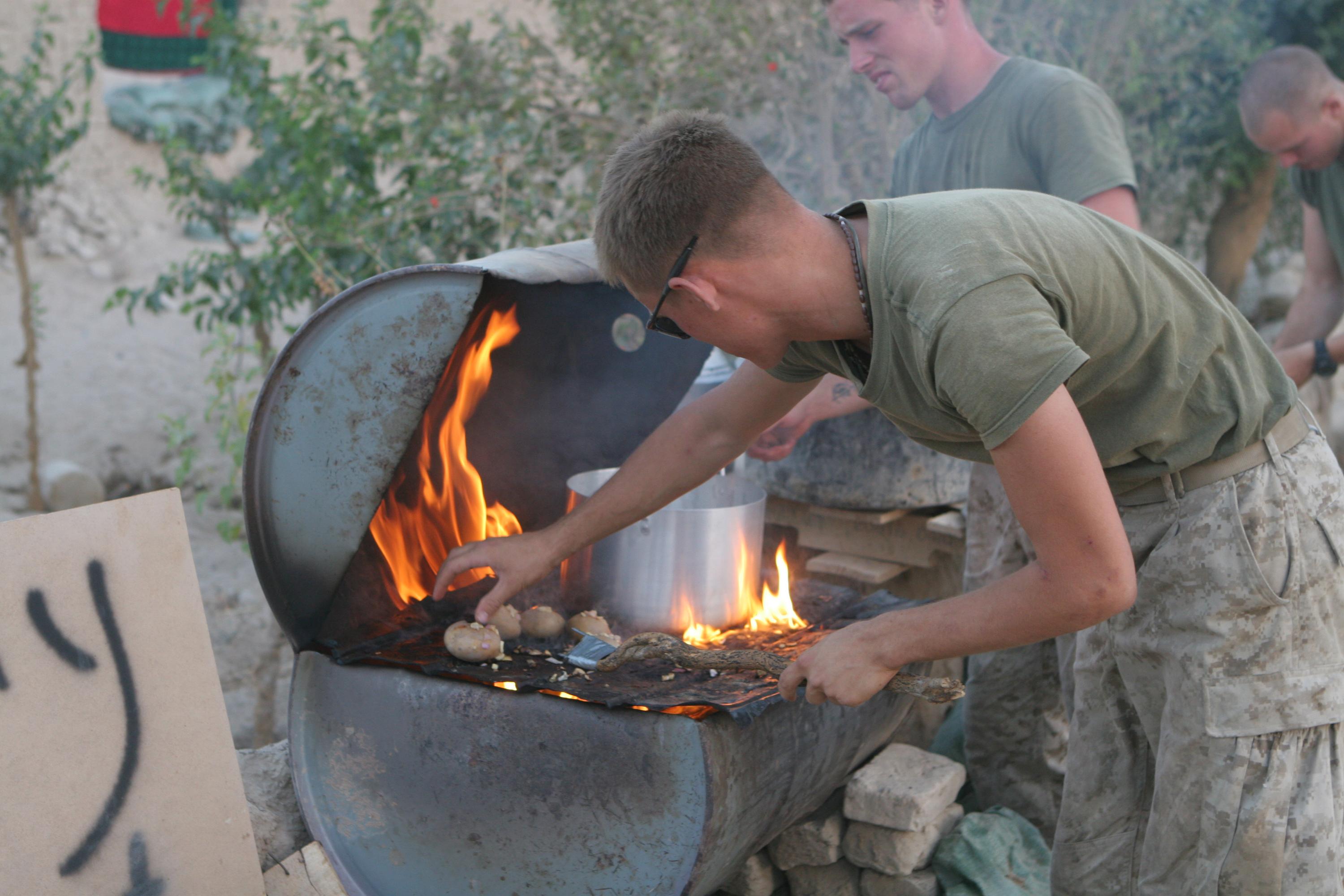
No ice cream for the Marines. Food was prepared over an open fire in the Helmand Province, Afghanistan.
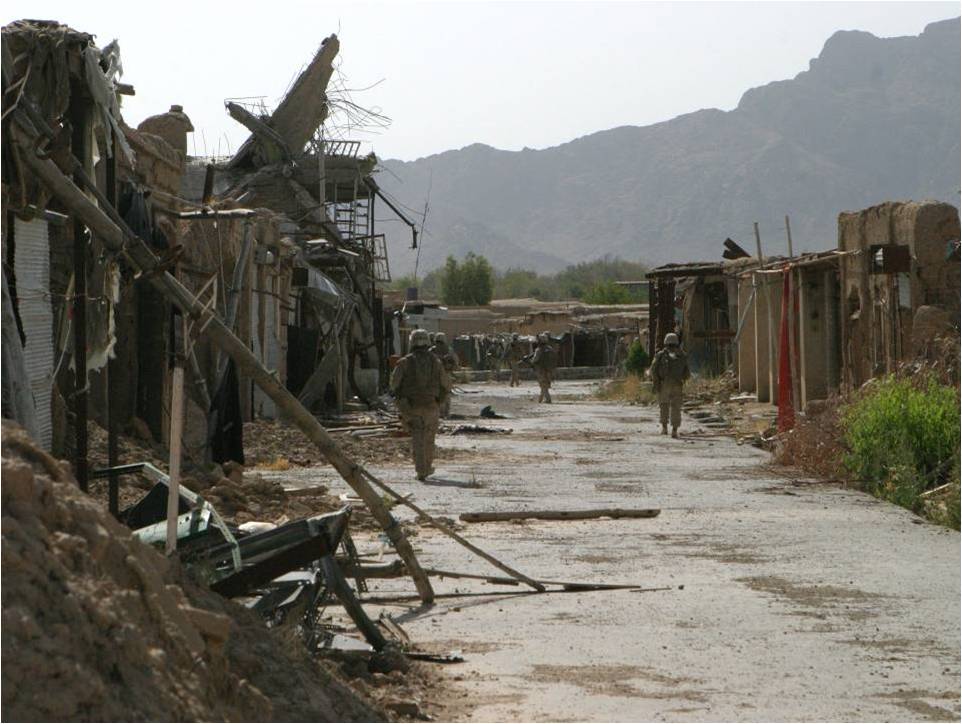
Marines on patrol in Now Zad, Afghanistan.
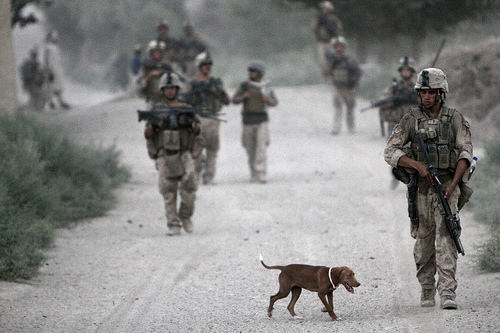
Corporal William Ash, a squad leader from 1st Platoon, Bravo Company, Battalion Landing Team 1st Battalion, 6th Marine Regiment, 24th Marine Expeditionary Unit, NATO International Security Assistance Force (ISAF), along with a stray dog lead a patrol through a city in Helmand Province, Afghanistan. When the platoon moved into the area, they found two stray dogs, and each time the Marines head out on patrol the dogs are right at the Marines’ side.
Continuing with the 3rd Brigade Combat Team, 10th Mountain Division, is there anything to do in Logar? Perhaps so. “Recently in Logar, armed locals blocked the highway into Kabul for hours, in protest of a night raid where US forces killed one and detained three others. According to local reports, the nearly 2,000 protestors burned tires and chanted anti-US slogans.”
The capabilities of the 10th Mountain Division versus the Marines is not at issue here. The issue pertains to command decisions concerning how troops are to be used, the strategy employed in Afghanistan, and the tactics used to effect that strategy. Clearly, this is not the right use of the 10th Mountain Division.
16 years, 12 months ago
Over at Abu Muqawama, Abu M. is telling us about his lamentable bent towards socialistic jobs programs by finally advocating the F-22 program. Well, not quite. The kind of people who will continue to work – engineers, highly skilled technicians, programmers, etc. – are not who the current administration is targeting for their programs. Abu M., our friend, is still not synched up with the administration. Really. We have our doubts that he ever will be completely. This is good. As for the GOP turncoats who advocate the F-22 because it will bring jobs (as Abu M. notes), their districts have a bunch of pansy-ass panty-waist sniveling lackeys for Representatives who need to be summarily run out of Washington and then tarred and feathered. The right reason to support the F-22 is – as I learned just recently from a reputable source – technical.
By month’s end, President Barack Obama must decide whether to order the building of more F-22 Raptors or let the production lines close. Only 203 of the aircraft described by the think tank Air Power Australia as “the most capable multirole combat aircraft in production today” have been built or ordered.

The F-22 Raptor performs as impressively as it looks.
Support for the aircraft is not limited to defense hawks. Last month, 44 U.S. senators, including Edward Kennedy and John Kerry, sent the president a letter requesting an additional order of unspecified size to prevent the planned 2011 shutdown. Bowing to political reality rather than reflecting true military needs, the Air Force now claims it could possibly get by with just 60 more aircraft.
Despite this, and notwithstanding the current Boeing and Lockheed Martin publicity campaign, the Raptor may well have its wings clipped. The main reason: Strategists plan to fight the next war based on the last (or current) one. Where once we planned for massive set-piece battles, now it seems many can’t see beyond guerrilla warfare with lightly armed insurgents. Conventional war weapons programs are being eliminated or slashed.
The F-22, which entered service three years ago, blends key technologies that formerly existed only separately on other aircraft — or not at all. Its stealthiness will make trigger-happy combatants shoot at birds. It has agility, air-to-air combat abilities and penetrability far beyond that of the F-15 Eagle which entered service 33 years ago. It cruises at Mach-plus speeds without using fuel-guzzling afterburners.
But the end of the Cold War, the current guerrilla wars, and what Air Power Australia calls a deliberate campaign of “concocting untruthful stories about its capabilities, utility and cost,” has devastated Raptor purchases. Originally the Air Force requested up to 762, but the Pentagon’s 1990 Major Aircraft Review reduced that to 648. This was subsequently cut to 442, then 339, then to 277, before the current 203, of which 134 have been built.
A major criticism of the Raptor is the cost, which at about $339 million per aircraft is many times the original estimate. But much of this reflects a wisely added ground attack role, inflation, and a sneaky but common ruse used to cut weapon procurements.
Technology development costs are fixed. So each time an order is reduced, per-unit prices go up. Critics slashed the F-22 order, and then cited the “stunning” per-unit cost to slash away again. This game has played out with one weapon system after another, helping explain why an initial plan for acquiring 132 B-2 Spirit bombers ended with a pitiful purchase of 21. But the current per-unit cost for each additional F-22 is around $136 million, according to the Air Force.
If necessary, the Air Force says it will try to fill the F-22 shortage by keeping F-15s flying to 2025. It won’t work. Even eight years ago, “some foreign aircraft we’ve been able to test, our best pilots flying their airplanes [from other countries] beat our pilots flying our airplanes every time,” then-Air Force Commander John Jumper told Congress.
Two years earlier, the independent Federation of American Scientists (FAS) noted that the Russian Sukhoi Flanker Su-27, which entered service eight years after the Eagle, “leveled the playing field” with the F-15. Su-27’s, both Russian-built and Chinese pirated copies, are now in arsenals around the world.
Nor are enemy fighters our only worry. Russian surface-to-air missiles (SAMs) have improved dramatically in recent years. The country’s S-300 system is “one of the most lethal, if not the most lethal, all-altitude area defense,” noted the International Strategy and Assessment Service, “a Virginia-based think tank focused on U.S. and Allied security issues.” three years ago. China also has the S-300 and the Russians announced in December they’ll soon sell units to Iran.

The F-22 may be the only aircraft that can penetrate the Soviet S-400 missile system, yet opponents focus entirely on dogfighting.
The sale not only would threaten stand-off warning and control systems like AWACS but also tremendously boost defense of Iran’s Bushehr nuclear reactor and Natanz uranium-enrichment site.
The newer S-400 system, already deployed, is far better able to detect low-signature targets and aircraft generally, as far away as 250 miles away, according to the FAS. That’s twice that of the S-300. When mated with the Triumf SA-20/21 missile, which Russia claims it tested in December, it can even knock down ballistic missiles.
“Only the F-22 can survive in airspace defended by increasingly capable surface-to-air missiles,” declared Air Force Association President Mike Dunn in December.
Some have demanded trading off F-22s for more of the cheaper F-35 Lightning II Joint Strike Fighter (JSF), although it’s vastly inferior in both air-to-air combat and ground defense penetration. Further, much of that lower price reflects the economy of scale of the vastly larger order F-35 orders, even as increased development costs have tremendously upped the Lightning II price tag.
The current Air Force budget estimate says the “flyaway unit cost” of its F-35 version will be strikingly higher than that of the F-22 during the first four years of production. Only then will assembly line expansion drop the F-35 sticker to $91 billion by FY 2013.
The Russia bear has awakened from hibernation to rebuild its lost empire. China continues its inexorable military expansion. Iran desperately wants The Bomb, while North Korea revels in unpredictability. Yes, Virginia, we really do have potential enemies with weapons other than AKs and IEDs. We desperately need far more F-22 Raptors — preferably to prevent wars but if need be to win them.
Sorry to steal Michael Fumento’s thunder by duplicating his post completely, but it deserved complete mention, and also complete attribution. And so just build the F-22 and say thanks to Fumento for a good article. And stop the socialistic jobs programs, okay?
16 years, 12 months ago
For those who follow John Robb at Global Guerrillas, John turns our head with a couple of recent posts, and they are related (the mistaken narrative in the first informs the view in the second). First, Robb conveys some strange musings on Iraq and the lack of applicability of our experience there to Afghanistan.
Perversely, the US military doesn’t see what happened in Iraq as luck. Revisionist history is now attributing it to the successful application of COIN doctrine and secret weapons (arg!). As a result of these assumption errors, it isn’t using the lull in the conflict as a window of opportunity to withdraw. This would be the smart thing to do given the fiscal crunch in the US.
The second pertains to the Pakistan’s truce with the Taliban in Swat.
To the extent there is an upside,
- Open warfare will slow, curtailing the bad effects of a unpopular guerrilla war on Pakistan’s military.
- These groups can now be negotiated with, since it is likely that by giving these Islamic groups local control, it forces them into a position of defending gains. They now have something to lose.
- Internal opposition will mount as these Islamic groups over reach with their application of Sharia.
Attaboy! Only John Robb could find good in the settlement with the Taliban and bad in the success in Iraq. Let’s unpack this a bit. But stay tuned for some personal revelations on this ridiculous notion of luck (and maybe a bit more)!
First off, Robb assumes that the Taliban have no global interests and will negotiate in good faith. The past three years in Pakistan have shown this to be a false axiom, and we have discussed this in our own articles. Says Baitullah Mehsud,
“We want to eradicate Britain and America, and to shatter the arrogance and tyranny of the infidels. We pray that Allah will enable us to destroy the White House, New York, and London.”
The second point is just as important and related to both his comment on Swat and his view of the successes in Iraq. It is absolutely critical to get the correct narrative on Iraq. Without it the wrong lessons will be learned and thus will become institutional obstacles rather than tools.
The Captain is a Calvinist, and so to The Captain’s Journal, luck doesn’t exist. But without a doubt The Captain’s Journal has many readers who do not see things through the lens of the Calvinian perspective. But those who don’t can’t define luck in a philosophically defensible way. Luck is something that is without power and lacking as a causative agent. Luck doesn’t effect change or cause things to happen. “Luck” is what people say when they haven’t thought clearly enough about it to say what really happened. Luck is when people throw up their hands and refuse to think any further because they are mentally lazy or their system is philosophically bankrupt.
But Robb isn’t really lazy, and he doesn’t ascribe the success to something nonexistent. He is just using the term loosely. Writers and analysts shouldn’t do that. Earlier in the article he summarizes what he believes happened in Iraq.
… a low level civil war that put two front pressure on guerrilla groups, a commander (Petaeus) that was able to abandon doctrine in favor of developments taking place on the ground (local commanders reporting that Sunni tribal groups were willing to work with the US), [creating] a crack in the Iraqi open source insurgency that enabled the US military to turn hundreds of guerrilla/tribal groups into US funded/armed militias.
It’s all about the tribes to Robb. The tribes were a significant part of the turnaround in Anbar, to be sure, but without the proper context this narrative can be misleading. As we have discussed before, Colonel MacFarland noted the state of the tribes upon his arrival to Anbar.
… the sheiks were sitting on the fence.
They were not sympathetic to al-Qaeda, but they tolerated its members, MacFarland says.
The sheiks’ outlook had been shaped by watching an earlier clash between Iraqi nationalists — primarily former members of Saddam Hussein’s ruling Baath Party — and hard-core al-Qaeda operatives who were a mix of foreign fighters and Iraqis. Al-Qaeda beat the nationalists. That rattled the sheiks.
“Al-Qaeda just mopped up the floor with those guys,” he says.
Similarly, Abu Ahmed in al Qaim, Iraq (the Western part of Anbar), lost to al Qaeda until the U.S. Marines joined the fight at his behest. The tribe-only approach to the success in Iraq, or in other words, the either-or approach to the narrative, is flawed in that it fails to recognize the symbiotic connection between the indigenous and U.S. forces. No one “reported” that the tribes were willing to work with the U.S. forces as if waiting for approval. U.S. forces worked with tribal sheikhs from the beginning in Anbar, and this persistence it eventually paid off. Rather than either-or, it was both-and.
With a foreign army (referring to al Qaeda) having invaded Anbar, the tribes needed another army to help drive it away. Without a functional Iraqi army, they turned to the U.S. forces. Similarly, the tribes in Pakistan and Afghanistan will not be able to drive out the Taliban alone. Force projection and strength are required.
This is the crucial point where Robb fails to grasp the fundamental nature of the problem with the Taliban and al Qaeda. He reaches the stunning and inverted conclusion that having achieved victory is the only thing that will bring the Taliban to the bargaining table, and that the circumstances alone will defeat the insurgency. This coheres with Robb’s usual position that insurgencies cannot be defeated. Getting the narrative wrong is perilous, and lessons learned and applied can only redound to success when they are the right lessons.
Prior: The Anbar Narrative
17 years ago
Our friend Dave Dilegge at the Small Wars Journal is soon to publish a number of perspectives on the new media. Yours truly contributed a paragraph to this piece, so jump on over there to see if Dave has published this article yet. If not, then jump over there tomorrow too. In fact, make the SWJ a daily stop. Since Dave will include our little paragraph it won’t be rehearsed here. But as a perspective to occupy your attention over the weekend, here is a sober and yet snarky take on Milblogging from the perspective of The Captain’s Journal.
How is it possible to ascertain the difference TCJ makes, if any? Very difficult. TCJ thinks that the affect of the new media is very much a mixed bag, with the professional military still learning to deal with the openness and unstructured nature of it all. TCJ knows with certainty at times that our efforts are not having the intended affect. TCJ called out the Taliban strategy to target logistical lines one year before it began to occur and continued to harp on this issue repeatedly. When nothing of strategic or tactical value comes from such efforts, we have failed, and failed badly.
Yet there are encouraging signs. In our analysis of the battle of Wanat, TCJ extensively covered Observation Post Top Side and its role in the horrible affair. We focused on the terrain and its role in Combat Outposts and counterinsurgency. To our great delight, fellow blogger Slab from OpFor commented on this article. He said “Where I think you hit the nail on the head is when you mention the terrain. The platoon in Wanat sacrificed control of the key terrain in the area in order to locate closer to the population. This was a significant risk, and I don’t see any indication that they attempted to sufficiently mitigate that risk. I can empathize a little bit – I was the first Marine on deck at Camp Blessing back when it was still Firebase Catamount, in late 2003. I took responsibility for the camp’s security from a platoon from the 10th Mountain Div, and established a perimeter defense around it. Looking back, I don’t think I adequately controlled the key terrain around the camp. The platoon that replaced me took some steps to correct that, and I think it played a significant role when they were attacked on March 22nd of 2004. COIN theorists love to say that the population is the key terrain, but I think Wanat shows that ignoring the existing natural terrain in favor of the population is a risky proposition, especially in Afghanistan.”
Later, using analysis tools TCJ noticed this article being studied at great length by a reader at the Counterinsurgency Center at Leavenworth. The Captain went to bed happy that night. Two counterinsurgency practitioners had discussed the issue of terrain in COIN without ever talking directly to each other. They did so because the Captain wrote an article on the subject. Mission accomplished.
Another such example occurred just today, with someone from Army.com network domain from Fort Benning who Googled the phrase “need for Army linguists in COIN,” with TCJ category Language in COIN coming up first on the first page (where The Enemy of My Enemy is linked). Hopefully, someone somewhere will be persuaded to spend a few more dollars on teaching language to young warriors.
TCJ is mostly analysis and advocacy. There is certainly a symbiotic relationship with the main stream media, but we believe that we are as valuable an analysis asset as anyone in the main stream media. On occasion, we scoop exclusive interviews and other information, such as with intelligence sources in Ramadi that scooped us the word on the smuggling lines of Abdul Sattar Abu Risha being targeted and shut down with kinetic operations as a precursor to the “flipping” of the tribes in Anbar. Our sources are as good or better than any in the main stream media.
It has been said that blogging is an exercise in vanity. Perhaps, and perhaps not. Maybe this is true only to a limited extent. TCJ could get 100,000 visits per day (an impossibility good but hyperbole to make a point), but if it could be proven that we had not one iota of affect on policy, strategy, logistics or tactics, then this blog would be shut down tomorrow. Visits are irrelevant if no impact is being made.
Milblogging can be hard work, regardless of what the reader may think. If one is serious about these things and strives to make a difference, then he must study, read, think, stay up late pondering things that effect life and death, and think about the sons of America that have perished along the way, and the pain experienced by their parents or spouses. If you’re trying to pick a hobby, there are much easier and more lighthearted things to do with your time. This can be heavy stuff.
Now for the questions. TCJ wants to know a few things. When the donate button was up on the web site in an attempt to fund embeds for Jim Spiri and The Captain, why didn’t anyone donate a single dollar? If this is an indication of the value of this web site, then why does this site bring visitors back regularly, and why has traffic increased? With the high intelligence level of many of the readers of this web site – and there are some smart ones – why don’t we get more comments? One has to register for the web site, but that’s easy. One has to register for Michael Totten’s web site too, but he gets regular comments. At one time the reader didn’t have to register for comments, but the hate mail, profanity and even threats in the comments created a need to bring more control. Why has this resulted in much fewer comments?
More questions. Why does TCJ have readers it doesn’t even know? Granted, one can register for Feedburner and read the feed without ever visiting the site. But why would a reader not drop a note and let us know they exist, and agree or disagree with our perspective? Speaking of Feedburner, can someone please explain why the numbers fluctuate so wildly? Why will it show 320 readers on Feedburner one morning, and 198 that night? What does that mean? And for that matter, how many Google Reader readers do we have?
Now to the sardonic and snarky. TCJ absolutely, positively and completely refuses to compare ourselves with other blogs. We won’t do it. Period. So readers should not do it. We do what we do, others do what they do. Leave others out of it.
And speaking of comparisons, what about that guy John Robb at Global Guerrillas? Check out his Feedburner readers? 11416 at this writing. Why isn’t TCJ that high? In terms of comparison, we are as good as Robb, aren’t we? Maybe we need to work harder on coming up with slick and pedantic acronyms for everything. Or maybe would should talk more about swarm theory. Then we would have 11416 readers instead of 320 – or 198 – or whatever.
One of the brighter sides of blogging like this is the exchange of e-mail that occurs between bloggers and professional military. Guys like the Godfather of Milblogging, Matthew Currier Burden, knows who I am and is happy to talk with me. TCJ has enjoyed the witty quips back and forth between Andrew Exum who blogs at Abu Muqawama. It has been a pure pleasure to get to know Dave Dilegge at the Small Wars Journal. TCJ absolutely cherishes the long, thoughtful, scholarly and very personal notes back and forth with Col. Gian Gentile, Academy Professor and Military History Division Chief at West Point. TCJ also appreciates all of the trust various professional military have placed in us, giving us first hand accounts, personal perspectives, good analysis and sometimes OPSEC (which of course TCJ doesn’t divulge). This is always good for creating the right perspective, even if the information is too sensitive to share. And TCJ is smart enough to know when something is too sensitive to share. There are also more journalists and bloggers such as Andrew Lubin and Steve Schippert, who we consider very good friends, who have been kind, and who have played an important role in the evolution of TCJ.
Mostly, TCJ is thankful to God for the safe return of our very own warrior from Iraq in 2007, and soon-to-be safe return from the 26th MEU in 2009. This blog existed as an outlet on sleepless nights waiting for that fateful knock at the door by a Marine Chaplain that didn’t happen. If there is a single bit of worth to this blog it will be continued. But this is so very difficult to measure. What metric would one apply, and how would data be gathered to assess that metric?
There are still many questions, and this article hasn’t yielded any answers.
17 years ago
Reader Brett Turner kindly sent the following story our direction. Regular readers of The Captain’s Journal know that we have harped on the weight of body armor – and in particular, ESAPI plates – in just about every article (on body armor) we have written. We have strongly recommended government money be spent on designing new and improved ESAPI plates that don’t weigh as much as the current generation of plates. The total weight of the MTV comes to around 32 pounds. We have recommended that experts be engaged, from materials engineering to fracture mechanics practitioners. Now comes a University of Virginia student who has led the effort we recommended, except that there is no government money involved – yet.
The most stalwart medieval knight probably griped about the crippling weight of his shining armor.
The metal’s inflexibility left plenty to complain about as well. And there was its nasty tendency of allowing sharp edges and pointy-tipped projectiles through cracks and creases.Things haven’t changed much.
The nation’s combat forces continue to deal with these same shortcomings, despite tremendous advancements in modern body armor. U.S. Army Sgt. Jeff O’Dell saw vivid examples of body armor saving American lives during his deployment in Iraq.
The University of Virginia second-year student also knows how Enhanced Small Arms Protective Inserts can restrict movement and fail to stop multiple bullets. The four bulky ceramic plates now in use in protective vests used by American forces are also heavy, bringing the weight of a vest to nearly 30 pounds.
“I was deployed in Iraq as a fire support specialist from August 2005 to December 2006,” said O’Dell, who is serving in the National Guard while attending UVa. “Our armor vest had single ceramic plates in the front, back and on each side.
“The vest has saved the lives of some of my buddies, but having worn it a lot I know it can be improved upon. It’s too heavy, it doesn’t stop multiple rounds and it doesn’t flex.
“The Army has had a lot of issues with the body armor being recalled, and a lot of the troops have been complaining about its effectiveness, weight and so forth. I really think it’s something that needs to be fixed.”
Last September O’Dell seized upon an opportunity to possibly help save countless lives in the future — maybe even his own. As a double major in biomedical engineering and mechanical engineering, he took a Design Discovery class that introduces second-year students to conceptual and practical design work.
The class educates students on how to come up with novel products and ultimately market them. The class is broken into small teams of students who work together on projects they originate.O’Dell teamed up with Ann Bailey, Adam Rogers and Dan Abebayehu. When the student-soldier proposed the idea of creating a better armor vest the others quickly signed on.
“I had family members in the military so this hit close to home for me,” said Bailey, who is from Elkton. “And I like the idea of working with something that will actually be beneficial to someone.
“This project has been a real opportunity to work on something that will actually make a difference. I also like the fact that we’re at a school with so many resources and where the professors are so willing to help.
“When we were in the research phase we needed to figure out a particular thing, and I went to talk to a professor in the materials science department. He dropped whatever it was he was doing, pulled up a Web site and explained to me exactly what we needed to know.”The armor vest project quickly became more than an exercise in how to get a passing grade. Inspired by O’Dell, who will likely be deployed to Afghanistan later this year, the team began working feverously on a new design that would eliminate the historic shortcomings of body armor.
A few months ago examples of the students’ new vest were put to the test at H.P. White Lab in Maryland. In the company’s ballistics testing facility, round after armor-piercing round were fired into the vests.
The team’s radically new design proved so successful and groundbreaking that a second round of testing will take place on Thursday. This time Army representatives will be present to evaluate the students’ system firsthand.
“The Army is interested because we’ve come up with a design that offers flexibility and more capability for stopping multiple armor-piercing rounds,” said O’Dell, who was born and raised in Martinsville. “A lot of it has to do with our design, and a lot of it is the material we’re changing.
“When the results came out so well during the first round of testing we made contact with a possible commercialization partner, which is an armor company in Pennsylvania. They got in touch with the Army and set up the testing for later this month.
“We actually came up with a concept for vehicle armor as well. During the first test it was hit by 10, 30-caliber armor-piercing rounds and stopped all 10.”
The new vest presents a classic example of what can result from a well thought-out course that emphasizes creativity and cooperation. O’Dell lauded the fact that the class was structured to give students step-by-step guidance during each stage of the project.
The students were made aware of available resources and professors who were experts in areas that could be helpful. One expert was Haydn N. Wadley, Edgar Starke Professor of Materials Science and Engineering. He gave the four students a crash course in body armor materials and how they work.
William F. Walker continues to guide and mentor the engineering students. He said his main goal in the class was to motivate students to go out and find their own problems to work on.
“I want the students to find something they’re passionate about, and will throw themselves into fully,” said Walker, associate professor of biomedical engineering and electrical and computer engineering at UVa. “Some students will accept the challenge like this team has done, and will go like mad.
“What Jeff and his team members have done is really not in my area of expertise, but the data they’ve gotten in testing so far really speaks for itself. Experts I’ve spoken to who do know this field haven’t seen anything like this before.
When the defense contractors have nothing else to gain because they already have a fat contract and thus no incentive to design something better, a young warrior-student steps into the gap. What a story. God bless this effort, and God bless these students.
This information is proprietary, so they will be unwilling to go into too much detail concerning the materials and design specifications. But we will contact them to see just what we might learn about the effort. We will be tracking this very closely.
Prior: Body Armor (category)
17 years ago
I like Ralph Peters. Always have. I enjoy reading his analyses even when I disagree. Ralph is a good writer, great stylistically, and certainly knowledgeable on a great many things. That’s why I have concluded that Ralph has been smoking pot, or hash. I’m certain of it. Certain.
Not any pot, mind you, but some bad, bad weed. Something’s wrong with the stuff he has been doing. That’s the only explanation for his most recent analysis of the options in Afghanistan. Just a little of it is reproduced below.
We needed to smash our enemies and leave. Had it proved necessary, we could have returned later for another punitive mission. Instead, we fell into the great American fallacy of believing ourselves responsible for helping those who’ve harmed us. This practice was already fodder for mockery 50 years ago, when the novella and film The Mouse That Roared postulated that the best way for a poor country to get rich was to declare war on America then surrender …
Ranked from best to worst, here are our four basic options going forward:
• Best. Instead of increasing the U.S. military “footprint,” reduce our forces and those of NATO by two-thirds, maintaining a “mother ship” at Bagram Air Base and a few satellite bases from which special operations troops, aircraft and drones, and lean conventional forces would strike terrorists and support Afghan factions with whom we share common enemies. All resupply for our military could be done by air, if necessary.
Stop pretending Afghanistan’s a real state. Freeze development efforts. Ignore the opium. Kill the fanatics.
• Good. Leave entirely. Strike terrorist targets from over the horizon and launch punitive raids when necessary. Instead of facing another Vietnam ourselves, let Afghanistan become a Vietnam for Iran and Pakistan. Rebuild our military at home, renewing our strategic capabilities.
• Poor. Continue to muddle through as is, accepting that achieving any meaningful change in Afghanistan is a generational commitment. Surge troops for specific missions, but not permanently.
• Worst. Augment our forces endlessly and increase aid in the absence of a strategy. Lie to ourselves that good things might just happen. Let U.S. troops and Afghans continue to die for empty rhetoric, while Pakistan decays into a vast terrorist refuge.
Dude. Quick. Somebody grab his bong while he isn’t looking. Actually, this notion of smashing our enemies and leaving has a very robust and time-honored tradition. I have discussed it extensively with one particular Marine to whom I am very close (wink), and even the enlisted men know that there are various foreign policy paradigms. This idea also matches quite nicely with the imperial nature of the U.S. Marine Corps, fighting our battles on foreign soil rather than our own, and the expeditionary nature and structure of the Corps. As long as we recognize that we would be back into Afghanistan – and we most certainly would – then leaving now is a viable option.
It’s the first (so-called “best”) option that causes The Captain’s Journal to believe that Ralphie has been taking a few tokes on some wicked reefer. The first option is not viable. If we withdraw to a couple of bases, it would be similar to withdrawing completely. The Afghan police would be slaughtered within two to three weeks. The Afghan National Army would last longer, maybe six weeks. The Taliban would be inside Kabul in force within a few weeks, and the Karzai regime wouldn’t last longer than the six weeks that the Army existed. The Taliban would take over again.
Any interpreters, transporters or moderates would be summarily executed by the Taliban. There would be no logistical supply into any of the bases, and so all supply would be done by air to the larger base and helicopter by smaller base. The helicopters would be routinely shot down by rocket fire. The Taliban would completely control the terrian outside of all bases, and no intelligence would be forthcoming to kill the bad actors. No intelligence would be forthcoming because there would be no one left alive who would talk to the U.S. about the whereabouts of the bad actors. There would be no interpreters left alive, and so no communication with the Afghan population at all. It would be like the Tower of Babel. The police would all be dead, and the Army wouldn’t exist any more.
The main base would always be under attack my mortar, RPG, rocket and small arms fire, and no missions outside of the base would occur via ground transport because of the IEDs. It would all have to occur via helicopter, and Taliban would be permanently garrisoned outside of the base to shoot down any helicopter that ventured out of the base. The base would be relegated to force protection alone, and staying alive would be the goal of the miserable deployment for the Soldiers and Marines.
As for the smaller bases, they would take so many casualties that assignment to them would be seen as a death sentence. Casualties wouldn’t even be able to be flown back to the main base (and certainly not Germany or Aircraft Carriers) for treatment. Staying alive would be the main occupation of men on the main base. It would be almost impossible on the smaller FOBs or outposts.
In short, the first option won’t work. It’s not that it isn’t desirable. We have tried it for six years in Afghanistan, and it’s why we are where we are at the moment. So withdraw completely – bring them all home – get rested up and retrained – and then prepare to go back and do it again later. So be it. The next Afghanistan campaign in three or four years after another 9/11. That’s a viable strategy. It will work. Or, go big and present force projection in order to kill the enemy, secure the population, and build a system that prevents the existence of threats to America.
But the small footprint option is a loser. It won’t work, and by the time we figure that out, too many sons of America will have died in such a stupid plan. And someone please grab Ralph’s bong. He needs to get clear-headed. He is a contributor to this thing. We need him sober.
17 years ago
Having made a forecast and allowing the dust to settle on the scene in Swat, The Captain’s Journal is turning back full circle to see how all of this is shaking out for Afghanistan.
It is understood the North West Frontier Province government has agreed an amnesty for Taliban fighters, including those who have bombed girls’ schools and video shops and beheaded opponents.
It also follows a shake-up in the Taliban alliance led by Baitullah Mehsud. He has announced a new umbrella group, the Shura Ittehadul Mujahideen, which includes two senior militant commanders who had until now been regarded as ‘pro-Pakistan government’ Taliban.
According to one militant source in Bajaur, Baitullah Mehsud had recently received a message from the Taliban’s ‘supreme leader’, Mullah Omar, calling on him to stop attacks on the Pakistan Army and reminding him that Nato forces in Afghanistan were their real enemy.
And our forecast?
Implementation of Sharia law is only part of the deal. The Pakistani Army will leave. The institutions set up by the Taliban are now formalized and official, recognized by the Pakistani government. Given the proximity of Swat to Afghanistan, safe haven for the Taliban doesn’t even begin to explain the depths of the problem. The problem goes not only to territory and terrain, but preoccupation of the Tehrik-i-Taliban (TTP).
Although not exclusively, the TTP has primarily been disposed with fights inside of the North West Frontier Province and Federally Administered Tribal Areas. They are now no longer occupied with fights with the Pakistani Army.
These fighters are now free to engage U.S. troops, and thus has Pakistan traded off its “security” for that of Afghanistan. And the campaign in Afghanistan has just gotten a little harder.
So if this report is accurate, we find out the impetus for the combination of the Tehrik-i-Taliban with other Taliban commanders as well as the “settlement” with Pakistan. Mullah Omar rebuked the TTP for attention on Pakistan, and reminded them that infidels were just across the border.
This is new information, but as for the forecast concerning the new attention on Afghanistan, you heard it here first.
17 years ago
Eventually the goal is to turn over the security of the Afghan population to the Afghan National Army and Afghan Police. This lofty goal is a long way off, according to the intitutional problems known to exist within the Afghan police. Drug addiction is the first hurdle.
Sixty per cent of the Afghan police in the country’s southern province of Helmand use drugs, it is claimed.
The estimate, made by a UK official working in the province, was contained in emails obtained by the BBC.
International forces are fighting a fierce counter-insurgency campaign against Taleban militants and other insurgents in Helmand.
But British officials are clearly worried about the reliability of the Afghan police.
“We are very concerned by the levels of drug abuse among the police,” the British Foreign Office said in a statement.
On patrol with the 3rd Brigade Combat Team of the 10th Mountain Division we get the raw reaction to the Afghan police and their lack of honor and integrity.
“The police are just worthless,” fumed Fulat Khan, 20, when Haight said his troops were backing up the local cops. “Anytime there is a fight in the community, the police just laugh and watch it. We need an organization or a number we can call so somebody can come here and help us.”
This report is profoundly troubling, especially given the previous reports of drug problems in the Afghan National Army. There is much work to do within the government and institutions themselves in order even to begin to turn over security to Afghanistan.
17 years ago
Pakistan’s Tehrik-i-Taliban, led by Baitullah Mehsud, have released an important statement.
NORTH WAZIRISTAN – Bringing an end to their internal rifts, Tehreek-i-Taliban Pakistan (TTP) leaders have renamed their group as Shura Ittehadul Mujahideen with the purpose of striving for the supremacy of Islam and crushing infidels.
The three leading militant groups calling themselves as Taliban have circulated a single-page Urdu pamphlet in different parts of Waziristan, which confirmed that they had got united according to the wishes of Mujahideen leaders like Mullah Muhammad Omar and Sheikh Osama bin Laden.
The three leaders Hafiz Gul Bahadar, Baitullah Mehsud and Maulvi Nazir have confirmed the establishment of Shura Ittehadul Mujahideen with certain objectives. The pamphlet said the target of the Shura Ittehadul Mujahideen was to get Mujahideen united at a single platform for Jihad and stop those who were violating and crossing the limits. It said that TTP had decided to shun differences and join hands with one another. It added the TTP supported Mullah Muhammad Omar and Osama bin Laden’s struggle against Obama, Zardari and Karzai administrations.
A number of Quranic verses have been referred in the pamphlet, stressing upon Muslims to get united and join hands against non-believers.
Another account gives us reason to pause concerning the evolution of this organization.
The announcement described Mulla Omar and Osama bin Laden as their leader. They vowed to continue the Jihad for the enforcement of Sharia in the region.
It further said that it was yet unclear whether Tehrik Taliban has been finished.
Besides, Taliban leaders belonging to Bajaur, Swat and Mohmand Agency were not invited.
It’s difficult to know – and maybe premature to speculate – about why other commanders weren’t invited. The most probable reason is that the Tehrik-i-Talban included everyone in the meeting who mattered to the highest leadership. Baitullah Mehsud and his closest commanders were there, and Baitullah is completely in charge of the TTP. His enemies, far and near, should beware. Inclusion of others would have been pointless.
More important to this pronouncement is that there now seems to be a formal recognition of the globalist intentions of the Tehrik-i-Taliban, and a statement that the infighting between factions would come to an end, or at least, so says the highest leaders.
We have noted this globalist aspect of the TTP before.
In some places they aim to enforce strict sharia law. In others, the Taliban want to establish bases from which to work in support of the resistance against foreign forces in Afghanistan.
In yet other areas, the purpose is simply to create chaos and anarchy so that militants can engage the Pakistani armed forces and deter them from supporting the global “war on terror”.
However, the ultimate mission of the groups is steadily harmonizing, that is, to support the regional war and then the global war against Western hegemony; this is the concept driving the neo-Taliban.
The Captain’s Journal will be watching this development. More time is needed fully to understand the implications of the pronouncement by the TTP.





