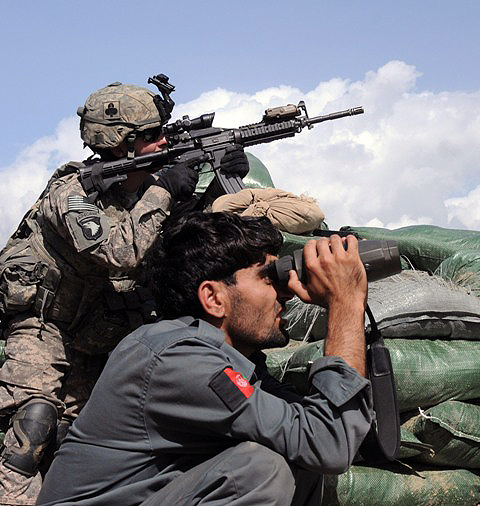
Articles by Herschel Smith


The “Captain” is Herschel Smith, who hails from Charlotte, NC. Smith offers news and commentary on warfare, policy and counterterrorism.


Karzai Bans Security Firms

15 years, 4 months ago

We have been stupid and allowed Hamid Karzai to do what he threatened to do in the interest of trying to create the perception of a viable government in Kabul.

The Afghan government said yesterday it has started dissolving private security businesses in the country by taking steps to end the operations of eight companies, including the one formerly known as Blackwater and three other international contractors.

“We have very good news for the Afghan people today,’’ presidential spokesman Waheed Omar told reporters in the capital. “The disbanding of eight private security firms has started.’’

Afghan President Hamid Karzai announced in August that private security contractors would have to cease operations by the end of the year — wiping out an industry with tens of thousands of guards who protect military convoys, government officials, and businesspeople.

Some security contractors have been criticized for operating more like private militias, and the government said it could not have armed groups that were independent of the police or military forces.

The eight companies include Xe Services, the North Carolina-based contractor formerly called Blackwater, and NCL Holdings LLC of Virginia, Four Horsemen International of New Mexico, and Compass International of London, Omar said.

Two large Afghan companies, White Eagle Security Services and Abdul Khaliq Achakzai, are on the list. The remaining two companies are small operations with fewer than 100 employees, so he declined to name them.

Omar said many of the companies had turned in weapons, some voluntarily. He did not say why the eight had been chosen as the first to be closed down, and if any international companies had actually left the country. A statement issued by the president’s office was more strongly worded, saying that the process of closing down the eight companies was “almost complete.’’

An owner of White Eagle, Sayed Maqsud, said his company had handed over weapons for a contract that was completed but was still employing guards under another contract.

“We are not shut down. Only we gave up 340 weapons,’’ Maqsud said, explaining that the company’s contract to guard fuel convoys for American troops in southern Helmand province had ended. He said he fired 530 guards who had been working under that program when the contract finished and handed over the guns to the government.

However, he said they have another 1,200 guards protecting cellphone towers for South Africa-based mobile phone company MTN, with plans to continue that unless the government says they have to close down.

Karzai’s original decree on private security companies gave an exemption to companies that guard the compounds of international embassies or organizations. It was unclear what this means for companies on the list that also have contracts to guard US government installations or other diplomatic missions.

Omar said the government was focused on security companies that are providing protection for highways or convoys, not those training Afghan forces or guarding embassies. He said the national security forces are not yet able to protect embassies and international organizations.

The US Embassy in Kabul said it was looking into what the decision would mean for US government contracts.

The Afghan government has estimated that 30,000 to 40,000 armed security guards are working in the country. The Interior Ministry has 52 security companies licensed, but some older contracts are still being completed by unlicensed operations. About half of the companies are Afghan-owned.

I’m sure that this will end well.  I’m sure that this is “very good news for the Afghan people.”  I’m sure that the Afghan National Army and Afghan National Police will be able to fill the gap.  And you know all about the Taliban having infiltrated the ANA and ANP, right?  And you know all about the inability of NGOs to perform their function due to the increase in security incidents, right?

I’m sure that this will end well for the campaign.

From the Front Lines in Afghanistan

15 years, 4 months ago

An important and recent account of combat action from a friend and patriot currently in Afghanistan.

How can you not love and admire the American fighting man. Men who are sent perform pointless, thankless tasks in the service of their nation. Poorly lead, poorly supported; they still manage to perform with patience and valor. It is unfortunate that there are no words to describe the thoughts and actions of such men. I try to explain to the privileged 99% of American citizens who do not serve, just what this means. And fail miserably. They just look at me, disbelief on their faces and I’m sure, disgust on mine.

So the platoon is vehicle mounted, MRAPS and Hmmwv’s with ANA in Ford Rangers. The platoon negotiates a defile with high ground all around and the ambush is sprung when the lead and then trail vehicles are disabled with IED and RPG fire. Its a good size linear ambush; PKM’s and RPG’s. The platoon takes causalities immediately and all vehicular maneuver is initially destroyed under intense fire. The soldiers dismount to fight for their lives. Even the gunners are forced off their turrets.The Taliban forces have RPG 9’s and are trying to take the vehicles apart even as the PKM fire is pinning the dismounts and killing and wounding. C2 is a mess and the some of the ANA forces are trying to run away.

One soldier, armed with an old iron sighted M14 he found in a Conex container in a small outpost, targets three PKM gunners who have the main element pinned down. The Taliban forces intend to reduce this force to the point that they can conduct a ground assault across the ambush site and secure equipment and prisoners. Platoon leadership is massing fires and calling for Medivac and CAS, but it’s not going too well.

The RPG men are at 200-350 meters, close to their max range. They are popping up and down over various rocky berms that define the surrounding high ground above the kill zone. They know their business; target the vehicles and masses of men, hold them in place so that the machinegun fire and ground assault forces can finish the job. As they pop up and down they make lousy targets for the ambushed forces pinned down below. The RPG’s are fast and loud and leave an evil, snaking, brown smoke trail in their wake.

Its the PKM fire that is the real issue. Cleverly and with sound tactical acumen, they are positioned within their max range on a berm above and behind the RPG gunners. It is very difficult for the U.S. Forces on the valley floor to see them and fix them with their own fires. Here the M4 is not really in its element. Firing up slope from exposed positions at machine gunners with cover and concealment, the little 5.56mm round is no match for the  7.62mm rounds delivered at a high rate of fire. The soldiers are off their trucks, away from their own machine guns and heavy weapons which again are very limited due to the steeply sloping terrain. They are difficult to elevate to the point that effective fire can be delivered. The Taliban RPG and PKM gunners suffer no limitations.

The platoon leadership struggles to maintain their fires and a fighting force. Despite all the chaos they begin to get vehicles moving and their remaining heavy weapons on target. The Taliban is tightening the noose on this ambush. The balance of the U.S. forces are still dismounted, returning fire and treating casualties. The Taliban now has 360 degree fire on this tiny force. U.S. Forces are surrounded and need to get the heck out of there.

The M14 gunner has watched fire from 3 specific PKM’s who have the front, back and sides of the ambushed forces pinned down. With some assistance spotting fire, he is able to silence or slow them down. He then takes the initiative and with a fire team in tow; maneuvers on a ridge line and kills the assault commander, his body guard and other PKM gunners. This breaks the back of the assault force and the platoon is now able to take charge of their Alamo Vally and recover their tactical loses from the ambush. CAS is now on site but no one cares. It’s F15’s and they rarely drop anything for fear of civilian collateral damage. Besides, the Platoon FAC is mired in ROE as opposed to mission, concerns. He is removed from the platoon COP within 24 hours of this fight.

The ambush is defeated but the remains of the platoon have very little time to recover and remove their own dead and wounded and to police the Taliban dead. The remains of the Taliban force are quickly scrutinized. The U.S Forces need to get the heck out of this ambush site before they are counter attacked by a larger Taliban force.

The Taliban assault force commander is well dressed and equipped. His pockets are rifled to reveal papers identifying him as a Pakistani Intelligence official. Its difficult to match his identification papers to his person because he was shot in the face and not much remains. He is also caring a small black book that has identifying and contact information for all the ANA and ANP officials in this area. The platoon interpreter is on site and he suggests that the information in this black book demonstrates the complicity of all local Afghan officials.

The Platoon consolidates vehicles and equipment for evacuation. Dustoff arrives for the wounded and though full of complaints, hauls the combat dead as well. Some equipment is destroyed on site with Thermite and direct fire and the Platoon returns to their COP to debrief, refit and turn-in their hard earned combat intelligence. Its really just another day in Afghanistan.

There are many themes from previous discussions, from Pakistani duplicity in this campaign, to micromanagement of the enlisted men, to ANA cowardice and lack of discipline, to the need for additional training in marksmanship and the need to arm members of fire teams and squads with various weapons that enable them to engage in more long range fire and maneuver tactics (in Marine Corps terms, this would mean relying heavily on the DM, or Designated Marksman, or Scout Sniper for long range targeting).  It also means arming squads with M14s or some equivalent weapon.  There are tens of thousands of M14s still in armories in the U.S. waiting to be utilized.

But without rehearsing too much detail on the main themes of heroism, megalomaniacal staff level officers, weapons training and selection, and poor performance of our allies, this account takes its place among the great ones in this campaign.  God bless the U.S. warrior.

Continued Logistical Problems for NATO Through Pakistan

15 years, 4 months ago

From The New York Times:

Armed militants attacked and set fire to at least 20 parked tanker trucks carrying fuel for NATO and American troops in Afghanistan on Monday, the police said. It was the third such strike in Pakistan  since Friday.

The attack, not far from the capital, Islamabad, took place on a supply line that has been stalled because of a temporary border closing imposed by the Pakistani authorities to protest a NATO helicopter attack that killed three Pakistani soldiers last week.

The border closing has exacerbated tensions between the United States and Pakistan but has been welcomed by Islamist groups opposed to Pakistan’s support of the American-led war in Afghanistan.

Umer Hayat, a police officer, said three people were killed in the latest burning of fuel trucks, for which he blamed terrorists.

The attackers opened fire on trucks parked at a poorly guarded terminal before setting them afire, he and other officers said.

The trucks were waiting to travel to the Torkham border crossing along the Khyber Pass, used to transport fuel, military vehicles, spare parts, clothing and other nonlethal supplies for foreign troops in Afghanistan. Pakistan’s other main route into landlocked Afghanistan, in Chaman in the southwest, has remained open.

While NATO and the United States have alternative supply routes into Afghanistan, the Pakistani ones are the cheapest and most convenient. Most of the nonlethal supplies headed to the American-led war effort are transported over Pakistani soil from the port of Karachi in the south.

On Friday, a day after the closing of the Khyber Pass route to NATO and American traffic, there were two attacks on oil tankers headed to Afghanistan. The Pakistani Taliban claimed responsibility for at least one of them and vowed to attack again.

It seems to me on deep reflection that I recommended that we engage the Caucasus region 1.5 years ago for purposes of logistics as well as other reasons.  Yes, I think I did.

You would think something as important as logistics in a land-locked country had been addressed and analyzed before.  Yes, I’m sure it has.  I very sure.  I’m very, very sure.  I’m certain it has.  I’m very certain.  I’m VERY, VERY CERTAIN.  It’s just that the idiots at the White House won’t listen to the Milbloggers.

And we discussed this again eight months ago, saying that it still wasn’t too late to do the right thing.  So I am still certain that I have addressed this issue, and I am still waiting for us to do the right thing.

So how is that alternate logistics route through the Caucasus region going?  You know, the one that avoids Pakistan, engages Georgia, Azerbaijan and Turkmenistan, and flips the double barreled middle finger at Russia?

Combat Action in Eastern Afghanistan

15 years, 4 months ago

U.S. Army Pfc. Ryan L. Carson of Richmond, Va., a member of the Company Intelligence Support Team with Company A, 1st Battalion, 327th Infantry Regiment, Task Force Bulldog, and an Afghan National Police officer search the nearby hillside just prior to a more than three-hour firefight at the Shege East ANP checkpoint Sept. 18th.

In the Kunar Province, “An estimated two dozen insurgents fired rocket-propelled grenades, heavy machine guns and small arms at the post in eastern Afghanistan’s Kunar Province. International Security Assistance Forces and ANP responded in kind with small arms, heavy machine gun and mortar fire. Neither ISAF nor ANP personnel were injured during the attack.”

In the Paktya Province:

One Afghan security contractor and five insurgents were killed when a squad-sized element of insurgents attacked three bases near Gardez, Paktya province, Sept. 24. At least two others were injured.

The attack began when insurgents opened fire on the Forward Operating Base Goode (Gardez) entry control point with AK-47 rifles at about noon, said U.S. Army Capt. Scott M. Frederick, the FOB commander of FOB Lightning. One insurgent was killed and a truck belonging to a respected village elder was hit by a rocket-propelled grenade and set aflame in this initial attack.

After coalition forces suppressed the first wave of the attack, four insurgents who had been wearing suicide vests removed their explosive vests and began firing on the entry control point with AK-47 rifles. All four were killed. One of the suicide vests “cooked off,” but caused no damage. Coalition forces seized the other three before they detonated.

The small group of surviving insurgents escaped to a nearby wadi, or dry riverbed, where they were fired upon by U.S. troops at FOB Lightning. The insurgents retreated to the tree line and began firing on both FOB Lightning and FOB Thunder, an adjacent Afghan National Army installation.

Suddur, an Afghan National Army soldier in Garrison Kandak, 203rd Thunder Corps was guarding FOB Thunder’s entry control point when the attack was under way, and described the events.

“At first it was just a few people firing, we thought it was [celebratory fire for] a wedding,” he said. “Then, the firing increased dramatically, and we called the quick reaction force.”

The firefight went on uninterrupted for about 20 minutes, and sporadic gunfire continued for at least another hour. Rounds could be heard ricocheting inside the wire of both installations.

In the Khost Province:

U.S. Apache attack helicopters virtually wiped out a platoon-size insurgent force that was assaulting a combat outpost in eastern Afghanistan’s Khost province Sept. 21, according to coalition spokesmen.

But while the AH-64 Apaches were the agents of the insurgents’ destruction, a combination of at least one unmanned aerial vehicle and ground-based surveillance cameras was the key to identifying the insurgents before they were able to launch their attack, according to an account of the battle published online by Task Force Rakkasan, which is built around the 3rd Brigade of the 101st Airborne Division (Air Assault). The unmanned aerial vehicle was “an organic brigade UAV system,” said TF Rakkasan spokesman Maj. S. Justin Platt.

Coalition forces suffered no casualties during the multi-hour nighttime battle at Combat Outpost Spera, said Platt. Nor were there any reports of civilian casualties.

COP Spera, located about 10 miles from the Pakistan border, is manned by soldiers from TF Rakkasan’s A Troop, 1st Squadron, 33rd Cavalry Regiment, as well as Afghan forces. Platt declined to be more specific about the size of the coalition force at Spera, but according to an April story by the Associated Press, “the outpost is regularly manned by one U.S. platoon of 20-30 troops serving 10-week rotations along with an Afghan National Army company about 100-strong.”

These instances are positive in their engagement of the enemy, and some of the engagement involves patrols.  All of the engagements involve patriotic Soldiers doing their duty, and any time the Taliban masses forces against U.S. troops, they lose badly or at least have a low kill ratio compared to U.S. troops.  Not a single casualty occurred in the three engagements detailed above.  This is very good.  Very good indeed.

But as we proceed through this campaign, we will win or lose based on whether these engagements are within or without the confines of FOBs.  We need to be chasing the enemy and killing them in the hills and tree lines in which they hide.  Recall the boys in the Korengal as reported by C. J. Chivers?

Prior: The Five Hundred Meter War

A Terrorist Attack That America Cannot Absorb

15 years, 4 months ago

According to Bob Woodward who has recently completed his book entitled Obama’s Wars, an interesting view of terrorist attacks has emerged from the White House.

Woodward’s book portrays Obama and the White House as barraged by warnings about the threat of terrorist attacks on U.S. soil and confronted with the difficulty in preventing them. During an interview with Woodward in July, the president said, “We can absorb a terrorist attack. We’ll do everything we can to prevent it, but even a 9/11, even the biggest attack ever . . . we absorbed it and we are stronger.”

I’m not particularly fond of Woodward’s use of anonymous sources, but let’s assume for the moment the complete accuracy of this position.  At a minimum, it hasn’t been denied by the White House.  It’s difficult to imagine a more important opinion on the future of terrorist attacks on the homeland than that of the President.  It’s also impossible to underestimate the horrible confusion, naivety and childlike grasp of homeland security that this opinion betrays.

I had originally passed over this quote as something that would quietly die, that didn’t really represent the thinking of the Department of Homeland Security, and that wouldn’t prevent the administration from doing what was necessary to prevent attacks on the homeland to the degree possible.  But Bob Woodward was interviewed by Bill O’Reilly tonight, and neither of them actually had a problem with the quote other than simply that the President of the U.S. shouldn’t say such things in public.

In a brief attempt to address this mistaken notion of the inherent capability to absorb any attack, I will pose one that we simply cannot absorb.  The scenario I am about to describe can be accomplished by simple, direct attacks and without reference to more complicated organizational skills except for weapons, dedicated fighters and effective timing.  The scenario I am about to describe would quite literally destroy the economy of the nation for a long time.  I am hesitant to describe it in detail; when I do this sort of thing I usually get charged with giving the terrorists ideas.

But the fact of the matter is that the terrorists already know these things, and it is important to educate the American people to the dangers right outside the gate.  It’s also important to reflect on what it means to kill terrorists on foreign soil and destroy their sanctuaries rather than allow them to perpetrate attacks with which we cannot cope.  That said, it’s time to describe the attack.

I don’t want to divulge too much detail concerning what could be regarded as nuclear safeguards information.  But the reader will have to trust me when I say that commercial nuclear power plants are hardened.  They were so prior to 9/11, but they are even more so now.  They are not fertile ground for terrorist attacks, even for the most well trained, well armed and educated group of fighters.  I cannot go any further in discussing the details of nuclear security, but the terrorists also know that nuclear reactors are not fertile fighting ground.  Forget about them.

Not so for commercial fossil facilities.  They are not hardened and not well guarded.  The most vulnerable structure, system or component for large scale coal plants is the main step up transformer – that component that handles electricity at 230 or 500 kV.  They are one of a kind components, and no two are exactly alike.  They are so huge and so heavy that they must be transported to the site via special designed rail cars intended only for them, and only about three of these exist in the U.S.

They are no longer fabricated in the U.S., much the same as other large scale steel fabrication.  It’s manufacture has primarily gone overseas.  These step up transformers must be ordered years in advance of their installation.  Some utilities are part of a consortium to keep one of these transformers available for multiple coal units, hoping that more will not be needed at any one time.  In industrial engineering terms, the warehouse min-max for these components is a fine line.

On any given day with the right timing, several well trained, dedicated, well armed fighters would be able to force their way on to utility property, fire missiles or lay explosives at the transformer, destroy it, and perhaps even go to the next given the security for coal plants.  Next in line along the transmission system are other important transformers, not as important as the main step up transformers, but still important, that would also be vulnerable to attack.  With the transmission system in chaos and completely isolated due to protective relaying, and with the coal units that supply the majority of the electricity to the nation incapable of providing that power for years due to the wait for step up transformers, whole cites, heavy industry, and homes and businesses would be left in the dark for a protracted period of time, all over the nation.

The economy would collapse, regardless of how much good will and positive hope there was among the ruling elite.  The hard facts of life – America in the dark – would soon become apparent to everyone, and the economy wouldn’t be able to absorb it.

That’s only one of the many possibilities, and in order to avoid the charge of divulging too much detail to terrorists, I will stop here.  But suffice it to say that if you give me weapons, ordnance, time and 300 or 400 dedicated fighters with a calendar and a watch, I could collapse the economy of America.

Where would these fighters come from?  Recall that we have previously discussed two very good papers on Hezbollah and their activities in the Americas.  They’re around, lying in wait for orders, and it’s best not to have them on our soil.  It’s best to confront them away from the infrastructure that is proving itself to be so vulnerable to their malicious aims.

Yon, Lynch, Starbuck, Spiri and Neutics

15 years, 5 months ago

First up in recommended reading #6 comes Michael Yon, who has been busy on his Facebook page.  He sends this rather remarkable picture along.


Michael is the foremost photographer and journalist covering any war today, and it pays to make regular visits to his site and Facebook page.

Next, Tim Lynch has some very nice words for me.  I sincerely appreciate the undeserved accolades.  I get my tactical views from, ahem, um … one certain Marine I know.  Concerning The Five Hundred Meter War, Tim observes:

I do not know the woman who was kidnapped that well but can say she was one of the more experienced and savvy operators in the eastern region.  The company she works for, DAI, is one of the “big boys” in the reconstruction business and although they are not as nimble or fast as we are they are still damn good.  So here we are in the middle of the surge and the security situation has never been worse.  If the security situation continues to degrade it is just a matter of time before all of us reconstruction types pull up the stakes and go home.  The U.S. Military is the only organization which can effect change now as it is apparent the government of Afghanistan is not going to ever be able to produce security in its present form.  I think I am speaking for the outside the wire community when I say (to ISAF)  ”it’s time to get off the FOB’s and into the fight….or we’re done here.”

Tim is the foremost voice among contractors, and his observations are salient and on point.  One cannot find such hard hitting and accurate analysis anywhere else.  His warnings are ominous and depressing, but need to be heard.

Next, Starbuck at Wings Over Iraq discusses robotic mules and whether the Marines need them, linking my discussion about the best way to ensure that the Marines become irrelevant.  I still think that the best way to help the Marines with heavy loads is the way the Small Wars Manual says to do it, with mules, instead of machines that sound like a million angry Africanized bees and need battery power to work.

Next, visit Jim Spiri who is recently back from Afghanistan.  Finally, visit Hermeneutics: Afghanistan for a first hand account of one Soldier’s deployment.  The pictures and personal account are compelling reading.

Weapons and Personal Security

15 years, 5 months ago

From National Review Online’s Corner comes a must read on the drop in violent crime and how it is inversely proportional to the number of weapons in circulation.  Note that I said inversely proportional, not proportional.  More precisely for myself, I have layers of security.  The first weapon I have is a living beast.

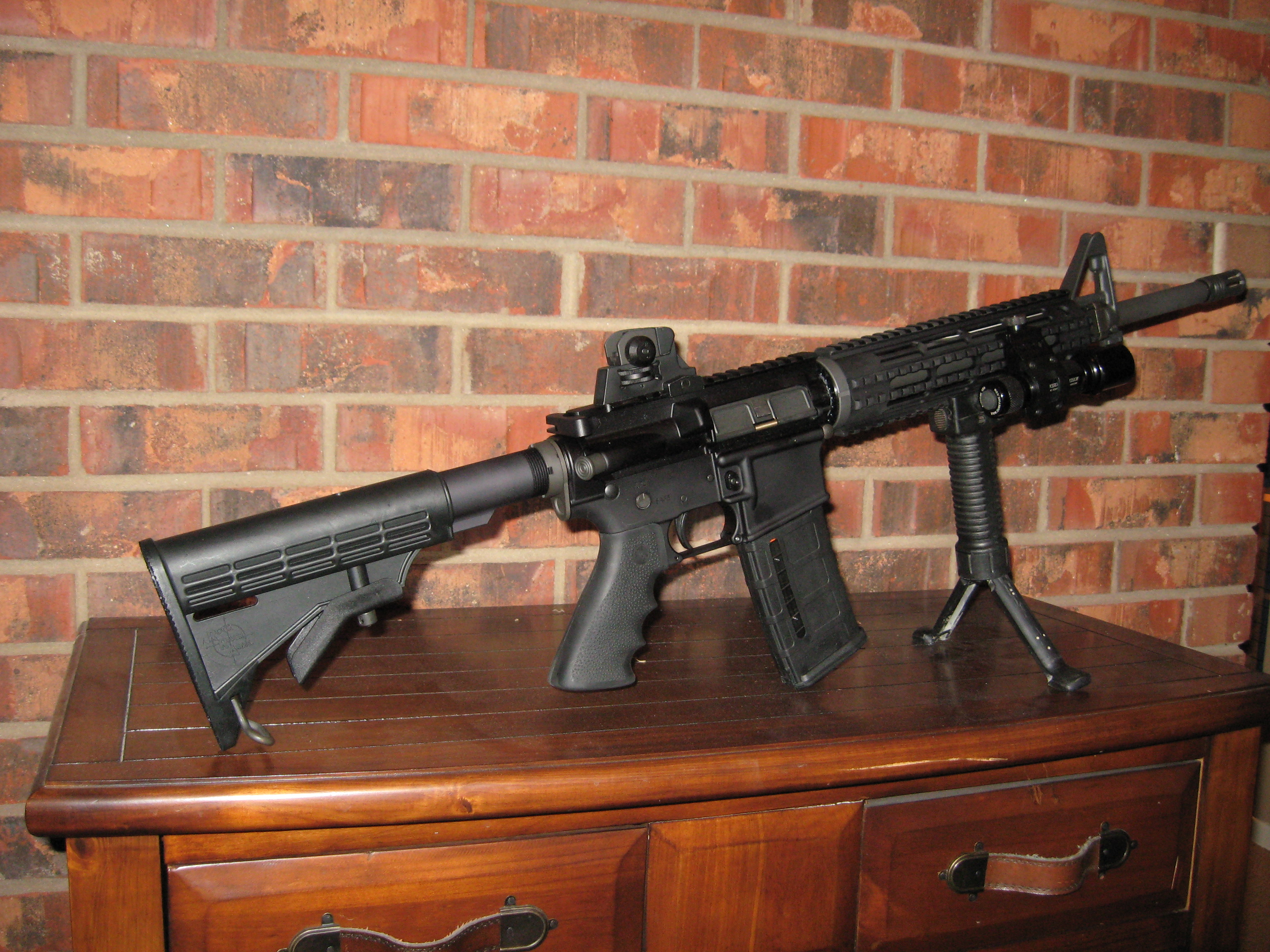
Her name is Heidi, and she is a red and rust Dobie, still growing at 70 lb.  She worships me, and she gets a mouthful of anyone who becomes a threat to me.  The next girl with which an intruder must contend is this one.


She is my Rock River Arms Elite Car A4, and so far it has been kitted up with rear iron sights, a PMAG, a military-issue forward vertical grip, a tactical light, and an offset mount for that light (so that the same hand that holds the forward grip can illuminate the light without use of a pressure switch because of the proximity of the light).  I still have a laser and optics to go.  If anyone from Trijicon wants to offer me a free set of optics (an ACOG with the Scripture still on it) for a review on TCJ, let me know.

In the first case, my baby gets a mouthful of the intruder.  In the second case, the intruder gets a mouthful of my baby.  In either case, the intruder gets what he deserves, and my babies still love me.

Pakistan Furious Over U.S. Cross-Border Taliban Raids

15 years, 5 months ago

The U.S. has recently conducted air operations just across the Pakistani border.

NATO helicopters conducted a rare cross-border operation into Pakistan Saturday, killing dozens of militants, according to the alliance.

NATO in Afghanistan said the first cross-border strike came a day after rebels attacked an Afghan border outpost in eastern Khost province. In a second strike, two helicopters returned to the border area and came under fire before killing several more insurgents.

Dawn gives us a little more detail.

US military sources say that all 30 – killed during a hot pursuit on Friday – were Haqqani Network fighters.

The militants, the sources said, had attacked Combat Outpost Narizah, an Afghan base eight miles from the Pakistani border in Tani district of Khost.

US forces repelled the attack and pursued the militants to their post just across the border in North Waziristan.

“An air weapons team in the area observed the enemy fire, and following Inter-national Security Assistance Force rules of engagement, crossed into the area of enemy fire,” the International Security Assistance Force stated in a press release.

It’s a positive development that rather than confining our combat operations to protecting the population we’re chasing the insurgents as I have observed needed to be done so many times before.  But in another development, Pakistan is not happy with the cross-border operations.

Pakistan reacted angrily today after Nato said US helicopters had crossed into its territory from Afghanistan to attack militants, claiming to have killed more than 50 Taliban fighters.

The admission that two incursions had taken place over the weekend by helicopters from the Nato-led International Security Assistance Force (Isaf), and possibly a further cross-border raid today, came after recent reports of a covert CIA military force in Afghanistan that crosses into Pakistan to kill Taliban and al-Qaida fighters.

Pakistan’s foreign ministry condemned the incursions as a “clear violation and breach of the UN mandate under which Isaf operates”, saying it had made a formal protest to Nato. “In the absence of immediate corrective measures, Pakistan will be constrained to consider response options,” said Abdul Basit, the foreign ministry spokesman.

So Pakistan is doing a little saber-rattling of their own, still wanting to play both sides against the middle and protect it’s asset – the Taliban – in its neurotic, make-believe future war with India.

This will be a good test of our resolve to be successful in Afghanistan.  Either we offer up obsequious explanations, excuses and discussions about how this was within the rules of engagement, or we tell the Pakistanis that we did it, we’re proud of the results, and it’s going to happen again … and again … and again … until they get their own shop under control.  Stay tuned.

Counterinsurgency: Let’s Drink Tea Later

15 years, 5 months ago

Canadians are running into cultural issues in Kandahar.

The Pashtun people of southern Afghanistan have a saying: “He is not a Pathan who does not give a blow for a pinch.”

“Nang” and “badal” — honour and revenge, respectively — trump even the holy book of the Qur’an for many Pashtuns, and so it is with caution that Canada sends its troops to live among them as part of its widening counter-insurgency strategy in Kandahar province.

It’s widely understood that, as the proverb suggests, a Pashtun (or Pathan) man will respond aggressively to even the most minor slight, extracting revenge to defend the honour of himself and his family. Those considered friends and guests are protected and respected with the same zeal.

“Respect and honour is very important to them,” said Capt. Paul Stokes, a member of the Royal Canadian Regiment battle group currently in Kandahar.

Canadian soldiers bound for Afghanistan are taught about the different tribal and family affiliations that have affected the tides of war in the region for generations. They’re warned of the sometimes primitive living conditions and taught a few words of Pashto. Some even carry well-thumbed phrasebooks.

But nothing can entirely prepare them for the experience of living among the locals, Stokes said. “You can teach it in class, but you don’t appreciate it until you see the differences and experience it.”

Canadian soldiers currently live and work among Afghan police and soldiers and live in or near small villages, venturing out every day to try to forge trust within the local population.

They attend elaborate community meetings, known as shuras, where the pace is plodding and the casual drift of time can prove a challenge for military-minded westerners like Stokes.

“The western culture is a very fast-paced culture, with emails and TV. We want to get to a meetings and get right to the heart of the matter. That’s not the way it is (in Afghanistan),” he said.

“You go there, you have tea, you have coffee, you have food, you may have an entire meal and talk about your families and friends, and then — whether it be 15 minutes later or an hour later — you get to the heart of the discussion.”

Capt. Ashley Collette has travelled to Third World countries before, so the living conditions she and her platoon found in the village of Nakhonay were less of a shock to her than to some of her colleagues.

Life in the village in Panjwaii, southwest of Kandahar city, has more benefits than drawbacks, but it has not been without its challenges, she said.

“The experience itself of living right alongside the locals is one that I’d argue you can’t really prepare yourself for. It’s a unique experience in itself,” Collette said.

Being unable to speak the language is also a problem.

Of course being unable to speak the language is a problem, just as are poor translators.  And true enough, little contributions to the population are a good thing.  In Fallujah 2007 there was a problem with feral dogs (packs of dogs would literally attack Marine patrols as well as the population).  In addition to what the Marines did to the population (e.g., heavy policing, kicking doors in, etc.), one thing they did for the population was to perform patrols with the sole purpose of getting the feral dog population under control.  They accomplished this in short order.  The people of Fallujah appreciated this.

But one thing that the Marines didn’t do was change their behavior.  In spite of the Iraqi cultural revulsion at dogs, the Marines had theirs – both bomb sniffing and adopted dogs – the adopted dogs helping in locating and warning indications of feral dogs packs.  The Marines projected forces regardless of cultural morays, and the tea-drinking came later when the population decided that the Marines would win.

The Marines are taking turnover of Sangin from the British, and there is mixed reaction.

… tribal elder Muhammad Khan says British troops were mindful of local culture, and treated people well.

”The former infidels [British] were better than these new ones [Americans],” said Mr Khan.

“Britons were respectful of our culture and traditions. They wouldn’t search someone on a motorcycle with his wife in the back seat.

”But American troops don’t care. They stop us and search both man and his woman. This is what we know of Americans.”

A number of residents have reservations about the arrival of US forces.

Gul Muhammad, from Sangin town, said: ”I liked the way British soldiers conducted operations.

“After they were attacked, they would go to the exact house and target the very attacker without harming others.”

Another resident expressed his concerns about civilian casualties.

”Americans behave differently,” said Aazar Gulalai. “They attack indiscriminately and target everybody in the vicinity after they are targeted by the Taliban, or suffer casualties in a mine explosion.

”All of them shoot at us. They all target us. We and the Taliban become the same for them after they are attacked.

”We are civilians. We don’t have any animosity with the Taliban, or government.”

Sangin is one of the most heavily populated districts in Helmand, with a population of around 150,000.

But a number of people left the town of Sangin in recent years as a result of fighting. One of them, Abdul Wali, hopes that he will be able to return home soon.

”We left Sangin because of continual attacks and fighting,” says Abdul Wali. “I hope Americans will bring security with them and schools will be opened.”

Over the past few months, Americans have already taken on security responsibility for many other districts in Helmand, including Nawa, Garmsir, Marjah, Khanshin and Nawzad.

A number of people in these districts claim that British forces failed to bring security there because they did not want to risk fighting the Taliban.

”Americans are serious,” says Muhabbat Khan, a resident of Nawa district. “Security is much better now here. The British were only concerned about their on security.

”British troops couldn’t handle casualties. They used to retreat all the time and this would further embolden the Taliban.”

A few residents of Sangin expressed hope that Americans would bring not only security to their district, but much needed development and jobs for the people.

Several observations are in order.  First, the British can certainly take casualties, and their bravery is not in question.  What the example of Musa Qala showed us is that the British approach to counterinsurgency is different because of their officer corps.  Two years ago the British enacted their plans to deescalate the violence against the Taliban.  The rest, they say, is history.

But more to the point, the counterinsurgency reactionary would study this report and decide that it’s time for cultural re-education.  Send the Marines to more PowerPoint presentations, and make sure that they have all of their cultural I’s dotted and T’s crossed.  To the Marines in Anbar this was irrelevant, and it should be irrelevant to the Marines in Helmand.

Returning to the first report about the high sounding Pashtun traditions of honor, it wouldn’t appear that their honor isn’t so great that they would forbid the Taliban from ruling them with a heavy hand and purvey death to the insurgents.  Indeed, the population in Sangin wants it all too.  They want security and then jobs, but they have no animosity towards anyone.

Regardless of their lack of animosity, they will be forced to choose sides, and they will contribute to their own security or they will have none, from either the Marines or the Taliban.  They can drink tea later.  There is work to do first for everyone involved.

The Best Way to Ensure That the Marines Become Irrelevant

15 years, 5 months ago

From National Defense Magazine, another silly article on massive amphibious assault landings in the 21st century (only part reproduced below).

While many pundits (Editorial comment: And to whom might this be referring?) contend that ship-to-shore fighting is fast becoming archaic, Marine Corps leadership insists that future conflicts may again require amphibious skills. They admit that training for a forced entry operation has atrophied during the last nine years of conflict and the Corps’ alliance between ships and sailors is not what it once was.

“In order to capitalize on the Navy-Marine Corps relationship, we need concepts like ship-to-shore maneuver in order to get the best out of both sides of the equation,” said Brig. Gen. Robert F. Hedelund, commanding officer of the Marine Corps Warfighting Laboratory.

The trick in the future is to conduct a beach landing from a ship sailing beyond the horizon, miles away from shore where it is safe from anti-ship missiles. That means marines not only will have to stomach a longer journey to shore, but also they will have to operate ashore knowing that supplies, medical evacuations and fire support will take more time.

In an experiment during the biennial Rim of the Pacific naval exercise in Hawaii, the Marine Corps Warfighting Laboratory put to the test a revamped concept of storming the beach. It gave a company landing team, enhanced by an artillery platoon, a suite of advanced communications and robots to help them fight, resupply and evacuate casualties.

“We’re taking the things that marines are doing in Afghanistan and sprinkling saltwater on them,” said Vince Goulding, director of the experiments division in the lab. “We’re taking them from the sea base, bringing them ashore to do the things they’ve already learned how to do.”

Marines know how to land on a beach. The challenge is sustaining them on the shore when the ship is a hundred miles at sea maneuvering with the naval force, said Goulding. “How do you get food to them? How do you take care of injured marines? Can you command and control them adequately? How do you provide fires for them?”

Some of those questions were answered during a four-day amphibious assault exercise on Oahu. In the early morning hours of the first day, marines from Golf Company, 2nd Battalion, 3rd Marine Regiment and Alpha Battery, 1st Battalion, 12th Marine Regiment lined up in the hangar of the amphibious ship. They loaded up with packs that were stuffed full of experimental communication gear and batteries. One by one they marched down into the lower vehicle bay and onto the three landing craft docked in the well deck. As the ship rocked on the heavy seas, sailors aboard the craft greeted them by saying, “You will get sick.” They instructed the marines to vomit into the plastic bags provided or to use their helmets. So warned, the marines dispersed. Some climbed into truck cabs for the hour-long ride; others sat inside the windowless passenger areas.

For many of the marines, it was the first time they had ever operated aboard a ship, much less ridden to shore in a landing craft.

More than an hour later, an innocuous bump marked when the LCAC hit the beach. The marines ran off the deck and collected ashore as the artillery vehicles were unloaded. Many troops had radio handsets tucked underneath their helmets and strapped into place over their ears. There was a little bit of shouting, a name here, a name there, but mostly it was quiet as the marines spoke discreetly into their radios. It was an amphibious landing unlike any other that had preceded them. By the end of the next 72 hours, they had accomplished their mission of rooting out a terrorist training compound.

The experiment is analogous to what the Marine Corps did in the 1930s, in trying to get ready for amphibious fight in Pacific, Goulding said. “We’re preparing for the amphibious fight, wherever it might be, in 2020.”

The experiment proved that the company landing team concept is feasible, but that improvements are needed in the size, weight and power of the infantry gear.

“We’re still on the curve where the technology we’re getting for individual marines is driving up the weight,” said Hedelund.

The demand for water was a significant concern for commanders both ashore and at sea. A large number of helicopter sorties from the ship were carrying water. When they dropped off the supplies, troops did not have vehicles to transport the goods.

“I am convinced now more than ever that a MV-22 Osprey-borne dismounted marine infantry company inserted into rough terrain needs some sort of organic, internally transportable ground mobility asset,” said Goulding. Whether it’s manned or unmanned is beside the point, he said. Dismounted troops need a way to move supplies.

“When those infantry platoons were resupplied with 5-gallon cans of water, except for what they could put into CamelBaks and drink, they now had this stuff with them, and it became a mobility impediment to them,” explained Goulding.

A small vehicle, such as the John Deere Gator, could fit inside an MV-22 Osprey. It could be driven by troops and help them transport supplies, he said.

The amphibious landing concept from a ship sailing beyond the horizon is viable, Goulding said in an interview after the exercise concluded. But “we need to get hot on ship-to-maneuver logistics,” he pointed out.

“This is a problem from two ends: It ties up a high-demand low-density aviation asset that we could better employ by providing mobility to marines on the ground,” said Goulding. “It also demonstrated that we need to do better foraging for water.”

Goulding, a retired marine, flew over the mountainous Kahukus Training Range twice in a helicopter during the exercise. “There is water everywhere in the Kahukus,” he pointed out, but the marines had to rely on drinking water supplied from the ship.

In a separate effort, the lab is experimenting with a tactical reverse osmosis water purification unit that would have turned the free flowing Hawaiian water into potable water for the squads.

Good grief.  We’re complaining about the Marines becoming too heavy, while we plan to send them ashore in the extremely heavy Expeditionary Fighting Vehicles.  The Navy wants to be relevant, and in lieu of close support for the Marines, they plan on never-to-be-used powerless and irrelevant littoral combat ships.  We want to do massive amphibious assaults against unknown enemies, yet we plan to start from so far off shore that we’re vulnerable to missile fire for some twenty five miles or more.

We want to be self sufficient, and yet logistics controls us to the point that we are planning for reverse osmosis purification units.  We want to be quick to get to shore, but we cast our lots with the EFV when a new fleet of helicopters would allow us fast transit to the shore (and further inland) and fast-roping would allow quick ingress to the battle space with light, fast and well trained troops.

But are our Marines well trained?  From backpacking, hiking and camping, I and each of my four children know how to purify water from our surroundings.  I and each of my four children know how to climb and rappel.  I and each of my four children know how to make decisions on the fly, not waiting on specific commands but relying on broad mission goals to guide our actions.  And only one among my four children is a Marine.

It would have been better for the Marines if they had been dropped on shore from helicopters and told that their first mission was to “Find your own damn water and food – you have no support and you’re on your own.”  That would have built self sufficiency and small unit leadership.

It’s expectations such as this – EFV, constant logistics, bloated support to infantry troop ratio, gadgets and doodads in place of adapt, improvise and overcome – that will cause future administrations to turn to SOCOM and Special Operations Forces rather than the Marines to conduct special missions, expeditionary engagements and small wars, and in general turn to the SOCOM chain of command rather than the U.S. Marine Corps.  This model for the future is the best way to ensure that the Marines become irrelevant.

Good grief.  The Marines are in need of a gut check.


26th MEU (10)
Abu Muqawama (12)
ACOG (2)
ACOGs (1)
Afghan National Army (36)
Afghan National Police (17)
Afghanistan (704)
Afghanistan SOFA (4)
Agriculture in COIN (3)
AGW (1)
Air Force (41)
Air Power (10)
al Qaeda (83)
Ali al-Sistani (1)
America (22)
Ammunition (304)
Animals (321)
Ansar al Sunna (15)
Anthropology (3)
Antonin Scalia (1)
AR-15s (393)
Arghandab River Valley (1)
Arlington Cemetery (2)
Army (90)
Assassinations (2)
Assault Weapon Ban (29)
Australian Army (7)
Azerbaijan (4)
Backpacking (4)
Badr Organization (8)
Baitullah Mehsud (21)
Basra (17)
BATFE (246)
Battle of Bari Alai (2)
Battle of Wanat (18)
Battle Space Weight (3)
Bin Laden (7)
Blogroll (3)
Blogs (24)
Body Armor (23)
Books (3)
Border War (18)
Brady Campaign (1)
Britain (39)
British Army (36)
Camping (5)
Canada (19)
Castle Doctrine (1)
Caucasus (6)
CENTCOM (7)
Center For a New American Security (8)
Charity (3)
China (19)
Christmas (18)
CIA (30)
Civilian National Security Force (3)
Col. Gian Gentile (9)
Combat Outposts (3)
Combat Video (2)
Concerned Citizens (6)
Constabulary Actions (3)
Coolness Factor (3)
COP Keating (4)
Corruption in COIN (4)
Council on Foreign Relations (1)
Counterinsurgency (218)
DADT (2)
David Rohde (1)
Defense Contractors (2)
Department of Defense (220)
Department of Homeland Security (26)
Disaster Preparedness (5)
Distributed Operations (5)
Dogs (15)
Donald Trump (27)
Drone Campaign (4)
EFV (3)
Egypt (12)
El Salvador (1)
Embassy Security (1)
Enemy Spotters (1)
Expeditionary Warfare (18)
F-22 (2)
F-35 (1)
Fallujah (17)
Far East (3)
Fathers and Sons (2)
Favorite (1)
Fazlullah (3)
FBI (39)
Featured (192)
Federal Firearms Laws (18)
Financing the Taliban (2)
Firearms (1,866)
Football (1)
Force Projection (35)
Force Protection (4)
Force Transformation (1)
Foreign Policy (27)
Fukushima Reactor Accident (6)
Ganjgal (1)
Garmsir (1)
general (15)
General Amos (1)
General James Mattis (1)
General McChrystal (44)
General McKiernan (6)
General Rodriguez (3)
General Suleimani (9)
Georgia (19)
GITMO (2)
Google (1)
Gulbuddin Hekmatyar (1)
Gun Control (1,717)
Guns (2,405)
Guns In National Parks (3)
Haditha Roundup (10)
Haiti (2)
HAMAS (7)
Haqqani Network (9)
Hate Mail (8)
Hekmatyar (1)
Heroism (5)
Hezbollah (12)
High Capacity Magazines (16)
High Value Targets (9)
Homecoming (1)
Homeland Security (3)
Horses (2)
Humor (72)
Hunting (60)
ICOS (1)
IEDs (7)
Immigration (123)
India (10)
Infantry (4)
Information Warfare (4)
Infrastructure (4)
Intelligence (23)
Intelligence Bulletin (6)
Iran (171)
Iraq (379)
Iraq SOFA (23)
Islamic Facism (64)
Islamists (98)
Israel (19)
Jaish al Mahdi (21)
Jalalabad (1)
Japan (3)
Jihadists (82)
John Nagl (5)
Joint Intelligence Centers (1)
JRTN (1)
Kabul (1)
Kajaki Dam (1)
Kamdesh (9)
Kandahar (12)
Karachi (7)
Kashmir (2)
Khost Province (1)
Khyber (11)
Knife Blogging (7)
Korea (4)
Korengal Valley (3)
Kunar Province (20)
Kurdistan (3)
Language in COIN (5)
Language in Statecraft (1)
Language Interpreters (2)
Lashkar-e-Taiba (2)
Law Enforcement (6)
Lawfare (14)
Leadership (6)
Lebanon (6)
Leon Panetta (2)
Let Them Fight (2)
Libya (14)
Lines of Effort (3)
Littoral Combat (8)
Logistics (50)
Long Guns (1)
Lt. Col. Allen West (2)
Marine Corps (281)
Marines in Bakwa (1)
Marines in Helmand (67)
Marjah (4)
MEDEVAC (2)
Media (68)
Medical (146)
Memorial Day (6)
Mexican Cartels (46)
Mexico (70)
Michael Yon (6)
Micromanaging the Military (7)
Middle East (1)
Military Blogging (26)
Military Contractors (5)
Military Equipment (25)
Militia (9)
Mitt Romney (3)
Monetary Policy (1)
Moqtada al Sadr (2)
Mosul (4)
Mountains (25)
MRAPs (1)
Mullah Baradar (1)
Mullah Fazlullah (1)
Mullah Omar (3)
Musa Qala (4)
Music (25)
Muslim Brotherhood (6)
Nation Building (2)
National Internet IDs (1)
National Rifle Association (97)
NATO (15)
Navy (31)
Navy Corpsman (1)
NCOs (3)
News (1)
NGOs (3)
Nicholas Schmidle (2)
Now Zad (19)
NSA (3)
NSA James L. Jones (6)
Nuclear (63)
Nuristan (8)
Obama Administration (222)
Offshore Balancing (1)
Operation Alljah (7)
Operation Khanjar (14)
Ossetia (7)
Pakistan (165)
Paktya Province (1)
Palestine (5)
Patriotism (7)
Patrolling (1)
Pech River Valley (11)
Personal (76)
Petraeus (14)
Pictures (1)
Piracy (13)
Pistol (4)
Pizzagate (21)
Police (672)
Police in COIN (3)
Policy (15)
Politics (998)
Poppy (2)
PPEs (1)
Prisons in Counterinsurgency (12)
Project Gunrunner (20)
PRTs (1)
Qatar (1)
Quadrennial Defense Review (2)
Quds Force (13)
Quetta Shura (1)
RAND (3)
Recommended Reading (14)
Refueling Tanker (1)
Religion (499)
Religion and Insurgency (19)
Reuters (1)
Rick Perry (4)
Rifles (1)
Roads (4)
Rolling Stone (1)
Ron Paul (1)
ROTC (1)
Rules of Engagement (75)
Rumsfeld (1)
Russia (37)
Sabbatical (1)
Sangin (1)
Saqlawiyah (1)
Satellite Patrols (2)
Saudi Arabia (4)
Scenes from Iraq (1)
Second Amendment (708)
Second Amendment Quick Hits (2)
Secretary Gates (9)
Sharia Law (3)
Shura Ittehad-ul-Mujahiden (1)
SIIC (2)
Sirajuddin Haqqani (1)
Small Wars (72)
Snipers (9)
Sniveling Lackeys (2)
Soft Power (4)
Somalia (8)
Sons of Afghanistan (1)
Sons of Iraq (2)
Special Forces (28)
Squad Rushes (1)
State Department (23)
Statistics (1)
Sunni Insurgency (10)
Support to Infantry Ratio (1)
Supreme Court (79)
Survival (214)
SWAT Raids (58)
Syria (38)
Tactical Drills (38)
Tactical Gear (17)
Taliban (168)
Taliban Massing of Forces (4)
Tarmiyah (1)
TBI (1)
Technology (21)
Tehrik-i-Taliban (78)
Terrain in Combat (1)
Terrorism (96)
Thanksgiving (13)
The Anbar Narrative (23)
The Art of War (5)
The Fallen (1)
The Long War (20)
The Surge (3)
The Wounded (13)
Thomas Barnett (1)
Transnational Insurgencies (5)
Tribes (5)
TSA (25)
TSA Ineptitude (14)
TTPs (4)
U.S. Border Patrol (8)
U.S. Border Security (22)
U.S. Sovereignty (29)
UAVs (2)
UBL (4)
Ukraine (10)
Uncategorized (105)
Universal Background Check (3)
Unrestricted Warfare (4)
USS Iwo Jima (2)
USS San Antonio (1)
Uzbekistan (1)
V-22 Osprey (4)
Veterans (3)
Vietnam (1)
War & Warfare (432)
War & Warfare (41)
War Movies (4)
War Reporting (21)
Wardak Province (1)
Warriors (6)
Waziristan (1)
Weapons and Tactics (80)
West Point (1)
Winter Operations (1)
Women in Combat (21)
WTF? (1)
Yemen (1)

February 2026
January 2026
December 2025
November 2025
October 2025
September 2025
August 2025
July 2025
June 2025
May 2025
April 2025
March 2025
February 2025
January 2025
December 2024
November 2024
October 2024
September 2024
August 2024
July 2024
June 2024
May 2024
April 2024
March 2024
February 2024
January 2024
December 2023
November 2023
October 2023
September 2023
August 2023
July 2023
June 2023
May 2023
April 2023
March 2023
February 2023
January 2023
December 2022
November 2022
October 2022
September 2022
August 2022
July 2022
June 2022
May 2022
April 2022
March 2022
February 2022
January 2022
December 2021
November 2021
October 2021
September 2021
August 2021
July 2021
June 2021
May 2021
April 2021
March 2021
February 2021
January 2021
December 2020
November 2020
October 2020
September 2020
August 2020
July 2020
June 2020
May 2020
April 2020
March 2020
February 2020
January 2020
December 2019
November 2019
October 2019
September 2019
August 2019
July 2019
June 2019
May 2019
April 2019
March 2019
February 2019
January 2019
December 2018
November 2018
October 2018
September 2018
August 2018
July 2018
June 2018
May 2018
April 2018
March 2018
February 2018
January 2018
December 2017
November 2017
October 2017
September 2017
August 2017
July 2017
June 2017
May 2017
April 2017
March 2017
February 2017
January 2017
December 2016
November 2016
October 2016
September 2016
August 2016
July 2016
June 2016
May 2016
April 2016
March 2016
February 2016
January 2016
December 2015
November 2015
October 2015
September 2015
August 2015
July 2015
June 2015
May 2015
April 2015
March 2015
February 2015
January 2015
December 2014
November 2014
October 2014
September 2014
August 2014
July 2014
June 2014
May 2014
April 2014
March 2014
February 2014
January 2014
December 2013
November 2013
October 2013
September 2013
August 2013
July 2013
June 2013
May 2013
April 2013
March 2013
February 2013
January 2013
December 2012
November 2012
October 2012
September 2012
August 2012
July 2012
June 2012
May 2012
April 2012
March 2012
February 2012
January 2012
December 2011
November 2011
October 2011
September 2011
August 2011
July 2011
June 2011
May 2011
April 2011
March 2011
February 2011
January 2011
December 2010
November 2010
October 2010
September 2010
August 2010
July 2010
June 2010
May 2010
April 2010
March 2010
February 2010
January 2010
December 2009
November 2009
October 2009
September 2009
August 2009
July 2009
June 2009
May 2009
April 2009
March 2009
February 2009
January 2009
December 2008
November 2008
October 2008
September 2008
August 2008
July 2008
June 2008
May 2008
April 2008
March 2008
February 2008
January 2008
December 2007
November 2007
October 2007
September 2007
August 2007
July 2007
June 2007
May 2007
April 2007
March 2007
February 2007
January 2007
December 2006
November 2006
October 2006
September 2006
August 2006
July 2006
June 2006
May 2006

about · archives · contact · register

Copyright © 2006-2026 Captain's Journal. All rights reserved.