
Of Marines, Counterinsurgency, Widows and Cows
BY Herschel Smith 17 years, 7 months ago
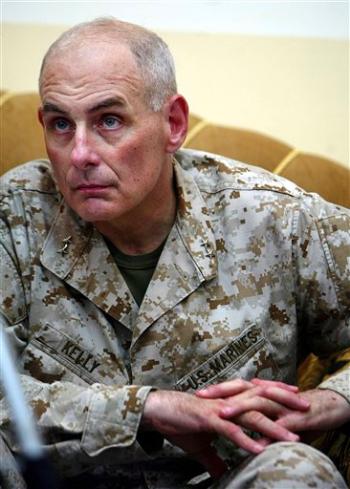
U.S. Marine Maj. Gen John Kelly, the top U.S. commander in Anbar Province, is seen before the start of a handover ceremony at the government headquarters in Ramadi, capital of Anbar province, in Iraq Monday, Sept. 1, 2008. Progress is proceeding apace in Anbar, and the Marines are leaving the Fallujah area of operations headed mainly for Camp Baharia and Al Asad Air Base.
We have observed before that it is the responsibility of the people and government of Iraq to progress on reconciliation, and that the Marines can help only marginally in this endeavor and certainly don’t belong in the middle of internecine struggles at this point in the counterinsurgency and reconstruction effort. Maj. Gen. Kelly regrets, though, the lack of progress in sectarian reconciliation, saying that “the Shiite-led government should have poured reconstruction money into the Sunni region after Sunni fighters joined forces with U.S. troops to chase al-Qaida out of the western province.
Marine Maj. Gen. John F. Kelly told The Associated Press that his greatest “mission failure” was his inability to bring together the government in Baghdad and the Sunnis in Anbar to take advantage of the steep decline in violence … Although Kelly said his mission did not include asking the central government for more money for the Sunni province, he was clearly frustrated by the lack of progress — a schism that stems from decades of brutal oppression of Shiites under Saddam Hussein’s Sunni-led regime.”
In a time in our nation when the reflexive tendency is to avoid responsibility for things assigned to your responsible charge, the U.S. Marines still accept responsibility for things they weren’t assigned. It’s a still sure and reliable sign that the phrase semper fidelis is more than mere words – it’s a code by which the Marines live.
The adaptability, wisdom and scholarly approach to the campaign in Anbar is a testimony to the character of the Marines and their leadership. It hasn’t ended, and the example provided to the government of Iraq even recently by the Marines couldn’t be more stark. Rather than “close with and destroy the enemy by fire and maneuver,” the Marines are making sure that they have done their very best to ensure that there is no enemy, once again at the direction of Maj. Gen. Kelly.
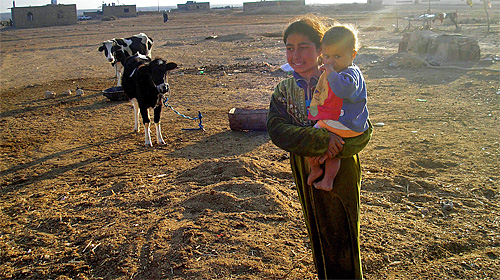
As American forces work to revive Iraq’s tattered farming economy, they seem to have found an effective new weapon.
Cows.
At the suggestion of an Iraqi women’s group, the Marine Corps recently bought 50 cows for 50 Iraqi widows in the farm belt around Fallouja, once the insurgent capital of war-torn Anbar province.
The cow purchase is seen as a small step toward reestablishing Iraq’s once-thriving dairy industry, as well as a way to help women and children hurt by the frequent failure of the Iraqi government to provide the pensions that Iraqi law promises to widows.
The early sign is that the program is working. Widows, many with no other income, have a marketable item to sell, as well as milk for their children. Although Iraqis, particularly women, are often reluctant to participate in an American effort, the cows were immediately popular.
“It was an easy sell,” said Maj. Meredith Brown, assigned to the Marines’ outreach program for Iraqi women.
The idea, proposed by members of the Women’s Cultural Center in Fallouja, at first met with resistance from U.S. military officers and civilian officials involved in aid programs for Anbar. Nothing in their training provided guidance in haggling for livestock.
But those objections quickly evaporated when Maj. Gen. John Kelly, the top Marine in Iraq, signaled his support, Brown said. The Iraqis now refer to their animals as Kelly’s Cows.
Though Kelly’s support may have been based on gut instinct, the need to beef up Iraq’s badly broken dairy industry was argued in a Nov. 25 report by Land O’Lakes Inc.
The Minnesota cheese-and-butter company was hired by the Marine Corps to examine the Iraqi dairy industry. Its 38-page report, based on field research in the fall by two Land O’Lakes dairy specialists, concluded that there was enormous growth potential for the industry in a milk-drinking, cheese-eating nation that can locally produce enough milk to satisfy only 5% of the demand.
The study also pointed out that, even in Iraqi farm families with able-bodied adult males, much of the work is left to women: “Women milk the cows, bring feed and fodder to the animals and are supported by their children.”
In Anbar, two factors drew the Marines to the cow purchase: It was small-scale and it was suggested by the Iraqis. The Marines have learned that big-ticket projects, or those imposed by the U.S. on the Iraqis without local support, start with two strikes.
The Marines began buying cows in November at a livestock market at Saqlawiyah. Of the 50 cows, 35 were pregnant and 10 already had calves, which went along with their mothers. The five others were taken to a laboratory for artificial insemination. Brown put the program cost so far at $58,000.
To qualify for a free cow, each widow had to sign an agreement not to slaughter or sell the animal and instead to use the milk as a marketable item or for the family.
The project is not entirely altruistic. The Marines believe that widows with at least some economic resources are less likely to join Al Qaeda to carry out suicide attacks in exchange for a promise that their children will be cared for after the women are gone.
“If she’s desperate enough, she just might put on that [suicide] vest or drive that truck” full of explosives, Maj. Brown said.
Rather than being in the middle of internecine struggles, the Marines have led by example. This is counterinsurgency at its very best, and represents the closing of an era in Anbar. It’s the final phase of the campaign, and while troops will remain in Iraq for some time to help ensure border sovereignty, proper training of Iraqi Security Forces and robust actions against remaining hard core al Qaeda in Iraq fighters, General Kelly has every reason to be proud of his Marines and his own effort. Mission accomplished.






Trackbacks & Pingbacks
Comments
RSS feed for comments on this post. TrackBack URL
Leave a comment