
Review and Analysis of Afghanistan Counterinsurgency Campaign
BY Herschel Smith 18 years, 7 months ago
In Musa Qala: The Argument for Force Projection, and Clarifying Expectations in Afghanistan, we discussed ongoing counterinsurgency operations in Afghanistan in light of the battle for Musa Qala, Afghanistan’s “battle of Fallujah” that never occurred. We discussed the heavy bombing approach, the evacuation of families from the city, the lack of adequate force projection to take and hold Musa Qala, the British desire to negotiate with the Taliban, and disparate doctrines held by Australia (more forces are necessary) and the U.S. (advocating the small footprint COIN approach).
Continuing with this theme, we noted that Secretary of Defense Robert Gates was prepared to talk tough to NATO in order to get more troops dedicated to the campaign in Afghanistan. While various main stream media reports and blog entries are hailing Musa Qala as a great victory, Gates has directly admitted that the campaign needs to undergo a transition. “Gates called for overhauling the alliance’s Afghan strategy over the next three to five years, shifting NATO’s focus from primarily one of rebuilding to one of waging “a classic counterinsurgency” against a resurgent Taliban and growing influx of al-Qaida fighters.”
So how did this summit of NATO leaders turn out? The British still want to pay enough money to split the Taliban, but intend to send no more troops into theater. The Australians, along with every other NATO member who has troops in theater, will draft a ‘plan’ to make the Afghanistan campaign more successful, but intend to send no more troops. Gates was reduced to platitudes like: ” … while the United States also ha[s] no plans to send more troops in the short-term, [we will be] trying more creative ways to encourage other NATO members to increase their presence in Afghanistan.”
While the Taliban would most surely like to have held Musa Qala, they determined that withdrawal and reversion to more clandestine tactics were strategically superior. “As Afghanistan has headed into its bitterly cold winter, the Taliban have retreated from direct combat operations and have resorted to roadside bombs to target coalition forces, says Major Michael Bassingthwaighte, a commander in Australia’s Reconstruction Task Force based in Tarin Kowt … With the coming of winter, many Taliban fighters had fled across the unpatrolled border into Pakistan or to distant homes for the Islamic holiday period of Eid. He expects the tempo of Taliban combat operations to increase after the poppy harvesting season finishes in April, a period when the Taliban find it hard to recruit fighters.”
The Afghanistan campaign suffers most particularly in the South. The south continues to move steadily in the wrong direction. Instability has spread to a number of previously benign provinces. Some countries, especially European ones that have contributed to NATO’s forces, are unenthusiastic about the shooting war they find themselves involved in. After a summer of repeatedly retaking the same two districts of Kandahar province, the Canadian commander, Brigadier-General Guy Laroche, commented: “Everything we have done in that regard is not a waste of time, but close to it”.
There are signs, too, that as the insurgency meshes itself tightly with the drugs trade, a sizeable proportion of the population may feel it has a vested interest in prolonged insecurity which allows narcotics production to flourish.
The winter is at least a moment to pause and reflect on strategy for next year. At Musa Qala, NATO and Afghan forces easily defeated the Taliban but as diplomats in Kabul, the capital, concede, a far greater challenge is then defending against reinfiltration. Securing territory means getting the support of local people. In Helmand, for example, this requires teams of anthropologists and political officers to deal with a mosaic of tribal interest groups, an approach used by American forces elsewhere in the country. That means a greater emphasis on reconciliation and negotiation with local Taliban leaders, as well as training Afghan forces so they are able to take the lead in military operations.
Politically the challenges are no easier. The Afghan public, particularly in the south, is gloomy about the future. Dismay over corruption and wrangling between different ethnic groups suggest that Afghan leaders, such as President Hamid Karzai, will need substantial support from outsiders for a long time yet. America is backing the idea of sending a “super envoy” to co-ordinate international efforts in Afghanistan. But the government remains unable even to reach out across areas of the south. Where it cannot reach there may need to be more controversial “tribal solutions”, such as village militias to provide local security and efforts to empower tribal elders and local systems of justice.
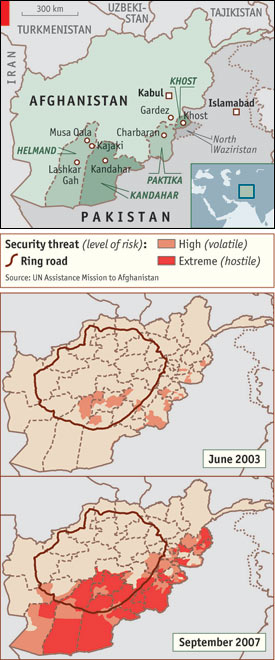
But it must be remembered that the tribal solution was implemented in Anbar from a position of strength. Far from being unable to reach areas of Anbar, Marines were deployed all over the province, engaged in kinetic and constabulary operations as well as public relations, reconstruction and engagement of the population in paying labor. We have also argued at The Captain’s Journal that the solution to the poppy problem is not to spray or use other means to kill the crops. This might be seen as out-terrorizing the terrorists. The solution to the insurgency problem is to target the insurgents, and the solution to the drug problem is interdiction and reconstitution of the agricultural industry in Afghanistan. But this requires force projection. It also requires largesse, civil affairs, diplomacy, and other arms of “soft power.” But soft power is founded on the pretext of hard power, not the other way around.
There is currently a policy review underway for the Afghanistan campaign. “Amid rising concerns about lagging progress in Afghanistan, the top U.S. commander in the region has launched a review of the American mission there with a major focus on counterterrorism efforts, a senior U.S. military official said Sunday. Adm. William Fallon, the head of U.S. Central Command, has ordered senior staff to conduct a thorough review of the six-year-old war against al Qaeda and its Taliban allies in Afghanistan, the senior official confirmed to CNN. The review has been under way for several weeks, and Fallon is not considering any new recommendations until its completion, the official said. The study, first reported by The New York Times, is focused on efforts by U.S. troops along Afghanistan’s rugged border with Pakistan.”
The first quarter of 2008 should reveal the results of this policy review. Unless the campaign in Afghanistan is taken as seriously as it has been in Iraq, the policy review will not have been successful. There are troops available for deployment in Afghanistan, but they are currently in Germany and South Korea. Will the Pentagon have the courage to engage in global strategic thinking, or will the deliverance of this study be more platitudes about being creative?
See also Future COIN in Afghanistan, Small Wars Journal Blog






On December 18, 2007 at 3:40 am, Brian H said:
Are there any commitments in the LW that the Euros have actually fulfilled? Maybe Sarkozy can be induced to walk the walk. Someone needs to.
On December 18, 2007 at 7:53 am, Dominique R. Poirier said:
Brian,
Herschel Smith is certainly better informed than I am about the physical presence of Europeans and French forces in Afghanistan, more especially.
However, I am in position to express an opinion since I am physically in France at this time and be somewhat knowledgeable on French politics and defense.
France has consistently expressed its will to restore diplomatic relations with the United States since the election of Nicolas Sarkozy, which happened earlier this year; and I haven’t been able to spot any clue suggesting a lack of sincerity in this praiseworthy endeavor as yet.
As far as I can see, all U.S. or else experts who wrote on this subject seem to share the same opinion.
Notwithstanding, I consider that this friendly attitude is still too fresh to make any serious forecast, or even just draw definitive conclusions, for the following reasons.
The new French President has to cope with a strong and largely represented left-leaning opposition at home, both within the government in particular and in officialdom in general. “Traditionally,” if I may say so, the United States doesn’t enjoy good image within the walls of the Ministry of Defense, from top to bottom and since long already; and this detail deserves to be taken in consideration given the tremendous influence this ministry exerts in this country. In this latter case this attitude owes much less to “usual” French anti-Americanism than to a feeling made up of distrust and jealousy sustained by an unmistakable and pointless complex of inferiority.
French economy is in bad shape and, despite the visible efforts of the daring new President to slow down the steady fall of the French industry in all domains, there is no signs suggesting any significant improvement at this time. This is normal since the whole French private economy is still crippled by constraining regulations on labor force, heavy taxes, and by an ubiquitous as elusive presence of the state at nearly all levels of the society; all characteristics that claim much longer than a few months to be changed, if ever there is such thing as a sincere will to change things that thoroughly.
All these difficulties limit considerably any ambitions of significant military intervention or cooperation on the side of the United States in particular from a political standpoint at this time, as with anyone else owing to economic reasons in general.
Also, there are numerous historical records in French politics suggesting ever possible sudden and unexpected reversal.
Prudence strongly recommends to bear this in mind.
Ultimately—and that is a more personal consideration—we cannot allow ourselves to neglect the worse case scenario, which is based on a lesson Russia, and Vladimir Putin more especially, taught us. That is, the new French president and his policy may ever aim at no more than temporarily beguiling the confidence and trust of the United States as part of a long termed and less friendly strategy. We have to ascertain that the new French friendly attitude toward the United States and its allies is authentic, durable, and that the less or more known strong and decades-long Russian influence in France has not played a part at some point in this context.
As yet, all new measures adopted by the government of Nicolas Sarkozy, though they appear to be suitable in some instances, could not be totally incompatible in a remote future with a domestic policy similar to this we are witnessing in Russia today.
Another coincidence which makes me somewhat uncomfortable is that much more than half the members of the new French government holding key positions are left-leaning old-guard politics who are not notoriously known for their sympathy in favor of free-entrepreneurship and individual freedom and their proponents.
At this last regard, if I accept as valid this theory of diversion aiming at the French Socialist Party, which seems to provide its share of unexpected results, yet I fail to see at which point it applies to former Ministers of the Jacques Chirac’s government.
Wait and see, once more.