Since then, it has performed flawlessly with 450 SMC, albeit a little stiff on the recoil. Recall that the 450 SMC round comes with a rifle primer rather than a pistol primer, leaving more room for powder. With stippled wooden grips I’m sure I wouldn’t be able to shoot more than three or four dozen rounds before getting some hand sting. I would need to install different grips if I intended to shoot 450 SMC all day at the range.
But the question came up about this round whether the higher spring constant affected the gun’s ability to properly cycle .45 ACP (i.e., does the weaker ammunition incompletely cycle the slide and cause a FTF/FTE)?
I can confidently say after having shot several brands of .45 ACP with the stiffer 22# spring that I’ve had no malfunctions at all. To me this is good news since I won’t have to change the spring for my choice of ammunition.
“They all started out as ‘weapons war,’ you lying dumb@$$!” I’d love to hear somebody within microphone range yell back. Having “every other terrible implement of the soldier” is what the Founders intended “the people” to keep and bear. Even the rigged Miller opinion admitted the plan was for their arms to have “some reasonable relationship to the preservation or efficiency of a well-regulated militia [or] that this weapon is any part of the ordinary military equipment, or that its use could contribute to the common defense.”
I’ve pointed out before ” …the next time some loud mouth tells you that “civilians” should not have “weapons of war designed only to kill others,” inform them that every soldier or Marine is first and foremost a civilian (in that he came from our ranks and will return to our ranks), and that every weapon that has ever been designed, or improvised, by an insurgency or uniformed army, is a weapon of war. There are no exceptions, from sticks to rocks, from shotguns to rifles, from revolvers to pistols, from bolt action long guns to machine guns.”
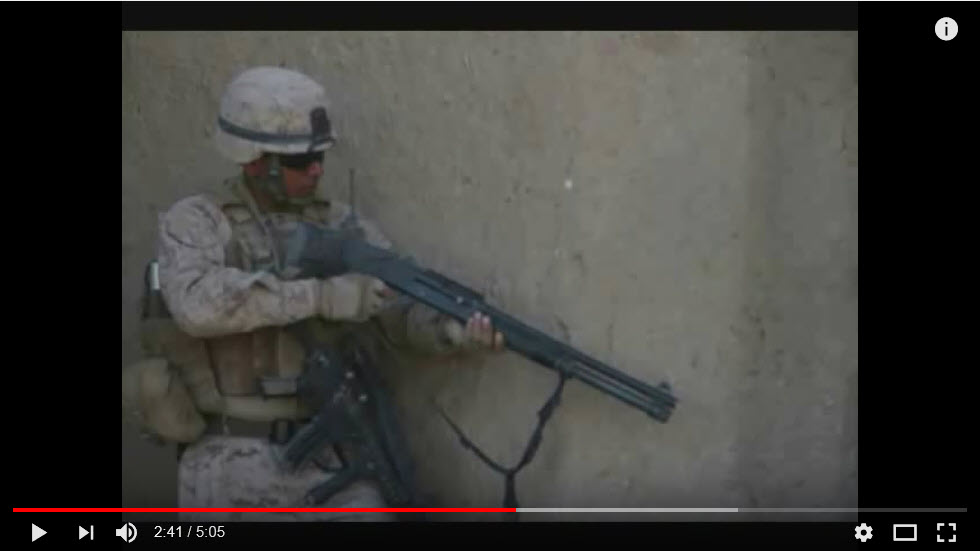
Literally. The Marine Corps used shotguns to clear rooms in Now Zad, Afghanistan. Carlos Hathcock used a Winchester model 70, as did the Marine Corps in Desert Storm. Revolvers were in use in WWI, perhaps during parts of WWII (I truly wish I could find a picture of use of revolvers in Vietnam, Iraq and Afghanistan – that would make my day, and I and readers could celebrate an astounding victory!). The Marine Corps infantry officer course in Quantico still teaches the use of improvised weapons in the bush, including rocks and sticks in hand-to-hand fights. I have a 9mm pistol, but John Moses Browning’s 1911 is still my favorite gun to shoot, as it is with Clint Smith.
In addition to their archery equipment, both men had 9 mm pistols. Chris Gregersen had a Glock 43. Donivan Campbell had a Sig Sauer P320. Both guns were loaded with full metal jacketed (FMJ) cartridges.
I like Dean’s detail – I always want to know what weapon was used and what caliber it was.
He took a snap sight picture and fired at the bear’s rear. It was probably 16 seconds into the attack. The point of aim was the bear’s hind quarters. There was no other choice. The bear and Donivan were up slope with brush on either side. There was no time to flank the bear, on a steep hill side, with considerable brush, when fractions of a second could make the difference between life and death. Chris had a clear shot. He has considerable experience shooting under stress while hunting. He says he has “shot a lot.” He had a brief worry about hitting his friend, so he had to do it right.
[ … ]
Chris emphasized bear spray would not have been sufficient. The spray would have been directed at the bear’s backside. If the spray had reached the bear’s head, it would have disabled Donivan as well. When the bear charged again, the bear spray would have been unlikely to reach the bear through the heavy cover.
There were multiple charges, each time repelled by yelling and gunfire. The injuries were bad, and Dean has some good pictures of the area as well.
This further confirms that bear spray is simply not an effective deterrent against a determined, large predator. But a gun is – I guess I would have chosen a larger bore handgun. There is also this observation.
A warden suggested more power, and a large magazine capacity gave a better chance of hitting the central nervous system. He recommended the Glock 20 in 10mm
I have a better solution: A 1911 shooting 450 SMC, with higher muzzle velocity and a heavier bullet. I’m accurate with it, I just can’t shoot 50 rounds without ceasing to have fun. It’s not a plinker.
Another misgiven “fact” I see running rampant is associated with comparing stainless steel to chromemoly steel barrels for longevity. Stainless steel barrels will, yes, shoot their best for more rounds, but, chromemoly will shoot better for an overall longer time. Lemmeesplain: the difference is in the nature of the flame cutting effect on these two steels. Stainless tends to form cracks, looking like a dried up lakebed, while chromemoly tends to just get rough, like sandpaper. The cracks provide a little smoother surface for the bullet to run on (until they turn into something tantamount to a cheese grater). The thing is that when stainless stops shooting well it stops just like that. So, stainless will go another 10 to 15 percent more x-ring rounds, but chromemoly is liable to stay in the 10-ring at least that much longer than stainless steel.
I was asked a question about red dot sights for MSRs, and I really don’t know that much about them. I have an EOTech for an AR pistol, but as best as I’m aware, EOTech pretty much has a lock on the holographic side of things. I don’t think anyone else makes a holographic sight. I could be wrong.
As for standard red dots, there’s Trijicon, Burris, Holosun, and a whole host of others.
Which red dot sights do readers like, and why? List them by price point if you can.
It’s called hunting, and it’s fun. Of course, you ultimately need to put a bullet through a squirrel’s quarter-size brain, and your gun is the tool for tying the process together. But if you’re going squirrel hunting mainly to show off your custom rimfire, the redneck who’s using iron sights and knows how to identify and creep up on the sound of pignut husks peppering the ground can probably teach you a thing or two.
That squirrel hunting has become overlooked is a hell of a statement about modern hunting culture. “You hunt squirrels?” people say to me. “That’s cool. My grandpa used to hunt those.” Instead of woodsmanship, today’s hunters seem to value and obsess over gear, especially guns and cartridges and optics. We pore over information about bullets and twist rates and custom turrets so that we’re ready for that 400-plus-yard shot we’re sure we’re going to get—but we forget to pick our feet up and whisper on the way there. We buy choke tubes and reflex sights and pattern shotguns with $10 shells so we can kill a turkey from 70 yards—but in the process, we fail to learn what a drumming turkey sounds like because we have never listened to one that’s been completely fooled at 15 steps.
When you see a bunch of outdoorsmen gathered around a phone these days to look at pictures of a buck or bull, the question you’re almost bound to hear is: How far was the shot? If it was a close shot, the hunter’s reply is usually sheepish: “Oh, he walked by at 40 steps. Kind of hard to miss that.”
I’m sorry, but there’s something wrong with that. Getting close enough to count coup ought to be the mark of a good hunter—not something to defend because it makes the shot too easy. If that’s not obvious to you, then I think you need to try the most overlooked hunt in North America. And when your buddies break out their phones to compare critters, make sure you show off a photo of a limit of squirrels and brag about sneaking in to 20 yards for six clean headshots with your .22 and 4X Walmart scope.
Funny. My youngest son was saying that same thing to me just this morning. Oh, he knows a thing or two about long range precision shooting. He was a DM and he went through Scout Sniper training.
But he would still rather shoot at 20-40 yards than 250 or further. Because that’s hunting.
The enemy didn’t like the trench broom one bit. In September 1918, the German government issued a diplomatic protest, complaining that the Model 97 Trench Gun was illegal because “it is especially forbidden to employ arms, projections, or materials calculated to cause unnecessary suffering” as defined in the 1907 Hague Convention respecting the Laws and Customs of War on Land. When the Americans rejected this, the German high command then threatened to execute any soldier caught with a Trench Gun or even just Trench Gun shells. General Pershing replied that, henceforth, any Germans caught with flamethrowers or saw-bladed bayonets would be lined up and shot. As far as is known, no American or German POWs were executed under such circumstances.
So the next time some loud mouth tells you that “civilians” should not have “weapons of war designed only to kill others,” inform them that every soldier or Marine is first and foremost a civilian (in that he came from our ranks and will return to our ranks), and that every weapon that has ever been designed, or improvised, by an insurgency or uniformed army, is a weapon of war. There are no exceptions, from sticks to rocks, from shotguns to rifles, from revolvers to pistols, from bolt action long guns to machine guns.
That’s a Red Herring anyway. They don’t care about the details. They just want you disarmed of all weaponry. You’re easier to control that way.
Field & Stream. I will note for the record that the average price is high because this is a left-skewed distribution. There are some reasonably priced rifles (like the Browning X-Bolt, Mauser M18, Savage M10 Stealth, and Bergara B-14), with the highest price being $3,999 (for the Proof Switch).
So maybe the mean should have been a geometric mean rather than arithmetic mean. In any case, you get the point. Accuracy doesn’t necessarily have to come with a big price tag these days.

 6 years, 4 months ago