I doubt it, but let’s rehearse some recent events before diving too far into my assessment.
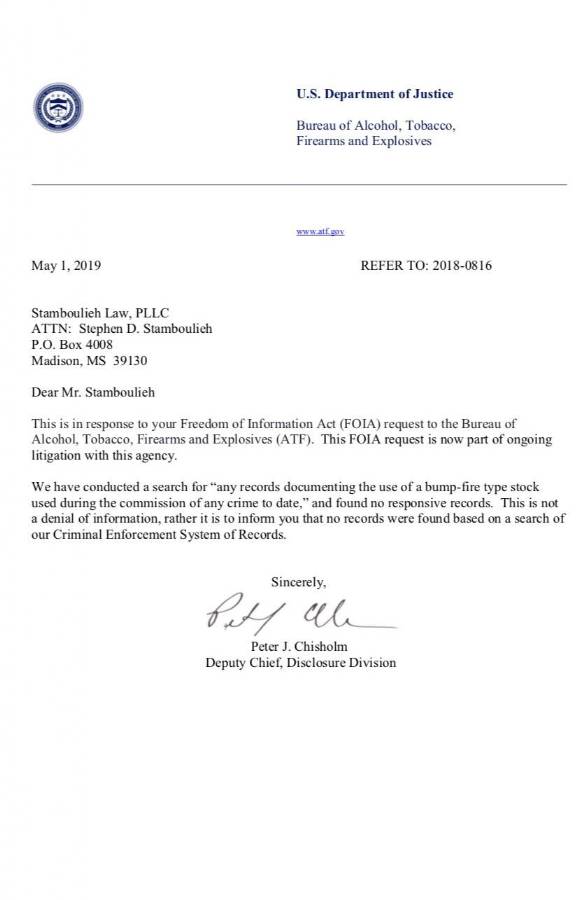
Even most NRA members, it would appear, still do not get that the issue of bump stocks (and the ban dictated by the stroke of a pen by one man) isn’t about bump stocks.
“You know what? I didn’t even know what a bump stock was,” said Patrick Callahan, 61, from Wyoming. “I have no problem with a bump stock being banned, to be honest with you. I think there’s always balances.”
Sebastian is still arguing, seemingly, that as long as we all retreat in unison, everything will be okay (or at least as good as it can ever be given that we are likely on the losing side anyway). We just need to avoid division. If I’ve misinterpreted Sebastian in this admittedly cursory treatment of his latest post, please feel free to correct me. But on the previous [related] post by Sebastian which I’ve linked (and will do so again), commenter Stephen Wright lays out the following charge.
Talking no-compromise in a political battle is like Hitler not allowing his troops at Stalingrad (and other places) to retreat and maneuver intelligently like a modern army has to. It’s idiotic. But I fear that there’s enough idiots on our side buying into this that it may split our fairly large minority and keep us from being politically effective.
It’s ironic that when the pro-gun movement is actually historically the strongest we may ultimately lose the war that we had been winning until now.
Let’s leave behind the issue of whether we’re winning (there is indication that at the local and state level, there is progress in things like open carry, despite S.C.’s intransigence, while at the national level there hasn’t been a win in a very long time, Heller and McDonald are on the list of mixed-bags). Consider the brashness and audacity of the charges.
Stephen seems to be saying, “While this can’t really be compared to WWII, or Hitler’s refusal to retreat, and while I have no plan to break the habit of retreat and actually win anything, and while we have no real leadership and a completely dysfunctional organization, I want to retreat yet again, and if you don’t retreat with me, then our ultimate loss will be on your conscience.” It’s really a remarkable thing when the only thing upon which we can agree is that one side wants perpetual retreat, and the other does not. And the retreatists will blame the non-retreatists for any losses. This drips with irony.
Chris Cox seems to be absent in the debates, but since he is a Wayne LaPierre sycophant, he’s likely on Wayne’s side. Wayne Lapierre is fighting for his life, and so far it looks like he is winning, even if he takes the NRA down with him. Oliver North is one of the losers in all of this.
Oliver North announced Saturday that he would not serve a second term as National Rifle Association president, making it clear he had been forced out by the gun lobby’s leadership after his own failed attempt to remove the NRA’s longtime CEO in a burgeoning divide over the group’s finances and media operations.
“Please know I hoped to be with you today as NRA president endorsed for reelection. I’m now informed that will not happen,” North said in a statement that was read by Richard Childress, the NRA’s first vice president, to members at the group’s annual convention.
North, whose one-year term ends Monday, did not show up for the meeting, and his spot on the stage was left empty, his nameplate still in its place. His statement was largely met with silence. Wayne LaPierre, whom North had tried to push out, later received two standing ovations.
It was a stunning conclusion to a battle between two conservative and Second Amendment titans — North, the retired Marine lieutenant colonel with a ramrod demeanor who was at the center of the Iran-Contra scandal of the 1980s, and LaPierre, who has been battle-tested in the decades since he took up the mantle of gun rights. He has fought back challenges that have arisen over the decades, seemingly emerging unscathed each time. In this latest effort, he pushed back against North, telling members of the NRA’s board of directors that North had threatened to release “damaging” information about him to them and saying it amounted to an “extortion” attempt.
Note well. Apparently it wasn’t up to him, or even the board of directors. He was “informed” of this decision. I’ll return to that momentarily.
As for Wayne, there were some awkward goings-on this weekend.
According to someone we’ve spoken to who’s in a position to know, NRA Executive Vice President Wayne LaPierre met with influential board members and fund-raisers last night and was asked for his resignation. The meeting reportedly became heated and LaPierre stormed out. He then responded to the demand with a scathing letter to those involved, refusing to step down.
So first there is the issue of exactly how an elected board of directors along with an elected president can demand the resignation of a bureaucrat, and be rejected by said bureaucrat outright and that organization continue to function. It can’t. I assess that the NRA is a completely dysfunctional organization and has been for a long time.
Leaving aside the issue of Ackerman McQueen, and $200,000 of wardrobe purchases by LaPierre, the bylaws, people and organizational structure aren’t sufficient to rid the group of ne’er-do-wells, whether LaPierre or the cretins who are financial liabilities and parasites to the organization. A board of directors who doesn’t direct may as well quit and go home. If there are too many bad apples in the mix, then it’s appropriate for the entire group to go down in flames, suffering the personal, legal and financial loss attending their malfeasance. Membership on the board of directors means legal and fiduciary culpability, as it should on any board.
But can this situation be salvaged? Should it be salvaged? I said a few days ago that the NRA had supported the NFA, the GCA, the Hughes Amendment, the bump stock ban, and red flag laws. It’s all true. This is an incomplete list. Via David Codrea, this list adds to my own.
The real issue with the VNRA isn’t corruption or not doing enough to push rights. The problem is what the group actively does to violate rights. NFA ’34, GCA ’68, FOPA ’86. Everyone knows those. It shows how long the rot has existed.
They tried to keep HELLER from going to SCOTUS. They actively killed constitutional carry legislation in New Hampshire. They wrote an “assault weapon” ban in Ohio. They sabotaged an RKBA/free speech case in NH.
I had forgotten how many open carry fights the NRA has sabotaged, and it’s also true that the NRA didn’t want Heller going to the SCOTUS. I consider Heller only a partial win because of the wording Scalia put in there supporting gun control at the local and state level, and the weakness of it leading to McDonald, which still isn’t recognized by lower courts. But Alan Gura snatched a modicum of victory from the jaws of defeat.
The point is that in almost every case where retreat was possible, the NRA has led the way. Then oftentimes, as with Heller, they claimed credit for what small victory the SCOTUS gave us. In every exigency in life, a man must make functional judgments. Whom to marry, where to work, how much to save, with whom to be associated.
In this case, the analysis is quite simple. If an organization is working against your interests, it’s an easy decision to jettison support for said organization. It makes no sense to support people who intend harm to your liberties. If this is considered on a tactical level (retreat might be a good option now), then it is incumbent on our detractors to explain how said retreat will be reversed and good use made of it rather than sling accusations. I see a lot of hand-wringing, but I see no detractor channeling Sun Tzu. If you want to be a general, then learn to lead and learn to win.
The issue of red flag laws is problematic, while the issue of bump stocks is more emblematic. Either way, it’s a mistake to see this in terms of issues without seeing the larger aggregate as well. I dislike harping on Sebastian, but his most recent post begins this way.
But what got us here isn’t that we didn’t shout “no” loud enough. We didn’t end up here because we’re not pure enough. That’s always what religious zealots turn to when disaster strikes. It’s a natural human reaction. But it usually leads to doing the wrong thing.
Exactly how it leads to doing the wrong thing he doesn’t explain, he just says so. And any hint of unwillingness to make more compromises becomes “zealotry.” Very well. I believe that the second amendment is meaningless inasmuch as it guarantees our right to keep and bear arms. I believe that the Almighty has not only extended that right to man, He has demanded that men defend home and hearth, as well as answer for placing and keeping tyrants in power. The second amendment is a covenant, with blessings and consequences (or curses) for adherence and breakage. The right to keep and bear arms without infringement is sacred. We observed before that gun control is wicked.
The Bible does contain a few direct references to weapons control. There were many times throughout Israel’s history that it rebelled against God (in fact, it happened all the time). To mock His people back into submission to His Law, the Lord would often use wicked neighbors to punish Israel’s rebellion. Most notable were the Philistines and the Babylonians. 1 Samuel 13:19-22 relates the story: “Not a blacksmith could be found in the whole land of Israel, because the Philistines had said, “Otherwise the Hebrews will make swords or spears!” So all Israel went down to the Philistines to have their plowshares, mattocks, axes, and sickles sharpened…So on the day of battle not a soldier with Saul and Jonathan had a sword or spear in this hand; only Saul and his son Jonathan had them.” Nebuchadnezzar king of Babylon also removed all of the craftsmen from Israel during the Babylonian captivity (2 Kings 24:14). Both of these administrations were considered exceedingly wicked including their acts of weapons control.
If this makes me a zealot, then I wear that badge proudly. And now we’re to the root of the issue. I may be a zealot, but at least I have an epistemological basis for my statements, and my world and life view dictates my value judgments.
For those who see this through a more pedestrian lens, it will be less important until it becomes important, at which point they would have to explain their next steps because I can’t.
The NRA may survive this, but not in the same form. It will be known as the home of the Fudds, or it will jettison the ne’er-do-wells, clean house, and begin a campaign of grading politicians truthfully and keeping those grades up-to-date. It will include in that campaign an honest attempt to stand against the tide of control coming.
If the NRA decides not to approach it that way, it will morph back into an organization that teaches people to shoot bolt action rifles at father-son or mother-daughter events. But they can begin sending the money back to their constituents and proceed apace with defunding themselves, because you don’t get wealthy by teaching people to shoot rifles. You obtain some measure of power by truthfully and honestly representing your constituency.
Finally, David Codrea notes of the war between factions that “Not that “Wayne LaPierre prevailing, for now, is a “win” for membership. Nor would it be had North succeeded. This was a coup attempt by NRA’s long-term PR firm Ackerman McQueen to replace former gravy train riders with current ones. There are no clean hands here, and with the weekend battle “won” by current management, don’t expect dramatic changes in the way things are run as long as they’re in power.”
But even if they’re able to rid themselves of the rot within, the question is whether they can return to their roots. Their tap root is one of preservation of the rights recognized in the constitution, including weapons of war. “What the Fudds either don’t know (or do, but have no intention of ruining a “good” meme by admitting), is that it wasn’t until after WWII that “the NRA concentrated its efforts on another much-needed arena for education and training.”

 6 years, 10 months ago