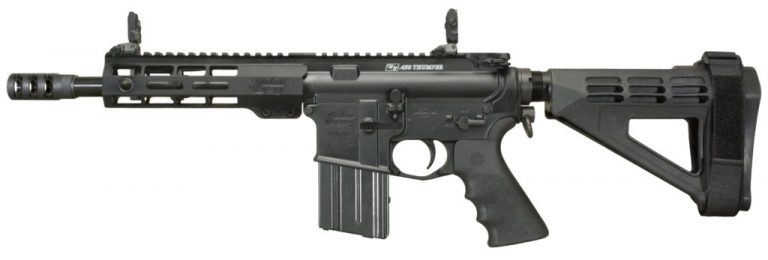
Windham Weaponry .450 Bushmaster Pistol
BY Herschel Smith
How many of you think you could handle .450 Bushmaster in an AR pistol and regain sight picture after the first shot in – oh, I don’t know – under four or five seconds?

How many of you think you could handle .450 Bushmaster in an AR pistol and regain sight picture after the first shot in – oh, I don’t know – under four or five seconds?
American Rifleman quotes training material for 1911 operators from WWI.
Too much stress cannot be laid on the fact the pistol is an emergency weapon. The man who wants a stock on his pistol so that he can shoot it at a distance of several hundred yards has no understanding of the function of the arm. It is solely for the personal protection of the bearer when the enemy is within very short range and there is no possibility of accomplishing more with the other weapons with which the soldier may happen to be armed.
The member of an automatic rifle or machine gun squad who stops serving his rifle or machine gun to indulge in pistol practice at the enemy is wholly without a proper sense of his duty to his comrades. At the same time the stupid man who does not use his pistol when the enemy is on top of him and his gun is jammed or it is no longer possible to use it profitably, deserves no better fate than that which he will probably get, that is, immediate death.
When conditions are such that the opportunity for the proper use of the pistol in the near future appears probable, every man armed with the pistol should so place his weapon that it can be used in the minimum of time. What this position will be will depend on the circumstances. It may be on the parapet alongside the gunner, or on the flap of the carrier’s musette, or in the holster.
For the average man, 25 yards may be taken as the maximum range at which the pistol should be fired. To fire at longer ranges will usually result in no casualties for the enemy but only an empty pistol at the crucial moment. This does not apply to a very small percentage of expert shots, but a man should be quite sure that he can be classed as such before violating the general rule.”
Boy that sure is sage advice, and for all handgun operators, not just 1911s. Things haven’t changed much in those many years. I don’t mind being told that I’m not Jerry Miculek. Because I’m not.
Gareth Glaser could be seen as an optimist. After all, he believes gun owners will pay more to implement strong safety mechanisms in firearms.
He even believes gun owners might be willing to have chips implanted in their hands.
The implanted microchip would send a signal to a “smart gun” held in that person’s hand allowing for the trigger to operate, Glaser, CEO of Lodestar Firearms, told NBC10.
The implant is only one of a few ideas to improve the safety of guns. Glaser said a ring or watch could also be used as signal-bearers — if worn, a handgun could be fired.
It’s called “token recognition technology”: The technology keeps a gun from firing unless the “token” is within inches of the trigger. Glaser believes it’s the gun of the future.
“Our token is either going to be in a ring, in a bracelet, or quite possibly implanted right here between your thumb and forefinger,” Glaser said as he showed off a similar smart gun made in Germany. “I think law enforcement would go for that.”
As NBC10 reported in November for an initial story on smart gun technology and the impediments to their sales growth in the United States, an average of seven children shoot themselves each day.
That type of tragedy is exactly what spurred Glaser, of Radnor Township in Delaware County, Pennsylvania, to getting into the firearm manufacturing business. The former executive with 30 years’ experience in the energy and pharmaceutical industries was at a colleague’s party when the woman’s son shot himself accidentally with a shotgun.
Oooo … yep. I’m sure law enforcement will go for that. And I can’t wait for those chips to be surgically implanted in my hand. I’m sure willing to double the cost of firearms, even though I will have to cut by half my purchases.
I encourage Mr. Glaser to spend, spend, spend, spend like a drunken sailor to make this smart gun technology. It’s brand new. No one has tried it before. Please write me a note Mr. Glaser and let me know how it works out. I want to meet those LEOs who are willing to use “smart guns.”
Prior: Smart Gun Tag
The versatility of the .22 Mag. lies in the wide range of ammunition available for it. With bullet weights ranging from 28 to 40 grains, and with rifle muzzle velocities spanning 600 fps – from about 1,700 to 2,300 fps – the .22 Mag. might not shoot as flat or fast as the .17 HMR, but it is unquestionably a more practical cartridge.
A 40-grain FMJ load for the .22 Mag. will penetrate almost 20 inches in 10 percent ordnance gelatin. This is a great load for head-shooting tree squirrels because it won’t damage excessive amounts of meat. On the other hand, CCI’s 30-grain JHP load screams out of a rifle barrel at more than 2,300 fps and expands like a bomb. This makes it a great load for ground hogs or prairie rodents.
[ … ]
I’d not suggest the .22 Mag. as the ideal defensive handgun cartridge, but keep this in mind: Older or less physically capable folks might not be able to handle a centerfire handgun. Fortunately, the ammunition companies have recognized this and now offer personal protection loads for the .22 Mag. Hornady has a Critical Defense load and Speer a Gold Dot load. At handgun velocities, both can be expected to penetrate about 1 foot in 10 percent ordnance gelatin, with the bullets expanding to more than .30 caliber.
Of course, the .22 magnum isn’t going to take down large game or be a battle rifle, but that’s not its purpose. I torn between the .22 magnum and the newer high velocity .17 HMR. But I find this last quoted paragraph compelling. I don’t carry a .22 magnum for personal defense, but women might find what I carry problematic.
If you can convince your wife to carry a .22 magnum wheel gun when she won’t carry anything else, that’s much better than nothing against two-legged threats.
In Do You Need To Break In A New Rifle Barrel, I said that I have followed this procedure for breaking in new rifles barrels.
This involves (1) a round, (2) brush/solvent/patch full stroke down the barrel, (3) dry patch or mop, next round, and so on. This process continues for several dozen rounds, then you skip to three rounds before the same procedure, and so on until the process is completed at 50 or more rounds. You’ll wear out at least two bore brushes this way. I’ve done it. A bore guide is handy, and a day at the range is necessary. You can’t complete the process in under a day.
At GoHunt.com, the author outlines a similar procedure, and states that:
I’ve read a lot of things on this subject (mostly during the random years when I decide to pick up a new gun) and it seems that most people will agree that a rifle break-in period is a good thing … Basically, the process of breaking in a new barrel is essentially just conditioning the barrel to smooth everything out (remove small burrs). Some barrel materials may take more rounds, others might not need much at all. Keep in mind that you don’t want to burn your barrel up in this process. Rifle barrels don’t last forever, so like I mention at the end of this article, if your rifle shoots great using half the steps, then call it good.
Running 50 rounds through the barrel along with copper wiring for cleaning purposes is hardly going to burn the barrel. But also remember that I embedded some video by barrel manufacturers who have all weighed in telling us that the process just isn’t necessary for the barrel, but more necessary for the throat. It’s also not apparent to me how the process isn’t duplicated by sending rounds through the barrel anyway, regardless of the cleaning stroke in between shots.
If you have strong opinions on this, please weigh in. I’m beginning to lean against this procedure the more I think about it.
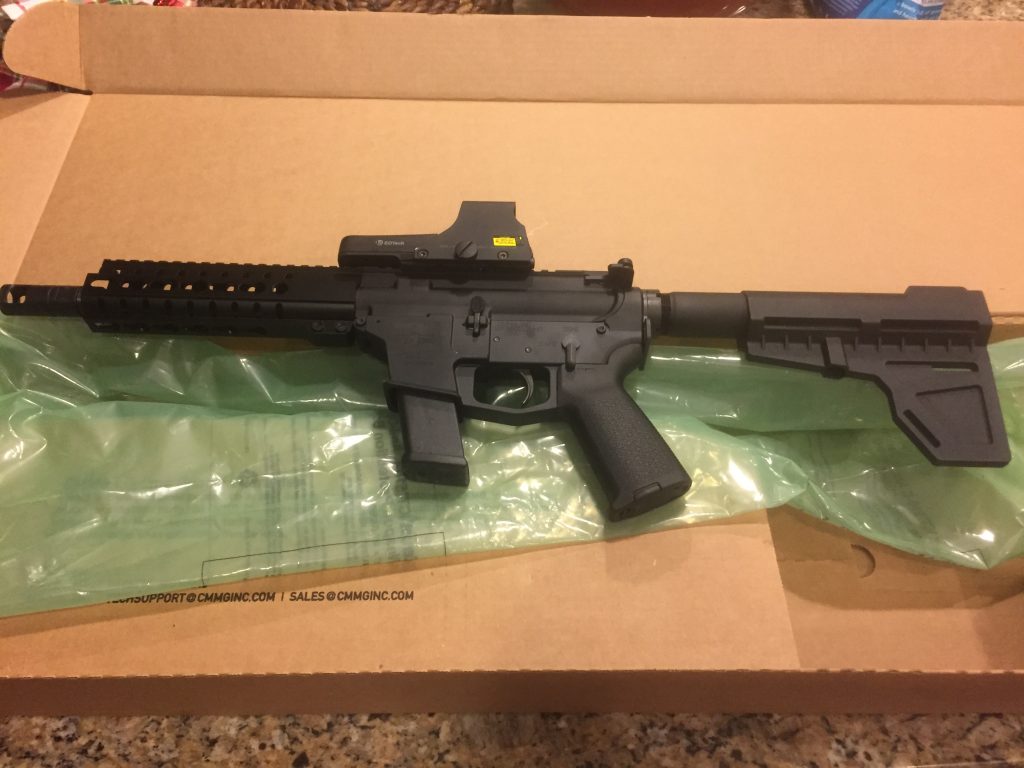
Watch in the coming weeks. You may see another picture of a CMMG .45 gun, with a slightly different barrel length.
In 1949, the Soviet armed forces put a new, deadly assault rifle into general use, the AK-47. The Mikhail Kalashnikov design was soon disseminated around the world as a cheap, effective, durable military and police weapon.
America’s answer came fewer than 10 years later in a modification of the AR-10, a selective fire rifle first developed by Gosport, Indiana, native Eugene Stoner and two of his assistants at ArmaLite. A re-designed AR-10 was soon marketed to the military by Colt as the M-16, and was sold to the public as the AR-15.
Stoner died in 1997, during the 10-year period starting in 1994 when new AR-15s with certain features were outlawed for civilian use under the Federal Assault Weapons Ban. So, he wasn’t around to see the ban’s lifting in 2004. Since then, AR-15-style rifles have been a common denominator in several high-profile mass shootings.
Thursday was the fifth anniversary of the shooting at Sandy Hook Elementary School in Newtown, Connecticut. Twenty-eight people, including 20 5- and 6-year-old first-grade students, were shot to death.
There is no reasonable civilian purpose for this type of weapon. Unlike handguns, they offer no reliable accuracy at close range for home protection purposes. And, unlike bolt-action rifles and shotguns, they require little to no skill in the hunting realm.
This is a gun designed to kill as many people as possible as quickly as possible. Period.
The sad truth is that re-banning the AR-15 and the like won’t even begin to address the most prevalent weapon used in mass shootings: legally obtained handguns. That’s a much thornier issue. But, if we can’t even call the AR-15-style rifle a step too far, how do we imagine we’ll ever be able to address the larger gun problem in this country?
You learn something every day from the more educated gun owners, yes? AR-15s are great at (presumably) moderate to long ranges for “killing as many people as possible as quickly as possible.” But they “offer no reliable accuracy at close range for home protection purposes.”
Better work fast, men. Your trusted battle carbine is no good for CQB. By the way, Stephen Bayezes says hello. As do hundreds of thousands of Soldiers and Marines who have relied on said weaponry for room clearing operations.
Why would U.S. special forces want to manufacture Russian machine guns?
Just watch any video of a conflict such as Iraq and Syria, and the answer becomes clear. Many of the combatants are using Russian or Soviet weapons, or local copies thereof, from rifles to rocket launchers to heavy machine guns mounted on pickups. Which means that when U.S. special forces provide some of these groups with weapons, they have to scrounge through the global arms market to buy Russian hardware as well as spare parts.
So U.S. Special Forces Command, which oversees America’s various commando units, has an idea: instead of buying Russian weapons, why not build their own? That’s why USSOCOM is asking U.S. companies to come up with a plan to manufacture Russian and other foreign weapons.
The goal is to “develop an innovative domestic capability to produce fully functioning facsimiles of foreign-made weapons that are equal to or better than what is currently being produced internationally,” according to the USSOCOM Small Business Innovation Research proposal.
More specifically, USSOCOM wants American companies to explore whether it is feasible to “reverse engineer or reengineer and domestically produce the following foreign-like weapons: 7.62×54R belt fed light machine gun that resembles a PKM (Pulemyot Kalashnikova Modernizirovany), and a 12.7×108mm heavy machine gun that resembles a Russian-designed NSV (Nikitin, Sokolov, Volkov).”
Applicants for the research project must produce “five fully functional prototypes, to include firing of live ammunition, of a foreign-like weapon that resembles the form, fit, and function of a Russian-designed NSV 12.7×108mm heavy machine gun.”
However, USSOCOM won’t make the process easy by providing assistance such as technical drawings. Interested companies will have to make their own drawings of foreign weapons, acquire the appropriate parts and raw materials, and create a manufacturing capability.
Companies will also have to “address the manufacture of spare parts to support fielded weapons.” In addition, they must be prepared to start up and shut down production as needed, as well as provide varying quantities of weapons.
USSOCOM also emphasizes that foreign weapons must be strictly made in America. Manufacturers “will employ only domestic labor, acquire domestically produced material and parts, and ensure weapon manufacture and assembly in domestic facilities.”
Though USSOCOM is starting with a pair of Russian machine guns, the research proposal speaks of foreign-made weapons in general. “Developing a domestic production capability for foreign-like weapons addresses these issues while being cost effective as well as strengthens the nation’s military-industrial complex, ensures a reliable and secure supply chain, and reduces acquisition lead times.”
Of course, one unstated solution to this problem is for the problem not to exist at all, which would mean minding our own damn business and not arming everyone on earth with weapons. America has become Imperialists, meddlers, bilkers of armaments, precious metals, money, children and oil. Basically, anything worth something on the open market interests Washington, most of all the deep state (including Senators, the FBI and the CIA).
The second thing that should be pointed out is that the world would prefer American weapons if we made them better. The Stoner system of arms (in particular today that means mostly the AR-15) is ubiquitous, but for machine guns, both light and heavy, or basically anything that needs to operate open bolt rather than closed bolt for heat dissipation, the rest of the world leads the way, including with the M249 SAW (not so for the M2, which as best as I know, is still the best heavy machine gun in the world).
Without the NFA and gun control act, civilians would be able to manufacture and innovate in order to field the very best armaments on the planet. We have the best engineers, the best machinists, the best gunsmiths and the best mechanics on the planet, so there isn’t any reason we can’t field the best armaments on the planet.
But machines are vetted on the open civilian market, not within the closed circles of the military industrial apparatus. We will always lag behind, as we should, because the rulers want to rule, and they fear the American public.
Too bad. Suck it up, American military. You get machines built by the lowest cost bidder, and innovation isn’t in the game plan. The government is out of money, and civilians have been excluded from the process. We are doing our own thing.
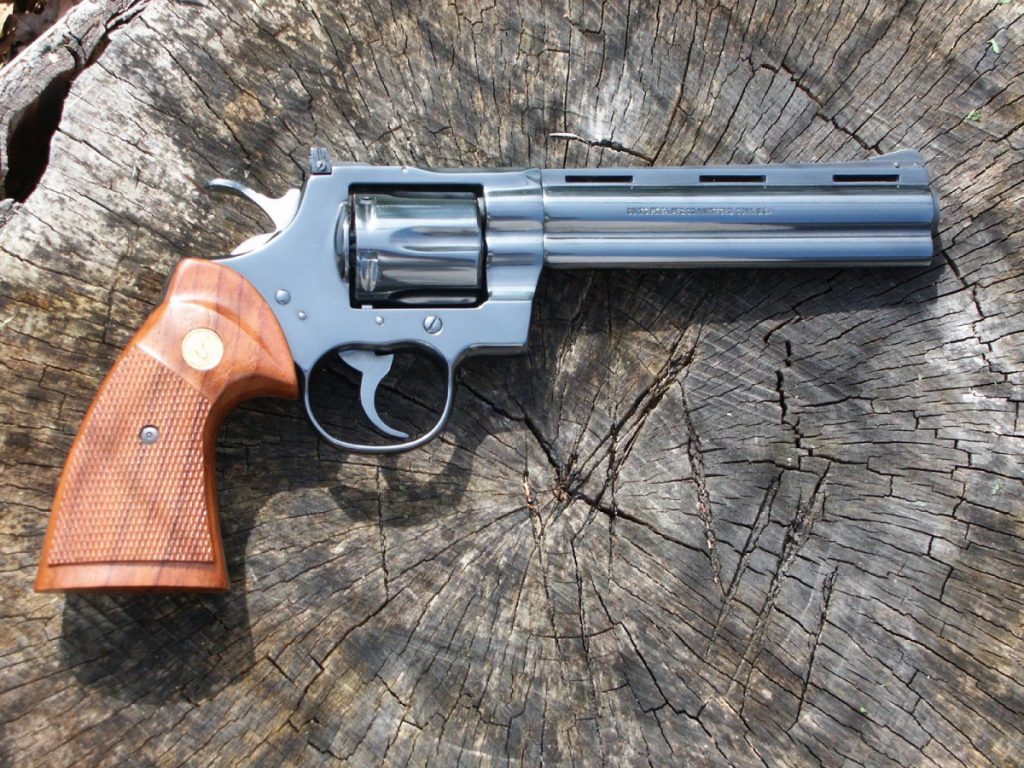
A recent article in a second-class gun magazine reviewed several handguns that were introduced at the 2017 SHOT Show in Las Vegas. The author called revolvers “antiquated technology on par with the manual typewriter,” but went on to state that despite this, American gun consumers simply cannot get enough of them. He was certainly correct on that account.
If anything, revolvers are just as popular today as ever, if not moreso given the introductions of new, exciting models from major gun manufacturers. If these wheel guns did not sell, why would gun makers continue to produce them? In fact, they cannot keep up with demand for new revolvers.
Now, to be fair, that author is just another millennial type who was not raised on wheel guns. These guys grew up on cable TV, tofu, sushi, MTV, X-Boxes, and sports drinks. They go all goo-goo for pistols. The more switches and buttons to push, the better. Just the sound of a racking slide makes them break out in goose bumps.
Trying to describe the practical aspects of a revolver, the fun and beauty of the timing of a hammer cocking to align with a loaded cylinder chamber is like trying to talk about a 1955 Ford Thunderbird or a Chevy SS with a 396 under the hood. That guy probably drives an electric car.
I recently spoke to a gun store employee who said the same thing. There has been a rediscovery of revolvers within the past year to two. I hope I’ve been in some small way responsible for that in my own little circle of readers. I commented to him that there is no reason that the revolver should ever become obsolete.
He shrugged and said, “And they’re a ton of fun to shoot!” Well, yes, more fun than pistols, but I agree with the author. It’s more than that. It’s the beauty of the machine, the precision of the action, the gorgeous build of the gun, the feel of the “purchase,” and the sweet, light trigger in single action.
And don’t discount the reliability factor either. Finally, the small gap between the cylinder and forcing cone means that rounds that cannot be handled in most pistols (excepting the VERY large and heavy Desert Eagle) can be handled in revolvers, up to and including 500 S&W. You cannot achieve 1400 FPS with a 9mm pistol because of chamber pressure, but you can with a .357 magnum wheel gun.
I did the plastic (polymer) gun scene, and sold them all for 1911s and revolvers. Revolvers are only passé to immature, pea brain millennials who have no appreciation for the finer things.