Jerry Miculek Does The 350 Legend
BY Herschel Smith 6 years, 3 months ago
I still think it’s an impressive cartridge, with power greater than 30-30 or 300 Blackout, able to be shot from a MSR, and much less recoil than .450 Bushmaster.
 6 years, 3 months ago
I still think it’s an impressive cartridge, with power greater than 30-30 or 300 Blackout, able to be shot from a MSR, and much less recoil than .450 Bushmaster.
6 years, 3 months ago
Shooting Illustrated had an assessment of the Barnes Precision Carbine. It seems a nice enough gun, although for the price you’re getting into BCM and Rock River Arms prices. I do like the looks of the hand guard, though. But what caught my eye was this chart.
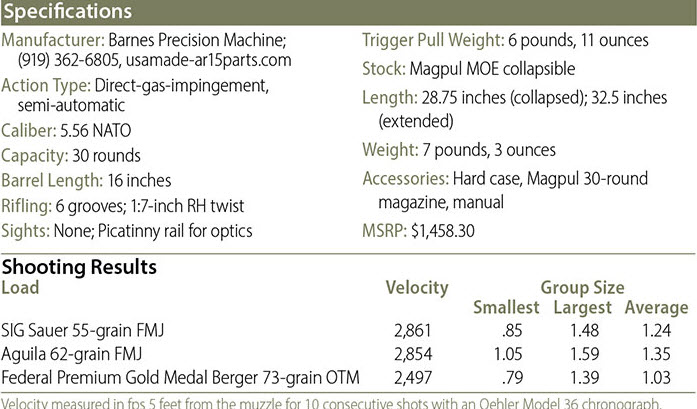
I find this fascinating. I’m a wonk, I admit. But even if you don’t find it as interesting as I do, I’d request that you [a] see this first and foremost as a fishing expedition, not a tutorial (because that’s not my job), and [b] keep track of similar data and send to me as you run across it.
So here’s my specific interest. Technically, MOA is a measure of precision, not accuracy. Accuracy can be modified based on sight (or optic) adjustments. If you don’t understand the difference between accuracy and precision, without going through the mathematics of the Central Limit Theorem, you can see this article. So now you’ll understand why I am using the term precision for this information.
The precision is lower for the 62 grain bullets than for 55 grain or 73 grain. It would have been nice to see additional testing with Sierra MatchKing 77 grain OTM. The difference above is nontrivial.
We saw in a previous post (not because I knew this information, but because I know how to find this information) that when the Army tested the M855A1 round, they were using accurized 1:8 twist barrels, not 1:7 twist as per MilSpec. They got worse precision with the new ammunition with 1:7 twist barrels. The M856 tracer round is 63.7 grains, and the Army had to show that the barrel could stabilize the round in order to justify the new bullet.
A twist rate that is too high can over-stabilize bullets, leading to “keyholing.” We know that, and so it’s important not to overdo barrel twist. It is fairly standard knowledge that use of the 1:7 twist leads to slightly less precision for the 55 grain, and maybe for the 62 grain green tip. But it manages to stabilize the heavier rounds, including the rounds that are apparently in current use within SpecOps.
This stabilization is necessary because of changes made to the service rifle. The original M-16 had a much milder twist rate than does the shorter barrels in use today. The shorter barrels are a direct result of trouble getting into and out of vehicles for dismounted operations, going through buildings and around walls, and the general requirements of MOUT. In order to make the ammunition work for these shorter barrels, the engineers had to monkey around with twist.
Now I’m to my main point. I take interest in the fact that the precision is lower for the medium weight bullets. I’ll stipulate that the variables are many, including perhaps the most important one, barrel harmonics. I’d love to talk to some of the original engineers and test shooters for the newest Army round, but it’s likely that I’d never get the truth.
But what I can do is compile data of my own. I’m wondering if this behavior stands up with other twist rates? I’m also interested in whether barrel length plays a role. Why did the precision decrease with medium weight bullets, and recover at the lower and higher ends?
At any rate, if you run across any data for 1:9 twist, 1:8 twist, or any more data on 1:7 twist, using different bullet weights, I’d be very interested to learn the precision of the groups and plot for future reference.
Thanks in advance.
6 years, 4 months ago
A better solution here, where the National Rifle Association is so influential, would be to render illicit firearms useless.
It is not as insurmountable as it might appear.
Today, one can walk into a gun shop and purchase, for instance, a .22, .38 or .44-caliber handgun. Most firearms are built to accommodate one size round only. Here’s what would happen if the manufacture of today’s standard-size rounds were outlawed, and .21, .37, or .43-caliber rounds took their place: Eventually, gun owners would run out of the old ammo, and their weapons would become paperweights.
We’d have the opportunity for a national gun policy do-over. New, tougher gun registration and ownership policies, some already favored by NRA membership, would be enacted in conjunction with the changeover in rounds calibration. Fresh attention could be paid to newer, research-vetted strategies, such as the universal adoption of smart-gun technology and limiting the size of rounds available to civilians. Police and military would keep their current firearms and ammuntion, manufactured and distributed under strictest control.
To use the recalibrated rounds, people would have to purchase new weapons to fire them. Many would object. Why should a law-abiding citizen spend hundreds, perhaps thousands of dollars to replace one’s gun collection?
Gun manufacturers could offer a six-month window for any person eligible to turn in their old weapons and receive a partial rebate toward the purchase of new ones. For manufacturers and retailers, these sales would amount to a windfall of epic proportions.
We’ve discussed it many times before, but make sure your logistics considers such exigencies. Controllers are always looking for more ways and more things to control. It’s what they do, it’s who they are down deep in their soul.
6 years, 4 months ago
Surprised they didn’t mention Lucky Gunner.
6 years, 5 months ago
The new Hornady 4DOF ballistics calculator is so precise because it combines what Hornady calls the Four Degrees of Freedom. In other words, it takes into account windage, elevation, range and angle of attack to generate a drag coefficient.
Typically, my ammo column focuses on the technical aspects of ammunition; it’s not a place to tell stories. For this installment, I’m going depart from that because about the only thing better than a good story is a sloppy wet kiss from your spouse or a winning lottery ticket. (Both of which are beyond my ability to deliver.)
Recently, a few magazine editors visited for a week. Egos were on display and opinions were as thick as brass on the range at Gunsite Academy. The purpose of this soiree was to test about two dozen rifles, some purpose-built for connecting at extended distances. I have access to a 1,700-yard range and we spent the day there. My 17-year-old son, Bat, served as the official range rat.
After our 500-yard testing was complete, I told my associates I needed to get the DOPE (data of previous engagement) on my son’s African rifle. This would save a trip back to the range and give him some time behind the gun as payment for the support role he’d been filling. On the outside everyone happily assented, on the inside I’m sure they were thinking it was time to get out of the rain.
The previous evening we’d chronographed the Hornady Precision Hunter ELD-X load for the 6.5 Creedmoor he’d be using. That velocity, along with the bullet and related specifics were entered into Hornady’s 4DOF ballistic calculator, which is available online. I’d printed the results and our goal was to confirm elevation come-ups out to 500 yards. Amazingly, this was done with five shots; my son connected center target at 100, 200, 300, 400 and 500 yards. The data generated by the Hornady 4DOF calculator was spot-on.
This article appeared in 2017, but I’ve never seen their calculator. I see that its results can be sent to spreadsheet. This is nice. I’d rather have the full calculations including math models.
6 years, 8 months ago
1. It’s certainly not the only target cartridge in existence.
2. It’s not old enough to be your grandfather’s cartridge.
3. It’s trendy, and trendy sucks.
4. It’s going to take over the hunting industry.
5. It works.
Amusing, as intended. As for effectiveness, you might want to check out this piece entitled 6.5 Creedmoor Proven: How Does It Actually Perform On Big Game?
Prior: 6.5 Creedmoor Ammo Prices
6 years, 8 months ago
James is also an avid reloader. We had a good chuckle over the latest wonder rifle cartridge, the 6.5 Creedmoor. In 1896 the 6.5 x 55 Swedish Mauser was introduced to the shooting public. It was a smokeless powder cartridge. It became the most popular moose rife in Sweden and probably still is. When the .270 Winchester was introduced to the shooting public the date on the .270 was very close to the 6.5 x 55. In my teen years I wanted to get one but all that was available was war surplus.
Now comes the 6.5 Creedmoor which if you look closely at the 6.5 stats it is very close to the .270. I don’t remember the .270 ever being suggested as a 1,000-yard rifle. Don’t get me wrong, the 6.5 Creedmoor is a welcomed addition to the shooting community, but is the cost of the ammunition worth it? Next time you are at a retailer, check out the price of .270 ammunition compared to 6.5 Creedmoor ammo.
By the way, a friend of mine hunts with a 6.5, loves it, and has taken a monster Maine buck with it. As for me, when I am hunting in a rifle-authorized area, I will continue to use my .270.
There’s nothing wrong with either one, but remember, the 6.5 Creedmoor is a short action cartridge (based on the .308 case) while the .270 is a long action cartridge (based on the .30-06 case). That means the 6.5 Creedmoor is easier to deal with in semi-auto.
At any rate, I think he’s exaggerating the price of the 6.5 Creedmoor. There is a wider variability in prices for the 6.5, so for a 20-round box you can spend less than a dollar a round, but as much as $2 per round. On the other hand, pretty much all of the 6.5 is available for less than $1 per round if you buy in bulk through someone like Lucky Gunner.
6 years, 8 months ago
While I said that I carried 450 SMC (and a slightly modified 1911 with a stiffer recoil spring) into the bush, I had never shot it.
Over the weekend I had the opportunity to take a very special little boy out to a field and teach him to shoot a .22LR Cricket. I was a great time, and he exhibited the patience to do it right. I was very proud of him.
But I used the chance to shoot a couple of rounds of 450 SMC through that 1911 to see how it performed. While it has been said that the 450 SMC causes 78% more recoil than 45 ACP, I cannot bear that out from my experience.
Maybe it did, but I don’t find the recoil from the 45 ACP to be that stiff anyway. I managed to shoot two shots of 450 SMC rapid fire and put them within a 3-4 inch two-shot group at 20 yards, first time, no practice shots.
I didn’t find the recoil to be problematic at all. I would liken it to a combination of the push you get from the 45 ACP with the snappy muzzle flip of the 9mm.
Hopefully, much more to come on the 450 SMC. I like it.
6 years, 8 months ago
In the late 1980s, gunwriter Dean Grennell took .451 Detonics Mag. brass and trimmed it to the same overall length as the .45 ACP cartridge case, thus creating the .45 Super. Grennell wrote an article for the February 1988 issue of Gun World Magazine, discussing his new version of the .45 ACP, which was capable of pushing a 185-grain bullet to 1,300 fps. In the August 1988 issue of Gun World Magazine, a second article about the .45 Super—written by Tom Ferguson—appeared. Ferguson was interested in Grennell’s concept cartridge, but he wanted to take things a step further. He took a handful of .451 Detonics Mag. brass and a 1911 pistol to Ace Hindman of Ace Custom 45s. Hindman came up with the idea of heavier springs in the 1911 to make it more suited to the higher-pressure cartridge.
In 1994, Fernando Coelho—owner of Triton Cartridge—reached out to Garey Hindman, Ace’s son, who was still converting 1911s and even some Smith & Wesson Model 4506 pistols to accommodate the.45 Super. The problem with the cartridge was a lack of suitable brass. Coelho had recently started Triton Cartridge and felt that with his background in load development, coupled with actual in-house pressure testing, he would be able to come up with reliable, factory-loaded, .45 Super ammunition. A deal was struck and Coelho reached out to Starline Brass to get the ball rolling. The folks at Starline worked with Coelho to establish correct internal case-wall dimensions, web-area thickness and overall hardness of the cartridge case.
But, just like the .300 BLK found fame because of its name, the.45 Super—as a commercial cartridge—was doomed because of what it was called. You see, when Ace Hindman passed away, his son trademarked “.45 Super.” When Triton made factory-loaded .45 Super ammo, Garey Hindman would get a royalty, which was something a bit unusual in the ammunition business. Because of this, no major firearm or ammunition manufacturer would offer .45 Super guns or ammunition. There was also the concern that a shooter might load and fire .45 Super ammo in a vintage .45 ACP revolver or an old 1911 and get an unpleasant surprise.
All this led to the birth of the .450 SMC. Coelho was fed up with the inherent issues of the .45 ACP/.45 Super cartridge case and the damage being done to the potential growth of the .45 Super. One of the case problems was primer flow; you could experiment with different brands of primers and powder, but most of the time primers would flow back around the tip of the firing pin. The solution: switch to a small-primer pocket and utilize a small-rifle primer. Coelho reached out to Starline again, asking the company to make .45 Super brass with a small-primer pocket. That solved the primer-flow problem and Triton Cartridge soon began offering factory-loaded .450 SMC ammunition. It was loaded to a maximum average pressure (MAP) of 32,000 psi, which is slightly higher than .45 Super pressures, but still less than the 37,500 psi pressure of the 10 mm. The new name—.450 SMC—solved the trade-mark problem, and Triton had two loads: a 165-grain bullet at 1,450 fps and a 230-grain bullet at 1,150 fps.
When Triton went out of business in 2003, it looked like the .450 SMC was doomed. But, another new ammunition company stepped up to offer one of the most potent and practical magnum-category, .45-caliber, defensive-handgun cartridges ever created. Mike McNett of DoubleTap Ammunition recognized the usefulness of the .450 SMC and his Cedar City, UT-based company now offers six .450 SMC loads.
Comparatively speaking, the hottest factory 185-grain .45 ACP load you can buy will generate only about 1,140 fps, and the fastest 230-grain offering only about 1,000 fps. Essentially, what you get with the .450 SMC are 10 mm velocities with a .45-caliber instead of a .40-caliber bullet.
Of course, since no one is manufacturing .450 SMC handguns, what you’re probably wondering is what you have to do to shoot .450 SMC in your .45 ACP. Well, a .450 SMC cartridge can be fired in any .45 ACP handgun. However—and this is a big however—it should only be fired in full-size .45 ACP handguns that have a +P rating. (A 20- to 22-pound recoil spring in your favorite 5-inch 1911, or a 21- to 23-pound spring in a Glock.)
This is a great article. I was unaware of all of that history, and as I said, I have 450 SMC and carried it recently.
I’m not really sympathetic to getting “nasty surprises” because the burden to do what’s smart should rest squarely on the shoulders of the user. In other words, don’t be an idiot. However, I do understand issues of legal liability. They haven’t completely gone away with the 450 SMC design.
Then there is this: “A 230-grain load fired from the .450 SMC cartridge out of a 5-inch 1911 will generate about 78 percent more recoil than a 230-grain load fired from a .45 ACP.”
With the .450 SMC (Short Magnum Cartridge) you get > 10mm velocity with a heavier bullet. What you have to accept is the heavier recoil.





