Articles by Herschel Smith


The “Captain” is Herschel Smith, who hails from Charlotte, NC. Smith offers news and commentary on warfare, policy and counterterrorism.


Taliban Control of Supply Routes to Kabul

17 years, 4 months ago

The Taliban recently attempted another large scale conventional-style operation in the Helmand Province. It didn’t go well.

About 100 militants have been killed in Afghanistan’s Helmand province, half in air strikes that thwarted an attack on a key town, Afghan and British forces said yesterday.

Between 50 and 60 militants were killed in airstrikes as they tried to enter the provincial capital of Lashkar Gah from three directions. British Lieutenant-Colonel Woody Page said the attempt was ”virtually unpre-cedented” in the area in the scale of the attacking force and their degree of coordination.

With the exception of the battle of Wanat, regardless of their perceived capabilities, every time they conduct major conventional operations against British or U.S. forces, they lose badly. It is tactics like this that are keeping the Taliban from gaining control any more quickly than they have. Hopefully the Taliban will continue to believe that they can engage in conventional operations against coalition forces. Working as guerrillas is more efficient for them and bad for us.

But gaining control they are, in spite of their losses due to large scale operations. The lack of forces to provide security for the population has caused the Taliban, who are in constant contact with the population, to gain control of all major routes into and out of Kabul except one.

At a gas station on the outskirts of Kabul, lounging in the shade of a transport truck, Mohammed Raza describes how he escaped death.

Last month, a U.S. contractor promised him $10,000 if he’d drive a truck full of diesel from Kabul to Kandahar, offering seven times more than he could earn by transporting his usual shipments of sugar. But the Taliban forbid drivers from carrying fuel to the foreign troops, he said, and the insurgents run checkpoints on the road between Afghanistan’s two largest cities. He rejected the offer. One of his friends took the assignment, he said, and the Taliban cut off his head.

“Many drivers now are selling their lives,” the 25-year-old said, nervously twisting the fringe of his beard.

The Taliban are isolating Afghanistan’s capital city from the rest of the country, choking off important supply routes and imposing their rules on the provinces near Kabul. Interviews suggest that the Taliban have gained control along three of the four major highways into the city, and some believe it’s a matter of time before they regulate all traffic around the capital …

But the insurgents don’t need to attack the capital; by hobbling the government’s ability to reach its own citizens beyond the city gates, security analysts say, the Taliban make the rulers of Kabul irrelevant in broad swaths of the country. It’s more than a propaganda victory; the insurgents are grabbing the same political high ground the Taliban exploited during their previous sweep to power in the 1990s, by positioning themselves as the best enforcers of security in rural Afghanistan.

The roadblocks have also started to pinch the foreign troops. Military bases find themselves running short of fuel and other supplies …

People who work for the government, or have any association with the foreign presence, now travel covertly on the main highways of southern, central, and eastern Afghanistan. They disguise themselves as rural peasants, carry no identification cards, and erase numbers from their cellphones that might connect them with the government.

Some devise even more elaborate strategies for dealing with Taliban checkpoints, arranging for friends to impersonate religious figures who can vouch for them if they’re stopped by the insurgents.

Truck drivers often leave a rear door open at the back of their tractor-trailers, securing their cargo with a spider web of ropes, so that Taliban can easily look inside and check the shipment for anything forbidden by the insurgency. The Taliban even scrutinize the drivers’ customs paperwork to certify that the goods are destined for non-military consumers …

Not only do the Afghan security forces lack numbers, but they’re also corrupt and even colluding with the insurgents, said Colonel Asadullah Abed, chief of the criminal investigation division for the 10 central provinces around Kabul.

The 40-year-old policeman says he’s no friend of the Taliban, and has a sheaf of threatening letters from the insurgents to make his point.

But he worries that his colleagues at small posts outside the city are not so devoted to the government’s cause.

Each of the four major gateways into Kabul are guarded by Afghan police, soldiers, and intelligence officers, Col. Abed said, but the insurgents easily bribe their way through. People with loyalties to the insurgents have also infiltrated the ranks of Afghanistan’s security establishment, he added: “They’re not working honestly.”

Col. Abed paused to look at a reporter’s military-issued accreditation card, and noted that the small piece of identification would be a death warrant on most highways outside the city. “You’re a foreigner travelling with this,” he said, pointing to the ID badge, “and you can travel the Shomali road okay, but any other road they will capture you after one kilometre.”

As long as the Taliban interdict traffic patterns outside of Kabul into the countryside of Afghanistan, Operation Enduring Freedom will fail. But there is also the corollary problem of corruption within the Afghan forces, police and army.

While this corruption remains there cannot be a complete turnover of responsibility to the Afghan government. Operation Enduring Freedom is a long, long way from completion.

The Talibanization of Karachi

17 years, 4 months ago

The Captain’s Journal has discussed the influx of Taliban to Karachi before, as well as the fact that it is an important port city through which NATO supplies flow (ultimately through two passes, one at the Torkham Crossing and the other through the Southwestern city of Chaman). But the supplies mainly come into Pakistan through the port of Karachi. There are reports of a massive influx of Taliban into Karachi and the surrounding provinces.

Muttahida Qaumi Movement (MQM) chief Altaf Hussain has said that more than 400,000 Afghans and foreigners equipped with weapons have entered the city and alleged that these terrorists wanted to occupy Karachi and Hyderabad and the entire Sindh.

In a statement issued from London on Sunday, he warned that they did not want to fight anyone but added that if the MQM areas were attacked they would defend themselves in accordance with the UN Charter and Islamic Shariat.

He said that the MQM wanted to make Pakistan a liberal and democratic state and not a country governed by al-Qaeda, Taliban or religious extremists.

“The MQM is against all kinds of extremism and terrorism and wants to give equal rights to each and every segment of the society including minorities.”

This report is probably exaggerated (the total is probably << 400,000), but a much better anecdotal account of the Talibanization of Karachi comes from Richard Engel of NBC News along with his interpreter.

Many Pakistanis attend madrassas because they offer free education, supplementing the government’s lacking public school system. For centuries madrassas were the only form of education in the Islamic world. From Morocco to Indonesia, most madrassas have a similar layout, with a mosque at the center and classrooms upstairs. The vast majority of madrassas are moderate charities that teach religious values, the Koran and the traditions of the Prophet Mohammed.

But some madrassas in Pakistan have churned out suicide bombers indoctrinated in jihad and a paranoid but widespread philosophy that they must attack innocent civilians to defend their faith from the United States, Israel and other modern-day “crusaders.”

Former President Pervez Musharraf promised to reform and regulate Pakistan’s hard-line madrassas. It never happened. According to Karachi’s former mayor Farooq Sattar, there are now more than 2,000 illegal madrassas in Karachi alone. This was one of them.

“What do you think of the Taliban and their influence here?” I asked the students.

More blank stares.

“What do you think about the U.S. incursions?”

That got a reaction.

“God willing, we will fight them,” said one teenager with a purple scar on his chin. “They are the enemy,” he said and launched into a long explanation of America’s goal to occupy Muslim lands and undermine Islam. I’ve heard the same speech from Cairo to Lebanon, Baghdad to Riyadh. God bless the Internet.

A few minutes later my driver/fixer, a very tough guy from a very tough part of Pakistan, tapped me on the shoulder.

“I think you have been here long enough,” he said. It was time to go.

But I still hadn’t seen any Taliban.

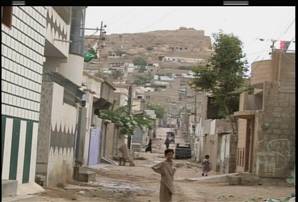
Malik suggested we go deeper into the slum, to the neighborhood right under the cliffs and quarries. He was nervous about taking a foreigner, but had an idea. There was a graveyard in the area.

“We can pretend to be offering prayers for the dead,” Malik suggested. “I’ll pray over one of the graves and you can see the neighborhood for yourself.”

Malik said praying at a gravesite would give us an excuse to be in the area and raise less suspicion.

It didn’t exactly work. As soon as I stepped out of the jeep by the gravestones, I was again surrounded by a group of people. They didn’t have weapons or appear threatening, but didn’t attempt to hide their sympathies for the Taliban. One man proudly told me several suicide bombers had prayed in a nearby mosque.

But others were scared of the Taliban. A man who spoke English told me the Taliban were in control of the area.

“Do the Pakistani police or soldiers ever come here?” I asked him. “No, they can’t come here.”

“How do people feel here?”

“We are all frightened. The Taliban has taken over.”

More men, athletically built in their 20s and 30s, started to arrive.

“Who are these people?” I asked the English speaker.

“They are Taliban.”

“Do they understand what we are saying? Do they understand English?”

“No, but you shouldn’t stay here. It is not comfortable here. You should not be here.”

“Who runs this neighborhood?”

“They do.”

The new arrivals didn’t want to be interviewed.

“Stop asking them questions,” the English speaker advised.

We left a few minutes later.

“We couldn’t come here at night,” Malik said as we were driving out of the neighborhood. “Now we had an excuse to come to the graveyard. But at night, there would be no reason to be here.”

Both of these reports point to the same thing, even if in different ways.  The campaign is in deep trouble when the main route for supplies, ordnance and fuel is in trouble. If the Taliban have their way, Karachi will not be hospitable for very much longer. Causing a diminution of Taliban capabilities and turning the tide of the campaign is very important, and it’s important to do so in a timely manner.

Red Dawn

17 years, 4 months ago

For war movie aficionados, Red Dawn was much more than entertainment and story-telling. It was in some ways profound military, moral and geopolitical commentary. For this reason it’s possible for Jonah Goldberg at the National Review to maintain interest in this subject throughout a number of posts, amounting to a discussion thread concerning a war movie (admittedly a B grade movie from Hollywood’s perspective) on a major and well visited blog. It just isn’t possible adequately to summarize or reproduce the beginnings of the thread or its evolution (you can find the posts here, here, here and here). But the last one stands out as needing a response. A few salient quotes follow.

I hate the Soviets as much as the next guy. Well, actually much, MUCH more than the next guy since I actually had to live there for 25 years. Unlike you, I actually took an oath to defend the Constitution from all enemies foreign and domestic (during my naturalization ceremony). And unlike you, I actually voted for Milius (for NRA board). But I am less enthusiastic about the “Red Dawn” than a lot of your readers …

Some sentiments are very boneheaded. Remember the scene where a Soviet detachment tried to sneak upon Wolverines using a tracking device carried by the mayor’s son? They were defeated and the captured prisoners executed. In response to their mention of the Geneva Convention Patrick Swayze says “Never heard of it”. That’s just a callous answer and a much better one would explain that systemic Soviet violations of the Convention (depicted earlier in the movie) legally made the Convention non-binding for the American side too. Furthermore, when one of the Wolverines asks “What’s the difference between us and them?”, Swayze replies “We live here”. This is just monumentally stupid. By this logic in 1945 the Nazis were morally superior to everybody else because they were fighting on their own territory. I’m afraid this dialog will be repeated verbatim in the remake –
only the point will be made by the Taliban or by the Iraqi members of Al Qaeda in Iraq.

Well, perhaps so, and perhaps there is no possibility that the remake of Red Dawn can ever be anything other than morally indignant given its origins in Hollywood. But this response above, while taking on the appearances of moral superiority, fails in one major aspect of ethics. It assumes that something, some action, some position taken by the U.S., cannot ring true because of its very origins, or have any deontological import regardless of the apparent ease with which the moral equivalence argument is invoked.

Let’s admit right up front that perhaps Swayze should have said something like “we are Americans and they aren’t” rather than “we live here.” It would have been better and easier to defend. But we shouldn’t expect too much from High School students, and his answer is good enough for a dialogue starter. At least he gets the sentiment correct. He doesn’t flounder in inaction and hand wringing over his moral right to defend himself and his family and friends.

Evil and excess will announce it’s presence in every endeavor given man’s moral turpitude. The fact that the U.S. has had some breaches of ethics in our history (very few of them, in fact) doesn’t make us comparable to the Soviets any more than it makes al Qaeda comparable to American fighters in the war for independence. Location is irrelevant; the theoretical framework for the action is everything.

Still need more? Okay. Let’s try this. Robert Kaplan’s magnificent book Imperial Grunts has a stunning introduction entitled “Injun Country” (one cannot claim to understand the global war on terror before reading this volume). It’s a very erudite discussion of the roots of imperial defense of the homeland, and not just for Great Britain. It’s orientation is America, and her defense began soon after she was a country by ensuring that her battles were on the periphery of the domain (or beyond).

The turn of the century found the United States with bases and base rights in fifty-nine countries and overseas territories, with troops on deployments from Greenland to Nigeria, and from Norway to Singapore. Even before the 9/11 attacks, special operations command was conducting operations in 170 counties per year. Defense of the realm is not a new phenomenon in American history.

The moral equivalence argument, if one wants to make it, is easier than simply pointing to a comment in Red Dawn. It’s also dumb given the profound differences between the U.S. and the Soviets. The Soviets wanted to control the world, just as Hitler did. Their aspirations involved complete domination, and no amount of adherence to rules of engagement, law of armed conflict or various conventions would have made them noble.

Conversely, the U.S. has never even once entertained the idea of ownership of the wealth of nations conquered during war or rule over her people. Even now the U.S. is spending wealth defending South Korea so that it can pursue its ridiculous “sunshine diplomacy,” and gives Japan an umbrella of protection so that she doesn’t have to go nuclear to ensure a defense against China. Do you doubt it? Jettison the umbrella of protection and see how fast Japan develops nuclear weapons. Also consider the costs of Operation Iraqi Freedom against a backdrop of the U.S. acquiescing to the notion of negotiations with Iraq to achieve a SOFA (status of forces agreement) for future presence of troops.

The U.S. has been a force for good in the world, and the Soviets have been a force for evil. The inability (or refusal) to acknowledge this is why Hollywood will never create a movie about Iraq or Afghanistan that does well as the box office. It’s also why, in the words of one individual with whom I have discussed these ideas, “it took me a while thinking about it, but after reading your posts, I’ve come to the conclusion that we and the Georgians are right and the Russians are wrong, simply because that’s the way it is. We are Americans and they aren’t. They are Russians. We have a right to defend our homeland overseas, and Russia doesn’t because they are an evil regime.” Sure, one can argue that the noblest intention can be marred by morally ugly actions carrying out those intentions, but that’s a reason to change those ugly actions, not the intentions or the campaigns.

While one may argue for isolationism and against intervention overseas due to various reasons (not the least of which is that there are unintended consequences to such actions), there are also unintended consequences to failure to act. For those who wish for complete disengagement overseas, they should be careful what they wish for. Battling jihadists on American soil may mean witnessing this evil in real time, with fighters gunning down women and children in shopping malls, suicide bombers at large industrial complexes and buildings, destroyed electrical grids and poisoned water supplies.

America learned long ago (at the time of expansion into the Western frontier) to defend her homeland by ensuring that her battles took place elsewhere. She also learned in short order not to make stupid moral equivalence arguments concerning men and regimes who intended evil for others.

Why we can’t negotiate with the Taliban

17 years, 4 months ago

Rosie Dimanno has covered Marine operations in the Helmand Province, and four months ago The Captain’s Journal said we like Rosie. She has it going on – she gets it. Concerning negotiations with the Taliban, Rosie tells us just what the scoop is.

There’s really no excuse, in these days of instant reporting verification, to misquote or misrepresent a quote.

Unless, of course, the intention is to manipulate and deceive.

This is what Brig. Mark Carleton-Smith, the man in charge of Britain’s 8,000 troops in Afghanistan, said last weekend: “We’re not going to win this war. It’s about reducing it to a manageable level of insurgency that’s not a strategic threat and can be managed by the Afghan army.

“We may well leave with there being a low but steady ebb of rural insurgency.”

Carleton-Smith called for negotiations with the Taliban.

“If the Taliban were prepared to sit on the other side of the table and talk about a political settlement, then that’s precisely the sort of progress that concludes insurgencies like this.”

It’s nothing that hasn’t been said before. Indeed, Afghan President Hamid Karzai has, for the past three years, urged Taliban leaders to join him in dialogue – provided they accept Afghanistan’s new constitution and denounce violence. The Taliban has disdainfully declined.

They just keep killing, both troops and civilians. In recent months, the neo-Taliban has particularly targeted female aid workers, female-owned small businesses, female teachers.

In so doing, they can pluck out two thorns with one blast: Women who don’t know their place (indoors, under a burqa) and anyone trying to alleviate the misery of Afghan civilians.

The insurgents – more closely associated with Al Qaeda than at any time since pre-2001 – do not negotiate. The militants aren’t interested in securing more Pashtun representation in government. This isn’t political.

It’s about reversing any incremental gains Afghanistan has made since the Taliban was ousted. It’s about imposing, as before, the most narrow, oppressive and isolating of Islamist theocracy on an exhausted citizenry.

This is just what we have been saying for months now. The Anbaris weren’t religiously motivated jihadists, and thus siding with the U.S. was not only in their best interests, but inevitable given the relentless Marine operations in Anbar.

The Taliban are persuaded to fight for other reasons, there is insufficient force projection in Afghanistan, and Rosie is right. Calls for negotiations are not new, and in fact, negotiations themselves are not new, if you count negotiations as effeminate pleading by Hamid Karzai. Just as there have been “talks” with the Iranians for 25 years (contrary to the claims of the surrender-ists), there have been pleas by Hamid Karzai and his ilk for several years for the Taliban to end the violence. They have declined and will continue to do so.

NATO Cannot Be Rehabilitated

17 years, 4 months ago

More than five months ago on the heels of a number of bureaucratic entanglements that had slowed the progress of recently deployed Marines in Afghanistan, The Captain’s Journal asked the question Can NATO Be Rehabilitated? We also predicted that in order to give Petraeus latitude to implement counterinsurgency doctrine, we would have to bring U.S. forces out from under the command of NATO, or possibly place a U.S. General in charge of NATO forces. This has come to pass as we predicted.

We have also noted that the campaign in Afghanistan relies heavily on special forces and raids against mid-level Taliban commanders rather than contact with the population and ensuring security. In other words, it is being treated as a counter-terrorism campaign rather than a counterinsurgency campaign. Australian infantry is not even allowed to engage in kinetic operations, and must sign documentation concerning their deployment that they have not provoked such fire fights.

Rather than making contact with the population, many NATO troops have been kept on Forward Operating Bases (FOBs); rather than finding and killing the enemy, NATO has placed emphasis on reconstruction efforts, reconstruction that goes unused in many cases because there is no security. Rather than conducting dismounted patrols, many troops have been confined to vehicles, obviously increasing the risk from IEDs.

There are noises that NATO countries are getting serious about the campaign.

The Berlin government has extended the mandate of Germany’s military mission in Afghanistan for 14 months and agreed to deploy an extra 1,000 troops there.

The decision would keep German troops in Afghanistan until December 2009, boosting their number to 4,500.

The move requires approval by the lower house of parliament, which was due to debate the issue later on Tuesday.

Germany is currently the third biggest contributor to the 47,000 Nato-led force in Afghanistan.

Sounds like a positive step, no? Well, not so fast. Forget force projection by infantry. Germany won’t even use its special forces for kinetic operations.

Germany has admitted its Special Forces have spent three years in Afghanistan without doing a single mission, and are now going to be withdrawn.

More than 100 soldiers from the elite Kommando Spezialkrafte regiment, or KSK, are set to leave the war-torn country after their foreign minister revealed they had never left their bases on an operation.

The KSK troops were originally sent to Afghanistan to lead counter-terrorist operations.

But Frank-Walter Steinmeier, the foreign minister, admitted they had not been deployed “a single time” in the last three years, despite a desperate shortage of Special Forces units in the country.

Troops from Britain’s Special Boat Service and the SAS work round the clock, across Afghanistan, alongside US navy Seals and Delta Force, to target terrorists, arrest drug lords and rescue hostages.

The KSK were part of the US-led Operation Enduring Freedom, which spearheads the international hunt for Osama bin Laden.

Senior military officials last night blasted the KSK commanders for keeping the troops in camp. One western military official accused Germany of “sitting on the sidelines while the rest of the world fights”.

He said: “It’s just unbelievable to think there have been 100 highly-trained troops sitting doing nothing for three years, while everyone else has worked their socks off. It’s no good sending troops if they don’t do anything. They might as well have stayed at home.”

Another source said: “It’s ludicrous that they would be here and not contributing.”

Berlin is under almost constant pressure from the rest of Nato to increase its troop contribution and scrap special national caveats which prevent German troops deploying to volatile parts of the country, like Helmand. Last year it emerged that Norwegian troops, fighting alongside their German allies, were forced to abandon a battle at tea-time because German pilots refused to fly emergency medical helicopters in the dark.

Mr Steinmeier claimed the KSK’s inactivity as an excuse to withdraw the Commandos from Afghanistan.

He said: “That’s why the KSK element should be taken out of the OEF mandate.”

Berlin was set to renew the KSK mission for another year in November, but they are now expected to fly home instead.

A spokesman for Operation Enduring Freedom said: “We don’t have enough troops in Afghanistan.”

But, he added: “Common sense says if they weren’t being used, they won’t be missed.”

The KSK revelations came as Nato’s leading commanders were renewing their calls for more troops.

Angela Merkel, the German chancellor, agreed to send an extra 1,000 troops to Afghanistan this week, but they will be confined to the north of the country which is relatively safe.

Most of Germany’s troops are based in Mazar-e Sharif, at an airbase complete with a series of bars and a nightclub. Nato wants Germany to do more in Afghanistan, but the mission is deeply unpopular with German voters.

Mr Steinmeier told Der Spiegel newspaper: “You cannot just keep piling elements on without taking a critical look at our current responsibilities.”

Our question five months ago was prescient. There are individual countries who are assisting in Afghanistan, but as an organization, our judgment is that NATO cannot be rehabilitated. This is why, for all of his bluster about returning America to a position of respect across the globe, Barack Obama’s demand that NATO fulfill an increased role in Afghanistan is a doomed strategy. More troops to sit on FOBs and provide force protection for themselves (while Marines and British forces take the brunt of the battle in the South) won’t help the campaign.

Have the Taliban Really Rejected al Qaeda?

17 years, 4 months ago

Regular readers of The Captain’s Journal know that we oppose negotiations with the Taliban (just as we opposed the deal with Mullah Abdul Salaam for Musa Qala). But Hamid Karzai has prostrated himself before Mullah Omar, beseeching him to stop the violence.

On the first day of Id al-Fitr, President Hamid Karzai had a great treat in store for his people. In a speech he said: “A few days ago I pleaded with the leader of the Taliban, telling him ‘My brother, my dear, come back to your homeland. Come back and work for peace, for the good of the Afghan people. Stop this business of brothers killing brothers’.” My brother? My dear? Yes, and yes again. Karzai is an Afghan version of the metrosexual man. He sometimes even cries publicly, though that’s not to everyone’s taste.

A large dose of wishful thinking has gone into this notion that the Taliban are actually negotiating with Kabul, or rather, that any meaningful representatives of the Taliban are negotiating on behalf of the Taliban. In fact, there are some fairly compelling denials that this is occurring. “Zabeeh Ullah, spokesman of Mullah Umar has said that Taliban has no relation[ship] to negotiations with Afghan government. He termed it as an attempt by Afghan government to create differences between Talibans. He said that Mullah Abdus Salam Zaeef, Moulvi Abdul Wakeel Mutawakal and Maulana Rehmani were not their representatives.” Furthermore, the idea that Mullah Omar would willingly choose to negotiate with Hamid Karzai stands in stark contrast to his history, even his recent history. In a recent al Qaeda video commemorating the seventh anniversary of the 9/11 attacks, Mullah Omar’s spokesman promises more large scale attacks.

Finally, the NEA Foundation has recently translated a fairly succinct but informative message from the Taliban.

In the Name of Allah, Most Compassionate, Most Merciful … The mainstream media is reporting about a ‘peace process’ between the Taliban and the Kabul puppet administration which is being sponsored by Saudi Arabia and supported by Britain – or, alternatively, that there are ‘unprecedented talks’ taking place involving a senior ex-Taliban member who is traveling between Kabul and alleged bases used by Taliban senior leadership figures in Pakistan.

The Shura Council of the Islamic Emirate of Afghanistan (IEA) considers such baseless rumors as part of the failed efforts by our enemies to create distrust and doubts among Afghans, other nations, and the mujahideen. No official member of the Taliban – now or in the past – has ever negotiated with the U.S. or the puppet Afghan government. A handful of former Taliban officials who are under house arrest or who have surrendered do not represent the Islamic Emirate. If our fight was for control of ministries and other prominent positions in the puppet administration, then such negotiations would have made sense – but this is not the case. Our struggle is to implement the rules of Allah in Afghanistan by eradicating the enemies of Islam.

A dialogue which is in the interests of Afghanistan and Islam will never be concealed from the nation. Our struggle will continue until the departure of all foreign troops.

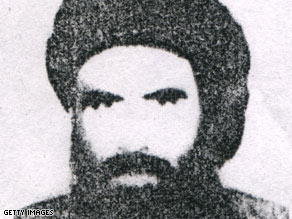
In these few paragraphs not only has Omar denounced the idea that there can be negotiations with either the U.S. or Kabul, he also tells us again what his aim is. The Taliban aren’t after cooperation or even high level ministry positions. The existing government in Kabul won’t do.

While even Secretary of Defense Gates has made it clear that there can be compromise with the Taliban, Mullah Omar has said that the same kind of government that existed prior to 9/11 – and that gave sanctuary to al Qaeda – must be implemented in Kabul. Nothing less is acceptable.

Since it take two parties to cooperate, there can be no cooperation.

60 Minutes and the Special Forces Hunt for bin Laden

17 years, 4 months ago

Like many of you, I watched the 60 Minutes exposé on the special forces hunt for Osama bin Laden. My reaction was probably unlike most, but typical of the articles that frequent The Captain’s Journal. But more on my reactions in a moment. While we don’t normally interface with posts at other sites on a regular basis, this one is an exception that warrants special attention because of the salient points to be made on the campaign in Afghanistan. Christian at Defense Tech has an important post up on the whole sordid affair (you’ll see why it’s sordid momentarily).

So, after I posted the last thread, I went over to a forum that’s populated with no-joke special operations forces troops and looked at the discussion on the KBL/ Dalton Fury imbroglio. Man is it hot in there.

Apparently, Dalton Fury’s real name is Maj. Thomas Greer. I was wrong in thinking he was Pete Blaber, though it does turn out from the discussion that Blaber has a book of his own coming out called “The Mission, The Men, and Me: Lessons from a Former Delta Force Commander” that’s supposed to be available in December.

These operators at the forum are none too kind to a guy who’s attempting to “profit” from revealing covert operations covered under top secret non disclosure agreements. They skewer him and smoke his body over a pit of coals. But none of them disputes who he is, what he’s done or how the mission went down. There’s little comment about the actual 60 Minutes broadcast, though it would have been helpful if the reporters had mentioned the controversy Fury has caused and held fast on calling him by his real name (I did a search and his name comes up as a faculty member of American Military University). Once it’s out in the open, it looks a little ridiculous for a reputable news organization to stick to a pseudonym.

As a reporter who’s covered the military for a decade, I get a little annoyed at the knuckle-dragger attitude that someone who says anything about their covert activity should be banished. Give me a break. That attitude perpetuates an elitist, Samurai mentality that says “you don’t need to know. Just trust us, we know what we’re doing…”

Sorry, but I — and millions of other Americans — pay your salary and we damned right want to know what you’re doing. You work for us. So I’m glad, as long as it doesn’t deliberately put lives in danger of death (like the politically-motivated CIA tell-alls did back in the ’70s), that these stories come out. There’s been seven years between then and now, surely Delta and CIA have new ways of doing things that aren’t compromised by this book.

There is also a discussion thread at the Small Wars Journal in which it is concluded that this individual is the “real deal,” and it spends some time on the efforts at redaction that occurred between Greer and SOCOM. Good grief. Let’s go straight out of the gate and make our position clear. The Captain’s Journal doesn’t care who Greer is or if he is the “real deal” (any more than we care about the commenters at Defense Tech) except insofar as it goes to accuracy of his account and hence the ability to critique our strategy.

Further, the comment thread at Defense Tech is as brutal to Christian as the original one to which he points. I won’t waste time rehearsing it, but one particularly obnoxious example is this by someone with the pseudonym Krag (these people never use their real names):

Pathetic. You want to know…TS. Join an elite unit and then you’ll know. Otherwise, quit whining. The military doesn’t “work for” you or any other whining civvie. We work for the preservation of the Constitution. You pay taxes of which a small portion goes to pay for your collective defense…that entitles you to squat as to TTPs and classified information.

Get over yourself.

Congratulations Krag! Drop your dumbass pseudonym, tell The Captain’s Journal your real name and address, and we’ll send your B.A. degree in navel-gazing. But as for this elitist mentality and cloak-and-dagger secrecy, how do you say it in contemporary slang? The Captain’s Journal isn’t down with that.

If something is OPSEC, then it can’t be released. If it isn’t then it’s free game. Period. It shouldn’t be any more complex than that. TTPs can be OPSEC too, and the decision simply must be made as to whether the information is or isn’t OPSEC. Then we can move forward with the information, commentary and analysis.

Our position on special forces has been made clear before. We are a Marine blog. In the Marines, no one is special – or everyone is special, depending upon your perspective. Infantry is king, and every billet supports infantry. We are opposed to Recon being separated from the infantry unit they support. The Captain’s Journal supports the notion that special forces should be seen as specialized billets, not supermen who maintain a cloak-and-dagger secrecy, separated from the units they support.

On a related note, I could only chuckle when I recently watched the Navy SEALS (Military Channel) as they did their 6 mile run with a 50 lb. backpack, after which they qualified at 100 yards with a rifle (Marines qualify at 500 yards). In the Marines, a day that causes you to say “my life sucks” might include a 20 mile hump on a 100 degree F day with full body armor, backpack, SAW and three drums of ammunition, and hydration system (for a total of 120 pounds) followed by squad rushes for 1000 meters in the mud with live ammunition, followed by the Gunny telling you that the Lt. Col. has decided that we have two weeks to get everyone to the next belt in the MCMAP, so we get to “stay in the field, commune with nature and beat the hell out of each other for the next two weeks.” But I digress into the very thing with which I charge the “special” people.

Since we have now dispatched the juvenile navel-gazing and the “we’re so special, can’t you all see how we’re so special, tell us we’re special” mentality and can consider the things we learned on 60 Minutes (we didn’t learn much beyond what we already knew), our reaction was as our regular readers might imagine it to be. “There you have it in all its glory – the stupid Rumsfeld legacy.”

Air Force special operators with satellite uplinks guiding JDAMS to target, CIA operatives making shady deals with halfway reliable (or all the way unreliable) allies, Delta Force operators in the background, gizmos, gadgets and thingamajigs, tribal elements in the foreground, minute-by-minute radio communications on the whereabouts of UBL, and cloak-and-dagger secrecy after the fact … it all makes for interesting television, civilian amazement, and even more honest books about the abject failure of the Rumsfeld strategy in Afghanistan.

Marines are always in ready reserve, and if their forces needed supplementing, the 82nd or 101st Airborne should have been able to respond to the need of the moment. There is absolutely no replacement for infantry, and in this case, terrain control, interdiction and authority over transit was the solution to the problem. Infantry could have provided this, special forces could not. We let UBL escape, and it was not the fault of special forces. It was Rumsfeld’s fault. It was a strategic blunder.

It isn’t a reflection on their specialized billets, their capabilities or their commitment. It’s a function of force projection. Special forces cannot supply the force projection necessary to win counterinsurgencies. Only infantry can do this. This is what we learn when we put aside the sophomoric posturing over who’s special and who isn’t.

NATO and Poppy: The War Over Revenue

17 years, 4 months ago

We’ve covered this before, but it’s time to circle back around and address it again, this time with a bit more nuance. General John Craddock is incredulous and says it’s time to give him a break.

NATO’s top operations commander hit out on Monday at allies resisting his call for the alliance to use more aggressive tactics against Afghan drug production.

“We still have a handful of nations…who have not listened to the argument but are countering with questions that have been answered over and over and over again,” NATO Supreme Commander for Europe General John Craddock told a seminar in Brussels.

The U.S. general, who has called for tougher action against drug labs and trafficking networks, rejected the idea that his proposal would worsen the Taliban insurgency and stressed it would not involve targeting farmers’ crops.

“This is not about eradication. The fear that this will make the Taliban more mad at us? Give me a break!” he said.

“What are these suicide bombs and IEDs, these terrorist attacks, all about? How can it be any worse?”

Craddock quoted U.N. estimates that the trade in drugs was bringing in about $100 million every year to the Taliban and said the trade also fuelled corruption in the Afghan government.

“If we can take away the wherewithal that they can build these bombs, the ability to buy the materiel and pay the bomb maker, the ability to buy the bullets and pay the trigger puller, isn’t that a good thing?” he asked.

“I will not rest until I have exhausted every avenue to convince the political leaders of NATO that this is a moral requirement to protect their forces.”

On a mission, he is. But not so fast. Will poppy eradication really stop the flow of revenue into the Taliban coffers? In Kidnapping: The Taliban’s New Source of Income and Financing the Taliban we pointed out how the Taliban had learned to behave like an organized crime syndicate, making protection and extortion money on everything from kidnapping to taxes on businesses and even marble quarries.

It isn’t obvious that a total eradication of poppy from the landscape would cause a diminution of Taliban capabilities. But let’s acknowledge General Craddock’s point that we shouldn’t care a whole lot how the Taliban feel if we destroy their income. If in fact there are Taliban – farmers by day, fighters by night – who are growing and making money from poppy, and we can positively identify them as being Taliban, then The Captain’s Journal is in favor of destruction of their crops.

But there’s the rub, isn’t it? If we can make positive ID of Taliban, then destruction of their crops is irrelevant since we should stalk and kill them. On the other hand, the real question isn’t whether we are going to make the Taliban more mad at us. It’s whether some heretofore uninvolved farmer or his sons become enraged at the destruction of their livelihood and then become Taliban. The real concern is stoking the insurgency with new members, not the disposition of the old members.

Finally, just in case any of this gets lost on our leadership, remember that the U.S. Marines, the best warriors on the planet, including COIN, specifically avoided poppy eradication during their tenure in the Helmand Province. They were there to kill Taliban, not crops, said they.

Indeed, from negotiating with alleged moderates to poppy eradication to [you fill in the blank _______], everyone is searching for a magic incantation to utter, a special section of FM 3-24 released only to the Gnostic special few that tells us how to do COIN, some trickery of the enemy, or some other solution to the campaign that doesn’t involve more troops. If we only do this, we can win – if we only do that, we can be successful. Alas, there is no easy solution forthcoming.

On Negotiating with the Taliban

17 years, 4 months ago

This comment at the Small Wars Journal Blog by a British officer reminds us again of the myth that has sprung up around the narrative of Anbar.

… dialogue with Afghan tribes/groupings that provided the ‘freedom’ for them to accept localised security responsibility. Given the nature of some of these local forces it was this aspect of our tactical activity that I recall being the subject of friction between the Brit and US chains of command. Slightly ironic when one considers the subsequent endorsement of the ‘awakening’ in Al An bar and Baghdad. Clearly this latter course of action was driven by our own limited means and was fraught with risk. However, compromise is, I submit, an enduring tenet of COIN.

The irony is only apparent, and belongs to the realm of myth-telling concerning the U.S. experience in the Anbar Province. The one who believes that kinetic operations and force projection weren’t the pre-condition for the tribal awakening would do well to remember U.S. Marine deaths in Anbar – approximately 1000 between active duty and reserve.

No less than Colonel MacFarland gives us a synopsis of the tribal view upon his arrival in Ramadi.

“The prize in the counterinsurgency fight is not terrain,” he says. “It’s the people. When you’ve secured the people, you have won the war. The sheiks lead the people.”

But the sheiks were sitting on the fence.

They were not sympathetic to al-Qaeda, but they tolerated its members, MacFarland says.

The sheiks’ outlook had been shaped by watching an earlier clash between Iraqi nationalists — primarily former members of Saddam Hussein’s ruling Baath Party — and hard-core al-Qaeda operatives who were a mix of foreign fighters and Iraqis. Al-Qaeda beat the nationalists. That rattled the sheiks.

“Al-Qaeda just mopped up the floor with those guys,” he says.

“We get there in late May and early June 2006, and the tribes are on the sidelines. They’d seen the insurgents take a beating. After watching that, they’re like, ‘Let’s see which way this is going to go.’ “

Note that even initially the tribes didn’t like the presence of al Qaeda, but just as with Abu Ahmed in al-Qaid, who lost to al Qaeda until aided by U.S. Marines, they needed security and assistance along with a strong presence by U.S. forces in order for their resistance to be successful. The awakening didn’t materialize out of nothing, but rather had a cornerstone, without which the foundation wouldn’t have stood.

So how well does this compare with the situation in Afghanistan? First of all, the Taliban willingly approved of sanctuary for al Qaeda rather than fought against them prior to 9/11. Second, they willingly fight side-by-side with their fighters today against U.S. and NATO forces. Third, Operation Enduring Freedom is an “economy of force” campaign, which means that, as we were told by both Generals McNeill and McKiernan, we don’t have enough troops, and by definition, this means that we don’t have the force projection necessary to do the job of counterinsurgency.

The view is therefore clouded when the loss of the campaign is on the horizon. Senior British military leadership believes that the war is lost.

Britain’s most senior military commander in Afghanistan has warned that the war against the Taliban cannot be won. Brigadier Mark Carleton-Smith said the British public should not expect a “decisive military victory” but should be prepared for a possible deal with the Taliban.

His assessment followed the leaking of a memo from a French diplomat who claimed that Sir Sherard Cowper-Coles, the British ambassador in Kabul, had told him the current strategy was “doomed to fail”.

Carleton-Smith, commander of 16 Air Assault Brigade, which has just completed its second tour of Afghanistan, said it was necessary to “lower our expectations”. He said: “We’re not going to win this war. It’s about reducing it to a manageable level of insurgency that’s not a strategic threat and can be managed by the Afghan army.”

The brigadier added: “We may well leave with there still being a low but steady ebb of rural insurgency . . . I don’t think we should expect that when we go there won’t be roaming bands of armed men in this part of the world. That would be unrealistic and probably incredible.”

Negotiating with the Taliban means giving power and authority to Mullah Omar, who paid Baitullah Mehsud $70,000 to mastermind attacks against diplomats of countries involved in the publication of sacrilegious cartoons of Prophet Mohammed, and who has also acknowledged the authority of Baitullah Mehsud over the TTP (Tehrik-i-Taliban).

Baitullah himself has global aspirations. “We will continue our struggle until foreign troops are thrown out. Then we will attack them in the US and Britain until they either accept Islam or agree to pay jazia (a tax in Islam for non-Muslims living in an Islamic state).”

So the difference between the Anbar awakening and the Taliban insurgency are stark, and serve to highlight the confusion of this British officer who doesn’t understand why we cannot negotiate with the Taliban. More troubling, however, is the acquiescence of General Petraeus to the notion of peace-making with the Taliban.

For Afghanistan, he spoke of increasing international forces and what he called “thickening” local forces as well, through greater political engagement of tribes and reconciliation with fighters who were not hard-core. There was also the need to engage countries in the region, including Saudi Arabia, to help with the Taliban, he said.

This must be done very carefully, since the force projection necessary to convince the tribes to reject extremism has not been implemented since the beginning of the campaign. We must do first things first. As for the mistaken effort to get the Saudis to collaborate and win the peace, the Taliban clearly aren’t interested. Why should they be, since they are winning? Negotiating in this instance is a sign of weakness. The Anbaris wanted security and patronage. We have nothing that the Taliban and al Qaeda want. The mistake is a simple one of category. We aren’t involved in a traditional counterinsurgency. We are waging a counterinsurgency against religious jihad. They want us.

On Patrol with Marines in Afghanistan

17 years, 4 months ago

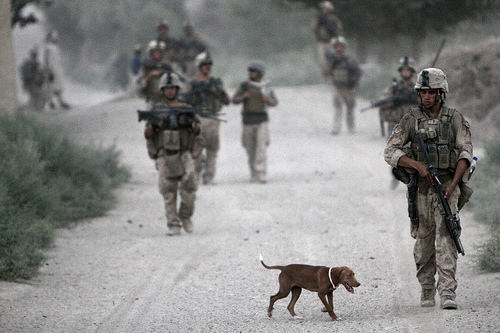
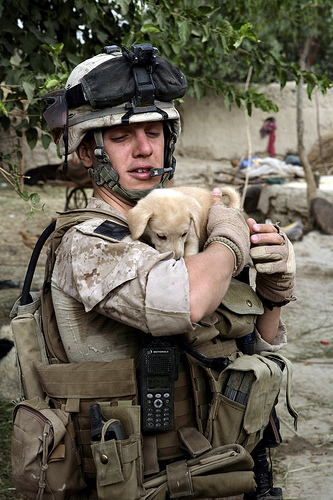
Corporal William Ash, a squad leader from 1st Platoon, Bravo Company, Battalion Landing Team 1st Battalion, 6th Marine Regiment, 24th Marine Expeditionary Unit, NATO International Security Assistance Force (ISAF), along with a stray dog lead a patrol through a city in Helmand Province, Afghanistan. When the platoon moved into the area, they found two stray dogs, and each time the Marines head out on patrol the dogs are right at the Marines’ side.

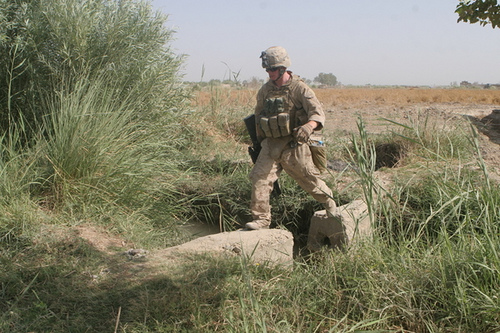
Marine from the 24th MEU in the Helmand Province, Afghanistan.

Marine with dog.


26th MEU (10)
Abu Muqawama (12)
ACOG (2)
ACOGs (1)
Afghan National Army (36)
Afghan National Police (17)
Afghanistan (704)
Afghanistan SOFA (4)
Agriculture in COIN (3)
AGW (1)
Air Force (41)
Air Power (10)
al Qaeda (83)
Ali al-Sistani (1)
America (22)
Ammunition (304)
Animals (323)
Ansar al Sunna (15)
Anthropology (3)
Antonin Scalia (1)
AR-15s (393)
Arghandab River Valley (1)
Arlington Cemetery (2)
Army (91)
Assassinations (2)
Assault Weapon Ban (29)
Australian Army (7)
Azerbaijan (4)
Backpacking (4)
Badr Organization (8)
Baitullah Mehsud (21)
Basra (17)
BATFE (246)
Battle of Bari Alai (2)
Battle of Wanat (18)
Battle Space Weight (3)
Bin Laden (7)
Blogroll (3)
Blogs (24)
Body Armor (23)
Books (3)
Border War (18)
Brady Campaign (1)
Britain (39)
British Army (36)
Camping (5)
Canada (19)
Castle Doctrine (1)
Caucasus (6)
CENTCOM (7)
Center For a New American Security (8)
Charity (3)
China (19)
Christmas (18)
CIA (30)
Civilian National Security Force (3)
Col. Gian Gentile (9)
Combat Outposts (3)
Combat Video (2)
Concerned Citizens (6)
Constabulary Actions (3)
Coolness Factor (3)
COP Keating (4)
Corruption in COIN (4)
Council on Foreign Relations (1)
Counterinsurgency (218)
DADT (2)
David Rohde (1)
Defense Contractors (2)
Department of Defense (220)
Department of Homeland Security (26)
Disaster Preparedness (5)
Distributed Operations (5)
Dogs (15)
Donald Trump (27)
Drone Campaign (4)
EFV (3)
Egypt (12)
El Salvador (1)
Embassy Security (1)
Enemy Spotters (1)
Expeditionary Warfare (18)
F-22 (2)
F-35 (1)
Fallujah (17)
Far East (3)
Fathers and Sons (2)
Favorite (1)
Fazlullah (3)
FBI (39)
Featured (192)
Federal Firearms Laws (18)
Financing the Taliban (2)
Firearms (1,867)
Football (1)
Force Projection (35)
Force Protection (4)
Force Transformation (1)
Foreign Policy (27)
Fukushima Reactor Accident (6)
Ganjgal (1)
Garmsir (1)
general (15)
General Amos (1)
General James Mattis (1)
General McChrystal (44)
General McKiernan (6)
General Rodriguez (3)
General Suleimani (9)
Georgia (19)
GITMO (2)
Google (1)
Gulbuddin Hekmatyar (1)
Gun Control (1,717)
Guns (2,406)
Guns In National Parks (3)
Haditha Roundup (10)
Haiti (2)
HAMAS (7)
Haqqani Network (9)
Hate Mail (8)
Hekmatyar (1)
Heroism (5)
Hezbollah (12)
High Capacity Magazines (16)
High Value Targets (9)
Homecoming (1)
Homeland Security (3)
Horses (2)
Humor (72)
Hunting (61)
ICOS (1)
IEDs (7)
Immigration (123)
India (10)
Infantry (4)
Information Warfare (4)
Infrastructure (4)
Intelligence (23)
Intelligence Bulletin (6)
Iran (171)
Iraq (379)
Iraq SOFA (23)
Islamic Facism (64)
Islamists (98)
Israel (19)
Jaish al Mahdi (21)
Jalalabad (1)
Japan (3)
Jihadists (82)
John Nagl (5)
Joint Intelligence Centers (1)
JRTN (1)
Kabul (1)
Kajaki Dam (1)
Kamdesh (9)
Kandahar (12)
Karachi (7)
Kashmir (2)
Khost Province (1)
Khyber (11)
Knife Blogging (7)
Korea (4)
Korengal Valley (3)
Kunar Province (20)
Kurdistan (3)
Language in COIN (5)
Language in Statecraft (1)
Language Interpreters (2)
Lashkar-e-Taiba (2)
Law Enforcement (6)
Lawfare (14)
Leadership (6)
Lebanon (6)
Leon Panetta (2)
Let Them Fight (2)
Libya (14)
Lines of Effort (3)
Littoral Combat (8)
Logistics (50)
Long Guns (1)
Lt. Col. Allen West (2)
Marine Corps (281)
Marines in Bakwa (1)
Marines in Helmand (67)
Marjah (4)
MEDEVAC (2)
Media (68)
Medical (146)
Memorial Day (6)
Mexican Cartels (47)
Mexico (71)
Michael Yon (6)
Micromanaging the Military (7)
Middle East (1)
Military Blogging (26)
Military Contractors (5)
Military Equipment (25)
Militia (9)
Mitt Romney (3)
Monetary Policy (1)
Moqtada al Sadr (2)
Mosul (4)
Mountains (25)
MRAPs (1)
Mullah Baradar (1)
Mullah Fazlullah (1)
Mullah Omar (3)
Musa Qala (4)
Music (25)
Muslim Brotherhood (6)
Nation Building (2)
National Internet IDs (1)
National Rifle Association (97)
NATO (15)
Navy (31)
Navy Corpsman (1)
NCOs (3)
News (1)
NGOs (3)
Nicholas Schmidle (2)
Now Zad (19)
NSA (3)
NSA James L. Jones (6)
Nuclear (63)
Nuristan (8)
Obama Administration (222)
Offshore Balancing (1)
Operation Alljah (7)
Operation Khanjar (14)
Ossetia (7)
Pakistan (165)
Paktya Province (1)
Palestine (5)
Patriotism (7)
Patrolling (1)
Pech River Valley (11)
Personal (76)
Petraeus (14)
Pictures (1)
Piracy (13)
Pistol (4)
Pizzagate (21)
Police (672)
Police in COIN (3)
Policy (15)
Politics (998)
Poppy (2)
PPEs (1)
Prisons in Counterinsurgency (12)
Project Gunrunner (20)
PRTs (1)
Qatar (1)
Quadrennial Defense Review (2)
Quds Force (13)
Quetta Shura (1)
RAND (3)
Recommended Reading (14)
Refueling Tanker (1)
Religion (499)
Religion and Insurgency (19)
Reuters (1)
Rick Perry (4)
Rifles (1)
Roads (4)
Rolling Stone (1)
Ron Paul (1)
ROTC (1)
Rules of Engagement (75)
Rumsfeld (1)
Russia (37)
Sabbatical (1)
Sangin (1)
Saqlawiyah (1)
Satellite Patrols (2)
Saudi Arabia (4)
Scenes from Iraq (1)
Second Amendment (708)
Second Amendment Quick Hits (2)
Secretary Gates (9)
Sharia Law (3)
Shura Ittehad-ul-Mujahiden (1)
SIIC (2)
Sirajuddin Haqqani (1)
Small Wars (72)
Snipers (9)
Sniveling Lackeys (2)
Soft Power (4)
Somalia (8)
Sons of Afghanistan (1)
Sons of Iraq (2)
Special Forces (28)
Squad Rushes (1)
State Department (23)
Statistics (1)
Sunni Insurgency (10)
Support to Infantry Ratio (1)
Supreme Court (79)
Survival (214)
SWAT Raids (58)
Syria (38)
Tactical Drills (38)
Tactical Gear (17)
Taliban (168)
Taliban Massing of Forces (4)
Tarmiyah (1)
TBI (1)
Technology (21)
Tehrik-i-Taliban (78)
Terrain in Combat (1)
Terrorism (96)
Thanksgiving (13)
The Anbar Narrative (23)
The Art of War (5)
The Fallen (1)
The Long War (20)
The Surge (3)
The Wounded (13)
Thomas Barnett (1)
Transnational Insurgencies (5)
Tribes (5)
TSA (25)
TSA Ineptitude (14)
TTPs (4)
U.S. Border Patrol (8)
U.S. Border Security (22)
U.S. Sovereignty (29)
UAVs (2)
UBL (4)
Ukraine (10)
Uncategorized (105)
Universal Background Check (3)
Unrestricted Warfare (4)
USS Iwo Jima (2)
USS San Antonio (1)
Uzbekistan (1)
V-22 Osprey (4)
Veterans (3)
Vietnam (1)
War & Warfare (432)
War & Warfare (41)
War Movies (4)
War Reporting (21)
Wardak Province (1)
Warriors (6)
Waziristan (1)
Weapons and Tactics (80)
West Point (1)
Winter Operations (1)
Women in Combat (21)
WTF? (1)
Yemen (1)

February 2026
January 2026
December 2025
November 2025
October 2025
September 2025
August 2025
July 2025
June 2025
May 2025
April 2025
March 2025
February 2025
January 2025
December 2024
November 2024
October 2024
September 2024
August 2024
July 2024
June 2024
May 2024
April 2024
March 2024
February 2024
January 2024
December 2023
November 2023
October 2023
September 2023
August 2023
July 2023
June 2023
May 2023
April 2023
March 2023
February 2023
January 2023
December 2022
November 2022
October 2022
September 2022
August 2022
July 2022
June 2022
May 2022
April 2022
March 2022
February 2022
January 2022
December 2021
November 2021
October 2021
September 2021
August 2021
July 2021
June 2021
May 2021
April 2021
March 2021
February 2021
January 2021
December 2020
November 2020
October 2020
September 2020
August 2020
July 2020
June 2020
May 2020
April 2020
March 2020
February 2020
January 2020
December 2019
November 2019
October 2019
September 2019
August 2019
July 2019
June 2019
May 2019
April 2019
March 2019
February 2019
January 2019
December 2018
November 2018
October 2018
September 2018
August 2018
July 2018
June 2018
May 2018
April 2018
March 2018
February 2018
January 2018
December 2017
November 2017
October 2017
September 2017
August 2017
July 2017
June 2017
May 2017
April 2017
March 2017
February 2017
January 2017
December 2016
November 2016
October 2016
September 2016
August 2016
July 2016
June 2016
May 2016
April 2016
March 2016
February 2016
January 2016
December 2015
November 2015
October 2015
September 2015
August 2015
July 2015
June 2015
May 2015
April 2015
March 2015
February 2015
January 2015
December 2014
November 2014
October 2014
September 2014
August 2014
July 2014
June 2014
May 2014
April 2014
March 2014
February 2014
January 2014
December 2013
November 2013
October 2013
September 2013
August 2013
July 2013
June 2013
May 2013
April 2013
March 2013
February 2013
January 2013
December 2012
November 2012
October 2012
September 2012
August 2012
July 2012
June 2012
May 2012
April 2012
March 2012
February 2012
January 2012
December 2011
November 2011
October 2011
September 2011
August 2011
July 2011
June 2011
May 2011
April 2011
March 2011
February 2011
January 2011
December 2010
November 2010
October 2010
September 2010
August 2010
July 2010
June 2010
May 2010
April 2010
March 2010
February 2010
January 2010
December 2009
November 2009
October 2009
September 2009
August 2009
July 2009
June 2009
May 2009
April 2009
March 2009
February 2009
January 2009
December 2008
November 2008
October 2008
September 2008
August 2008
July 2008
June 2008
May 2008
April 2008
March 2008
February 2008
January 2008
December 2007
November 2007
October 2007
September 2007
August 2007
July 2007
June 2007
May 2007
April 2007
March 2007
February 2007
January 2007
December 2006
November 2006
October 2006
September 2006
August 2006
July 2006
June 2006
May 2006

about · archives · contact · register

Copyright © 2006-2026 Captain's Journal. All rights reserved.