Articles by Herschel Smith


The “Captain” is Herschel Smith, who hails from Charlotte, NC. Smith offers news and commentary on warfare, policy and counterterrorism.


Interpreters, Language and Counterinsurgency

17 years, 3 months ago

For a smart analysis of what knowledge of the indigenous language can do for you in counterinsurgency, see our previous article The Enemy of My Enemy. We have long been a proponent of more and better language training for both enlisted men and officers preparing to deploy to Iraq. But we still badly need good interpreters, and yet stupid decisions will soon undermine the interpreter program in Iraq.

The U.S. military has barred Iraqi interpreters working with American troops in Baghdad from wearing ski masks to disguise themselves, prompting some to resign and others to bare their faces even though they fear it could get them killed.

Many interpreters employed by the U.S. government and Western companies do everything they can to avoid being recognized on the job because extremists have tortured and killed Iraqis accused of collaborating with the enemy.

“The terps are the No. 1 wanted here,” said A.J., a 36-year-old military interpreter, using the shorthand for his profession. “More than the Americans. More than anyone.”

The interpreters have come to symbolize the bravery of Iraqis who have aided the American project in Iraq. About 300 U.S. military interpreters have been killed since 2003, according to Kirk Johnson, a former official in Iraq with the U.S. Agency for International Development who has fought to make it easier for interpreters and other Iraqis to come to the U.S.

U.S. military officials said they began to enforce the mask ban in September because security in Baghdad has improved dramatically.

“We are a professional Army, and professional units don’t conceal their identity by wearing masks,” Lt. Col. Steve Stover, a U.S. military spokesman.

Some U.S. soldiers said enforcing the policy makes them feel terrible.

“It’s a life-and-death issue for them,” said Staff Sgt. Jeremy Ziegler, who works in Dora, a district in southern Baghdad.

“We can’t work for the U.S. Army if we don’t wear a mask,” said Maximus, 28, who has worked as an interpreter for the military on and off since 2003. “If they recognize our face, they’re going to kill our families.”

“Maximus” is not exaggerating. Consider the 2007 example of an interpreter for the British Army in Basra.

A man said to have been an interpreter for the British Army in Basra has been killed by militia gunmen on the very day that his wife learnt she was pregnant with their first child.

Nine or ten masked men went to the home of Moayed Ahmed Khalaf in the al-Hayaniah district of Basra and beat him in front of his wife and mother, four sources told The Times. They then dragged him away, telling the frantic women that they would bring him back shortly. Khalaf’s body was found on Al Qa’ed Street later that night. He had been shot multiple times, according to Colonel Ali Manshed, commander of the Shatt-al-Arab police station.

A cousin, a close friend and two other interpreters all told The Times that Khalaf, 31, had worked for the British at their Basra airport base. Colonel Manshed said that everyone questioned by the police had said Khalaf was an interpreter, adding: “He was a good man, everyone liked him and there was no other reason to kill him.”

The best way to use the desire to have interpreters who don’t hide their identity is to use masks as metrics as was done in Fallujah in 2007. The more interpreters feel the need to wear masks, the more work needs to be done in order to ensure security. The less interpreters wear masks, the greater indication that is of success. In Fallujah it was the Iraqi Police who wore masks – in this case, it’s the interpreters.

But this brings up another point. None of them (IP or interpreters) are uniformed U.S. Army or Marines. Said Lt. Col. Stover, “We are a professional Army, and professional units don’t conceal their identity by wearing masks.” Odd statement, this. The Army and Marines don’t conceal their identity, so what is Col. Stover talking about? Again, the IP and interpreters aren’t our Army. Why wouldn’t we understand and be sensitive to cultural and local issues such as the need for security and protection of identity? At some point this becomes more than just stupid. It’s immoral to force interpreters to risk their family’s safety unnecessarily.

Also, Lt. Col. Stover isn’t quite right concerning the notion of U.S. forces not concealing their identity. It is customary and routine for Special Operations Forces not only to wear garb that conceals their identity, but also to issue pro forma declarations about everything related to their operations being OPSEC (Operational Security). This is certainly an overreaction, but true nonetheless. We are affording our own forces protections that we won’t allow our contracted interpreters.

How Many Troops Can We Logistically Support in Afghanistan?

17 years, 3 months ago

Glenn Reynolds links the Small Wars Journal on a potential surge in Afghanistan, and Michael Yon weighed in saying that in his opinion the proposed 25-40K troops won’t be enough.  Then Glenn asks a salient and insightful question: How many troops can we support, logistically, in Afghanistan?  Glenn has been carefully examining the reports.

The Captain’s Journal has a right to weigh in on this subject because first of all, we have been advocating a surge for Afghanistan for at least one year, manned partly by an expeditious withdrawal of Marines from the Anbar Province as recommended by Commandant Conway (we are, after all, a Marine blog).  Second, we make very few forecasts,  but when we do, we have good track record of accuracy.  When Army intelligence was claiming that there wouldn’t be a spring offensive in Afghanistan, we said that there would be a two-front Taliban offensive, one by the Tehrik-i-Taliban in Pakistan and the other in Afghanistan by the followers of Mullah Omar.

We also described the strategy of interdiction of NATO supplies into Afghanistan many months before it began to occur.  Afghanistan is land-locked, and transportation of supplies and ordnance to U.S. and NATO troops occurs basically in three ways.  Ten percent comes into Afghanistan via air supply.  The other ninety percent comes in through the port city of Karachi, of which the vast majority goes to the Torkham Crossing (and then to Kabul) via the Khyber pass, with some minor portion going to Kandahar through Chaman.

This interdiction of supply routes by the Taliban is an integral part of their offensive.  The Taliban have been successful in stopping and confiscating some of the supplies, and Pakistan officials have temporarily stopped transit of sealed containers through Khyber.

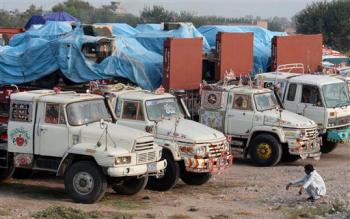
A Pakistani driver sits beside parked trucks loaded with supplies for American and NATO forces, Sunday, Nov. 16, 2008 in Peshawar, Pakistan. Pakistan has temporarily suspended oil tankers and trucks carrying sealed containers from using a key passage to Afghanistan, an official said Sunday, a move that will likely impact supplies heading to U.S. and NATO troops. (AP Photo/Muhammad Iqbal)

So returning to the question of logistical support of U.S. troops, there has been an impact from insecurity thus far, and assuming a closing of the transit routes by Taliban fighters, no logistics would be sustainable.  But ironically, an increase in force projection in Afghanistan will bring its own logistical rewards and unintended [good] consequences.

We tend to see the struggle through Western eyes, and where we see territorial borders, the Taliban and al Qaeda see nothing.  It is we who see the phantom, not the Taliban.  The enemy is a transnational insurgency and knows no borders, and operations against them in Afghanistan will cause pressure in Pakistan as well.  Fighters from Pakistan have been sent to assist fighters in Afghanistan on a regular basis, and Baitullah Mehsud has made it one of his duties to support the anti-government efforts in Afghanistan.  Logistics and the degree to which supply routes remain operational will be a function of pressure on the Taliban, and the coupling of these two variables is inversely related.

Does this analysis not sound convincing because it is open source and proferred by a non-professional?  Very well.  Listen to a jihadi say it: “If NATO remains strong in Afghanistan, it will put pressure on Pakistan. If NATO remains weaker in Afghanistan, it will dare [encourage] Pakistan to support the Taliban, its only real allies in the region.”

While analysis at The Captain’s Journal relies mainly upon open source information from jihadist web sites, Pakistani, Afghan and other news sources, 95% of which can be Taliban propaganda on any given day, we were right on the danger in Khyber based on these sources, as well as the fact that there would be a two-front spring offensive.  The trick is to know when it’s propaganda and when it’s not.

The U.S. should continue to work on alternative means of supply, as well as pressure the Pakistan Army to continue operations against the Tehrik-i-Taliban in Khyber and in and around Peshawar.  But the surest way to put pressure on the Taliban is to conduct kinetic operations against them in Afghanistan.  Pressure on the Taliban anywhere will redound to open supply routes.

UPDATE: Welcome to Instapundit readers, and thanks to Glenn for the interest.

Cryin’ Cause the Story’s Sad

17 years, 3 months ago

The L.A. Times looks at women in combat, and while the whole article is worth reading, here is one quote that waxed interesting.

“I felt like the Gestapo,” she said. “All I could think of was ‘What would I feel like if somebody did this to me?’ “

Regular readers know our position on women in combat. Women in the military is one thing, but women in combat is quite another. Russia had women in the infantry during its war with Afghanistan, and found that women suffered a disproportionately high number of lower extremity injuries and men did foolish things attempting to pair up with and take care of women. There is the thing of testosterone, and it’s different because God made it that way. The PT requirements are different between male and female Marines because they have to be, and the Marines don’t allow women in infantry.

The day that the Marines have women in the infantry will be the day that the U.S. Marines as we know it ceases to exist. OF course, all of this is controversial, and it could be that The Captain’s Journal has made a number of women mad over this post. As for kicking in doors in counterinsurgency, to be sure, one has to know when to show respect for a sheikh and when to treat him like the rest of the population – when to bust in doors, and when to sit and watch ball games on TV. It should all redound to winning the counterinsurgency campaign, and whatever is deemed appropriate at the time should be done.

As for the woman who couldn’t stop feeling like the Gestapo, the immediate reaction here at TCJ comes from a tune by Joe Walsh, and the line is “and we don’t need the ladies cryin’ cause the story’s sad.”

For the women reading this post, just relax with some weekend music instead of being angry with us.

The Afghanistan Kajaki Dam and Hydroelectric Plant

17 years, 3 months ago

Our friend Joshua Foust at Registan asks some salient questions concerning the Kajaki dam.

Remember that time Michael Yon bravely reported the “top secret” mission to refurbish the Kajaki hydro plant? The same top secret mission ISAF bragged about in a press release on the very same day? It seemed like a wonderful thing, a stunning blow both to the Taliban in Helmand (who couldn’t stop its transportation and installation), and to the naysayers who are convinced there is no hope for the country.

Yes, we sure do. In fact, The Captain’s Journal recalls a week before Yon wrote about the dam project when we authored:

The British Approach to Counterinsurgency, and

Defense Analysts Echo The Captain’s Journal Concerning Kajaki Dam

And what The Captain’s Journal said was important and prescient. But first, back to Joshua’s questions. He cites a recent New York Times article that updates the situation around the dam project.

It has been a rare instance of a fulfilled promise in the effort to build up Afghanistan’s infrastructure. But even with the step forward, the improvements to the dam, in an inaccessible area of northern Helmand Province, are still being held hostage by the Taliban’s growing ability to mount offensives in recent years. The overall power project has been repeatedly delayed because of the difficulty of security and logistics. And the rest of the original $500 million proposal to augment the capacity of the dam itself has not been approved, cast in doubt by the Taliban’s gains.

“In the case of the Kajaki Dam or others, the security situation impedes the delivery of the service,” the American ambassador to Afghanistan, William B. Wood, told reporters in Washington in June. “The reason that there isn’t more light at night and more warmth in winter for south Afghanistan is because the Taliban has not let us do everything, work as effectively as we’d like to on the Kajaki Dam.” …

The huge operation was criticized in the British news media, which questioned the exposure of British soldiers to such high risk to save an American government assistance project.

Yet for the Afghans employed here, and the frustrated residents of cities like Kandahar, who have lived with barely a few hours of electricity a day for the past seven years, NATO was belatedly meeting its commitment to bring development to southern Afghanistan…

Mr. Rasoul is now in charge of the next stage, with an American engineer, George H. Wilder, 62, who works for the American contractors in charge of the project, the Louis Berger Group. They work and live in a small construction camp next to the dam, protected by a battalion of British and Afghan soldiers who keep the Taliban, who hold the surrounding villages, at bay. Everything the workers and soldiers need comes by helicopters that fly high over the brown, barren mountains and then spiral down over the green-blue reservoir into the camp to avoid enemy fire.

Josh asks the following question:

This remains remarkable: a Berlin Airlift for southern Afghanistan, if you will. But the fundamental objection to it remains: is it smart to build an expensive, borderline indefensible power station when you cannot provide basic security and services to the nearby villagers? This turbine camp represents, along with all the hope and sunshine, an enormous, juicy target for militants or drug lords seeking a way to poison the entire southern effort. While it’s nice that the camp “rarely comes under [direct] fire anymore” thanks to some impressive soldiering by the British, how long will those gains stay in play once the turbine is installed and the power substations set up? Will an entire battalion be required to defend each? … Am I alone in thinking we could be spending our time, money, resources, and (most importantly) manpower in a much better way?

One commenter to Joshua’s post appears to be on drugs, when he dreams a psychedelic vision wherein Obama talks the Taliban into siding with the U.S. and guarding the dam as if they were productive members of society. But inebriated commenters notwithstanding, The Captain’s Journal pointed out in the above two links one week before Michael Yon covered this affair (and it was a brave operation indeed by British forces) that similar to the irrigation canal that was blocked by al Qaeda in Iraq by merely shoveling dirt into it, and the electricity supplies that were terminated by simply destroying the local electrical grid, the Taliban don’t have to destroy the dam or the generators. All they have to do is kill the operators or destroy the electrical grid by cutting transmission lines or blowing up towers.

It’s easy, unfortunately, and it ruins the hard fought reconstructions efforts. We also said:

The point is that in order for infrastructure to work, the enemies of that infrastructure must be targeted. The dam won’t long operate if its operators are all killed, or if other replacement parts have to undergo such intensive operations in order to be deployed at the plant. Infrastructure is good, as is good governance. But for these softer tactics in counterinsurgency to be successful, the Taliban must be engaged and killed. The softer side of counterinsurgency might win a lasting peace, but cannot win kinetic operations.

We’ve got the order wrong. We’re attempting to do reconstruction before ensuring security; similarly, efforts to rebuild Highway 1 from Kabul to Kandahar are failing due to the holes in the tarmac caused by unmolested Taliban.

The Captain’s Journal is sorry to be the bearer of bad news, but there is no magic, there are no buttons to push, no deep Gnostic incantations to utter. Security must be provided to the population in order to win counterinsurgencies, and this means killing the hard core Taliban. There are believed to be on the order of 20,000 of them in the Helmand Province alone.

The Role of the Pakistan and Afghanistan Police in Counterinsurgency

17 years, 3 months ago

Major Cliff Gilmore, USMC, currently in Fundahar working with the Afghan police, sends this anecdotal account of the state of affairs inside the Afghan police.

One young Afghan policeman told me several weeks ago that until he attended the newly established police training course he didn’t really understand what a “police officer” is. In his experience police were just local thugs armed with rifles provided by the local tribal leader who set up check points along the road to collect tolls for profit. The concept of police who exist to “protect and serve” appealed strongly to him, helps keep my personal hope alive and builds my confidence that we are making steady progress toward the goal of building a principled police force that is trusted by the community and committed to defending it.

With a reputation for thuggery and corruption like this, it’ll be a long time before our counterinsurgency efforts will be able to rely on faithful assistance from the Afghan political or security infrastructure. The Afghan army isn’t much better, and it should be noted that in our recent Analysis of the Battle of Wanat we didn’t mention that the run up to the battle found the Afghan army holding meetings with the local population while deliberately neglecting to include the U.S., and collusion between the local police chief and the Taliban who would eventually attack Vehicle Patrol Base Wanat.

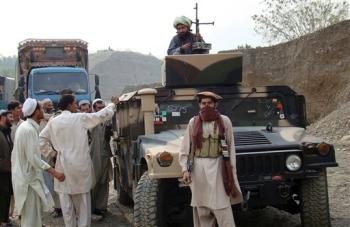
Pakistan doesn’t fare much better. Just a few days ago U.S. cargo was interdicted in the Khyber pass by Baitullah Mehsud’s Terik-i-Taliban, and several HMMWVs were taken and driven around with Taliban banners. Take careful note of one picture of the Taliban with a HMMWV.

Photograph by AP

No one is on the phone to Police informing them of the Taliban with a stolen U.S. HMMWV. It appears to be quite the party at the roadside of this village.  In fact, in the North West Frontier Province as many as 400 police officers have resigned in fear for their lives.

Ismaeel Khan is one of hundreds of cops in the restive valley of Swat who have recently resigned after being threatened by Taliban militants to either quit or face “dire consequences.”

“Around 400 cops, including myself, have resigned from our posts as we all still want to live,” Khan, 42, a head constable in Swat police, told IslamOnline.net.

Militants of the pro-Taliban Tehrik Nifaz Shariat-e-Muhammadi (TSNM) of Maulvi Fazlullah issued a warning to local policemen last month to resign from their posts.

“We don’t want to fight you (local policemen) as you are our own people,” read one of several pamphlets circulated by TSNM militants.

“Therefore, it is in your better interest to either leave your jobs or get ready for dire consequences.”

The pamphlets advised local policemen to advertise their names in local newspapers if they quit their jobs.

Khan, like many colleagues, was initially defiant to cow to the threats but continuing ambushes targeting military and police convoys changed his mind.

“I consulted with my other friends, who all were of the same opinion that we should quit our jobs to save our lives.”

They published a joint advertisement in a local newspaper informing the Taliban militants that they have quit the police force.

A senior police officer of the North Western Frontier Province (NWFP), which borders Afghanistan, confirmed the resignation of around 350 local policemen.

“Yes, ads regarding their resignations from the police force are being published in local newspapers in order to save themselves and their families from Taliban,” he told IOL requesting anonymity.

“We cannot stop them. We are fully aware of their position. They are locals and they have to live there.”

Khan, the head constable in Swat police, believed he had no other option but comply to the militants’ demand.

“It was my job. I had been earning livelihood for my family, but I realized that there was no other option left for me because of the complete insecurity,” he told IOL.

“Even army troops who live in heavily cordoned off places are not safe, let alone us (policemen) who are locals and an easy target.”

Some 102 policemen have been killed in the past 10 months in militant attacks in Swat and neighboring areas.

It’s indications such as this that tell us why General Petraeus said that he was taking on what would be the longest campaign of the “Long War.” Given the importance of working with local police in counterinsurgency, let’s hope and pray that Major Cliff Gilmore and warriors like him are successful with the budding young police candidates who actually wish to make a difference.

Interdiction of U.S. Supplies in Khyber Pass

17 years, 3 months ago

The Captain’s Journal has been very specific, detailed and insistent in our coverage and analysis of the Khyber pass and Torkham Crossing and the need to maintain lines of supply from the port city of Karachi through to Afghanistan. See:

Targeting of NATO Supply Lines Through Pakistan Expands

Taliban and al Qaeda Strategy in Pakistan and Afghanistan

Khyber Pass (category)

Torkham Crossing (category)

The situation is devolving into one of complete control by the Taliban in the Khyber region, and a recent hijacking of supply trucks has been carried out by Baitullah Mehsud’s forces.

Militants in northwest Pakistan hijacked 13 trucks carrying supplies for Western forces in Afghanistan on Monday as they passed through the Khyber Pass, a government official said.

Most supplies, including fuel, for U.S. and other Western forces battling a Taliban insurgency in landlocked Afghanistan are trucked through neighboring Pakistan, which is also facing growing militant violence.

Security along the road leading to the border has deteriorated this year and soldiers carried out a sweep in part of the Khyber region in June to push militants back from the outskirts of Peshawar, the main city in the northwest.

The trucks were seized at four places along a 35 km (20 mile) stretch of the road, said a senior government administrator in the Khyber region.

“About 60 masked gunmen popped up on the road and took away the trucks with their drivers. Not a single shot was fired anywhere,” the official, Bakhtiar Mohmand, told Reuters.

Mohmand said the trucks were not carrying weapons or ammunition but he was not sure what goods they were taking.

He said he believed militants loyal to Pashtun Taliban commander Baitullah Mehsud were responsible.

“Baitullah’s men are behind this as they’re very well-equiped and trained,” he said.

But it’s really worse than this report indicates. The Taliban are driving around in stolen HMMWVs.

Taliban militants were driving around in captured US army Humvee armoured vehicles in Pakistan’s tribal region close to the historic Khyber Pass last night after hijacking more than a dozen supply trucks travelling along the vital land route that supplies coalition forces in Afghanistan.

The capture of the Humvees – these days the symbol of US intervention in Iraq and elsewhere – is a serious embarrassment to US commanders of the coalition forces.

Pakistani reporters in the area said the militants unloaded the Humvees from shipping containers on the backs of the trucks and drove off in them, after decorating them with flags and banners of the banned umbrella organisation Tehrik-i-Taliban Pakistan, which is led by Baitullah Mehsud. Mehsud is closely allied to Osama bin Laden and the Taliban leader Mullah Omar.

The reporters said the hijackings had taken place “in clear view of (Pakistani) paramilitary personnel” deployed at the nearby Jamrud Fort, who “did not take any action”.

“All this happened on the international highway (linking Pakistan with Afghanistan) and you can imagine the implications this can have for us,” an official told Pakistan newspaper Dawn.

Indeed. If there was any additional indication needed as to the capabilities and intent of the Pakistani forces, this should be sufficient. The Pakistani military took no action, and likely will not in the future.

Obama to Talk to Iran About Afghanistan

17 years, 3 months ago

Oh boy. Here we go.

The incoming Obama administration plans to explore a more regional strategy to the war in Afghanistan — including possible talks with Iran — and looks favorably on the nascent dialogue between the Afghan government and “reconcilable” elements of the Taliban, according to Obama national security advisers.

It’s as if the radical Mullahs haven’t sent their Quds force to instigate unrest and insecurity in Iraq, kill Americans, and ship EFPs and other weapons to both Iraq and Afghanistan (to the Taliban). It’s as if Iran is not the main entry point for enemy fighters into Afghanistan. It’s as if the Iranians aren’t furious over the proposed Status of Forces Agreement with Iraq. It’s as if Iran isn’t occupying Lebanon through Hezbollah. Yes, it’s as if the radical Mullahs in Iran have our best interests at heart.

What exactly does Obama expect Iran to do for us? Stop the shipment of weapons and fighters? Agree to the SOFA with Iraq? Pull out of Lebanon? Send peacekeeping troops to fight the Taliban side by side with U.S. troops? Send money to finance the U.S. war effort?

My God. The juveniles are now in charge.

Analysis of the Battle of Wanat

17 years, 3 months ago

Stars and Stripes summarizes the investigation into the battle of Wanat, and links a redacted version of the report: “AR 15-6 Investigation Findings and Recommendations – Vehicle Patrol Base (VPB) Wanat Complex Attack and Casualties,13 July 2008,” Part 1 and Part 2.

The AR 15-6 provides a fairly detailed analysis and event time line of the battle, and we learn quite a bit about the things that led up to the battle and the ensuing casualties. The report necessarily ends with findings and opinion concerning force protection among other things, and several observations of the battle and subject report are warranted.

The Waygul Valley and in particular the location of the Wanat VPB is in steep, rugged terrain, and location of any sort of combat outpost (or VPB) was risky from the standpoint of force protection, but the decision had been made approximately one year earlier to move COP (Combat Outpost) Bella to VPB Wanat due to the fertile human terrain for counterinsurgency.

The meetings with tribal and governmental officials to procure territory for VPB Wanat went on for about one year, and one elder privately said to U.S. Army officers that given the inherent appearance of tribal agreement with the outpost, it would be best if the Army simply constructed the base without interaction with the tribes. As it turns out, the protracted negotiations allowed AAF (anti-Afghan forces, in this case an acronym for Taliban, including some Tehrik-i-Taliban) to plan and stage a complex attack well in advance of turning the first shovel full of sand to fill HESCO barriers.

VPB Wanat did indeed have concertina wire, HESCO barriers and other means of force protection, but in every direction the base was on the low ground. One particularly fateful decision was the construction and garrisoning of Observation Post “Top Side,” which sat on slightly higher ground to the East of VPB Wanat.

Just before the battle began on July 12, 2008, troops from VPB Wanat observed men they believed to be enemy combatants positioning and preparing for battle, but consistent with a theme here at The Captain’s Journal, decision-making is not given latitude in these circumstances (e.g., no PID, not actively engaged in hostilities against U.S. troops at the time, or whatever the case – this portion of the report is redacted. See TCJ coverage of Rules of Engagement).

At 2350, AAF initiated a large scale attack on VPB Wanat and OP Top Side. The enemy numbering several hundred were located at the perimeter of the VPB and in surrounding buildings and from hillsides at elevated positions compared to VPB Wanat. The enemy engaged primarily with automatic weapons and RPGs.

OP Top Side was also under heavy attack by the enemy. In fact, of the 36 casualties suffered in this battle (nine dead, 27 wounded), nine were sustained in the first fifteen to twenty minutes of the attack, specifically at OP Top Side. The enemy were close enough to engage OP Top Side by throwing grenades and shooting automatic rifles from no more than twenty meters.

In response to calls for help, three waves were sent to reinforce OP Top Side. Of the first wave, two more U.S. soldiers died while attempting to set up a machine gun position. The second wave of reinforcements saw the twelfth, thirteenth, fourteenth and fifteenth U.S. casualties. Of these fifteen casualties, eight perished attempting to defend OP Top Side (out a total of nine dead in the totality of the battle of Wanat that night).

There were between 21 and 52 AAF killed and 45 wounded. Considering a clinical assessment of kill ratio can be a pointer to the level of risk associated with this VPB and OP. 21/9 = 2.33, 52/9 = 5.77 (2.33 – 5.77), and 45/27 = 1.67. These are very low compared to historical data (on the order of 10:1).

One bright spot in the battle concerns air support. Close Air Support (CAS) was initiated within 27 minutes of start of the battle, and Close Combat Aviation (CCA) was initiated within 62 minutes of start of the battle. Aircraft supporting U.S. troops includes B-1 bombers, F-15s, A-10s and AH-64 Apache Attack Helicopters. Multiple “gun runs” were conducted “danger close” to U.S. troops.

One key breakdown in force protection pertained to intelligence. Multiple villagers, including tribal elders, had told multiple U.S. troops that an attack on VPB Wanat was imminent, but the assumption that such an attack would be probative caused little concern among the leadership. But the enlisted ranks included men who knew what was coming. Cpl. Gunnar Zwilling suspected that his days were numbered, while he and his band of brothers in the 173rd Airborne Brigade Combat Team prepared for a mission near Wanat, Afghanistan. “It’s gonna be a bloodbath,” he told his father, Kurt Zwilling, on the phone in what would be their last conversation.

In fact, there had been daily reports of 200-300 fighters massing to attack COP Bella in the first 10 days of July before transfer of operations to VPB Wanat, and while U.S. forces anticipated a transfer of enemy activity to Wanat, they didn’t anticipate such heavy conventional operations. The AAF fielded a company-sized force to attack OP Top Side and VPB Wanat.

While we witnessed the adolescent fawning over Nir Rosen’s embedding with the Taliban (to which The Captain’s Journal was unimpressed and claimed that all of the information was already known without his having whored himself to the enemy), the real question is not why we haven’t listened to Nir Rosen. Rosen is irrelevant. The question is why U.S. intelligence would ignore reports directly from tribal elders in the town in which they wish to conduct COIN, thus losing nine sons of America.

There is also the issue of OP Top Side and whether such an Observation Post should have been garrisoned with so little force protection and such proximity and elevational vulnerabilities. Again, eight of the nine U.S. troops who perished that fateful night did so as a result of OP Top Side.

More broadly, the implementation of combat outposts (or VPB, or OP) should consider the modern day origins of such practice, i.e., the Marines in Anbar. COPs were “hopscotched” across Ramadi and other cities in Anbar (combined COP and police precincts in Fallujah), and while reinforcements were within minutes of each COP in Anbar, the first reinforcements arrived at VPB Wanat approximately two hours after start of the battle. While the terrain in Afghanistan is more rural, wide open and unfriendly to COPs located so closely together, still, the notion of a COP relies on reinforcements in close proximity.

Afghanistan is still an under-resourced campaign, as both Generals McNeill and McKiernan have told us. Counterinsurgency TTPs can only be implemented if the campaign is treated as COIN rather than counterterrorism operations against high value targets.

Finally, in the future, the Army would do well to consider the Marines in Helmand and their COIN tactics.  Kinetic operations served as the basis for reconstruction efforts, and no Marine asked for permission to attack Garmser.  More than 400 Taliban died as a result of Marine operations in Helmand.  One year of planning to open an COP at Wanat is about 11.5 months wasted.

In summary, while the TTP of VPB Wanat and OP Top Side were questionable, and while Afghanistan is an underresourced campaign, the men who fought that fateful night were brave in the superlative. America should be justly proud of her sons who fought with such valor.

Russian Nuclear Submarine Accident

17 years, 3 months ago

There are conflicting reports concerning a recent Russian nuclear submarine accident. One such report has the culprit as a failure of the fire protection system to actuate. The second account has the failure as the spurious actuation of the fire protection system.

Twenty people were killed on board a Russian nuclear submarine, the navy said on Sunday, in an accident that exposed the gap between the Kremlin’s ambitions and its military capability.

The accident, which happened while the submarine was on sea trials in the Pacific Ocean, was the deadliest to hit Russia’s navy since the Kursk nuclear submarine exploded beneath the Barents Sea in 2000, killing all 118 sailors on board.

Prosecutors investigating the latest incident said they suspected the victims died after inhaling a toxic gas used as a fire suppressant when the vessel’s fire extinguishing systems went off unexpectedly.

It was not clear why the portable breathing gear usually issued to Russian submarine crews did not save them. A navy spokesman said the nuclear reactor was not damaged and the vessel was now in port.

“Twenty people died,” the Prosecutor-General’s Office said in a statement. “Results of a preliminary investigation show that death occurred as a result of freon gas entering the lungs.”

It appears that the later account is correct. The sailors died of suffocation when freon (a Dupont brand name for refrigerant) made the atmosphere uninhabitable.

The victims suffocated after the submarine’s fire-extinguishing system released Freon gas, said Vladimir Markin, an official with Russia’s top investigative agency. He said forensic tests found Freon in the victims’ lungs.

Seventeen civilians and three seamen died in the accident and 21 others were hospitalized after being evacuated to shore, Dygalo said, adding that none of the injuries were life-threatening.

“The submarine’s nuclear reactor was operating normally and radiation levels were normal,” Dygalo said, explaining that the accident affected two sections of the submarine closest to the bow.

Markin’s agency, the Investigative Committee under the Prosecutor General’s office, has launched a probe into the accident, which he said will focus on what activated the firefighting system and possible violations of submarine operating rules.

Lev Fyodorov, a top Russian chemical expert, agreed that the Freon pushed oxygen out, causing those inside to die of suffocation. But he wondered why the individual breathing kits that everyone on board is supposed to have did not keep people from dying.

“People on board the sub may have failed to use their breathing equipment when they found themselves in an emergency,” he told the AP.

Igor Kurdin, a retired navy officer who heads an association of former submariners, told Ekho Moskvy radio that the high death toll probably resulted from shipyard workers who lacked experience in dealing with the breathing kits.

A siren warning the crew that the firefighting system was turning on also may have failed, RIA Novosti quoted an unidentified navy official as saying, so those on board might not have realized that Freon was being released until it was too late.

U.S. submarines use primarily Halon as a fire suppressant, and the combustion and thermal decomposition products are designed to be limited to less than lethal concentrations given the short bursts of release of the gas.

The design on board the Russian submarine sounds dubious and the system apparently lacked in construction quality assurance. The gap between the Kremlin’s ambitions and capabilities is wide, and this latest accident is a long line of malfunctions that have plagued the Russian Navy, not the least of which is the Kursk accident.

Logistics will dictate troop withdrawal from Iraq

17 years, 3 months ago

The recent elections in the U.S. demonstrate, among other things, the basic inability of much of the population to ask even the most basic, probative questions. President-elect Obama ran on a platform of “ending this war” (referring to Iraq), but even moderately informed listeners might have asked the question, “what war?” There is no war in Iraq. There once was war in Iraq, and it became a counterinsurgency campaign, and is a currently peacekeeping, training and reconstruction operation.

As for the claim that the troops will be brought home, the President-elect has much less control over the means to deliver that promise than he might wish. The logistics of deployment are extremely complicated and manpower and budget intensive, and redeployment back to the States is likely to be even more difficult.

The reality is that it’s difficult to get out fast. It took the Soviets nine months to pull 120,000 troops out of Afghanistan. They were simply going next door, and they still lost more than 500 men on the way out. Pulling out 10 combat brigades — roughly 30,000 troops, along with their gear and support personnel — would take at least 10 months, Pentagon officials say. And that’s only part of the picture. There are civilians who would probably want to head for the exit when GIs started packing. They include some 50,000 U.S. contractors and tens of thousands of Iraqis who might need protection if we left the country.

Slowing things down further is the sheer volume of stuff that we would have to take with us — or destroy if we couldn’t. Military officials recently told Congress that 45,000 ground-combat vehicles — a good portion of the entire U.S. inventory of tanks, helicopters, armored personnel carriers, trucks and humvees — are now in Iraq. They are spread across 15 bases, 38 supply depots, 18 fuel-supply centers and 10 ammo dumps. These items have to be taken back home or destroyed, lest they fall into the hands of one faction or another. Pentagon officials will try to bring back as much of the downtime gear as possible — dining halls, office buildings, vending machines, furniture, mobile latrines, computers, paper clips and acres of living quarters. William (Gus) Pagonis, the Army logistics chief who directed the flood of supplies to Saudi Arabia for the 1991 Gulf War and their orderly withdrawal from the region, cites one more often overlooked hurdle: U.S. agricultural inspectors insist that, before it re-enters the U.S., Army equipment be free of any microscopic disease that, as Pagonis puts it, “can wipe out flocks of chickens and stuff like that.”

The most recent estimates have hinted at 18 months to two years redeploy the troops either stateside or to Afghanistan, remarkably about the same duration as the yet-to-be-approved Status of Forces Agreement (SOFA) between the U.S, and Iraq which governs U.S. troop presence in Iraq through the year 2011. Obama’s promises notwithstanding, logistics officers rule. They will dictate when and how fast we withdraw from Iraq.

There are other promises (or at least, demands) that, now that the President-elect is in the position where he must deliver on them, might not prove so easy as merely mentioning them in a stump speech. As for more NATO troops for Afghanistan, Canada, at least, will say no in the future to any extension of commitment. “Canada’s foreign minister said Wednesday that Canada won’t remain in Afghanistan beyond its 2011 commitment even if Barack Obama, the U.S. president-elect, asks for an extension.”

John Adams said that facts are stubborn things. Just so. So too are promises.


26th MEU (10)
Abu Muqawama (12)
ACOG (2)
ACOGs (1)
Afghan National Army (36)
Afghan National Police (17)
Afghanistan (704)
Afghanistan SOFA (4)
Agriculture in COIN (3)
AGW (1)
Air Force (41)
Air Power (10)
al Qaeda (83)
Ali al-Sistani (1)
America (22)
Ammunition (304)
Animals (323)
Ansar al Sunna (15)
Anthropology (3)
Antonin Scalia (1)
AR-15s (393)
Arghandab River Valley (1)
Arlington Cemetery (2)
Army (91)
Assassinations (2)
Assault Weapon Ban (29)
Australian Army (7)
Azerbaijan (4)
Backpacking (4)
Badr Organization (8)
Baitullah Mehsud (21)
Basra (17)
BATFE (246)
Battle of Bari Alai (2)
Battle of Wanat (18)
Battle Space Weight (3)
Bin Laden (7)
Blogroll (3)
Blogs (24)
Body Armor (23)
Books (3)
Border War (18)
Brady Campaign (1)
Britain (39)
British Army (36)
Camping (5)
Canada (19)
Castle Doctrine (1)
Caucasus (6)
CENTCOM (7)
Center For a New American Security (8)
Charity (3)
China (19)
Christmas (18)
CIA (30)
Civilian National Security Force (3)
Col. Gian Gentile (9)
Combat Outposts (3)
Combat Video (2)
Concerned Citizens (6)
Constabulary Actions (3)
Coolness Factor (3)
COP Keating (4)
Corruption in COIN (4)
Council on Foreign Relations (1)
Counterinsurgency (218)
DADT (2)
David Rohde (1)
Defense Contractors (2)
Department of Defense (220)
Department of Homeland Security (26)
Disaster Preparedness (5)
Distributed Operations (5)
Dogs (15)
Donald Trump (27)
Drone Campaign (4)
EFV (3)
Egypt (12)
El Salvador (1)
Embassy Security (1)
Enemy Spotters (1)
Expeditionary Warfare (18)
F-22 (2)
F-35 (1)
Fallujah (17)
Far East (3)
Fathers and Sons (2)
Favorite (1)
Fazlullah (3)
FBI (39)
Featured (192)
Federal Firearms Laws (18)
Financing the Taliban (2)
Firearms (1,867)
Football (1)
Force Projection (35)
Force Protection (4)
Force Transformation (1)
Foreign Policy (27)
Fukushima Reactor Accident (6)
Ganjgal (1)
Garmsir (1)
general (15)
General Amos (1)
General James Mattis (1)
General McChrystal (44)
General McKiernan (6)
General Rodriguez (3)
General Suleimani (9)
Georgia (19)
GITMO (2)
Google (1)
Gulbuddin Hekmatyar (1)
Gun Control (1,717)
Guns (2,406)
Guns In National Parks (3)
Haditha Roundup (10)
Haiti (2)
HAMAS (7)
Haqqani Network (9)
Hate Mail (8)
Hekmatyar (1)
Heroism (5)
Hezbollah (12)
High Capacity Magazines (16)
High Value Targets (9)
Homecoming (1)
Homeland Security (3)
Horses (2)
Humor (72)
Hunting (61)
ICOS (1)
IEDs (7)
Immigration (123)
India (10)
Infantry (4)
Information Warfare (4)
Infrastructure (4)
Intelligence (23)
Intelligence Bulletin (6)
Iran (171)
Iraq (379)
Iraq SOFA (23)
Islamic Facism (64)
Islamists (98)
Israel (19)
Jaish al Mahdi (21)
Jalalabad (1)
Japan (3)
Jihadists (82)
John Nagl (5)
Joint Intelligence Centers (1)
JRTN (1)
Kabul (1)
Kajaki Dam (1)
Kamdesh (9)
Kandahar (12)
Karachi (7)
Kashmir (2)
Khost Province (1)
Khyber (11)
Knife Blogging (7)
Korea (4)
Korengal Valley (3)
Kunar Province (20)
Kurdistan (3)
Language in COIN (5)
Language in Statecraft (1)
Language Interpreters (2)
Lashkar-e-Taiba (2)
Law Enforcement (6)
Lawfare (14)
Leadership (6)
Lebanon (6)
Leon Panetta (2)
Let Them Fight (2)
Libya (14)
Lines of Effort (3)
Littoral Combat (8)
Logistics (50)
Long Guns (1)
Lt. Col. Allen West (2)
Marine Corps (281)
Marines in Bakwa (1)
Marines in Helmand (67)
Marjah (4)
MEDEVAC (2)
Media (68)
Medical (146)
Memorial Day (6)
Mexican Cartels (47)
Mexico (71)
Michael Yon (6)
Micromanaging the Military (7)
Middle East (1)
Military Blogging (26)
Military Contractors (5)
Military Equipment (25)
Militia (9)
Mitt Romney (3)
Monetary Policy (1)
Moqtada al Sadr (2)
Mosul (4)
Mountains (25)
MRAPs (1)
Mullah Baradar (1)
Mullah Fazlullah (1)
Mullah Omar (3)
Musa Qala (4)
Music (25)
Muslim Brotherhood (6)
Nation Building (2)
National Internet IDs (1)
National Rifle Association (97)
NATO (15)
Navy (31)
Navy Corpsman (1)
NCOs (3)
News (1)
NGOs (3)
Nicholas Schmidle (2)
Now Zad (19)
NSA (3)
NSA James L. Jones (6)
Nuclear (63)
Nuristan (8)
Obama Administration (222)
Offshore Balancing (1)
Operation Alljah (7)
Operation Khanjar (14)
Ossetia (7)
Pakistan (165)
Paktya Province (1)
Palestine (5)
Patriotism (7)
Patrolling (1)
Pech River Valley (11)
Personal (76)
Petraeus (14)
Pictures (1)
Piracy (13)
Pistol (4)
Pizzagate (21)
Police (672)
Police in COIN (3)
Policy (15)
Politics (998)
Poppy (2)
PPEs (1)
Prisons in Counterinsurgency (12)
Project Gunrunner (20)
PRTs (1)
Qatar (1)
Quadrennial Defense Review (2)
Quds Force (13)
Quetta Shura (1)
RAND (3)
Recommended Reading (14)
Refueling Tanker (1)
Religion (499)
Religion and Insurgency (19)
Reuters (1)
Rick Perry (4)
Rifles (1)
Roads (4)
Rolling Stone (1)
Ron Paul (1)
ROTC (1)
Rules of Engagement (75)
Rumsfeld (1)
Russia (37)
Sabbatical (1)
Sangin (1)
Saqlawiyah (1)
Satellite Patrols (2)
Saudi Arabia (4)
Scenes from Iraq (1)
Second Amendment (708)
Second Amendment Quick Hits (2)
Secretary Gates (9)
Sharia Law (3)
Shura Ittehad-ul-Mujahiden (1)
SIIC (2)
Sirajuddin Haqqani (1)
Small Wars (72)
Snipers (9)
Sniveling Lackeys (2)
Soft Power (4)
Somalia (8)
Sons of Afghanistan (1)
Sons of Iraq (2)
Special Forces (28)
Squad Rushes (1)
State Department (23)
Statistics (1)
Sunni Insurgency (10)
Support to Infantry Ratio (1)
Supreme Court (79)
Survival (214)
SWAT Raids (58)
Syria (38)
Tactical Drills (38)
Tactical Gear (17)
Taliban (168)
Taliban Massing of Forces (4)
Tarmiyah (1)
TBI (1)
Technology (21)
Tehrik-i-Taliban (78)
Terrain in Combat (1)
Terrorism (96)
Thanksgiving (13)
The Anbar Narrative (23)
The Art of War (5)
The Fallen (1)
The Long War (20)
The Surge (3)
The Wounded (13)
Thomas Barnett (1)
Transnational Insurgencies (5)
Tribes (5)
TSA (25)
TSA Ineptitude (14)
TTPs (4)
U.S. Border Patrol (8)
U.S. Border Security (22)
U.S. Sovereignty (29)
UAVs (2)
UBL (4)
Ukraine (10)
Uncategorized (105)
Universal Background Check (3)
Unrestricted Warfare (4)
USS Iwo Jima (2)
USS San Antonio (1)
Uzbekistan (1)
V-22 Osprey (4)
Veterans (3)
Vietnam (1)
War & Warfare (432)
War & Warfare (41)
War Movies (4)
War Reporting (21)
Wardak Province (1)
Warriors (6)
Waziristan (1)
Weapons and Tactics (80)
West Point (1)
Winter Operations (1)
Women in Combat (21)
WTF? (1)
Yemen (1)

February 2026
January 2026
December 2025
November 2025
October 2025
September 2025
August 2025
July 2025
June 2025
May 2025
April 2025
March 2025
February 2025
January 2025
December 2024
November 2024
October 2024
September 2024
August 2024
July 2024
June 2024
May 2024
April 2024
March 2024
February 2024
January 2024
December 2023
November 2023
October 2023
September 2023
August 2023
July 2023
June 2023
May 2023
April 2023
March 2023
February 2023
January 2023
December 2022
November 2022
October 2022
September 2022
August 2022
July 2022
June 2022
May 2022
April 2022
March 2022
February 2022
January 2022
December 2021
November 2021
October 2021
September 2021
August 2021
July 2021
June 2021
May 2021
April 2021
March 2021
February 2021
January 2021
December 2020
November 2020
October 2020
September 2020
August 2020
July 2020
June 2020
May 2020
April 2020
March 2020
February 2020
January 2020
December 2019
November 2019
October 2019
September 2019
August 2019
July 2019
June 2019
May 2019
April 2019
March 2019
February 2019
January 2019
December 2018
November 2018
October 2018
September 2018
August 2018
July 2018
June 2018
May 2018
April 2018
March 2018
February 2018
January 2018
December 2017
November 2017
October 2017
September 2017
August 2017
July 2017
June 2017
May 2017
April 2017
March 2017
February 2017
January 2017
December 2016
November 2016
October 2016
September 2016
August 2016
July 2016
June 2016
May 2016
April 2016
March 2016
February 2016
January 2016
December 2015
November 2015
October 2015
September 2015
August 2015
July 2015
June 2015
May 2015
April 2015
March 2015
February 2015
January 2015
December 2014
November 2014
October 2014
September 2014
August 2014
July 2014
June 2014
May 2014
April 2014
March 2014
February 2014
January 2014
December 2013
November 2013
October 2013
September 2013
August 2013
July 2013
June 2013
May 2013
April 2013
March 2013
February 2013
January 2013
December 2012
November 2012
October 2012
September 2012
August 2012
July 2012
June 2012
May 2012
April 2012
March 2012
February 2012
January 2012
December 2011
November 2011
October 2011
September 2011
August 2011
July 2011
June 2011
May 2011
April 2011
March 2011
February 2011
January 2011
December 2010
November 2010
October 2010
September 2010
August 2010
July 2010
June 2010
May 2010
April 2010
March 2010
February 2010
January 2010
December 2009
November 2009
October 2009
September 2009
August 2009
July 2009
June 2009
May 2009
April 2009
March 2009
February 2009
January 2009
December 2008
November 2008
October 2008
September 2008
August 2008
July 2008
June 2008
May 2008
April 2008
March 2008
February 2008
January 2008
December 2007
November 2007
October 2007
September 2007
August 2007
July 2007
June 2007
May 2007
April 2007
March 2007
February 2007
January 2007
December 2006
November 2006
October 2006
September 2006
August 2006
July 2006
June 2006
May 2006

about · archives · contact · register

Copyright © 2006-2026 Captain's Journal. All rights reserved.