Baitullah Mehsud’s Hit List
Sharif brothers on Baitullah Mehsud's hit list.
No Georgian destruction of Tskhinvali, contrary to lying Russian claims.
Nuclear yield within six to twelve months.
McNeill ties length to Pakistan tribal region, likely to be protracted anyway.
Multinational force press release on Sadr City operations and seizure of weapons and munitions.
"We will fight them to the end."
War on terror not popular with Pakistani population.
U.S. presence expanding Southward in Iraq.
Its full steam ahead for Iran.
And SECDEF Gates continues to press this issue.
Pajamas Media exclusive: how your tax dollars fund terror.
Southwestern Baptist Theological Seminary Graduate executed in Afghanistan.
Nearly 1000 dead from harshest Afghan winter in 30 years.
Attacks in Baghdad down 80% according to Iraqi Army.
Lack of appropriate defense spending a grave situation.
Olmert claims Iran still on target to construct nuclear weapon.
Promoted to Army Vice Chief of Staff. Well deserved.
Must read on Israeli Army shame and lawyer happiness with war against Hezbollah.
Libyans joining jihad in increasing numbers.
How relevant will Maliki be to Iraq's future?
Maj. Gen. Gaskin: "The positive trends are permanent."
Abizaid questions whether Maliki can bring unity to Iraq.
From the Multinational Force, more on Operation Lion Pounce.
An important ally in Iraq has been assassinated.
Israel to show Chairman of Joint Chiefs of Staff nuclear intelligence on Iran.
Cabinet approves proposed agreement with U.S.
Prof. Kingsley Browne on his new book.
Major General Robert Scales: "Outcome is irreversible"
Mullen says military needs larger slice of GNP to modernize.
For siding with the U.S. against al Qaeda.
Terrorist poses as bride. Ugh!
Legislation in trouble.
Al Qaeda documents discovered near Syrian border.
Shameful people jeer disabled veterans in swimming pool.
Saudi jihadist in Iraq tells his personal story.
Concerning Iranian meddling and Quds.
Michael Yon breaks bread with General Petraeus.
Ralph Peters on the advancements in Iraq.
War between al Qaeda and Hezbollah.
Traumatic brain injury not recognized.
Ballistic Sensor Fused Munition.
High intensity electronic warfare.
Iranian weapons are a sign of continued Iranian meddling in Iraq.
U.S. forces in Iraq are using a high-resolution, thermal/infrared sensor system.
Washington Post profiles AQI (al Qaeda in Iraq, or al Qaeda in Mesopotamia).
Taiwan may not be as secure as we would like to think.
Be thankful your daughter isn't be raised in Basra.
Pastor discusses rules of engagement and sacrificial U.S. deaths.
In counterinsurgency (COIN), patience is a virtue. But violence has decreased so fast in
The L.A. Times looks at women in combat, and while the whole article is worth reading, here is one quote that waxed interesting.
“I felt like the Gestapo,” she said. “All I could think of was ‘What would I feel like if somebody did this to me?’ “
Regular readers know our position on women in combat. Women in the military is one thing, but women in combat is quite another. Russia had women in the infantry during its war with Afghanistan, and found that women suffered a disproportionately high number of lower extremity injuries and men did foolish things attempting to pair up with and take care of women. There is the thing of testosterone, and it’s different because God made it that way. The PT requirements are different between male and female Marines because they have to be, and the Marines don’t allow women in infantry.
The day that the Marines have women in the infantry will be the day that the U.S. Marines as we know it ceases to exist. OF course, all of this is controversial, and it could be that The Captain’s Journal has made a number of women mad over this post. As for kicking in doors in counterinsurgency, to be sure, one has to know when to show respect for a sheikh and when to treat him like the rest of the population - when to bust in doors, and when to sit and watch ball games on TV. It should all redound to winning the counterinsurgency campaign, and whatever is deemed appropriate at the time should be done.
As for the woman who couldn’t stop feeling like the Gestapo, the immediate reaction here at TCJ comes from a tune by Joe Walsh, and the line is “and we don’t need the ladies cryin’ cause the story’s sad.”
For the women reading this post, just relax with some weekend music instead of being angry with us.
My son’s MOS is 0311: Marine Infantry. It is my policy not to blog on things I learn from my son. However, it is nice to see these things in print elsewhere, even if rather cleaned up for publication. W. Thomas Smith, Jr., has written a great article entitled Young Man’s Work: A Snapshot of Marine Life.
Tired, dirty, footsore, slightly dehydrated, hungry, and with an aching back and shoulders, I limped toward the battalion headquarters building from where a clean, fit, and slightly younger Lt. Col. Jason Bohm — task force commander of 1st Battalion, 4th Marines — emerged. I had just returned to Forward Operating Base Al Qaim after several days operating out of one of Bohm’s battle positions up on Iraq’s Syrian border. Bohm was getting ready to head back out to be with his men.
“Colonel, this is young man’s work,� I said.
He smiled and responded, “That it is.�
Notice, I did not say young person’s work. Nor did I say simply, man’s work. Though I’ve unconsciously understood infantry work to be “young man’s work� ever since I participated in my first, fast, route-stepping distance-march with heavy equipment under a searing Camp Pendleton, California sun some 25 years ago, the conscious reality of it surfaced for the first time during my recent, second trip to Iraq.
Granted, “once a Marine, always a Marine.� But at 48-years-old, and a civilian for most of my adult life, I won’t pretend that I am as capable today of fighting, surviving, and contributing to an infantry unit in action, as I was when I was in my early 20’s. By most standards for my age, I’m still strong and quick and I certainly know how to fight. But I also know my limitations, and in spite of my willingness, my body simply cannot endure the extreme heat and cold as easily as it once did. It cannot bear the same loads that it once did, nor can it run the necessary distances at the necessary speeds, negotiate the physical obstacles, or function, as it once managed to, when deprived of food and sleep. Neither can it perform the myriad other tasks required of young infantrymen in modern war.
The fact is, beyond my ability to shoot and think, I would be a burden on any infantry force in a desperate situation in which everyone needs to pull his own load and assist others with theirs. I think this is true for most war correspondents, though many would never admit it.
Infantry campaigning is difficult, and it has been ever since man first picked up a few stones, shouldered a club, and moved against a neighboring tribe. And despite modern weapon-systems and many of the new modes of delivery — helicopter, various ground conveyances — that difficulty has not changed.
Of course, we all remember former Congresswoman Patricia Schroeder’s attempt to dismiss the physical severity of modern combat with her now-famous line: “A woman can push a button just as easily as a man.� Perhaps, if combat were limited to waiting on the unthinkable in an air-conditioned missile silo in the American West, but that’s not how war actually works.
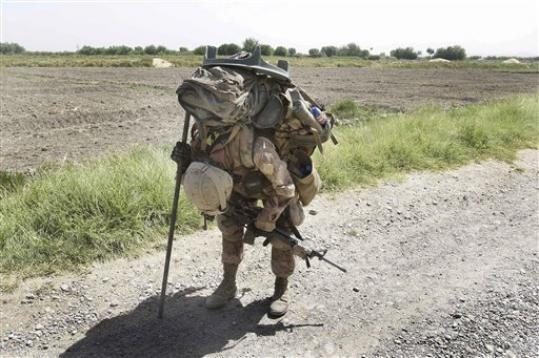
Ground combat — including fighting, campaigning, and surviving in the wild — is a young man’s work. It means bearing heavy loads (In the modern world, much of a unit’s gear can be carried in vehicles. But because soldiers today have so much gear, a lot of it — particularly personal equipment — simply has to be borne on one’s back, shoulders, and hips.), surviving in remote environs and severe weather conditions, and maintaining a level of proper hygiene for good health: None of which are easy in an environment where men are hunting one another.
One example worth noting: During the 1st Marine Division’s epic fighting-withdrawal from Korea’s Chosin Reservoir in 1950, Marines in one of the most remote regions on earth found themselves up against some of the worst weather imaginable; Snow, ice, and mercilessly cold temperatures, which often plummeted to 30-40 degrees below zero, were among the climate elements endured. Long, black nights and lashing winds of up to 40 and 50 miles an hour sometimes dropped the temperatures even further. Everything froze: Motor oil, medicines, blood plasma, even hands and feet. Marines touching the steel of their weapons often lost skin. Everyone was bundled up as best as possible, but it was never enough. Worse, the heavy clothes caused the exerting Marines to sweat. If they stood still for any length of time, the sweat turned to ice. The severe frostbite and other cold-related injuries were staggering.
As the Marines pulled back along the narrow reservoir road, the enemy attacked again-and-again, often at close quarters with the bayonet. So the withdrawing Marines had to stay alert, healthy, and ready to respond with brute force in an instant. They also had to keep their wits about them and remain in formation.
When the Marines at Chosin needed to relieve themselves, they did so on the road. To stray from the column meant death by ambush or getting lost and freezing. They urinated on the march, and relieved themselves otherwise by stopping and squatting in the middle of the road while other troops simply passed by. It was simply a reality of the animal-like existence for infantry troops on the move in combat. It hasn’t changed in over 50 years, or a thousand.
Iraq for the infantry — particularly those in the forward-most patrol bases and battle positions — is no different in that sense.
I hope I have gotten you interested. Finish the article here. If you read nothing else this week, read Smith’s article. The feminists will howl.  Their howls don’t change a thing, and Smith is still right.
This is reminiscent of Ernie Pyle’s description of the infantry.
I love the infantry because they are the underdogs. They are the mud-rain-frost-and-wind boys. They have no comforts, and they even learn to live without the necessities. And in the end they are the guys that wars can’t be won without.
I wish you could see just one of the ineradicable pictures I have in my mind today. In this particular picture I am sitting among clumps of sword-grass on a steep and rocky hillside that we have just taken. We are looking out over a vast rolling country to the rear.
A narrow path comes like a ribbon over a hill miles away, down a long slope, across a creek, up a slope and over another hill.
All along the length of this ribbon there is now a thin line of men. For four days and nights they have fought hard, eaten little, washed none, and slept hardly at all. Their nights have been violent with attack, fright, butchery, and their days sleepless and miserable with the crash of artillery.
The men are walking. They are fifty feet apart, for dispersal. Their walk is slow, for they are dead weary, as you can tell even when looking at them from behind. Every line and sag of their bodies speaks their inhuman exhaustion.
On their shoulders and backs they carry heavy steel tripods, machine-gun barrels, leaden boxes of ammunition. Their feet seem to sink into the ground from the overload they are bearing.
They don’t slouch. It is the terrible deliberation of each step that spells out their appalling tiredness. Their faces are black and unshaven. They are young men, but the grime and whiskers and exhaustion make them look middle-aged …
My son’s MOS is 0311: Marine Infantry. It is my policy not to blog on things I learn from my son. However, it is nice to see these things in print elsewhere, even if rather cleaned up for publication. W. Thomas Smith, Jr., has written a great article entitled Young Man’s Work: A Snapshot of Marine Life.
Tired, dirty, footsore, slightly dehydrated, hungry, and with an aching back and shoulders, I limped toward the battalion headquarters building from where a clean, fit, and slightly younger Lt. Col. Jason Bohm — task force commander of 1st Battalion, 4th Marines — emerged. I had just returned to Forward Operating Base Al Qaim after several days operating out of one of Bohm’s battle positions up on Iraq’s Syrian border. Bohm was getting ready to head back out to be with his men.
“Colonel, this is young man’s work,� I said.
He smiled and responded, “That it is.�
Notice, I did not say young person’s work. Nor did I say simply, man’s work. Though I’ve unconsciously understood infantry work to be “young man’s work� ever since I participated in my first, fast, route-stepping distance-march with heavy equipment under a searing Camp Pendleton, California sun some 25 years ago, the conscious reality of it surfaced for the first time during my recent, second trip to Iraq.
Granted, “once a Marine, always a Marine.� But at 48-years-old, and a civilian for most of my adult life, I won’t pretend that I am as capable today of fighting, surviving, and contributing to an infantry unit in action, as I was when I was in my early 20’s. By most standards for my age, I’m still strong and quick and I certainly know how to fight. But I also know my limitations, and in spite of my willingness, my body simply cannot endure the extreme heat and cold as easily as it once did. It cannot bear the same loads that it once did, nor can it run the necessary distances at the necessary speeds, negotiate the physical obstacles, or function, as it once managed to, when deprived of food and sleep. Neither can it perform the myriad other tasks required of young infantrymen in modern war.
The fact is, beyond my ability to shoot and think, I would be a burden on any infantry force in a desperate situation in which everyone needs to pull his own load and assist others with theirs. I think this is true for most war correspondents, though many would never admit it.
Infantry campaigning is difficult, and it has been ever since man first picked up a few stones, shouldered a club, and moved against a neighboring tribe. And despite modern weapon-systems and many of the new modes of delivery — helicopter, various ground conveyances — that difficulty has not changed.
Of course, we all remember former Congresswoman Patricia Schroeder’s attempt to dismiss the physical severity of modern combat with her now-famous line: “A woman can push a button just as easily as a man.� Perhaps, if combat were limited to waiting on the unthinkable in an air-conditioned missile silo in the American West, but that’s not how war actually works.
Ground combat — including fighting, campaigning, and surviving in the wild — is a young man’s work. It means bearing heavy loads (In the modern world, much of a unit’s gear can be carried in vehicles. But because soldiers today have so much gear, a lot of it — particularly personal equipment — simply has to be borne on one’s back, shoulders, and hips.), surviving in remote environs and severe weather conditions, and maintaining a level of proper hygiene for good health: None of which are easy in an environment where men are hunting one another.
One example worth noting: During the 1st Marine Division’s epic fighting-withdrawal from Korea’s Chosin Reservoir in 1950, Marines in one of the most remote regions on earth found themselves up against some of the worst weather imaginable; Snow, ice, and mercilessly cold temperatures, which often plummeted to 30-40 degrees below zero, were among the climate elements endured. Long, black nights and lashing winds of up to 40 and 50 miles an hour sometimes dropped the temperatures even further. Everything froze: Motor oil, medicines, blood plasma, even hands and feet. Marines touching the steel of their weapons often lost skin. Everyone was bundled up as best as possible, but it was never enough. Worse, the heavy clothes caused the exerting Marines to sweat. If they stood still for any length of time, the sweat turned to ice. The severe frostbite and other cold-related injuries were staggering.
As the Marines pulled back along the narrow reservoir road, the enemy attacked again-and-again, often at close quarters with the bayonet. So the withdrawing Marines had to stay alert, healthy, and ready to respond with brute force in an instant. They also had to keep their wits about them and remain in formation.
When the Marines at Chosin needed to relieve themselves, they did so on the road. To stray from the column meant death by ambush or getting lost and freezing. They urinated on the march, and relieved themselves otherwise by stopping and squatting in the middle of the road while other troops simply passed by. It was simply a reality of the animal-like existence for infantry troops on the move in combat. It hasn’t changed in over 50 years, or a thousand.
Iraq for the infantry — particularly those in the forward-most patrol bases and battle positions — is no different in that sense.
I hope I have gotten you interested. Finish the article here. If you read nothing else this week, read Smith’s article. The feminists will howl.  Their howls don’t change a thing, and Smith is still right.
This is reminiscent of Ernie Pyle’s description of the infantry.
I love the infantry because they are the underdogs. They are the mud-rain-frost-and-wind boys. They have no comforts, and they even learn to live without the necessities. And in the end they are the guys that wars can’t be won without.
I wish you could see just one of the ineradicable pictures I have in my mind today. In this particular picture I am sitting among clumps of sword-grass on a steep and rocky hillside that we have just taken. We are looking out over a vast rolling country to the rear.
A narrow path comes like a ribbon over a hill miles away, down a long slope, across a creek, up a slope and over another hill.
All along the length of this ribbon there is now a thin line of men. For four days and nights they have fought hard, eaten little, washed none, and slept hardly at all. Their nights have been violent with attack, fright, butchery, and their days sleepless and miserable with the crash of artillery.
The men are walking. They are fifty feet apart, for dispersal. Their walk is slow, for they are dead weary, as you can tell even when looking at them from behind. Every line and sag of their bodies speaks their inhuman exhaustion.
On their shoulders and backs they carry heavy steel tripods, machine-gun barrels, leaden boxes of ammunition. Their feet seem to sink into the ground from the overload they are bearing.
They don’t slouch. It is the terrible deliberation of each step that spells out their appalling tiredness. Their faces are black and unshaven. They are young men, but the grime and whiskers and exhaustion make them look middle-aged …
In my article Religion and Insurgency: A Response to Dave Kilcullen (and associated comments), I responded to Dave Kilcullen’s article Religion and Insurgency at the Small Wars Journal. In order to continue the conversation, let’s tackle a real life instance where cultural and religious sensitivities come to bear in the counterinsurgency campaign. Whereas it might have been assumed that the only application to my claims was that of seeing the insurgent as a jihadist, religiously motivated and completely unamenable to our COIN efforts (certainly this is one application for some number of them), there are far more applications where a proper understanding of religion and culture would help frame the discussion.
A Stryker Colonel Talks About the Situation in Iraq:
FORT LEWIS - The commander says the loss of two soldiers hit everyone hard. We had a rare opportunity to speak with Col. Stephen Townsend from Baghdad Tuesday.
The 4,000 Fort Lewis-based soldiers have been there since last summer and now are in the hotspot, Baghdad.
“We feel pretty fortunate to be doing what we’re doing,” Col. Townsend said. “Right now, the Arrowhead Brigade is employed in a role that is ideally suited for a Stryker Brigade. We’re being very mobile. We’re going to where the tough jobs are. We’re helping out with both the Coalition and the Iraqi security forces there where the tough jobs are.
“We’re pretty fortunate about that. It’s pretty gratifying to see the progress the Iraqi security forces are making. In fact, the operation that we’re in now an Iraqi general is actually running the operation and I’m working for him rather than an American general.”
Col. Townsend and the 3rd Brigade have been to Iraq before, but this is their first time patrolling Baghdad.
Cpl. Jason Ratliff out on patrol says on video provided by the Army, “We always look for weapons and we try to see if people know anything.”
PFC Elizabeth Turan on patrol says, “It’s kind of scary because you don’t know if someone is going to pull a gun out. But it’s not that bad.”
‘Elizabeth’ is not one of those names that can be mistaken since it is not a gender-neutral name. ‘Elizabeth’ is a woman, and she is on patrol in Baghdad. We might make several observations about this.
For whatever reason (meeting recruitment goals, political pressures), the Pentagon wants women in combat. Of course, there are practical matters with which to contend, including unit cohesion, lower torso strength of women, a higher rate of lower extremety injuries, etc. (in fact, the Russian campaign in Afghanistan saw a much higher rate of lower extremity injuries in women). But leaving behind the practical effect on U.S. forces, has anyone stopped to consider what we are communicating to those whose hearts and minds we want to win?
In the heavily patristic and tribal society that is Iraq (and in fact the whole Middle East), family and tribe function to a great extent by providing protection and security. This is codified into the religious framework of the region by Islam. The very notion of accepting security from women would be seen as scandalous, humiliating and repugnant to the head of a family or tribal elder. But in our so-called “security plan,” accepting security from women is precisely what we are offering (and in fact demanding) from men who cannot accept this offer.
We routinely offer up rhetorical flourish on winning hearts and minds, while Elizabeth is on patrol in Baghdad. And no one stops to ponder the question “just what are the consequences of these actions?”
Prev | List | Random | Next · Join Powered by RingSurf! |