Lt. Col. Christian Cabannis fully adheres to and advocates the doctrines of population-centric counterinsurgency.
Christian Cabannis met a social worker before deploying to Afghanistan. Not for his own wellbeing, but to better understand the task at hand. It was his mother’s idea.
Her son is a lieutenant colonel in the US marines and the commanding officer of the 2nd Battalion 8th Marine Regiment.
He is in charge of perhaps the most dangerous part of Afghanistan and also one of the poorest. So his mother wanted him to better understand what it is that motivates the poor and how to win their support.
He describes this mission as “armed social work”; providing hope for the needy and defence against the Taliban …
It is pure, modern counter-insurgency strategy (Coin) and what American and British generals believe is the key to winning this war. Lt Col Cabannis says that until recently the mission lacked the right focus.
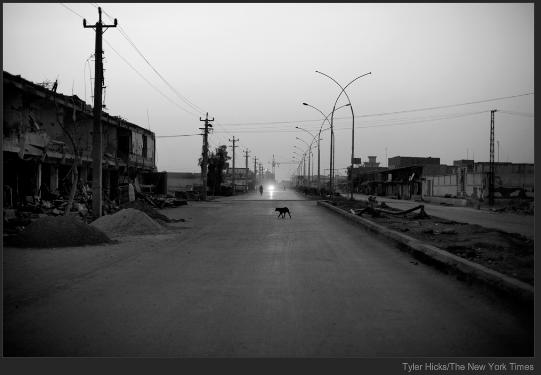
Three years ago, Garmsir market was shot up and abandoned; the scene of pitched battles between British forces and the Taliban. But today UK and US troops have driven them away from the town and Garmsir is held up as a success story.
In the past three months, US marines have built on British efforts to establish meaningful local government …
He believes that many insurgents can be persuaded to put down their weapons and re-join society and there are discussions under way as to how to achieve this.
The marines’ success is in part due to sheer size; having the force strength to push into new areas, to stay there and to engage in what they call “consent-winning activities” on a much larger scale than Britain has been able to.
There is much left out of this account of the battle for Garmsir, Afghanistan. The facts left out of the account actually causes this account to skew the interpretation and may change the context the reader places around the events, thus affecting the import of the story.
The British were unable to take and hold Garmsir, and so in 2008 the U.S. Marines 24th MEU initiated large scale operations to take it from the Taliban. The operations relied on heavy kinetics, but was welcomed by the people of Garmsir. The drive against the Taliban continued in such heavy military operations that the fire fights were at times described as full bore reloading by the Marines. As if speaking to population-centric counterinsurgency experts who believe that they must win the population by nonkinetic means, town elder Abdul Nabi told the Marines “We are grateful for the security. We don’t need your help, just security.” The 24th MEU killed some 400 Taliban during their deployment.
In 2008 the Marines were doing the right things – they certainly didn’t lack focus. But the 24th MEU had to leave, and they turned over to the British, who once again couldn’t hold the terrain, either physical or human. Thus more U.S. Marine Corps operations had to be initiated in the Helmand Province in 2009.
Accompanying the fantasy-narrative that the lack of focus in the past has given way to a brilliant new strategy to win Afghanistan is a robust defense of the rules of engagement by Lt. Col. Cabannis.
Watch CBS News Videos Online
This is a big change since the spring. All U.S. forces in Afghanistan are now being told to protect civilians even if the enemy gets away. Over the last eight years, Afghans have been outraged by civilian deaths and it’s a big reason the U.S. is not winning.
“Killing a 1000 Taliban is great but if I kill two civilians in the process, it’s a loss,” Lt. Col. Cabaniss said.
Asked how many enemies have been killed so far, Cabaniss said, “I have no idea and it’s really irrelevant.”
“Body counts not something that you track?” Pelley asked.
“It doesn’t tell me that I’m being successful. It doesn’t tell me that at all. The number of tips that I receive from the local population about IED’s in the area, Taliban in the area, that is a measure of effectiveness,” Cabaniss explained.
This is an important exchange, and we should spend some time dissecting and analyzing it. The reason the U.S. is not winning is force projection, or lack thereof. There aren’t enough troops, as we saw with the 2008 campaign for Garmsir in the Helmand Province. The ANP and ANA cannot possibly hold the terrain once it has been taken and won’t be ready for quite some time. In fact, there is some indication that the locals themselves are a bit disgusted by the ROE.
But even for population-centric counterinsurgency advocates, this exchange is full of nonsense. To be sure, the population may be one means of marginalizing the insurgents, getting intelligence on them, and then conducting intelligence-driven raids, killing or capturing them. This was done en masse in Iraq, especially in 2007. But in the interview Cabannis makes a leap from an enabling feature of counterinsurgency to the end or purpose of it.
If a Province has 1000 Taliban and the U.S. Marines kill them all, and along with them the Marines inadvertently kill two noncombatants, it’s preposterous to suggest that this is a loss. This suggestion is tantamount to saying that for every noncombatant we kill greater than five hundred pop up in his place.
Further, why did Cabannis use the values of 1000 and 2? Would it have been acceptable to have killed a single noncombatant if we had killed 1000 Taliban? If so, is he suggesting that the ratio of generation to kill rate of insurgents is greater than 500: 1 but less than 1000:1? Or perhaps if these suggestions sound a bit pedantic, it’s more likely that he is simply using theatrics and hyperbole to make a point. But if one has to use theatrics, the point itself suffers from lack of credibility.
Finally, why is killing Taliban great? If it’s great because it assures the population that they are protected, then we should endeavor to do more of it. Killing noncombatants is never a good thing, but giving the insurgents safe haven amongst the domiciles of villages sends the opposite message than we intend. It gives them operating space, and it tells the villagers that we won’t pursue the insurgents on their own terrain, and thus there is no protection from them once they come into your homes and villages. The very time you need the protection is precisely the time we will abandon you to the enemy.



 16 years, 4 months ago