Articles by Herschel Smith


The “Captain” is Herschel Smith, who hails from Charlotte, NC. Smith offers news and commentary on warfare, policy and counterterrorism.


FOB Fenty and Attacks in Jalalabad

15 years, 7 months ago

No one could report as clearly as Tim Lynch on the recent attacks in Jalalabad.

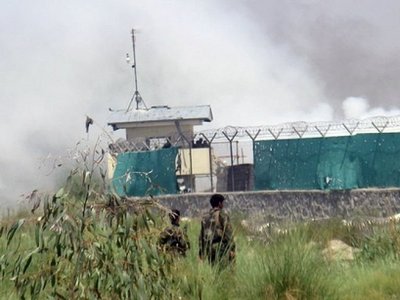
Last Wednesday morning the local Taliban sent eight guys to attack the US Army base at Jalalabad Airfield known as FOB Fenty.  They initiated the attack with a car bomb in a rarely used entry point on the southeastern side of the airfield which is well away from the Torkham to Jalalabad road.  The remaining attackers tried to bum rush the damaged gate and got shot all to hell by the American soldiers who man the guard towers.  Adding insult to injury there just happened to be a section of fully armed and fueled Apaches in the air and they were instantly able to pounce on the survivors of the futile charge at the damaged gate as they fled back towards a small village called Moqamkhan.  A joint force of ANA and 101st Paratroopers went into the village and finished off the survivors in a short fire fight.  FOB Fenty was back to normal by noon but the attack did generate plenty of news which may have been the point.

The Washington Post reported that:

Earlier Wednesday, insurgents detonated a car bomb outside the gate of an air base that serves as a NATO military hub in eastern Afghanistan and engaged in a gun battle with guards in the latest unsuccessful attempt by militants to penetrate a military compound.

At least eight suspected militants were slain in the attack on Jalalabad air base, Afghan officials said. The Taliban asserted responsibility for the operation, the Associated Press reported.

After the initial blast, NATO officials said, insurgents attacked the base’s guards with rocket-propelled grenades and small arms, wounding two.

NATO officials said the air base’s perimeter was not breached. “Afghan and coalition forces are always prepared to deal with attacks on this facility,” Maj. Mary Constantino, a NATO spokeswoman, said in a statement. “The response this morning was immediate.”

It would be good to get some clarification on this.  My contact (a contractor in Jalalabad) says that the outermost perimeter, manned by ANA, was indeed breached, but the U.S. forces responded quickly and didn’t allow incursions into the FOB (i.e., the inner security wasn’t breached).  Either way, Tim continues:

The attack on FOB Fenty has had zero impact on the local citizens or the troops stationed on the FOB – it was stupid and recognized as such.  But Jalalabad has had a series of IED attacks in the Safi Bazaar which is in the main downtown area.  The word on the street is that these are bombing targeting “un-Islamic” stores but they have hit cell phone stores and a juice bar which clearly fall within the definition of being properly Islamic. These attacks are very concerning but to date none of the local security offices have been able to turn up a night letter.  This area of the bazaar has had its share of problems over the past few years with several firefights breaking out between vendors with the local ANP joining in for good measure.  This could be score settling or the Taliban may feel strong enough to operate in openly in Jalalabad (which I doubt.)

I agree with Tim, and it isn’t clear to me what the insurgents were trying to accomplish.  There wasn’t any possibility of overrunning FOB Fenty.  Enemy tactics include massing of forces when they are attacking much smaller outposts.  Tim ends with an interesting and heartening account of the goings-on in Jalalabad.

Right now things are not looking too cool in Jbad for us internationals but there could be change afoot.  Lost in all the news surrounding the appointment of Gen Petraeus is the amazing (one sided) fights which have been happening in both Kunar and Nuristan Provinces.  Last week the troops stationed at the Nuristan PRT in Kala Gush spent several hours watching video feed of some 200 fighters climbing the mountain to the west of them in order to stage a massive attack.  Or something.  By the time these guys had humped all the heavy guns, mortars, rockets, ammo, etc… up the mountain there were B1’s stacked above them with 2000 lbs JDAMS.  Talk about an ass whooping – these kind of attacks really piss off the local tribes because their young men join the fighters and losing young men for nothing is not covered in any part of the Pashtunwali code.

Good.  As long as we are aggressively chasing and killing the enemy, we are doing what I have advocated.  We can do more, but we can’t do any less than that and win.  The best place to kill them is away from the population.  When they invite us to do so, we must oblige.

More Rules of Engagement Examples from Afghanistan

15 years, 7 months ago

From Time:

An episode last month illustrates the quandary American troops face. In early June, on the southern edge of Kandahar city, a small Army convoy drove into a nighttime ambush. Within seconds, a turret gunner in one of the vehicles was hit in the arm. Muzzle flashes pierced the dark, alerting fellow troops to where the shots were coming from. But, thinking that they had to clearly identify the triggerman before firing back, they waited before retaliating, even as rounds of hostile fire poured in. Only after an officer radioed back with the go-ahead did the Americans return heavy fire. By then, the militants had melted away.

The wounded soldier, Private First Class Trevor Longcore, of Shadow Troop, 1-71 Cavalry, caught a lucky break: he wasn’t hit by a bullet but by a piece of shrapnel that had apparently ricocheted off his vehicle’s armor. But a month into their deployment into Afghanistan, he and his compatriots are still frustrated by the constant heat-of-the-moment uncertainty about returning fire. For many troops, the strict rules of engagement — overlaid with tactical directives meant to limit civilian casualties — are a source of confusion and, they contend, are putting U.S. soldiers in greater danger. “We have all of these stupid rules that in the end wind up hurting more people. I mean, hesitation can mean death out here,” says one disgruntled soldier serving in the volatile south …

In Marjah, the desert town in central Helmand province where U.S. Marines are battling a resurgent Taliban, roving groups of militants on foot and motorbike take potshots at the Americans when they are not setting up ambushes and IEDs. Yet even if Marines see an attack taking shape around them, the current rules of engagement mandate that they cannot shoot unless they are first shot at. The insurgents know this, so they often “drop and go”: firing from a distance, then abandoning their weapons. Sometimes Marines never get a single shot off in defense, an exercise in restraint that is especially taxing for the American military’s hardiest warriors.

McChrystal’s advocates argue that McChrystal’s tactical directive was misunderstood and applied too restrictively at lower levels of command (the rules have been distorted as they pass down the chain of command).  But that dog won’t hunt.  His tactical directive remains available for viewing, and his words set the context for its application: “If you are in a situation where you are under fire from the enemy… if there is any chance of creating civilian casualties or if you don’t know whether you will create civilian casualties, if you can withdraw from that situation without firing, then you must do so.”  The reader can make up his own mind.

But without weighing in again on the restrictive nature of the ROE in Afghanistan, I will only observe one more time that while the rules for engagement of the enemy in Iraq were too restrictive, or so I argued, they were not the same as those in Afghanistan.  Period.  There is a difference, and you can judge for yourself how successful each campaign has been.  For a reminder of how insurgents were engaged in Iraq, see Recon by Fire (or what some commenters called the “Drake Shoot”).

General David Petraeus, Max Boot and Independent Analysis

15 years, 7 months ago

Several months ago Max Boot did something I would never do, and offered what he called rare praise for Andrew Sullivan.  The subject of the article was mainly about Petraeus and his statements on Israel, but in the same article Max made some fairly strong observations or allegations about Diana West.

Andrew McCarthy writing for National Review Online penned a lengthy rebuttal to Max’s advocacy for Petraeus, while also analyzing the statements Petraeus had recently made concerning Israel.  Max’s position has seemed profoundly weak to me, and McCarthy’s rebuttal appears determinative in light of the alternatives.  Petraeus has said, for example:

… enduring hostilities between Israel and some of its neighbors present distinct challenges to advance our interest in the AOR (Area of Responsibility). Israeli-Palestinian tensions often flare into violence and large scale armed confrontations. The conflict foments anti-American sentiment, due to a perception of U.S. favoritism for Israel. Arab anger over the Palestinian question limits the strength and depth of U.S. partnerships with governments and peoples in the AOR and weakens the legitimacy of moderate regimes in the Arab world. Meanwhile Al-Qaeda and other militant groups exploit that anger to mobilize support. The conflict also gives Iran influence in the Arab world through its clients, Lebanese Hizbollah and Hamas.

Now, one can even agree with the General that Israel and the Palestinian-Israel conflict is the fulcrum upon which everything tips in the Middle East.  It doesn’t offend or bother me in the least; I just believe that this view is naive and meant primarily as a narrative for simpletons.  Let’s be clear.  Palestine or Israel could cease to exist tomorrow, and Iran would still pursue regional hegemony.  There would still be hatred among some in the Middle East towards the U.S. (Wahhabists, etc.) regardless of who did or didn’t exist, or what other conflict was or wasn’t going on.

But whatever your view, McCarthy’s article was rather conclusive, that is, until Max Boot responded to McCarthy.  He has been a determined advocate for Petraeus and his Israel policy, indeed.  Joshua Foust explains why.

The recent revelation that Gen. Petraeus — now installed as the third commander of the flagging Afghan War in two years— collaborated with at least one pundit to get his story into the public isn’t exactly earth-shaking. But it might point to deeper problems with the commentary industry: namely, who’s driving the discussion?

An activist named Philip Weiss recently posted to his blog an e-mail chain that revealed Petraeus jovially chatting with Los Angeles Times columnist and Council on Foreign Relations Senior Fellow Max Boot (Weiss makes a big deal out of Petraeus’ use of a smiley-face emoticon, though he’s probably overreacting about his supposed run for the presidency). At issue was a statement Petraeus gave the Senate Armed Services Committee that was critical of Israel. Wanting to combat the negative things pro-Israel pundits were saying about him, Petraeus reached out to Boot, who promptly repeated Petraeus’s statements, arguments, and talking points in his writing without directly disclosing their source.

None of this is terribly surprising, in the abstract: Petraeus has taken Boot on numerous DOD-funded trips around the wars in Iraq and Afghanistan, and in return Boot has written repeatedly about how the wars are worth fighting, etc. It’s kind of a standard quid pro quo and makes sense from the general’s perspective. What’s odd, and this is where Weiss is onto something, is that Boot would go so far as to take cues directly from Petraeus, no longer writing as a pro-war partisan but as Petraeus’s unofficial spokesman.

It is an unfortunately common relationship in the think tank and commentary universe: writers find government figures they respect and wish to support, and those figures make supporting them as easy as possible.

Joshua goes on to discuss the ethics of this approach to advocacy.  You can make up your own mind.  As for regular readers of The Captain’s Journal, you would find it implausible to the point of simply impossible that I publish anyone’s talking points.  I know that some Milblogs and commentators that.  That group has not and will never include this one.  If you must publish someone else’s talking points, it means that you don’t have any thoughts of your own.

Recommended Reading and Viewing: Getting Hit to Get the Shot

15 years, 7 months ago

I recommend that you spend a few minutes taking in Michael Yon’s latest entry, and spend the time to read it through to the end.  There are some pictures you might want to see, and this montage is very compelling.

What Really Happened at Wanat?

15 years, 7 months ago

The Battle of Wanat has been in the news lately.  Richard Engel with MSNBC did an expose on Wanat, and still grieving father David Brostrom says a number of wise things concerning the battle, but veers eventually into the lack of soft efforts (building schools, interacting with the population, etc.).  In previous articles I have disagreed with this perspective, since it makes no sense to charge Chosen Company with lack of COIN efforts when they were in a deadly fight for their lives on an hour by hour basis for the entire deployment.  Besides, Major Jim Gant gives us a realistic perspective concerning these things.

This is nothing more than a side bar comment as I have not studied nor read the details of what occurred at Wanat.

However, at the same time we were conducting tribal engagement with the Mohmand tribe (2003), we were also conducting combat operations in the Pesch Valley and the Korangal Valley. The details of these missions are not important. However, we had two informal “meetings” with the tribal leaders in and around the area where Wanat is located. The first time we held a meeting they informed us they did not want us coming through their tribal area. I explained to them, in detail, that we had to move through that area in order to accomplish other missions. I emphasized that we did not want to fight their tribe. They told us that we were not welcome there and if we came through their again that we would have to fight. My answer was simple,”OK. Let’s finish lunch together and then we will fight.” That very day we were involved in a very large fight with them on our way out of the valley.

Several weeks later, the tribal elders came to our firebase and we had another “meeting.” The same topics were talked about. We enjoyed a very nice lunch together and the outcome was – we will continue to fight. We could not come to any type of agreement on how we could work this issue out.

So we continued to conduct combat operations to include raids in their tribal area.

But at least we understood each other.

One last note. The terrain there was by far the most difficult terrain I have ever fought in.

Sometimes, you just have to fight…

Once again, this isn’t a statement about Wanat per se, but the tribes who live in and around the area. They are a tough, fighting group of people.

The U.S. Naval Institute Proceedings has recently published an interesting analysis of the role of weapons in the battle of Wanat, entitled “What Really Happened at Wanat.”  Excerpts are give below (and the reader is left to visit the USNI web site for further study).

Immediately after the release of the Army’s Occasional Paper, press reports seized on Soldiers’ accounts of weapon stoppages detailed in it. The Times reported that “Soldiers who survived the battle described how their automatic weapons turned white hot and jammed from nonstop firing.” A November 2009 Defense News story also cited reports of weapon stoppages, but went further, attempting to connect the deaths of Soldiers in the battle to the enduring debate over the reliability and lethality of the military’s primary infantry weapon, the M4 carbine.

Since its introduction with U.S. forces during the Vietnam War, the M16 rifle and its offspring, including the M4, have been the subject of some controversy, especially related to reports of the weapons’ reliability in combat. Initial reports from Vietnam indicated a high incidence of stoppages. These were in fact directly related to the Army’s initial decision to alter the ammunition’s propellant from military specifications (mil-specs) and to dispense with chrome plating the M16’s chamber—an improvement that had become a standard feature of all U.S. military small arms since World War II.

Both decisions led to premature corrosion of the chamber and ultimately to stoppages. Upgrades, including those that improved the manufacturing process and design of the weapon’s buffer, bolt, trigger components, and chamber, which would receive a chrome lining, resulted in a much superior M16A1. Troops issued the M16A1 in 1969 and later rarely complained about their weapons. One Marine rifleman did complain in a 1967 letter to his family following the battle for Hills 881 and 861 above Khe Sanh: “We left with 72 men in our platoon and came back with 19. Believe it or not, you know what killed most of us? Our own rifles. Practically every one of our dead was found with his [M16] torn down next to him where he had been trying to fix it.”

Not mentioned in the letter was the fact that many of the Marines who fought at Khe Sanh had been issued their M16s only days before the action and probably were unfamiliar with them. Also worth mentioning is the fact that the M16 of four decades ago is not the same weapon as the M4 in service in Iraq and Afghanistan today. Enhancements made to the original design have substantially improved the weapon’s reliability, so much so that commanders often praise the M4. At the 2006 Infantry War Fighting Conference, Major General Walter Wojdakowski, commanding general, U.S. Army Infantry Center & School, called the M4 “one of many success stories in combat operations in Iraq and Afghanistan.”

Yet troops outnumbered at Wanat, like those described in the Khe Sanh account 41 years before, were still plagued by numerous weapon stoppages. Studies conducted by the Army, by independent research institutions, and by Colt itself offer some indication of the cause. In particular, they provide some possible explanations for the numerous stoppages suffered by Wanat’s defenders.

The Army’s draft Occasional Paper states that to maintain fire parity with their attackers, the Chosen Few Company soldiers “were firing their weapons ‘cyclic,’ on full automatic at the highest possible rates of fire.” For this reason, the paper concludes, some Soldiers experienced stoppages.

Staff Sergeant Erich Phillips, manning the 120-mm mortar, recalled that during the engagement his “M4 quit firing and would no longer charge when [he] tried to correct the malfunction.” An engineer specialist who loaded for Phillips recalled that, “Staff Sergeant Phillips poured out fire,” going “through three rifles using them until they jammed.” Specialist Chris McKaig, defending OP Topside, also experienced problems with his M4. “My weapon was overheating,” he recalled. “I had shot about 12 magazines by this point already and it had only been about a half hour or so into the fight. I couldn’t charge my weapon and put another round in because it was too hot, so I got mad and threw my weapon down.”

This same thread is pulled in the Douglas R. Cubbison study out of Leavenworth (I still won’t release or publish this paper since it has not been publicly released).  I find the issue of weapons reliability to be a compelling theme, but in the end, an incorrect one.  It isn’t surprising that an M4 that has fired 12 magazines within 30 minutes no longer functions properly.  Better, more reliable weapons could have been provided to the men of Chosen company (e.g., piston rather than direct gas impingement), and the outcome would still have been the same.

Most of the men who perished that fateful day did so attempting to defend or relieve OP Top Side (8 of the 9 who perished), and the kill ratio that day still favored the U.S. troops (“There were between 21 and 52 AAF killed and 45 wounded. Considering a clinical assessment of kill ratio can be a pointer to the level of risk associated with this VPB and OP. 21/9 = 2.33, 52/9 = 5.77 (2.33 – 5.77), and 45/27 = 1.67. These are very low compared to historical data (on the order of 10:1).”).

It’s tempting to point the finger at weapons systems, just as it is tempting to fault the company with lack of soft COIN efforts.  But in the end, they were outnumbered about 6:1 (300+ to about 50), they were on a poor choice of terrain, they had poor logistics, they suffered lack of air and artillery support, and most importantly, they simply were never given the proper number of troops or the resources to engage in force protection, much less robust force projection.  They were under-resourced, and no analysis of weapons systems can change that fact.  Rather than focus on why the M4 jams after firing 360 rounds in 30 minutes, the real question is why this particular M4 had to be put through this kind of test to begin with?

Taking Back the Infantry Half-Kilometer

Second Guessing the Battles of Wanat and Kamdesh

Wanat Video II

Wanat Video

The Battle of Wanat, Massing of Troops, and Attacks in Nuristan

The Contribution of the Afghan National Army in the Battle of Wanat

Investigating the Battle of Wanat

Analysis of the Battle of Wanat

The Long Term Counterinsurgency Work in Marjah

15 years, 7 months ago

From Financial Times:

Tracing his finger over a map of Marjah, Lance Corporal Paul Horchler sketched the route ahead. He would lead his marines along a canal, past the spot where a buried bomb had exploded the day before, then down a track nicknamed “ambush alley”.

His patrol was almost guaranteed to succeed. Either the Americans would have a chance to ask the locals where the Taliban were, or the insurgents would reveal themselves by shooting at them. Whatever happened, they stood to learn.

After trudging for an hour down a path flanked by fields and scattered adobe houses, seemingly deserted in the midday heat, the marines found a man willing to talk. He said he had seen four Taliban fighters at a nearby bazaar 30 minutes earlier.

“The Taliban, they’re probably watching us. I guarantee they are watching us,” said Lance-Corporal Monty Buchanan. “Whoever’s in the area will decide what they want to do, if they want to hit us or not.”

This is the daily grind faced by US marines in Marjah almost five months after they seized the town in Nato’s biggest operation of the nine-year Afghan war.

The offensive in southern Helmand province was billed as a centrepiece of General Stanley McChrystal’s strategy of pouring in US forces to protect the population from insurgents, but the climate of fear remains palpable.

Even before the general’s forced resignation last month over the publication of a Rolling Stone article in which he and his aides poured derision on the Obama administration questions were growing about the strategy.

General David Petraeus, who assumed command of the international force in Afghanistan on Sunday, is a leading US theorist in countering guerrilla warfare and has pledged continuity in strategy, although he has not ruled out adjusting its implementation.

L Cpl Horchler’s four-hour ramble past lavender fields and sunflowers outside Marjah was a lesson in the difficulties not only of separating the population from the insurgents, but in telling them apart. Many fighters operate within their communities, rendering the distinction even less clear.

Most of Marjah appeared to have deemed it too hot to be outside when the marines and Afghan soldiers set out into what felt like an immense vista for such a small patrol to cover; one that afforded almost infinite hiding places.

Marines who seized Marjah from the Taliban in a blaze of publicity are now facing almost daily ambushes staged by attackers skilled at burying home-made mines or hiding them under bunches of dried poppy stalks.

The patrol flinched when a rat-tat-tat echoed across a field like the sound of distant machinegun fire: it turned out to be a creaking water pump. Moments later, L Cpl Horchler, 22, aimed his rifle at what appeared to be a figure traversing a distant sand dune on a motorbike, suspecting he might be a Taliban spotter. The man vanished over the ridge.

A gunshot snapped the air and again the marines started. One of the Afghan soldiers had fired a warning to halt a minibus they wanted to search. A patch of disturbed earth on the track prompted a diversion for fear it concealed a bomb.

The informant’s compound felt safer than the road, although not much. One of the Afghan troops urged L Cpl Horchler to interrogate the owner of the shop where the insurgents had been seen. He refused, loathe to risk endangering his source.

L Cpl Horchler’s men returned to base unscathed, but a second patrol would be attacked on the same route a few hours later by insurgents armed with rifles and rocket-propelled grenades.

As Lance Corporal Mark Reno, 23, said: “I’m sure we’ve shaken hands with them on a daily basis and not even known who they were.”

Analysis & Commentary

In McChrystal Calls Marjah a Bleeding Ulcer, I laid out some hard questions for my readers.

Did General McChrystal not cover the basics of classical counterinsurgency doctrine with his civilian bosses?  Did he or any of his reports mislead the administration into believing that Marjah or any other town in Afghanistan would be pacified in 90 days?  Did he or his reports – or anyone in the administration – really believe that this government ex machina we brought to Marjah would work?

It now appears that the answers to the first two questions above is no, and the answer to the last one which is yes.  The surprise at how long Marjah is taking betrays an actual belief that they could shout presto, clap their hands and make Marjah safe, secure and serene.

Forgotten are the long years of counterinsurgency work to win the Anbar Province, and in its place was substituted bare, unsubstantiated doctrine.  That there was surprise among McChrystal’s staff and the Pentagon is a pointer to harder points that need to be made; they see the world in a childlike fashion.

If nothing else comes from the Rolling Stone expose on McChrystal and his staff, we learn about the immaturity of McChrystal’s staff and even McChrystal himself.  The false beliefs concerning Marjah are in the books, but one example (out of many) comes to us by way of anecdote.

Even in his new role as America’s leading evangelist for counterinsurgency, McChrystal retains the deep-seated instincts of a terrorist hunter. To put pressure on the Taliban, he has upped the number of Special Forces units in Afghanistan from four to 19. “You better be out there hitting four or five targets tonight,” McChrystal will tell a Navy Seal he sees in the hallway at headquarters. Then he’ll add, “I’m going to have to scold you in the morning for it, though.” In fact, the general frequently finds himself apologizing for the disastrous consequences of counterinsurgency. In the first four months of this year, NATO forces killed some 90 civilians, up 76 percent from the same period in 2009 – a record that has created tremendous resentment among the very population that COIN theory is intent on winning over. In February, a Special Forces night raid ended in the deaths of two pregnant Afghan women and allegations of a cover-up, and in April, protests erupted in Kandahar after U.S. forces accidentally shot up a bus, killing five Afghans. “We’ve shot an amazing number of people,” McChrystal recently conceded.

Despite the tragedies and miscues, McChrystal has issued some of the strictest directives to avoid civilian casualties that the U.S. military has ever encountered in a war zone. It’s “insurgent math,” as he calls it – for every innocent person you kill, you create 10 new enemies. He has ordered convoys to curtail their reckless driving, put restrictions on the use of air power and severely limited night raids. He regularly apologizes to Hamid Karzai when civilians are killed, and berates commanders responsible for civilian deaths. “For a while,” says one U.S. official, “the most dangerous place to be in Afghanistan was in front of McChrystal after a ‘civ cas’ incident.” The ISAF command has even discussed ways to make not killing into something you can win an award for: There’s talk of creating a new medal for “courageous restraint,” a buzzword that’s unlikely to gain much traction in the gung-ho culture of the U.S. military.

But however strategic they may be, McChrystal’s new marching orders have caused an intense backlash among his own troops. Being told to hold their fire, soldiers complain, puts them in greater danger. “Bottom line?” says a former Special Forces operator who has spent years in Iraq and Afghanistan. “I would love to kick McChrystal in the nuts. His rules of engagement put soldiers’ lives in even greater danger. Every real soldier will tell you the same thing.”

We have discussed the issue of a campaign against high value targets conducted by SOF.  I don’t believe in it.  I don’t think it works to curtail the insurgency.  But besides considerations of the utility of the strategy (and it is a strategy, not a tactic), there is the issue of maintenance of troop morale.  McChrystal set up a military cultural milieu in which direct action kinetics was relegated (or reserved) to SOF, while the so-called general purpose forces were essentially told to be policemen, and given rules of engagement that are more restrictive than those for police departments in the U.S.  Nothing McChrystal could have done would have worked so thoroughly to bust troop morale.

McChrystal’s vision is why he worked so poorly with the Marines and within the context of the MAGTF.  The Corps doesn’t buy into McChrystal’s bifurcation, and (properly) wants more control of goings-on within their battle space than McChrystal was willing to give them.  I gave Tad Sholtis (McChrystal’s PAO) multiple chances to say something – anything – positive about the MAGTF and the job the Marines were doing in Helmand.  No such praise came, and my communications with them were marked mostly by lip biting and equivocation.

I don’t know what the era of Petraeus will bring, and if he doesn’t immediately press authority down the chain of command, unshackle the enlisted men, reduce the rules of engagement with the enemy, ban PowerPoint presentations, unleash air power, get Soldiers off of the several huge bases they’re on, press for more distributed operations, and give commanders complete control over their battle space, then we will lose.  Either way, for the last year, the children have been in charge.

CNN Editor Sad Over Death of Hezbollah Spiritual Leader

15 years, 7 months ago

Via Weekly Standard, CNN Editor Octavia Nasr posts on Twitter:

Sad to hear of the passing of Sayyed Mohammad Hussein Fadlallah.. One of Hezbollah’s giants I respect a lot..

Fadlallah was the spiritual leader of Hezbollah and is believed to be responsible for the deaths of 241 Marines and Navy Corpsmen in the 1983 Beirut barracks bombing.  Not coincidentally, the leader of Hezbollah, Nassan Nasrallah, also states his approval for the cleric’s vision and promise to carry on.

“We promise his soul that we will remain faithful to his sacred goals for which he lived, worked and sacrificed day and night, as we will sacrifice everything to defend them,” Hizbullah leader Sayyed Hassan Nasrallah said.

So CNN is squared up shoulder to shoulder with Hezbollah.  The real question is this: is anyone really surprised?

Afghanistan Policy in Disarray

15 years, 7 months ago

The first living Medal of Honor recipient since Vietnam is soon to be named, which is good news.  The disturbing part of the Washington Post article is at the end.

“We should be stationing our troops in places where they won’t be earning the Medal of Honor because the population and terrain favor us and we have quick access to air support,” said John Nagl, one of the authors of the Army’s counterinsurgency doctrine and president of the Center for a New American Security, a defense think tank.

Leaving behind the issue of allowing the insurgents safe haven for recruiting, raising of funds, training and rest, and leaving behind the issue of protection of lines of logistics and all of the other objections that could be raised to this incredibly stolid statement, Nagl’s quote betrays an Afghanistan policy and strategy that is in complete disarray.

He wants retreat in the face of enemy fires, allowing air power to accomplish the engagement.  But the incredibly incompetent Afghan National Army is embedded with U.S. troops, and is learning to retreat and allow air power to finish the fight.  What they will do when the U.S. has withdrawn in a year or two Nagl doesn’t say.

More importantly, McChrystal’s tactical directive severely restricts the use of air power.  In fact, the Taliban know this and have used it to their advantage.

The Taliban no longer run and hide when they see a fighter jet overhead, brazenness that airmen attribute to the nearly year-old directive to limit close-air support.

Joint terminal attack controllers, airmen on the ground who call in airstrikes, and fighter pilots report that insurgents are encouraging each other to continue firing because they know the Air Force’s F-16s and A-10s are dropping far fewer bombs now than this time last year.

“Keep fighting; [coalition forces] won’t shoot” is the order that enemy leaders are giving — in Pashtun and Dari, words that the JTACs have heard over their radios.

Pilots notice the bolder attitude, even from their bird’s-eye view in the sky.

“It can be very frustrating when you can see them shooting at our guys,” said Capt. Andy Vaughan as he walked out to his A-10 on a March 24 mission over southern Afghanistan. “They know we are not allowed to engage in certain situations.”

“The A-10 pilots … are just left circling in the skies,” said an Air Force officer here who asked not to be identified because he is not authorized to speak on the record.

So Nagl and CNAS want severely restrictive rules of engagement, including for the use of air power, because of their belief in the doctrines of population-centric counterinsurgency and the possibility for noncombatant casualties, but CNAS also wants to send this severely restricted air power after the Taliban in order to keep it safe for the Soldiers who engage the Taliban.

I’m pointing out the paradox not so much in an attempt to embarrass Nagl or CNAS, but to show the depressing lack of leadership and strategic vision for the campaign.  It is just that bad.

Counterinsurgency and the Enervation of the Warrior Spirit

15 years, 7 months ago

I find much with which to agree when Bing West weighs in, and he has done so on counterinsurgency in an odd context: he is reviewing three books.  I will focus on his review of Kilcullen’s book, Counterinsurgency, by copying the parts relevant to my observations.

According to Kilcullen, the theory that nation building is synonymous with counterinsurgency began in 2006 with a “group of intelligent and combat-experienced junior officers working quietly to change the way that military organizations thought and operated.” At that time, too many U.S. battalions were charging around Iraq in search of an ephemeral enemy, rousting civilians whose retaliation was aiding the insurgents. Kilcullen’s “intelligent junior officers” wanted to revise doctrine so that U.S. soldiers would protect rather than harass the population. Their efforts were codified in Counterinsurgency Field Manual 3-24 (FM 3-24), which defined nation building as a military mission and focused on population protection rather than offensives against the enemy.

My first observation has to do with the fact that there are many defenders of contemporary counterinsurgency doctrine who ascribe to it false beliefs.  That is, they do not understand that it is an either-or relationship in Kilcullen’s view (and in FM 3-24), not a both-and relationship.  It isn’t about both targeting the enemy and winning hearts and minds by protecting the population.  It’s about jettisoning the notion of chasing or attacking the enemy altogether.  Population-centric counterinsurgency is an exclusive-use procedure to the doctrinaire COIN officers.  Merely incorporating population considerations doesn’t do it.  To them it is a radical paradigm shift.  Of course, it is one with which I disagree.  Continuing:

But while 45 percent of U.S. Army officers believed that the publication of FM 3-24 had significant influence in changing field operations, only 22 percent of the Marine Corps’s upper ranks concurred. Success in Iraq emanated from Anbar, an area assigned to the marines. There, various Sunni tribes came over to the strongest tribe of them all—the Americans—and turned against al-Qaeda.

In this now-famous province, there was scant “nation building.” The Sunnis in Anbar distrusted Prime Minister Nuri al-Maliki, a sectarian Shia who ignored local officials and withheld funding. When General David Petraeus took command, his brilliance lay in building on the momentum already created from the bottom up, eventually paying one hundred thousand Sunni “Sons of Iraq” to protect their local neighborhoods. The United States was able to turn the tables because the Sunnis tired of fighting well-equipped, well-trained and well-informed U.S. armed forces, not because Iraqi politicians put aside their thievery and selfishness.

Bing is right.  There was scant nation building in the Anbar Province.  Bing is wrong to ascribe the Sons of Iraq program to Petraeus (Odierno was responsible for championing the idea, while the Marines were first to come up with the idea and implement it with U.S. Marine Corps funds).  But it’s no mistake that Marine Corps officers don’t buy into the idea of population-centric COIN as an exclusive-use procedure.  They didn’t do it in the Anbar Province, and they won.

IN AFGHANISTAN, population protection and nation building have been emphasized at the unintended expense of aggressive war fighting. The top commander there, General Stanley McChrystal, has issued severe restrictions on the use of artillery and air support. While there is an admirable moral aspect to this restraint, the strategic rationale is less clear. If NATO so alienates the population by accidentally killing civilians that many more join the Taliban, then why do the Taliban deliberately kill three times as many ordinary Afghans without causing three times the backlash, leading to their defeat?

Kilcullen recommends “putting the well-being of noncombatant civilians ahead of any other consideration, even—in fact, especially—ahead of killing the enemy.” That too is a wise and moral admonition. But don’t expect reciprocity. The Pashtun tribes do not betray the Taliban in their midst. Few are arrested, and even fewer are put behind bars, because the police and judges routinely accept bribes in return for releases. The result is that Afghanistan on a per capita basis holds fewer criminals (insurgents included) in jail than does Sweden.

Based on his infantry experience and training, Kilcullen composes doctrinal essays; they are meant to provide signposts and general guidance. When he writes prescriptions such as “focus on the population . . . and fight the enemy only when he gets in the way,” others take him too literally. In southern Helmand Province, for instance, visiting American officials routinely stroll through markets that were until recently under Taliban control. Yet when U.S. troops in Helmand attacked enemy strongholds far from the marketplaces, they were criticized for violating the doctrine of protecting the population.

Their commander, Brigadier General Larry Nicholson, in a conversation with me, responded, “Of course we guard the local markets. But I won’t grant the enemy a sanctuary to decide when to attack those markets. Wherever the Taliban run, I’m coming after them.”

What a strange and bizarre world in which we live.  A U.S. Marine Corps general must defend his attacks against the enemy from attacks within the U.S. military.  Finally:

Because they are partnered with our troops, Afghan soldiers are copying our rules of engagement and risk-avoidance procedures. Since they wear our heavy armor, they too cannot pursue the light and mobile Taliban forces. When the enemy initiates contact, the Afghan soldiers are trained to wait alongside our troops until our attack helicopters force the Taliban to flee. The Afghan soldiers will not be able to fight that way as U.S. resources are reduced. The Afghan security forces simply cannot take over the fight anytime soon. By not sending in sufficient troops years ago and by pursuing erratic operational strategies since, the U.S. military has prolonged its central task of training Afghans to defeat the Taliban …

Kilcullen is a stalwart warrior who has experienced combat. His essays in Counterinsurgency are thoughtful and spirited, as befits a scholar whose ideas helped to shape the 2006 FM 3-24. At the same time, the danger inherent in indeterminate counterinsurgency, defined as population protection and fighting “the enemy only when he gets in the way,” is the unintended enervation of our own warrior spirit.

At least the Marines are continuing to close with and destroy the enemy by fire and maneuver (doing squad rushes against the enemy in Afghanistan).  I cannot vouch for what the Army is doing, but as for the Afghan National Army, we have discussed their ineptitude before.  They are still waiting on the sidelines for U.S. forces to clear the enemy.  This is a recipe for disaster, and they won’t be anywhere near ready by mid-2011.  We are pursuing a failing strategy.  But Bing is right concerning U.S. forces.  Population-centric COIN – when applied as an exclusive-use procedure – appears to be causing the enervation of the warrior spirit.

Ideologues and Counterinsurgency

15 years, 8 months ago

At Blackfive, Uncle Jimbo (Jim Hanson) swerves way outside his lanes and lampoons an article penned by Colonel Gian Gentile, Professor of History at West Point and veteran of Operation Iraqi Freedom.  Says Jim:

Crush points out, while nodding sagely in agreement, a piece by COL Gian Gentile bemoaning the idea that an insurgency should be fought using a counterinsurgency strategy. I think it bears a look at COL Gentile and his deep and abiding distaste for COIN prior to taking him too seriously. There is plenty to debate about the best way to counter an insurgency, but if you are going to debate you need an open mind. That is lacking here as the rhetoric in COL Gentile’s piece clearly shows.

Jim continues:

Did I miss something, I thought that a switch to COIN was one of the major factors in our victory in Iraq. (sic) even (sic) the Anbar Awakening was conditioned upon our employing a strategy that was focused on safeguarding the populace and helping the Iraqis do just that …

The fact that I am quite familiar with COL Gentile and his opinions regarding COIN would seem to argue against his feeling that there was no public debate about how to deal w/ insurgents. It seems more likely that since he lost those public debates he is now bitter. The Army needed a doctrine to deal with the active insurgencies we were facing and COL Gentile was definitely heard, he simply didn’t prevail. We continue to evaluate the effectiveness of the particular tactics that make up this doctrine and empirical evidence from the battlefield is examined to facilitate that. it may seem counter-intuitive for an Army to have a sweetness & light side, but it remains a fact that you can’t kill your way out of every problem.

Gentile’s article is entitled Time for the Deconstruction of Field Manual 3-24, published by National Defense University Press.  It’s a fairly short article, but several money quotes are given below.

Of course, leaders in war must be held accountable for their actions and what results from them. But to use as a measuring stick the COIN principles put forth in FM 3–24 with all of their underlying and unproven theories and assumptions about insurgencies and how to counter them is wrong, and the Army needs to think hard about where its collective “head is at” in this regard.

It is time for the Army to debate FM 3–24 critically, in a wide and open forum. The notion that it was debated sufficiently during the months leading up to its publication is a chimera. Unfortunately, the dialogue within defense circles about counterinsurgency and the Army’s new way of war is stale and reflects thinking that is well over 40 years old. In short, our Army has been steamrollered by a counterinsurgency doctrine that was developed by Western military officers to deal with insurgencies and national wars of independence from the mountains of northern Algeria in the 1950s to the swamps of Indochina in the 1960s. The simple truth is that we have bought into a doctrine for countering insurgencies that did not work in the past, as proven by history, and whose efficacy and utility remain highly problematic today. Yet prominent members of the Army and the defense expert community seem to be mired in this out-of-date doctrine.

Gentile goes on to cite several historical examples of counterintuitive effects in warfare, and then argues for the deconstruction of FM 3-24 with more openness to dialogue and debate than when it was first penned.

We will return to Gentile’s points later.  But Jim Hanson makes a blunder so obvious that it must be addressed before we can go any further.  He says “even (sic) the Anbar Awakening was conditioned upon our employing a strategy that was focused on safeguarding the populace and helping the Iraqis do just that.”  Anbar was won by switching strategy to a population-centric COIN model upon the advent of General David Petraeus, or so Hanson apparently believes.

This is approximately the same narrative that I heard Bill O’Reilly reiterate: “General Petraeus was able to convince the tribes in Iraq to oppose AQI, and that’s why the surge succeeded.”  It’s the narrative for the population, for the simpletons who need a short synopsis embodied in heroic proportions and in a single individual.  Americans love their generals, and their exploits tend towards the mythical.

The reality in the Anbar Province was much dirtier, much bloodier, much harder and much more costly than this narrative portrays.  The U.S. Marine Corps suffered more than a thousand Marines who perished in Anbar, and many thousands more who were maimed.  They didn’t die because of improper strategy, and the things that happened in Anbar were set into motion long before February 10, 2007 when Petraeus took over Operation Iraqi Freedom.

Colonel Sean MacFarland took Ramadi in May/June of 2006.  He observed that:

“The prize in the counterinsurgency fight is not terrain,” he says. “It’s the people. When you’ve secured the people, you have won the war. The sheiks lead the people.”

But the sheiks were sitting on the fence.

They were not sympathetic to al-Qaeda, but they tolerated its members, MacFarland says.

The sheiks’ outlook had been shaped by watching an earlier clash between Iraqi nationalists — primarily former members of Saddam Hussein’s ruling Baath Party — and hard-core al-Qaeda operatives who were a mix of foreign fighters and Iraqis. Al-Qaeda beat the nationalists. That rattled the sheiks.

“Al-Qaeda just mopped up the floor with those guys,” he says.

“We get there in late May and early June 2006, and the tribes are on the sidelines. They’d seen the insurgents take a beating. After watching that, they’re like, ‘Let’s see which way this is going to go.’ “

But his approach was heavily kinetic.

Col. Sean MacFarland arrived in Ramadi as commander of the U.S. 1st Brigade, 1st Armored Division. His four Army and Marine battalion commanders built small outposts throughout the city, from which troops patrolled every block. When al Qaeda in Iraq challenged this intrusion, the Americans fought back with overwhelming firepower. Unlike other American commanders at the time, who sought to minimize their losses, Col. MacFarland did not relent when American casualties mounted. “My measure of effectiveness would not be low friendly casualties,” he told Mr. Michaels. “My measure of success would be defeating the enemy.”

Mr. Michaels explains that Col. MacFarland’s military operations helped to convince Sattar that the Americans—then at a low point in their effort to reshape Iraq—would persist and prevail in Anbar Province. So did Col. MacFarland’s personal diplomacy. “Instead of telling [the Iraqis] that we would leave soon and they must assume responsibility for their own security,” Col. MacFarland recalled, “we told them that we would stay as long as necessary to defeat the
terrorists.”

In Haditha, it was a variant of the same story.  Sand berms were used to quell the flow of insurgents into Haditha from the Syrian border, but in a pattern that was to play out all over Anbar, a local strongman helped to control the population, a former officer in the Saddam Hussein army known simply as Colonel Faruq, with the power and charisma to bring the town to heel.

In Al Qaim AQI had the tribes beaten down until the U.S. Marines engaged in enough heavy kinetics that the tribes wanted to ally themselves with the Marines.  After that point, a local strongman named Abu Ahmed helped to police the population.

By early 2007 both foreign fighters and indigenous insurgents had been driven from Al Qaim, Ramadi and Haditha, and they had landed squarely in Fallujah.  When the 2/6 Marines arrived in Fallujah in April of 2007, they had to construct some of Forward Operating Base Reaper while laying on their backs and passing sand bags over their bodies (to eventually be used for walls) because of the constant fire coming their way.  The previous unit had begin patrolling only at night because of snipers, and because they didn’t own the daytime, IEDs controlled their night time patrols, thus relegating them to sitting in their FOBs for the last three weeks of their deployment awaiting relief.  The population was so allied with AQI that their children were sent out with black balloons to demarcate patrol locations so that insurgent mortars could target the U.S. Marines (even at grave risk to the children).

Operation Alljah was started, and the Marines went in hard (I am not linking the Wikipedia link on Operation Alljah because of know with certainty that much of the data is simply erroneous or mistaken and incomplete.  The link is essentially worthless).  HMMWVs with loud speakers were deployed to every Mosque in the city bellowing U.S. positions and propaganda.  Heavy and aggressive patrols were conducted, and heavy fires were employed any time any insurgent used weapons against the Marines, including everything from fire team and squad level weapons to combined arms.

Policing of the population was aggressive, ubiquitous and around the clock.  In order to address the vehicle-borne IED problem, the use of automobiles was prohibited within Fallujah proper until such time as security was established.  Concrete barricades were set up throughout the city, and census data was taken on the entire population, much of it at night so that the population was awakened to Marine presence in their homes.

Many local insurgents were killed, and also even more foreign fighters.  Insurgents from Chechnya, men with skin “as black as night,” and even “men with slanted eyes” were killed in Fallujah in the summer of 2007.  The city was locked down and the atmosphere made very uncomfortable for the population – until, that is, they began cooperating with the U.S. Marines Corps.

I know many more things that I simply cannot share concerning this operation, but things that I have communicated to Colonel Gian Gentile.  Suffice it to say that Colonel Gentile isn’t frightened by invoking Iraq as an example of proper counterinsurgency strategy.  Whatever the incredibly intelligent General David Patraeus did for Baghdad and beyond, The Anbar Narrative is one of U.S. Marine Corps force projection.  But it didn’t stay that way.  Eventually, the warrior scholar emerged, and Lt. Col. William F. Mullen (now Colonel Mullen) was at city council meetings discussing power supply and trash collection.  Eventually, also, the concrete barricades were removed.

Colonel Gian Gentile isn’t a proponent of jettisoning counterinsurgency doctrine, despite what Jim Hanson believes.  Gentile knows that there are phases to campaigns, and one particular paper that has been influential in my thinking (given to me by Gentile) is from The Journal of Strategic Studies, entitled The Malayan Emergency as Counter-Insurgency Paradigm.  One money quote reads as follows:

It is naive to think that the blend of policies found at the optimisation phase of successful insurgencies will work well at the outset of a conflict. Hence, though measures to win ‘hearts and minds’ have their place in all phases, if only to dampen the effects of collateral damage and hatred of the security forces, in Malaya the emphasis in the critical 1950-52 phase was on getting effective command, small unit patrols bolted onto areas, and population control and security.

This campaign followed the example of phased counterinsurgency, with hard tactics and carrots and sticks employed at the right time and in the right degree.  The problem Gentile is addressing pertains to the unsubstantiated belief that everywhere, at all times, under all circumstances, and without exception, the center of gravity of a counterinsurgency campaign is the population.  I have also addressed this in Center of Gravity Versus Lines of Effort in COIN.  I envision multiple lines of effort, Gentile envisions a situation in which the troops on the ground discover the center of gravity if there is one, both views variants on the same theme.

Either way, Gentile is right, and the doctrines of FM 3-24 are in need of re-evaluation.  Jim Hanson has done a disservice to the practice of warfare by so quickly and disrespectfully dismissing Gentile’s arguments.  Moreover, he has come unarmed to an intellectual battle with a Jedi Master named Gentile.  It’s embarrassing for Hanson, even if he is too stolid to know it.  Colonel Gentile is discussing population-centric counterinsurgency as an exclusive use procedure, and demurring, while Hanson is discussing – well, I don’t know what.  By my Google mail search, I have exchanged literally hundreds of e-mails with Colonel Gentile on the issue of counterinsurgency.  What has Jim Hanson done to ensure that he has the proper understanding of Gentile’s position?  He doesn’t tell us.  Pity.

The question concerns the way in which to conduct counterinsurgency in the unfortunate advent of the situation in which we have no other choice.  In this, Gentile is sipping Merlot and smoking fine cigars in the back room where the decisions are being made, while Hanson is shouting and throwing down with his boys drinking PBR in the front room.  Occasionally, the raucous behavior spills over to the back room until the MPs arrive.  I’ll side with Gentile, thank you.

Postscript: See also Extracting Counterinsurgency Lessons: The Malayan Emergency and Afghanistan


26th MEU (10)
Abu Muqawama (12)
ACOG (2)
ACOGs (1)
Afghan National Army (36)
Afghan National Police (17)
Afghanistan (704)
Afghanistan SOFA (4)
Agriculture in COIN (3)
AGW (1)
Air Force (41)
Air Power (10)
al Qaeda (83)
Ali al-Sistani (1)
America (22)
Ammunition (304)
Animals (321)
Ansar al Sunna (15)
Anthropology (3)
Antonin Scalia (1)
AR-15s (393)
Arghandab River Valley (1)
Arlington Cemetery (2)
Army (90)
Assassinations (2)
Assault Weapon Ban (29)
Australian Army (7)
Azerbaijan (4)
Backpacking (4)
Badr Organization (8)
Baitullah Mehsud (21)
Basra (17)
BATFE (246)
Battle of Bari Alai (2)
Battle of Wanat (18)
Battle Space Weight (3)
Bin Laden (7)
Blogroll (3)
Blogs (24)
Body Armor (23)
Books (3)
Border War (18)
Brady Campaign (1)
Britain (39)
British Army (36)
Camping (5)
Canada (19)
Castle Doctrine (1)
Caucasus (6)
CENTCOM (7)
Center For a New American Security (8)
Charity (3)
China (19)
Christmas (18)
CIA (30)
Civilian National Security Force (3)
Col. Gian Gentile (9)
Combat Outposts (3)
Combat Video (2)
Concerned Citizens (6)
Constabulary Actions (3)
Coolness Factor (3)
COP Keating (4)
Corruption in COIN (4)
Council on Foreign Relations (1)
Counterinsurgency (218)
DADT (2)
David Rohde (1)
Defense Contractors (2)
Department of Defense (220)
Department of Homeland Security (26)
Disaster Preparedness (5)
Distributed Operations (5)
Dogs (15)
Donald Trump (27)
Drone Campaign (4)
EFV (3)
Egypt (12)
El Salvador (1)
Embassy Security (1)
Enemy Spotters (1)
Expeditionary Warfare (18)
F-22 (2)
F-35 (1)
Fallujah (17)
Far East (3)
Fathers and Sons (2)
Favorite (1)
Fazlullah (3)
FBI (39)
Featured (192)
Federal Firearms Laws (18)
Financing the Taliban (2)
Firearms (1,866)
Football (1)
Force Projection (35)
Force Protection (4)
Force Transformation (1)
Foreign Policy (27)
Fukushima Reactor Accident (6)
Ganjgal (1)
Garmsir (1)
general (15)
General Amos (1)
General James Mattis (1)
General McChrystal (44)
General McKiernan (6)
General Rodriguez (3)
General Suleimani (9)
Georgia (19)
GITMO (2)
Google (1)
Gulbuddin Hekmatyar (1)
Gun Control (1,717)
Guns (2,405)
Guns In National Parks (3)
Haditha Roundup (10)
Haiti (2)
HAMAS (7)
Haqqani Network (9)
Hate Mail (8)
Hekmatyar (1)
Heroism (5)
Hezbollah (12)
High Capacity Magazines (16)
High Value Targets (9)
Homecoming (1)
Homeland Security (3)
Horses (2)
Humor (72)
Hunting (60)
ICOS (1)
IEDs (7)
Immigration (123)
India (10)
Infantry (4)
Information Warfare (4)
Infrastructure (4)
Intelligence (23)
Intelligence Bulletin (6)
Iran (171)
Iraq (379)
Iraq SOFA (23)
Islamic Facism (64)
Islamists (98)
Israel (19)
Jaish al Mahdi (21)
Jalalabad (1)
Japan (3)
Jihadists (82)
John Nagl (5)
Joint Intelligence Centers (1)
JRTN (1)
Kabul (1)
Kajaki Dam (1)
Kamdesh (9)
Kandahar (12)
Karachi (7)
Kashmir (2)
Khost Province (1)
Khyber (11)
Knife Blogging (7)
Korea (4)
Korengal Valley (3)
Kunar Province (20)
Kurdistan (3)
Language in COIN (5)
Language in Statecraft (1)
Language Interpreters (2)
Lashkar-e-Taiba (2)
Law Enforcement (6)
Lawfare (14)
Leadership (6)
Lebanon (6)
Leon Panetta (2)
Let Them Fight (2)
Libya (14)
Lines of Effort (3)
Littoral Combat (8)
Logistics (50)
Long Guns (1)
Lt. Col. Allen West (2)
Marine Corps (281)
Marines in Bakwa (1)
Marines in Helmand (67)
Marjah (4)
MEDEVAC (2)
Media (68)
Medical (146)
Memorial Day (6)
Mexican Cartels (46)
Mexico (70)
Michael Yon (6)
Micromanaging the Military (7)
Middle East (1)
Military Blogging (26)
Military Contractors (5)
Military Equipment (25)
Militia (9)
Mitt Romney (3)
Monetary Policy (1)
Moqtada al Sadr (2)
Mosul (4)
Mountains (25)
MRAPs (1)
Mullah Baradar (1)
Mullah Fazlullah (1)
Mullah Omar (3)
Musa Qala (4)
Music (25)
Muslim Brotherhood (6)
Nation Building (2)
National Internet IDs (1)
National Rifle Association (97)
NATO (15)
Navy (31)
Navy Corpsman (1)
NCOs (3)
News (1)
NGOs (3)
Nicholas Schmidle (2)
Now Zad (19)
NSA (3)
NSA James L. Jones (6)
Nuclear (63)
Nuristan (8)
Obama Administration (222)
Offshore Balancing (1)
Operation Alljah (7)
Operation Khanjar (14)
Ossetia (7)
Pakistan (165)
Paktya Province (1)
Palestine (5)
Patriotism (7)
Patrolling (1)
Pech River Valley (11)
Personal (76)
Petraeus (14)
Pictures (1)
Piracy (13)
Pistol (4)
Pizzagate (21)
Police (672)
Police in COIN (3)
Policy (15)
Politics (998)
Poppy (2)
PPEs (1)
Prisons in Counterinsurgency (12)
Project Gunrunner (20)
PRTs (1)
Qatar (1)
Quadrennial Defense Review (2)
Quds Force (13)
Quetta Shura (1)
RAND (3)
Recommended Reading (14)
Refueling Tanker (1)
Religion (499)
Religion and Insurgency (19)
Reuters (1)
Rick Perry (4)
Rifles (1)
Roads (4)
Rolling Stone (1)
Ron Paul (1)
ROTC (1)
Rules of Engagement (75)
Rumsfeld (1)
Russia (37)
Sabbatical (1)
Sangin (1)
Saqlawiyah (1)
Satellite Patrols (2)
Saudi Arabia (4)
Scenes from Iraq (1)
Second Amendment (708)
Second Amendment Quick Hits (2)
Secretary Gates (9)
Sharia Law (3)
Shura Ittehad-ul-Mujahiden (1)
SIIC (2)
Sirajuddin Haqqani (1)
Small Wars (72)
Snipers (9)
Sniveling Lackeys (2)
Soft Power (4)
Somalia (8)
Sons of Afghanistan (1)
Sons of Iraq (2)
Special Forces (28)
Squad Rushes (1)
State Department (23)
Statistics (1)
Sunni Insurgency (10)
Support to Infantry Ratio (1)
Supreme Court (79)
Survival (214)
SWAT Raids (58)
Syria (38)
Tactical Drills (38)
Tactical Gear (17)
Taliban (168)
Taliban Massing of Forces (4)
Tarmiyah (1)
TBI (1)
Technology (21)
Tehrik-i-Taliban (78)
Terrain in Combat (1)
Terrorism (96)
Thanksgiving (13)
The Anbar Narrative (23)
The Art of War (5)
The Fallen (1)
The Long War (20)
The Surge (3)
The Wounded (13)
Thomas Barnett (1)
Transnational Insurgencies (5)
Tribes (5)
TSA (25)
TSA Ineptitude (14)
TTPs (4)
U.S. Border Patrol (8)
U.S. Border Security (22)
U.S. Sovereignty (29)
UAVs (2)
UBL (4)
Ukraine (10)
Uncategorized (105)
Universal Background Check (3)
Unrestricted Warfare (4)
USS Iwo Jima (2)
USS San Antonio (1)
Uzbekistan (1)
V-22 Osprey (4)
Veterans (3)
Vietnam (1)
War & Warfare (432)
War & Warfare (41)
War Movies (4)
War Reporting (21)
Wardak Province (1)
Warriors (6)
Waziristan (1)
Weapons and Tactics (80)
West Point (1)
Winter Operations (1)
Women in Combat (21)
WTF? (1)
Yemen (1)

February 2026
January 2026
December 2025
November 2025
October 2025
September 2025
August 2025
July 2025
June 2025
May 2025
April 2025
March 2025
February 2025
January 2025
December 2024
November 2024
October 2024
September 2024
August 2024
July 2024
June 2024
May 2024
April 2024
March 2024
February 2024
January 2024
December 2023
November 2023
October 2023
September 2023
August 2023
July 2023
June 2023
May 2023
April 2023
March 2023
February 2023
January 2023
December 2022
November 2022
October 2022
September 2022
August 2022
July 2022
June 2022
May 2022
April 2022
March 2022
February 2022
January 2022
December 2021
November 2021
October 2021
September 2021
August 2021
July 2021
June 2021
May 2021
April 2021
March 2021
February 2021
January 2021
December 2020
November 2020
October 2020
September 2020
August 2020
July 2020
June 2020
May 2020
April 2020
March 2020
February 2020
January 2020
December 2019
November 2019
October 2019
September 2019
August 2019
July 2019
June 2019
May 2019
April 2019
March 2019
February 2019
January 2019
December 2018
November 2018
October 2018
September 2018
August 2018
July 2018
June 2018
May 2018
April 2018
March 2018
February 2018
January 2018
December 2017
November 2017
October 2017
September 2017
August 2017
July 2017
June 2017
May 2017
April 2017
March 2017
February 2017
January 2017
December 2016
November 2016
October 2016
September 2016
August 2016
July 2016
June 2016
May 2016
April 2016
March 2016
February 2016
January 2016
December 2015
November 2015
October 2015
September 2015
August 2015
July 2015
June 2015
May 2015
April 2015
March 2015
February 2015
January 2015
December 2014
November 2014
October 2014
September 2014
August 2014
July 2014
June 2014
May 2014
April 2014
March 2014
February 2014
January 2014
December 2013
November 2013
October 2013
September 2013
August 2013
July 2013
June 2013
May 2013
April 2013
March 2013
February 2013
January 2013
December 2012
November 2012
October 2012
September 2012
August 2012
July 2012
June 2012
May 2012
April 2012
March 2012
February 2012
January 2012
December 2011
November 2011
October 2011
September 2011
August 2011
July 2011
June 2011
May 2011
April 2011
March 2011
February 2011
January 2011
December 2010
November 2010
October 2010
September 2010
August 2010
July 2010
June 2010
May 2010
April 2010
March 2010
February 2010
January 2010
December 2009
November 2009
October 2009
September 2009
August 2009
July 2009
June 2009
May 2009
April 2009
March 2009
February 2009
January 2009
December 2008
November 2008
October 2008
September 2008
August 2008
July 2008
June 2008
May 2008
April 2008
March 2008
February 2008
January 2008
December 2007
November 2007
October 2007
September 2007
August 2007
July 2007
June 2007
May 2007
April 2007
March 2007
February 2007
January 2007
December 2006
November 2006
October 2006
September 2006
August 2006
July 2006
June 2006
May 2006

about · archives · contact · register

Copyright © 2006-2026 Captain's Journal. All rights reserved.