A federal judge yesterday dismissed all 18 causes of action in a civil lawsuit filed against Columbia police officers involved in a February 2010 raid.
The suit filed by Jonathan Whitworth, his wife, Brittany Whitworth, and her son was scheduled for a Jan. 23 trial in federal court in Jefferson City. U.S. District Judge Nanette Laughrey granted the defendants’ request for a summary judgment, dismissing all counts alleged against the city of Columbia and the 12 police officers who were on the scene during the SWAT raid.
“We always knew this was a tough case, but that doesn’t mean we will shy away from tough cases,” said Jeff Hilbrenner, the Whitworths’ attorney. “The conduct of Columbia police was so extreme we thought it needed to be reviewed by a court. The Whitworths will evaluate whether they want to appeal the judge’s ruling.”
[ … ]
The plaintiffs’ lawsuit stemmed from a Columbia police SWAT raid of the Whitworths’ home in southwest Columbia. Police believed Jonathan Whitworth was a major distributor of marijuana. Two of the family’s dogs were shot, one fatally, during the SWAT team’s entry, and a small amount of marijuana and drug paraphernalia were found. Whitworth pleaded guilty to possession of drug paraphernalia in April 2010 and was issued a $300 fine.
His wife and her son, who was 7 at the time, were present during the raid. Bullet holes, a dead dog and another wounded dog allegedly amounted to thousands of dollars in damages, the suit claimed.
The lawsuit was seeking restitution for damages to personal property and medical and veterinary expenses. It was filed in September 2010 against the 12 police officers who were at the raid for their contribution toward an alleged violation of the plaintiffs’ constitutional rights.
Here is video of the SWAT raid.
Let’s summarize this. A “small amount of marijuana,” one dead and one wounded dog, a shot-up house, and endangerment of a family. The use of SWAT tactics is inherently dangerous, which is why [innocent] 68 year old Eurie Stamps was shot and killed by a SWAT team member who tripped with his finger on the trigger of his weapon causing him to fire it due to sympathetic muscle reflexes.
These tactics are dangerous for the team members too. Let me be clear about this. I have weapons. If I think my home is being invaded, I’m not slowing down to figure out by whom. The home invader is going to get shot. Period. So the salient question is this: why would anyone voluntarily choose to implement such tactics when there is another choice?
They could have chosen to wait until everyone left the home, bring along animal control to safely handle the dogs, and searched the home in assured peace and safety. If anything was found that warranted further legal action, then wait until the individual comes home and arrest him in the driveway.
But they chose to endanger themselves, the targeted individual, his wife, his child, and his two dogs. Why? What good reason could there possibly be for making this choice? Do SWAT teams want to play soldier so badly that they are willing to endanger the public, and are judges concerned enough about a “small amount of marijuana” that they are willing to see military tactics used against U.S. citizens?
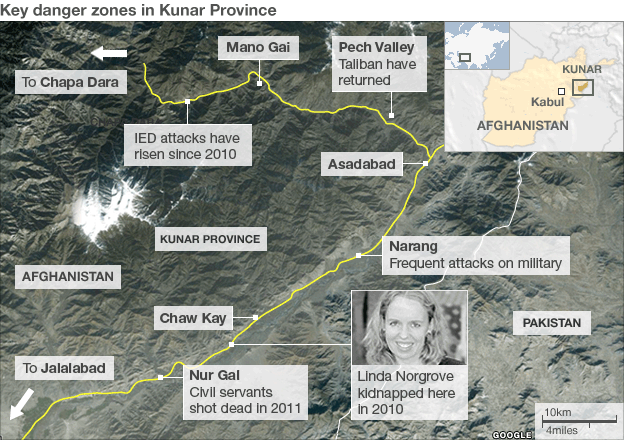
What happens when US forces pull out of the most dangerous parts of Afghanistan? The BBC’s Bilal Sarwary, the first journalist to visit one of the areas the US left in Kunar province, uncovers a disturbing situation.
Kunar has always been a crucible of conflict. Tucked away in the north-eastern corner of Afghanistan, it borders Pakistan’s tribal badlands. It is one of the first ports of call for war-minded militants crossing the mountain passes.
But after the US-led invasion, troops began to assert their hold over the province. It is now littered with US and Nato bases and despite bloody battles there, the US invested heavily. Roads were asphalted, buildings renovated and a sense of security slowly developed. Villagers went about their business while infrastructure was put in place.
The US pulled out of parts of Kunar last year, beginning the withdrawal process. What has happened in the province since then makes for grim reading.
The new roads are now pock-marked with craters left by militants who plant bombs targeting Western and Afghan forces.
[ … ]
When I visited the picturesque Pech valley in the west of the province, a cloud of gloom hung over it.
In Barkanday village, I found a group of tribal elders brooding over their predicament: where once US forces were a deterrent to the Taliban, the Afghan government is notable only for its absence.
“It is Taliban across the river,” one elder said. “They are lying in wait. At the first opportunity, they will descend on the village to take their revenge,” he said, refusing to give his name for fear of retribution.
[ … ]
“When US forces left, they told us that our security was now the responsibility of the Afghan government,” Mohammad Akbar said. “But the Afghan government exists only in the district headquarters at Mano Gai.”
I did not come across a single soldier or official on my way there or during my four-hour stay. Villagers say development has also suffered.
Worthless Afghan National Army troops and corrupt Afghan National Police. It seems that someone should have said something about the ANA and ANP – you know, how the ANA were curled up in fetal positions under blankets during the battle of Kamdesh at COP Keating.
[The Pech River Valley is] … strategically irrelevant to the campaign planners who focused their efforts on population-centric counterinsurgency and thus withdrew troops to redeploy in larger population centers. Not strategically irrelevant to me. Google the phrase Abandoning the Pech and see where TCJ lies in authority. I have supplied a surrogate conversation between flag officers when AQ returns to the Pech (which would be now), and argued that without hitting the Taliban’s recruiting grounds, fund raising and revenue development, training grounds, and logistical supply lines, the campaign cannot be won. I have pleaded that we not abandon the chase, and that we kill every last Taliban. Campaign management and I just disagree.
The Marines are pulling out of Afghanistan completely in 2012, and there is a general drawdown of all troops underway. If you’re deploying at the moment (and I know of some men who are), you have to wonder why, to what end, and whether you’re going to attempt to do anything other than survive the deployment?
Robert Bunker writing at Small Wars Journal assesses the relative threat posed by transnational Islamic jihadists versus the Mexican cartels. After citing a portion of Napolitano’s concern about the growth of the lone wolf terror threat, Robert weighs in.
While the above statements—some might even say political “sound bytes”— uttered by US Homeland Security Director Janet Napolitano were directed at America’s European allies, they convey the ongoing Washington obsession with Al Qaeda to the exclusion of other non-state threat entities. The memory of the 9/11 attacks is still a visceral experience for most of our nation’s financial and political elites.
Napolitano now equates lone wolf (Al Qaeda inspired) attackers, who need to take commercial aircraft to reach the US, as a significant threat to our nation. Such terrorists have extremely limited combat capabilities, both destructive and disruptive, and suffer from lack of training, equipment, and finances. They represent nodal criminal-soldiers (devoid of network support) who at best can engage in sporadic active aggressor (shooter) or IED (improvised explosive device) attacks. Such attackers are not the most pressing US national security threat; even if a few got through, the damage inflicted will be inconsequential to the integrity of American society and the functioning of its governmental system. Yes—even a suicide bomber or two detonating in the Mall of the Americas, on Wall Street, or in a high-end bistro in N.W. DC is a survivable attack for our nation, though the media would replay newscasts of the incident ad infinitum and make quite a bit of money off of the ad revenue in the process.
I’m a bit troubled by Robert’s seeming dismissal of the threat of transnational Islamic insurgency. True enough, the so-called “lone wolf” cannot do much more than inflict terror and localized loss of life and property. But Robert is assuming that all such terrorists are going to be lone wolfs. Perhaps not, and perhaps also since we know that Hezbollah fighters are crossing the Southern Border, Robert’s assumption forces the conclusion that it isn’t a threat.
On the contrary, in A Terrorist Attack That America Cannot Absorb I described a plausible scenario in which economic disaster would be effected as a result of the attack. True enough, this kind of attack would require several hundred well trained, well equipped and highly motivated fighters – fighters and equipment that a group like al Qaeda may not currently be able to field. But it’s also true that Hezbollah may be able to, and an attack of this nature, even if only partially successful with fewer fighters than I have described, would have significant consequences. In my view Robert is thinking tactically rather than strategically as he pans the idea that transnational Islamic fighters are no longer a threat. Small time hits against human-targer rich environs are a tactic of terror. Destruction of infrastructure directly resulting in the inability to replace that infrastructure is a strategy – one that thankfully the enemy hasn’t deployed.
However, I agree with his assessment of the threat of Mexican cartels.
What is most amazing about Napolitano’s statements is that they ignore a far more significant threat derived from geographic proximity, mass of numbers, training and organization, wealth, and corruptive capability. Mexican cartel operatives do not have to take commercial flights to get to the US and hundreds-of-thousands of personnel exist running the gamut from foot-soldiers through lookouts into narcotics production and distribution, street extortion, human trafficking, kidnapping, and bulk thefts. Tens-of-thousands of these cartel members operate in the US in conjunction with US street, prison, and motorcycle gangs which number well in excess of 1 million individuals. The Mexican cartels control more wealth than Al Qaeda ever had at its disposal—even at Osama bin Laden’s high point— and have specialized commando units on par, if not surpassing, the best Al Qaeda could ever field. Further, the Mexican cartels have taken corruption to an art form and have compromised entire regions of the Mexican state. This corruption is now being used in a targeted manner on the US border— hundreds of documented incidents exist— a capability with which Al Qaeda has never possessed to threaten the US homeland.
Common sense dictates that we address the real threat next door and already over the border— in excess of 1,000 US cities have Mexican cartel operatives in them. While the Mexican cartel threat to the US is subtler than that of Al Qaeda— the 9/11 attacks were indeed fierce and bloody— it is also in many ways more threatening, especially now that Al Qaeda central is a former shell of itself. While ‘border spillover’ attacks and corruption have been downplayed and wide swaths of Mexico resemble a war zone (with well over 45,000 deaths), we continually hear DHS rhetoric about Al Qaeda being the #1 threat to the United States.
On a related note, I am not at all persuaded that we are winning the border war by reports that arrests on the Southern border have plummeted. The number of Hispanic students in Alabama also recently plummeted due the implementation of E-Verify. The failing American economy is less enticing for illegal immigrants, and so it isn’t surprising that the balance of illegals coming and going is being modified. There is also a shift in violence within Mexico itself, meaning that areas that were once secure are now not, and vice versa.
That doesn’t mean that the border is secure. Analogous errors in judgment occurred in Iraq when we believed that the tribal awakening in Ramadi secured Anbar, when in reality the insurgents had simply moved to Fallujah and had to be cleared from that city in 2007. Pressing the Taliban out of Helmand moved them to Quetta (for R&R), Kandahar, Kunar and Nuristan.
The cartels will prove to be adaptive and amorphous, and we should generally ignore anecdotes as a pointer to larger trends.
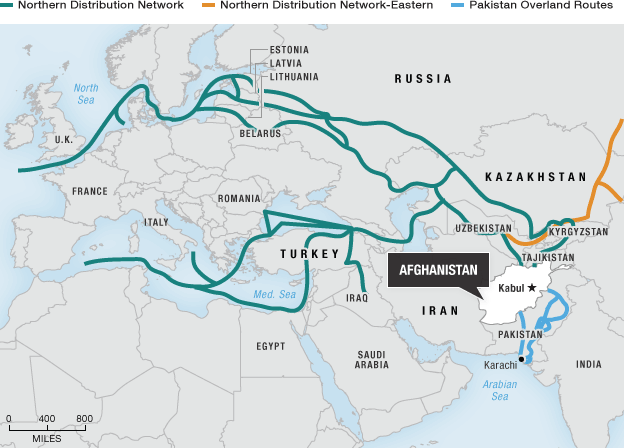
Our dependence on the lines of logistics through Chaman and the Khyber Pass, as well as Pakistan’s duplicity towards the U.S., are well-worn issues with regular readers. The Northern logistics routes are in increased and expanding usage due to the troubles in Pakistan.
Image courtesy of EagleSpeak. The magnitude of the challenge is well described for us by Vice Adm. Mark Harnitchek, deputy commander of the U.S. military’s Transportation Command.
“This is the logistics challenge of our generation” … “The challenge of my father’s generation was escorting convoys across the north Atlantic when we didn’t know how to do that very well. Convoys in 1943 would lose 16 of their 32 ships. The Army had their challenge supplying Patton in his race across France, keeping him resupplied. Supporting operations in Afghanistan is our generational challenge.”
For the first seven years of the war in Afghanistan, almost all supplies and equipment were shipped by sea to the Pakistani port of Karachi. From there, they were trucked overland to Afghanistan, through parts of Pakistan effectively controlled by the Taliban.
In 2008, according to Harnitchek, the U.S. military lost as much as 15 percent of its supplies in those areas due to ambushes and theft. Establishing another supply route became a top priority.
Near the beginning of 2009 I explained the necessity for the Northern logistics route, and described it in detail. The routes shown above come close, but still rely on Russia and fail to engage Turkmenistan. I recommended that we develop a route “through the Caucasus region, specifically, from the Mediterranean Sea through the Bosporus Strait in Turkey, and from there into the Black Sea. From the Black Sea the supplies would go through Georgia to neighboring Azerbaijan. From here the supplies would transit across the Caspian Sea to Turkmenistan, and from there South to Afghanistan.”
I explained the urgency of the situation, and also described in subsequent posts on logistics how reliance on lines of logistics through Russia could affect the outcome of New START as well as endanger Georgia and cause another Russian incursion into the Caucasus (Ossetia and beyond). Yet we are still lethargic concerning full development of the Northern logistics routes.
As targeted killings have risen sharply across Afghanistan, American and Afghan officials believe that many are the work of counterintelligence units of the Haqqani militant network and Al Qaeda, charged with killing suspected informants and terrorizing the populace on both sides of the Afghanistan-Pakistan border.
Military intelligence officials say that the units essentially act as death squads and that one of them, a large group known as the Khurasan that operates primarily in Pakistan’s tribal areas, has been responsible for at least 250 assassinations and public executions.
The Haqqani network is, of course, coddled and enabled by the Pakistani ISI. For some inexplicable reason the otherwise clear thinking Bing West comments concerning this report that:
The administration has to adopt a tough, transactional negotiating posture with Pakistan.
What is this song of enchantment that Pakistan continues to sing to its disappointed suitors? Is it nuclear weapons? There is the need for robust Pentagon war gaming concerning the securing of Pakistan’s nuclear weapons, as I have described. Is it the belief that more negotiations will convince Pakistan not to support the Afghan Taliban? Is it the belief that Pakistan isn’t really controlled by Islamic fundamentalism, or that the Army isn’t preoccupied with fabricated and delusional notions of danger from India?
Whatever it is, we are years behind schedule in divorcing ourselves from Pakistan, whether concerning logistics or reliance on their internal security over their nuclear arsenal. The Obama administration is “scrambling to repair” relations with Pakistan, as I would have expected. But leaving the juvenile and moving to the adult, when even most knowledgeable analysts are suggesting that we need to take a tough negotiating stance and repair relations with Pakistan, we have a problem.
These relations with Pakistan never really existed. Pakistan’s ultimate aim has never changed, even though the campaign has evolved. Pakistan wants its high-powered insurgents (e.g., the Haqqani network) in order to effect change in Afghanistan (on its whim) and convince India that it is a force to be reckoned with, Kashmir or elsewhere. Pakistan isn’t an ally of the U.S., and never was. It’s time to stop pretending that they are. It is always difficult to face the truth, but time is short and the situation is dire.
All monies should cease, lines of logistics should shift completely to the North, and in the future if Pakistan wants to engage the U.S. as an ally, it must start over and prove itself. We must always negotiate from a position of strength, as we learned from Sun Tzu.
The US Supreme Court declined Monday to take up a potentially important gun rights case examining whether a federal regulation banning loaded firearms from vehicles in a government park violated the constitutional right to keep and bear arms.
Lawyers for a Virginia man had asked the justices to examine a question left largely unresolved in the high court’s two prior landmark rulings identifying the scope and substance of Second Amendment protections. The question is: Does the Second Amendment guarantee a right to bear arms in public for personal protection?
The court dismissed the case in a one-line order without comment. The action leaves lower court rulings intact and postpones the prospect of high court clarification on a key gun rights issue.
[ … ]
The dismissed appeal, Masciandaro v. US (10-11212), had asked the court to examine whether Americans have a right to carry loaded weapons in public places for self defense.
How the justices answered that question would have established guideposts for future gun regulations at the local, state, and national levels of government.
In the 2008 decision, District of Columbia v. Heller, the court said that gun rights are not unlimited. The court said there is no right to “carry any weapon whatsoever in any manner whatsoever and for whatever purpose.”
The details of the case can be found here, here and here. Fundamantally at issue is whether the Second Amendment carries the right to possess a weapon outside the home, and the lower courts are almost begging for the Supreme Court to answer this question in the wake of the half-hearted Heller ruling.
Heller and McDonald left open important questions regarding the scope of the self-defense right beyond the home and the appropriate method for evaluating government regulations affecting it. The lower courts have struggled mightily with these issues. See, e.g., Masciandaro, 638 F.3d at 467 (“But a considerable degree of uncertainty remains as to the scope of that right beyond the home and the standards for determining whether and how the right can be burdened by governmental regulation.”); United States v. Skoien, 614 F.3d 638, 640 (7th Cir. 2010) (en banc) (“Skoien II”) (Heller creates an individual right that includes keeping operable handguns at home for self-defense but “[w]hat other entitlements the Second Amendment creates, and what regulations legislatures may establish, were left open.”), cert. denied, 131 S. Ct. 1674 (2011).
The highest state courts that have considered the issue unanimously decided that the Second Amendment right is limited to the home. Maryland, the District of Columbia, Illinois, Massachusetts, New York, and Kansas have all limited Heller to its holding. For example, the Maryland Court of Appeals upheld Maryland’s firearm permitting statute, concluding that the right is unavailable outside the home. Williams v. State, 417 Md. 479, 496 (Md. 2011) (stating that “[i]f the Supreme Court, in this [Heller] dicta, meant its holding to extend beyond home possession, it will need to say so more plainly”), petition for cert. filed, 79 U.S.L.W. 3594 (Apr. 5, 2011). That court noted that Illinois, the District of Columbia, and California also limited the right in similar cases. Id. at 496-99. Given this trend, state courts that confront Second Amendment issues in the future will likely limit its protection to the home.
Other state and federal courts have held that even if the right might exist outside the home, it is substantially weaker than the right enjoyed in the home.
So in spite of the urgent need to sort out the lower court chaos concerning bearing arms, the Supreme Court declined to hear Sean Masciandaro’s case.
Supreme Court fail … big time. This is just what Lanny Breuer asked them to do in his brief, and I’m sure that Dennis Henigan is popping the cork somewhere.
While the Obama White House and some of his disciple politicians disagree that Texas border counties may be in a growing “war zone,” the impact of drug cartel violence and power in Mexico could be affecting American households in more direct means than generally believed.
For instance, avocados and lime costs imported into the U.S. from Mexico are subject to a drug cartel tax, or “la cota,“ said a former cartel member, who talked with the Examiner, provided we did not reveal his real name.
Carlos is a 28-year-old Mexican national moved to the San Antonio area to escape cartel torture, death and “before they killed the only family I have left.”
“They charge those farmers and packers ‘la cota’ for each truck they send out,” Carlos explained. “And before the trucks make it to the distribution, they might get stopped three or four times for la cota.”
Carlos described what happens to anyone that doesn’t pay the tax.
“They call it Mexican insurance,” he said. “They tell you they know who your wife is, or your mother, or your daughters and you better pay or we will rape and kill them.”
“They pay the cartels what they want, like a toll road,” Carlos observed. “We charged about 600 or 700 pesos for each truck about five years ago, but I don’t know any more what it is. It’s a common thing.”
“Americans think the drug gangs just make their money from the drugs, but they make money off of your food and imports that come from Mexico too,” claimed Carlos.
“Sometimes those terminals in Mexico and even here in Texas wait for the trucks to get there, but if the drug gangs don’t get paid, those trucks will not get there,” Carlos observed. “You ask any of them (distributors or terminals) and they will tell you this is more common than people think.”
I advocated against the war on poppy in battling the Taliban; the Taliban make their money by various means, including (but not limited to) precious metal mines, pomegranates, timber, and extortion. I advocated against the war on poppy for the same reason that I advocate seeing the war against the cartels and other insurgents as a border war. Drugs isn’t the defining characteristic of the warlords and insurgents in Mexico (and increasingly North of the border), just as the Taliban won’t cease to exist if we destroy all of the poppy crops in the Helmand Province.
I have little vested interest in the final disposition of a war on drugs or whether drugs are legal, except as follows. Drug users have hitched me to their wagon, just like 48% of the balance of the (non-tax paying) American public. If the pro-legalization forces would simply unhitch the rest of the tax- and rate-payers from their wagon, we might be persuaded to side with them. To do this, ensure that I don’t have to pay one cent of welfare for lost work time or support of out of work drug users, or one cent of medical costs associated with drug use, or any other cost not being discussed here but associated with drug use. After pro-legalization advocates do this, then – and only then – will I consider supporting their cause. Until then, I have a right and vested interest in the behavior of anyone and everyone whom my tax monies support. If you don’t approve of my meddling, neither do I. Remove my support and I won’t meddle. It’s a win-win proposition. You make the first move.
I will consider supporting their cause (and delaying my support until such time as my preconditions obtain), because drug legalization, or lack thereof, won’t significantly affect the insurgency to the South. I can’t possibly lose in this deal.
We have previously discussed the adoption of military style tactics, techniques and procedures by the Mexican cartels, the increasing corruption of the U.S. border patrol, and the recruitment of large numbers of High Schoolers by the cartels. After observing that the use of the National Guard is problematic for a number of reasons (including the lack of training, the lack of appropriate rules for the use of force, etc.), I recommended that:
… we view what is going on as a war against warlords and insurgents who will destabilize the state both South and even North of the border. I have further recommended that the RUF be amended and the U.S. Marines be used to set up outposts and observation posts along the border in distributed operations, even making incursions into Mexican territory if necessary while chasing insurgents (Mexican police have used U.S. soil in pursuit of the insurgents).
While militarization of border security may be an unpalatable option for America, it is the only option that will work. All other choices make the situation worse because it is allowed to expand and grow. Every other option is mere window dressing.
“I have learned to live with trash,” said fifth-generation Arizona rancher Jim Chilton.
He saw his once-beautiful ranch, just a few miles from the border with Mexico, is now dotted with clusters of crushed trees and cactus, whole hillsides have been turned into charred eyesores, years worth of his award-winning conservation projects obliterated — and the whole thing is littered with trash, tons and tons of trash. And some of the trash was dead bodies.
Chilton had the misfortune of settling in the path of what would become a dangerous drug- and human-smuggling route on the U.S.-Mexican border, parallel with the notorious Peck Canyon Corridor.
“I’ve got 30,000 to 40,000 illegal aliens coming right through the ranch every year, and the Forest Service says each one leaves about eight pounds of trash. That means 100 tons of trash. Some cows eat the plastic bags and about 10 head a year die a slow and painful death. At $1,200 a head, that means we lose $12,000 a year to trash.”
Chilton saw southern Arizona not as the headline-grabbing political flashpoint of the Justice Department’s failed “Fast and Furious” guns-to-smugglers tracking project, but as the land-grabbing opportunism of Obama’s resource management agencies and, sadly, the failure of the U.S. Border Patrol to secure that bloody line separating the United States from Mexico.
The land-grabbing chapter of the trash story has gone largely unnoticed, but surfaced last year when the Bureau of Land Management proposed to shut down target shooting on 490,000 acres in the Sonoran Desert National Monument — and in large swaths of other public lands as well.
The reason? Monument manager Richard Hanson claimed shooters were leaving trash at the shooting sites, an outrageously trumped up excuse, but Hanson’s claim couldn’t be refuted at the time.
The BLM had closed 400,000 acres of publicly owned, national monument lands across three states to recreational shooting activities in 2010, labeling recreational shooting as a resource-harming activity and a public safety threat.
That was a clear signal showing that the SDNM move was just another step in Interior Secretary Ken Salazar’s obnoxious “lock-it-up-and-kick-’em-out” plans that have drawn the ire of Congress.
If it seems that the administration is taking an un-serious view of border security (intentionally conflating the trash left by illegals with shooters), then this report shouldn’t surprise anyone.
Federal agents trying to patrol the U.S.-Mexico border say they’re hampered by laws that keep them from driving vehicles on huge swaths of land because it falls under U.S. environmental protection, leaving it to wildlife — and illegal immigrants and smugglers who can walk through the territory undisturbed.
A growing number of lawmakers are saying such restrictions have turned wilderness areas into highways for criminals. In recent weeks, three congressional panels, including two in the GOP-controlled House and one in the Democratic-controlled Senate, have moved to give the Border Patrol unfettered access to all federally managed lands within 100 miles of the border with Mexico.
While the cartels develop intricate intelligence networks and adopt military style tactics, the U.S. prohibits access to lands controlled by the Bureau of Land Management due to EPA regulations, and blames trash at the border on shooters. It’s no wonder that insurgents have gone hunting at the border – not hunting for animal game, but human game.
Five illegal immigrants armed with at least two AK-47 semi-automatic assault rifles were hunting for U.S. Border Patrol agents near a desert watering hole known as Mesquite Seep just north of the Arizona-Mexico border when a firefight erupted and one U.S. agent was killed, records show.
A now-sealed federal grand jury indictment in the death of Border Patrol agent Brian A. Terry says the Mexican nationals were “patrolling” the rugged desert area of Peck Canyon at about 11:15 p.m. on Dec. 14 with the intent to “intentionally and forcibly assault” Border Patrol agents.
They should take the 7th Army (and the Ghost of Patton), and all its subordinate units, and move it lock, stock & barrel to Del Rio, TX. They can then patrol the banks of the Rio Grande with Bradley’s, Apaches & Cobras. Then, let’s see how much success these border insurgents, armed with the semi-auto AKs have against that.
Germany has the strongest economy in Europe. It can afford to defend itself from Russian aggression. If it can’t, then we have PLENTY of military contractors that can sell them the weapons that they need. Europe needs to stand on its own. Our resources need to be protecting our borders, not Germany’s.
This sentiment is certainly in line with my own, but unfortunately, roving the border with Bradley Fighting Vehicles won’t work. This requires combat outposts and Marines (or Soldiers) on foot patrol. Infantry – not mechanized infantry – is the order of the day.
But it will require more than that. As long as we continue to treat the border as a law enforcement endeavor, with agents subject to rules such as those outlined in the Supreme Court decision in Tennessee versus Garner, with criminals imprisoned or sent back to Mexico to try it all again, we will continue to lose the war at the border. Imprisonment of drug traffickers and illegals won’t work any more than prisons work in counterinsurgency. Prisons are a costly ruse.
Make no mistake about it. This isn’t a war against drugs, or a war against the drug cartels, or a war against illegal immigration, or even a war against human trafficking or Hezbollah fighters entering the U.S. at the Southern border. This is a war for national sovereignty – a border war.
A border war. Only when we militarize the border with combat outposts and shoot all trespassers will we even begin to wage the war on the enemy’s terms. In spite of claims that the Posse Comitatus Act applies, this war is against non-U.S. citizens, and it is a fight for the survival of what defines America. Presidents in both parties have seen America as an idea rather than a location with secure borders.
If America is an idea and the Southern border is to be just an imaginary line, then we have already lost. If America deserves defending, then we must do what is both uncomfortable and necessary to effect its security.
My entire family is with me, including grandchildren. I am thankful for that. I am thankful for the sustenance and provisions that a sovereign God has provided to me and my family over the year. I am thankful that I live in the freest nation on earth, and that I am free to own firearms for the defense of my family.
I am thankful that God has spared our nation from what it so richly deserves with our corrupt politicians. Most of all, I am thankful for salvation by grace, through faith in Jesus Christ.
Thanksgiving is uniquely an American Christian holiday, perhaps my favorite time of the year. This season remember your blessings, and have a happy Thanksgiving with your family.
Concerning one of Tim Lynch’s posts, I commented on a picture that:
Tim, the dude to your right needs to have better muzzle discipline. Tell him to stop pointing that dead blame thing at you! At least his finger isn’t on the trigger.
To which Tim responded:
That was one of the Afridi Tribal fighters and none of them have a clue about gun handling, combat marksmanship, known distance marksmanship, cleaning their weapons etc…. So you end up getting muzzle flagged often which, as I recall, earned you a 5 minute room of pain session in Bravo 1/8 back in the day. You get muzzle flagged a lot from the Brit military too – their weapons handling is also atrocious.-
Yea, I know one Marine who, when he was a Private, had a ND from his SAW, and let’s just say this “room of pain” thing … well, we’ll leave it at that. Room of pain. Concentrate on the word pain. And … no ND ever occurred again from his SAW. Not even one more time.
Recall that Michael Yon discussed an ND from Canadian Brigadier General Menard, and was deeply criticized for it? Well, this is apparently a pattern within the Canadian military.
Officers in the Canadian military were partly to blame for lax firearms safety in Afghanistan, a military judge said as he sentenced a former reservist to four years in jail for fatally shooting a fellow soldier.
Lieutenant-Colonel Louis-Vincent d’Auteuil said on Friday that Matthew Wilcox was well trained and “should have known better” than to point a loaded pistol at his best friend, Corporal Kevin Megeney, on March 6, 2007.
However, Col. d’Auteuil also said senior officers at Kandahar Airfield hadn’t done enough to crack down on improper handling of firearms before and during the deployment of Mr. Wilcox’s unit.
“No discipline was imposed other than warning soldiers,” the judge said, referring to incidents in which soldiers failed to unload the magazines from their pistols after leaving a shooting range on the base.
“All combined brought an atmosphere … where a human being forgot to unload his weapon, pointed and fired at somebody and killed somebody. He is responsible, but the Canadian Forces must be blamed for not having the proper leadership in the circumstances.”
[ … ]
“Leaders, section leaders, the company commanders … created an atmosphere that let soldiers think if they forget to unload their weapons, it was not a big deal,” he said.
As a civilian shooter and firearms owner and holder of a concealed handgun permit, I have more discipline than this. Much more. This behavior is simply atrocious and should not be tolerated in any military anywhere in the world or by civilian shooters either. The U.S. Marines make sure that its men know better with a … well, Tim called it a “room of pain.”
Gun owners who have historically been able to use public lands for target practice would be barred from potentially millions of acres under new rules drafted by the Interior Department, the first major move by the Obama administration to impose limits on firearms.
Officials say the administration is concerned about the potential clash between gun owners and encroaching urban populations who like to use same land for hiking and dog walking.
“It’s not so much a safety issue. It’s a social conflict issue,” said Frank Jenks, a natural resource specialist with Interior’s Bureau of Land Management, which oversees 245 million acres. He adds that urbanites “freak out” when they hear shooting on public lands.
If the draft policy is finally approved, some public access to Bureau lands to hunters would also be limited, potentially reducing areas deer, elk, and bear hunters can use in the West.
So exactly how would such regulations be implemented?
This is the key paragraph foes say could lead to shooters being kicked off public lands:
“When the authorized officer determines that a site or area on BLM-managed lands used on a regular basis for recreational shooting is creating public disturbance, or is creating risk to other persons on public lands; is contributing to the defacement, removal or destruction of natural features, native plants, cultural resources, historic structures or government and/or private property; is facilitating or creating a condition of littering, refuse accumulation and abandoned personal property is violating existing use restrictions, closure and restriction orders, or supplementary rules notices, and reasonable attempts to reduce or eliminate the violations by the BLM have been unsuccessful, the authorized officer will close the affected area to recreational shooting.”
The new regulation may as well say that for any reason under the sun when an employee of the BLM wants to close down lands to shooting, he may do so at his discretion. This has a potentially huge affect on shooters, and the most remarkable thing is its broad sweep (note that implementation of the regulation doesn’t require demonstrated safety issues), combined with the bypassing of the process for making law – you know, the Congress. Congress has been left out because, you know, the Obama administration knows better than to have to wait on something silly like the law-making process.



 14 years, 2 months ago