
Rapidly Collapsing U.S. Foreign Policy
BY Herschel Smith 17 years, 6 months ago
Iran is quickly advancing towards becoming a nuclear state. In troubling developments in air power, Iran can now deploy UAVs, and Russia may have supplied Iran with new air defense systems, including their long range S-300 surface to air missiles. If they haven’t, the system is being used as a bargaining chip by Russia. There are reports that they have refused to sell the missile system, but responding to the Israeli plan to sell weapons systems to Georgia by saying that Moscow expected Israel “to show the same responsibility.” In the first case, Iran is armed with an air defense system that would make an attack against its nuclear assets much more difficult. In the second case, Russia has used this potentiality to weaken Georgia and prime it for another invasion.
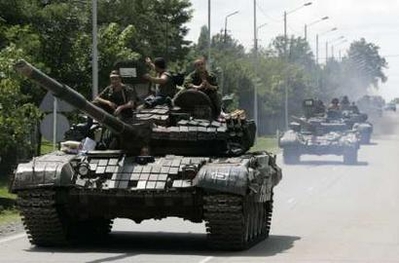
Pavel Felgenhauer at the The Jamestown Foundation has recently published a commentary entitled Russia’s Coming War with Georgia. The commentary very smartly connects the isolated Russian base in Armenia – which in itself is further demonstration of Russian intentions of control over its “near abroad” – with the need to control Georgia. Says Felgenhauer, “The ceasefire last August has left the strategically important Russian base in Armenia cut off with no overland military transit connections. The number of Russian soldiers in Armenia is limited to some 4000, but during 2006 and 2007 large amounts of heavy weapons and supplies were moved in under an agreement with Tbilisi from bases in Batumi and Akhalkalaki (Georgia). At present there are some 200 Russian tanks, over 300 combat armored vehicles, 250 heavy guns and lots of other military equipment in Armenia – enough to fully arm a battle force of over 20,000 (Nezavisimoye Voyennoye Obozrenie, August 20, 2004). Forces in Armenia can be swiftly expanded by bringing in manpower by air transport from Russia. Spares to maintain the armaments may also be shipped in by air, but if a credible overland military transit link is not established within a year or two, there will be no possibility to either replace or modernize equipment. The forces will consequently degrade, undermining Russia’s commitment to defend its ally Armenia and Moscow’s ambition to reestablish its dominance in the South Caucasus.”
Concerning the timing of the potential invasion, Felgenhauer observes:
While snow covers the Caucasian mountain passes until May, a renewed war with Georgia is impossible. There is hope in Moscow that the Georgian opposition may still overthrow Mikheil Saakashvili’s regime or that the Obama administration will somehow remove him. However, if by May, Saakashvili remains in power, a military push by Russia to oust him may be seriously contemplated. The constant ceasefire violations could escalate to involve Russian servicemen – constituting a public casus belli. The desire by the West to “reset” relations with Moscow, putting the Georgia issue aside, may be interpreted as a tacit recognition of Russia’s right to use military force.
With the addition of the Biden pronouncement that the U.S. would “press the reset button” with Russia, the U.S. is now in the throes of a logistical dilemma. On the one hand, the missile defense program for NATO states is meant as a deterrent for a potential Iranian nuclear and missile based military capability. On the other hand, the current administration is seen as likely to jettison the whole project.
The U.S. is now beholden to Russia for logistical supply lines to Afghanistan. General David Petraeus has visited numerous European and Central Asian countries recently, including Kyrgyzstan and Uzbekistan. Supplies are soon to leave Latvia bound for Afghanistan. But the common element in all of the logistical supply lines are that they rely on Russian good will. This good will exists as long as the missile defense doesn’t, and the missile defense was intended to be used as a deterrent for Iranian nuclear ambitions.
Alternative supply routes have been suggested, including one which wouldn’t empower Russian hegemony in the region, from the Mediterranean through the Bosporus strait, into the Black sea, and through Georgia to neighboring Azerbaijan. From there the supplies would transit across the Caspian Sea to Turkmenistan, and from there South to Afghanistan. An alternative to the air route from the recently closed Manas Air base is sea transport to India, rail or truck to the Indian-controlled Kashmir region, and then air transport to Kabul. But none of these options has been pursued. The current administration is locked into negotiations that empower Russia.
Pakistan President Zardari has observed, and correctly so, that Pakistan is in a state of denial concerning the threat posed by the Taliban, yet rather than eliminate the threat, the strategy has been to make peace deals with the Tehrik-i-Taliban and plead for the same financial bailout being offered across America, saying that in order to defeat the Taliban Pakistan needs a “massive program,” a “Marshall Plan” to defeat the Taliban through economic development.
Certainly, some of the foreign policy problems were present with the previous administration, from the failure to plan for logistics for Afghanistan, to support for Musharraf’s duplicitous administration, assisting the Taliban by demure on the one hand while money was received with the other. But the currents appear to be pointing towards a revised world opinion of what the U.S. is willing to sustain on behalf of “good relations,” and the current administration’s prevarications appear to be going headlong into numerous dilemmas.
We wish to use the missile program in Europe as an bargaining chip to avoid the reality of an Iranian nuclear program, while the Iranian supreme has said that “relations with the U.S. have for the time being no benefit to the Iranian nation.” Russia, who is assisting Iran in its military buildup, is unimpressed because we have planned for no other option for logistics for Afghanistan except as dictated by Vladimir Putin. The best that we can come up with, so far, is to forestall the planned troop reduction in the European theater, a troop reduction that is needed to help fund and staff the war against the global insurgency.
Pakistan’s Zardari figures that if the administration is willing to give away on the order of a trillion dollars, they can play the game of “show me the money” like everyone else, from Russia over logistical lines to Afghanistan to over-leveraged homeowners in the U.S.
Israel figures that all of this points to throwing their concerns under the bus, and thus they have launched a covert war against Iran, a program that is unlikely to be successful, pointing to broader regional instability in the near term. Hassan Nasrallah, leader of Hezbollah, has said that they will acquire or have acquired anti-aircraft weapons. While they have stood down over the war in Gaza, they are apparently preparing for more of the same against Israel.
The current administration has attempted to befriend Syria, while at the same time the USS San Antonio has interdicted Iranian weapons bound by ship to Syria, intended for Hezbollah or Hamas. Most of this has occurred within less than two months of inauguration of the current administration in Washington. It may prove to be a difficult four years, with unintended consequences ruling the day.
Update: Welcome to Instapundit readers and thanks to Glenn for the link.






On February 24, 2009 at 3:18 pm, fumento said:
I have a piece out in Defense News (http://www.fumento.com/military/raptor2009.html) that discusses the capabilities of the S-300 system within the context of the need to continue building more of the F-22 Raptor. I write:
Russian surface-to-air missiles (SAMs) have improved dramatically in recent years. The country’s S-300 system is “one of the most lethal, if not the most lethal, all-altitude area defense,” noted the International Strategy and Assessment Service, “a Virginia-based think tank focused on U.S. and Allied security issues.” three years ago. China also has the S-300 and the Russians announced in December they’ll soon sell units to Iran.
The sale not only would threaten stand-off warning and control systems like AWACS but also tremendously boost defense of Iran’s Bushehr nuclear reactor and Natanz uranium-enrichment site.
The newer S-400 system, already deployed, is far better able to detect low-signature targets and aircraft generally, as far away as 250 miles away, according to the FAS. That’s twice that of the S-300. When mated with the Triumf SA-20/21 missile, which Russia claims it tested in December, it can even knock down ballistic missiles.
“Only the F-22 can survive in airspace defended by increasingly capable surface-to-air missiles,” declared Air Force Association President Mike Dunn in December.